
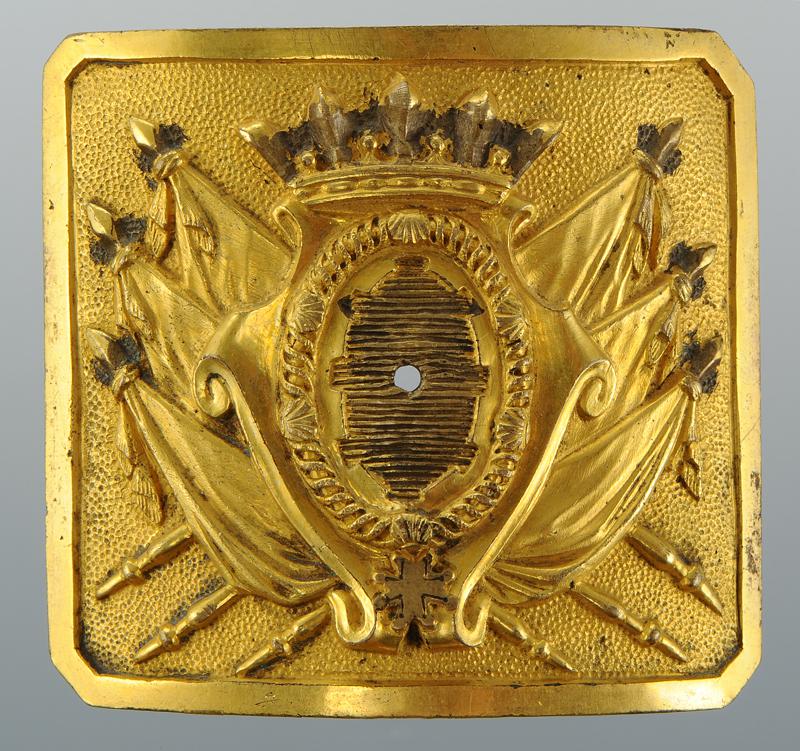
Waistbelt plate of an Officier des Lanciers de Monsieur, model 1814, modified during the Hundred Days.

Sold out
BELT PLATE OF AN OFFICER OF THE LANCERS OF MONSIEUR, model 1814, modified during the Hundred Days period. 551
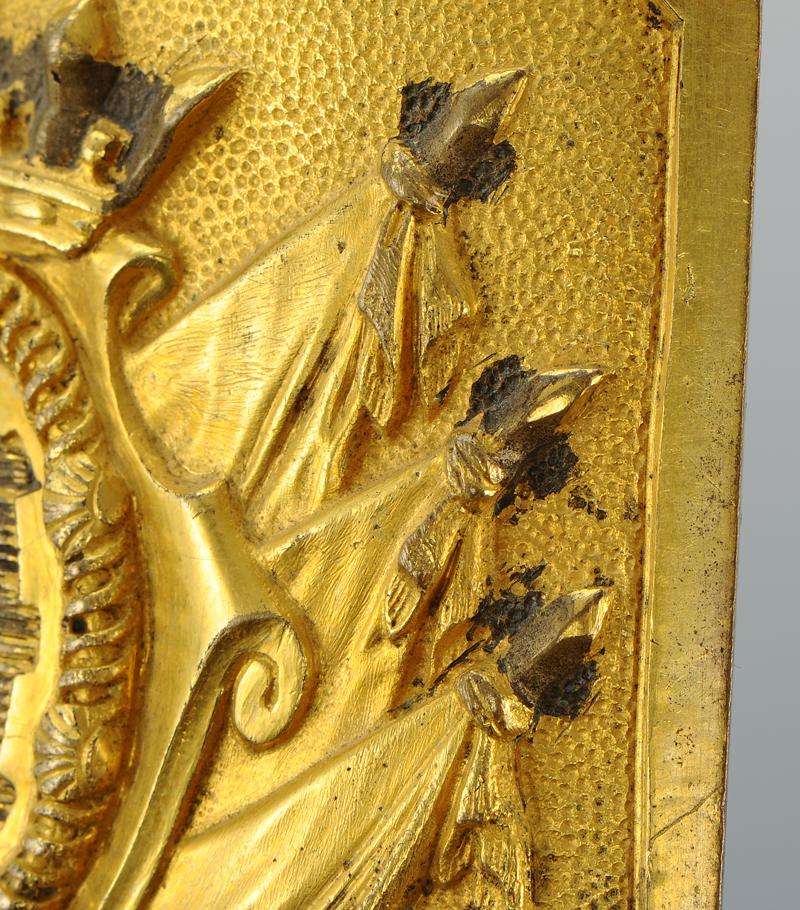
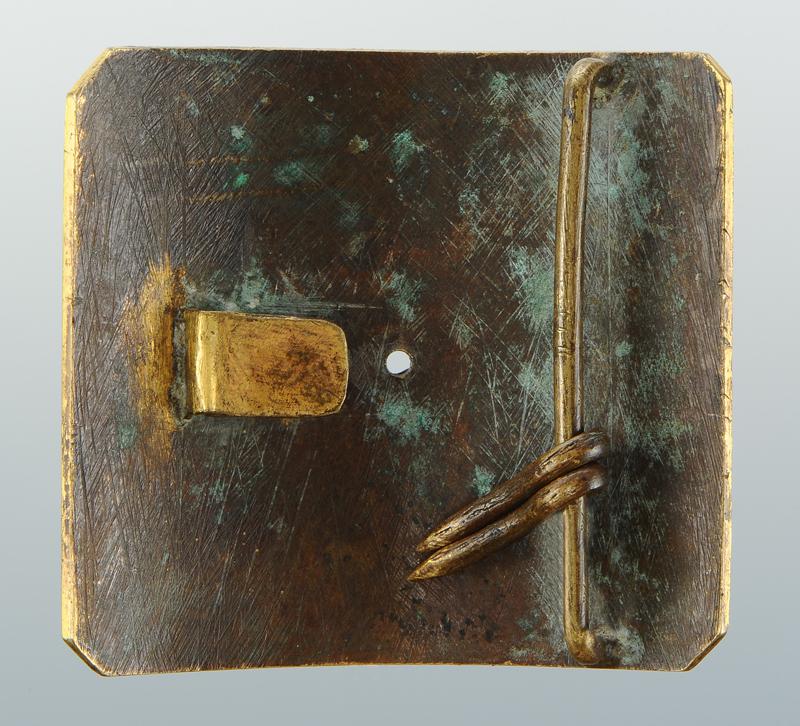
Cast brass plate, chiseled and then gilt. The fleur-de-lis have been removed and the center of the insignia pierced to allow for the attachment of an Imperial Eagle. At the back, a hook and a two-pronged fastener are soldered. It measures 84 mm in height, 78 mm in width with its curvature, and 76 cm in width without the curvature.
France.
Hundred Days.
Very good condition, modified over time.
PROVENANCE: Former Saint-Aubin collection. Two copies of this model are known, both identical and modified during the Hundred Days. One belongs to the collections of the Army Museum; it was worn by Lieutenant Colonel Berteche and comes directly from the family, as it was donated by his granddaughter to the artillery museum in 1899, along with the epaulettes, belt, and cartridge box.
Mr. Marcel Saint-Aubin, a collector turned antiquarian between the world wars, is a well-known figure among collectors but has not had any biographies or articles published on his life. I will now share some information from my archives to shed light on this esteemed connoisseur:
"Mobilized during the First World War along with his brother in the infantry, his brother was killed at Verdun. Both shared a passion for military memorabilia; both drew and published their sketches in the magazine 'La Giberne' before 1914.
After the war, he established himself as an antiquarian. In 1926, he lived at 108 rue de Ménilmontant (Paris 20th arrondissement), a location far from the typical antique dealer neighborhoods. His specialty was military curiosities, a field that had captivated him for a long time. The spark that ignited his interest in this field came from his first find: a Consulate-era light cavalry officer's sword, his first beautiful sword, which he called his 'lucky charm' and always cherished.
Being an antiquarian allowed Saint-Aubin to see and possess these cherished objects for a period of time. A keen connoisseur, he never made mistakes, and his clients benefited from his expertise. A passionate researcher, everything he discovered in his life was remarkably diverse. Silent and modest, his art and manner left an indelible impression on the collectors who knew him.
Like most military item dealers of that time, Marcel Saint-Aubin did not have a store. He received clients in his apartment where few objects were on display, occupying only temporary places. Generally, like Paul Jean, he would fetch the items he wanted to sell from the adjacent room and present them without saying much, often with a slight smile. If the presented object was truly exceptional, he would simply say, without raising his voice, 'It's top-notch…'
In June 1940, during the occupation, he moved to Guingamp. He returned to Paris and resettled at the end of 1951, in the house he had bought at 16 rue Henri Pape, in the 13th arrondissement, once again, far from the antique dealer district.
His love for the objects he parted with was evident in the care he took in packaging them. A master with his hands, he meticulously protected even the most modest pieces.
Marcel Saint-Aubin passed away at the age of 83, leaving behind the respect of all who knew him and a legacy of a man with great moral values."
Cast brass plate, chiseled and then gilt. The fleur-de-lis have been removed and the center of the insignia pierced to allow for the attachment of an Imperial Eagle. At the back, a hook and a two-pronged fastener are soldered. It measures 84 mm in height, 78 mm in width with its curvature, and 76 cm in width without the curvature.
France.
Hundred Days.
Very good condition, modified over time.
PROVENANCE: Former Saint-Aubin collection. Two copies of this model are known, both identical and modified during the Hundred Days. One belongs to the collections of the Army Museum; it was worn by Lieutenant Colonel Berteche and comes directly from the family, as it was donated by his granddaughter to the artillery museum in 1899, along with the epaulettes, belt, and cartridge box.
Mr. Marcel Saint-Aubin, a collector turned antiquarian between the world wars, is a well-known figure among collectors but has not had any biographies or articles published on his life. I will now share some information from my archives to shed light on this esteemed connoisseur:
"Mobilized during the First World War along with his brother in the infantry, his brother was killed at Verdun. Both shared a passion for military memorabilia; both drew and published their sketches in the magazine 'La Giberne' before 1914.
After the war, he established himself as an antiquarian. In 1926, he lived at 108 rue de Ménilmontant (Paris 20th arrondissement), a location far from the typical antique dealer neighborhoods. His specialty was military curiosities, a field that had captivated him for a long time. The spark that ignited his interest in this field came from his first find: a Consulate-era light cavalry officer's sword, his first beautiful sword, which he called his 'lucky charm' and always cherished.
Being an antiquarian allowed Saint-Aubin to see and possess these cherished objects for a period of time. A keen connoisseur, he never made mistakes, and his clients benefited from his expertise. A passionate researcher, everything he discovered in his life was remarkably diverse. Silent and modest, his art and manner left an indelible impression on the collectors who knew him.
Like most military item dealers of that time, Marcel Saint-Aubin did not have a store. He received clients in his apartment where few objects were on display, occupying only temporary places. Generally, like Paul Jean, he would fetch the items he wanted to sell from the adjacent room and present them without saying much, often with a slight smile. If the presented object was truly exceptional, he would simply say, without raising his voice, 'It's top-notch…'
In June 1940, during the occupation, he moved to Guingamp. He returned to Paris and resettled at the end of 1951, in the house he had bought at 16 rue Henri Pape, in the 13th arrondissement, once again, far from the antique dealer district.
His love for the objects he parted with was evident in the care he took in packaging them. A master with his hands, he meticulously protected even the most modest pieces.
Marcel Saint-Aubin passed away at the age of 83, leaving behind the respect of all who knew him and a legacy of a man with great moral values."
Reference :
551
Order shipments will be suspended between July 31 and September 1.
Next update Friday, august 14 at 13:30 PM
FOR ALL PURCHASES, PAYMENT IN MULTIPLE CHECKS POSSIBLE
bertrand.malvaux@wanadoo.fr 06 07 75 74 63
SHIPPING COSTS
Shipping costs are calculated only once per order for one or more items, all shipments are sent via registered mail, as this is the only way to have proof of dispatch and receipt.
For parcels whose value cannot be insured by the Post, shipments are entrusted to DHL or Fedex with real value insured, the service is of high quality but the cost is higher.
RETURN POLICY
Items can be returned within 8 days of receipt. They must be returned by registered mail at the sender's expense, in their original packaging, and in their original condition.
AUTHENTICITY
The selection of items offered on this site allows me to guarantee the authenticity of each piece described here, all items offered are guaranteed to be period and authentic, unless otherwise noted or restricted in the description.
An authenticity certificate of the item including the description published on the site, the period, the sale price, accompanied by one or more color photographs is automatically provided for any item priced over 130 euros. Below this price, each certificate is charged 5 euros.
Only items sold by me are subject to an authenticity certificate, I do not provide any expert reports for items sold by third parties (colleagues or collectors).
Next update Friday, august 14 at 13:30 PM
FOR ALL PURCHASES, PAYMENT IN MULTIPLE CHECKS POSSIBLE
bertrand.malvaux@wanadoo.fr 06 07 75 74 63
An authenticity certificate of the item including the description published on the site, the period, the sale price, accompanied by one or more color photographs is automatically provided for any item priced over 130 euros. Below this price, each certificate is charged 5 euros.
Only items sold by me are subject to an authenticity certificate, I do not provide any expert reports for items sold by third parties (colleagues or collectors).