
HONOR SABER AWARDED TO MAJOR JEAN MONTAULON, 6th REGIMENT OF CHASSEURS À CHEVAL, CONSULATE ERA.


Sold out
HONOR SWORD AWARDED TO CHIEF ESCADRON JEAN MONTAULON, 6th REGIMENT OF CHASSEURS À CHEVAL, CONSULATE ERA.
Guard with one gilded bronze branch richly decorated in relief with oak, laurel, and acanthus leaf branches with a military trophy in the middle of the guard branch (height 141 mm, width 136 mm, thickness 8 mm); oval-shaped ears adorned with a Medusa head (height 66 mm, width 22 mm, thickness 10 mm); quillon ending in a Cerberus head. Gilded bronze short pommel adorned with garlands of foliage (height 55 mm, width 39 mm, thickness 27 mm). Ebony grip, checkered (apparent height 90 mm, max width 38 mm, thickness 24 mm).
Blade with a single fuller with a carpe tongue and a round spine, made of Damascus steel, with gold inscriptions in Islamic characters (height 846 mm, width at the heel 31 mm, thickness 8 mm, blade width about 55 mm).
Weight of the sword without scabbard 0.859 kilograms.
Scabbard in wood covered with dark brown waxed shagreen with a central seam braided in golden threads. The three fittings are gilded and chiseled, all adorned with a medallion with military attributes.
The locket bears the inscription: "HONOR SWORD - The First Consul to Cen Montaulon, Chief Escadron at the 6th Rt of Mounted Chasseurs; at the battle of Hohenlinden, his horse was killed under him and at the head of the infantry" (height 139 mm, width 42 mm, thickness 19 mm); in the upper part, a basin is cut in the shape of the ears, bordered by a protruding molding itself framed by a ribbon chiseled with foliage (height of the basin 139 mm, width of the basin 33 mm, thickness of the basin 22 mm); bale lug (height 12 mm, diameter 14 mm), ring lug (diameter 30 mm, thickness 4 mm).
The central fitting bears the inscription: "and through his intrepidity, he managed to extricate General Rischepanse's division which was surrounded by the enemy. Captured a thousand prisoners and took five cannons” (height 97 mm, width 38 mm, thickness 22 mm); bale lug (height 11 mm, diameter 14 mm), ring lug (diameter 30 mm, thickness 4 mm).
The drag is terminated by an iron blade (height 355 mm without the blade and 375 mm with the blade, width at the top 36 mm, thickness without the blade 18 mm, width at the blade level 44 mm, blade thickness at the lower end 4 mm).
Weight of the scabbard 0.545 kilograms.
This sword, as well as the Honor Sword awarded to Citizen Soulès (brigade leader), are the only two known to have been handed personally by the First Consul Bonaparte to the recipients, which explains their exceptional quality. Currently, only three swords of this model are known, that of Montaulon, that of Soulès, and a third very high-quality example not attributed, purchased in Great Britain in the 1970s/1980s, and sold at the Biennale des Antiquaires in Paris in 1998.
Very good conservation condition, slight wear of the gilding on the relief parts of the scabbard.
Consulate Era.
PROVENANCE
This sword comes from the former collection of Charles Marchal; he bought it in the years 1973/1974 from the descendants of Chief Escadron Montaulon. Illustrated in the magazine La Gazette des Armes No. 17 of June 1974. Exhibited at the biennale des antiquaires at the Grand Palais in 1978, and published in the Biennale 1978 catalog on pages 282 and 261.
BIOGRAPHY
The records of the officers of the 6th Regiment of Chasseurs à Cheval (SHAT archives reference 2YB 868): Montaulon (Jean), born on January 19, 1754, in Servi, Hérault. Started as a dragoon in the Languedoc regiment on March 1, 1774, he was successively promoted to brigadier on March 20, 1780, quartermaster on May 1, 1782, chief marshal-de-logis on September 1, 1784, and adjutant-sub-officer on July 1, 1787. With the dragons of Languedoc becoming the 6th regiment of mounted chasseurs, Montaulon was made standard-bearer on March 9, 1788, and became a second lieutenant on March 30, 1791. Promoted to lieutenant on January 1, 1792, and to captain on June 2 of the same year, he participated in campaigns from 1792 to the year IV with the armies of the North and Sambre-et-Meuse, and from year V to year IX with the armies of Danube and Rhine. On the 14th Vendémiaire of year III, at the Leignick affair, he fought with great bravery and received a saber cut on his right arm. On the 7th Fructidor of the same year, during the first crossing of the Sieg, he captured, with one squadron, 3 cannons and a howitzer defended by a battalion and 2 squadrons. During the second crossing of the same river, with one squadron and about forty riflemen, he charged the enemy, repelled them, and captured 2 redoubts equipped with 3 cannons, a howitzer, and protected by an infantry battalion, 2 squadrons of the Rohan Legion, and a reserve of grenadiers. He was appointed Chief Escadron on the 12th Nivôse of the year IV. On the 13th Prairial following, at the Altenkirchen affair, leading 2 squadrons of his regiment and about twenty men from the 1st Chasseurs, he seized 8 cannons and a howitzer defended by the Jordis-infantry regiment and 2 hussar squadrons. He was shot in the leg during this day. On the 12th Frimaire of the year IX, at the battle of Hohenlinden, with 6 companies from the 14th light brigade, 4 companies from the Polish Legion, and one squadron from his 6th Cavalry Chasseur Regiment, he captured 5 cannons, took 1,000 prisoners, and managed to free the surrounded Richepanse division. On the 29th of the same month, near Weltz, he took, with just one squadron, a convoy of 230 horses and forced a column of 1,000 men to disarm. On the 1st Germinal of the same year, Commander Montaulon was presented with an honor saber. He was assigned to the army of Holland in years XII and XIII, ranked in the 9th cohort of the Legion of Honor, appointed major of the 8th Chasseurs à Cheval Regiment on the 6th Brumaire of year XII, and appointed Officer of the Legion on the 25th Prairial of the same year. Retired on October 31, 1808.
In the History of the 8th Chasseurs à Cheval by the Count de Margon, it is mentioned that Montaulon received the Legion of Honor on the 19th Frimaire Year XII when he was a Major with the Chasseurs à Cheval. During the battles in 1805-1806, there is no mention of him, suggesting that he was either sidelined or already on the verge of retirement due to infirmity or illness. It is amusing to note that when the Commander of the Corps was replaced, he was not called upon, even though he held the rank of Major, which is ultimately the intermediary rank between the Corps Commander and the Escadron Chiefs.
Montaulon's career is noted in the work "Les Fastes de la Gloire," Tome 4, page 342. General of Division Hautpoult, wanting to end the fight, sent Captain Montaulon with a squadron to master the heights, and the cannons that were causing so much damage remained in our possession. (Excerpt from the campaigns of Sambre-et-Meuse in the year IV).
In the "Fastes de la Légion d'Honneur," it is written: Montaulon (Jean), born on January 19, 1754, in Servi, Hérault. Started as a dragoon in the Languedoc regiment on March 1, 1774, he was successively promoted to brigadier on March 20, 1780, quartermaster on May 1, 1782, chief marshal de-logis on September 1, 1784, and adjutant sub-officer on July 1, 1787. With the dragons of Languedoc becoming the 6th regiment of Chasseurs à cheval, he was made standard-bearer on March 9, 1788 and became a second lieutenant on March 30, 1791. Promoted to lieutenant on January 1, 1792, and to captain on June 2 of the same year, he participated in campaigns from 1792 to the year IV with the armies of the North and Sambre-et-Meuse, and from the year V to the year IX with the armies of the Danube and Rhine. On the 14th Vendémiaire of year III, at the Leignick affair, he fought with great bravery and received a saber cut on his right arm. On the 7th Fructidor following, during the first crossing of the Sieg, he captured, with one squadron, 3 cannons and a howitzer defended by a battalion and 2 squadrons. During the second crossing of the same river, with one squadron and about forty riflemen, he charged the enemy, repelled them, and captured 2 redoubts equipped with 3 cannons, a howitzer, and protected by an infantry battalion, 2 squadrons of the Rohan Legion, and a reserve of grenadiers. He was appointed Chief Escadron on the 12th Nivôse of year IV. On the 13th Prairial following, at the Altenkirchen affair, leading 2 squadrons of his regiment, and about twenty men from the 1st Chasseurs, he seized 8 cannons and a howitzer defended by the Jordis-infantry regiment and 2 hussar squads. He was shot during this day. On the 12th Frimaire of year IX, at the battle of Hohenlinden, with him were 6 companies of the 14th light brigade, 4 companies of the Polish Legion, and a squadron of the 6th Chasseur à Cheval, he captured 5 cannons, took 1,000 prisoners, and managed to extricate the surrounded Richepanse division. On the 29th of the same month, near Weltz, he captured, with one squadron, a convoy of 230 horses and forced a column of 1,000 men to lay down their arms. On the 1st Germinal, he received an honor saber. Employed in the army of Holland in years XII and XIII, he was classified in the 9th cohort of the Legion of Honor, appointed Major of the 8th Chasseurs à Cheval Regiment on the 6th Brumaire Year XII, and appointed an Officer of the Legion of Honor on the 25th Prairial of the same year. Retired on October 31, 1808.
Reference :
116
Next update Friday, november 6 at 13:30 PM
FOR ALL PURCHASES, PAYMENT IN MULTIPLE CHECKS POSSIBLE
bertrand.malvaux@wanadoo.fr 06 07 75 74 63
SHIPPING COSTS
Shipping costs are calculated only once per order for one or more items, all shipments are sent via registered mail, as this is the only way to have proof of dispatch and receipt.
For parcels whose value cannot be insured by the Post, shipments are entrusted to DHL or Fedex with real value insured, the service is of high quality but the cost is higher.
RETURN POLICY
Items can be returned within 8 days of receipt. They must be returned by registered mail at the sender's expense, in their original packaging, and in their original condition.
AUTHENTICITY
The selection of items offered on this site allows me to guarantee the authenticity of each piece described here, all items offered are guaranteed to be period and authentic, unless otherwise noted or restricted in the description.
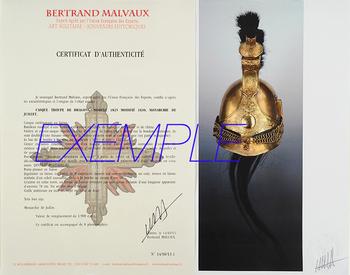
An authenticity certificate of the item including the description published on the site, the period, the sale price, accompanied by one or more color photographs is automatically provided for any item priced over 130 euros. Below this price, each certificate is charged 5 euros.
Only items sold by me are subject to an authenticity certificate, I do not provide any expert reports for items sold by third parties (colleagues or collectors).
FOR ALL PURCHASES, PAYMENT IN MULTIPLE CHECKS POSSIBLE
bertrand.malvaux@wanadoo.fr 06 07 75 74 63
An authenticity certificate of the item including the description published on the site, the period, the sale price, accompanied by one or more color photographs is automatically provided for any item priced over 130 euros. Below this price, each certificate is charged 5 euros.
Only items sold by me are subject to an authenticity certificate, I do not provide any expert reports for items sold by third parties (colleagues or collectors).