
OFFICER'S FLINTLOCK PISTOL, possibly attributed to a regiment of Dauphin cavalry. Former Monarchy, reign of Louis XIV, circa 1670-1680. 34638.
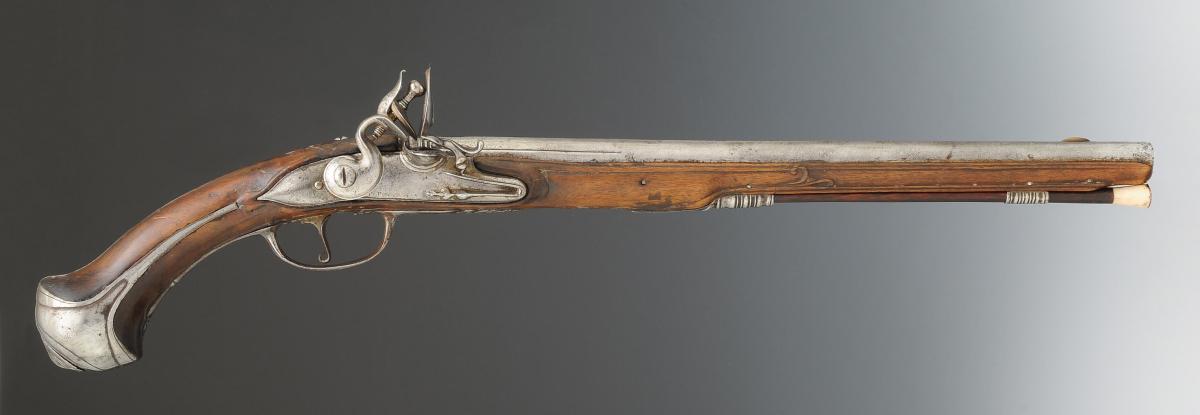
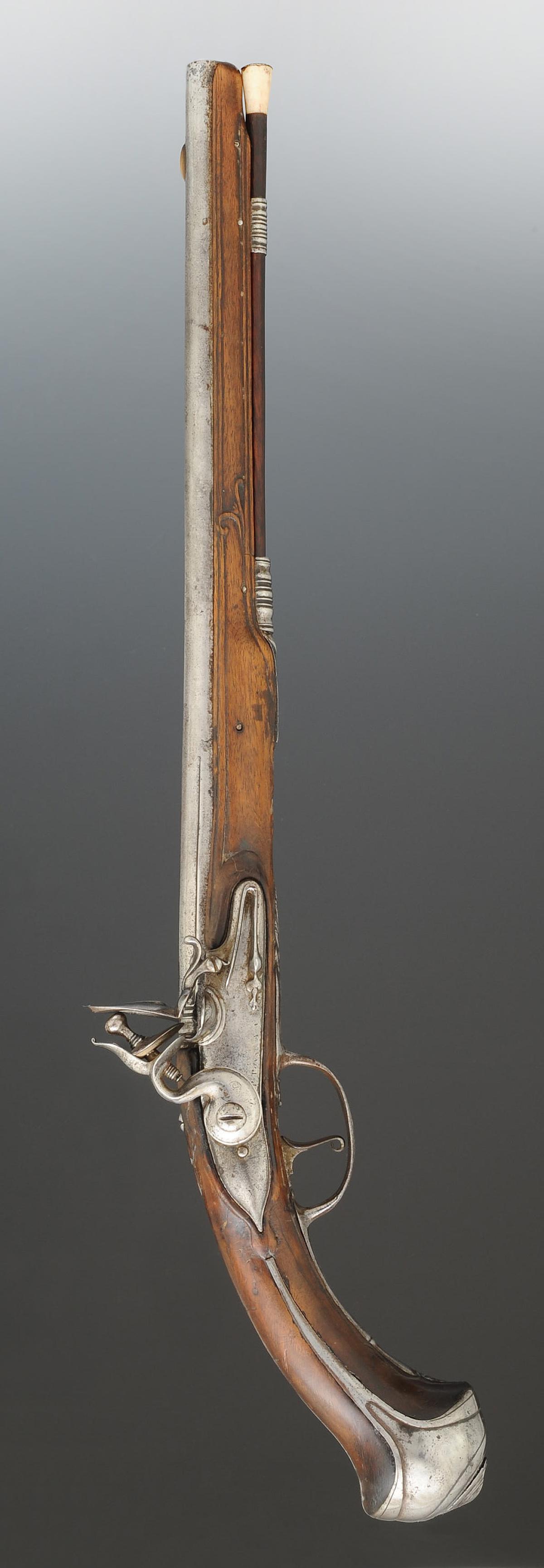
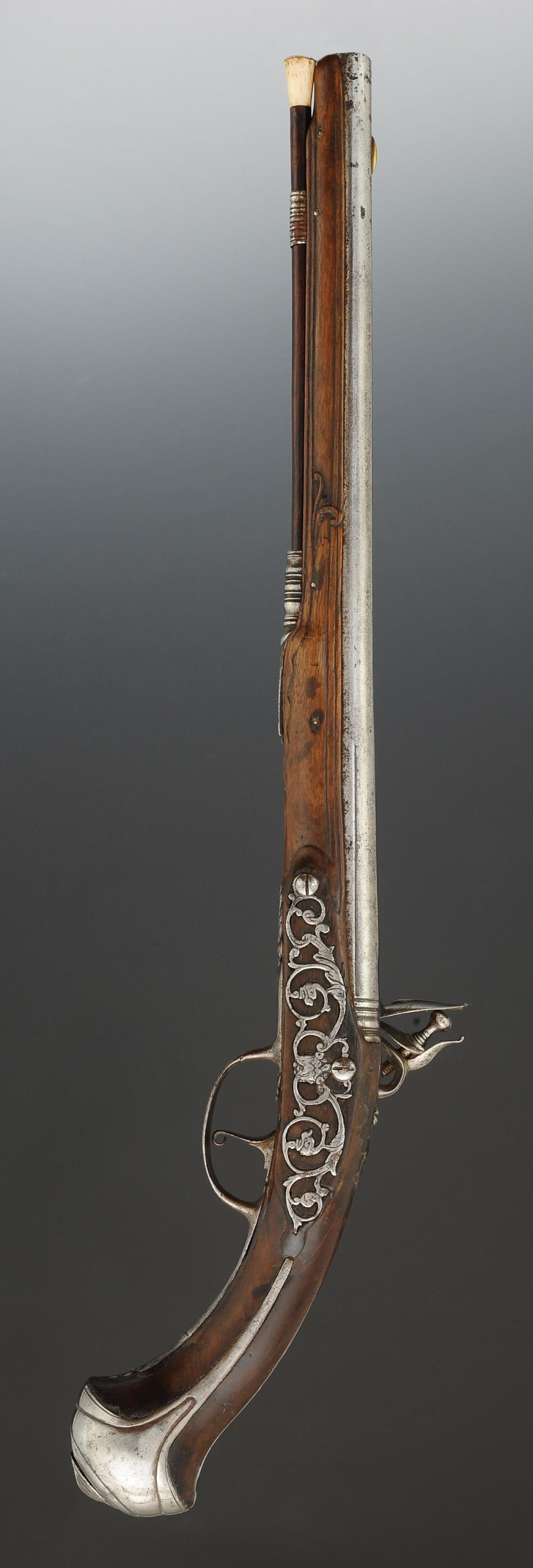
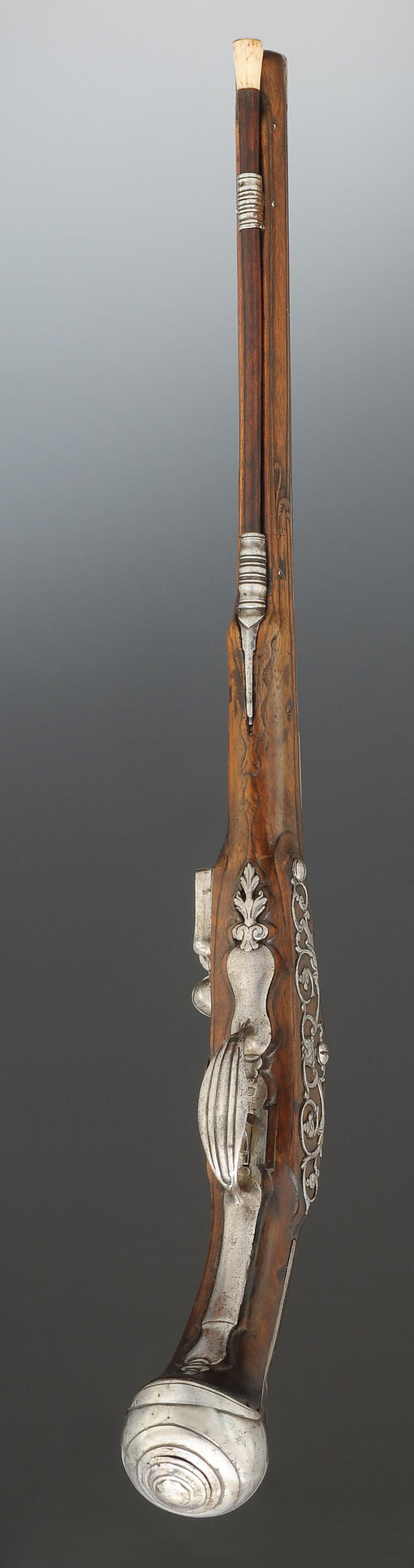
OFFICER'S ARQUEBUS PISTOL, possibly attributed to the Dauphin Cavalry regiment. Old Monarchy, reign of Louis XIV, around 1670-1680. 34638
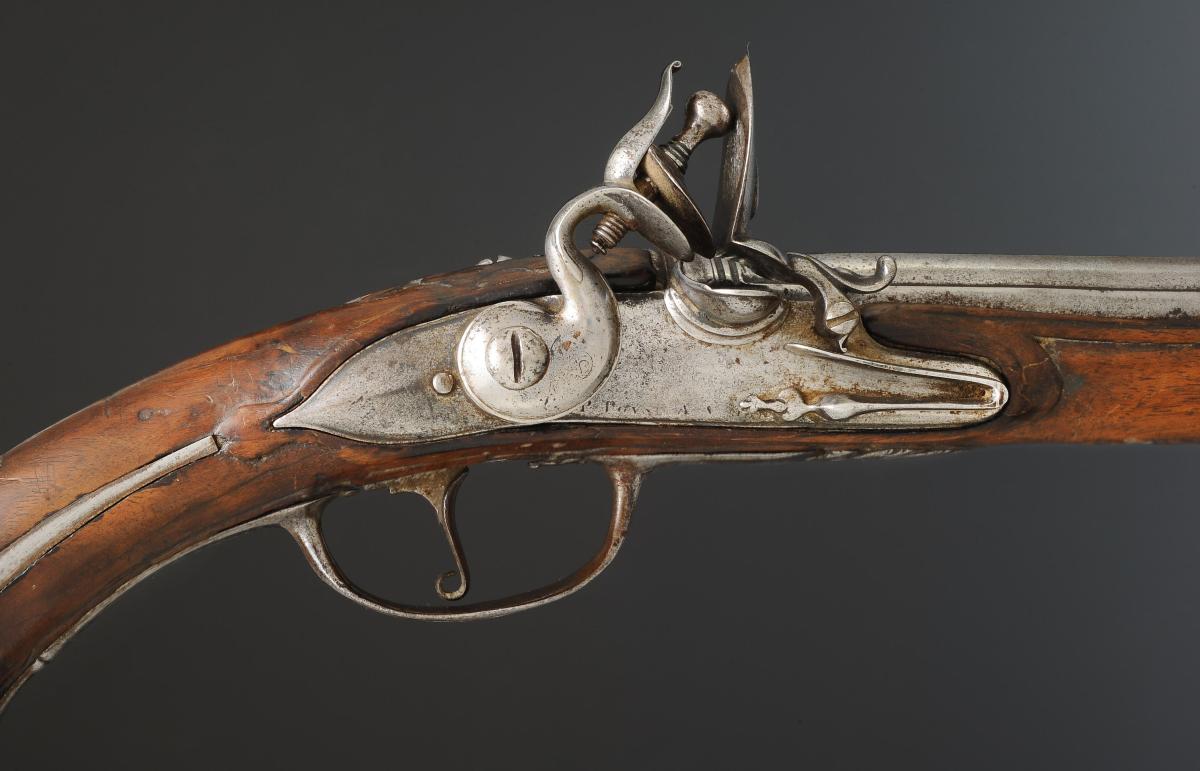
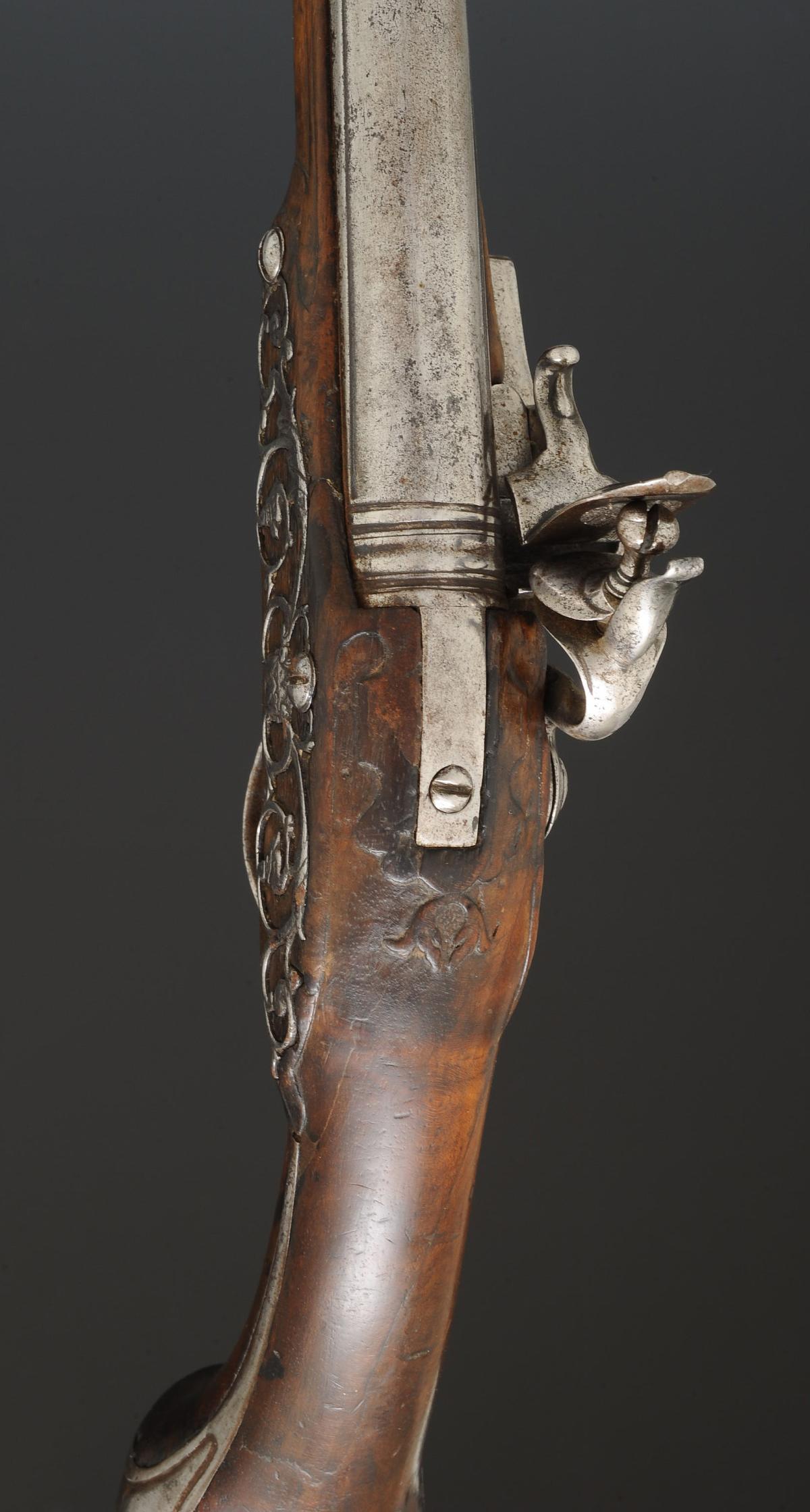
Walnut wood stock adorned with elegant moldings, entirely trimmed in iron. Eared butt cap, trigger guard with fluted and foliate motifs, molded ramrod pipes and chiseled open counterplate decorated with volutes featuring a leonine muzzle flanked by two small dolphins: these may refer to the following formations: Dauphin Cavalry formed in 1668; Dauphin Dragoons formed in 1673; or Dauphin Foreign formed in 1674. Round lock subtly marked at the bottom with "P. POULCE A SEDAN" (very faded); this gunsmith is identified around 1670. Barrel adorned with an astragal on the breech, then with a flat band extending to the brass front sight.
Total length of the weapon: 55 cm; barrel length: 37.5 cm; caliber: 14 mm; weight: 0.96 kg.
Walnut ramrod with its worm and a reinforced bone tip with its iron cap.
France.
Old Monarchy, reign of Louis XIV, around 1670-1680.
Very good condition with signs of wear and oxidation.
PROVENANCE:
From the former PM collection.
NOTE:
Pierre Poulce, Gunsmith, around 1670-1700, another gunsmith, probably his son: Paul Poulce around 1700-1720.
HISTORICAL BACKGROUND:
Dauphin Cavalry was formed on March 24, 1668. The regiment was raised in the context of the War of Devolution, led by Louis XIV against Spain in 1667-1668. Its name is directly linked to the Grand Dauphin Louis de France, the eldest son of Louis XIV and heir to the throne. It is this lineage that explains the name Dauphin Cavalry. A first cavalry unit associated with the Dauphin was created during the Flanders campaign. It notably took the name Chevau-légers du Dauphin. After the peace, the unit was reorganized and gradually took the form of a cavalry regiment. The regiment is thus intimately linked to the Royal House from its origins.
Dauphin Cavalry took part in the main wars of Louis XIV: the War of Devolution (1667-1668); the Dutch War (1672-1678); the Réunion War (1683-1684); the War of the League of Augsburg (1688-1697).
During the War of the Spanish Succession (1701-1714) was probably one of the most important periods of its history under the Old Monarchy. With the death of Charles II of Spain in 1700, the succession to the Spanish throne triggered a major European war. France under Louis XIV found itself opposed to a coalition including England, the Dutch Republic, and the Empire. Dauphin Cavalry served in the French armies during this conflict, participating in operations conducted in Flanders and in various theaters where French cavalry was engaged. This war was particularly exhausting for the French army. After the major French defeats at the beginning of the conflict, notably Blenheim (1704), the fighting continued for several years. The Treaty of Utrecht, followed by the treaties of Rastatt and Baden, eventually ended the conflict in 1713-1714.
It successively took part in several conflicts: War of the Quadruple Alliance (1718-1720), where the regiment participated in operations against Spain; War of the Polish Succession (1733-1738), it was engaged on the Rhine; War of the Austrian Succession (1740-1748); Seven Years' War (1756-1763).
Dauphin Dragoons, formed on September 14, 1673, during the Dutch War (1672-1678). It was raised by Louis-Jules, Marquis of Sauvebœuf, who became its first mestre de camp. Initially, it was a regiment of dragoons. In 1675 it became the Dauphin Dragoons. On August 1, 1675, Marquis de Sauvebœuf was killed in the battle of Saarbrücken, during the Dutch War, Louis XIV then decided to give the regiment to his eldest son, Louis de France, the Grand Dauphin, on August 29, 1675, the regiment was renamed Dauphin Dragoons. It was directly attached to the person of the Dauphin of France.
The regiment participated in the Dutch War from 1672 to 1678. One of its early significant engagements was the siege of Saint-Omer in 1677. The Dauphin Dragoons were then deployed around the fortress. Several companies were notably positioned at Château-Vieux and Wisques. On April 4, 1677, the dragoons of the Dauphin took part in the opening of the trench before Saint-Omer. The war ended with the treaties of Nijmegen in 1678-1679.
During the War of the League of Augsburg, 1688-1697, the regiment participated in the European war provoked by the opposition to Louis XIV's policy. It was engaged in the German theater and in operations against imperial forces.
The War of the Spanish Succession, 1701-1714, following the death of Charles II of Spain, the accession of Philip of Anjou, grandson of Louis XIV, sparked a new war. During this long conflict, the Dauphin Dragoons were engaged in operations conducted in the German theater and in the Spanish Netherlands.
Under the reign of Louis XV, it participated in the War of the Polish Succession (1733-1738). The Battle of San Pietro in 1734 is one of the typically remembered feats in the regiment's history.
The regiment then took part in the War of the Austrian Succession 1740-1748, in Germany and in the Low Countries.
The Seven Years' War: 1756-1763 was one of the last major campaigns of the Dauphin Dragoons under the Old Regime. In 1761, it joined the Army of Germany and was involved in operations against the allied forces during the Battle of Hochkirch/Hohenkirchen, on July 12, 1762, where the regiment distinguished itself.
Dauphin Foreign was created on March 12, 1674, during the reign of Louis XIV, and was one of the "foreign" regiments in the service of France. Its first mestre de camp-lieutenant was Joseph de Pons de Guimera, Marquis of Montclar, who commanded the regiment from its formation. He would later become a maréchal de camp and then a lieutenant general of the king's armies. The Dauphin of France was the owner mestre de camp, while the effective command was entrusted to a mestre de camp-lieutenant. This regiment was one of the six military units created for Louis de France, the Grand Dauphin, eldest son of Louis XIV:
1663: Chevau-légers du Dauphin company;
1665: Gendarmes du Dauphin company;
1667: Dauphin Infantry;
1668: Dauphin Cavalry;
1673: Dauphin Dragoons;
1674: Dauphin Foreign cavalry.
Therefore, Dauphin Foreign was the last of the great regiments created for the Military Household of the Dauphin.
The regiment was born during the Dutch War, which had been opposing France to a vast European coalition since 1672 and ended with the Treaty of Nijmegen in 1678-1679.
A few years later, France entered a new European war: the War of the League of Augsburg (1688-1697). The regiment notably saw the command of Raymond Balthasar de Phélipeaux, appointed mestre de camp-lieutenant in 1691. He became a maréchal de camp in 1696 and a lieutenant general in 1701.
From 1701, Dauphin Foreign took part in the War of the Spanish Succession when France fought a coalition including the Empire, England, and the Dutch Republic. The regiment was engaged in various theaters: the taking of the fort of Kehl in 1703; the taking of Augsburg in 1703; the Battle of Cassano in 1705; the Battle of Calcinato in 1706; the siege of Turin in 1706; the attempt against Toulon in 1707; the Battle of Malplaquet in 1709; the Battle of Denain in 1712, followed by the sieges of Landau and Fribourg.
Dauphin Foreign also participated in the Battle of Blenheim in 1704, one of the major French defeats of the war, with three squadrons, around 360 men, within the French and Bavarian army. The war gradually ended with the Treaties of Utrecht, Rastatt, and Baden.
During the War of the Polish Succession (1733-1738), it was once again engaged.
The career of Dauphin Foreign continued with the War of the Austrian Succession.
The Seven Years' War: 1756-1761 was the regiment's last war, as it was part of the French Army of the Lower Rhine.
On December 1, 1761, an order decided the regiment's reform, and Dauphin Foreign was incorporated into the Dauphin Cavalry regiment, with its last mestre de camp-lieutenant being the Marquis de Vibraye, appointed in 1759.
Upon the death of the Grand Dauphin in 1711, the regiment retained its name.
Price :
2 400,00 €
| Destination | Envoi recommandé | Envoi Recommandé + Express |
|---|---|---|
| Shipping France | 14,00 € | 50,00 € |
| Shipping Europe | 20,00 € | 60,00 € |
| Shipping world | 44,00 € | 100,00 € |
Insurance (1%) :
24,00 €
Reference :
34638
Next update Friday, octobre 30 at 13:30 PM
FOR ALL PURCHASES, PAYMENT IN MULTIPLE CHECKS POSSIBLE
bertrand.malvaux@wanadoo.fr 06 07 75 74 63
SHIPPING COSTS
Shipping costs are calculated only once per order for one or more items, all shipments are sent via registered mail, as this is the only way to have proof of dispatch and receipt.
For parcels whose value cannot be insured by the Post, shipments are entrusted to DHL or Fedex with real value insured, the service is of high quality but the cost is higher.
RETURN POLICY
Items can be returned within 8 days of receipt. They must be returned by registered mail at the sender's expense, in their original packaging, and in their original condition.
AUTHENTICITY
The selection of items offered on this site allows me to guarantee the authenticity of each piece described here, all items offered are guaranteed to be period and authentic, unless otherwise noted or restricted in the description.
An authenticity certificate of the item including the description published on the site, the period, the sale price, accompanied by one or more color photographs is automatically provided for any item priced over 130 euros. Below this price, each certificate is charged 5 euros.
Only items sold by me are subject to an authenticity certificate, I do not provide any expert reports for items sold by third parties (colleagues or collectors).
FOR ALL PURCHASES, PAYMENT IN MULTIPLE CHECKS POSSIBLE
bertrand.malvaux@wanadoo.fr 06 07 75 74 63
An authenticity certificate of the item including the description published on the site, the period, the sale price, accompanied by one or more color photographs is automatically provided for any item priced over 130 euros. Below this price, each certificate is charged 5 euros.
Only items sold by me are subject to an authenticity certificate, I do not provide any expert reports for items sold by third parties (colleagues or collectors).