
ARC TRIGGER PISTOL, model of 1733, for the Hussars de Rattk regiment, Ancient Monarchy, reign of Louis XV, between 1740 and 1743. 34627
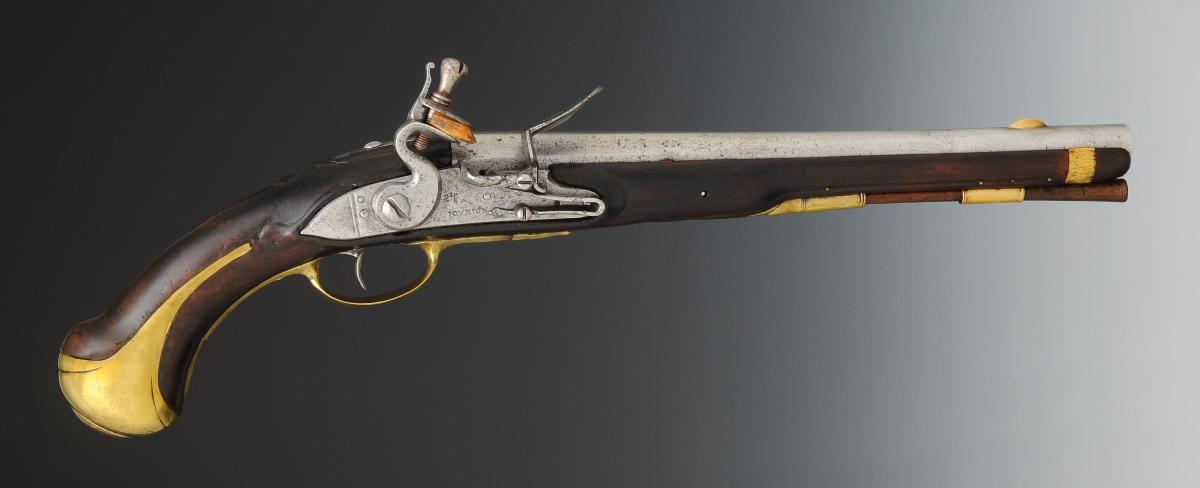
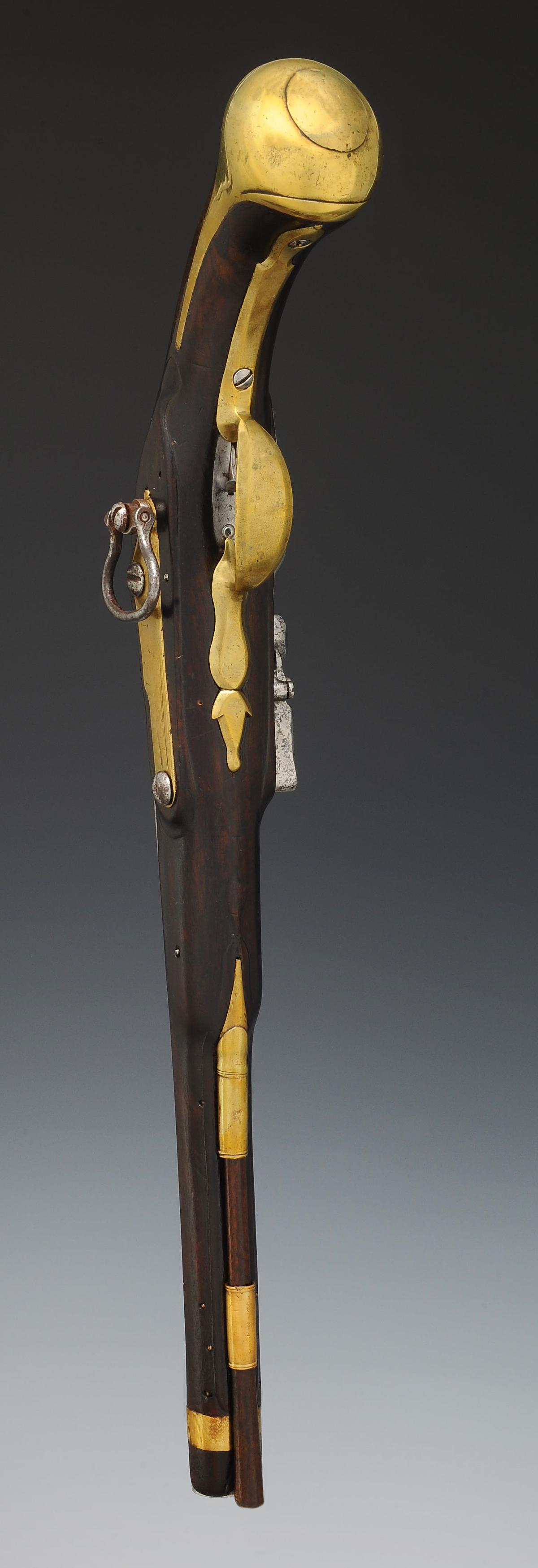
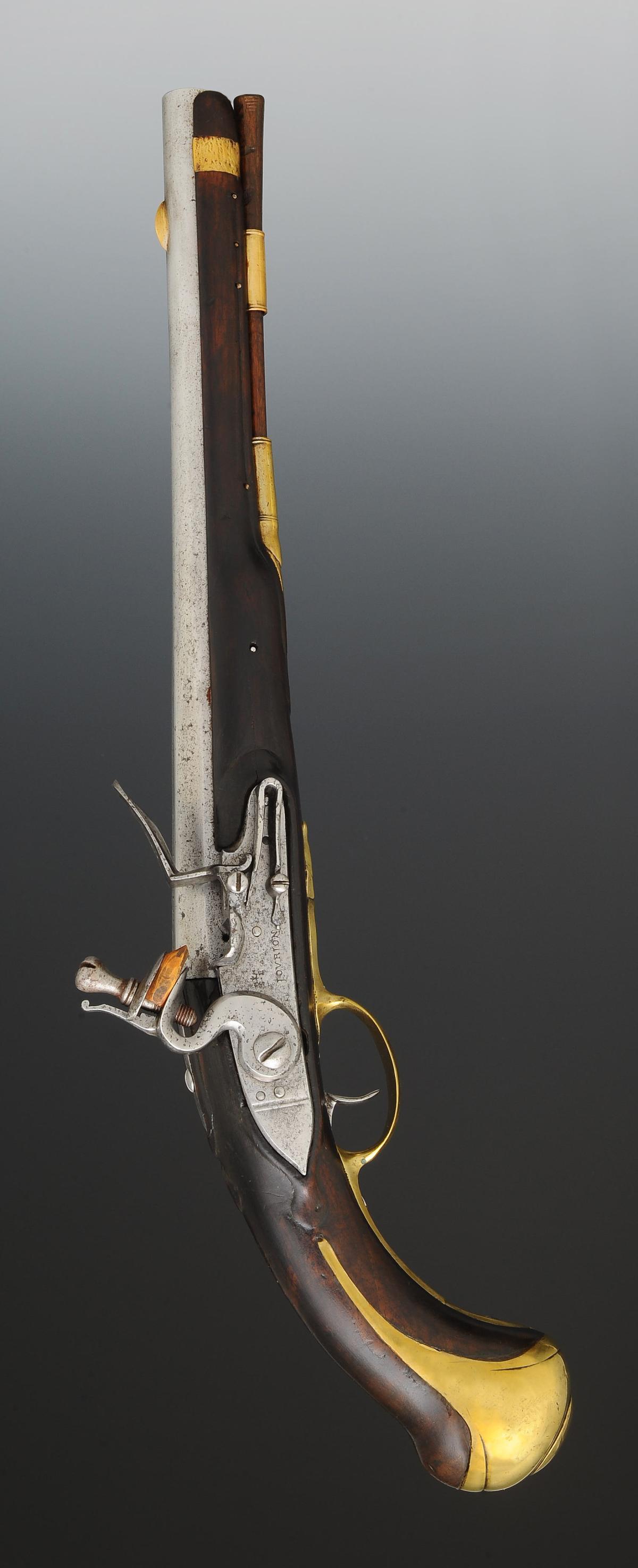
ARC GUN, 1733 model, for the Regiment of Hussars of Rattk, Old Monarchy, reign of Louis XV, between 1740 and 1743. 34627
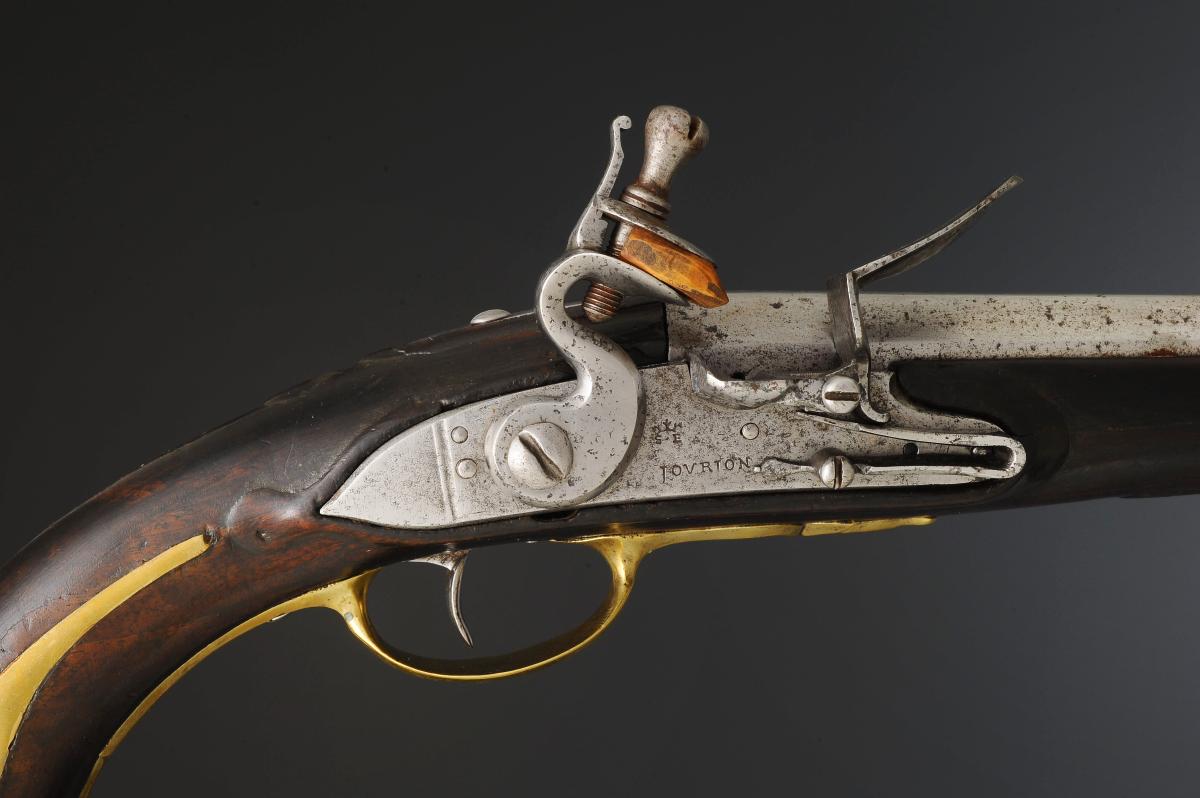
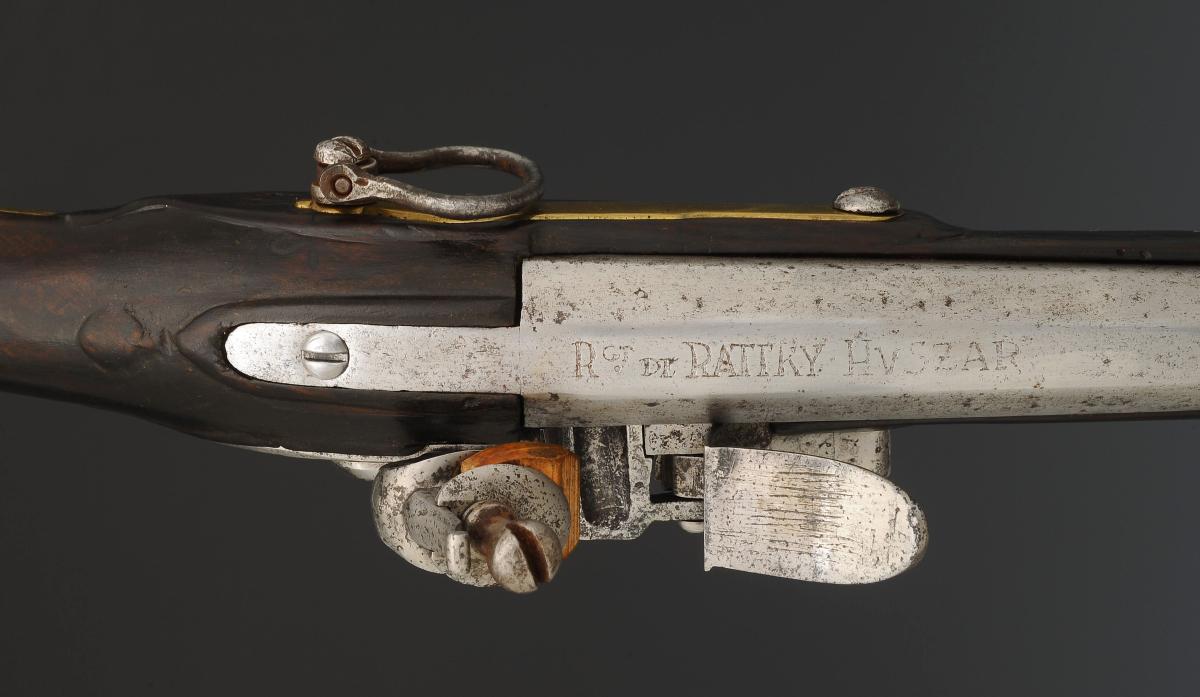
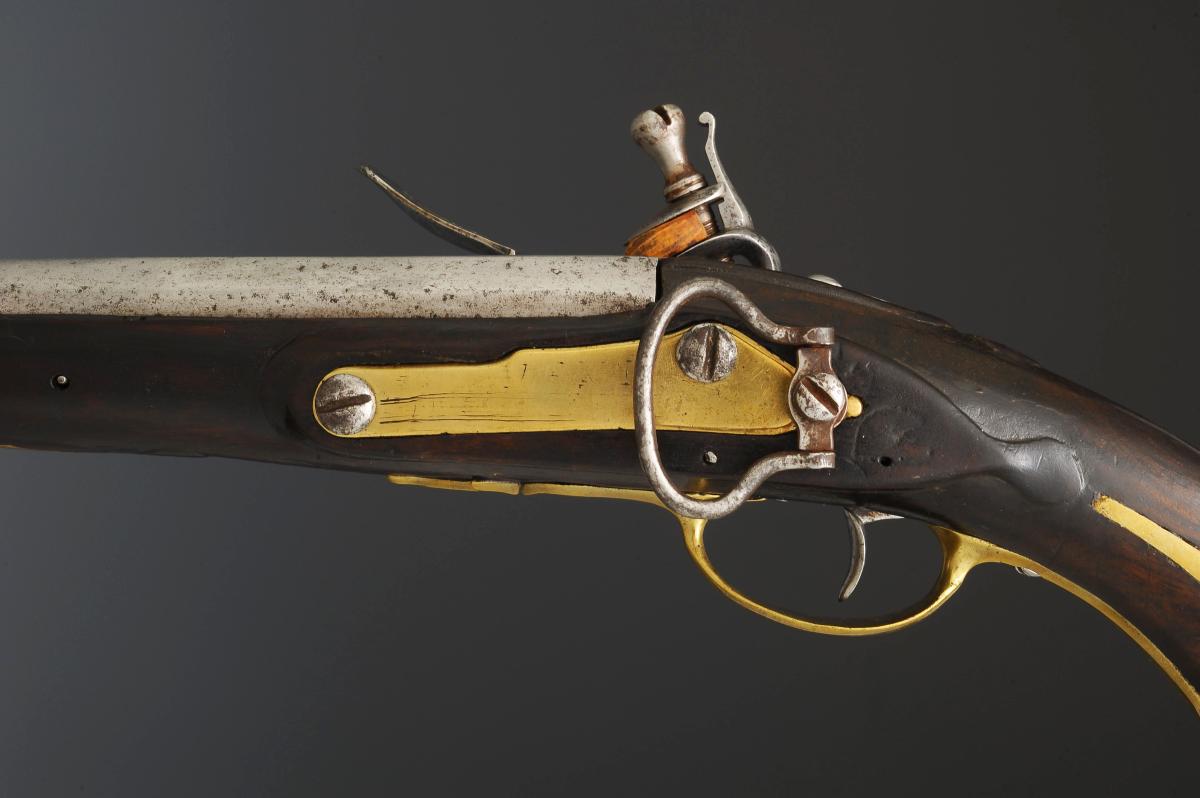
Walnut stock adorned with discreet moldings and trimmed in polished brass: butt cap with button and ears, trigger guard, ramrod loops, reinforcing band at the end of the stock, and engraved counterplate with the remnants of the serial number 13. Strong swivel buckle fixed with a screw through the end of the counterplate and intended for the suspension of the weapon on a shoulder strap. Square lock plate bearing the mark of the Saint Etienne manufacture, namely the letters "S" and "E" under a crown with the signature of the gunsmith-entrepreneur Simon Jourjon (JOVRJON) who held this position intermittently: 1719-1729-1731-1740-1741 and 1749. The inside of the lock plate is marked "CLAUDE CIZERON," a stocker from a family of Saint-Étienne gunsmiths. The barrel is engraved on the top flat: "REGT DE RATTKY HUSZAR."
Total length of the weapon: 48 cm; barrel length: 31 cm; caliber: 18 mm; weight: 1.23 kg.
France.
Old Monarchy, reign of Louis XV, between 1740 and 1743. 34627
Very good condition, old repair on the stock, slight oxidation from use, later ramrod.
PROVENANCE:
Former PM collection.
BIOGRAPHY:
SIMON JOURJON was born in 1672 in Saint-Étienne, he grew up within the guild of master gunsmiths and weapon assemblers of Saint-Étienne, and is believed to be the son of Mathieu Jourjon and Marie Barallon. He married Anne Martin on October 18, 1707, in Saint-Étienne. The couple had a daughter, Claudine-Thècle, born in 1719, and a son, Claude-Simon, born on November 8, 1717.
From the early 18th century (around 1700-1710), he established himself as a skilled master, producing cavalry pistols and luxury weapons. Starting in 1719, Simon Jourjon held the prestigious position of Entrepreneur of His Majesty's Weapons at the Saint-Étienne Manufacture. His tenure in this role was marked by its discontinuity (shared or alternating through successive contracts granted by the Secretary of War and the royal manufacture in 1719, 1729, 1731, 1740, 1741, and 1749). He was one of the master craftsmen responsible for producing and assembling the standard rifles of the royal army, including the first Model 1728 infantry rifles and their variations (cavalry rifles, dragon muskets, and officer pistols). He subcontracted the production of various parts (barrels, lock plates, brass or iron fittings, wooden stocks) to the Saint-Étienne master craftsmen before ensuring the testing, inspection, and delivery to the royal arsenals. In addition to his state contracts, the Jourjon workshop catered to a wealthy private clientele (officers, nobility, merchants).
He produced quality double-barreled pistols and hunting rifles; his civilian creations, especially his pairs of carriage or cavalry pistols, were renowned for the finesse of their lock plates and decorations. The workshop also housed very skilled engravers and metal cutters, sometimes solicited for other precision artisanal pieces.
Simon Jourjon died in Saint-Étienne in 1752 at the age of 80. His professional legacy was carried on by his family, notably by his grandson (or son according to the records of the time) Claude-Simon Jourjon, who continued to serve as an entrepreneur and gunsmith to the King in Saint-Étienne.
CLAUDE CIZERON embodies the figure of the highly specialized master-locksmith, active in Saint-Étienne around 1730-1770. He belonged to an important lineage of Saint-Étienne gunsmith artisans.
HISTORICAL:
The Rattky Hussars Regiment - also written as Rattsky, Ratky, or Rattky Hussars in sources - holds an important place in the history of the first Hungarian hussar regiments in the service of France. However, it is important to provide a clarification regarding the phrase "formed under this name in 1707": the unit existed from 1706 under the name Saint-Geniès; it took on the name Rattky when Georges (György) Ráttky took command on December 14, 1707.
History of the Rattky Hussars Regiment, 1706-1743
Origins: the first Hungarian hussars in the service of France
At the beginning of the 18th century, the French monarchy sought to develop the use of Hungarian-style light cavalry. Hussars, particularly suited for reconnaissance, raids, escorts, communications, and "small war," were highly sought after.
In the context of the War of the Spanish Succession (1701-1714), several Hungarian or predominantly Hungarian hussar formations were established in the service of France. The future Rattky regiment directly originates from a regiment organized in 1706 under the name Saint-Geniès, notably with Hungarians from various corps and deserters from the imperial army.
The turning point came with the arrival in France of Georges Ráttky de Salamonfa, a former kuruc officer and close to Francis II Rákóczi. Rákóczi had sent him to the French court to help regroup and organize the numerous Hungarians serving in the French armies. On December 14, 1707, Ráttky took command of the Saint-Geniès regiment, which from then on became commonly known as the Rattky Hussars regiment.
The regiment thus became one of the first truly emblematic formations of Hungarian military presence in France.
1708-1710: the War of the Spanish Succession
Under Ráttky, the regiment was engaged in the Flanders theater, where it served in the French armies commanded notably by Marshal Villars.
Battle of Oudenarde - July 11, 1708
The Rattky Hussars took part in the Battle of Oudenarde, one of the major clashes of the War of the Spanish Succession.
They fulfilled the traditional hussar missions of reconnaissance, communication, cover, and harassment of enemy forces. Hungarian sources highlight the regiment's presence in the major Flanders operations of 1708 and 1709.
Battle of Malplaquet - September 11, 1709
The following year, the regiment fought at Malplaquet, a particularly bloody battle where French forces faced the allied army commanded by Marlborough and Prince Eugene.
This campaign helped establish the reputation of Hungarian hussars in French service. They were regularly pitted against other Hungarian hussars now serving in the Habsburg imperial army.
1711: Ráttky wounded
In 1711, Georges Ráttky was seriously wounded. The effective command of the regiment was then assumed by his lieutenant-colonel Bálint (Valentin) Dessőffy, who later played a major role in the corps's history.
The regiment then gained a solid reputation, attracting young Hungarian officers who would play important roles in the French army.
1712-1718: the arrival of Bercsényi
One of the most significant episodes in the regiment's history is the arrival of Ladislas de Bercsényi.
After the defeat of Rákóczi's War of Independence, Bercsényi joined France in 1712. Louis XIV appointed him lieutenant-colonel of the Rattky regiment on December 31, 1712.
He notably participated in the 1713 operations, including the siege of Landau. Sources report that he distinguished himself leading a hussar detachment.
Bercsényi later became colonel of the regiment in 1718. This was a significant step, making the Rattky regiment one of the main training grounds for Hungarian officers in French service.
1719: Campaign in Spain
The regiment participated in the new French intervention against Spain in 1719, under the reign of Philip V.
Hungarian hussars were particularly suited for such operations: reconnaissance, raids, intercepting communications, protecting columns, and rapid operations.
Their conduct during this campaign helped promote the creation of new Hungarian hussar units. In this context, Bercsényi obtained authorization to raise his own regiment, composed mainly of Hungarians recruited among the Ottoman Empire exiles.
Thus, the Rattky regiment was directly involved in shaping the next generation of French Hungarian hussars, especially through the training of leaders like Bercsényi.
1720-1732: A regiment turned permanent
The peace period following the War of the Spanish Succession allowed the regiment to maintain its existence and continue recruiting.
It remained largely composed of Hungarians. Hungarian was the language of command for a long time, while the officers mastered French.
Several notable officers served in its ranks, including members of the Dessőffy family, such as:
Bálint Dessőffy, lieutenant-colonel then brigadier;
Miklós Dessőffy, the future successor of Ráttky;
Károly Dessőffy, who also began his career in the regiment.
The regiment gradually became a true nursery of Hungarian light cavalry officers in French service.
1733-1735: War of the Polish Succession
The regiment returned to operations during the War of the Polish Succession.
It was engaged in Italy under the overall command of Villars, then Coigny and Broglie.
In 1734, the Rattky hussars notably participated in the Lombardy operations and the fighting around Guastalla. They were used as light cavalry, advancing ahead of the main forces for reconnaissance and communication missions.
The campaign of 1734 was particularly significant for Ráttky's career. His military conduct was noted by the French command. On August 1, 1734, Louis XV appointed him a maréchal de camp, making him the first Hungarian officer in French service to reach this rank.
His regiment also took part in the 1735 operations, still in Italy. The Rattky hussars were employed to secure communications and liaisons between different elements of the French army.
1738-1740: Corsica
After the War of the Polish Succession, the regiment experienced a period of garrison duty and exercises.
However, it participated with the French expeditionary force in Corsican operations starting in 1738 when France intervened alongside the Republic of Genoa against the Corsican insurgents.
This participation showcased the regiment's versatility, now used in external operations of the French monarchy.
1741-1742: War of the Austrian Succession
The new war that broke out in 1740 following the death of Emperor Charles VI led the regiment to its last major theater of operations under its founder's command.
The French intervened in support of Charles Albert of Bavaria, future Emperor Charles VII, against Maria Theresa.
The Rattky regiment was engaged in Bohemia and participated in the campaign leading to the capture of Prague in November 1741.
When Austrian forces resumed the offensive in 1742, the French army found itself trapped in Prague. The hussars played a particularly important role in reconnaissance, communication, and operations beyond enemy lines, especially in searching for supplies and forage.
The death of Georges Ráttky in Prague - September 5, 1742
The most dramatic moment in the regiment's history occurred during the siege of Prague.
On September 5, 1742, Georges Ráttky died in Prague at around sixty years old after a career of over thirty years in French and Hungarian causes.
However, there is a nuance regarding the exact circumstances of his death.
The French administrative file simply states that he "died in Prague on September 5, 1742." Contemporary witnesses reported that he died of a stroke during the fighting. Historians who studied his records consider his death to have occurred in the context of military operations and in service.
Therefore, it is more accurate, in a historical account, to write: "Died in Prague on September 5, 1742, during the operations related to the city's siege." rather than stating unequivocally that he was "killed by a bullet" or "killed in combat," as sources do not provide certainty.
1742-1743: the regiment after Ráttky
After Ráttky's death, the command passed to his lieutenant-colonel Miklós Dessőffy (Nicolas Dessewffy).
Louis XV granted him the regiment at the request of Marshal Broglie. A letter from Belle-Isle dated January 31, 1743, confirmed that Dessőffy received the regiment after Ráttky's death.
The Rattky hussars then continued operations in Bohemia. They were notably used with Bercsényi's hussars around Kouřim and took part in the protection and rearguard during Belle-Isle's famous Bohemian retreat at the end of 1742.
They eventually returned to France in February 1743.
Yet, the regiment faced another setback: Miklós Dessőffy died in June 1743 during the Bohemian campaign.
After 1743: the end of the name "Rattky"
It is important to note that 1743 did not mark the disappearance of the regiment.
The unit remained in existence but gradually ceased to be known as Rattky. After Dessőffy's death, it passed to the Count de Lynden and became known as Lynden Hussars regiment.
It remained a formation largely marked by its Hungarian origin.
In 1756, the Lynden regiment was disbanded, and its elements were merged into the Bercsényi Hussars regiment.
This lineage is particularly interesting: the Bercsényi regiment, later becoming the 1st Parachute Chasseur Regiment, thus inherited part of the legacy of the first Hungarian hussars in France.
Walnut stock adorned with discreet moldings and trimmed in polished brass: butt cap with button and ears, trigger guard, ramrod loops, reinforcing band at the end of the stock, and engraved counterplate with the remnants of the serial number 13. Strong swivel buckle fixed with a screw through the end of the counterplate and intended for the suspension of the weapon on a shoulder strap. Square lock plate bearing the mark of the Saint Etienne manufacture, namely the letters "S" and "E" under a crown with the signature of the gunsmith-entrepreneur Simon Jourjon (JOVRJON) who held this position intermittently: 1719-1729-1731-1740-1741 and 1749. The inside of the lock plate is marked "CLAUDE CIZERON," a stocker from a family of Saint-Étienne gunsmiths. The barrel is engraved on the top flat: "REGT DE RATTKY HUSZAR."
Total length of the weapon: 48 cm; barrel length: 31 cm; caliber: 18 mm; weight: 1.23 kg.
France.
Old Monarchy, reign of Louis XV, between 1740 and 1743. 34627
Very good condition, old repair on the stock, slight oxidation from use, later ramrod.
PROVENANCE:
Former PM collection.
BIOGRAPHY:
SIMON JOURJON was born in 1672 in Saint-Étienne, he grew up within the guild of master gunsmiths and weapon assemblers of Saint-Étienne, and is believed to be the son of Mathieu Jourjon and Marie Barallon. He married Anne Martin on October 18, 1707, in Saint-Étienne. The couple had a daughter, Claudine-Thècle, born in 1719, and a son, Claude-Simon, born on November 8, 1717.
From the early 18th century (around 1700-1710), he established himself as a skilled master, producing cavalry pistols and luxury weapons. Starting in 1719, Simon Jourjon held the prestigious position of Entrepreneur of His Majesty's Weapons at the Saint-Étienne Manufacture. His tenure in this role was marked by its discontinuity (shared or alternating through successive contracts granted by the Secretary of War and the royal manufacture in 1719, 1729, 1731, 1740, 1741, and 1749). He was one of the master craftsmen responsible for producing and assembling the standard rifles of the royal army, including the first Model 1728 infantry rifles and their variations (cavalry rifles, dragon muskets, and officer pistols). He subcontracted the production of various parts (barrels, lock plates, brass or iron fittings, wooden stocks) to the Saint-Étienne master craftsmen before ensuring the testing, inspection, and delivery to the royal arsenals. In addition to his state contracts, the Jourjon workshop catered to a wealthy private clientele (officers, nobility, merchants).
He produced quality double-barreled pistols and hunting rifles; his civilian creations, especially his pairs of carriage or cavalry pistols, were renowned for the finesse of their lock plates and decorations. The workshop also housed very skilled engravers and metal cutters, sometimes solicited for other precision artisanal pieces.
Simon Jourjon died in Saint-Étienne in 1752 at the age of 80. His professional legacy was carried on by his family, notably by his grandson (or son according to the records of the time) Claude-Simon Jourjon, who continued to serve as an entrepreneur and gunsmith to the King in Saint-Étienne.
CLAUDE CIZERON embodies the figure of the highly specialized master-locksmith, active in Saint-Étienne around 1730-1770. He belonged to an important lineage of Saint-Étienne gunsmith artisans.
HISTORICAL:
The Rattky Hussars Regiment - also written as Rattsky, Ratky, or Rattky Hussars in sources - holds an important place in the history of the first Hungarian hussar regiments in the service of France. However, it is important to provide a clarification regarding the phrase "formed under this name in 1707": the unit existed from 1706 under the name Saint-Geniès; it took on the name Rattky when Georges (György) Ráttky took command on December 14, 1707.
History of the Rattky Hussars Regiment, 1706-1743
Origins: the first Hungarian hussars in the service of France
At the beginning of the 18th century, the French monarchy sought to develop the use of Hungarian-style light cavalry. Hussars, particularly suited for reconnaissance, raids, escorts, communications, and "small war," were highly sought after.
In the context of the War of the Spanish Succession (1701-1714), several Hungarian or predominantly Hungarian hussar formations were established in the service of France. The future Rattky regiment directly originates from a regiment organized in 1706 under the name Saint-Geniès, notably with Hungarians from various corps and deserters from the imperial army.
The turning point came with the arrival in France of Georges Ráttky de Salamonfa, a former kuruc officer and close to Francis II Rákóczi. Rákóczi had sent him to the French court to help regroup and organize the numerous Hungarians serving in the French armies. On December 14, 1707, Ráttky took command of the Saint-Geniès regiment, which from then on became commonly known as the Rattky Hussars regiment.
The regiment thus became one of the first truly emblematic formations of Hungarian military presence in France.
1708-1710: the War of the Spanish Succession
Under Ráttky, the regiment was engaged in the Flanders theater, where it served in the French armies commanded notably by Marshal Villars.
Battle of Oudenarde - July 11, 1708
The Rattky Hussars took part in the Battle of Oudenarde, one of the major clashes of the War of the Spanish Succession.
They fulfilled the traditional hussar missions of reconnaissance, communication, cover, and harassment of enemy forces. Hungarian sources highlight the regiment's presence in the major Flanders operations of 1708 and 1709.
Battle of Malplaquet - September 11, 1709
The following year, the regiment fought at Malplaquet, a particularly bloody battle where French forces faced the allied army commanded by Marlborough and Prince Eugene.
This campaign helped establish the reputation of Hungarian hussars in French service. They were regularly pitted against other Hungarian hussars now serving in the Habsburg imperial army.
1711: Ráttky wounded
In 1711, Georges Ráttky was seriously wounded. The effective command of the regiment was then assumed by his lieutenant-colonel Bálint (Valentin) Dessőffy, who later played a major role in the corps's history.
The regiment then gained a solid reputation, attracting young Hungarian officers who would play important roles in the French army.
1712-1718: the arrival of Bercsényi
One of the most significant episodes in the regiment's history is the arrival of Ladislas de Bercsényi.
After the defeat of Rákóczi's War of Independence, Bercsényi joined France in 1712. Louis XIV appointed him lieutenant-colonel of the Rattky regiment on December 31, 1712.
He notably participated in the 1713 operations, including the siege of Landau. Sources report that he distinguished himself leading a hussar detachment.
Bercsényi later became colonel of the regiment in 1718. This was a significant step, making the Rattky regiment one of the main training grounds for Hungarian officers in French service.
1719: Campaign in Spain
The regiment participated in the new French intervention against Spain in 1719, under the reign of Philip V.
Hungarian hussars were particularly suited for such operations: reconnaissance, raids, intercepting communications, protecting columns, and rapid operations.
Their conduct during this campaign helped promote the creation of new Hungarian hussar units. In this context, Bercsényi obtained authorization to raise his own regiment, composed mainly of Hungarians recruited among the Ottoman Empire exiles.
Thus, the Rattky regiment was directly involved in shaping the next generation of French Hungarian hussars, especially through the training of leaders like Bercsényi.
1720-1732: A regiment turned permanent
The peace period following the War of the Spanish Succession allowed the regiment to maintain its existence and continue recruiting.
It remained largely composed of Hungarians. Hungarian was the language of command for a long time, while the officers mastered French.
Several notable officers served in its ranks, including members of the Dessőffy family, such as:
Bálint Dessőffy, lieutenant-colonel then brigadier;
Miklós Dessőffy, the future successor of Ráttky;
Károly Dessőffy, who also began his career in the regiment.
The regiment gradually became a true nursery of Hungarian light cavalry officers in French service.
1733-1735: War of the Polish Succession
The regiment returned to operations during the War of the Polish Succession.
It was engaged in Italy under the overall command of Villars, then Coigny and Broglie.
In 1734, the Rattky hussars notably participated in the Lombardy operations and the fighting around Guastalla. They were used as light cavalry, advancing ahead of the main forces for reconnaissance and communication missions.
The campaign of 1734 was particularly significant for Ráttky's career. His military conduct was noted by the French command. On August 1, 1734, Louis XV appointed him a maréchal de camp, making him the first Hungarian officer in French service to reach this rank.
His regiment also took part in the 1735 operations, still in Italy. The Rattky hussars were employed to secure communications and liaisons between different elements of the French army.
1738-1740: Corsica
After the War of the Polish Succession, the regiment experienced a period of garrison duty and exercises.
However, it participated with the French expeditionary force in Corsican operations starting in 1738 when France intervened alongside the Republic of Genoa against the Corsican insurgents.
This participation showcased the regiment's versatility, now used in external operations of the French monarchy.
1741-1742: War of the Austrian Succession
The new war that broke out in 1740 following the death of Emperor Charles VI led the regiment to its last major theater of operations under its founder's command.
The French intervened in support of Charles Albert of Bavaria, future Emperor Charles VII, against Maria Theresa.
The Rattky regiment was engaged in Bohemia and participated in the campaign leading to the capture of Prague in November 1741.
When Austrian forces resumed the offensive in 1742, the French army found itself trapped in Prague. The hussars played a particularly important role in reconnaissance, communication, and operations beyond enemy lines, especially in searching for supplies and forage.
The death of Georges Ráttky in Prague - September 5, 1742
The most dramatic moment in the regiment's history occurred during the siege of Prague.
On September 5, 1742, Georges Ráttky died in Prague at around sixty years old after a career of over thirty years in French and Hungarian causes.
However, there is a nuance regarding the exact circumstances of his death.
The French administrative file simply states that he "died in Prague on September 5, 1742." Contemporary witnesses reported that he died of a stroke during the fighting. Historians who studied his records consider his death to have occurred in the context of military operations and in service.
Therefore, it is more accurate, in a historical account, to write: "Died in Prague on September 5, 1742, during the operations related to the city's siege." rather than stating unequivocally that he was "killed by a bullet" or "killed in combat," as sources do not provide certainty.
1742-1743: the regiment after Ráttky
After Ráttky's death, the command passed to his lieutenant-colonel Miklós Dessőffy (Nicolas Dessewffy).
Louis XV granted him the regiment at the request of Marshal Broglie. A letter from Belle-Isle dated January 31, 1743, confirmed that Dessőffy received the regiment after Ráttky's death.
The Rattky hussars then continued operations in Bohemia. They were notably used with Bercsényi's hussars around Kouřim and took part in the protection and rearguard during Belle-Isle's famous Bohemian retreat at the end of 1742.
They eventually returned to France in February 1743.
Yet, the regiment faced another setback: Miklós Dessőffy died in June 1743 during the Bohemian campaign.
After 1743: the end of the name "Rattky"
It is important to note that 1743 did not mark the disappearance of the regiment.
The unit remained in existence but gradually ceased to be known as Rattky. After Dessőffy's death, it passed to the Count de Lynden and became known as Lynden Hussars regiment.
It remained a formation largely marked by its Hungarian origin.
In 1756, the Lynden regiment was disbanded, and its elements were merged into the Bercsényi Hussars regiment.
This lineage is particularly interesting: the Bercsényi regiment, later becoming the 1st Parachute Chasseur Regiment, thus inherited part of the legacy of the first Hungarian hussars in France.
Price :
5 000,00 €
| Destination | Envoi recommandé | Envoi Recommandé + Express |
|---|---|---|
| Shipping France | 14,00 € | 50,00 € |
| Shipping Europe | 20,00 € | 60,00 € |
| Shipping world | 44,00 € | 100,00 € |
Insurance (1%) :
50,00 €
Reference :
34627
Next update Friday, octobre 9 at 13:30 PM
FOR ALL PURCHASES, PAYMENT IN MULTIPLE CHECKS POSSIBLE
bertrand.malvaux@wanadoo.fr 06 07 75 74 63
SHIPPING COSTS
Shipping costs are calculated only once per order for one or more items, all shipments are sent via registered mail, as this is the only way to have proof of dispatch and receipt.
For parcels whose value cannot be insured by the Post, shipments are entrusted to DHL or Fedex with real value insured, the service is of high quality but the cost is higher.
RETURN POLICY
Items can be returned within 8 days of receipt. They must be returned by registered mail at the sender's expense, in their original packaging, and in their original condition.
AUTHENTICITY
The selection of items offered on this site allows me to guarantee the authenticity of each piece described here, all items offered are guaranteed to be period and authentic, unless otherwise noted or restricted in the description.
An authenticity certificate of the item including the description published on the site, the period, the sale price, accompanied by one or more color photographs is automatically provided for any item priced over 130 euros. Below this price, each certificate is charged 5 euros.
Only items sold by me are subject to an authenticity certificate, I do not provide any expert reports for items sold by third parties (colleagues or collectors).
FOR ALL PURCHASES, PAYMENT IN MULTIPLE CHECKS POSSIBLE
bertrand.malvaux@wanadoo.fr 06 07 75 74 63
An authenticity certificate of the item including the description published on the site, the period, the sale price, accompanied by one or more color photographs is automatically provided for any item priced over 130 euros. Below this price, each certificate is charged 5 euros.
Only items sold by me are subject to an authenticity certificate, I do not provide any expert reports for items sold by third parties (colleagues or collectors).