
OFFICER'S HOLSTER PISTOL OF THE KING OF SPAIN'S ROYAL GUARD, 1789 model. Late 18th century, reign of Charles IV. 34591
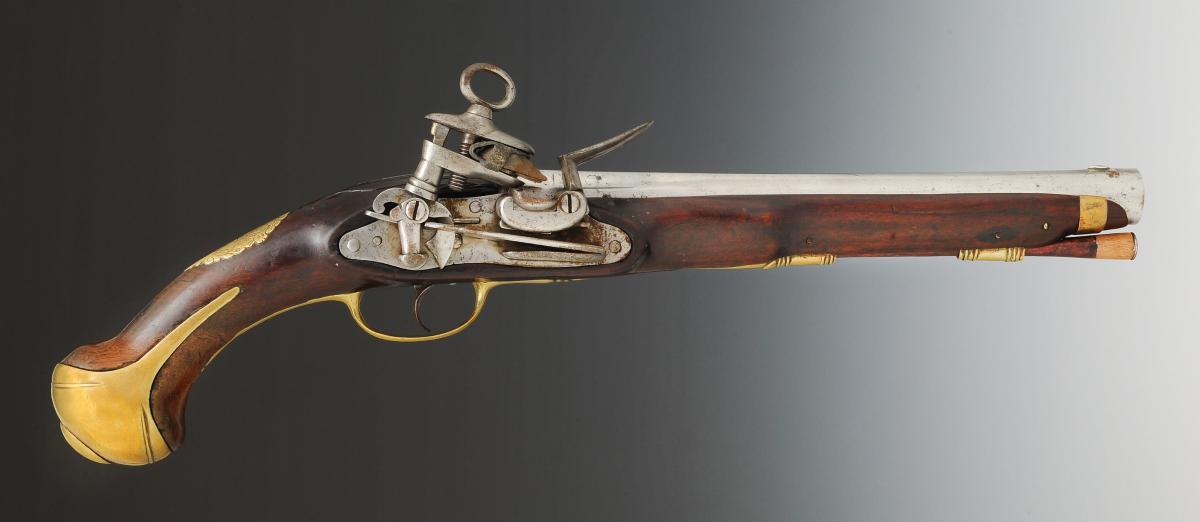
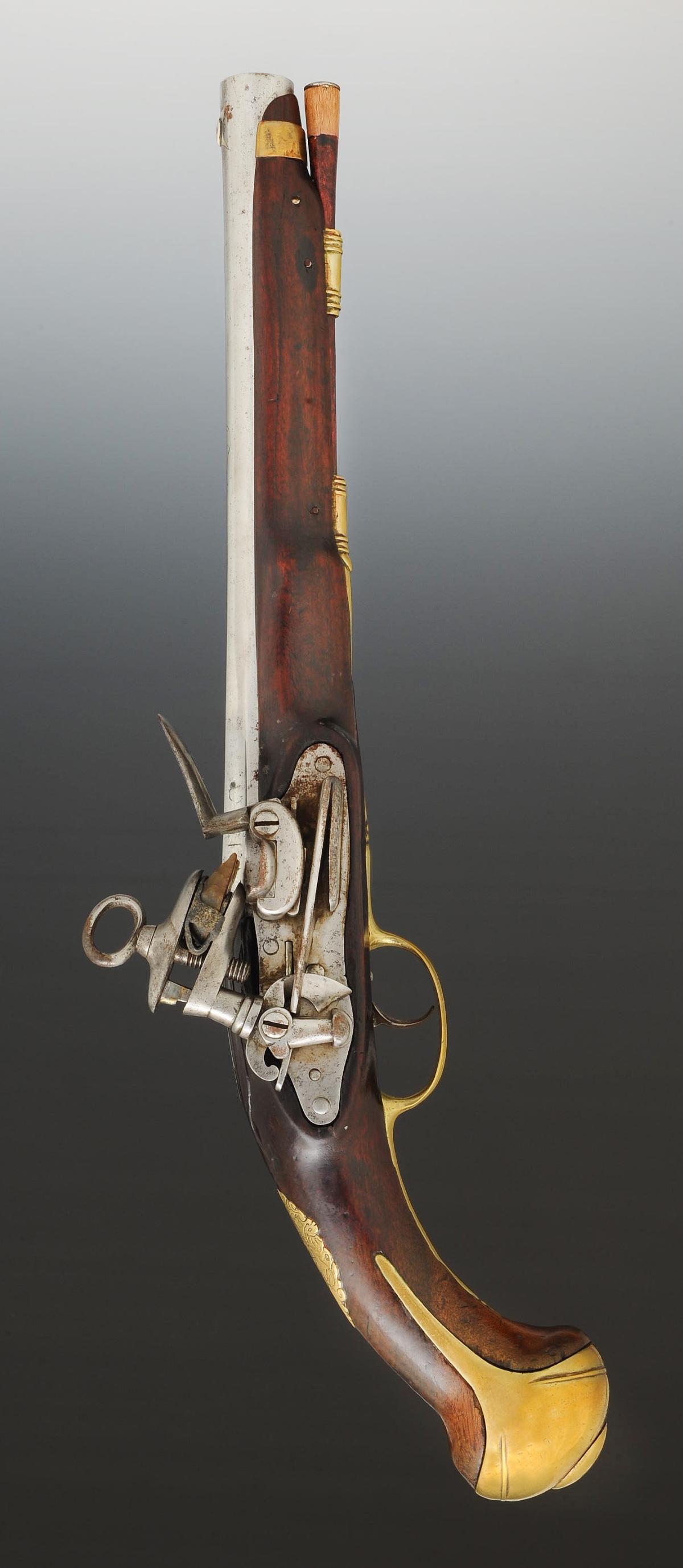
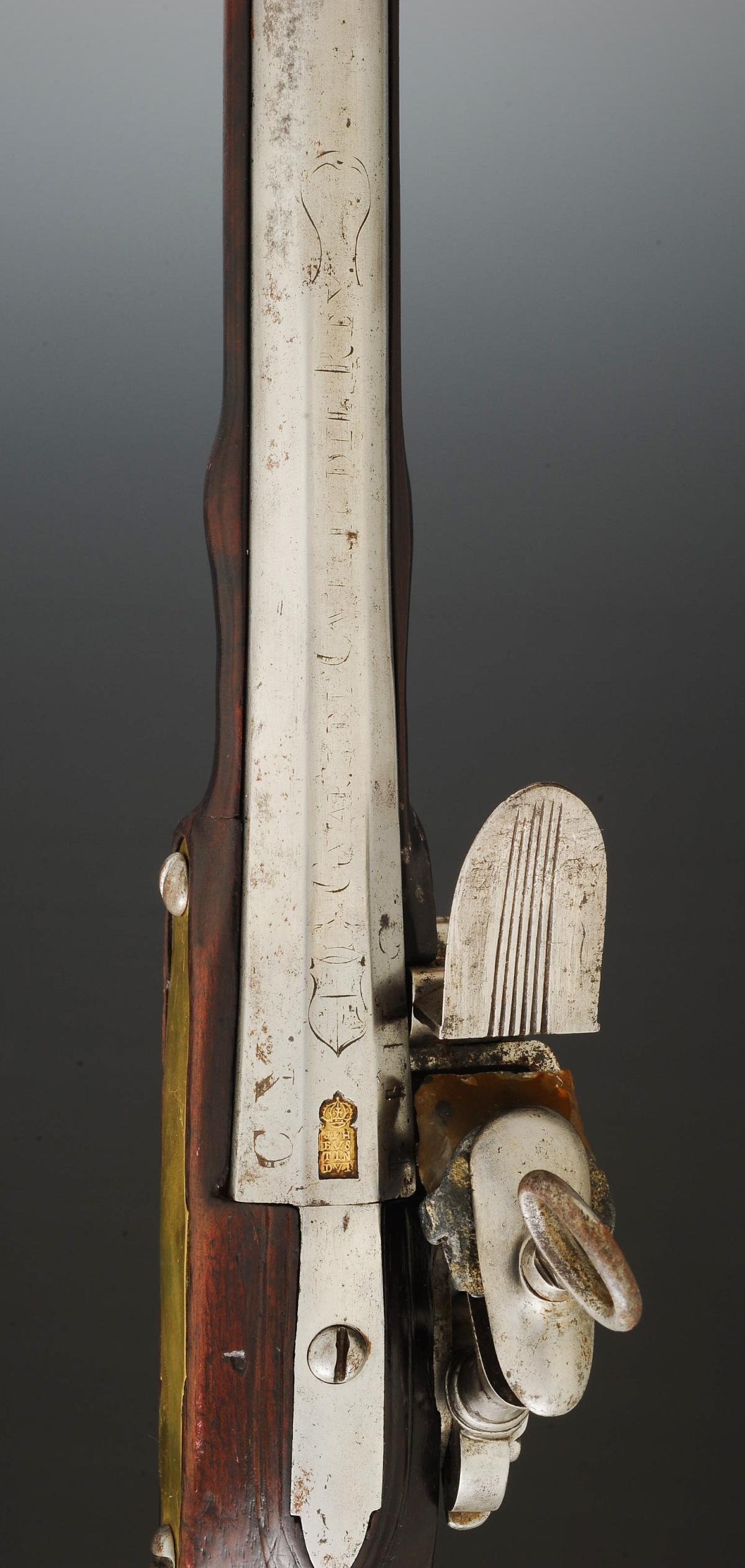
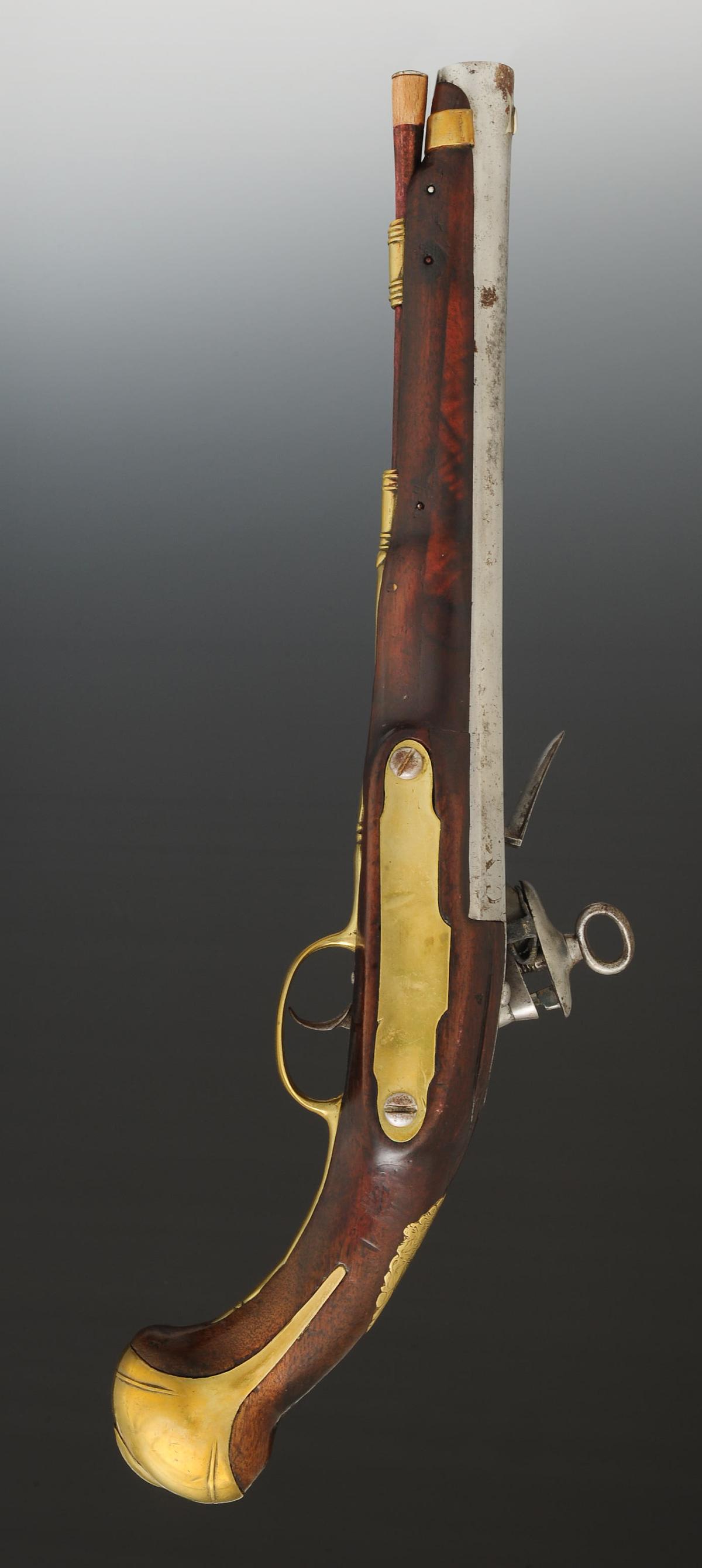
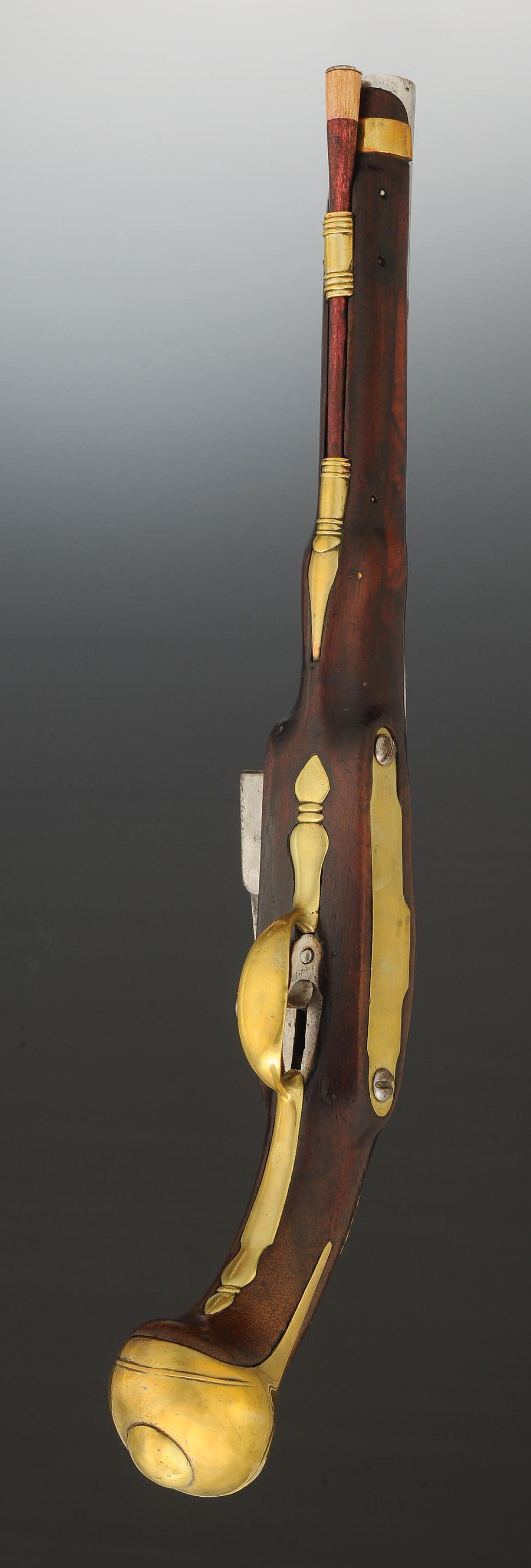
OFFICER'S ARGON PISTOL OF THE KING OF SPAIN'S GUARDS OF THE BODY, model of 1789. Late 18th century, reign of Charles IV. 34591
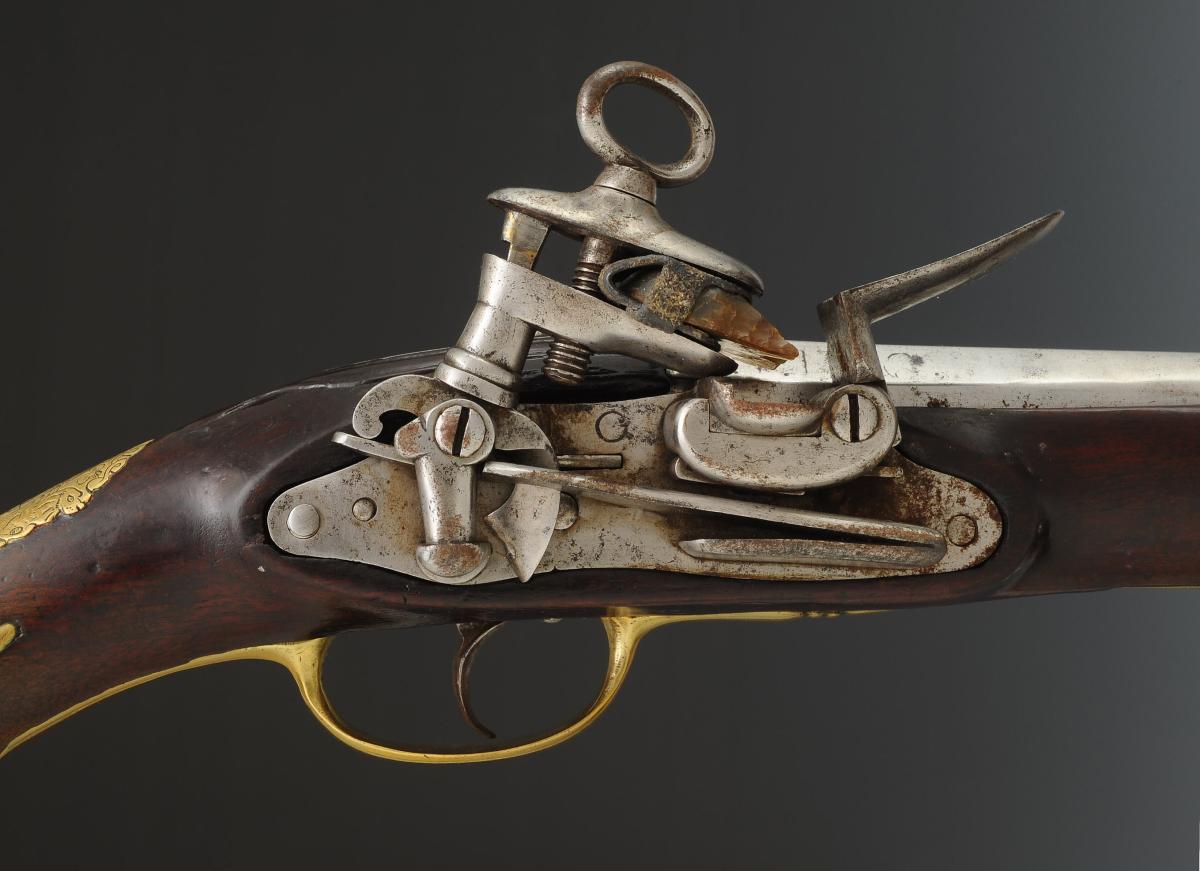
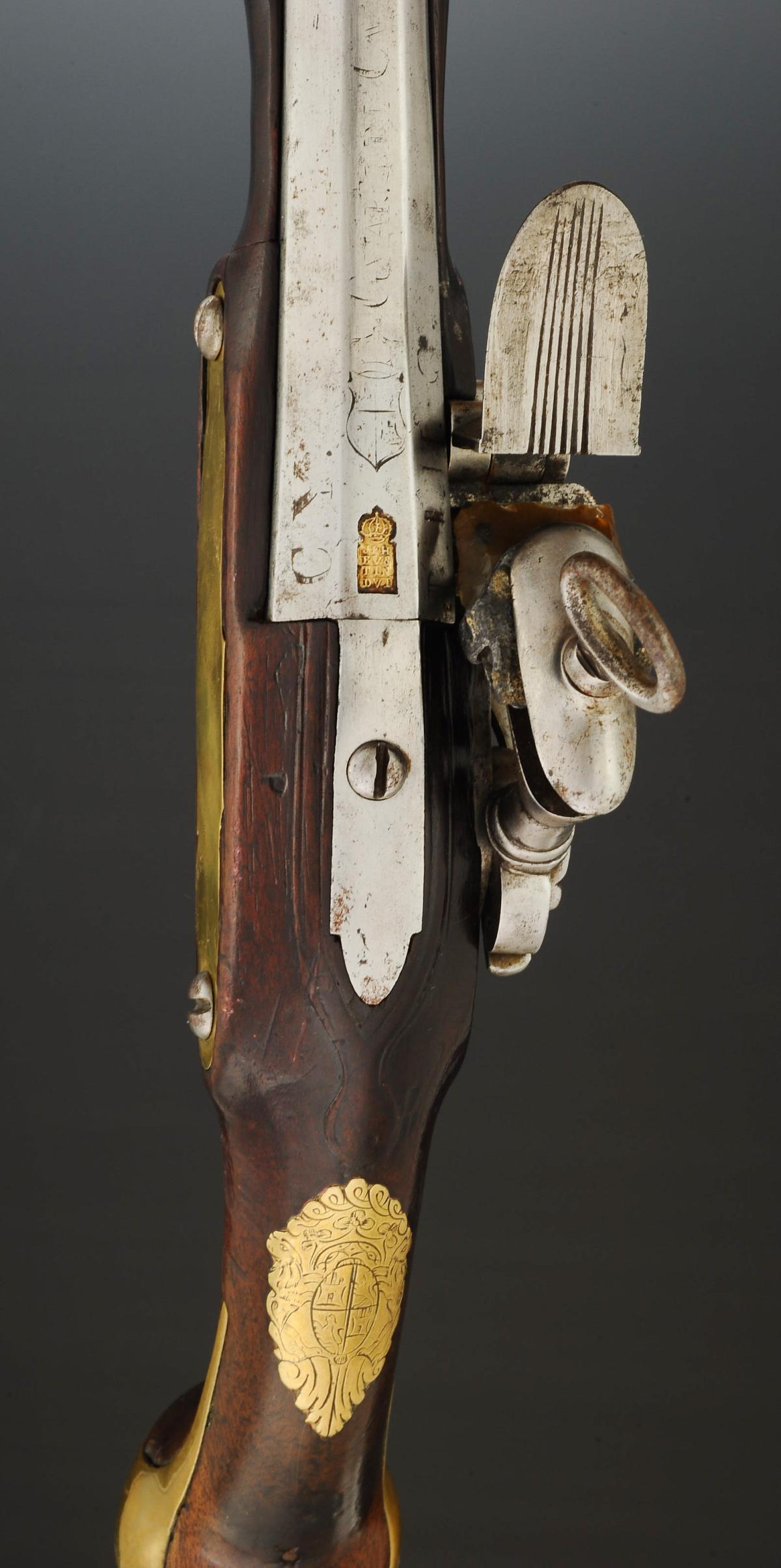
Walnut stock with polished brass fittings. The thumb piece is adorned with the coat of arms of Spain. The barrel with silver front sight is marked on top with the same coat of arms and "GVARDa DEL CVERPO DEL REY" (somewhat faded but still very legible). The touch hole bears the crowned and gilded coat of arms of the controller Juan Esteban de Bustinduy of Eibar. The oblique sides feature engravings "CY" and "PIN." The underside is dated 1789. Functional Spanish-style lock with original flint, marked inside with the controller's coat of arms of Juan Batista de Andonegui. Total length 45 cm; barrel length 27.2 cm; caliber 18 mm.
Spain.
Late 18th century, reign of Charles IV.
Good condition, the left side of the stock has been repaired in the period for 21 cm and the ramrod is modern.
PROVENANCE:
Former PM collection.
NOTE:
Manufacturing Specificities of the Model 1789: The Transition Lock: The 1789 model uses the famous high-quality Spanish miquelet lock (llave de patilla), very reliable and robust. Royal Brass Fittings: The fittings (decorative trigger guard, ear-shaped cap with fleur-de-lis or royal monogram) are made of solid brass, a material resistant to oxidation and offering the required golden shine for royal parades. Control Marks: Manufactured under the strict control of royal verifiers (like Sebastián de Sarria in Placencia), the barrels and locks received proof marks, the royal crown and the unit's inscription.
Juan Esteban de Bustinduy (or Bustindui) is considered by historians of armory as one of the greatest Spanish master gunsmiths and cannon makers of the late 18th and early 19th centuries. His name is closely associated with the excellence of the Eibar manufacture and the supply of luxury weapons for the Real Armería and the Royal Household (Casa Real), particularly under the reigns of Charles III, Charles IV, and Ferdinand VII.
His father, Agustín de Bustinduy, was a renowned master cannon maker and deputy of the armorer's guild in Eibar. His brother, José Joaquín de Bustinduy, also acted as a controller for the Reales Fábricas de Placencia between 1791 and 1797. Juan Esteban de Bustinduy, a royal arms controller, was quickly recognized as an unrivaled master in cannon forging.
Cited by Jovellanos (1796): The Spanish writer, jurist, and statesman Gaspar Melchor de Jovellanos, visiting Eibar in 1796, explicitly mentions Juan Esteban de Bustinduy in his famous Diaries as one of the most remarkable artist-gunsmiths in the region, commissioned by the nobility and the state for high-ranking hunting and officer's pistols.
His exceptional pieces are displayed in the Royal Armory Museum of Madrid. It was also his workshop that was tasked with crafting the precious pistol offered to the future King Ferdinand VII by the province of Guipúzcoa. His reputation and social standing in Eibar were significant, being elected Mayor of Eibar (Alcalde) in 1793 and representing the city at the General Assemblies (Juntas Generales) of the province. His family palace in Eibar (Palacio de Juan Estebanenekoa) was one of the notable buildings in the city.
The troop pistols of the Guardias de Corps were subject to regular military controllers like Sebastián de Sarria, while officer's argon pistols often benefitted from barrels forged or inspected by the most prestigious masters of the guild like Juan Esteban de Bustinduy.
Juan Bautista de Andonegui (or Andonaegui) is another prominent figure from the prestigious lineage of master gunsmiths and royal controllers in the Deba Valley (Placencia/Eibar) in the late 18th century. The surname Andonegui has deep historical roots in the province of Guipuscoa (mainly between Eibar, Elgoibar, and Placencia), a true cradle of Spanish gun metallurgy. Like his colleagues Juan Esteban de Bustinduy and Sebastián de Sarria, Juan Bautista de Andonegui followed the strict corporative path of Basque gunsmiths: learning iron forging, passing the guild council exam, and eventually becoming a Master Gunsmith.
During the 1780s-1800s (under the reigns of Charles III and Charles IV), Juan Bautista de Andonegui held the official position of royal controller at the Reales Fábricas de Armas. He was responsible for testing the gunpowder resistance and ensuring the compliance of handguns destined for elite regiments, notably the Guardias de Corps, model 1789. His hollow stamp is usually struck on the barrel's touch hole, in the form of the name ANDONEGUI or the initials JBA topped with a crown or cartridge.
HISTORICAL CONTEXT:
The Royal Body of Guards of Corps during the reign of Charles IV (Carlos IV) epitomized the pinnacle of military prestige, luxury, and discipline within the Spanish Royal Household.
Established in 1704 by Philip V (following the model of his grandfather Louis XIV's Guard of Corps), this elite cavalry corps provided close protection to the monarch, the royal family, and royal palaces (Madrid, Aranjuez, El Escorial, La Granja). To enter under Charles IV, one had to be of noble descent or hidalgo status (or prove "pure blood"), stand at least 1.70 m tall, present excellently, and demonstrate combat and riding skills. The corps was structured into national companies (Spanish, Italian, Flemish, and later American) under the direct command of captain generals or Spanish grandees.
In December 1788, Charles IV ascended to the Spanish throne. The year 1789 witnessed not only his coronation in Madrid but also the outbreak of the French Revolution in Paris.
During the War of Roussillon (1793-1795), several protection detachments accompanied the commanders-in-chief and the King.
During the Aranjuez Uprising (1808), it was the Guards of Corps who surrounded the royal palace of Aranjuez when the people and supporters of the Prince of Asturias (future Ferdinand VII) overthrew Minister Manuel Godoy, leading to the abdication of Charles IV.
In response to revolutionary threats, the Spanish Crown bolstered the sovereign's security. The Royal Household commissioned the royal Basque manufactories (especially Placencia and Eibar) to renew the sidearms for the mounted guard, resulting in the Model 1789.
The year 1789 marked a significant step in the modernization of their light armament, symbolized by the introduction of the famous Pistola para Guardias de Corps Modelo 1789.
Price :
3 000,00 €
| Destination | Envoi recommandé | Envoi Recommandé + Express |
|---|---|---|
| Shipping France | 14,00 € | 50,00 € |
| Shipping Europe | 20,00 € | 60,00 € |
| Shipping world | 44,00 € | 100,00 € |
Insurance (1%) :
30,00 €
Reference :
34591
Next update Friday, november 6 at 13:30 PM
FOR ALL PURCHASES, PAYMENT IN MULTIPLE CHECKS POSSIBLE
bertrand.malvaux@wanadoo.fr 06 07 75 74 63
SHIPPING COSTS
Shipping costs are calculated only once per order for one or more items, all shipments are sent via registered mail, as this is the only way to have proof of dispatch and receipt.
For parcels whose value cannot be insured by the Post, shipments are entrusted to DHL or Fedex with real value insured, the service is of high quality but the cost is higher.
RETURN POLICY
Items can be returned within 8 days of receipt. They must be returned by registered mail at the sender's expense, in their original packaging, and in their original condition.
AUTHENTICITY
The selection of items offered on this site allows me to guarantee the authenticity of each piece described here, all items offered are guaranteed to be period and authentic, unless otherwise noted or restricted in the description.
An authenticity certificate of the item including the description published on the site, the period, the sale price, accompanied by one or more color photographs is automatically provided for any item priced over 130 euros. Below this price, each certificate is charged 5 euros.
Only items sold by me are subject to an authenticity certificate, I do not provide any expert reports for items sold by third parties (colleagues or collectors).
FOR ALL PURCHASES, PAYMENT IN MULTIPLE CHECKS POSSIBLE
bertrand.malvaux@wanadoo.fr 06 07 75 74 63
An authenticity certificate of the item including the description published on the site, the period, the sale price, accompanied by one or more color photographs is automatically provided for any item priced over 130 euros. Below this price, each certificate is charged 5 euros.
Only items sold by me are subject to an authenticity certificate, I do not provide any expert reports for items sold by third parties (colleagues or collectors).