
COLUMN HEAD SWORD OF THE MILITARY AEROSTIERS CORPS, Directory - Consulate, from 1794 to 1799. 34585
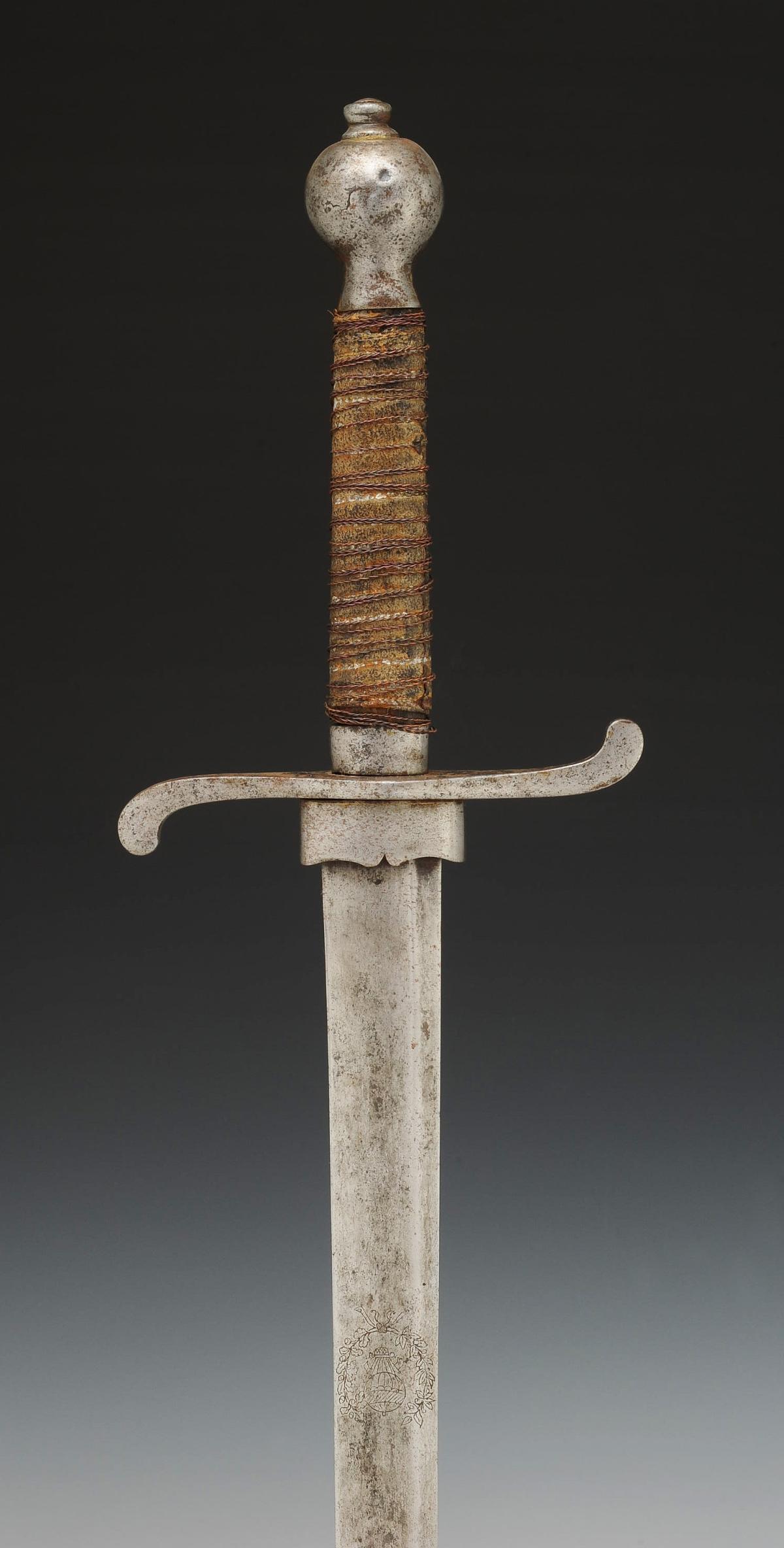
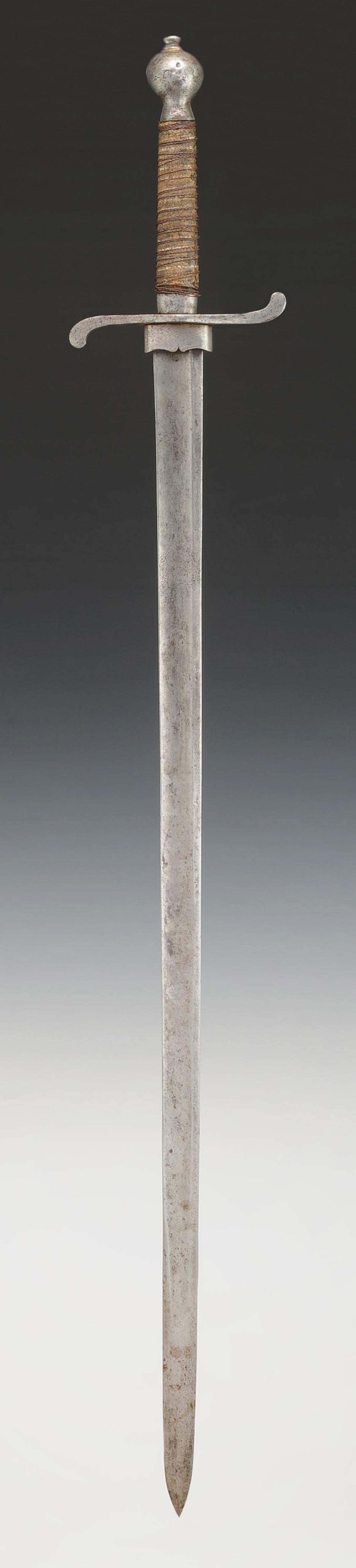
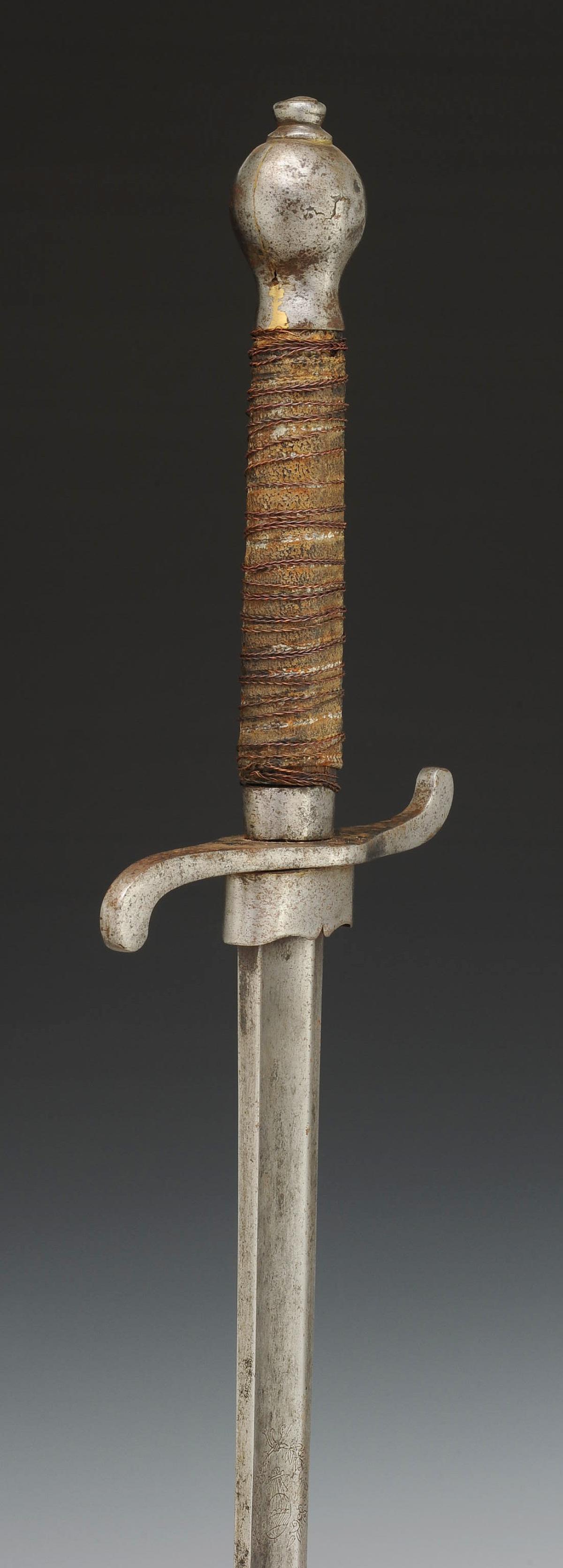

COLUMN HEAD SWORD OF THE MILITARY AEROSTIERS CORPS, Directory - Consulate, from 1794 to 1799. 34585
Iron hilt. Pommel guard, cross-guard with cap cover, and long wooden and leather filigree copper handle, iron ferrule, double inverted quillon. Straight special blade with back and hollow ground edges of 89 cm engraved 15 cm from the hilt and on the outside with the emblem of the engineering corps to which the aerostiers were attached: breastplate and liberty cap surrounded by oak and laurel. The interior side features the specific emblem of the corps: a balloon with basket also surrounded by oak and laurel.
France.
Directory - Consulate, from 1794 to 1799.
Very good condition, without scabbard.
PROVENANCE :
Ancienne collection PM.
NOTE:
Although lacking a drum major (only one drum per company) that could display this kind of ostentatious mark during parades, could the two created companies have been able to obtain one for an occasion that we are unaware of?
HISTORICAL BACKGROUND:
French military aerostiers, 1794-1799
The experience of French military aerostiers constitutes one of the world's first attempts to use an aircraft for military purposes. Their main mission at the time was reconnaissance and observation: stationed in a basket suspended from a captive balloon, observers could monitor enemy movements and transmit their observations to the ground army.
The corps was created in 1794 under the Convention, but its history continued throughout most of the Directory period before its abolition in 1799.
Origins: Why use a balloon in war?
The French Revolution occurred when ballooning was a very recent invention.
In 1783, the Montgolfier brothers carried out the first human ascensions in a balloon. Quickly, scientists began to consider military applications.
The idea was relatively simple: place an observer at a height to gain a much wider view of the battlefield.
The problem was that early balloons were difficult to control. The French therefore favored the captive balloon: the balloon remained tethered to the ground by ropes and could be raised to several hundred meters.
In this context, physicist Jean-Marie-Joseph Coutelle and chemist Nicolas-Jacques Conté played a crucial role in the birth of French military aeronautics. The experimental center was set up in Meudon, where work was done on hydrogen production and envelope construction.
1794: Birth of the military aerostiers
April 2, 1794 - creation of the first company
On 13 Germinal Year II (April 2, 1794), the Committee of Public Safety officially decided to create a company of aerostiers.
The text provided for a small specialized unit including:
1 captain;
1 sergeant-major;
1 sergeant;
2 corporals;
20 men.
Some of the men had to possess technical skills: masonry, carpentry, painting, chemistry, etc. This clearly shows that the aerostiers were not simply soldiers responsible for holding the balloon's ropes: they also had to be able to manufacture, inflate, and maintain the aerostat.
Captain Jean-Marie-Joseph Coutelle was entrusted with the command, while Nicolas-Jacques Conté directed the technical work in Meudon.
L'Entreprenant: the first French military balloon
The first balloon intended for military operations was named "L'Entreprenant."
It was a hydrogen balloon with a basket for observers.
However, its operation required significant ground infrastructure. It was necessary to produce large quantities of hydrogen, an operation that was long and technically complex.
This was one of the main limitations of military ballooning at that time: the balloon was very useful once in the air, but its movement and inflation were extremely cumbersome.
June 1794: Maubeuge, first military operations
The first company was sent to the Northern Army.
It arrived in Maubeuge, then besieged by Austrian forces.
On June 2, 1794, Coutelle ascended with L'Entreprenant. The balloon allowed for observing enemy positions from the air.
This was a major innovation: for the first time, an army had an observation post several hundred meters above the battlefield.
The balloon was also used during operations around Charleroi.
June 26, 1794: the Battle of Fleurus
This is the most famous episode in the history of the early aerostiers. On June 26, 1794, the French army faced the Austrian-Dutch forces commanded by Prince de Cobourg.
L'Entreprenant was placed above the battlefield.
Coutelle and his observers could monitor the enemy army's movements from the basket. Information was transmitted to the French troops through messages and signals.
The episode quickly became famous in the French army and was a spectacular demonstration of the balloon's military potential.
However, it is essential to be cautious with a frequently repeated idea: the balloon did not, by itself, "win" the Battle of Fleurus. Its value mainly lay in the new ability to observe the enemy's disposition.
June 1794: creation of a second company
The initial results were deemed interesting enough to warrant the expansion of the corps.
A second company of aerostiers was created at the end of June 1794.
The French system now relied on two components:
In the field:
the aerostier companies;
the captive balloons;
the observers;
the teams responsible for hydrogen production.
In Meudon:
manufacturing of the balloons;
technical research;
training of aerostiers.
October 1794: the Meudon Aeronautics School
On October 31, 1794 (10 Brumaire Year III), the National Aeronautics School of Meudon was established.
It was headed by Nicolas-Jacques Conté.
This was a significant moment: aeronautics became an organized military specialty.
The school's goals included:
training future aerostiers;
improving balloon construction techniques;
enhancing hydrogen production;
experimenting with new models;
providing balloons to operational companies.
Several aerostats were built in Meudon, including:
L'Entreprenant - Le Vétéran - Le Précurseur - Le Svelte - Le Télémaque - L'Hercule - L'Intrépide.
1795: the aerostiers during the Directory
In 1795, the Convention gave way to the Directory.
The experience of the aerostiers was maintained.
The first company continued its operations with the French armies, notably on the Rhine front.
Balloons were used in sieges and observation operations, particularly around Mainz, Bonn, Koblenz, and Ehrenbreitstein.
However, a fundamental difficulty began to emerge:
The balloon was very effective in a relatively static war but was much less suitable for a rapidly moving army.
To deploy a balloon, it was necessary to transport:
the envelope;
the basket;
the ropes;
the equipment;
the materials needed for hydrogen production;
and sometimes construct a specific furnace for this purpose.
This logistical burden significantly limited the use of aerostiers.
1796: the Wurtzbourg catastrophe
The year 1796 marked a turning point.
The aerostiers accompanied the French armies in operations in Germany.
During the Battle of Wurtzbourg, the company was captured by Austrian forces along with their equipment.
The balloon L'Intrépide thus fell into the hands of the Austrians.
It was later kept in Vienna and remains an exceptional testimony to this early military ballooning.
This capture also showed the vulnerability of the system: the equipment was bulky and difficult to evacuate quickly.
1797: return from captivity
After the 1797 Treaty of Leoben, the members of the first company were released.
Coutelle resumed his command.
However, the German experience had reinforced criticisms against the military use of balloons.
Some generals believed the aerostiers were too immobile and that the advantages gained did not outweigh the complexity of their implementation. Historical studies highlight reservations expressed by Hoche and Jourdan.
1798: the Egypt expedition
This was one of the last major attempts of the revolutionary military ballooning.
When Bonaparte prepared the Egypt expedition, Coutelle and Conté proposed the idea of including aerostiers.
Bonaparte agreed.
A company of aerostiers therefore took part in the expedition.
The project was ambitious: the French hoped to use their scientific and technical skills in Egypt.
However, the fate of French military aeronautics would be sealed by the naval Battle of Aboukir on August 1, 1798.
Aeronautical equipment was aboard the Patriote. The ship was destroyed, and the equipment intended for the balloons was lost.
The company thus found themselves in Egypt without their operational aeronautical equipment.
Nevertheless, the men were not useless: their technical skills were utilized for various endeavors of the expedition, particularly in constructing and maintaining machinery, workshops, and equipment.
1799: the end of the military aerostiers
The Directory eventually put an end to the experiment.
A clarification is needed here since sources sometimes provide different dates for the dissolution.
Historical sources and works dedicated to the corps converge on a Directory decree dated January 28, 1799 (9 Pluviôse Year VII) abolishing the Meudon school and disbanding the two companies.
Other publications mention January 15, February 17, or June 28, 1799, probably due to differences between the political decision, its administrative implementation, and the effective end of certain functions. Thus, for a rigorous historical chronology, it is preferable to consider January 28, 1799, as the date of the termination decree.
Organized French military aeronautics then practically vanished.
The failure was not due to the balloon being useless. On the contrary, aerial observation worked. The main challenges were operational:
- Hydrogen production was a major issue. Inflating a large balloon required producing a considerable amount of hydrogen, necessitating specific installations and a lot of time.
- Mobility. A revolutionary army gradually became a mobile army, whereas a captive balloon had to be: transported; inflated; maintained; protected; and eventually deflated or moved.
The system was therefore hardly compatible with rapid progress.
- Vulnerability; a visible balloon in the sky was an obvious target. The enemy could attempt to shoot the balloon down or capture the ground team.
- Weather; wind and atmospheric conditions severely limited observation opportunities.
- Information transmission. While the observer could see much, efficiently relaying information to the command was necessary. The aerostiers thus experimented with various communication systems: written messages, signals, pennants, and other communication methods.
Price :
1 200,00 €
| Destination | Envoi recommandé | Envoi Recommandé + Express |
|---|---|---|
| Shipping France | 20,00 € | 80,00 € |
| Shipping Europe | 33,00 € | 200,00 € |
| Shipping world | 100,00 € | 300,00 € |
Insurance (1%) :
12,00 €
Reference :
34585
Next update Friday, octobre 30 at 13:30 PM
FOR ALL PURCHASES, PAYMENT IN MULTIPLE CHECKS POSSIBLE
bertrand.malvaux@wanadoo.fr 06 07 75 74 63
SHIPPING COSTS
Shipping costs are calculated only once per order for one or more items, all shipments are sent via registered mail, as this is the only way to have proof of dispatch and receipt.
For parcels whose value cannot be insured by the Post, shipments are entrusted to DHL or Fedex with real value insured, the service is of high quality but the cost is higher.
RETURN POLICY
Items can be returned within 8 days of receipt. They must be returned by registered mail at the sender's expense, in their original packaging, and in their original condition.
AUTHENTICITY
The selection of items offered on this site allows me to guarantee the authenticity of each piece described here, all items offered are guaranteed to be period and authentic, unless otherwise noted or restricted in the description.
An authenticity certificate of the item including the description published on the site, the period, the sale price, accompanied by one or more color photographs is automatically provided for any item priced over 130 euros. Below this price, each certificate is charged 5 euros.
Only items sold by me are subject to an authenticity certificate, I do not provide any expert reports for items sold by third parties (colleagues or collectors).
FOR ALL PURCHASES, PAYMENT IN MULTIPLE CHECKS POSSIBLE
bertrand.malvaux@wanadoo.fr 06 07 75 74 63
An authenticity certificate of the item including the description published on the site, the period, the sale price, accompanied by one or more color photographs is automatically provided for any item priced over 130 euros. Below this price, each certificate is charged 5 euros.
Only items sold by me are subject to an authenticity certificate, I do not provide any expert reports for items sold by third parties (colleagues or collectors).