
Jean-François-Thérèse BARBIER (1753-1828), gouache of the 2nd Regiment of Chamborant Hussars, 1803, Consulate period. Inventory number: 33965.
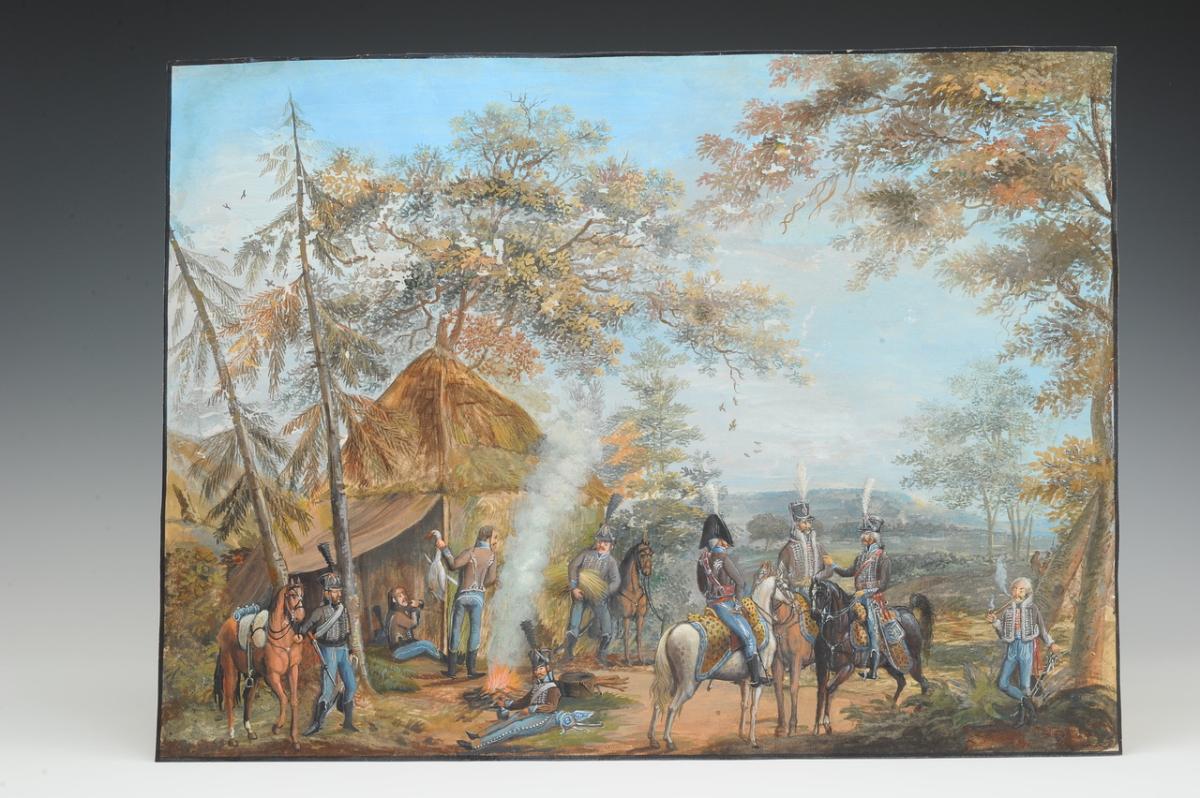

BARBIER Jean-François-Thérèse (1753-1828): GOUACHE OF THE 2nd REGIMENT OF HUSSARDS DE CHAMBORANT, 1803, Consulate. 33965
Original unsigned gouache depicting a camp scene of the 2nd regiment of hussards in 1803.
Dimensions: H 50 cm x W 70 cm.
France.
Consulate period (1803).
Very good condition, some minor losses.
HISTORICAL CONTEXT:
Colonel Barbier painted highly renowned gouaches when he was a first lieutenant at Chamborant (1793) and later as a colonel (1803). They provide very precise details on the equipment of the hussars of his time.
These gouaches have been the subject of a publication that can be found at the National Library of France on the Gallica digital archives website: "Hussards" by Jean and Raoul Brunon.
Some gouaches have been lost, so there are gaps in certain regiments. Your webmaster regularly uses the famous bivouac gouache from the eve of Austerlitz around the time of the 2nd regiment, when Colonel Barbier was in command. The regiment charged ten times and thus earned its first inscription in the silk of its standard.
BIOGRAPHY:
Jean-François-Thérèse Barbier, born on January 20, 1753 in Strasbourg and died in the same city on May 6, 1828, was a French general of the First Empire and a painter.
He was a student when he entered military service on February 13, 1772, as a second lieutenant in the Chamborant Hussar regiment, later becoming the 2nd Hussar regiment. He was promoted to first lieutenant on February 1, 1785, and to captain on January 15, 1792, serving with distinction in the campaigns of the Revolution in 1792 and 1793 with the Army of the North. His valor on the battlefield led to rapid promotions, and he was appointed squadron leader on November 5, 1792.
Appointed brigade chief on May 15, 1793, he took command of the 2nd Hussars when Colonel Frégéville was promoted to general. Despite being dismissed and tried before the criminal tribunal of the Army of the North, he was acquitted and reinstated in his position by Representative Laurent on February 10, 1794. He only left the command of his regiment from November 1793 to February 1794.
He participated in all the campaigns of the Revolution and his bravery never faltered. From the Armies of the North, 1793-1796, to Sambre and Meuse, 1796-1797, to Germany, 1797, he distinguished himself in the Rhine Army from 1798 to 1800. Brigade Chief Barbier was with the Rhine Army under Bernadotte from 1799 when the 2nd Hussars were ordered to go to Belgium. The Peace of Lunéville (February 9, 1801) found them stationed in Ghent, Antwerp, and on Cadzand Island; from the end of 1801, the regiment was distributed between Ghent, Mechelen, and Breda. In 1802, he was deployed in the army of Hanover under Bernadotte. His good service was rewarded on January 24, 1804, with the Legion of Honor, and on June 15 of the same year, he was made an officer of the order.
He distinguished himself in front of the Emperor at Austerlitz, where he was hit in the neck by a biscaïen on December 2, 1805, leading to his appointment as a commander of the Legion of Honor on December 25, 1805. He then participated in the campaign in Prussia in 1806 and was promoted to general of brigade on October 7, 1806, to take command of a second-line position. Created a baron of the Empire in 1808, he was given a grant in the Trasimène department but, due to his age and fatigue, he was subsequently employed in the command of garrisons. Admitted to non-activity status on September 1, 1814, and viewed unfavorably by the French Restoration for suspected Bonapartism, he was retired by order on November 25, 1818. he retired to his beloved city of Strasbourg where he was held in high esteem by the public and died on May 6, 1828, at his home at 5 Rue de la Nuée-Bleue in Strasbourg.
Until 1822, he was the owner of the Oberkirch Castle in Molsheim (Bas-Rhin), which he inherited from his wife under the First Empire.
Colonel of the 2nd Hussars on May 15, 1793
General of Brigade on October 7, 1806
Commander of the Legion of Honor on December 25, 1804
Baron of the Empire on June 29, 1808
HUSSARDS Gouaches by General Baron Jean-François Thérèse BERBIER, painted in 1789 as a first lieutenant in the Hussar Regiment of Chamborant and in 1803 as a colonel commanding the 2nd Hussar Regiment.
Jean and Raoul Brunon. Marseille - 1966
YOUNG COLONELS. VETERAN LIEUTENANTS.
During the reigns of Louis XV and Louis XVI, the foreign regiments had a large number of officers born outside of France; many of them had served, sometimes in the French ranks, sometimes in the troops of other nations, and often as enemies.
As the latest arrival among the regiments of France, the Hungarian officers who served in the hussars enjoyed a privileged trend, a trend that was shared by other German-speaking foreign regiments besides the hussars.
This trend originated from the Court, and Queen Marie-Antoinette was partially the inspiration behind this enthusiasm: many of the names borne by these officers were already familiar to her when, as an archduchess, she was at the Court of Vienna.
As officers of the King, the sense of duty of these foreign officers was primarily dominated by the royal idea, and this may explain the determination to emigrate that most of them took in 1792, leading to the departure of many of their soldiers.
BARBIER'S GOUACHES.
FIRST LIEUTENANT IN CHAMBORANT IN 1789.
COLONEL OF THE 2nd HUSSAR REGIMENT FROM 1793 TO 1806.
"Noblesse oblige, Chamborant autant," the old motto of the Chamborant Hussar Regiment has endured to this day. While even now, proudly being part of the Berchény or Esterhazy Regiments, the 1st and 2nd of the arm, it is only in Chamborant that the tradition has persisted of presenting oneself as: - "Chamborant, a certain name!"
After 1791, the 2nd Hussar Regiment has always retained its old name, both in the wars of the Republic and the Empire, as well as in the campaigns in Africa, during the Terrible Year, and the two World Wars.
However, before adopting the name that has remained, the hussars of Chamborant had illustrious experiences with other names. The regiment was created in 1735 by Count Esterhazy, a descendant of an ancient family of Hungarian magnates who sought refuge in France at the beginning of the 17th century - a branch of this family still exists in Austria, while another exists in France. The regiment became the Turpin-Hussars in 1747 and was renamed Chamborant in 1761.
Born in Strasbourg on January 20, 1753, Jean-François-Thérèse Barbier was a student when he joined the regiment as a second lieutenant on February 13, 1773; promoted to first lieutenant on March 11, 1781, he was appointed first lieutenant on February 1, 1785, captain on January 15, 1792, and squadron leader on November 5, 1792.
Appointed as brigade chief on May 15, 1793, he took command of the 2nd Hussars at the time when Colonel Frégeville was promoted to Brigadier General. Dismissed and tried before the criminal tribunal of the Army of the North, and then acquitted, he did not leave the command of his regiment except from November 1793 to February 1794.
From the Armies of the North, 1793-1796, to Sambre and Meuse, 1796-1797, to Germany, 1797, Brigade Chief Barbier was with the Rhine Armies under Bernadotte since 1799 when the 2nd Hussars were ordered to go to Belgium.
The Peace of Lunéville (February 9, 1801) found them stationed in Ghent, Antwerp, and on Cadzand Island; from the end of 1801, the regiment was distributed between Ghent, Mechelen, and Breda. Then they departed for Hanover at the beginning of May 1803.
It was at this time that Colonel Barbier executed the watercolor that we reproduce on the sixth plate. The date is all the more certain as Major Charles-Etienne de Ghigny was promoted to the 1st Hussars on the 6th of Brumaire, year XII (October 29, 1803), and is depicted on this gouache.
After remaining at the head of the 2nd Hussars for fourteen years, Barbier was promoted to general of brigade on October 7, 1806, and then obtained the title of Baron of the Empire on March 17, 1808. General Barbier died in Strasbourg on May 6, 1825. It was to Rugendas the father that the most accurate representations of hussar types from the end of the 16th century are owed.
While in Baden in 1946, a series of engravings were discovered in the hall of the Bühler Hôtel, deep within the Baden Forest, as part of a suite published by Rugendas around 1704 and dedicated by this artist to scenes from the wars of the League of Augsburg and the Spanish Succession, at least in the early stages of the latter. These were photographed with great eagerness as almost all depicted hussars in action, a document of great truth showing this troop as it was under Louis XIV.
Their uniform - if one can accept calling their attire by that name - their equipment, and harness were equally valid for the hussars in foreign service as well as for the hussars in the service of France. The only visible distinction was, for the latter, the fleur-de-lis adorning the rear corners of their pointed saddlecloths: to avoid being identified, it was sufficient to lift and fix these points.
The present collection, to which we have simply given the title: "Hussards," naturally does not aim to trace, even briefly, the history of the hussars, or to provide a description of their successive uniforms. By reading the preceding paragraphs, one can see that we have limited ourselves to writing brief notes on selected subjects; their purpose is to accompany Barbier's gouaches.
These gouaches, with such pleasant execution, so well marked with their time, are unpublished. The first five were executed by Barbier when he served as a first lieutenant in the Chamborant Hussar Regiment. We ourselves have dated them to the year 1789 because it is the most likely and corresponds to the details revealed by the examination of each gouache and the contemporary designations noted in ink on the back of three of them.
At this time, all the hussar regiments were deployed along the eastern borders, from Rocroy to Haguenau, with one of them positioned as an outpost in Landau, i.e., from left to right: Esterhazy (5th Regiment) (8th at Rocroy; Berchény (2nd) in Charleville; Lauzun (6th) in Verdun; Colonel General (1st) in Metz; Saxe (4th) in Haguenau; Chamborant (5th) in Landau. It is worth noting that the hussars of the early years portrayed by Rugendas on the spot.
We owe to the talent of Lieutenant Barbier the most excellent representations of hussars from the last years of the Old Monarchy. Thus, about a hundred years apart, the works of each of these artists lead us to make this connection.
Acquired about forty years ago, curiously, these gouaches by Barbier have two distinct provenances. Those representing hussars from the Berchény, Chamborant, Saxe-Conflans, and Lauzun Regiments were purchased in Paris, and we acquired the gouache representing a hussar from the Colonel-General Regiment in Nancy, which undoubtedly belongs to the same series. Each bears on the back a library monogram seeming to date from the last century but unfortunately indecipherable.
As seen, the hussar from the Esterhazy Regiment is missing from the lineup, which is a pity: it is hoped that this publication will help uncover this gouache! It is unnecessary to insist on the perfection of such documents, all of equal value, as the attention to detail, however insignificant, does not detract from the talent shown by the painter. Furthermore, a careful examination of each gouache reveals the soldier-artist's sure knowledge, who himself wore these uniforms, belted on their hussar belts, and packed these harnesses: from the shako to the arrangement of the hair, from the button connecting the giberne band to the musket-holder band, this button placed near the shoulder; the sash-belt tied low on the loins; the very long rolled cloak, its ends left pointed instead of folded; the sabretache worn short: everything is faithfully and precisely observed, details accentuating the interest of these small paintings embellished with lively and colorful scenes in the background.
Each of these hussars wears the 1786 standard uniform with slight variations, such as the skyblue facings of the dolman, not scarlet as in the hussar of Chamborant, and the coat trimmings of the hussars of the Colonel General, Saxe, and Lauzun, whose galons match the color of the braids. Reproduced in the dimensions of the originals, we will only mention certain details:
- Except for the Colonel General, Saxe, and Lauzun, whose sabretaches bear the crowned cipher of the King, namely the intertwined LL, Berchény and Chamborant have their sabretaches adorned with the same monogram, but superimposed with the letter R.
- Except for the Colonel General, who has a shamrock on his breeches in loops, the openings of the breeches flap of the other four hussars are bordered by an inverted spear.
- All the hussars are depicted with a montoir-side view; only the hussar of Chamborant turns his head in such a way that the recently displayed tricolor cockade, placed at the base of the plume, appears clearly.
- Berchény: the olive cord of the pelisse is a mixture of scarlet and white. Written in ink on the back of the gouache: "Perchini."
- Chamborant: The skyblue of the shako plume, the dolman facings, and the breeches are lighter than the skyblue of Berchény(7). The olive and cord of the pelisse are a mix of skyblue and white. There is no piping around the sabretache, which is simply bordered with ecru leather. The scallops of the saddlecloth, the piping of the coat, and the charge straps are black. Note the folded back saddlecloth for easier access to the pistols. The mustache is dark waxy black, which exemplifies the regulation stipulating that all hussars must wear a mustache hanging in a point, "dyed black or fake if necessary." Written in ink on the gouache's back: "Chamboran."
- Saxe: Similarly, the word "Saxe" is written on the back in the same hand.
- Lauzun: The skyblue shade is identical to that of Berchény. The same remark applies to the edge of the sabretache for that of Chamborant. On the back, in the same handwriting: * Lauzon ".
This hussar of Lauzun appears to be armed with a 1766 model musketon; this is logical, as the "hussar" musketon model 1786 likely had not yet been issued to the troops in 1789. Note the "water-colored" barrels of the musketons of Lauzun and Saxe (only the tip of the barrel of the latter's musketon is visible), as well as the pistols of the same color on the hussar of Chamborant.
We are aware of the existence of thirteen gouaches by Barbier; their dispersion leads us to imagine that others must still exist. In their enumeration, let's start with those that - temporarily, hopefully - have currently disappeared:
I. - Hussar of the 2nd Regiment, around 1803-1805, in dolman, pelisse on the shoulder, worn low, white horse walking to the right; musket An IX on the boot, worn over the right scabbard, the lower part of the stock therefore not touching the rider's thigh. In the background, a skirmish between hussars and infantry, a small painting of a similar nature to those adorning the gouaches we reproduce.
II. - Hussar of the 2nd Regiment, carrying the colonel's standard, 1803-1805. Similar to the same figure behind Colonel Barbier in the reproduced gouache on plate 6 of our collection. He is seen hors montoir, allowing us to see the absence of a musket, even though this hussar is wearing the musket-holder band over the giberne. The double-ended pennant is: 1 and 4 white, 2 and 3 skyblue. These two gouaches were in the Cottreau collection. What has become of them?
III. - Equestrian portrait of a captain of the 2nd Hussars, around 1803, with the inscription on the back: "Done in Ghent, Escaut department, in the month of thermidor An XI." This officer is portrayed in full dress, wearing the Legion of Honor cross on the unfastened pelisse held very low; this detail is insufficient to attempt to identify this captain among the eight in the 2nd Hussars in Year XI, who would all have worn a skyblue plume on their shakos for ordinary companies. Galloping, the horse is turned to the left; a large tree completes the scene; in the background, a cavalry combat is visible.
IV. - The Royal Museum of the Army in Brussels owns the portrait of Chief Squadron Ghigny, a
Original unsigned gouache depicting a camp scene of the 2nd regiment of hussards in 1803.
Dimensions: H 50 cm x W 70 cm.
France.
Consulate period (1803).
Very good condition, some minor losses.
HISTORICAL CONTEXT:
Colonel Barbier painted highly renowned gouaches when he was a first lieutenant at Chamborant (1793) and later as a colonel (1803). They provide very precise details on the equipment of the hussars of his time.
These gouaches have been the subject of a publication that can be found at the National Library of France on the Gallica digital archives website: "Hussards" by Jean and Raoul Brunon.
Some gouaches have been lost, so there are gaps in certain regiments. Your webmaster regularly uses the famous bivouac gouache from the eve of Austerlitz around the time of the 2nd regiment, when Colonel Barbier was in command. The regiment charged ten times and thus earned its first inscription in the silk of its standard.
BIOGRAPHY:
Jean-François-Thérèse Barbier, born on January 20, 1753 in Strasbourg and died in the same city on May 6, 1828, was a French general of the First Empire and a painter.
He was a student when he entered military service on February 13, 1772, as a second lieutenant in the Chamborant Hussar regiment, later becoming the 2nd Hussar regiment. He was promoted to first lieutenant on February 1, 1785, and to captain on January 15, 1792, serving with distinction in the campaigns of the Revolution in 1792 and 1793 with the Army of the North. His valor on the battlefield led to rapid promotions, and he was appointed squadron leader on November 5, 1792.
Appointed brigade chief on May 15, 1793, he took command of the 2nd Hussars when Colonel Frégéville was promoted to general. Despite being dismissed and tried before the criminal tribunal of the Army of the North, he was acquitted and reinstated in his position by Representative Laurent on February 10, 1794. He only left the command of his regiment from November 1793 to February 1794.
He participated in all the campaigns of the Revolution and his bravery never faltered. From the Armies of the North, 1793-1796, to Sambre and Meuse, 1796-1797, to Germany, 1797, he distinguished himself in the Rhine Army from 1798 to 1800. Brigade Chief Barbier was with the Rhine Army under Bernadotte from 1799 when the 2nd Hussars were ordered to go to Belgium. The Peace of Lunéville (February 9, 1801) found them stationed in Ghent, Antwerp, and on Cadzand Island; from the end of 1801, the regiment was distributed between Ghent, Mechelen, and Breda. In 1802, he was deployed in the army of Hanover under Bernadotte. His good service was rewarded on January 24, 1804, with the Legion of Honor, and on June 15 of the same year, he was made an officer of the order.
He distinguished himself in front of the Emperor at Austerlitz, where he was hit in the neck by a biscaïen on December 2, 1805, leading to his appointment as a commander of the Legion of Honor on December 25, 1805. He then participated in the campaign in Prussia in 1806 and was promoted to general of brigade on October 7, 1806, to take command of a second-line position. Created a baron of the Empire in 1808, he was given a grant in the Trasimène department but, due to his age and fatigue, he was subsequently employed in the command of garrisons. Admitted to non-activity status on September 1, 1814, and viewed unfavorably by the French Restoration for suspected Bonapartism, he was retired by order on November 25, 1818. he retired to his beloved city of Strasbourg where he was held in high esteem by the public and died on May 6, 1828, at his home at 5 Rue de la Nuée-Bleue in Strasbourg.
Until 1822, he was the owner of the Oberkirch Castle in Molsheim (Bas-Rhin), which he inherited from his wife under the First Empire.
Colonel of the 2nd Hussars on May 15, 1793
General of Brigade on October 7, 1806
Commander of the Legion of Honor on December 25, 1804
Baron of the Empire on June 29, 1808
HUSSARDS Gouaches by General Baron Jean-François Thérèse BERBIER, painted in 1789 as a first lieutenant in the Hussar Regiment of Chamborant and in 1803 as a colonel commanding the 2nd Hussar Regiment.
Jean and Raoul Brunon. Marseille - 1966
YOUNG COLONELS. VETERAN LIEUTENANTS.
During the reigns of Louis XV and Louis XVI, the foreign regiments had a large number of officers born outside of France; many of them had served, sometimes in the French ranks, sometimes in the troops of other nations, and often as enemies.
As the latest arrival among the regiments of France, the Hungarian officers who served in the hussars enjoyed a privileged trend, a trend that was shared by other German-speaking foreign regiments besides the hussars.
This trend originated from the Court, and Queen Marie-Antoinette was partially the inspiration behind this enthusiasm: many of the names borne by these officers were already familiar to her when, as an archduchess, she was at the Court of Vienna.
As officers of the King, the sense of duty of these foreign officers was primarily dominated by the royal idea, and this may explain the determination to emigrate that most of them took in 1792, leading to the departure of many of their soldiers.
BARBIER'S GOUACHES.
FIRST LIEUTENANT IN CHAMBORANT IN 1789.
COLONEL OF THE 2nd HUSSAR REGIMENT FROM 1793 TO 1806.
"Noblesse oblige, Chamborant autant," the old motto of the Chamborant Hussar Regiment has endured to this day. While even now, proudly being part of the Berchény or Esterhazy Regiments, the 1st and 2nd of the arm, it is only in Chamborant that the tradition has persisted of presenting oneself as: - "Chamborant, a certain name!"
After 1791, the 2nd Hussar Regiment has always retained its old name, both in the wars of the Republic and the Empire, as well as in the campaigns in Africa, during the Terrible Year, and the two World Wars.
However, before adopting the name that has remained, the hussars of Chamborant had illustrious experiences with other names. The regiment was created in 1735 by Count Esterhazy, a descendant of an ancient family of Hungarian magnates who sought refuge in France at the beginning of the 17th century - a branch of this family still exists in Austria, while another exists in France. The regiment became the Turpin-Hussars in 1747 and was renamed Chamborant in 1761.
Born in Strasbourg on January 20, 1753, Jean-François-Thérèse Barbier was a student when he joined the regiment as a second lieutenant on February 13, 1773; promoted to first lieutenant on March 11, 1781, he was appointed first lieutenant on February 1, 1785, captain on January 15, 1792, and squadron leader on November 5, 1792.
Appointed as brigade chief on May 15, 1793, he took command of the 2nd Hussars at the time when Colonel Frégeville was promoted to Brigadier General. Dismissed and tried before the criminal tribunal of the Army of the North, and then acquitted, he did not leave the command of his regiment except from November 1793 to February 1794.
From the Armies of the North, 1793-1796, to Sambre and Meuse, 1796-1797, to Germany, 1797, Brigade Chief Barbier was with the Rhine Armies under Bernadotte since 1799 when the 2nd Hussars were ordered to go to Belgium.
The Peace of Lunéville (February 9, 1801) found them stationed in Ghent, Antwerp, and on Cadzand Island; from the end of 1801, the regiment was distributed between Ghent, Mechelen, and Breda. Then they departed for Hanover at the beginning of May 1803.
It was at this time that Colonel Barbier executed the watercolor that we reproduce on the sixth plate. The date is all the more certain as Major Charles-Etienne de Ghigny was promoted to the 1st Hussars on the 6th of Brumaire, year XII (October 29, 1803), and is depicted on this gouache.
After remaining at the head of the 2nd Hussars for fourteen years, Barbier was promoted to general of brigade on October 7, 1806, and then obtained the title of Baron of the Empire on March 17, 1808. General Barbier died in Strasbourg on May 6, 1825. It was to Rugendas the father that the most accurate representations of hussar types from the end of the 16th century are owed.
While in Baden in 1946, a series of engravings were discovered in the hall of the Bühler Hôtel, deep within the Baden Forest, as part of a suite published by Rugendas around 1704 and dedicated by this artist to scenes from the wars of the League of Augsburg and the Spanish Succession, at least in the early stages of the latter. These were photographed with great eagerness as almost all depicted hussars in action, a document of great truth showing this troop as it was under Louis XIV.
Their uniform - if one can accept calling their attire by that name - their equipment, and harness were equally valid for the hussars in foreign service as well as for the hussars in the service of France. The only visible distinction was, for the latter, the fleur-de-lis adorning the rear corners of their pointed saddlecloths: to avoid being identified, it was sufficient to lift and fix these points.
The present collection, to which we have simply given the title: "Hussards," naturally does not aim to trace, even briefly, the history of the hussars, or to provide a description of their successive uniforms. By reading the preceding paragraphs, one can see that we have limited ourselves to writing brief notes on selected subjects; their purpose is to accompany Barbier's gouaches.
These gouaches, with such pleasant execution, so well marked with their time, are unpublished. The first five were executed by Barbier when he served as a first lieutenant in the Chamborant Hussar Regiment. We ourselves have dated them to the year 1789 because it is the most likely and corresponds to the details revealed by the examination of each gouache and the contemporary designations noted in ink on the back of three of them.
At this time, all the hussar regiments were deployed along the eastern borders, from Rocroy to Haguenau, with one of them positioned as an outpost in Landau, i.e., from left to right: Esterhazy (5th Regiment) (8th at Rocroy; Berchény (2nd) in Charleville; Lauzun (6th) in Verdun; Colonel General (1st) in Metz; Saxe (4th) in Haguenau; Chamborant (5th) in Landau. It is worth noting that the hussars of the early years portrayed by Rugendas on the spot.
We owe to the talent of Lieutenant Barbier the most excellent representations of hussars from the last years of the Old Monarchy. Thus, about a hundred years apart, the works of each of these artists lead us to make this connection.
Acquired about forty years ago, curiously, these gouaches by Barbier have two distinct provenances. Those representing hussars from the Berchény, Chamborant, Saxe-Conflans, and Lauzun Regiments were purchased in Paris, and we acquired the gouache representing a hussar from the Colonel-General Regiment in Nancy, which undoubtedly belongs to the same series. Each bears on the back a library monogram seeming to date from the last century but unfortunately indecipherable.
As seen, the hussar from the Esterhazy Regiment is missing from the lineup, which is a pity: it is hoped that this publication will help uncover this gouache! It is unnecessary to insist on the perfection of such documents, all of equal value, as the attention to detail, however insignificant, does not detract from the talent shown by the painter. Furthermore, a careful examination of each gouache reveals the soldier-artist's sure knowledge, who himself wore these uniforms, belted on their hussar belts, and packed these harnesses: from the shako to the arrangement of the hair, from the button connecting the giberne band to the musket-holder band, this button placed near the shoulder; the sash-belt tied low on the loins; the very long rolled cloak, its ends left pointed instead of folded; the sabretache worn short: everything is faithfully and precisely observed, details accentuating the interest of these small paintings embellished with lively and colorful scenes in the background.
Each of these hussars wears the 1786 standard uniform with slight variations, such as the skyblue facings of the dolman, not scarlet as in the hussar of Chamborant, and the coat trimmings of the hussars of the Colonel General, Saxe, and Lauzun, whose galons match the color of the braids. Reproduced in the dimensions of the originals, we will only mention certain details:
- Except for the Colonel General, Saxe, and Lauzun, whose sabretaches bear the crowned cipher of the King, namely the intertwined LL, Berchény and Chamborant have their sabretaches adorned with the same monogram, but superimposed with the letter R.
- Except for the Colonel General, who has a shamrock on his breeches in loops, the openings of the breeches flap of the other four hussars are bordered by an inverted spear.
- All the hussars are depicted with a montoir-side view; only the hussar of Chamborant turns his head in such a way that the recently displayed tricolor cockade, placed at the base of the plume, appears clearly.
- Berchény: the olive cord of the pelisse is a mixture of scarlet and white. Written in ink on the back of the gouache: "Perchini."
- Chamborant: The skyblue of the shako plume, the dolman facings, and the breeches are lighter than the skyblue of Berchény(7). The olive and cord of the pelisse are a mix of skyblue and white. There is no piping around the sabretache, which is simply bordered with ecru leather. The scallops of the saddlecloth, the piping of the coat, and the charge straps are black. Note the folded back saddlecloth for easier access to the pistols. The mustache is dark waxy black, which exemplifies the regulation stipulating that all hussars must wear a mustache hanging in a point, "dyed black or fake if necessary." Written in ink on the gouache's back: "Chamboran."
- Saxe: Similarly, the word "Saxe" is written on the back in the same hand.
- Lauzun: The skyblue shade is identical to that of Berchény. The same remark applies to the edge of the sabretache for that of Chamborant. On the back, in the same handwriting: * Lauzon ".
This hussar of Lauzun appears to be armed with a 1766 model musketon; this is logical, as the "hussar" musketon model 1786 likely had not yet been issued to the troops in 1789. Note the "water-colored" barrels of the musketons of Lauzun and Saxe (only the tip of the barrel of the latter's musketon is visible), as well as the pistols of the same color on the hussar of Chamborant.
We are aware of the existence of thirteen gouaches by Barbier; their dispersion leads us to imagine that others must still exist. In their enumeration, let's start with those that - temporarily, hopefully - have currently disappeared:
I. - Hussar of the 2nd Regiment, around 1803-1805, in dolman, pelisse on the shoulder, worn low, white horse walking to the right; musket An IX on the boot, worn over the right scabbard, the lower part of the stock therefore not touching the rider's thigh. In the background, a skirmish between hussars and infantry, a small painting of a similar nature to those adorning the gouaches we reproduce.
II. - Hussar of the 2nd Regiment, carrying the colonel's standard, 1803-1805. Similar to the same figure behind Colonel Barbier in the reproduced gouache on plate 6 of our collection. He is seen hors montoir, allowing us to see the absence of a musket, even though this hussar is wearing the musket-holder band over the giberne. The double-ended pennant is: 1 and 4 white, 2 and 3 skyblue. These two gouaches were in the Cottreau collection. What has become of them?
III. - Equestrian portrait of a captain of the 2nd Hussars, around 1803, with the inscription on the back: "Done in Ghent, Escaut department, in the month of thermidor An XI." This officer is portrayed in full dress, wearing the Legion of Honor cross on the unfastened pelisse held very low; this detail is insufficient to attempt to identify this captain among the eight in the 2nd Hussars in Year XI, who would all have worn a skyblue plume on their shakos for ordinary companies. Galloping, the horse is turned to the left; a large tree completes the scene; in the background, a cavalry combat is visible.
IV. - The Royal Museum of the Army in Brussels owns the portrait of Chief Squadron Ghigny, a
Price :
5 000,00 €
| Destination | Envoi recommandé | Envoi Recommandé + Express |
|---|---|---|
| Shipping France | 25,00 € | 60,00 € |
| Shipping Europe | 30,00 € | 80,00 € |
| Shipping world | 900,00 € | 250,00 € |
Insurance (1%) :
50,00 €
Reference :
33965
Next update Friday, septembre 18 at 13:30 PM
FOR ALL PURCHASES, PAYMENT IN MULTIPLE CHECKS POSSIBLE
bertrand.malvaux@wanadoo.fr 06 07 75 74 63
SHIPPING COSTS
Shipping costs are calculated only once per order for one or more items, all shipments are sent via registered mail, as this is the only way to have proof of dispatch and receipt.
For parcels whose value cannot be insured by the Post, shipments are entrusted to DHL or Fedex with real value insured, the service is of high quality but the cost is higher.
RETURN POLICY
Items can be returned within 8 days of receipt. They must be returned by registered mail at the sender's expense, in their original packaging, and in their original condition.
AUTHENTICITY
The selection of items offered on this site allows me to guarantee the authenticity of each piece described here, all items offered are guaranteed to be period and authentic, unless otherwise noted or restricted in the description.
An authenticity certificate of the item including the description published on the site, the period, the sale price, accompanied by one or more color photographs is automatically provided for any item priced over 130 euros. Below this price, each certificate is charged 5 euros.
Only items sold by me are subject to an authenticity certificate, I do not provide any expert reports for items sold by third parties (colleagues or collectors).
FOR ALL PURCHASES, PAYMENT IN MULTIPLE CHECKS POSSIBLE
bertrand.malvaux@wanadoo.fr 06 07 75 74 63
An authenticity certificate of the item including the description published on the site, the period, the sale price, accompanied by one or more color photographs is automatically provided for any item priced over 130 euros. Below this price, each certificate is charged 5 euros.
Only items sold by me are subject to an authenticity certificate, I do not provide any expert reports for items sold by third parties (colleagues or collectors).