
BELT BUCKLE OF A GENERAL OFFICER OF THE BATAVIAN REPUBLIC, Vendemiaire An XII type, 1800-1806, Consulate era. 3950

BELT PLAQUE OF A GENERAL OFFICER OF THE BATAVIAN REPUBLIC, Vendemiaire An XII type, 1800-1806, Consulate. Item no. 33950
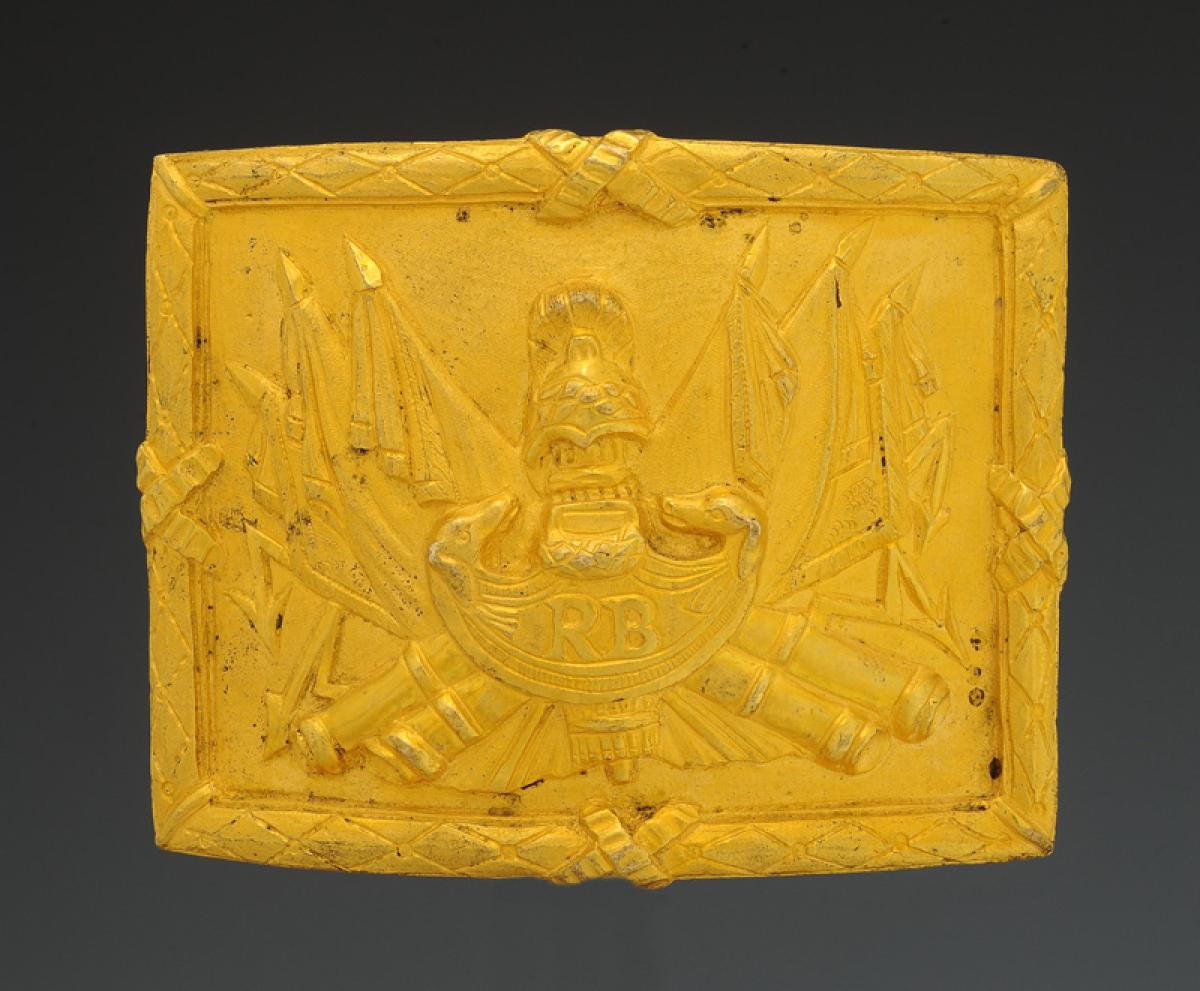
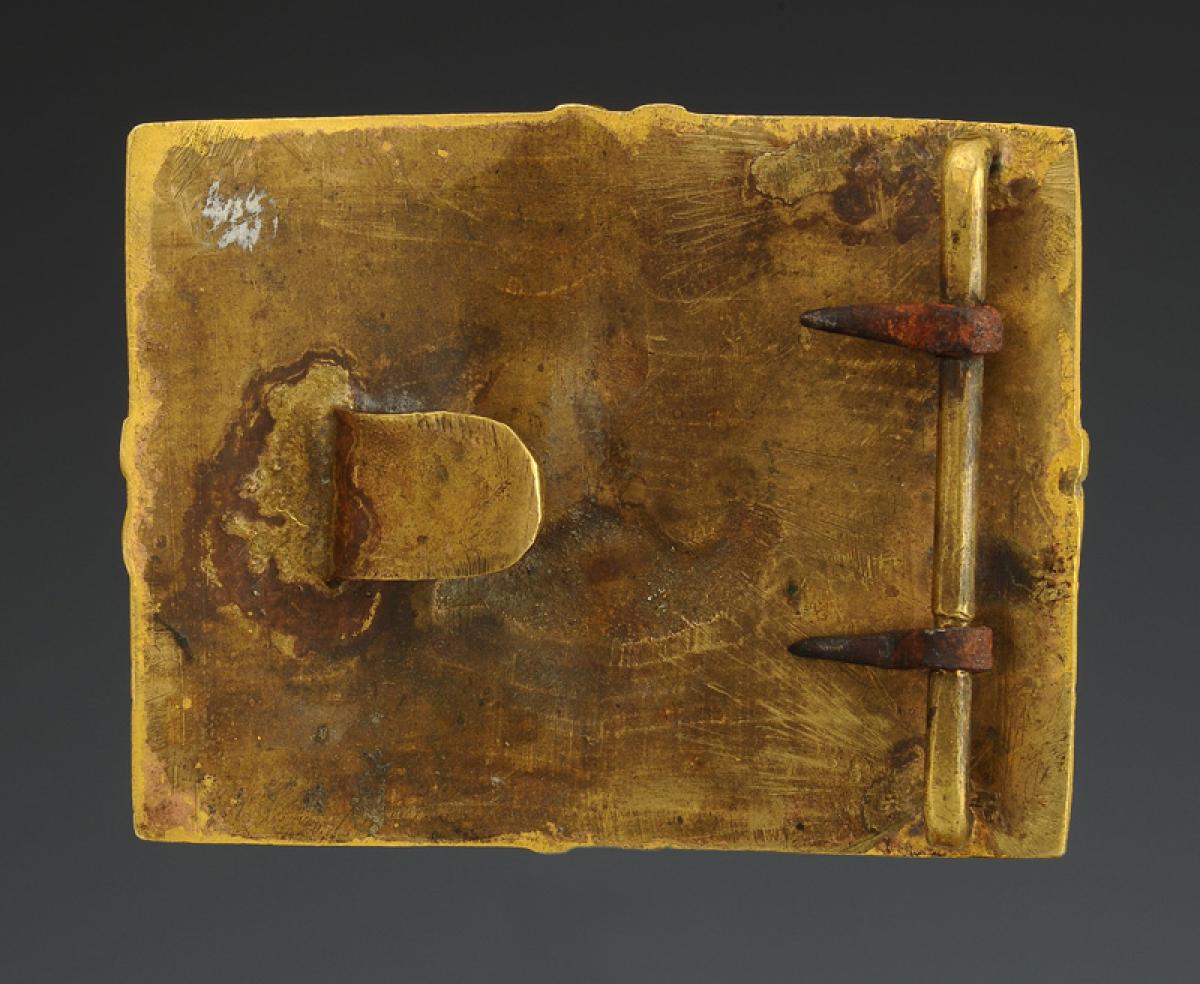
Rectangular bronze buckle entirely chiselled, gold-plated with raised and polished smooth part in agate stone. Height 7.3 cm, width without the curve 9.2 cm. In the center, a shield bearing the initials "R B" (Batavian Republic) is depicted bordered by two dog heads. This shield is placed on a bundle of fasces topped with a plumed helmet. In the background, a bundle of sparkling flags with cannons is represented. Matte sand background on the plate. Decorative framing strip adorned with oak branches and interlaced ribbons. Complete plaque on the rear side with its two-pronged hook and bracket.
Holland - Batavian Republic.
Around 1800-1806.
Perfect condition.
PROVENANCE:
Former Gilbert Putterie collection, then Museo Imperial.
NOTE:
Rare plaque model of which we only know two examples to date, this one and one preserved in the collections of the Army Museum in Paris.
HISTORICAL CONTEXT:
The Batavian Republic (in Dutch: Bataafse Republiek) was the successor state of the Republic of the United Provinces. It was proclaimed on January 19, 1795, and came to an end on June 5, 1806, with the accession of Louis Bonaparte to the Dutch throne. From October 1801, it became known in Dutch as the Bataafs Gemenebest (literally "Batavian Commonwealth"). Both names refer to the Germanic tribe of the Batavians, representing both Dutch ancestry and their ancient quest for freedom in their nationalist tradition. In the early months of 1795, French intervention led to the downfall of the old Republic of the United Provinces. The new Republic enjoyed wide support from the Dutch population and was a product of a genuine popular revolution. However, it was founded with armed support from revolutionary French forces. The Batavian Republic became a client state, the first of the "sister republics," and later a part of Napoleon's French Empire. The politics of the Batavian Republic were deeply influenced by the French, who supported no less than three coups d'état to bring to power the various political factions that France favored at different times in its own political development. Nevertheless, the process of creating a written Dutch Constitution was mainly motivated by internal political factors and not by French influence until Napoleon forced the Dutch government to accept his brother, Louis Bonaparte, as monarch. The political, economic, and social reforms brought about during the relatively short duration of the Batavian Republic had lasting effects. The federal structure of the old Republic of the United Provinces was definitively replaced by a unitary state. For the first time in Dutch history, the Constitution adopted in 1798 had a truly democratic character. For a time, the Republic was governed democratically, although the coup d'état of 1801 brought an authoritarian regime to power, following another amendment to the Constitution. The influence of this democratic period facilitated the transition to a more democratic government in 1848 (the constitutional revision by Johan Rudolf Thorbecke limiting the king's power). A ministerial type of government was introduced for the first time in Dutch history, and many current government departments date back to this period. Although the Batavian Republic was a client state of France, its successive governments tried to maintain a certain level of independence and to serve Dutch interests, even when they clashed with French interests. This conflict of interests led to the demise of the Republic, when the short-lived experience of the grand pensionary Rutger Jan Schimmelpenninck proved unsatisfactory to Napoleon. The next king, Louis Bonaparte, also refused to follow French diktats, eventually leading to his downfall in 1810 when the territory was annexed to the French Empire.
Rectangular bronze buckle entirely chiselled, gold-plated with raised and polished smooth part in agate stone. Height 7.3 cm, width without the curve 9.2 cm. In the center, a shield bearing the initials "R B" (Batavian Republic) is depicted bordered by two dog heads. This shield is placed on a bundle of fasces topped with a plumed helmet. In the background, a bundle of sparkling flags with cannons is represented. Matte sand background on the plate. Decorative framing strip adorned with oak branches and interlaced ribbons. Complete plaque on the rear side with its two-pronged hook and bracket.
Holland - Batavian Republic.
Around 1800-1806.
Perfect condition.
PROVENANCE:
Former Gilbert Putterie collection, then Museo Imperial.
NOTE:
Rare plaque model of which we only know two examples to date, this one and one preserved in the collections of the Army Museum in Paris.
HISTORICAL CONTEXT:
The Batavian Republic (in Dutch: Bataafse Republiek) was the successor state of the Republic of the United Provinces. It was proclaimed on January 19, 1795, and came to an end on June 5, 1806, with the accession of Louis Bonaparte to the Dutch throne. From October 1801, it became known in Dutch as the Bataafs Gemenebest (literally "Batavian Commonwealth"). Both names refer to the Germanic tribe of the Batavians, representing both Dutch ancestry and their ancient quest for freedom in their nationalist tradition. In the early months of 1795, French intervention led to the downfall of the old Republic of the United Provinces. The new Republic enjoyed wide support from the Dutch population and was a product of a genuine popular revolution. However, it was founded with armed support from revolutionary French forces. The Batavian Republic became a client state, the first of the "sister republics," and later a part of Napoleon's French Empire. The politics of the Batavian Republic were deeply influenced by the French, who supported no less than three coups d'état to bring to power the various political factions that France favored at different times in its own political development. Nevertheless, the process of creating a written Dutch Constitution was mainly motivated by internal political factors and not by French influence until Napoleon forced the Dutch government to accept his brother, Louis Bonaparte, as monarch. The political, economic, and social reforms brought about during the relatively short duration of the Batavian Republic had lasting effects. The federal structure of the old Republic of the United Provinces was definitively replaced by a unitary state. For the first time in Dutch history, the Constitution adopted in 1798 had a truly democratic character. For a time, the Republic was governed democratically, although the coup d'état of 1801 brought an authoritarian regime to power, following another amendment to the Constitution. The influence of this democratic period facilitated the transition to a more democratic government in 1848 (the constitutional revision by Johan Rudolf Thorbecke limiting the king's power). A ministerial type of government was introduced for the first time in Dutch history, and many current government departments date back to this period. Although the Batavian Republic was a client state of France, its successive governments tried to maintain a certain level of independence and to serve Dutch interests, even when they clashed with French interests. This conflict of interests led to the demise of the Republic, when the short-lived experience of the grand pensionary Rutger Jan Schimmelpenninck proved unsatisfactory to Napoleon. The next king, Louis Bonaparte, also refused to follow French diktats, eventually leading to his downfall in 1810 when the territory was annexed to the French Empire.
Price :
6 000,00 €
| Destination | Envoi recommandé | Envoi Recommandé + Express |
|---|---|---|
| Shipping France | 9,00 € | 30,00 € |
| Shipping Europe | 17,00 € | 50,00 € |
| Shipping world | 30,00 € | 70,00 € |
Insurance (1%) :
60,00 €
Reference :
33950
Next update Friday, octobre 9 at 13:30 PM
FOR ALL PURCHASES, PAYMENT IN MULTIPLE CHECKS POSSIBLE
bertrand.malvaux@wanadoo.fr 06 07 75 74 63
SHIPPING COSTS
Shipping costs are calculated only once per order for one or more items, all shipments are sent via registered mail, as this is the only way to have proof of dispatch and receipt.
For parcels whose value cannot be insured by the Post, shipments are entrusted to DHL or Fedex with real value insured, the service is of high quality but the cost is higher.
RETURN POLICY
Items can be returned within 8 days of receipt. They must be returned by registered mail at the sender's expense, in their original packaging, and in their original condition.
AUTHENTICITY
The selection of items offered on this site allows me to guarantee the authenticity of each piece described here, all items offered are guaranteed to be period and authentic, unless otherwise noted or restricted in the description.
An authenticity certificate of the item including the description published on the site, the period, the sale price, accompanied by one or more color photographs is automatically provided for any item priced over 130 euros. Below this price, each certificate is charged 5 euros.
Only items sold by me are subject to an authenticity certificate, I do not provide any expert reports for items sold by third parties (colleagues or collectors).
FOR ALL PURCHASES, PAYMENT IN MULTIPLE CHECKS POSSIBLE
bertrand.malvaux@wanadoo.fr 06 07 75 74 63
An authenticity certificate of the item including the description published on the site, the period, the sale price, accompanied by one or more color photographs is automatically provided for any item priced over 130 euros. Below this price, each certificate is charged 5 euros.
Only items sold by me are subject to an authenticity certificate, I do not provide any expert reports for items sold by third parties (colleagues or collectors).