
PLATE OF "DOORKEEPER PLACE CONSIGNMENT" OF WAR, Restoration - July Monarchy. 33831
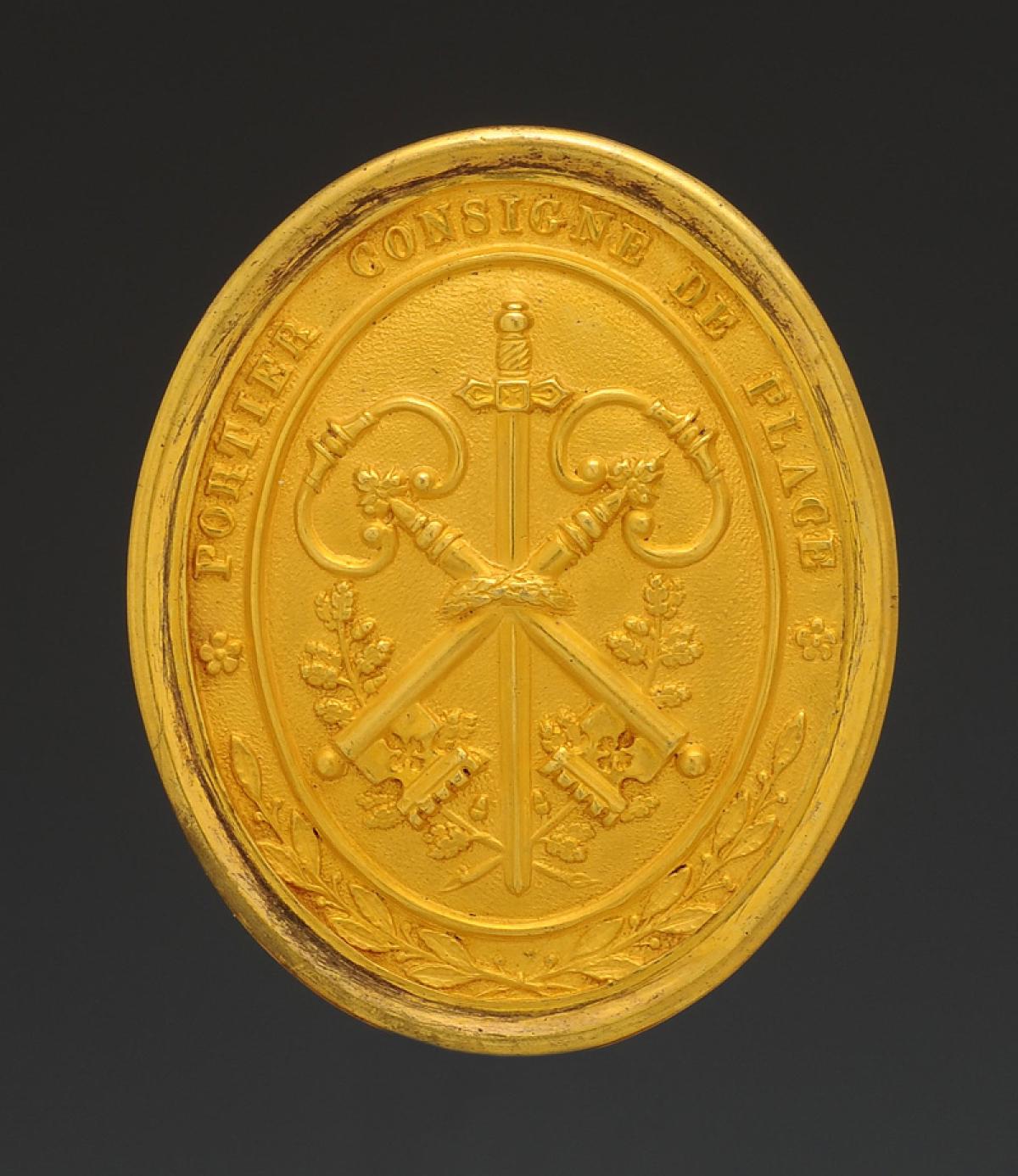

PLAQUE OF "GATEKEEPER OF WAR PLACE," Restoration - July Monarchy. 33831
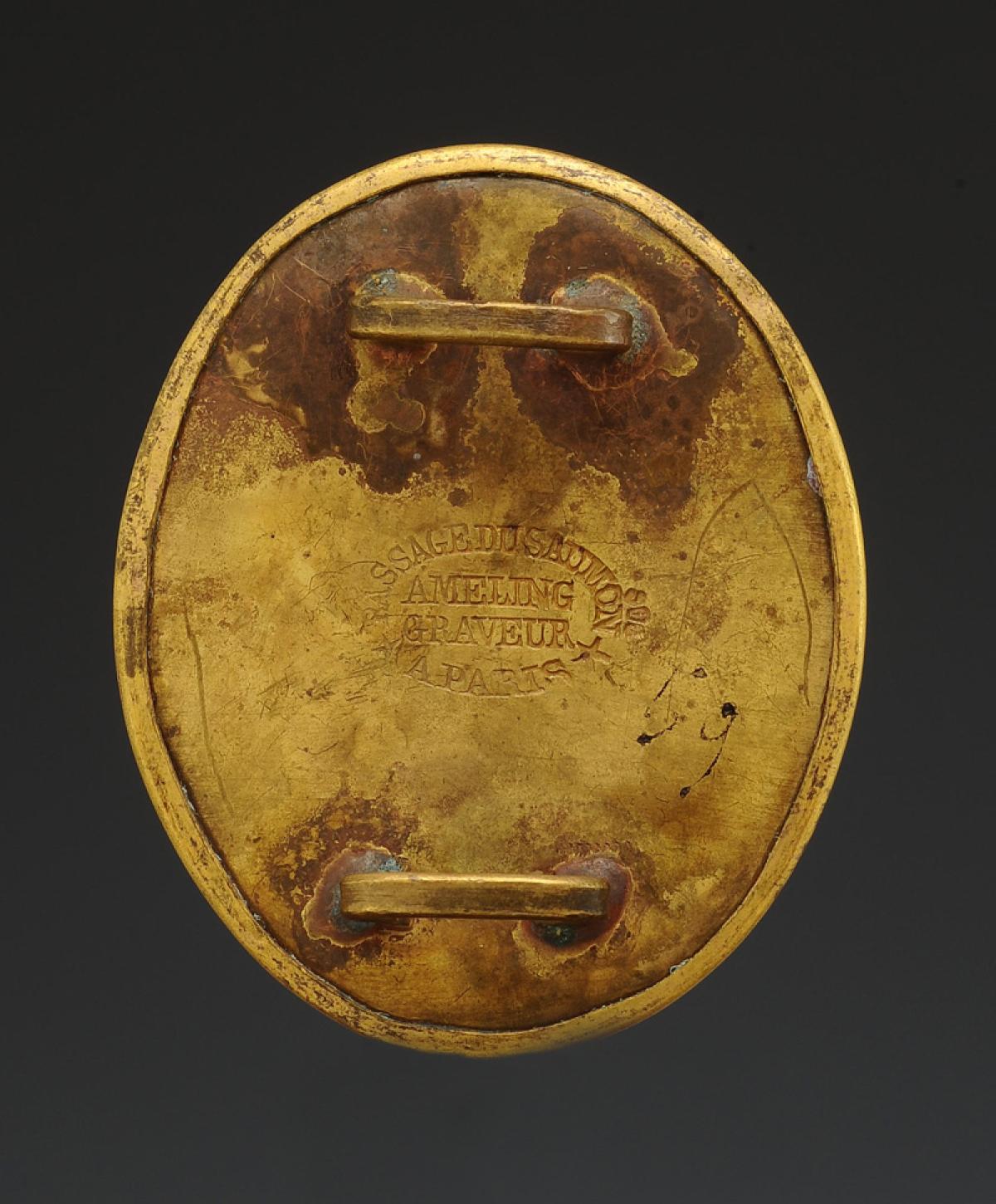
In stamped and gilded brass, oval in shape: Height 5.5 cm, width 4.6 cm, with a folded edge on a brass plate marked "AMELING ENGRAVER PASSAGE DU SAUMON A PARIS." It depicts two keys crossed over a sword with two oak branches, with an outer molding bearing the inscription "GATEKEEPER OF WAR PLACE." Complete with its two brass rear mounting brackets.
France.
Restoration - July Monarchy.
Perfect condition.
HISTORICAL BACKGROUND:
The role of gatekeeper of war place often fell to a retired or infirm non-commissioned officer, much like the battery keeper and occasionally a civilian.
He is responsible for the exits and gates and their keys for the fortification where he is assigned. His name comes from the old term "contre-portier," a man who held the keys to a stronghold in the Middle Ages. During the 19th century, it appears that a harness plate was provided to this individual so that they could be identified. It also seems that in certain cases, he was required to maintain a logbook of the names of individuals passing through the accesses under his charge.
The commission formalizes the role entrusted to an individual for a specific activity or task. Here, the Minister of War appoints Mr. François Chanquierre to the role of gatekeeper of the Porte de France Grand Givet at the Charlemont and Givet place during the 15th nivôse in year V. In wartime cities, there were gatekeepers known as "consigne" or gatekeeper-consigne, responsible for recording the names of foreigners entering and leaving the city.
In practice, the commission served as another form of permission. Since the revolution had passed, the state could no longer grant permissions to citizens who had become free, and a different term needed to be used to define the same concept, thus the term commission was utilized. Subsequently, with changing regulations, the word permission returned, as workers had to request permission for their work, and upon receiving it, they were granted a medal or a trade plate confirming the permission obtained. Coachmen were subject to this system, and on a day in the late 1820s, their work permission was replaced by a driver's license. The license being the shortened form of permission: to this day, we still request a driver's permission when we obtain our driver's license.
Source: LA POSTE AUX CHEVAUX.
In stamped and gilded brass, oval in shape: Height 5.5 cm, width 4.6 cm, with a folded edge on a brass plate marked "AMELING ENGRAVER PASSAGE DU SAUMON A PARIS." It depicts two keys crossed over a sword with two oak branches, with an outer molding bearing the inscription "GATEKEEPER OF WAR PLACE." Complete with its two brass rear mounting brackets.
France.
Restoration - July Monarchy.
Perfect condition.
HISTORICAL BACKGROUND:
The role of gatekeeper of war place often fell to a retired or infirm non-commissioned officer, much like the battery keeper and occasionally a civilian.
He is responsible for the exits and gates and their keys for the fortification where he is assigned. His name comes from the old term "contre-portier," a man who held the keys to a stronghold in the Middle Ages. During the 19th century, it appears that a harness plate was provided to this individual so that they could be identified. It also seems that in certain cases, he was required to maintain a logbook of the names of individuals passing through the accesses under his charge.
The commission formalizes the role entrusted to an individual for a specific activity or task. Here, the Minister of War appoints Mr. François Chanquierre to the role of gatekeeper of the Porte de France Grand Givet at the Charlemont and Givet place during the 15th nivôse in year V. In wartime cities, there were gatekeepers known as "consigne" or gatekeeper-consigne, responsible for recording the names of foreigners entering and leaving the city.
In practice, the commission served as another form of permission. Since the revolution had passed, the state could no longer grant permissions to citizens who had become free, and a different term needed to be used to define the same concept, thus the term commission was utilized. Subsequently, with changing regulations, the word permission returned, as workers had to request permission for their work, and upon receiving it, they were granted a medal or a trade plate confirming the permission obtained. Coachmen were subject to this system, and on a day in the late 1820s, their work permission was replaced by a driver's license. The license being the shortened form of permission: to this day, we still request a driver's permission when we obtain our driver's license.
Source: LA POSTE AUX CHEVAUX.
Price :
550,00 €
| Destination | Envoi recommandé | Envoi Recommandé + Express |
|---|---|---|
| Shipping France | 9,00 € | 30,00 € |
| Shipping Europe | 17,00 € | 50,00 € |
| Shipping world | 30,00 € | 70,00 € |
Insurance (1%) :
5,50 €
Reference :
33831
Next update Friday, octobre 9 at 13:30 PM
FOR ALL PURCHASES, PAYMENT IN MULTIPLE CHECKS POSSIBLE
bertrand.malvaux@wanadoo.fr 06 07 75 74 63
SHIPPING COSTS
Shipping costs are calculated only once per order for one or more items, all shipments are sent via registered mail, as this is the only way to have proof of dispatch and receipt.
For parcels whose value cannot be insured by the Post, shipments are entrusted to DHL or Fedex with real value insured, the service is of high quality but the cost is higher.
RETURN POLICY
Items can be returned within 8 days of receipt. They must be returned by registered mail at the sender's expense, in their original packaging, and in their original condition.
AUTHENTICITY
The selection of items offered on this site allows me to guarantee the authenticity of each piece described here, all items offered are guaranteed to be period and authentic, unless otherwise noted or restricted in the description.
An authenticity certificate of the item including the description published on the site, the period, the sale price, accompanied by one or more color photographs is automatically provided for any item priced over 130 euros. Below this price, each certificate is charged 5 euros.
Only items sold by me are subject to an authenticity certificate, I do not provide any expert reports for items sold by third parties (colleagues or collectors).
FOR ALL PURCHASES, PAYMENT IN MULTIPLE CHECKS POSSIBLE
bertrand.malvaux@wanadoo.fr 06 07 75 74 63
An authenticity certificate of the item including the description published on the site, the period, the sale price, accompanied by one or more color photographs is automatically provided for any item priced over 130 euros. Below this price, each certificate is charged 5 euros.
Only items sold by me are subject to an authenticity certificate, I do not provide any expert reports for items sold by third parties (colleagues or collectors).