
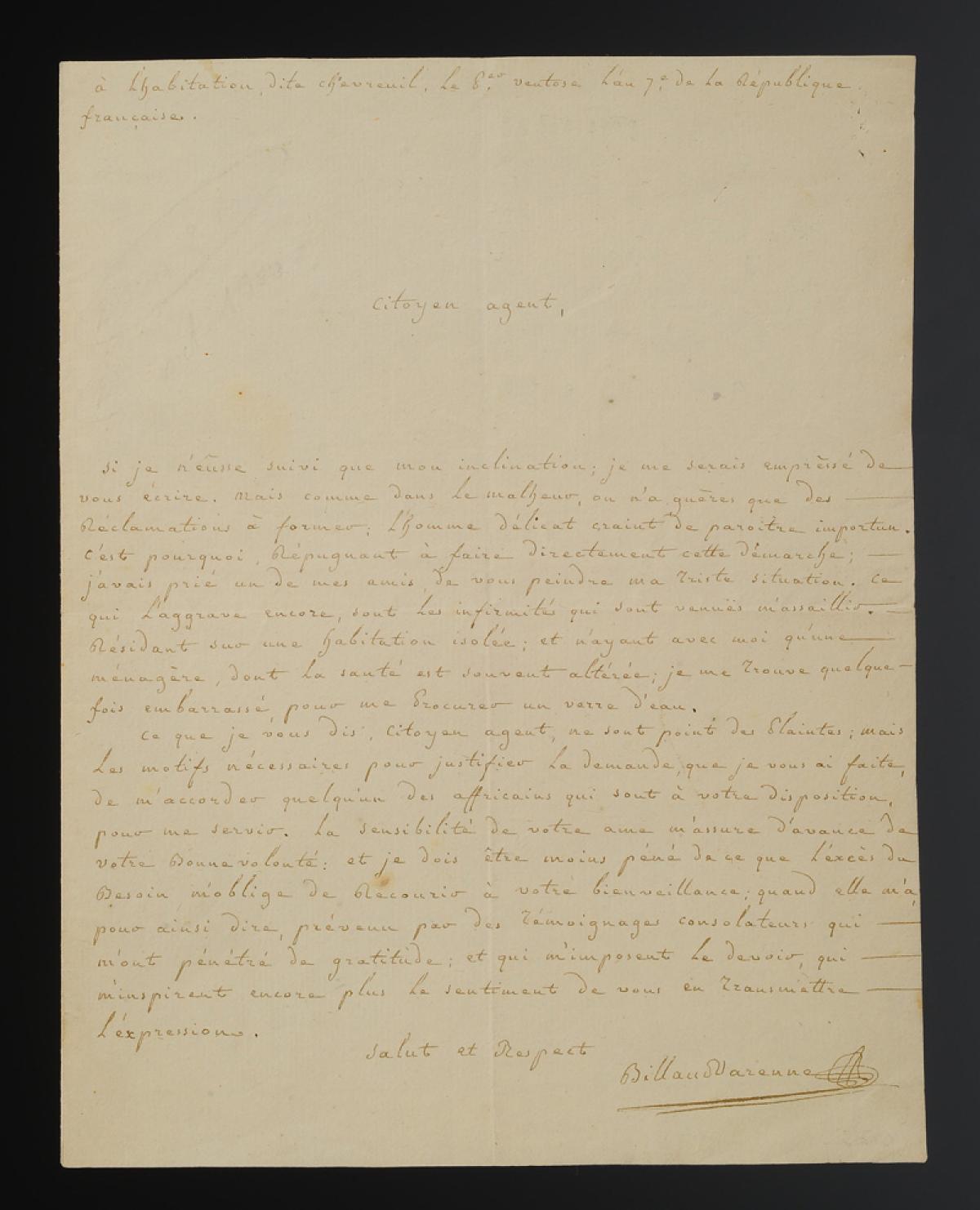
AUTOGRAPH LETTER OF BILLAUD-VARENNE, deported to Guyana, TO THE AGENT OF THE DIRECTORY IN CAYENNE, 8 Ventôse year 7 (26 February 1799). 18910-47
Sold out
HANDWRITTEN LETTER FROM BILLAUD-VARENNE, deported to Guyana, TO THE AGENT OF THE DIRECTOIRE IN CAYENNE, 8 ventôse, year 7 (February 26, 1799). 18910-47
Dated: "At the property known as Chevreuil, on the 8th ventôse of the 7th year of the French Republic."
Billaud-Varenne, deported to Guyana, requests from the Agent of the Directoire in Cayenne some Africans to serve him.
"If I had only followed my inclination, I would have hastened to write to you. But in misfortune, one has little besides complaints to make, and a sensitive man fears appearing importunate. Therefore, reluctant to make this request directly, I had asked a friend of mine to describe to you my sad situation. What worsens it are the infirmities that have befallen me. Residing on an isolated property, and having only a housekeeper with me, whose health is often affected, I find myself sometimes at a loss to even get a glass of water.
What I am telling you, Citizen Agent, is not mere complaints, but the necessary reasons to justify the request I have made to you to grant me one of the Africans at your disposal to serve me. The sensitivity of your soul assures me in advance of your goodwill, and I must be less troubled by the fact that extreme need compels me to seek your kindness, when you have already anticipated me with comforting gestures that have filled me with gratitude and impose on me the duty, which further inspires in me the feeling to convey my thanks to you.
Greetings and Respect. Signed: Billaud Varenne."
Double page. 1 page of writing. H 22.1 cm x 17.1 cm.
Good condition, crease marks, pale ink.
BIOGRAPHY:
Jacques-Nicolas Billaud, then Billaud-Varenne, nicknamed the Rectilinear Patriot or the Tiger, (La Rochelle, April 23, 1756 - Port-au-Prince, June 3, 1819) was a lawyer, Montagnard deputy to the National Convention and member of the Committee of Public Safety. He played a crucial role in the government of France during the Terror.
[...]
Deportation:
He arrived in Guyana on 2 thermidor (July 20, 1795). Billaud-Varenne remained imprisoned for four years despite his illness. He thus outlived his former colleague Collot d'Herbois, who died in 1796. In 1797, his wife, who remained in France and with whom he had good relations, obtained a divorce on the grounds of "husband's absence."
After the 18th Brumaire, Napoleon Bonaparte granted him clemency, which he refused. He decided to stay in Guyana, even after the colony was occupied by Portugal in 1809.
He settled as a farmer and lived modestly, alongside his partner, a former Black Guadeloupean slave named Brigitte [...].
Dated: "At the property known as Chevreuil, on the 8th ventôse of the 7th year of the French Republic."
Billaud-Varenne, deported to Guyana, requests from the Agent of the Directoire in Cayenne some Africans to serve him.
"If I had only followed my inclination, I would have hastened to write to you. But in misfortune, one has little besides complaints to make, and a sensitive man fears appearing importunate. Therefore, reluctant to make this request directly, I had asked a friend of mine to describe to you my sad situation. What worsens it are the infirmities that have befallen me. Residing on an isolated property, and having only a housekeeper with me, whose health is often affected, I find myself sometimes at a loss to even get a glass of water.
What I am telling you, Citizen Agent, is not mere complaints, but the necessary reasons to justify the request I have made to you to grant me one of the Africans at your disposal to serve me. The sensitivity of your soul assures me in advance of your goodwill, and I must be less troubled by the fact that extreme need compels me to seek your kindness, when you have already anticipated me with comforting gestures that have filled me with gratitude and impose on me the duty, which further inspires in me the feeling to convey my thanks to you.
Greetings and Respect. Signed: Billaud Varenne."
Double page. 1 page of writing. H 22.1 cm x 17.1 cm.
Good condition, crease marks, pale ink.
BIOGRAPHY:
Jacques-Nicolas Billaud, then Billaud-Varenne, nicknamed the Rectilinear Patriot or the Tiger, (La Rochelle, April 23, 1756 - Port-au-Prince, June 3, 1819) was a lawyer, Montagnard deputy to the National Convention and member of the Committee of Public Safety. He played a crucial role in the government of France during the Terror.
[...]
Deportation:
He arrived in Guyana on 2 thermidor (July 20, 1795). Billaud-Varenne remained imprisoned for four years despite his illness. He thus outlived his former colleague Collot d'Herbois, who died in 1796. In 1797, his wife, who remained in France and with whom he had good relations, obtained a divorce on the grounds of "husband's absence."
After the 18th Brumaire, Napoleon Bonaparte granted him clemency, which he refused. He decided to stay in Guyana, even after the colony was occupied by Portugal in 1809.
He settled as a farmer and lived modestly, alongside his partner, a former Black Guadeloupean slave named Brigitte [...].
Reference :
18910-47
Next update Friday, octobre 9 at 13:30 PM
FOR ALL PURCHASES, PAYMENT IN MULTIPLE CHECKS POSSIBLE
bertrand.malvaux@wanadoo.fr 06 07 75 74 63
SHIPPING COSTS
Shipping costs are calculated only once per order for one or more items, all shipments are sent via registered mail, as this is the only way to have proof of dispatch and receipt.
For parcels whose value cannot be insured by the Post, shipments are entrusted to DHL or Fedex with real value insured, the service is of high quality but the cost is higher.
RETURN POLICY
Items can be returned within 8 days of receipt. They must be returned by registered mail at the sender's expense, in their original packaging, and in their original condition.
AUTHENTICITY
The selection of items offered on this site allows me to guarantee the authenticity of each piece described here, all items offered are guaranteed to be period and authentic, unless otherwise noted or restricted in the description.
An authenticity certificate of the item including the description published on the site, the period, the sale price, accompanied by one or more color photographs is automatically provided for any item priced over 130 euros. Below this price, each certificate is charged 5 euros.
Only items sold by me are subject to an authenticity certificate, I do not provide any expert reports for items sold by third parties (colleagues or collectors).
FOR ALL PURCHASES, PAYMENT IN MULTIPLE CHECKS POSSIBLE
bertrand.malvaux@wanadoo.fr 06 07 75 74 63
An authenticity certificate of the item including the description published on the site, the period, the sale price, accompanied by one or more color photographs is automatically provided for any item priced over 130 euros. Below this price, each certificate is charged 5 euros.
Only items sold by me are subject to an authenticity certificate, I do not provide any expert reports for items sold by third parties (colleagues or collectors).