
Army of Saint Domingue. DETAILED ACCOUNT OF THE SITUATION OF THE FRENCH EXPEDITION ADDRESSED TO GENERAL IN CHIEF LECLERC, 16 ventôse year X (7 March 1802). 18910-45
Sold out
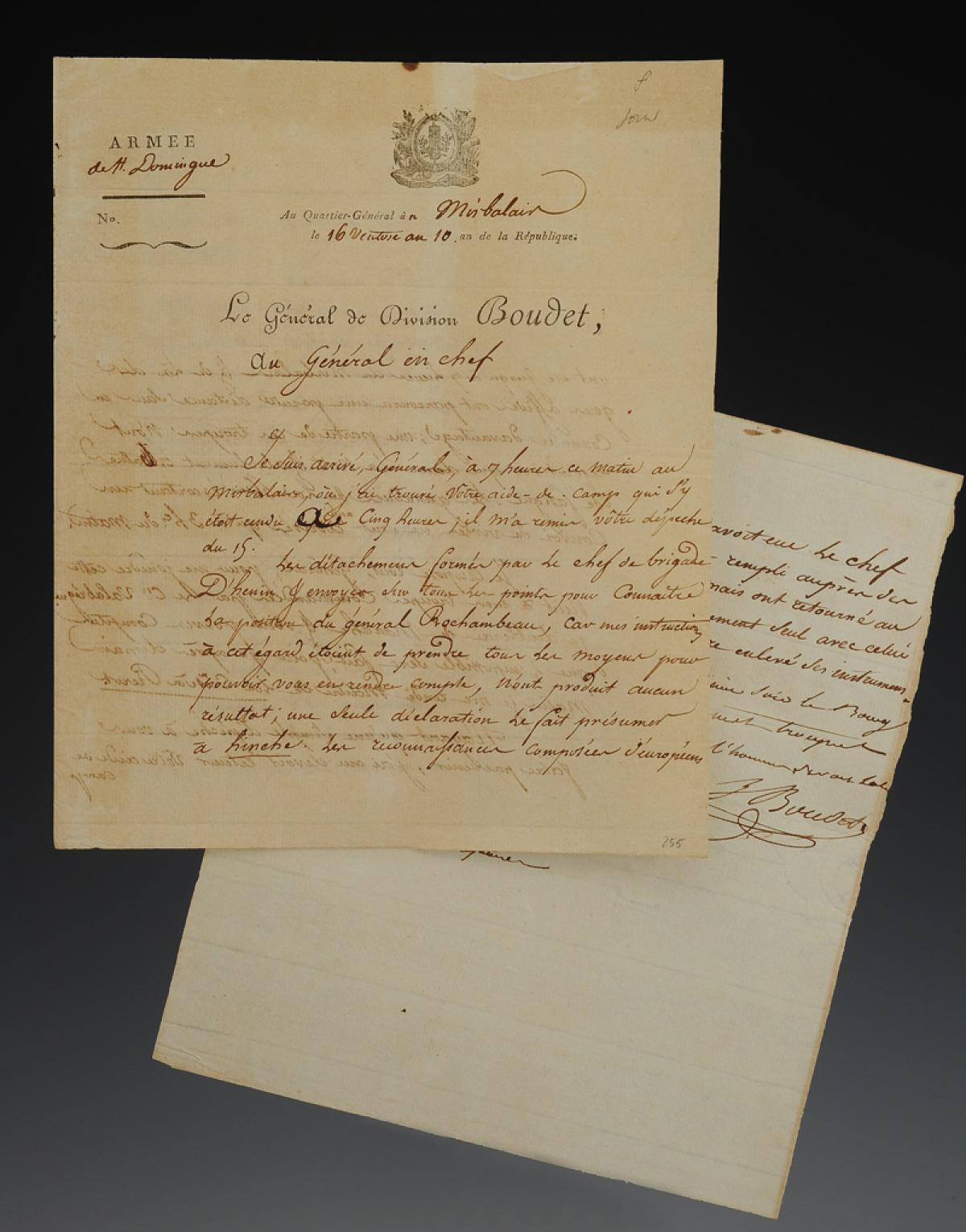
Army of Saint Domingue. DETAILED REPORT BY GENERAL BOUDET ON THE SITUATION OF THE FRENCH EXPEDITION SENT TO GENERAL-IN-CHIEF LECLERC, Mirbalais, 16 ventôse year X (March 7, 1802). 18910-45
Detailed report by General Boudet to General-in-Chief Leclerc, in which Rochambeau, d'Hénin, Vallabrègue, the Dorbigny, Lospinosse, Triano plantations, and the positions of Crête-à-Pierot are mentioned.
This document is an exceptional source of information on the engagement and difficulties of the expedition led by General Leclerc.
Heading "ARMY OF ST DOMINGUE / AT THE HEADQUARTERS OF MIRBALAIS on the 16th ventôse year 10." With a vignette.
With the rear secured in Port-au-Prince by Leclere, and in Saint Marc by Vallabrègue, the French expedition then sets out in pursuit of the rebel leaders. General Rochambeau, whom Boudet is trying to reach, advances towards the boundaries of the Spanish part in the region of Hinche, General Hardy moves towards the Cahos through the Artibonite valley; Boudet, while fortifying his positions in Mirebalais, prepares the attack on Crête-à-Pierrot, an essential base of the resistance system against the French army. This strategically important position, threatening Verette and Saint-Marc, is a fortified glacis where Toussaint maintains a garrison of 1500 men with 9 artillery pieces, under the command of Dessalines. It is also noted how carefully the Black soldiers are treated by Boudet, who grants them some responsibilities.
[...] The detachments formed by the brigade commander d'Hénin - sent to all points to determine Rochambeau's position, as my instructions in this regard were to take all means to report to you - have yielded no results; only one statement presumes his presence in Hinche. The reconnaissance missions composed of Europeans have ventured up to 7 leagues from Mirbalais [...] some of these troops only rejoined here late at night, completely exhausted. The grenadiers of the 56th escorting a convoy of supplies also arrived at 3 a.m. [...] you can count on the impossible being done so that by the day after tomorrow morning, I will have taken control of Crête à Pierrot.
Having only a brief dispatch to send to you, I deemed it necessary to keep your aide-de-camp who can report to you either tomorrow or the day after in person what time would not allow me to write to you.
I am leaving at Mirbalais a black battalion commander with around 130 men from his unit, so that this point, considered very important by our enemies, does not appear abandoned [...] but I have little confidence in the defense he would offer in case of an attack, as I must inform you that a gathering of 1200 men exists at the Dorbigny plantation, three leagues away from here, a post that would have been attacked tonight by the brigade commander d'Hénin without these new dispositions. The Triano post, where a fierce action took place and is seen as a point very favorable to those men, will be guarded by 30 European troops and an equal number of colonial troops, leaving at Mirbalais only a body of troops that does not give me much assurance for the provisions I leave there [...]
In a hostile country plagued by guerrilla warfare, supply problems appear to be of prime importance, with the region's water being unhealthy, Boudet worries about not having received the wine from the war commissary; however, he indicates: "[...] the troops I lead are provisioned with four days of biscuit. I will leave at Mirbalais, which should arrive today, 3000 rations with 10 thousand cartridges [...]"
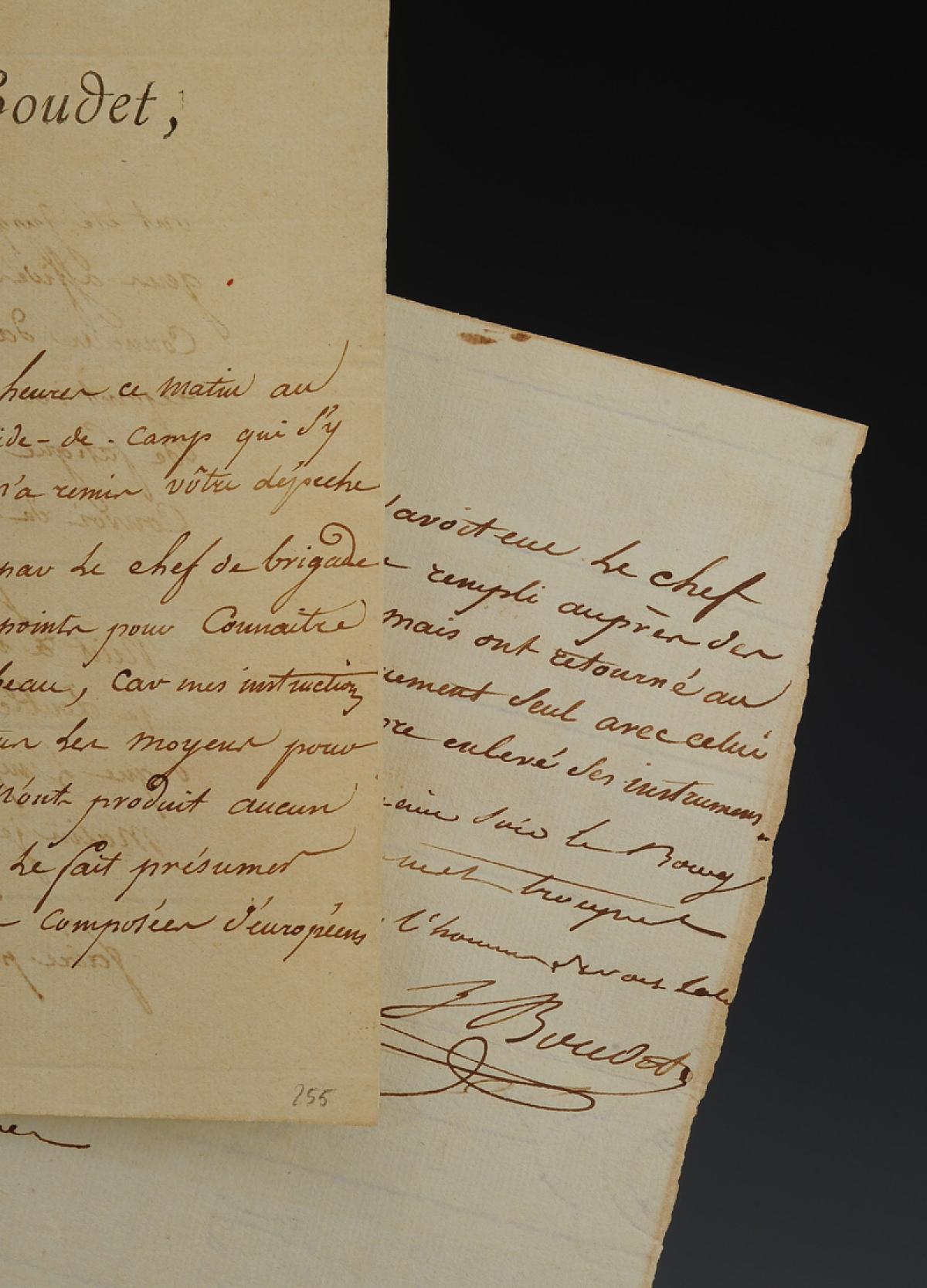
Likewise, he mentions the sanitary conditions of the army which seem concerning, as the yellow fever epidemic is wreaking havoc: "[...] I have just learned that squadron commander Vallabrègue, having left sick soldiers in St Marc, his ambulance could not follow him. Two surgeons that I had dispatched after the reconnaissance of the incident fulfilled their initial mission with the wounded, but returned to Port Republicain. I am left alone with the one from the 15th Light Infantry, whose instruments have also been taken. I hope, general, that by tomorrow evening, the town of Verettes will be occupied by my troops.
Signed: J. Boudet"
Dimensions: H 22.3 cm x 18.6 cm.
5 pages of writing.
In good condition.
BIOGRAPHY:
Jean Boudet, born on February 9, 1769, in Bordeaux and died on September 14, 1809, in Moravské Budějovice, in the Czech Republic, was a French general of the Revolution and Empire. He was buried in Bergerac, Dordogne. Much of his military career took place overseas (Guadeloupe, Haiti…).
[...] The Saint-Domingue Expedition:
As soon as peace negotiations with England were signed in London on October 1, 1801, he was designated to participate in the expedition being prepared for Saint-Domingue. Like several other leaders of this expedition — such as Edme Étienne Borne Desfourneaux or Donatien-Marie-Joseph de Rochambeau — he was chosen for his colonial experience. He was thus placed on October 8 in charge of the troops assembled in Rochefort, forming the core of his division during the Saint-Domingue expedition to crush the Haitian revolution. [...]
HISTORICAL CONTEXT:
The siege of Crête-à-Pierrot took place from March 4 to March 24, 1802, during the Saint-Domingue expedition in the context of the Haitian Revolution.
The siege of the Crête-à-Pierrot position will be one of the toughest battles of the campaign in Saint Domingue, with Toussaint-Louverture's troops putting up fierce resistance until the end of March. While the capture of the fort may be seen as a victory, the French forces will emerge weakened.
Detailed report by General Boudet to General-in-Chief Leclerc, in which Rochambeau, d'Hénin, Vallabrègue, the Dorbigny, Lospinosse, Triano plantations, and the positions of Crête-à-Pierot are mentioned.
This document is an exceptional source of information on the engagement and difficulties of the expedition led by General Leclerc.
Heading "ARMY OF ST DOMINGUE / AT THE HEADQUARTERS OF MIRBALAIS on the 16th ventôse year 10." With a vignette.
With the rear secured in Port-au-Prince by Leclere, and in Saint Marc by Vallabrègue, the French expedition then sets out in pursuit of the rebel leaders. General Rochambeau, whom Boudet is trying to reach, advances towards the boundaries of the Spanish part in the region of Hinche, General Hardy moves towards the Cahos through the Artibonite valley; Boudet, while fortifying his positions in Mirebalais, prepares the attack on Crête-à-Pierrot, an essential base of the resistance system against the French army. This strategically important position, threatening Verette and Saint-Marc, is a fortified glacis where Toussaint maintains a garrison of 1500 men with 9 artillery pieces, under the command of Dessalines. It is also noted how carefully the Black soldiers are treated by Boudet, who grants them some responsibilities.
[...] The detachments formed by the brigade commander d'Hénin - sent to all points to determine Rochambeau's position, as my instructions in this regard were to take all means to report to you - have yielded no results; only one statement presumes his presence in Hinche. The reconnaissance missions composed of Europeans have ventured up to 7 leagues from Mirbalais [...] some of these troops only rejoined here late at night, completely exhausted. The grenadiers of the 56th escorting a convoy of supplies also arrived at 3 a.m. [...] you can count on the impossible being done so that by the day after tomorrow morning, I will have taken control of Crête à Pierrot.
Having only a brief dispatch to send to you, I deemed it necessary to keep your aide-de-camp who can report to you either tomorrow or the day after in person what time would not allow me to write to you.
I am leaving at Mirbalais a black battalion commander with around 130 men from his unit, so that this point, considered very important by our enemies, does not appear abandoned [...] but I have little confidence in the defense he would offer in case of an attack, as I must inform you that a gathering of 1200 men exists at the Dorbigny plantation, three leagues away from here, a post that would have been attacked tonight by the brigade commander d'Hénin without these new dispositions. The Triano post, where a fierce action took place and is seen as a point very favorable to those men, will be guarded by 30 European troops and an equal number of colonial troops, leaving at Mirbalais only a body of troops that does not give me much assurance for the provisions I leave there [...]
In a hostile country plagued by guerrilla warfare, supply problems appear to be of prime importance, with the region's water being unhealthy, Boudet worries about not having received the wine from the war commissary; however, he indicates: "[...] the troops I lead are provisioned with four days of biscuit. I will leave at Mirbalais, which should arrive today, 3000 rations with 10 thousand cartridges [...]"
Likewise, he mentions the sanitary conditions of the army which seem concerning, as the yellow fever epidemic is wreaking havoc: "[...] I have just learned that squadron commander Vallabrègue, having left sick soldiers in St Marc, his ambulance could not follow him. Two surgeons that I had dispatched after the reconnaissance of the incident fulfilled their initial mission with the wounded, but returned to Port Republicain. I am left alone with the one from the 15th Light Infantry, whose instruments have also been taken. I hope, general, that by tomorrow evening, the town of Verettes will be occupied by my troops.
Signed: J. Boudet"
Dimensions: H 22.3 cm x 18.6 cm.
5 pages of writing.
In good condition.
BIOGRAPHY:
Jean Boudet, born on February 9, 1769, in Bordeaux and died on September 14, 1809, in Moravské Budějovice, in the Czech Republic, was a French general of the Revolution and Empire. He was buried in Bergerac, Dordogne. Much of his military career took place overseas (Guadeloupe, Haiti…).
[...] The Saint-Domingue Expedition:
As soon as peace negotiations with England were signed in London on October 1, 1801, he was designated to participate in the expedition being prepared for Saint-Domingue. Like several other leaders of this expedition — such as Edme Étienne Borne Desfourneaux or Donatien-Marie-Joseph de Rochambeau — he was chosen for his colonial experience. He was thus placed on October 8 in charge of the troops assembled in Rochefort, forming the core of his division during the Saint-Domingue expedition to crush the Haitian revolution. [...]
HISTORICAL CONTEXT:
The siege of Crête-à-Pierrot took place from March 4 to March 24, 1802, during the Saint-Domingue expedition in the context of the Haitian Revolution.
The siege of the Crête-à-Pierrot position will be one of the toughest battles of the campaign in Saint Domingue, with Toussaint-Louverture's troops putting up fierce resistance until the end of March. While the capture of the fort may be seen as a victory, the French forces will emerge weakened.
Reference :
18910-45

Next update Friday, octobre 9 at 13:30 PM
FOR ALL PURCHASES, PAYMENT IN MULTIPLE CHECKS POSSIBLE
bertrand.malvaux@wanadoo.fr 06 07 75 74 63
SHIPPING COSTS
Shipping costs are calculated only once per order for one or more items, all shipments are sent via registered mail, as this is the only way to have proof of dispatch and receipt.
For parcels whose value cannot be insured by the Post, shipments are entrusted to DHL or Fedex with real value insured, the service is of high quality but the cost is higher.
RETURN POLICY
Items can be returned within 8 days of receipt. They must be returned by registered mail at the sender's expense, in their original packaging, and in their original condition.
AUTHENTICITY
The selection of items offered on this site allows me to guarantee the authenticity of each piece described here, all items offered are guaranteed to be period and authentic, unless otherwise noted or restricted in the description.
An authenticity certificate of the item including the description published on the site, the period, the sale price, accompanied by one or more color photographs is automatically provided for any item priced over 130 euros. Below this price, each certificate is charged 5 euros.
Only items sold by me are subject to an authenticity certificate, I do not provide any expert reports for items sold by third parties (colleagues or collectors).
FOR ALL PURCHASES, PAYMENT IN MULTIPLE CHECKS POSSIBLE
bertrand.malvaux@wanadoo.fr 06 07 75 74 63
An authenticity certificate of the item including the description published on the site, the period, the sale price, accompanied by one or more color photographs is automatically provided for any item priced over 130 euros. Below this price, each certificate is charged 5 euros.
Only items sold by me are subject to an authenticity certificate, I do not provide any expert reports for items sold by third parties (colleagues or collectors).