
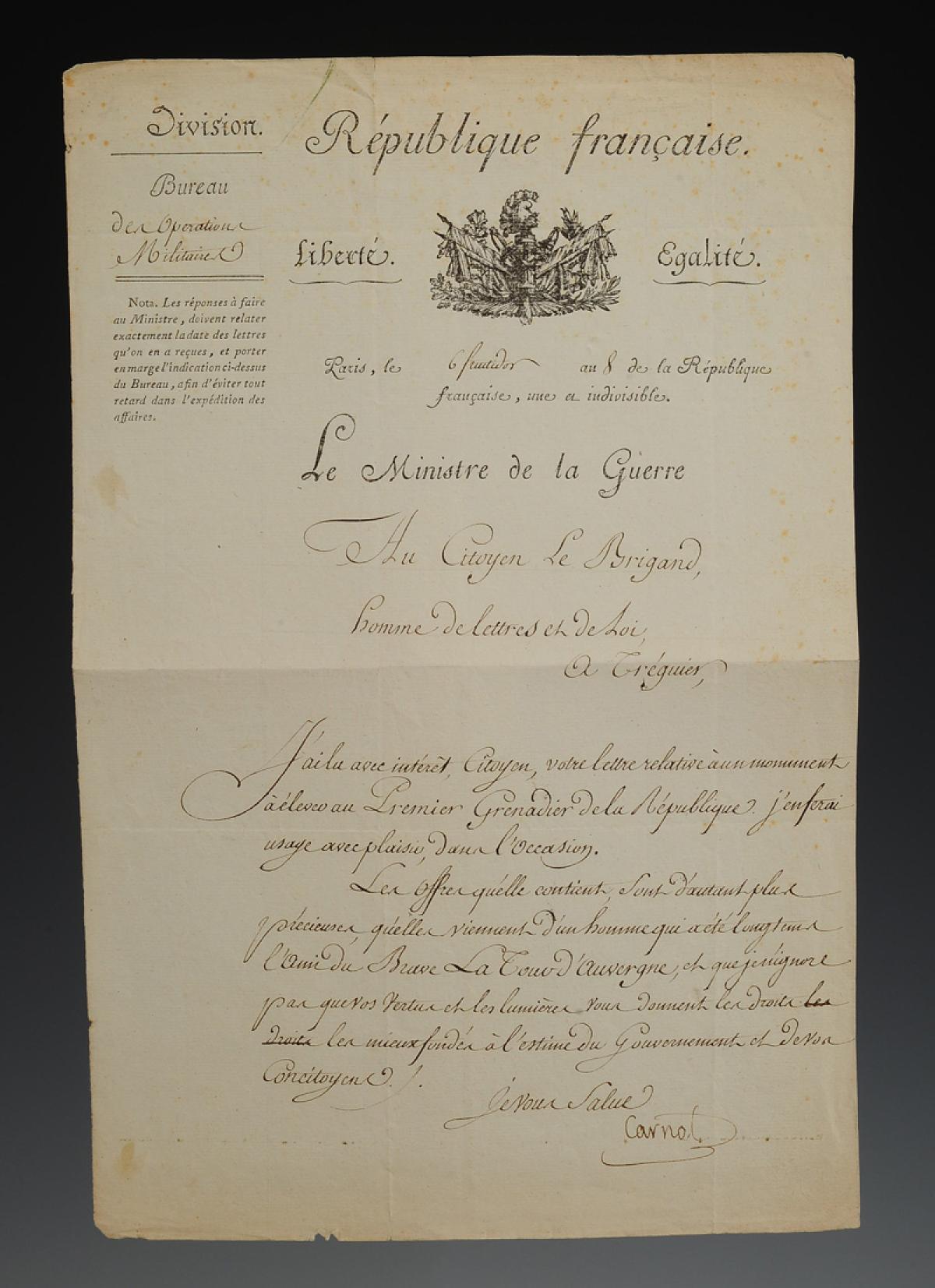
La Tour d'Auvergne-Corret. SIGNED LETTER BY CARNOT, Minister of War, addressed to Citizen Le Brigand approving the latter's idea to erect a monument to the "First Grenadier of France", on the 6th of Fructidor in the year 8 (August 23, 1798). 18910-37
Sold out
The Tour d'Auvergne-Corret. SIGNED LETTER CARNOT, Minister of War, addressed to Citizen Le Brigand approving the latter's idea to erect a monument to the "First Grenadier of France," on 6 Fructidor year 8 (August 23, 1798). 18910-37
Header "BUREAU DES OPÉRATIONS MILITAIRES. RÉPUBLIQUE FRANÇAISE / Liberté / Égalité".
Vignette.
Carnot writes to Citizen Le Brigand, a man of letters and law in Tréguier. He approves Le Brigand's idea to erect a monument to the First Grenadier of France, La Tour d'Auvergne, who had been killed the previous June 27th. La Tour d'Auvergne had returned to service to rescue Le Brigand's son.
"I have read with interest, Citizen, your letter concerning a monument to be erected to the First Grenadier of the Republic. I will gladly make use of it when the occasion arises. The offers it contains are all the more precious, coming from a man who was long a friend of the Brave La Tour d'Auvergne, and I am not unaware that your virtues and knowledge give you the most well-founded rights to the esteem of the Government and your fellow citizens. I salute you." Signed: Carnot.
Dimensions: 32.5 cm x 21.3 cm.
Fair condition, folds, foxing, small tears at the bottom of the page.
BIOGRAPHIES:
- Théophile Malo de La Tour d'Auvergne-Corret, born on December 23, 1743, in Carhaix (or its surroundings) in Brittany and died on June 27, 1800 (at the age of 56) in Oberhausen, Bavaria, was a French military officer. Napoleon granted him the title of "first grenadier of the Republic." He also wrote several works on the history of Brittany and Celtic languages.
- Lazare Nicolas Marguerite Carnot, born on May 13, 1753, in Nolay, France, and died on August 2, 1823, in Magdeburg, Prussia, was a French mathematician, physicist, officer, and statesman.
A deputy to the Legislative Assembly and then the National Convention, he was a member of the Committee of Public Safety in 1793-1794; his role in the successes of the French Revolutionary armies earned him the nicknames "Great Carnot" and "organizer of Victory." His role in the decision to carry out the massacres of the Vendée uprising is controversial.
As a Director in 1795, he played a political role in opposition during Napoleon's reign but still was promoted to general in 1812, then a Count of the Empire (an unfinished title as he did not go to the chancellery to remove the letters[2]) and Minister of the Interior during the Hundred Days. He died in 1823 while in exile as a regicide, having voted for the death of Louis XVI in 1793.
Header "BUREAU DES OPÉRATIONS MILITAIRES. RÉPUBLIQUE FRANÇAISE / Liberté / Égalité".
Vignette.
Carnot writes to Citizen Le Brigand, a man of letters and law in Tréguier. He approves Le Brigand's idea to erect a monument to the First Grenadier of France, La Tour d'Auvergne, who had been killed the previous June 27th. La Tour d'Auvergne had returned to service to rescue Le Brigand's son.
"I have read with interest, Citizen, your letter concerning a monument to be erected to the First Grenadier of the Republic. I will gladly make use of it when the occasion arises. The offers it contains are all the more precious, coming from a man who was long a friend of the Brave La Tour d'Auvergne, and I am not unaware that your virtues and knowledge give you the most well-founded rights to the esteem of the Government and your fellow citizens. I salute you." Signed: Carnot.
Dimensions: 32.5 cm x 21.3 cm.
Fair condition, folds, foxing, small tears at the bottom of the page.
BIOGRAPHIES:
- Théophile Malo de La Tour d'Auvergne-Corret, born on December 23, 1743, in Carhaix (or its surroundings) in Brittany and died on June 27, 1800 (at the age of 56) in Oberhausen, Bavaria, was a French military officer. Napoleon granted him the title of "first grenadier of the Republic." He also wrote several works on the history of Brittany and Celtic languages.
- Lazare Nicolas Marguerite Carnot, born on May 13, 1753, in Nolay, France, and died on August 2, 1823, in Magdeburg, Prussia, was a French mathematician, physicist, officer, and statesman.
A deputy to the Legislative Assembly and then the National Convention, he was a member of the Committee of Public Safety in 1793-1794; his role in the successes of the French Revolutionary armies earned him the nicknames "Great Carnot" and "organizer of Victory." His role in the decision to carry out the massacres of the Vendée uprising is controversial.
As a Director in 1795, he played a political role in opposition during Napoleon's reign but still was promoted to general in 1812, then a Count of the Empire (an unfinished title as he did not go to the chancellery to remove the letters[2]) and Minister of the Interior during the Hundred Days. He died in 1823 while in exile as a regicide, having voted for the death of Louis XVI in 1793.
Reference :
18910-37
Next update Friday, septembre 25 at 13:30 PM
FOR ALL PURCHASES, PAYMENT IN MULTIPLE CHECKS POSSIBLE
bertrand.malvaux@wanadoo.fr 06 07 75 74 63
SHIPPING COSTS
Shipping costs are calculated only once per order for one or more items, all shipments are sent via registered mail, as this is the only way to have proof of dispatch and receipt.
For parcels whose value cannot be insured by the Post, shipments are entrusted to DHL or Fedex with real value insured, the service is of high quality but the cost is higher.
RETURN POLICY
Items can be returned within 8 days of receipt. They must be returned by registered mail at the sender's expense, in their original packaging, and in their original condition.
AUTHENTICITY
The selection of items offered on this site allows me to guarantee the authenticity of each piece described here, all items offered are guaranteed to be period and authentic, unless otherwise noted or restricted in the description.
An authenticity certificate of the item including the description published on the site, the period, the sale price, accompanied by one or more color photographs is automatically provided for any item priced over 130 euros. Below this price, each certificate is charged 5 euros.
Only items sold by me are subject to an authenticity certificate, I do not provide any expert reports for items sold by third parties (colleagues or collectors).
FOR ALL PURCHASES, PAYMENT IN MULTIPLE CHECKS POSSIBLE
bertrand.malvaux@wanadoo.fr 06 07 75 74 63
An authenticity certificate of the item including the description published on the site, the period, the sale price, accompanied by one or more color photographs is automatically provided for any item priced over 130 euros. Below this price, each certificate is charged 5 euros.
Only items sold by me are subject to an authenticity certificate, I do not provide any expert reports for items sold by third parties (colleagues or collectors).