
East India Company. APPOINTMENT OF MR. ANDRÉ CORDERANT AS ENSIGN IN THE ARTILLERY CORPS SERVING THE EAST INDIA COMPANY, SIGNED LALLY, April 16, 1759. 18883-12
Sold out
Company of the Indies. APPOINTMENT OF MR. ANDRÉ CORDERANT AS ENSIGN IN THE ARTILLERY CORPS SERVING THE COMPANY OF THE INDIES, SIGNED LALLY, April 16, 1759. 18883-12
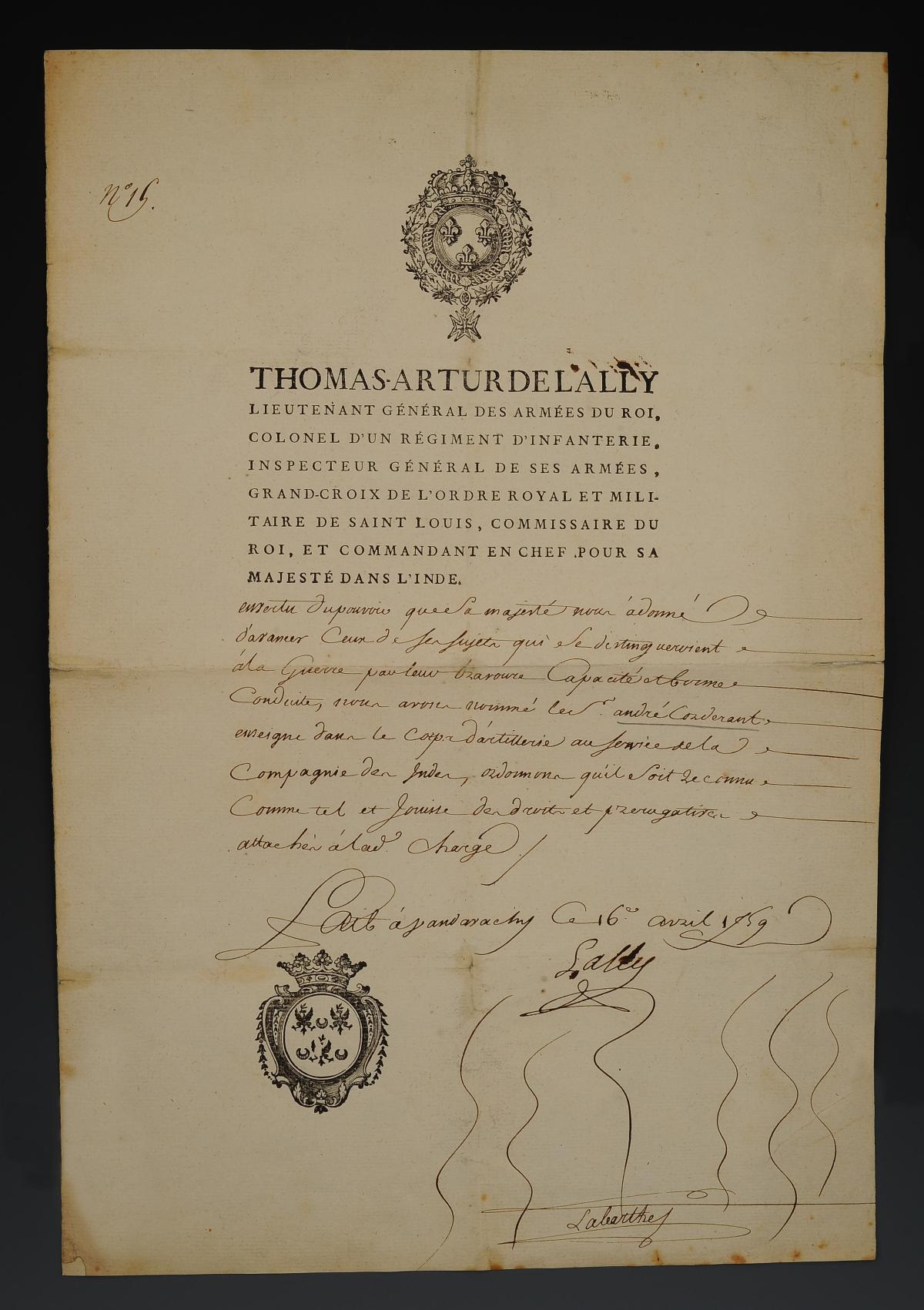
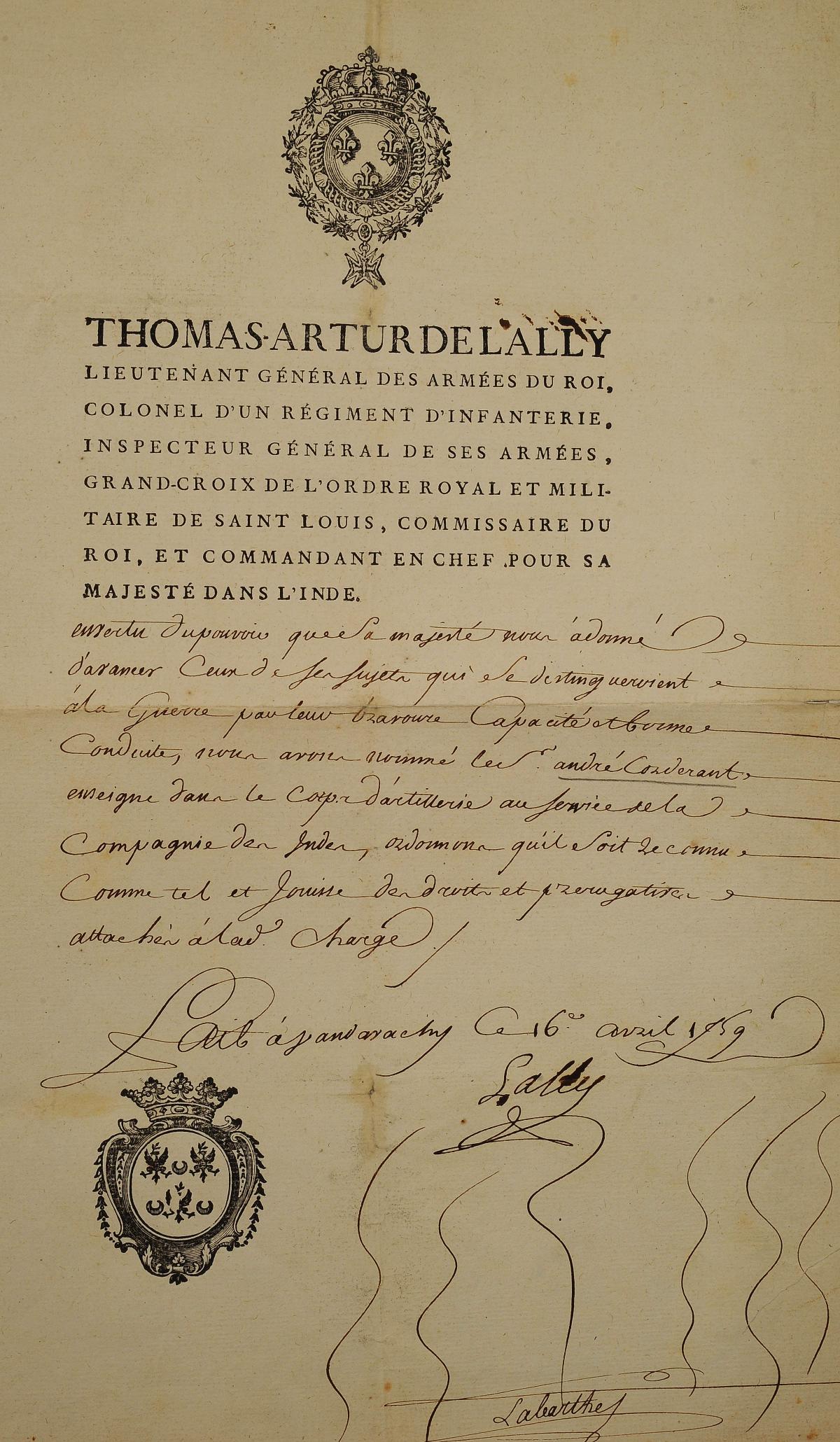
Printed document in black ink and completed with a pen. Appointment of Mr. André CORDERANT as ensign in the Artillery Corps serving the Company of the Indies. Signed "Lally".
Two beautiful vignettes, one with the Royal Order of Saint Louis in the header, the second with three crescents at the bottom. Piece « N°15 »
Header: "THOMAS ARTHUR DE LALLY, Lieutenant General of the King's Armies, Colonel of an Infantry Regiment, Inspector General of his Armies, Grand Cross of the Royal and Military Order of Saint Louis, Commissioner of the King, and Commander-in-Chief for His Majesty in India,
In virtue of the power that His Majesty has given us to advance those of his subjects who distinguished themselves in war by their bravery, ability, and good conduct, we have appointed Mr. André Corderant, ensign in the Artillery Corps serving the Company of the Indies, and order that he be recognized as such and enjoy the rights and prerogatives attached to said position.
Done at Vandachary on April 16, 1759.
Signed: LALLY".
Measures 43 cm x 29 cm.
Good condition, fold marks with tears on the edges, small ink stains.
BIOGRAPHY:
Thomas Arthur, Baron de Tollendal, Count of LALLY, known as "Lally-Tollendal", born on January 13, 1702 in Romans and executed at the Place de Grève, in Paris, on May 9, 1766, was a French military officer and high-ranking official of Irish origin. As Governor of the Indies, defeated by the English and accused of treason, he was beheaded.
[...]
After the War of the Austrian Succession, English power in India, which was held in check until 1754 by Dupleix, was rapidly expanding and threatening to ruin that of France. With the start of the Seven Years' War in 1755, reinforcements had to be sent, unless the risk of losing everything was accepted. After the disgrace of Dupleix, his deputy, Bussy, very enterprising and knowledgeable about the terrain, seemed to be the right choice to command, but the Minister of the Navy, Machault d'Arnouville, preferred Lally-Tollendal, a protege of Madame de Pompadour. Lally was a good soldier who detested the English, but he knew absolutely nothing about the Indian world. This major error, dictated by court considerations, was the cause of the failure of the entire campaign, the loss of India, and ultimately, that of Lally himself.
A squadron was initially promised, but the Royal Navy, which had significantly fewer ships than the Royal Navy, could only provide a mixed division consisting of one warship and eight ships armed by the East India Company. Lally was appointed royal commissioner, syndic of the East India Company, and overall commander of all French establishments in the East Indies. The small force under the Count d'Aché left France on May 2, 1757, and after a long and arduous journey, arrived at Isle de France (now Mauritius) on December 17, eight months after departure. Pondicherry came into view on April 29, 1758, after a difficult naval battle off Gondelour to fend off a British interception attempt.
The English had had enough time to fortify and strengthen their squadrons, as evidenced by this first naval battle. Despite landing 3,500 reinforcements by d'Aché, Lally managed to capture Gondelour, Arcate, and Fort St. David near Pondicherry by the end of 1758.
However, he lacked naval support because d'Aché's squadron had returned to Isle de France to escape the winter monsoon. Thus, he failed before Madras, as the city was resupplied in December 1758 by Pocock's squadron, which was able to remain there thanks to the sheltered base of Bombay. Lally was forced to lift the siege in February 1759 and retreat to Pondicherry. D'Aché brought him reinforcements and money in September 1759 after a final difficult naval battle against Pocock, who tried to block the city.
But Lally, while a good fighter, was a bad diplomat. Unfortunately, he rejected the alliances proposed by the nabobs, which had ensured the success of the French during Dupleix's time. He completely misunderstood the Hindus, whom he wrongly considered as "Savages". Second mistake: he only wanted to fight in a European manner and scorned the sepoys companies, who had been equipped and trained by Dupleix and his officers in the European way. In Pondicherry itself, his relations with the administrators of the Company became very turbulent and difficult. Sadly, Lally also fell out with his excellent second, Bussy, a crucial figure in liaising with the sepoy companies and the Hindus. He gradually found himself isolated, while the English received considerable reinforcements and were not hesitant to rely on numerous Indian troops.
Voltaire, who was a shareholder in the East India Company, wrote on February 15, 1760, in a letter: "We have in Pondicherry a Lally... who will cost me sooner or later, twenty thousand livres annually..."
Reference :
18883-12
Next update Friday, november 13 at 13:30 PM
FOR ALL PURCHASES, PAYMENT IN MULTIPLE CHECKS POSSIBLE
bertrand.malvaux@wanadoo.fr 06 07 75 74 63
SHIPPING COSTS
Shipping costs are calculated only once per order for one or more items, all shipments are sent via registered mail, as this is the only way to have proof of dispatch and receipt.
For parcels whose value cannot be insured by the Post, shipments are entrusted to DHL or Fedex with real value insured, the service is of high quality but the cost is higher.
RETURN POLICY
Items can be returned within 8 days of receipt. They must be returned by registered mail at the sender's expense, in their original packaging, and in their original condition.
AUTHENTICITY
The selection of items offered on this site allows me to guarantee the authenticity of each piece described here, all items offered are guaranteed to be period and authentic, unless otherwise noted or restricted in the description.
An authenticity certificate of the item including the description published on the site, the period, the sale price, accompanied by one or more color photographs is automatically provided for any item priced over 130 euros. Below this price, each certificate is charged 5 euros.
Only items sold by me are subject to an authenticity certificate, I do not provide any expert reports for items sold by third parties (colleagues or collectors).
FOR ALL PURCHASES, PAYMENT IN MULTIPLE CHECKS POSSIBLE
bertrand.malvaux@wanadoo.fr 06 07 75 74 63
An authenticity certificate of the item including the description published on the site, the period, the sale price, accompanied by one or more color photographs is automatically provided for any item priced over 130 euros. Below this price, each certificate is charged 5 euros.
Only items sold by me are subject to an authenticity certificate, I do not provide any expert reports for items sold by third parties (colleagues or collectors).