
SABRE BELONGING TO US NAVY LIEUTENANT GLENN LEWIS DUNAGAN, model 1852, First half of the 19th century (circa 1937-1939). 32678

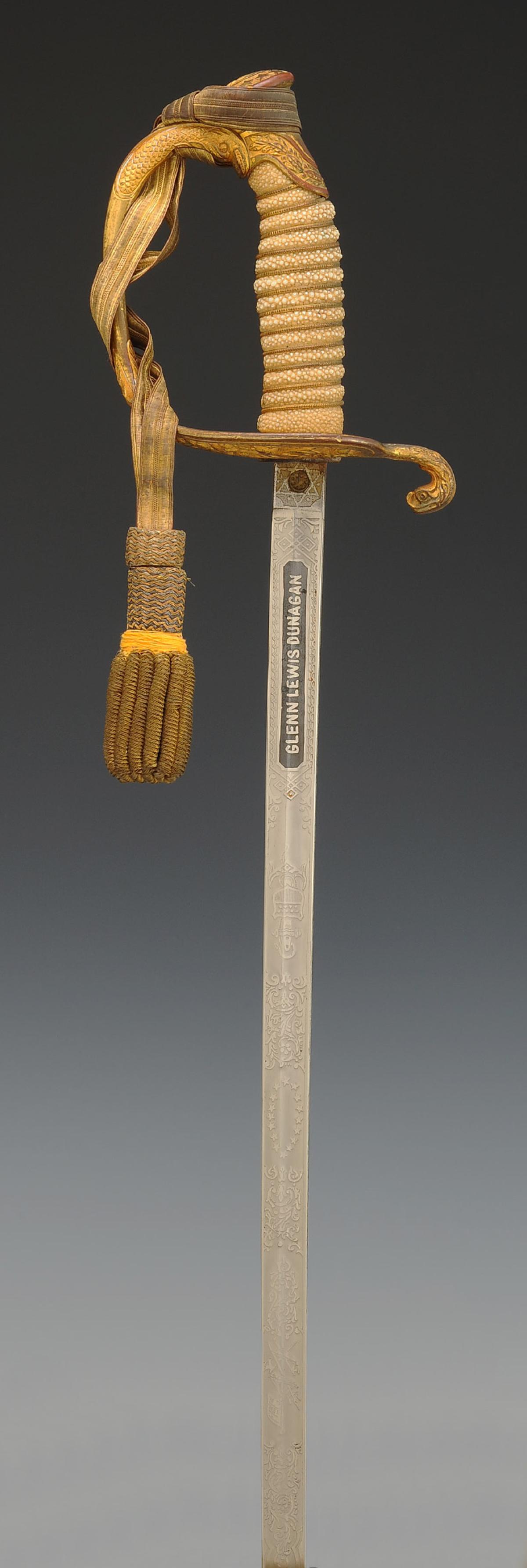

SABER BELONGING TO LIEUTENANT OF THE US NAVY GLENN LEWIS DUNAGAN, model 1852, First half of the 19th century (approximately 1937-1939). 32678
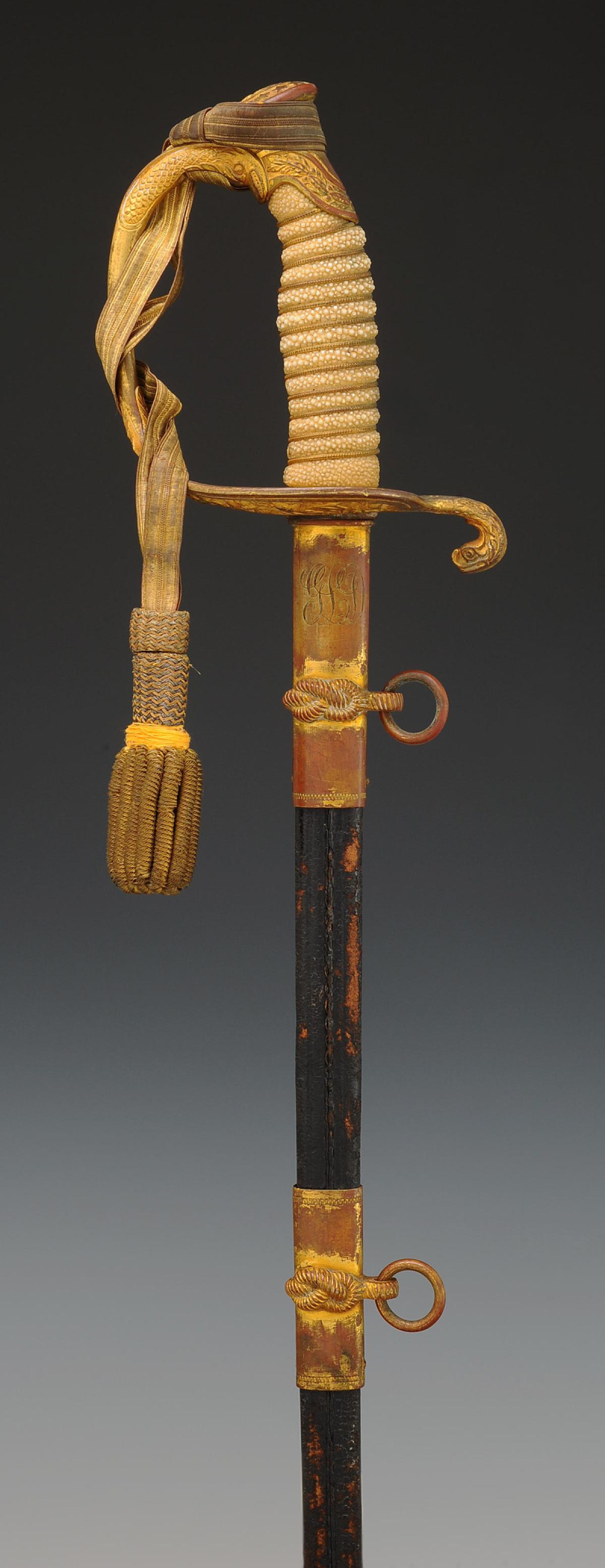
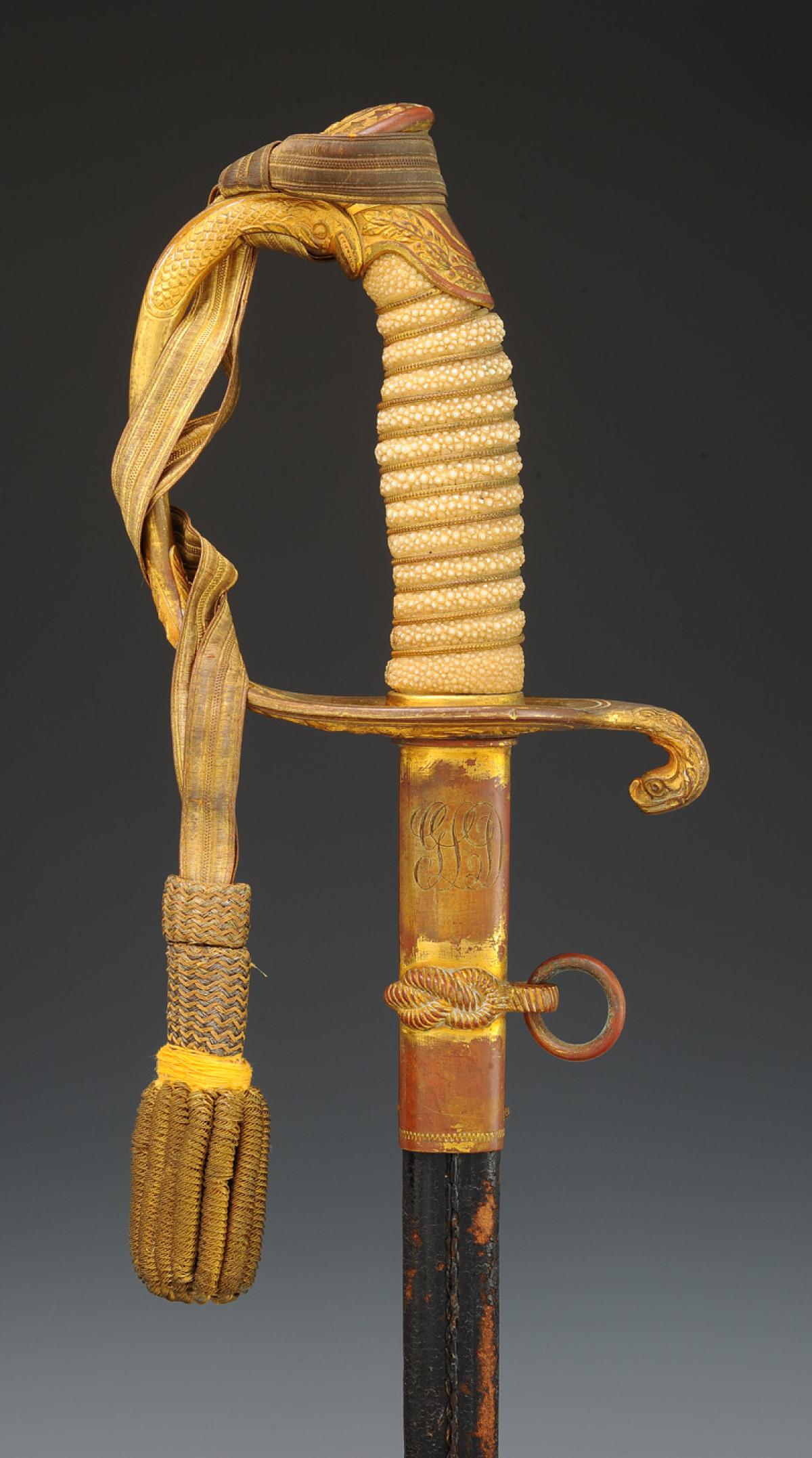
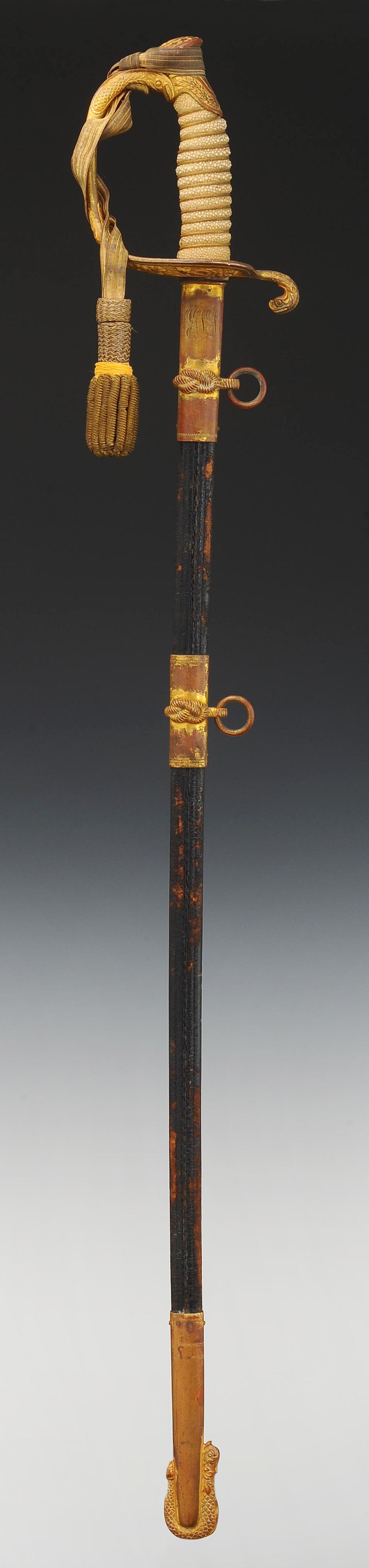
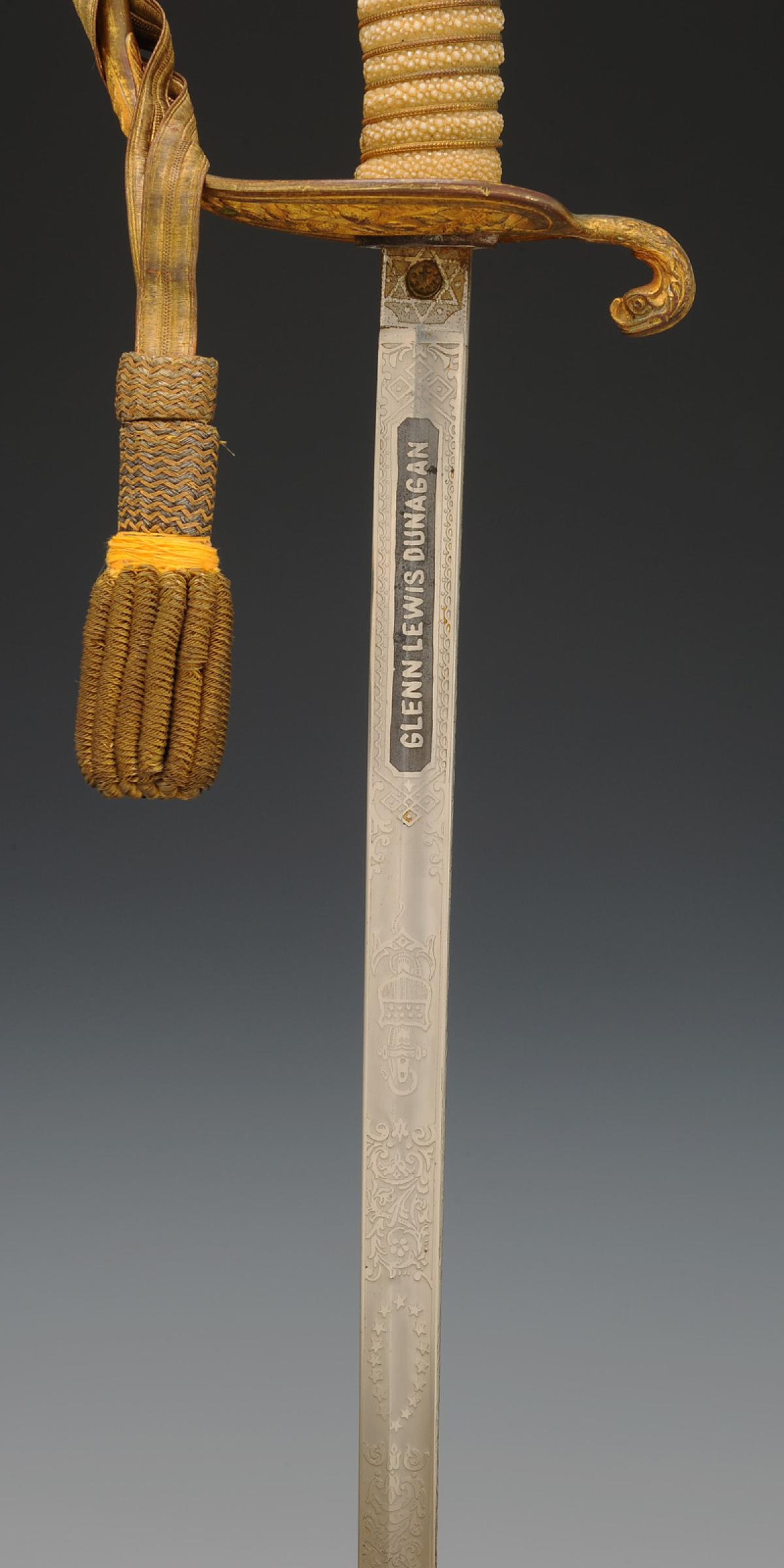
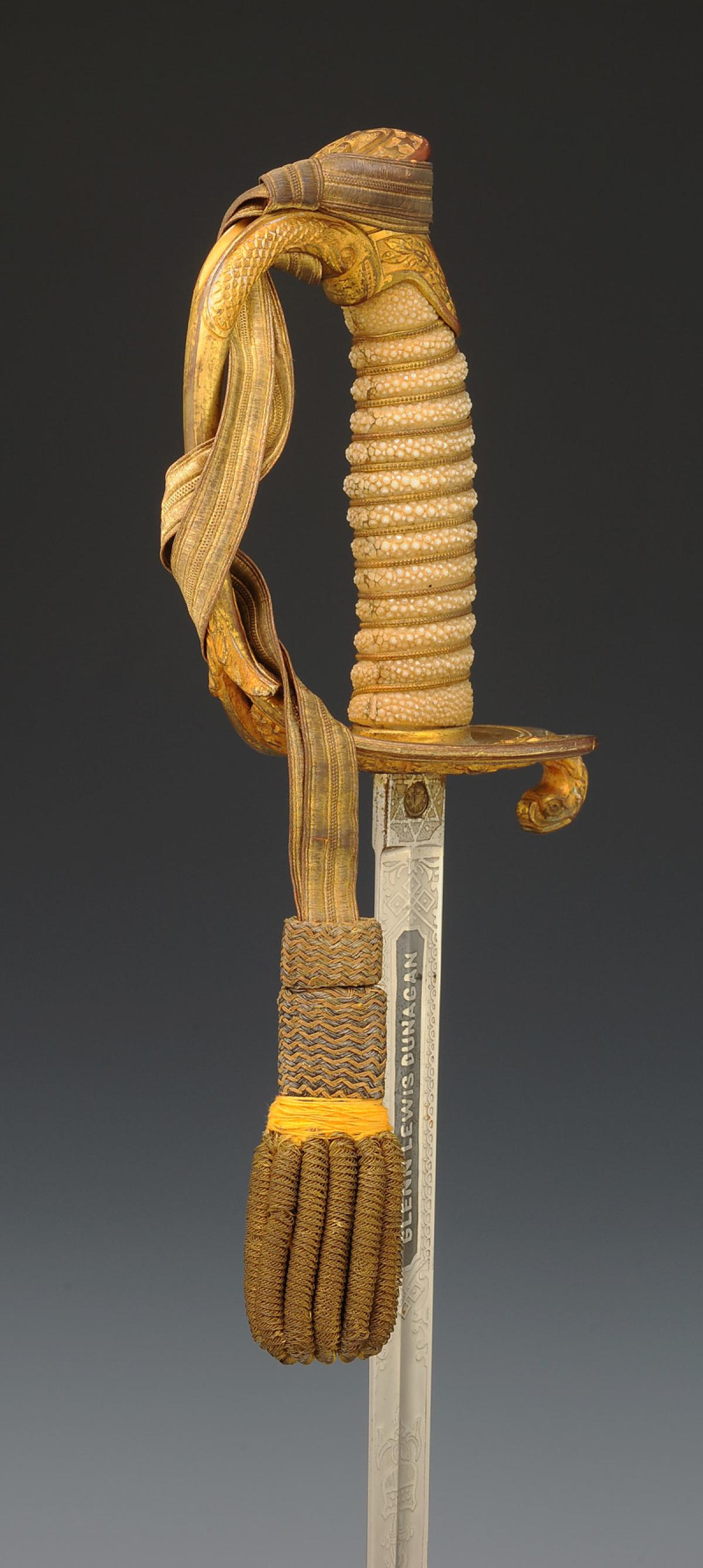
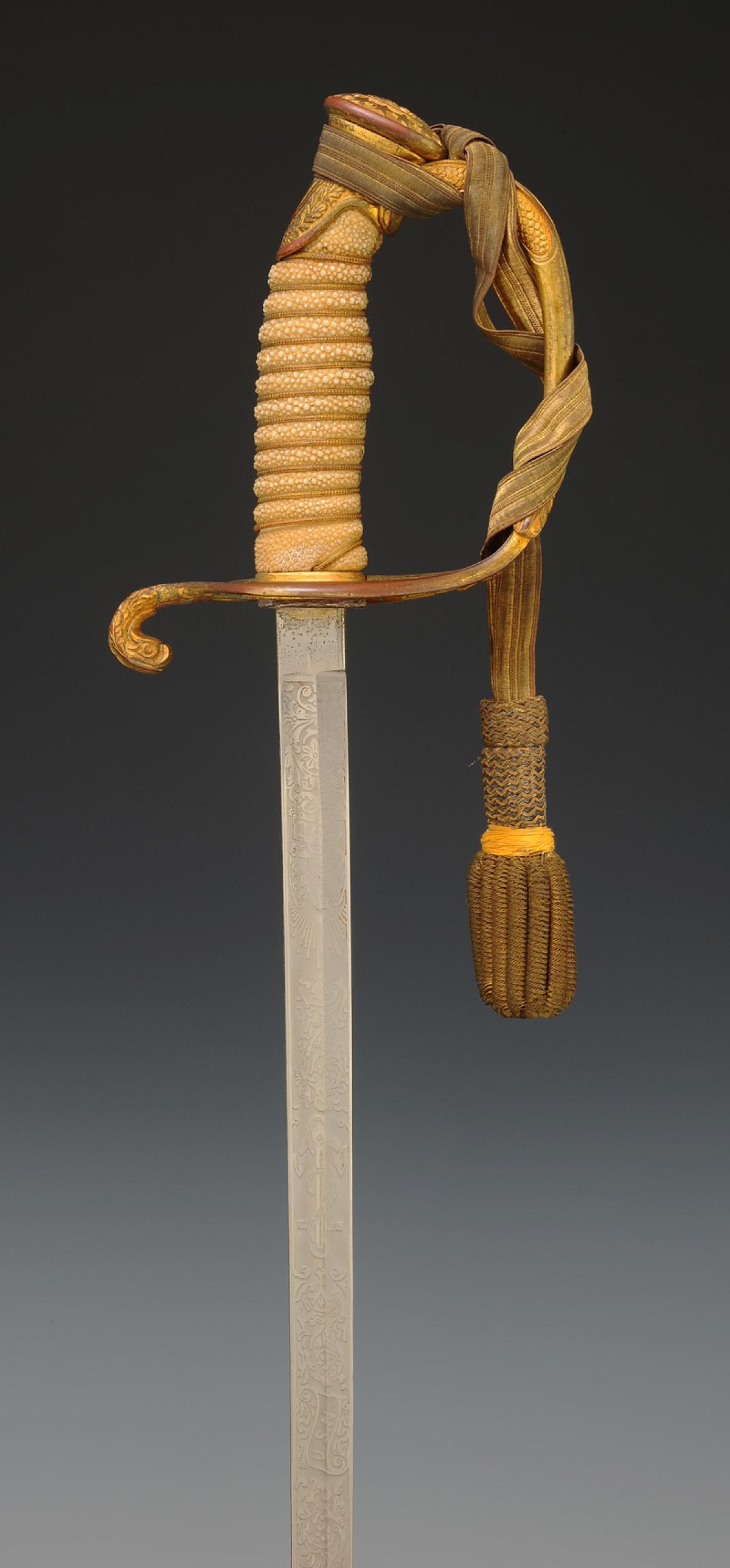
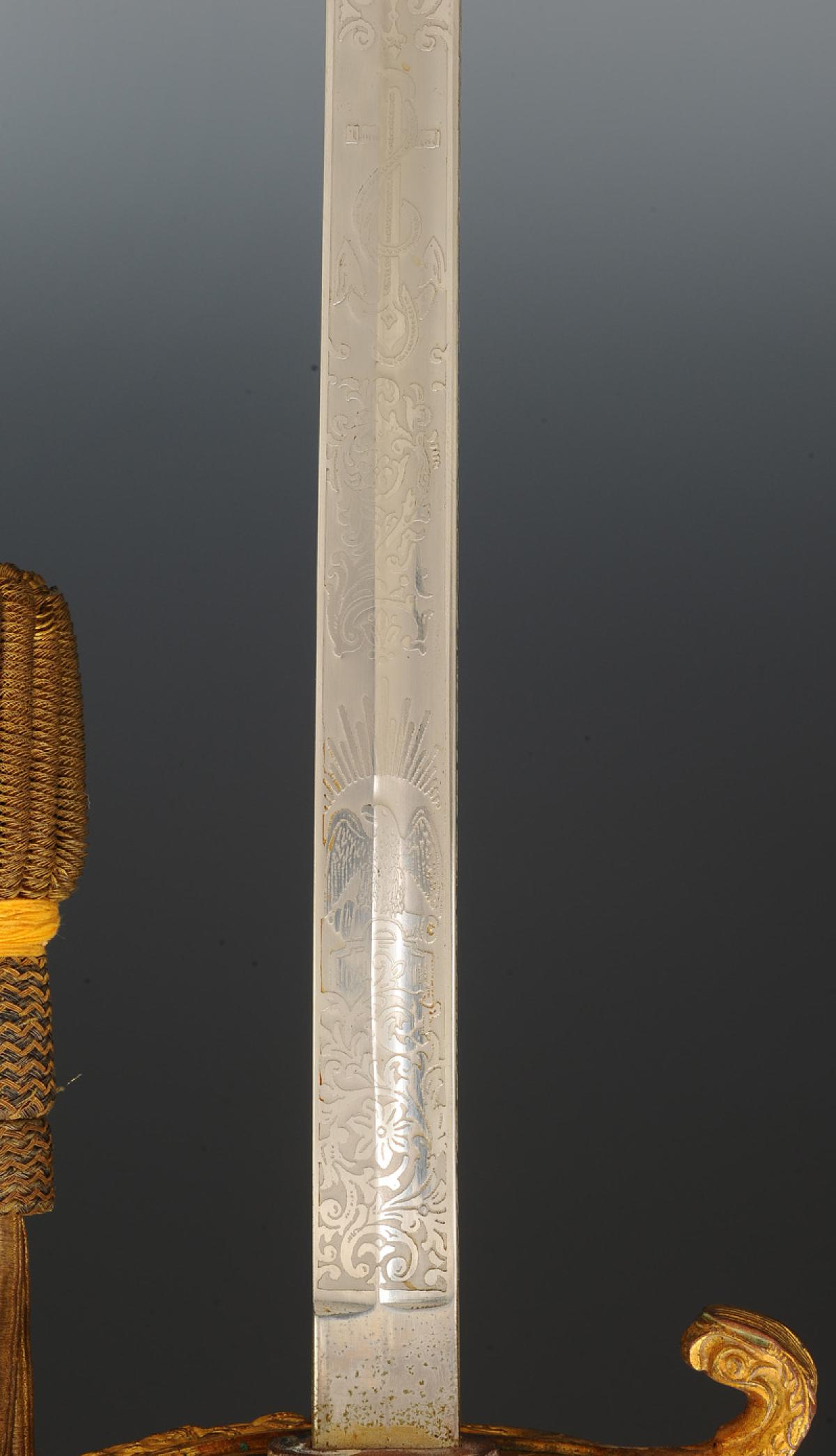
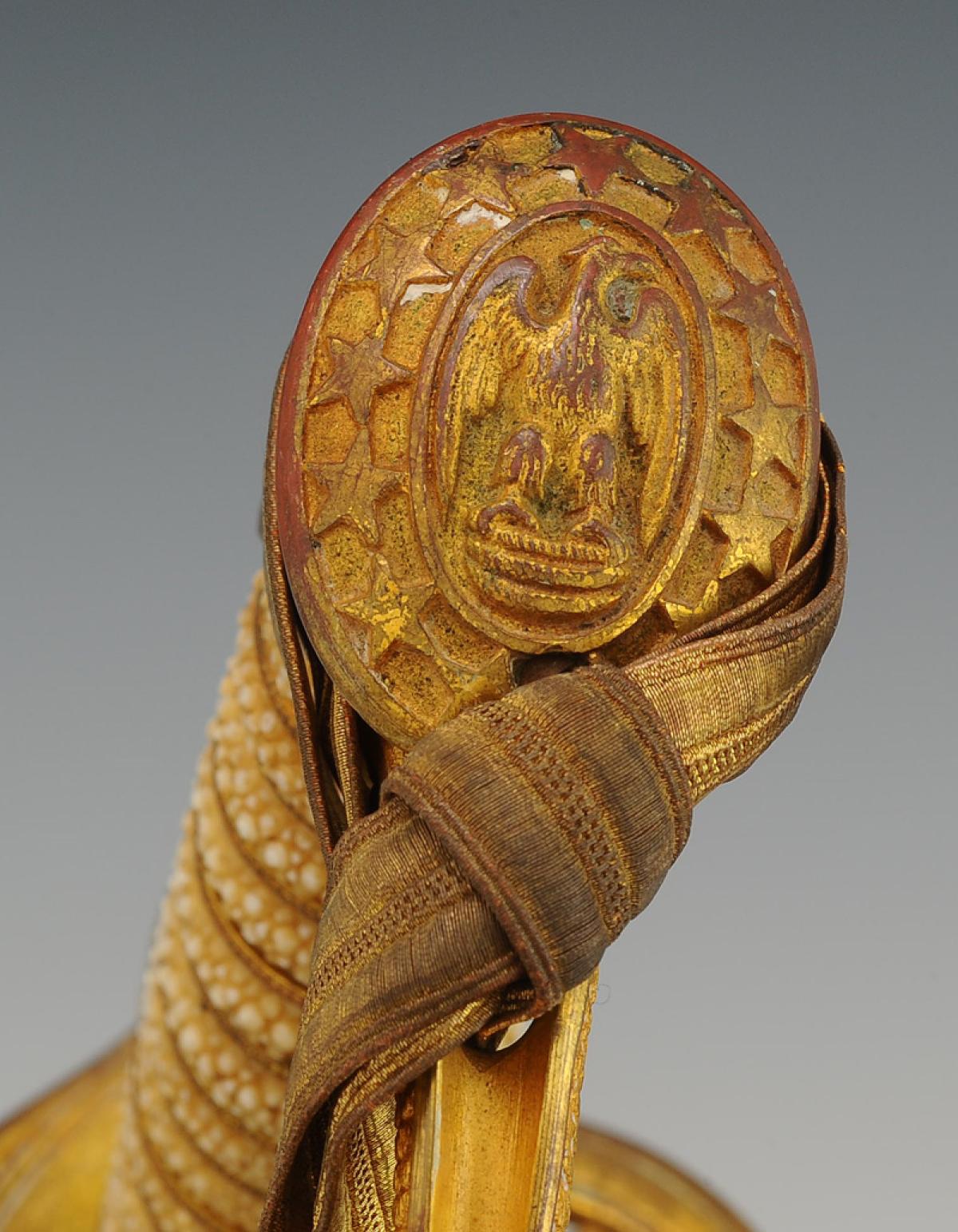
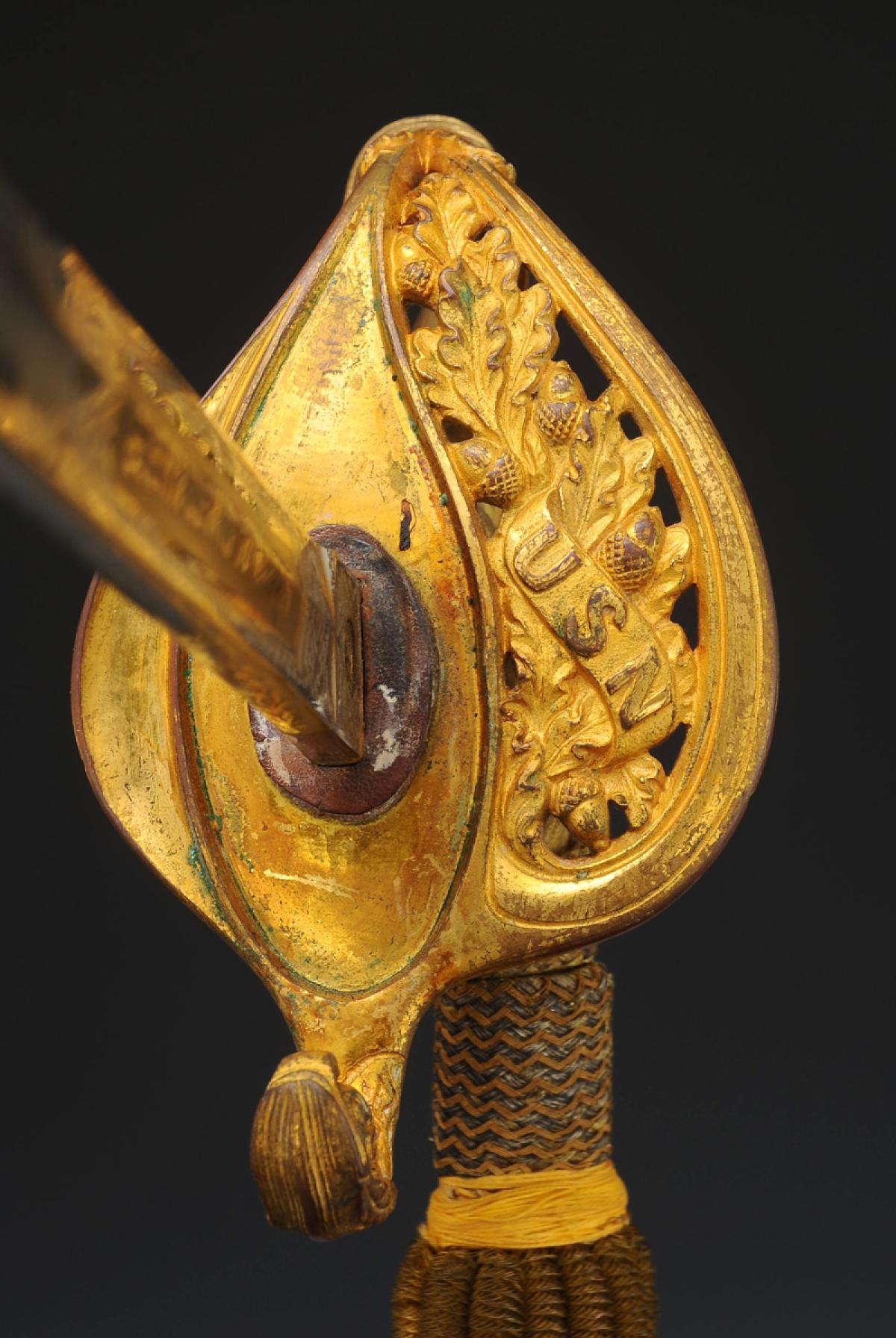
Gilt copper hilt. Two-branch guard forming a pierced shell decorated with a raised ribbon marked "USN" resting on an oak branch. Guard branch terminating in a dolphin shape at the top. Quillon representing a dolphin head. Cap with a short engraved tail of oak leaf branches with an oval cap depicting an American eagle surrounded by a wreath of thirteen stars. Ivory sharkskin-wrapped wooden grip, with silver-plated copper filigree. Natural leather knot. Straight blade with fullers, length 76 cm, nickel-plated and acid-etched on the obverse side at the base with a six-pointed star with the inscription « PROWED », then on two-thirds of the US Navy insignia framed by a vegetal decor and a gray background cartouche marked "GLENN LEWIS DUNAGAN"; and on the reverse, featuring the American eagle on a radiant background, a coiled anchor, and a ribbon with the inscription "U.S.N.", all on a vegetal decor.
Black varnished leather scabbard with three gilt copper fittings. Cap and central fitting embossed with a cable forming a knot with a suspension ring, bordered at their ends with a beaded molding. The cap bears the initials "GLD". The scabbard tip ending with a dolphin-shaped chape.
Gold passementerie sword knot, with large twisted cords known as "spinach seeds".
United States.
First half of the 19th century (approximately 1937-1939).
Good condition, slight wear of gilding on the relief of the hilt, rubbed gilding on the scabbard fittings, varnish on the leather scabbard chipped in places.
BIOGRAPHY :
GLENN LEWIS DUNAGAN
Deming, New Mexico
"Duke" "Dunny"
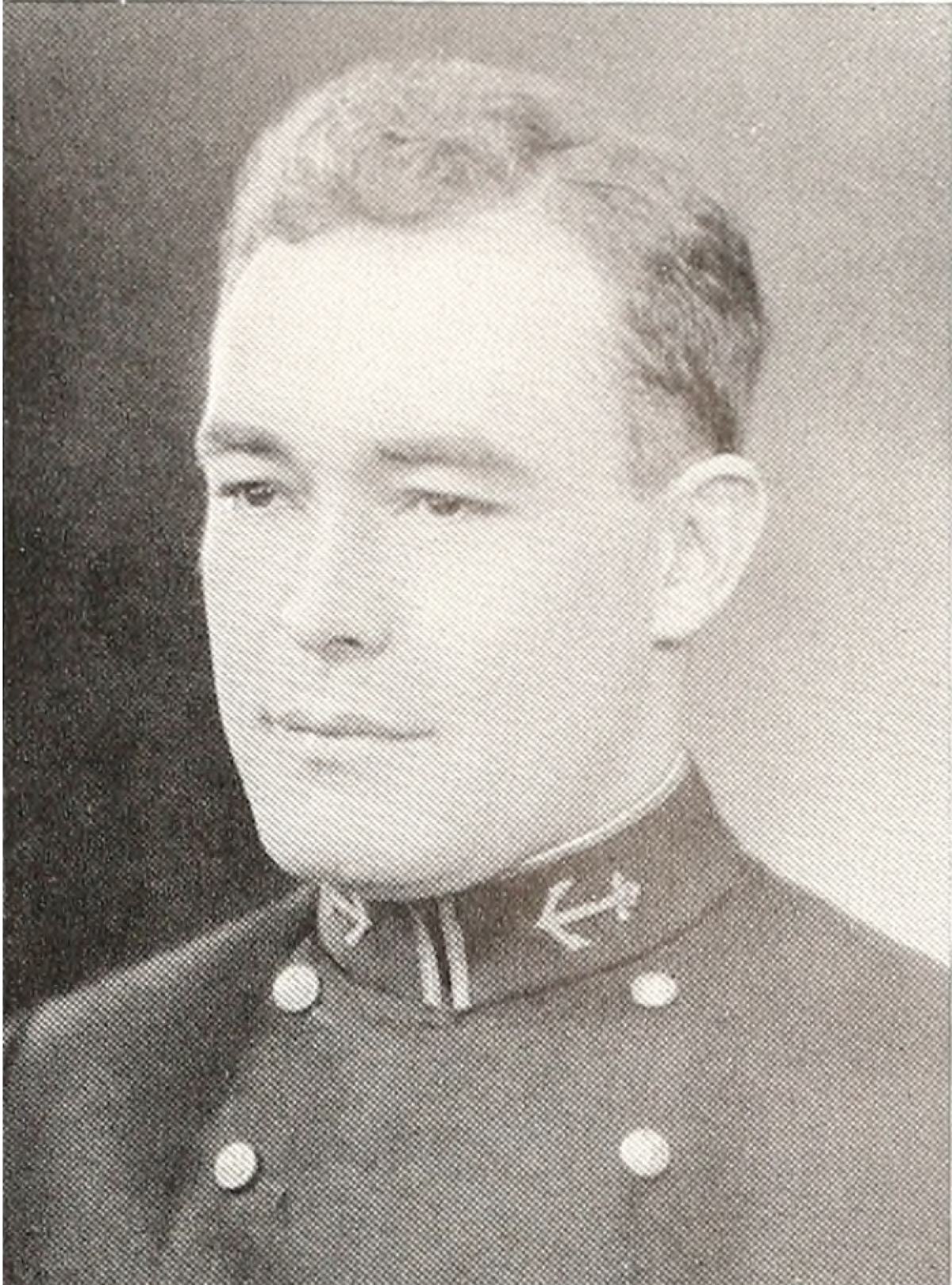
SOME few years ago a little border town in southern New Mexico lost a promising young cow-hand. For Glenn Dunagan up and left to seek his fortune in the world. Successively a cow-puncher, railroad "braky," student in the University of Colorado, locomotive fireman, flying cadet in the Army, sailor, and midshipman, Glenn seems to have had a varied life since he said goodbye to the desert. He finally cast his lot with the Navy, though even now we are not so sure of his continued presence. Academics will never stop him—but those dreams, oh those dreams! His favorite one is the founding of a gymnosophistic Utopia on a South Sea Island, where to eat, to sleep, to love, to live constitute the reg-book. To Glenn the aimless material strife of modern existence is all futility. Stoop not to drudgery, forget your troubles, be true to your instincts, fear not to live life in all its extremities!—here is what makes the wheels go round in that independent brain. He is fond of books and music, likes to write—even hopes some day to be an author. Perhaps those dreams will not be so unattainable after all for its the life in the mind that matters.
Loss
Glenn was lost on April 10, 1939 when his aircraft crashed near Del Mar, California.
While engaged in authorized and required flight in connection with gunnery work, SBU-1 airplane crashed, exploded and burned, at about 10.07 a.m., 10 April 1939, near Del Mar, Calif.:
Lieut, (jg) Glenn Lewis Dunagan, U.S.N.
Lieut, (jg) Thompson Clyde Guthrie, Jr., U.S.N.
The two were members of Scouting Squadron (VS) 2. Glenn had earned his wings as a qualified naval aviator on December 22, 1938.
Glenn was born in Alamosa, Colorado. His father Frank was in real estate, and his mother Luretta was a teacher and a deputy school superintendent. In 1910 the family including brother Finley and sister Evelyn lived in Mosca near the Great Sand Dunes National Park. In 1915 they moved to Deming, New Mexico, where his father became a livestock salesman.
In February 1922, Glenn starred as “The Ogre” in the Camp Fire Girl presentation of “Marry the Prince.” His mother was elected Superintendent of the Luna County Schools in 1924. He graduated from Deming High School in 1925. Upon graduation, he donated to the library a complete set of Makers of American History in 18 volumes, Makers of History in 30 volumes, and five volumes of Rollin’s Ancient History. In 1928 he donated a copy of Lindberg’s book “We” to the library.
After high school, Glenn was firing for the Santa Fe Railroad at San Marcial. He was then sent to Hurley for the fourth tramp run to Santa Rita. He later moved to Pueblo, Colorado, and then attended the University of Colorado at Boulder. In 1929 Senator Bronson M. Cutting appointed Glenn to the Naval Academy.
Glenn graduated from the Naval Academy in 1933 (Annapolis) and was then sent to Germany as a language student for two years. Following four years of service at sea, he completed aviation training at Pensacola.
In 1937 Glenn authored the article “Submarine History Makes Movie,” which appeared in an issue of the publication Our Navy.
In 1938 Glenn survived a crash at Pensacola. A member of Squadron One, he was on a training flight when his motor acted up. He landed in the bay, and the fuel line caught fire. Glenn jumped overboard with his parachute still on and was rescued by a crash boat from the station.
Glenn was survived by his wife Carmen, whom he married in 1934, his daughter born in 1935, and son Glenn Jr., born on November 28, 1936.
He is buried in Arlington National Cemetery.
Career
Glenn graduated on June 1, 1933 with his classmates, but he was not commissioned until August 29, 1935, when he was "Appointed in accordance with act of Aug. 29, 1935" (from Register of Commissioned and Warrant Officers of the United States Navy and Marine Corps of 1936).
Navy Directories & Officer Registers
The "Register of Commissioned and Warrant Officers of the United States Navy and Marine Corps" was published annually from 1815 through at least the 1970s; it provided rank, command or station, and occasionally billet until the beginning of World War II when command/station was no longer included. Scanned copies were reviewed and data entered from the mid-1840s through 1922, when more-frequent Navy Directories were available.
The Navy Directory was a publication that provided information on the command, billet, and rank of every active and retired naval officer. Single editions have been found online from January 1915 and March 1918, and then from three to six editions per year from 1923 through 1940; the final edition is from April 1941.
The entries in both series of documents are sometimes cryptic and confusing. They are often inconsistent, even within an edition, with the name of commands; this is especially true for aviation squadrons in the 1920s and early 1930s.
Alumni listed at the same command may or may not have had significant interactions; they could have shared a stateroom or workspace, stood many hours of watch together, or, especially at the larger commands, they might not have known each other at all. The information provides the opportunity to draw connections that are otherwise invisible, though, and gives a fuller view of the professional experiences of these alumni in Memorial Hall.
Gilt copper hilt. Two-branch guard forming a pierced shell decorated with a raised ribbon marked "USN" resting on an oak branch. Guard branch terminating in a dolphin shape at the top. Quillon representing a dolphin head. Cap with a short engraved tail of oak leaf branches with an oval cap depicting an American eagle surrounded by a wreath of thirteen stars. Ivory sharkskin-wrapped wooden grip, with silver-plated copper filigree. Natural leather knot. Straight blade with fullers, length 76 cm, nickel-plated and acid-etched on the obverse side at the base with a six-pointed star with the inscription « PROWED », then on two-thirds of the US Navy insignia framed by a vegetal decor and a gray background cartouche marked "GLENN LEWIS DUNAGAN"; and on the reverse, featuring the American eagle on a radiant background, a coiled anchor, and a ribbon with the inscription "U.S.N.", all on a vegetal decor.
Black varnished leather scabbard with three gilt copper fittings. Cap and central fitting embossed with a cable forming a knot with a suspension ring, bordered at their ends with a beaded molding. The cap bears the initials "GLD". The scabbard tip ending with a dolphin-shaped chape.
Gold passementerie sword knot, with large twisted cords known as "spinach seeds".
United States.
First half of the 19th century (approximately 1937-1939).
Good condition, slight wear of gilding on the relief of the hilt, rubbed gilding on the scabbard fittings, varnish on the leather scabbard chipped in places.
BIOGRAPHY :
GLENN LEWIS DUNAGAN
Deming, New Mexico
"Duke" "Dunny"
SOME few years ago a little border town in southern New Mexico lost a promising young cow-hand. For Glenn Dunagan up and left to seek his fortune in the world. Successively a cow-puncher, railroad "braky," student in the University of Colorado, locomotive fireman, flying cadet in the Army, sailor, and midshipman, Glenn seems to have had a varied life since he said goodbye to the desert. He finally cast his lot with the Navy, though even now we are not so sure of his continued presence. Academics will never stop him—but those dreams, oh those dreams! His favorite one is the founding of a gymnosophistic Utopia on a South Sea Island, where to eat, to sleep, to love, to live constitute the reg-book. To Glenn the aimless material strife of modern existence is all futility. Stoop not to drudgery, forget your troubles, be true to your instincts, fear not to live life in all its extremities!—here is what makes the wheels go round in that independent brain. He is fond of books and music, likes to write—even hopes some day to be an author. Perhaps those dreams will not be so unattainable after all for its the life in the mind that matters.
Loss
Glenn was lost on April 10, 1939 when his aircraft crashed near Del Mar, California.
While engaged in authorized and required flight in connection with gunnery work, SBU-1 airplane crashed, exploded and burned, at about 10.07 a.m., 10 April 1939, near Del Mar, Calif.:
Lieut, (jg) Glenn Lewis Dunagan, U.S.N.
Lieut, (jg) Thompson Clyde Guthrie, Jr., U.S.N.
The two were members of Scouting Squadron (VS) 2. Glenn had earned his wings as a qualified naval aviator on December 22, 1938.
Glenn was born in Alamosa, Colorado. His father Frank was in real estate, and his mother Luretta was a teacher and a deputy school superintendent. In 1910 the family including brother Finley and sister Evelyn lived in Mosca near the Great Sand Dunes National Park. In 1915 they moved to Deming, New Mexico, where his father became a livestock salesman.
In February 1922, Glenn starred as “The Ogre” in the Camp Fire Girl presentation of “Marry the Prince.” His mother was elected Superintendent of the Luna County Schools in 1924. He graduated from Deming High School in 1925. Upon graduation, he donated to the library a complete set of Makers of American History in 18 volumes, Makers of History in 30 volumes, and five volumes of Rollin’s Ancient History. In 1928 he donated a copy of Lindberg’s book “We” to the library.
After high school, Glenn was firing for the Santa Fe Railroad at San Marcial. He was then sent to Hurley for the fourth tramp run to Santa Rita. He later moved to Pueblo, Colorado, and then attended the University of Colorado at Boulder. In 1929 Senator Bronson M. Cutting appointed Glenn to the Naval Academy.
Glenn graduated from the Naval Academy in 1933 (Annapolis) and was then sent to Germany as a language student for two years. Following four years of service at sea, he completed aviation training at Pensacola.
In 1937 Glenn authored the article “Submarine History Makes Movie,” which appeared in an issue of the publication Our Navy.
In 1938 Glenn survived a crash at Pensacola. A member of Squadron One, he was on a training flight when his motor acted up. He landed in the bay, and the fuel line caught fire. Glenn jumped overboard with his parachute still on and was rescued by a crash boat from the station.
Glenn was survived by his wife Carmen, whom he married in 1934, his daughter born in 1935, and son Glenn Jr., born on November 28, 1936.
He is buried in Arlington National Cemetery.
Career
Glenn graduated on June 1, 1933 with his classmates, but he was not commissioned until August 29, 1935, when he was "Appointed in accordance with act of Aug. 29, 1935" (from Register of Commissioned and Warrant Officers of the United States Navy and Marine Corps of 1936).
Navy Directories & Officer Registers
The "Register of Commissioned and Warrant Officers of the United States Navy and Marine Corps" was published annually from 1815 through at least the 1970s; it provided rank, command or station, and occasionally billet until the beginning of World War II when command/station was no longer included. Scanned copies were reviewed and data entered from the mid-1840s through 1922, when more-frequent Navy Directories were available.
The Navy Directory was a publication that provided information on the command, billet, and rank of every active and retired naval officer. Single editions have been found online from January 1915 and March 1918, and then from three to six editions per year from 1923 through 1940; the final edition is from April 1941.
The entries in both series of documents are sometimes cryptic and confusing. They are often inconsistent, even within an edition, with the name of commands; this is especially true for aviation squadrons in the 1920s and early 1930s.
Alumni listed at the same command may or may not have had significant interactions; they could have shared a stateroom or workspace, stood many hours of watch together, or, especially at the larger commands, they might not have known each other at all. The information provides the opportunity to draw connections that are otherwise invisible, though, and gives a fuller view of the professional experiences of these alumni in Memorial Hall.
Price :
700,00 €
| Destination | Envoi recommandé | Envoi Recommandé + Express |
|---|---|---|
| Shipping France | 18,00 € | 80,00 € |
| Shipping Europe | 24,00 € | 150,00 € |
| Shipping world | 63,00 € | 200,00 € |
Insurance (1%) :
7,00 €
Reference :
32678
Next update Friday, octobre 23 at 13:30 PM
FOR ALL PURCHASES, PAYMENT IN MULTIPLE CHECKS POSSIBLE
bertrand.malvaux@wanadoo.fr 06 07 75 74 63
SHIPPING COSTS
Shipping costs are calculated only once per order for one or more items, all shipments are sent via registered mail, as this is the only way to have proof of dispatch and receipt.
For parcels whose value cannot be insured by the Post, shipments are entrusted to DHL or Fedex with real value insured, the service is of high quality but the cost is higher.
RETURN POLICY
Items can be returned within 8 days of receipt. They must be returned by registered mail at the sender's expense, in their original packaging, and in their original condition.
AUTHENTICITY
The selection of items offered on this site allows me to guarantee the authenticity of each piece described here, all items offered are guaranteed to be period and authentic, unless otherwise noted or restricted in the description.
An authenticity certificate of the item including the description published on the site, the period, the sale price, accompanied by one or more color photographs is automatically provided for any item priced over 130 euros. Below this price, each certificate is charged 5 euros.
Only items sold by me are subject to an authenticity certificate, I do not provide any expert reports for items sold by third parties (colleagues or collectors).
FOR ALL PURCHASES, PAYMENT IN MULTIPLE CHECKS POSSIBLE
bertrand.malvaux@wanadoo.fr 06 07 75 74 63
An authenticity certificate of the item including the description published on the site, the period, the sale price, accompanied by one or more color photographs is automatically provided for any item priced over 130 euros. Below this price, each certificate is charged 5 euros.
Only items sold by me are subject to an authenticity certificate, I do not provide any expert reports for items sold by third parties (colleagues or collectors).