
OFFICER SWORD OF THE INDIAN NAVY BELONGING TO COMMANDER HEDLEY VICARS BANFIELD, Commander of the ship HMIS LAWRENCE in 1940, First half of the 20th century. 32670


Sold out
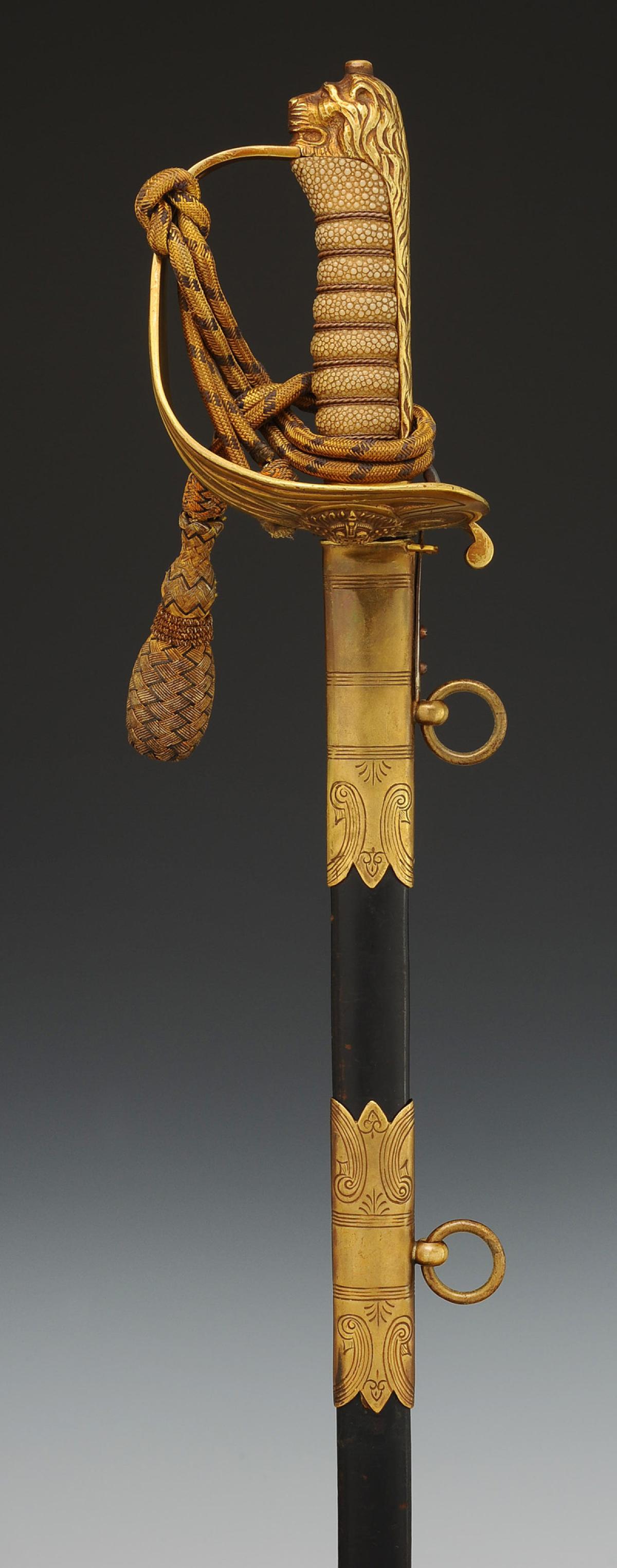
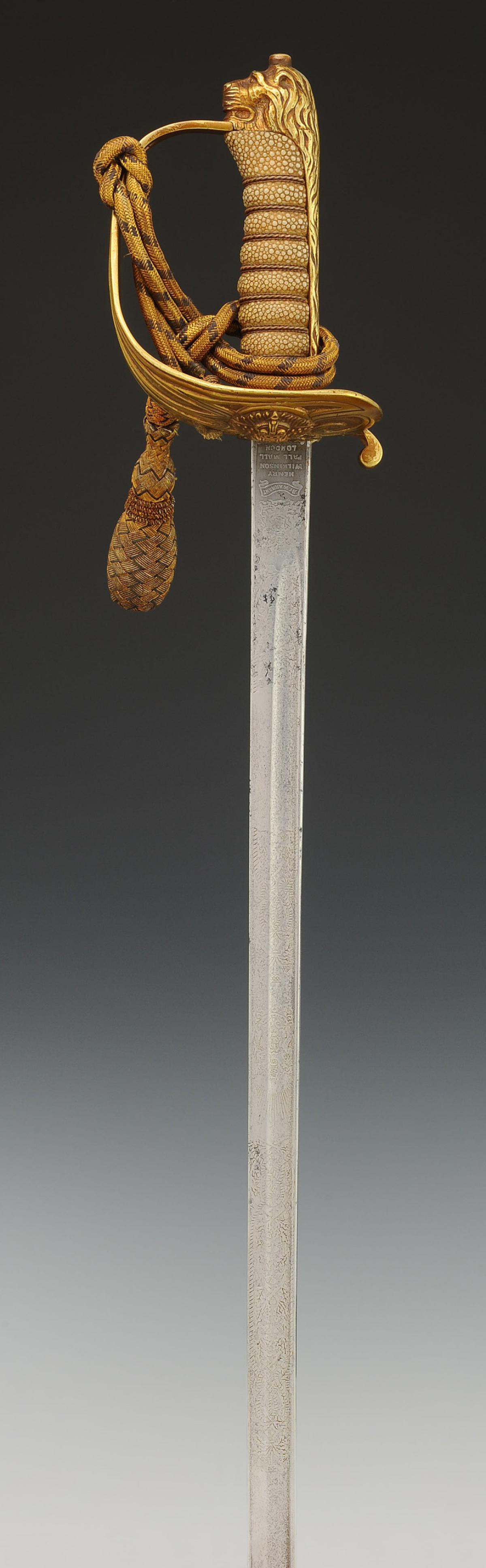
OFFICER'S SWORD OF THE INDIAN NAVY THAT BELONGED TO COMMANDER HEDLEY VICARS BANFIELD, Commander of the ship HMIS LAWRENCE in 1940, First half of the 20th century. 32670
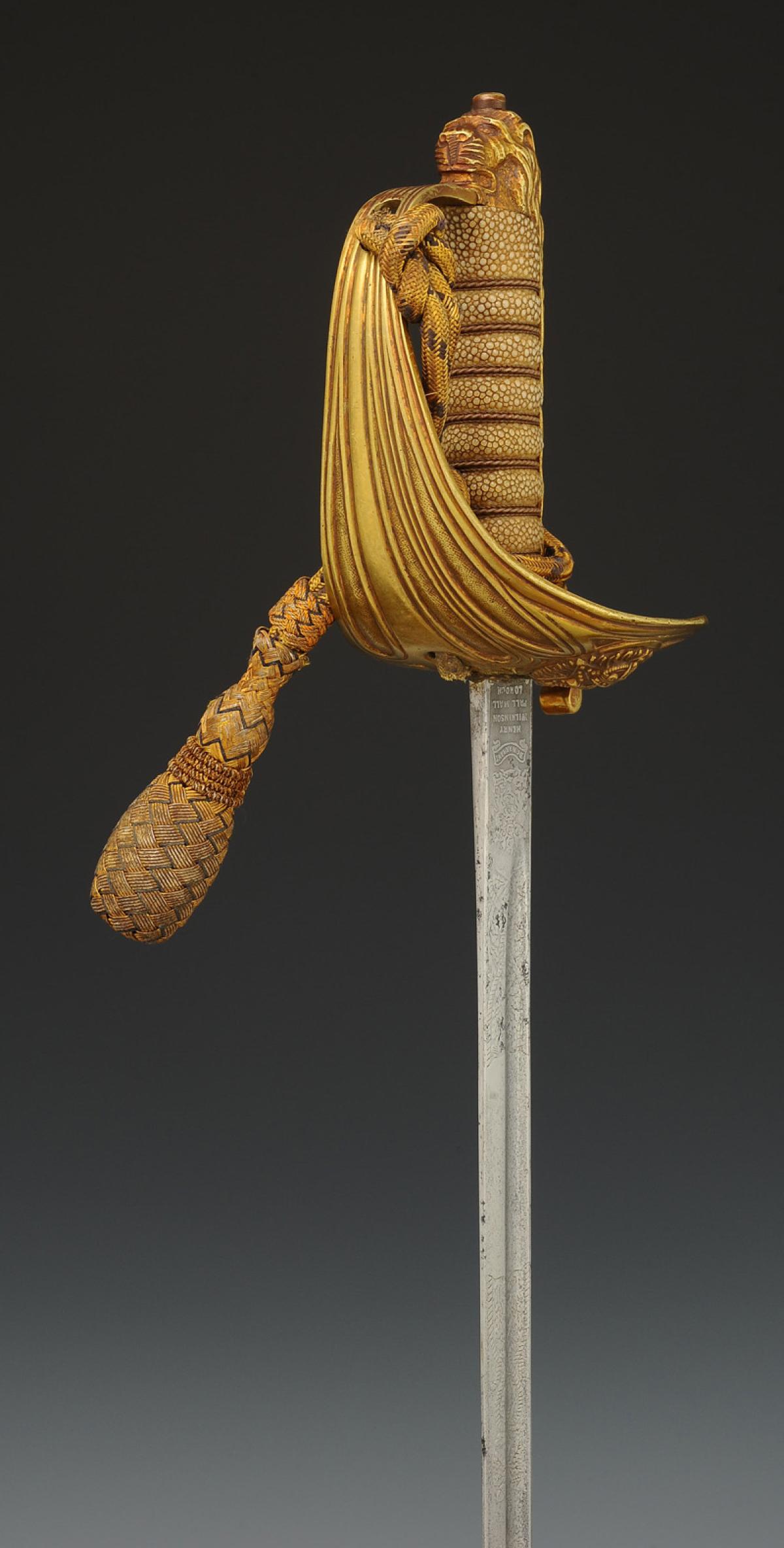
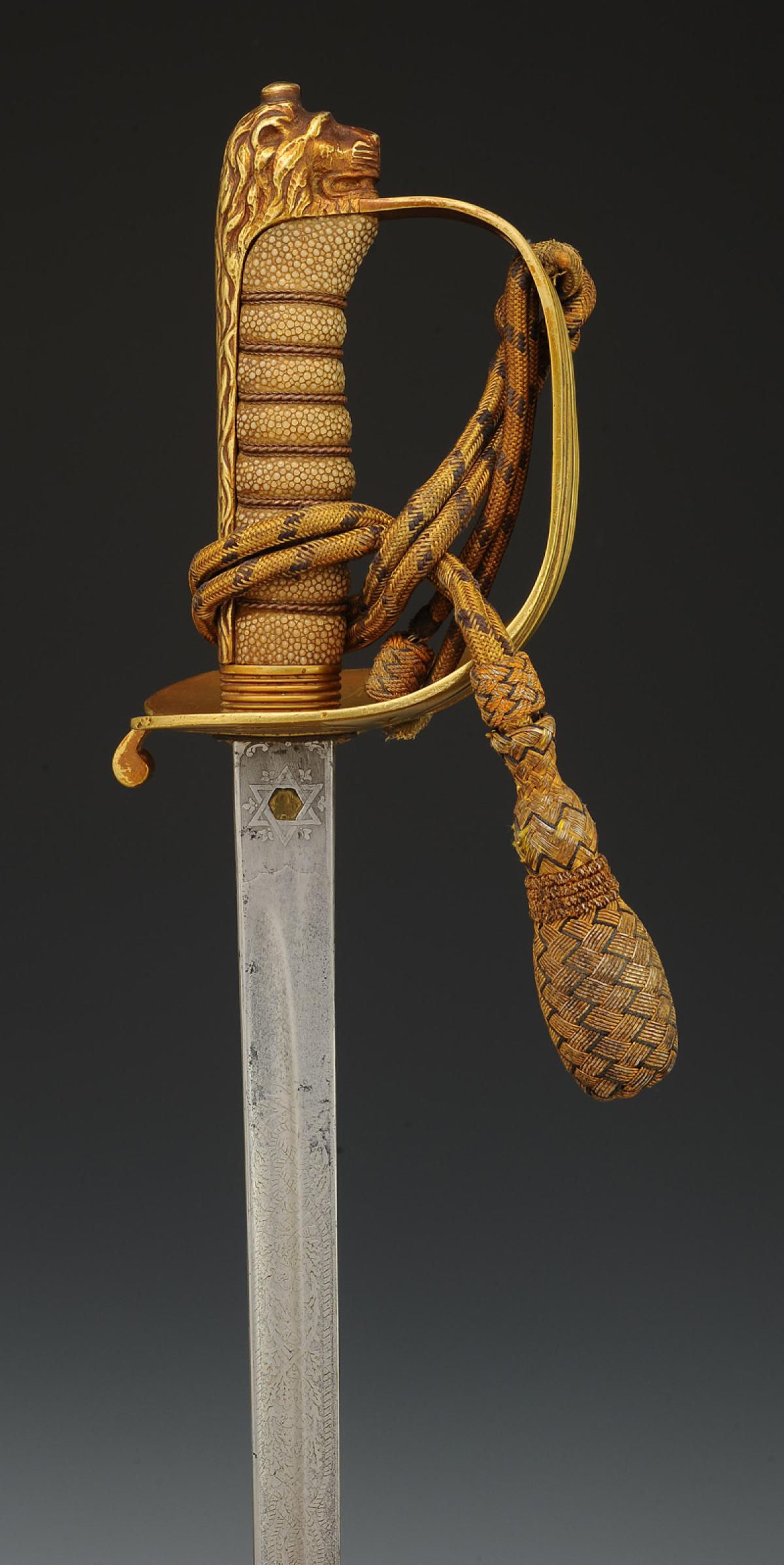
Sword based on the British 1827 pattern sword.
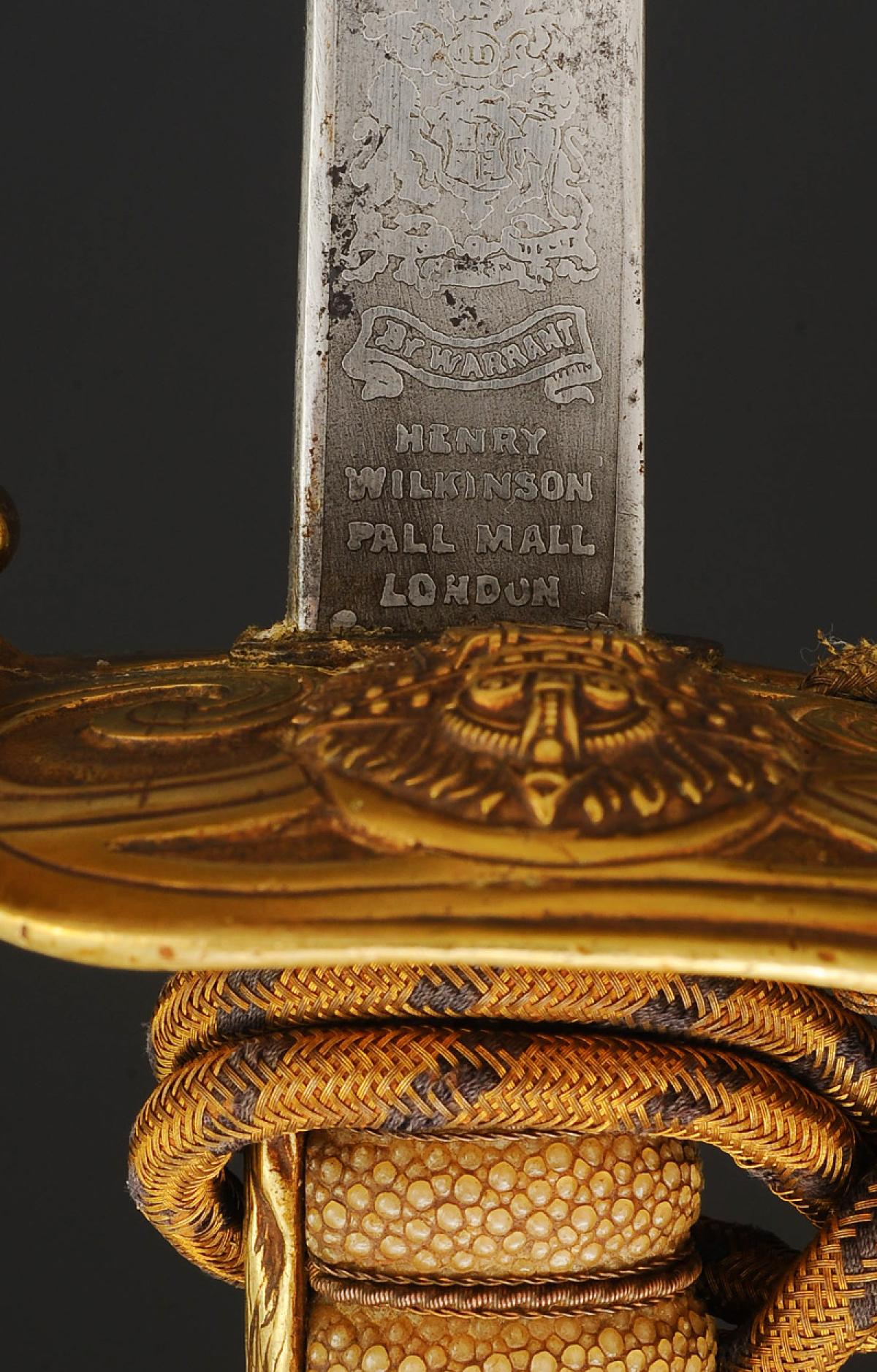
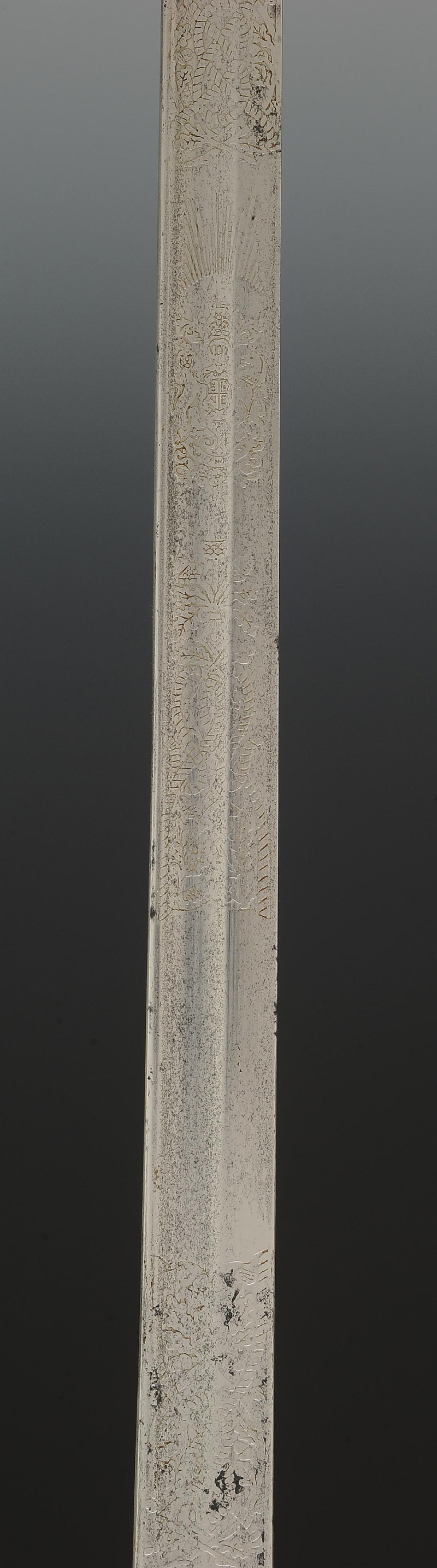
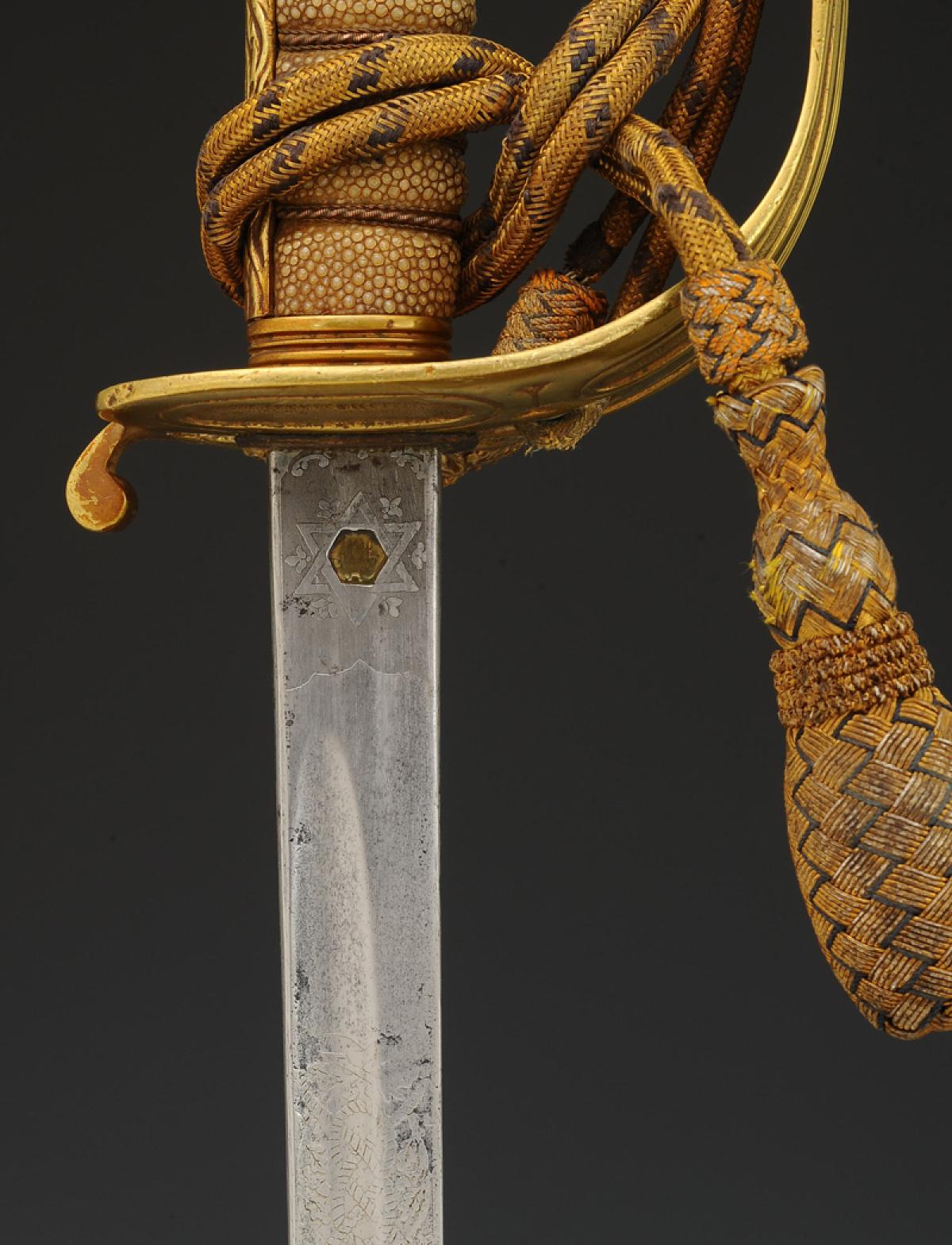
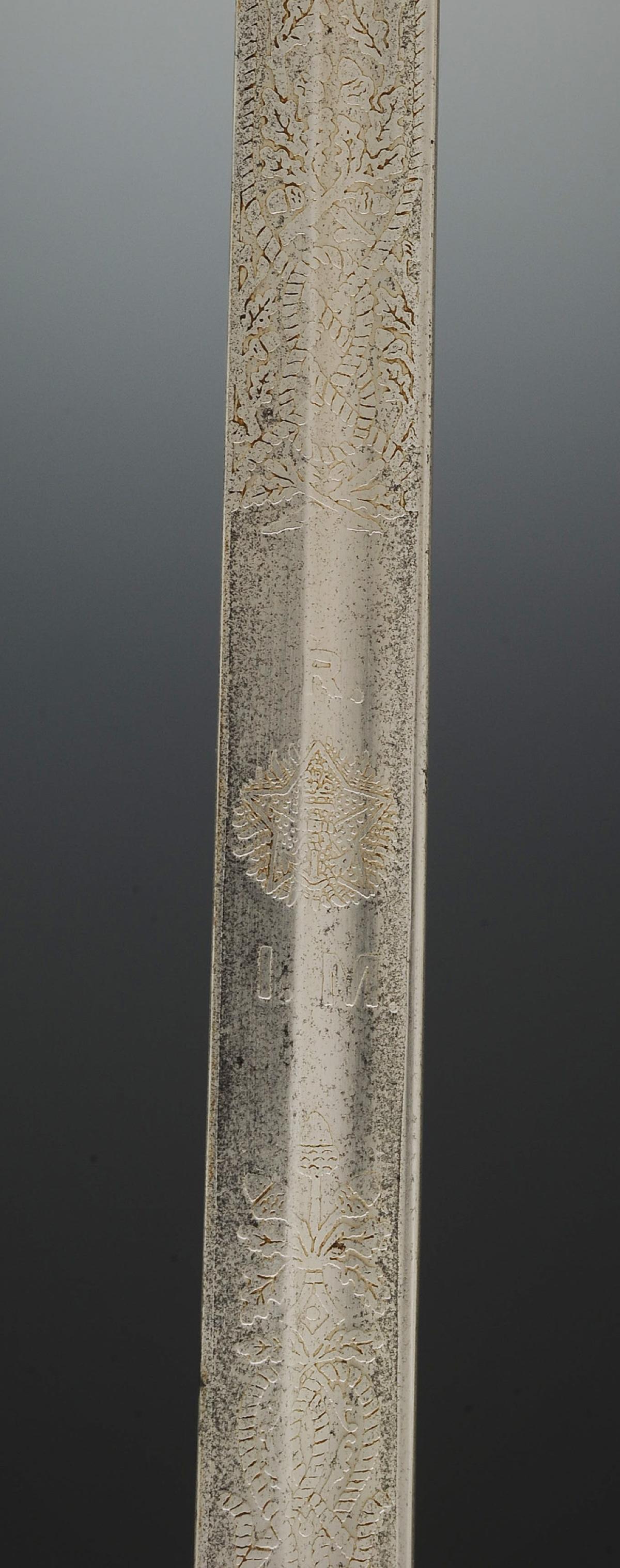
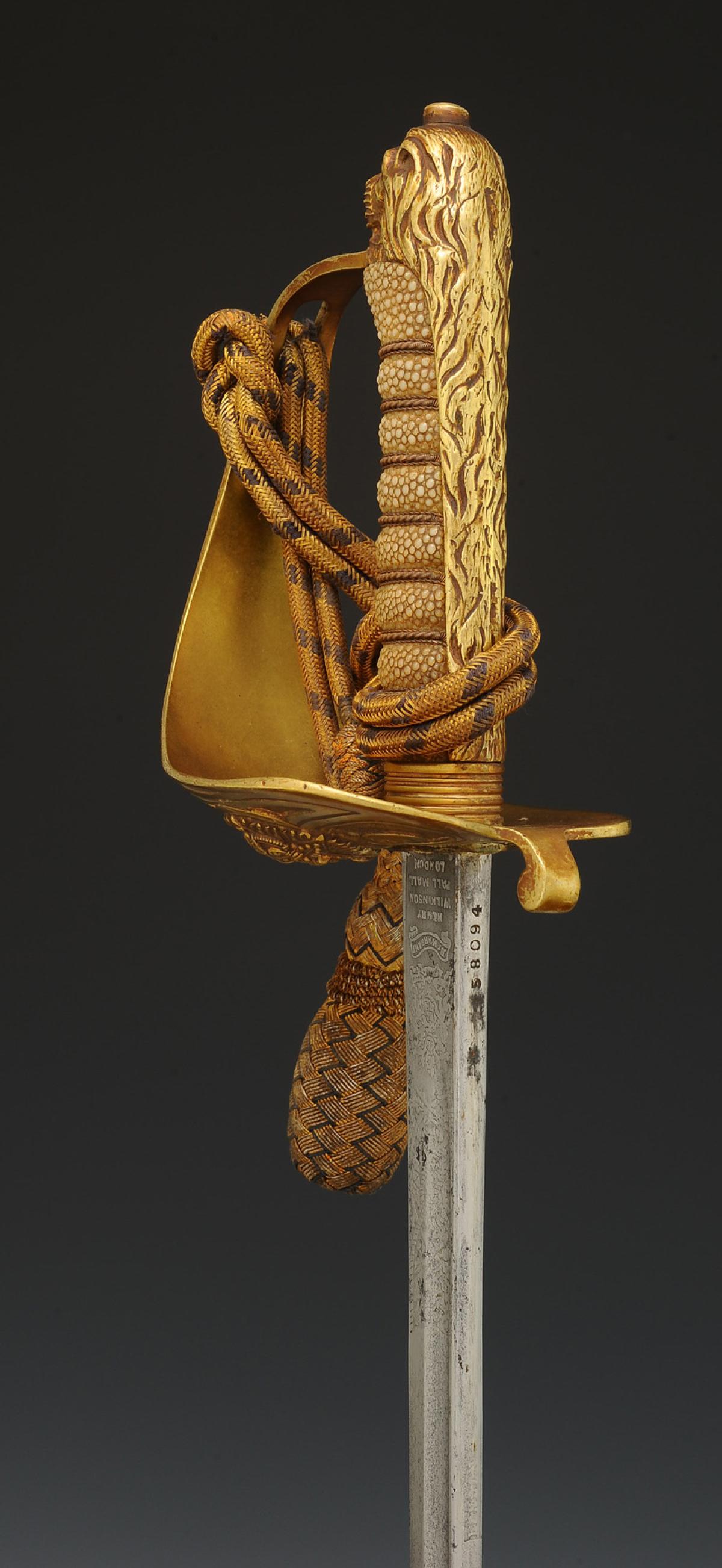
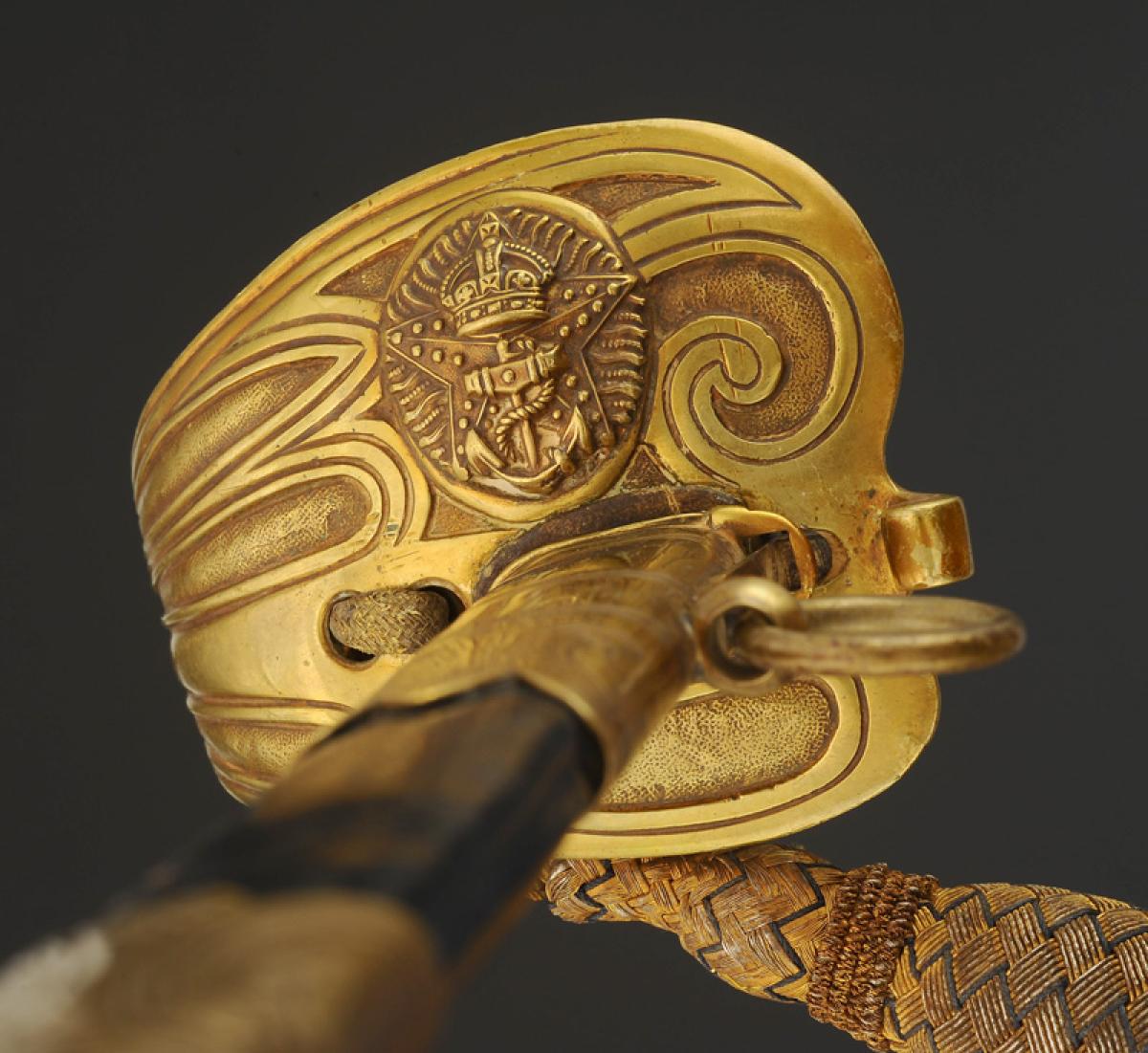
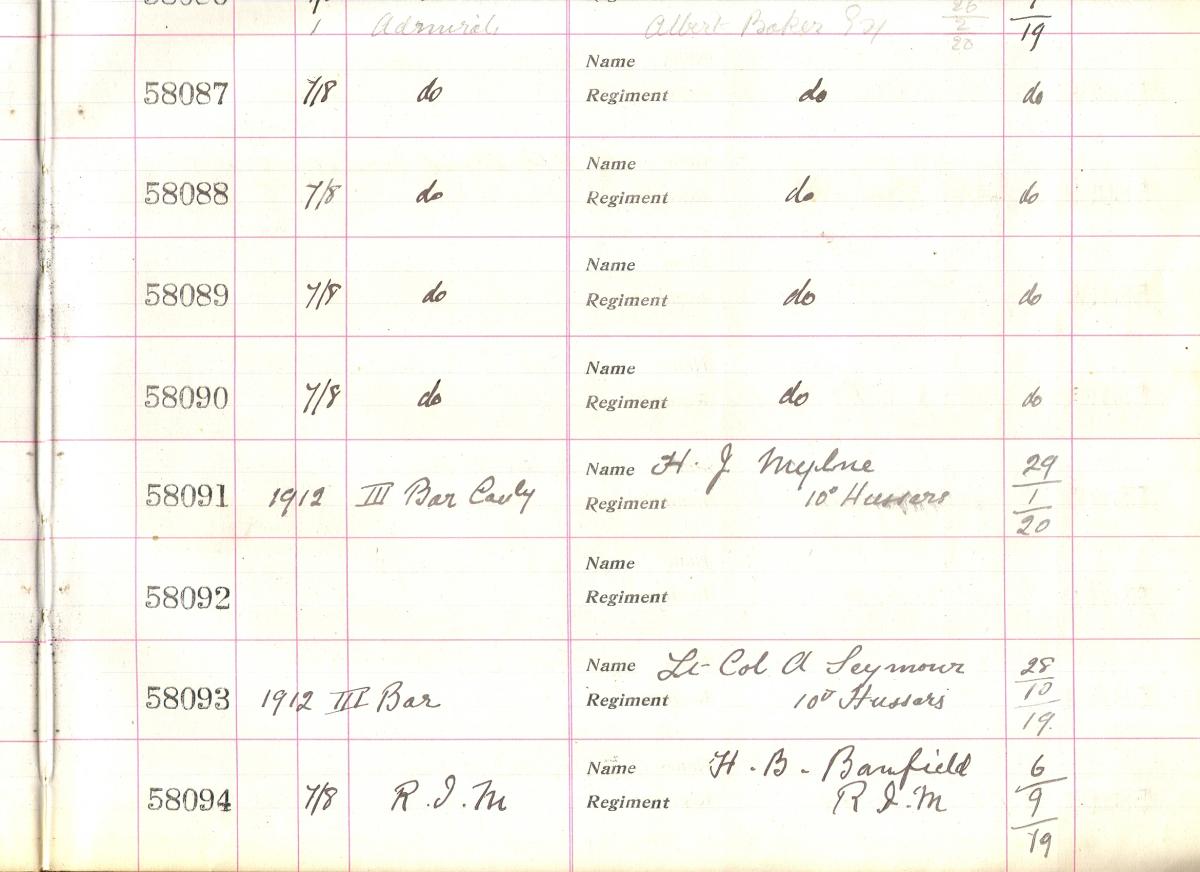
Brass hilt. Guard with a wide solid branch decorated with a molded medallion of a crowned fouled anchor on a background of a beaded star with radiant sun. Pommel with a long lion head tail. Handle made of wood covered with white shagreen filigree copper. Decorated ferrule with lines. Natural leather knot. Straight blade with grooves, length 81 cm, engraved on two-thirds on each side with acid: on the front face, signed at the heel with the English coat of arms with the inscription "BY WARRANT / HENRY / WILKINSON / PALL MALL / LONDON" and engraved with a vegetal decoration framing the arms of the Indian Empire (1); on the back face at the heel, a six-pointed star, the initials "R.I.M." flanking the arms of the Indian Navy (star on a radiant background). Blade back marked "58094". Natural leather knot.
Black varnished leather scabbard with three brass fittings engraved with lines and palmettes. Chape with suspension ring and clip as well as a steel frog securing the sword in the scabbard. Middle fitting with suspension ring. Scabbard tip with a lyre-shaped chape.
Dragoon cord mixed with black silk and gold trimmings.
India.
First half of the 20th century, circa 1940.
Very good condition, leather scabbard with a fold mark in its center.
(1) Coats of arms of the Indian Empire. The emblems are as follows: The Indian elephant surrounded by 9 lotuses, representing the imperial capital of New Delhi. Bengal tiger and ship of the English East India Company, representing the Bengal presidency. Rampant rhinoceros, representing the province of Assam.
HISTORY:
The HMIS Lawrence was a sloop, commissioned in 1919 in the Royal Indian Marine. It served during the Second World War in the Royal Indian Navy, the successor to the RIM. Its pennant number was changed to U83 in 1940.
Builder William Beardmore and Company
Launched 30 July 1919
Commissioned 27 December 1919
Decommissioned 1947
Fate Scrapped in 1947
Displacement 1,225 long tons (1,245 t) standard
Length 225 feet (69 m) p/p
248 feet 6 inches (75.74 m) overall
Beam 34 feet (10 m)
Draft 8 feet 9 inches (2.67 m)
Installed power 1,900 hp (1,400 kW)
Propulsion Gear-driven steam turbines, 2 Babcock boilers, 2 shafts
Speed 15 knots (17 mph; 28 km/h)
Complement 97
Armament 2 x 4-inch (100 mm) guns, 1 x 2-pounder pompom
The HMIS Lawrence was commissioned as part of the First World War emergency war program, launched by William Beardmore and Company on 30 July 1919 and completed on 27 December 1919. In the years immediately following the war, the Lawrence was used by the Royal Indian Marine for buoy and lighthouse maintenance and as a transport for senior officials in the Persian Gulf.
In 1925, while on anti-slavery patrols, the ship bombarded Fujairah Fort, destroying three of the fort's towers. At the outbreak of World War II, the Lawrence, whose armament had been increased by the addition of four 3-pounder guns and a second 2-pounder gun, was deployed to Masirah Island off the coast of Oman where it was used for patrols, participating in the unsuccessful search for the missing airliner Hannibal in March 1940.
Just before the outbreak of the Anglo-Iraqi War, Lawrence helped cover the landing of the 20th Indian Infantry Brigade at Basra on 18 April 1941. When Britain and the Soviet Union invaded Iran in August 1941, Lawrence took part in the attack on Abadan on 25 August 1941, boarding and capturing the Iranian gunboats Karkas and Shahbaaz, as well as two Italian merchant ships.
By late 1944, Lawrence was assigned to the HMIS Himalaya, the Karachi Gunnery School ship, and joined the Bombay Training Squadron in November 1945.
Lawrence was decommissioned and scrapped in 1947, two years after the end of the war.
BIOGRAPHY:
Hedley Shafto Johnstone Vicars (7 December 1826 – 22 March 1855) was a British Army officer and evangelist, killed in action during the Crimean War.
Vicars was born on 7 December 1826 in Mauritius, where his father, Captain Richard John Vicars (d. 1839), of the Royal Engineers, was stationed at the time. His mother, Marianne Williams, was from Newfoundland. He was the eldest of a large family.
After passing his exams at Woolwich on 22 December 1843, he was commissioned as an officer in the 97th Infantry Regiment and, the following year, was posted to Corfu. On 6 November 1846, he was promoted to the rank of lieutenant. In 1848, his regiment was transferred to Jamaica, and then in 1851 to Nova Scotia.
In November of that same year, he experienced a serious existential crisis, and his character underwent a profound transformation. He befriended Dr. Twining, the chaplain of the Halifax garrison, became a Sunday school monitor, visited the sick, and took every opportunity to read Scriptures and pray with the men of his company.
In 1852, he was appointed adjutant of his regiment. In May 1853, the regiment returned to England, and in August, he resigned from his adjutant post. He also became an active participant in Exeter Hall meetings and an active member of the Soldiers' Aid Society, meeting with railway workers on several occasions.
Before his regiment departed for the Crimea in early 1854, it was reported that "since Mr. Vicars has shown such devotion, he has rallied about four hundred men of the regiment to his cause." In Piraeus, many men from the 97th Regiment died from cholera, and Vicars, at their funerals, took every opportunity to address those present at the gravesides.
On 3 November 1854, he was promoted to captain. On 20 November 1854, he landed in the Crimea and, with his regiment, participated in the siege of Sevastopol. There, he continued his religious work, organizing prayer meetings in his tent, visiting the sick in hospitals, and carefully watching over his men.
In the night of 22 March 1855, while in the trenches, the Russians launched a major sortie from Sevastopol and, catching the English off guard, drove them out of their trenches. Vicars, keeping his men under control, fired a volley at the enemy from twenty paces, then, charging with the 97th Regiment, pushed back the Russians and regained control of the trenches.
He was killed in a Russian sortie from Sevastopol on 22 March 1855. Before falling, he killed two men barehanded, then was stabbed with a bayonet and shot in the right shoulder. He was buried the next day on the road to Woronzoff, near the milestone.
In his report of 6 April, Lord Raglan praised Vicars' bravery.
Tributes to Captain Hedley Vicars (with a portrait and a view of his grave), by the author of "The Victory Won," Catherine M. Marsh, were published shortly after his death. These tributes are dedicated "to her whom God graciously chose to sow in his young heart his first imperishable seed." The work received wide circulation and was translated into French, German, Swedish, and Italian.
Sword based on the British 1827 pattern sword.
Brass hilt. Guard with a wide solid branch decorated with a molded medallion of a crowned fouled anchor on a background of a beaded star with radiant sun. Pommel with a long lion head tail. Handle made of wood covered with white shagreen filigree copper. Decorated ferrule with lines. Natural leather knot. Straight blade with grooves, length 81 cm, engraved on two-thirds on each side with acid: on the front face, signed at the heel with the English coat of arms with the inscription "BY WARRANT / HENRY / WILKINSON / PALL MALL / LONDON" and engraved with a vegetal decoration framing the arms of the Indian Empire (1); on the back face at the heel, a six-pointed star, the initials "R.I.M." flanking the arms of the Indian Navy (star on a radiant background). Blade back marked "58094". Natural leather knot.
Black varnished leather scabbard with three brass fittings engraved with lines and palmettes. Chape with suspension ring and clip as well as a steel frog securing the sword in the scabbard. Middle fitting with suspension ring. Scabbard tip with a lyre-shaped chape.
Dragoon cord mixed with black silk and gold trimmings.
India.
First half of the 20th century, circa 1940.
Very good condition, leather scabbard with a fold mark in its center.
(1) Coats of arms of the Indian Empire. The emblems are as follows: The Indian elephant surrounded by 9 lotuses, representing the imperial capital of New Delhi. Bengal tiger and ship of the English East India Company, representing the Bengal presidency. Rampant rhinoceros, representing the province of Assam.
HISTORY:
The HMIS Lawrence was a sloop, commissioned in 1919 in the Royal Indian Marine. It served during the Second World War in the Royal Indian Navy, the successor to the RIM. Its pennant number was changed to U83 in 1940.
Builder William Beardmore and Company
Launched 30 July 1919
Commissioned 27 December 1919
Decommissioned 1947
Fate Scrapped in 1947
Displacement 1,225 long tons (1,245 t) standard
Length 225 feet (69 m) p/p
248 feet 6 inches (75.74 m) overall
Beam 34 feet (10 m)
Draft 8 feet 9 inches (2.67 m)
Installed power 1,900 hp (1,400 kW)
Propulsion Gear-driven steam turbines, 2 Babcock boilers, 2 shafts
Speed 15 knots (17 mph; 28 km/h)
Complement 97
Armament 2 x 4-inch (100 mm) guns, 1 x 2-pounder pompom
The HMIS Lawrence was commissioned as part of the First World War emergency war program, launched by William Beardmore and Company on 30 July 1919 and completed on 27 December 1919. In the years immediately following the war, the Lawrence was used by the Royal Indian Marine for buoy and lighthouse maintenance and as a transport for senior officials in the Persian Gulf.
In 1925, while on anti-slavery patrols, the ship bombarded Fujairah Fort, destroying three of the fort's towers. At the outbreak of World War II, the Lawrence, whose armament had been increased by the addition of four 3-pounder guns and a second 2-pounder gun, was deployed to Masirah Island off the coast of Oman where it was used for patrols, participating in the unsuccessful search for the missing airliner Hannibal in March 1940.
Just before the outbreak of the Anglo-Iraqi War, Lawrence helped cover the landing of the 20th Indian Infantry Brigade at Basra on 18 April 1941. When Britain and the Soviet Union invaded Iran in August 1941, Lawrence took part in the attack on Abadan on 25 August 1941, boarding and capturing the Iranian gunboats Karkas and Shahbaaz, as well as two Italian merchant ships.
By late 1944, Lawrence was assigned to the HMIS Himalaya, the Karachi Gunnery School ship, and joined the Bombay Training Squadron in November 1945.
Lawrence was decommissioned and scrapped in 1947, two years after the end of the war.
BIOGRAPHY:
Hedley Shafto Johnstone Vicars (7 December 1826 – 22 March 1855) was a British Army officer and evangelist, killed in action during the Crimean War.
Vicars was born on 7 December 1826 in Mauritius, where his father, Captain Richard John Vicars (d. 1839), of the Royal Engineers, was stationed at the time. His mother, Marianne Williams, was from Newfoundland. He was the eldest of a large family.
After passing his exams at Woolwich on 22 December 1843, he was commissioned as an officer in the 97th Infantry Regiment and, the following year, was posted to Corfu. On 6 November 1846, he was promoted to the rank of lieutenant. In 1848, his regiment was transferred to Jamaica, and then in 1851 to Nova Scotia.
In November of that same year, he experienced a serious existential crisis, and his character underwent a profound transformation. He befriended Dr. Twining, the chaplain of the Halifax garrison, became a Sunday school monitor, visited the sick, and took every opportunity to read Scriptures and pray with the men of his company.
In 1852, he was appointed adjutant of his regiment. In May 1853, the regiment returned to England, and in August, he resigned from his adjutant post. He also became an active participant in Exeter Hall meetings and an active member of the Soldiers' Aid Society, meeting with railway workers on several occasions.
Before his regiment departed for the Crimea in early 1854, it was reported that "since Mr. Vicars has shown such devotion, he has rallied about four hundred men of the regiment to his cause." In Piraeus, many men from the 97th Regiment died from cholera, and Vicars, at their funerals, took every opportunity to address those present at the gravesides.
On 3 November 1854, he was promoted to captain. On 20 November 1854, he landed in the Crimea and, with his regiment, participated in the siege of Sevastopol. There, he continued his religious work, organizing prayer meetings in his tent, visiting the sick in hospitals, and carefully watching over his men.
In the night of 22 March 1855, while in the trenches, the Russians launched a major sortie from Sevastopol and, catching the English off guard, drove them out of their trenches. Vicars, keeping his men under control, fired a volley at the enemy from twenty paces, then, charging with the 97th Regiment, pushed back the Russians and regained control of the trenches.
He was killed in a Russian sortie from Sevastopol on 22 March 1855. Before falling, he killed two men barehanded, then was stabbed with a bayonet and shot in the right shoulder. He was buried the next day on the road to Woronzoff, near the milestone.
In his report of 6 April, Lord Raglan praised Vicars' bravery.
Tributes to Captain Hedley Vicars (with a portrait and a view of his grave), by the author of "The Victory Won," Catherine M. Marsh, were published shortly after his death. These tributes are dedicated "to her whom God graciously chose to sow in his young heart his first imperishable seed." The work received wide circulation and was translated into French, German, Swedish, and Italian.
Reference :
32670
The delivery service will be closed from Tuesday, May 26th until June 3rd, 2026
Next update Friday, May 29 at 13:30 PM
FOR ALL PURCHASES, PAYMENT IN MULTIPLE CHECKS POSSIBLE
bertrand.malvaux@wanadoo.fr 06 07 75 74 63
SHIPPING COSTS
Shipping costs are calculated only once per order for one or more items, all shipments are sent via registered mail, as this is the only way to have proof of dispatch and receipt.
For parcels whose value cannot be insured by the Post, shipments are entrusted to DHL or Fedex with real value insured, the service is of high quality but the cost is higher.
RETURN POLICY
Items can be returned within 8 days of receipt. They must be returned by registered mail at the sender's expense, in their original packaging, and in their original condition.
AUTHENTICITY
The selection of items offered on this site allows me to guarantee the authenticity of each piece described here, all items offered are guaranteed to be period and authentic, unless otherwise noted or restricted in the description.
An authenticity certificate of the item including the description published on the site, the period, the sale price, accompanied by one or more color photographs is automatically provided for any item priced over 130 euros. Below this price, each certificate is charged 5 euros.
Only items sold by me are subject to an authenticity certificate, I do not provide any expert reports for items sold by third parties (colleagues or collectors).
FOR ALL PURCHASES, PAYMENT IN MULTIPLE CHECKS POSSIBLE
bertrand.malvaux@wanadoo.fr 06 07 75 74 63
An authenticity certificate of the item including the description published on the site, the period, the sale price, accompanied by one or more color photographs is automatically provided for any item priced over 130 euros. Below this price, each certificate is charged 5 euros.
Only items sold by me are subject to an authenticity certificate, I do not provide any expert reports for items sold by third parties (colleagues or collectors).