
FLAG EAGLE attributed to the 13th Regiment of Chasseurs à cheval, model 1804, First Empire. 33609
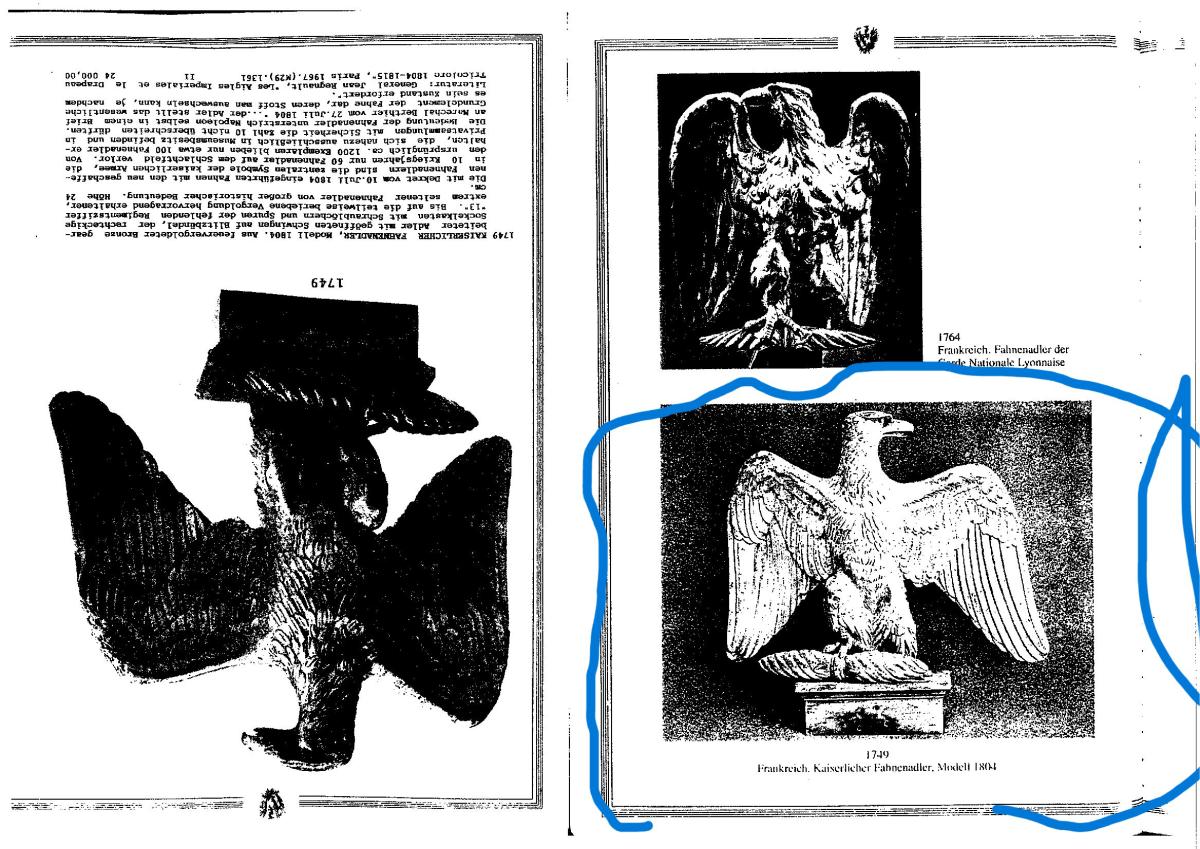

FLAG EAGLE attributed to the 13th Regiment of Chasseurs à Cheval, model 1804, First Empire. 33609
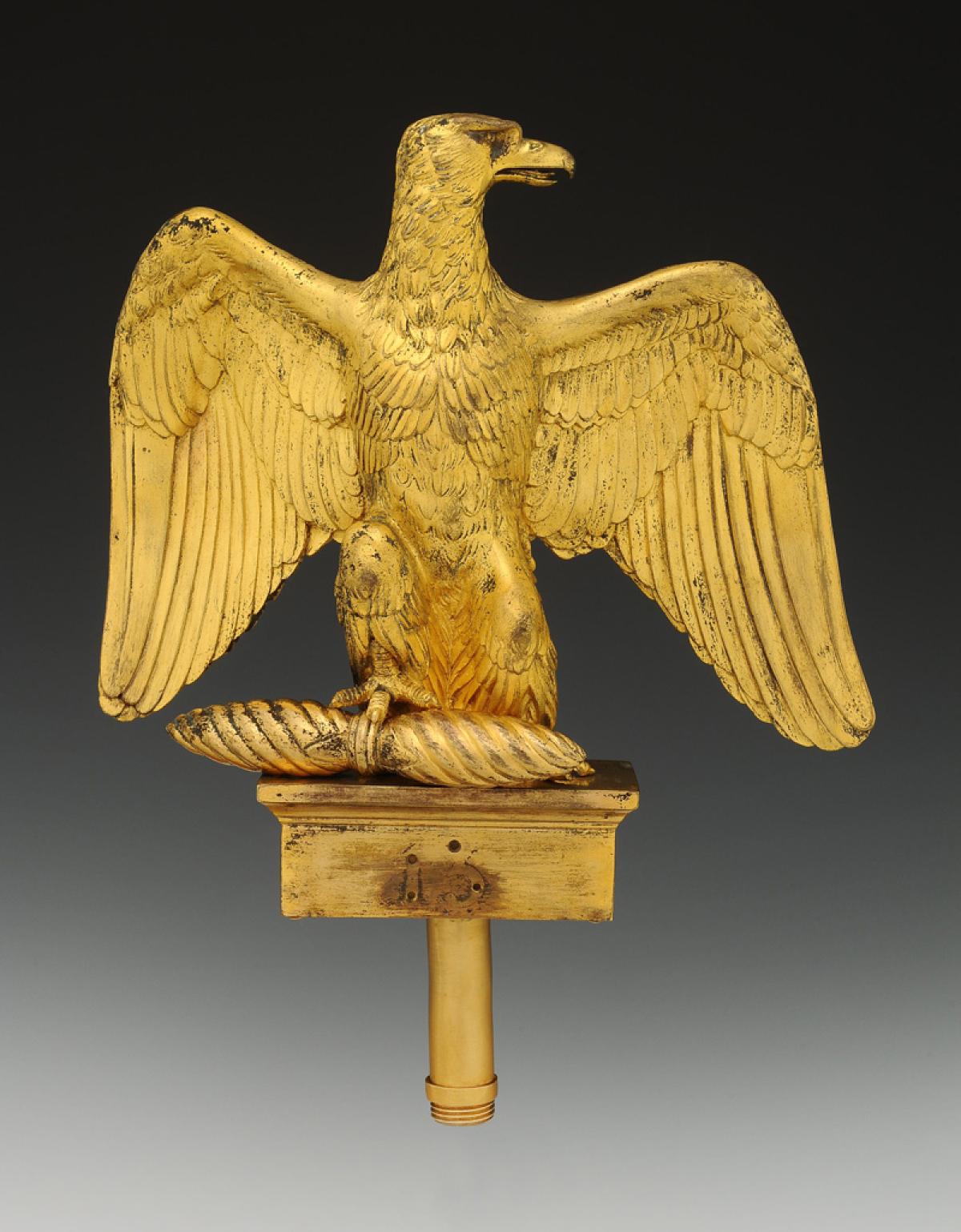
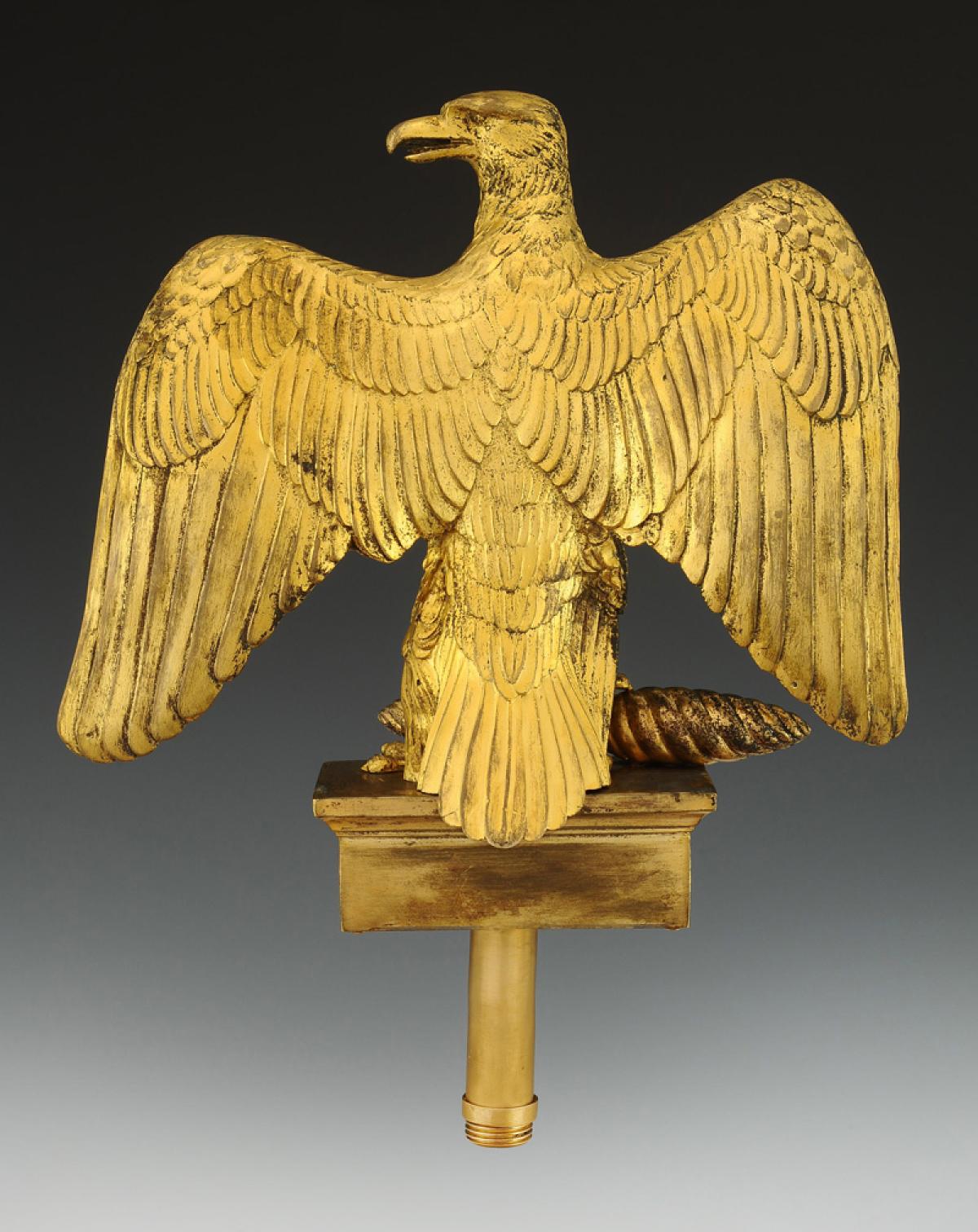
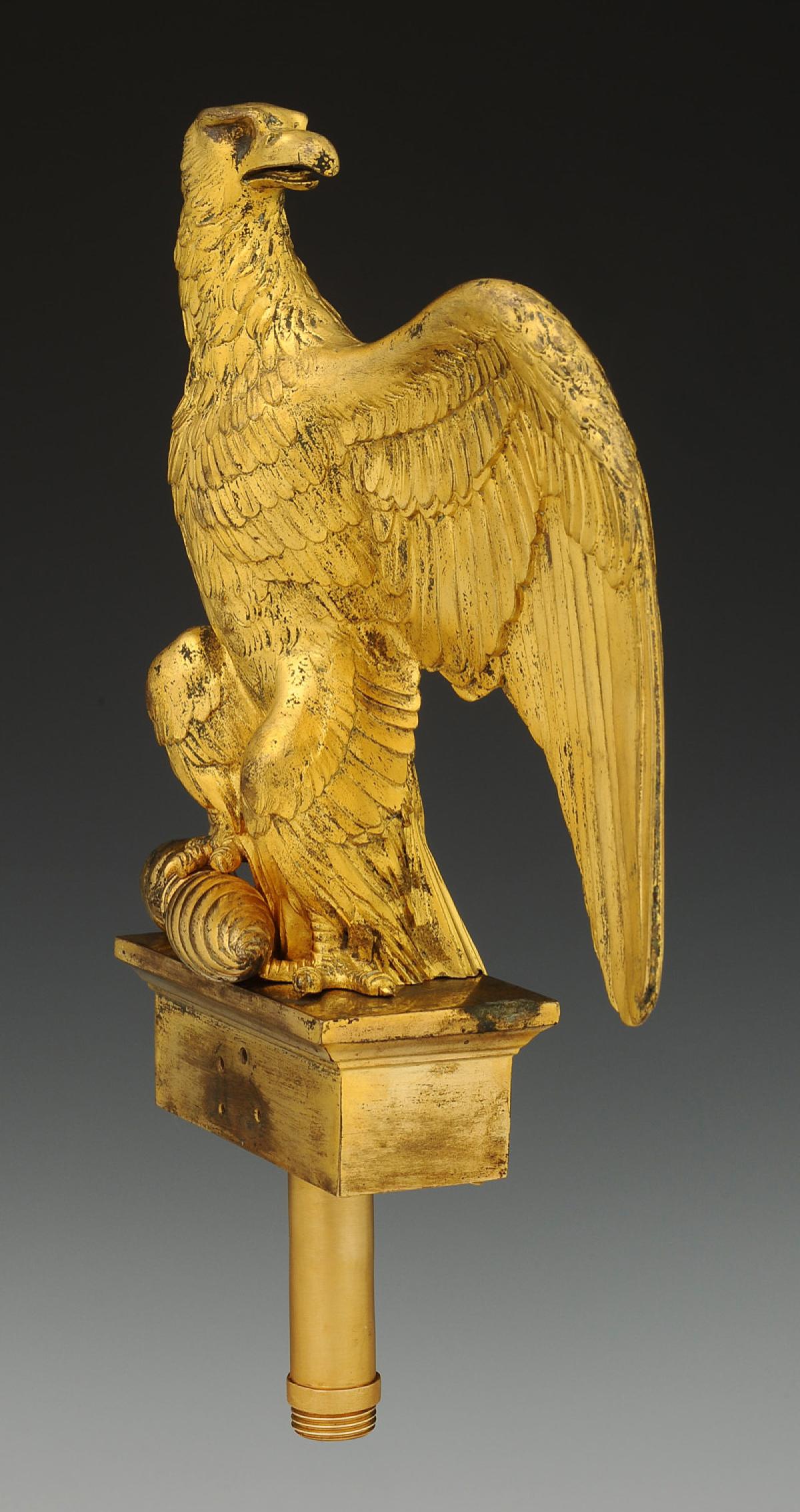
The 1804 model eagle is of very careful craftsmanship, entirely made of cast copper with chisel work. Total weight of the eagle is 1.750 kg.
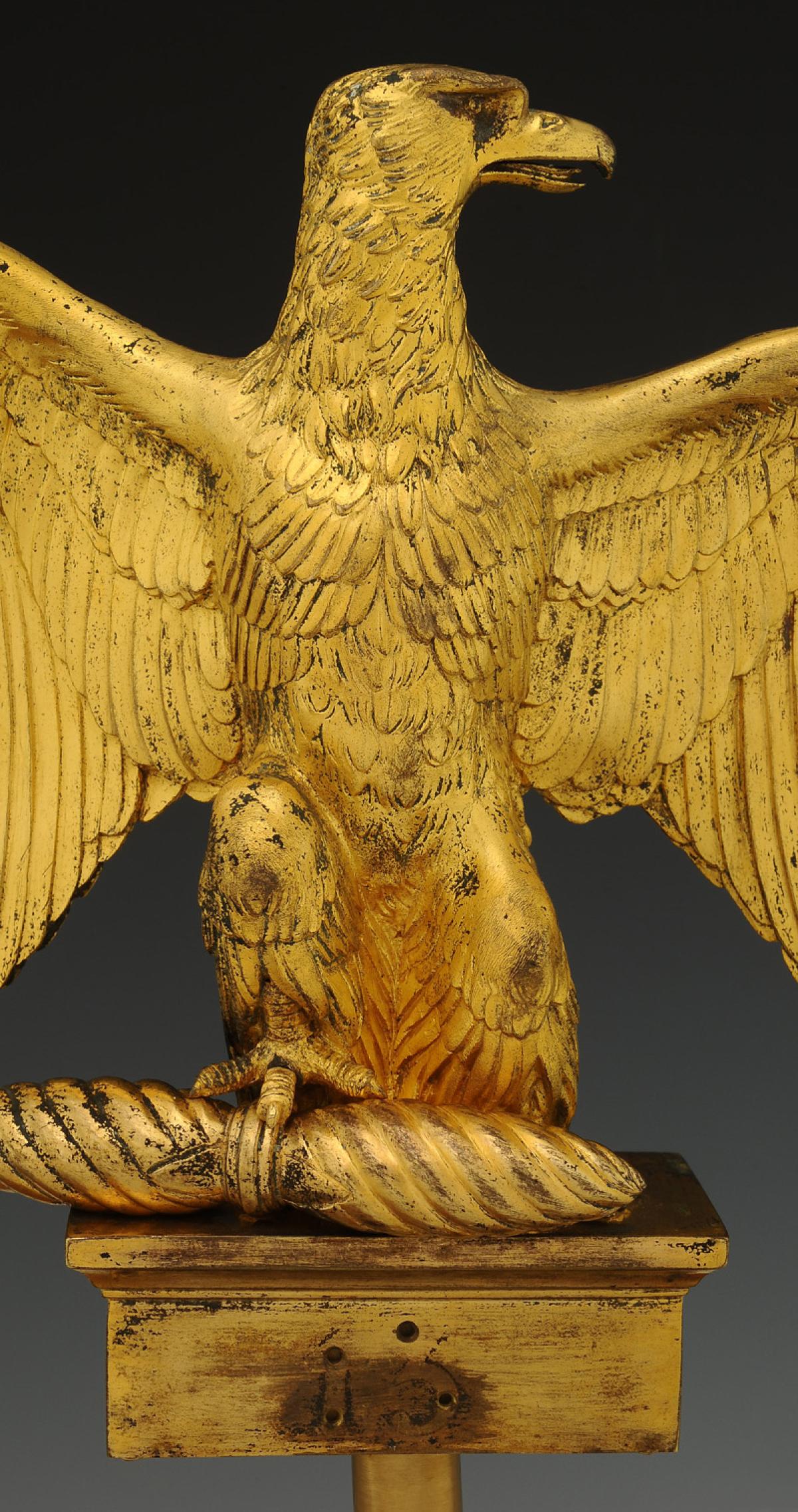
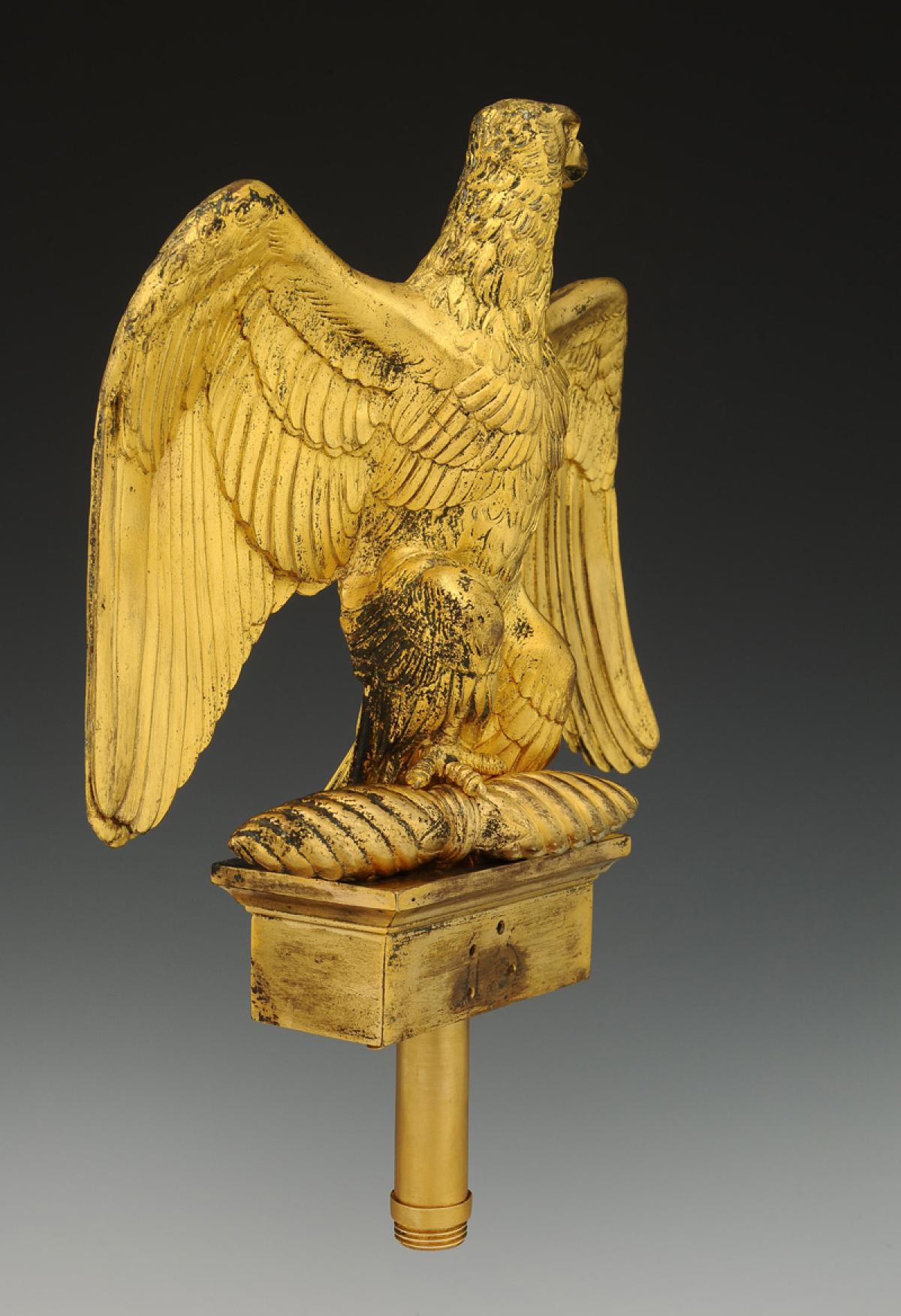
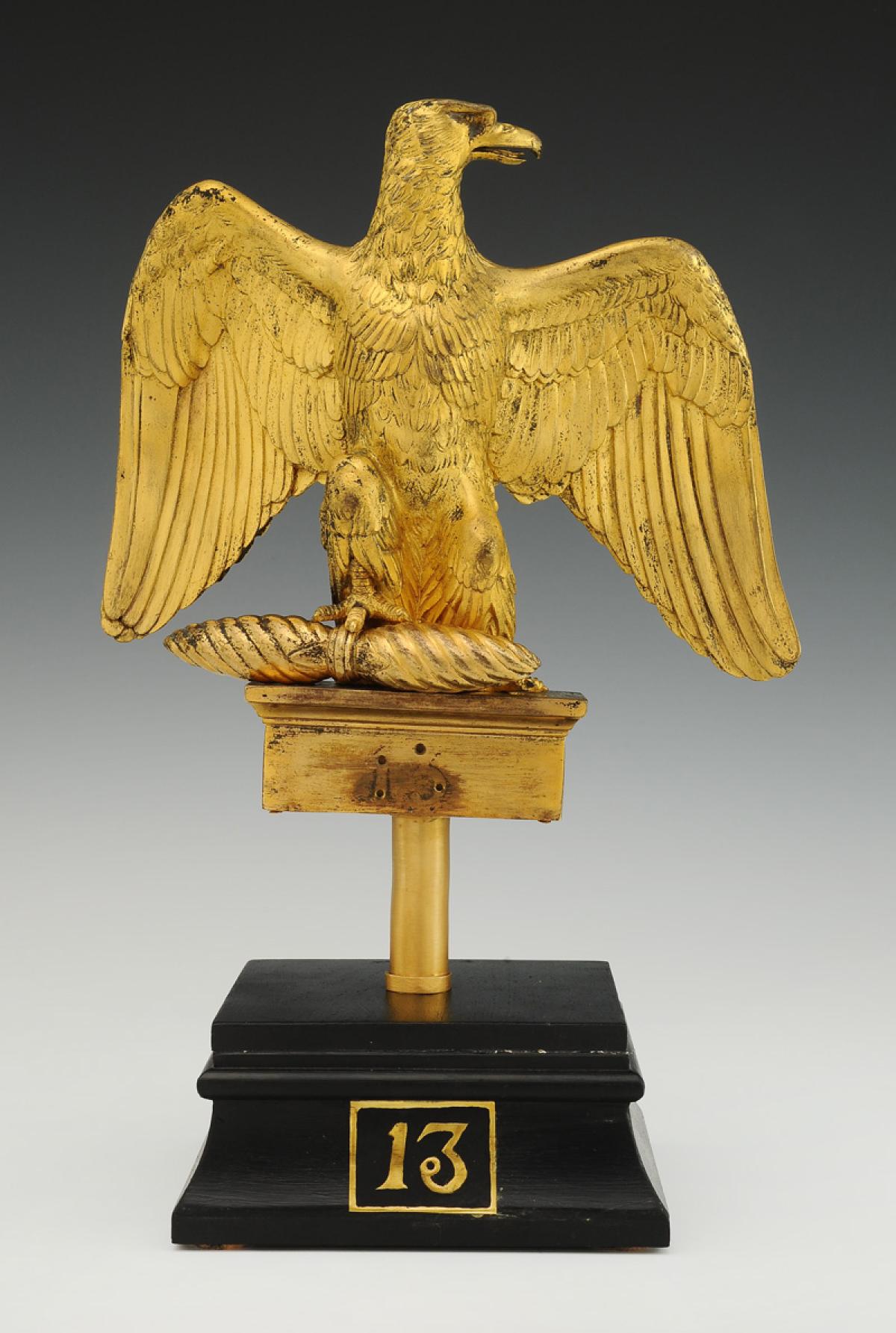
The head is turned to the right, horizontally positioned, with an elongated beak slightly open, clearly showing the tongue placed on the lower part. The wings are widely spread at their tips. Height at the front is 20 cm, height at the rear from the tip of the tail to the head is approximately 22 cm, width is 25 cm, and weight is 1.290 kg.
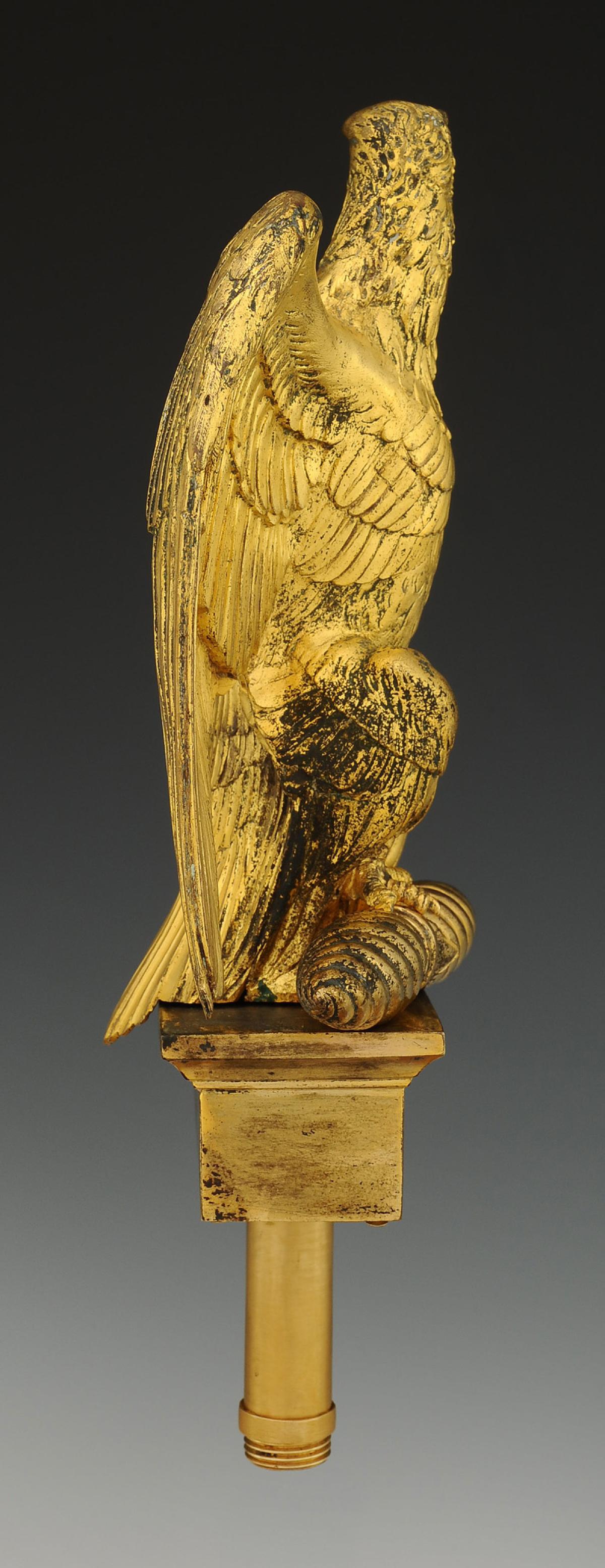
The eagle is made in two parts: the front and the back (including the left talon), fitted and soldered together (right talon is separate).
Under the left talon, there is a stamped marking "X I I I", under the right talon, the number "377" is struck.
The Jupiter spindle is slightly tilted without thunderbolts, similar to the eagles of the Second Empire model 1854, with a length of 13.7 cm, maximum diameter of 2.4 cm, minimum diameter of 2.1 cm in the center, and a weight of 186 grams.
The base is in the form of a rectangular box (height 4.3 cm, minimum length 10.3 cm, maximum length 11.6 cm, minimum width 4.4 cm, maximum width 6.1 cm). The back of the box is pierced with four holes intended to receive the regiment's identifying numbers, probably the 13th.
Inside the box, each corner is fitted with a small brass plate with screw threads.
France.
First Empire.
Very good general state of preservation, gilding restored posteriorly, non-model spindle.
PROVENANCE:
Taken by Blücher to the famous ZEUGHAUS museum in Berlin.
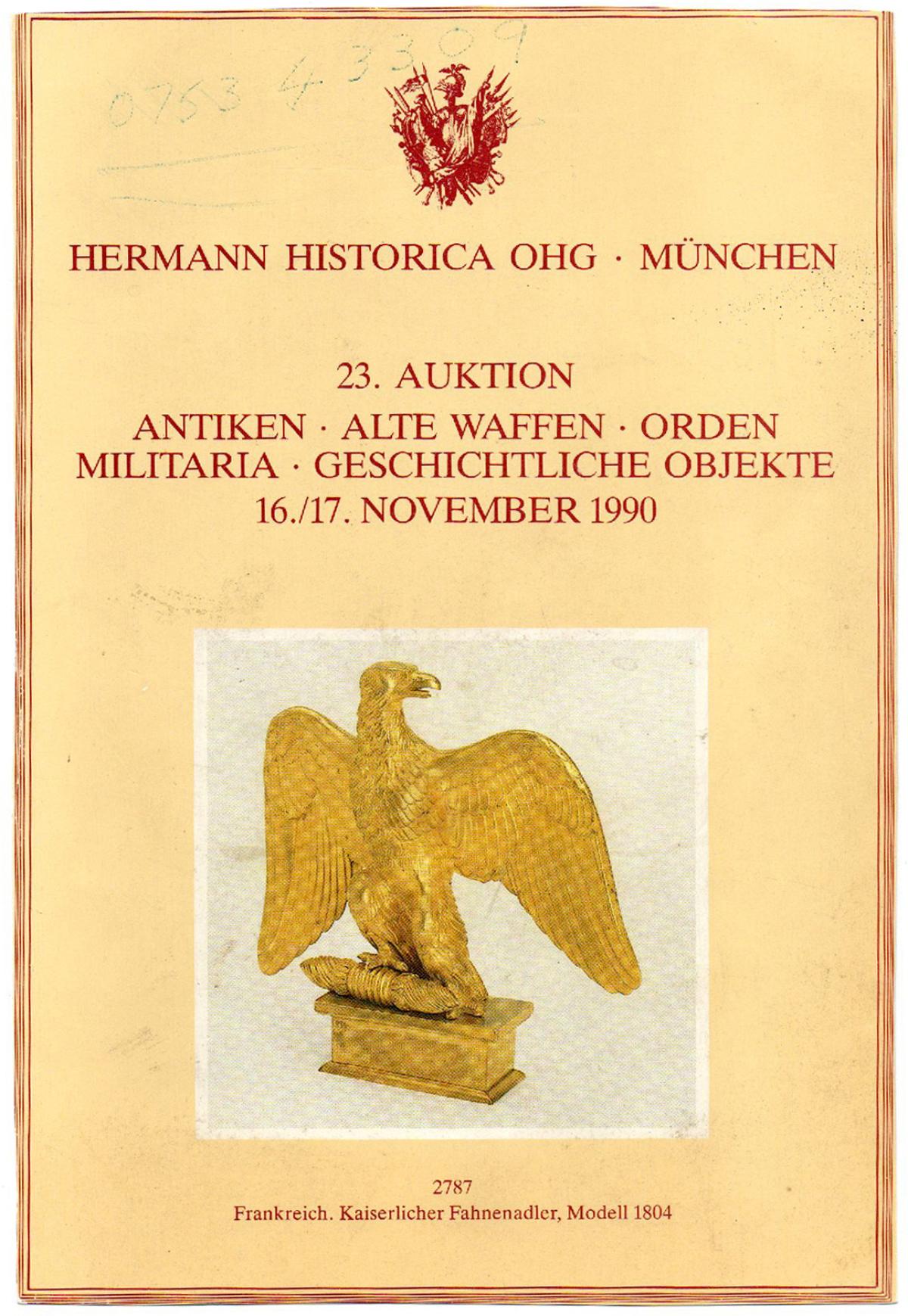
Sold at public auction at Herman Historica on November 16 and 17, 1990, under the lot number 1749.
Private collection in the United States (1990).
Adrian Forman Collection, United Kingdom.
Private collection, United Kingdom (2024).
ATTRIBUTION:
This eagle is very likely an eagle that belonged to the 13th Regiment of Chasseurs à Cheval of the First Empire.
Indeed, the eagles of the 13th Infantry Regiment of the Line in 1804 were distributed in a set of three, none of which have survived.
Three eagles were distributed to the 13th Light Infantry Regiment, none of which have survived.
The eagle of the 13th Cuirassier Regiment formed in 1808 likely received an eagle, but we have no additional information and no trace of it.
The 13th Dragoon Regiment received four eagles in 1804. Only one is known to us today, as it is preserved at the Royal Chelsea Hospital in London.
As for the 13th Hussar Regiment, it was formed on January 28, 1813. Records show that on March 11 of the same year, an eagle was requested, but it is unknown if it was distributed.
Regarding the 13th Regiment of Chasseurs à Cheval, four eagles and 1804 model standards were attributed to them. The eagle in service with the torn standard of the 1st Squadron remained in service, while the others were returned on March 26, 1812. These four emblems were taken by the Germans in 1815.
HISTORICAL BACKGROUND:
The 13th Regiment of Chasseurs à Cheval is a regiment established during the French Revolution under the name "Légion des Américains," also known at that time as the "Légion de Saint-George" after its commander.
Creation and Various Denominations:
Decree on the Organization of the Free Legion of Americans, December 6, 1792, in the 1st year of the French Republic.
- First lineage:
September 7, 1792: creation of a Free Legion made up of volunteers from the Antilles and African outposts who presented themselves before the Legislative Assembly, named the Legion of the Americans and the South. It was intended to have 800 chasseurs à pied (infantry hunters) and 200 chasseurs à cheval (cavalry hunters).
December 6, 1792: the American Hussars (one of their nicknames) were definitively established as a unit of chasseurs à cheval as the 800 chasseurs à pied could not be recruited.
February 21, 1793: renamed 13th Regiment of Chasseurs à Cheval (at this point, the future 14th Regiment of Chasseurs à Cheval also bore the number 13).
March 7, 1793: A decree combined the companies of the hussars of Death, the hussars of Equality, and the hussars of the Legion of the Alps to form the 13th Regiment of Chasseurs à Cheval.
March 1794: The 1st company, which was supposed to depart for Saint-Domingue but was instead transferred to Brest, was merged with squadrons from the Legion of the North, the dragons of the Mountain, and the national cavalry, under the name of 13th bis Regiment of Chasseurs à Cheval.
- 1795: Fusion of the 13th and 13th bis into a single regiment.
- December 1815: Disbanded.
- 1816: Creation of the Chasseurs de la Meuse Regiment.
- 1825: Renamed 13th Regiment of Chasseurs à Cheval.
[...]
- Second lineage:
- 1796: Guides of the Army of Italy.
- 1798: Guides of the Army of the Orient.
- 1800: Chasseurs à Cheval of the Consular Guard.
- 1804: Chasseurs à Cheval of the Imperial Guard.
- 1814: Royal Corps of the Chasseurs de France.
- 1815: Chasseurs à Cheval of the Imperial Guard.
- 1815: Dissolved.
- 1856: Regiment of Chasseurs à Cheval of the Imperial Guard.
- Common lineage:
- 1871: 13th Regiment of Chasseurs à Cheval, originating from the Regiment of Chasseurs à Cheval of the Imperial Guard.
[...]
- Colonels / Commanders:
- July 1793: Joseph Boulogne, known as Chevalier de Saint-George, confirmed as the regiment's head.
- September 1793: Chevalier de Saint-George is dismissed and replaced by Jean-François Target.
- 1794: Bouquet
- [...]
- 1802: Commander Nicolas Pultière
- 1807: Colonel Demangeot
- 1809: Montesquieu-Fezensac
- 1811: O'Shee
- 1814: Colonel Rodolphe de Faÿ de La Tour-Maubourg
- 1815: Colonel Bernard Prués
- [...]
- Combat History of the 13th Regiment of Chasseurs à Cheval:
- September 1792: Formation in Paris.
- November 1792: Organization in Amiens.
- February 1793: Barracks in Laon.
- March 1793: A squadron of 75 men follows Dumouriez's army.
- May 1793: The regiment's depot is established in Bethune. The unit is stationed in Lille with 559 men and attached to the Army of Belgium.
- April 22, 1793: The 1st company (84 men) is transferred to Brest to embark for Saint-Domingue. A delegation is sent to Paris, and the National Convention issues a decree on June 13, stating that these men cannot be sent to the colonies. They are placed under Jean-Baptiste Carrier's command and operate in the Vendée region where they are noted for their violence and excesses.
Campaigns:
- 1793-1794: Army of the North.
- 1796-1797: Army of Italy.
- 1797: Army of Sambre-et-Meuse.
- 1798-1799: Army of the Orient.
- 1799-1800: Army of Italy.
- 1805-1807: Grande Armée.
- 1805: December 2: Battle of Austerlitz.
- 1807: February 8: Battle of Eylau.
- 1808: Spain.
- 1809: Campaign in Germany.
- 1810-1813: Spanish War of Independence.
- 1812: Russian Campaign.
- 1813: Campaign in Germany, October 16-19: Battle of Leipzig.
- 1814: Spanish War of Independence, Campaign of France (1814), February 27: Battle of Orthez.
- 1815: Campaign in Belgium (1815).
[...]
GENERAL CHARACTERISTICS OF THE EAGLES OF 1804, 1810-1811, AND 1815
Gilt bronze eagle with ground gold, executed by Thomire, based on an original work by Chaudet. In 1804-1805, an eagle cost 145 French francs. The Eagle has its head turned to the right, slightly spread wings, its left talon holding a Jupiter thunderbolt without lightning. The Eagle rests on a pedestal shaped like a caisson originally bearing the regiment's number on the obverse and reverse.
Under the First Empire, three models of eagles were manufactured. The 1804 model, the 1810-1811 model, known as the "lightened model," and the 1815 model.
The 1804 model is the one put up for sale, and its characteristics are given in its description.
The so-called "lightened model" is a less carefully crafted version with a reduced weight of approximately 800 grams (instead of 1,850 to 2 kilograms for the 1804 model); this production began in 1809, and the price of this model was 165 French francs at the time. The 1815 model, also created by Thomire, is of lower quality. The eagle's beak is curved, the wings are folded with the lower part of the wings closer to the eagle's body. It weighs 1,450 kg, stands at a height of 18 cm to 20 cm, and was priced at 95 French francs.
EAGLES DISTRIBUTED DURING THE EMPIRE AND EXAMPLES THAT HAVE SURVIVED TO THE PRESENT DAY
According to the decree of July 10, 1804, each infantry battalion and cavalry squadron received an eagle, totaling more than 1,100 eagles. Not all of these eagles were distributed in 1804; it was not until 1805 that the manufacturers were able to provide all the specimens.
On February 18, 1808, the number of eagles was reduced to one per regiment, and many eagles were sent to the "Administration de la Guerre," some of which were used to replace eagles lost in combat.
Between 1807 and 1814, around 100 new eagles were given to new regiments or to regiments that had "honourably lost" their eagle in war. A total of 292 eagles were presented on June 1 and 4, 1815, at the Champ de Mai.
Today, there are approximately 124 authentic 1804 model eagles (46 in French museums, 10 in English museums, 55 in museums of other countries, and about 13 in private collections); 17 "lightened" eagles of the 1810-1811 model (7 in French museums, 2 in English museums, 7 in museums of other countries, and about 1 or 2 in private collections); there are only about 14 1815 model eagles remaining (3 in French museums, 2 in English museums, 2 or 3 in museums of other countries, and about 7 in private collections). This list is incomplete and does not include eagles for the National Guard or some "special" model eagles.
BIBLIOGRAPHY
- Archives Raoul and Jean Brunon (France, Musée de l'Empéri in Salon de Provence)
- Andolenko: Aigles de Napoléon contre drapeaux du Tzar, Eurimprim, Paris 1969
- Jean Brunon: Retour de nos aigles, Marseille 1949
- Pierre Charrié: Les aigles et drapeaux de 1804, Le Briquet 1966
- Pierre Charrié: Drapeaux et étendards de la Révolution et de l'Empire, Copernic, Paris 1982
- O. Hollander: Les drapeaux des demi-brigades de 1794 à 1804, Paris 1813
- O. Hollander: Nos drapeaux et étendards de 1812 à 1815, Paris 1902
- Juliette Niclausse: Thomire fondeur-ciseleur (1751-1843), Grund, Paris 1947
- Jean Renauld: Les aigles impériales et le drapeau tricolore, 1804-1815, Paris 1967
The 1804 model eagle is of very careful craftsmanship, entirely made of cast copper with chisel work. Total weight of the eagle is 1.750 kg.
The head is turned to the right, horizontally positioned, with an elongated beak slightly open, clearly showing the tongue placed on the lower part. The wings are widely spread at their tips. Height at the front is 20 cm, height at the rear from the tip of the tail to the head is approximately 22 cm, width is 25 cm, and weight is 1.290 kg.
The eagle is made in two parts: the front and the back (including the left talon), fitted and soldered together (right talon is separate).
Under the left talon, there is a stamped marking "X I I I", under the right talon, the number "377" is struck.
The Jupiter spindle is slightly tilted without thunderbolts, similar to the eagles of the Second Empire model 1854, with a length of 13.7 cm, maximum diameter of 2.4 cm, minimum diameter of 2.1 cm in the center, and a weight of 186 grams.
The base is in the form of a rectangular box (height 4.3 cm, minimum length 10.3 cm, maximum length 11.6 cm, minimum width 4.4 cm, maximum width 6.1 cm). The back of the box is pierced with four holes intended to receive the regiment's identifying numbers, probably the 13th.
Inside the box, each corner is fitted with a small brass plate with screw threads.
France.
First Empire.
Very good general state of preservation, gilding restored posteriorly, non-model spindle.
PROVENANCE:
Taken by Blücher to the famous ZEUGHAUS museum in Berlin.
Sold at public auction at Herman Historica on November 16 and 17, 1990, under the lot number 1749.
Private collection in the United States (1990).
Adrian Forman Collection, United Kingdom.
Private collection, United Kingdom (2024).
ATTRIBUTION:
This eagle is very likely an eagle that belonged to the 13th Regiment of Chasseurs à Cheval of the First Empire.
Indeed, the eagles of the 13th Infantry Regiment of the Line in 1804 were distributed in a set of three, none of which have survived.
Three eagles were distributed to the 13th Light Infantry Regiment, none of which have survived.
The eagle of the 13th Cuirassier Regiment formed in 1808 likely received an eagle, but we have no additional information and no trace of it.
The 13th Dragoon Regiment received four eagles in 1804. Only one is known to us today, as it is preserved at the Royal Chelsea Hospital in London.
As for the 13th Hussar Regiment, it was formed on January 28, 1813. Records show that on March 11 of the same year, an eagle was requested, but it is unknown if it was distributed.
Regarding the 13th Regiment of Chasseurs à Cheval, four eagles and 1804 model standards were attributed to them. The eagle in service with the torn standard of the 1st Squadron remained in service, while the others were returned on March 26, 1812. These four emblems were taken by the Germans in 1815.
HISTORICAL BACKGROUND:
The 13th Regiment of Chasseurs à Cheval is a regiment established during the French Revolution under the name "Légion des Américains," also known at that time as the "Légion de Saint-George" after its commander.
Creation and Various Denominations:
Decree on the Organization of the Free Legion of Americans, December 6, 1792, in the 1st year of the French Republic.
- First lineage:
September 7, 1792: creation of a Free Legion made up of volunteers from the Antilles and African outposts who presented themselves before the Legislative Assembly, named the Legion of the Americans and the South. It was intended to have 800 chasseurs à pied (infantry hunters) and 200 chasseurs à cheval (cavalry hunters).
December 6, 1792: the American Hussars (one of their nicknames) were definitively established as a unit of chasseurs à cheval as the 800 chasseurs à pied could not be recruited.
February 21, 1793: renamed 13th Regiment of Chasseurs à Cheval (at this point, the future 14th Regiment of Chasseurs à Cheval also bore the number 13).
March 7, 1793: A decree combined the companies of the hussars of Death, the hussars of Equality, and the hussars of the Legion of the Alps to form the 13th Regiment of Chasseurs à Cheval.
March 1794: The 1st company, which was supposed to depart for Saint-Domingue but was instead transferred to Brest, was merged with squadrons from the Legion of the North, the dragons of the Mountain, and the national cavalry, under the name of 13th bis Regiment of Chasseurs à Cheval.
- 1795: Fusion of the 13th and 13th bis into a single regiment.
- December 1815: Disbanded.
- 1816: Creation of the Chasseurs de la Meuse Regiment.
- 1825: Renamed 13th Regiment of Chasseurs à Cheval.
[...]
- Second lineage:
- 1796: Guides of the Army of Italy.
- 1798: Guides of the Army of the Orient.
- 1800: Chasseurs à Cheval of the Consular Guard.
- 1804: Chasseurs à Cheval of the Imperial Guard.
- 1814: Royal Corps of the Chasseurs de France.
- 1815: Chasseurs à Cheval of the Imperial Guard.
- 1815: Dissolved.
- 1856: Regiment of Chasseurs à Cheval of the Imperial Guard.
- Common lineage:
- 1871: 13th Regiment of Chasseurs à Cheval, originating from the Regiment of Chasseurs à Cheval of the Imperial Guard.
[...]
- Colonels / Commanders:
- July 1793: Joseph Boulogne, known as Chevalier de Saint-George, confirmed as the regiment's head.
- September 1793: Chevalier de Saint-George is dismissed and replaced by Jean-François Target.
- 1794: Bouquet
- [...]
- 1802: Commander Nicolas Pultière
- 1807: Colonel Demangeot
- 1809: Montesquieu-Fezensac
- 1811: O'Shee
- 1814: Colonel Rodolphe de Faÿ de La Tour-Maubourg
- 1815: Colonel Bernard Prués
- [...]
- Combat History of the 13th Regiment of Chasseurs à Cheval:
- September 1792: Formation in Paris.
- November 1792: Organization in Amiens.
- February 1793: Barracks in Laon.
- March 1793: A squadron of 75 men follows Dumouriez's army.
- May 1793: The regiment's depot is established in Bethune. The unit is stationed in Lille with 559 men and attached to the Army of Belgium.
- April 22, 1793: The 1st company (84 men) is transferred to Brest to embark for Saint-Domingue. A delegation is sent to Paris, and the National Convention issues a decree on June 13, stating that these men cannot be sent to the colonies. They are placed under Jean-Baptiste Carrier's command and operate in the Vendée region where they are noted for their violence and excesses.
Campaigns:
- 1793-1794: Army of the North.
- 1796-1797: Army of Italy.
- 1797: Army of Sambre-et-Meuse.
- 1798-1799: Army of the Orient.
- 1799-1800: Army of Italy.
- 1805-1807: Grande Armée.
- 1805: December 2: Battle of Austerlitz.
- 1807: February 8: Battle of Eylau.
- 1808: Spain.
- 1809: Campaign in Germany.
- 1810-1813: Spanish War of Independence.
- 1812: Russian Campaign.
- 1813: Campaign in Germany, October 16-19: Battle of Leipzig.
- 1814: Spanish War of Independence, Campaign of France (1814), February 27: Battle of Orthez.
- 1815: Campaign in Belgium (1815).
[...]
GENERAL CHARACTERISTICS OF THE EAGLES OF 1804, 1810-1811, AND 1815
Gilt bronze eagle with ground gold, executed by Thomire, based on an original work by Chaudet. In 1804-1805, an eagle cost 145 French francs. The Eagle has its head turned to the right, slightly spread wings, its left talon holding a Jupiter thunderbolt without lightning. The Eagle rests on a pedestal shaped like a caisson originally bearing the regiment's number on the obverse and reverse.
Under the First Empire, three models of eagles were manufactured. The 1804 model, the 1810-1811 model, known as the "lightened model," and the 1815 model.
The 1804 model is the one put up for sale, and its characteristics are given in its description.
The so-called "lightened model" is a less carefully crafted version with a reduced weight of approximately 800 grams (instead of 1,850 to 2 kilograms for the 1804 model); this production began in 1809, and the price of this model was 165 French francs at the time. The 1815 model, also created by Thomire, is of lower quality. The eagle's beak is curved, the wings are folded with the lower part of the wings closer to the eagle's body. It weighs 1,450 kg, stands at a height of 18 cm to 20 cm, and was priced at 95 French francs.
EAGLES DISTRIBUTED DURING THE EMPIRE AND EXAMPLES THAT HAVE SURVIVED TO THE PRESENT DAY
According to the decree of July 10, 1804, each infantry battalion and cavalry squadron received an eagle, totaling more than 1,100 eagles. Not all of these eagles were distributed in 1804; it was not until 1805 that the manufacturers were able to provide all the specimens.
On February 18, 1808, the number of eagles was reduced to one per regiment, and many eagles were sent to the "Administration de la Guerre," some of which were used to replace eagles lost in combat.
Between 1807 and 1814, around 100 new eagles were given to new regiments or to regiments that had "honourably lost" their eagle in war. A total of 292 eagles were presented on June 1 and 4, 1815, at the Champ de Mai.
Today, there are approximately 124 authentic 1804 model eagles (46 in French museums, 10 in English museums, 55 in museums of other countries, and about 13 in private collections); 17 "lightened" eagles of the 1810-1811 model (7 in French museums, 2 in English museums, 7 in museums of other countries, and about 1 or 2 in private collections); there are only about 14 1815 model eagles remaining (3 in French museums, 2 in English museums, 2 or 3 in museums of other countries, and about 7 in private collections). This list is incomplete and does not include eagles for the National Guard or some "special" model eagles.
BIBLIOGRAPHY
- Archives Raoul and Jean Brunon (France, Musée de l'Empéri in Salon de Provence)
- Andolenko: Aigles de Napoléon contre drapeaux du Tzar, Eurimprim, Paris 1969
- Jean Brunon: Retour de nos aigles, Marseille 1949
- Pierre Charrié: Les aigles et drapeaux de 1804, Le Briquet 1966
- Pierre Charrié: Drapeaux et étendards de la Révolution et de l'Empire, Copernic, Paris 1982
- O. Hollander: Les drapeaux des demi-brigades de 1794 à 1804, Paris 1813
- O. Hollander: Nos drapeaux et étendards de 1812 à 1815, Paris 1902
- Juliette Niclausse: Thomire fondeur-ciseleur (1751-1843), Grund, Paris 1947
- Jean Renauld: Les aigles impériales et le drapeau tricolore, 1804-1815, Paris 1967
Price :
120 000,00 €
| Destination | Envoi recommandé | Envoi Recommandé + Express |
|---|---|---|
| Shipping France | 17,00 € | 50,00 € |
| Shipping Europe | 24,00 € | 70,00 € |
| Shipping world | 68,00 € | 120,00 € |
Insurance (1%) :
1 200,00 €
Reference :
33609
Next update Friday, octobre 9 at 13:30 PM
FOR ALL PURCHASES, PAYMENT IN MULTIPLE CHECKS POSSIBLE
bertrand.malvaux@wanadoo.fr 06 07 75 74 63
SHIPPING COSTS
Shipping costs are calculated only once per order for one or more items, all shipments are sent via registered mail, as this is the only way to have proof of dispatch and receipt.
For parcels whose value cannot be insured by the Post, shipments are entrusted to DHL or Fedex with real value insured, the service is of high quality but the cost is higher.
RETURN POLICY
Items can be returned within 8 days of receipt. They must be returned by registered mail at the sender's expense, in their original packaging, and in their original condition.
AUTHENTICITY
The selection of items offered on this site allows me to guarantee the authenticity of each piece described here, all items offered are guaranteed to be period and authentic, unless otherwise noted or restricted in the description.
An authenticity certificate of the item including the description published on the site, the period, the sale price, accompanied by one or more color photographs is automatically provided for any item priced over 130 euros. Below this price, each certificate is charged 5 euros.
Only items sold by me are subject to an authenticity certificate, I do not provide any expert reports for items sold by third parties (colleagues or collectors).
FOR ALL PURCHASES, PAYMENT IN MULTIPLE CHECKS POSSIBLE
bertrand.malvaux@wanadoo.fr 06 07 75 74 63
An authenticity certificate of the item including the description published on the site, the period, the sale price, accompanied by one or more color photographs is automatically provided for any item priced over 130 euros. Below this price, each certificate is charged 5 euros.
Only items sold by me are subject to an authenticity certificate, I do not provide any expert reports for items sold by third parties (colleagues or collectors).