
FIELD DRESS UNIFORM OF A DIVISIONAL GENERAL, attributed to Joseph Bonaparte, King of Spain, model from the 1st day of Vendémiaire year 12, First Empire (July 22, 1813 - November 27, 1815). 33622
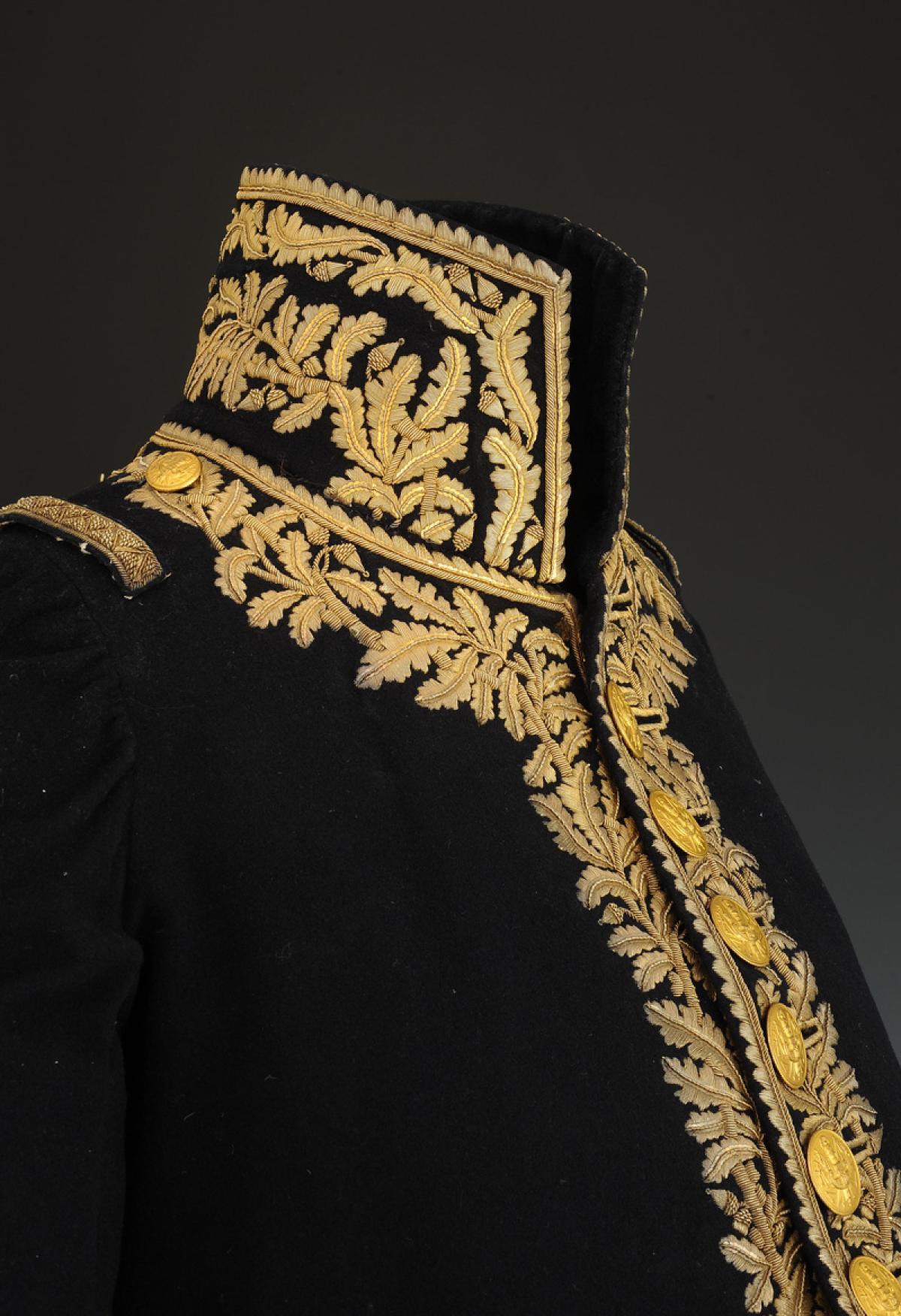
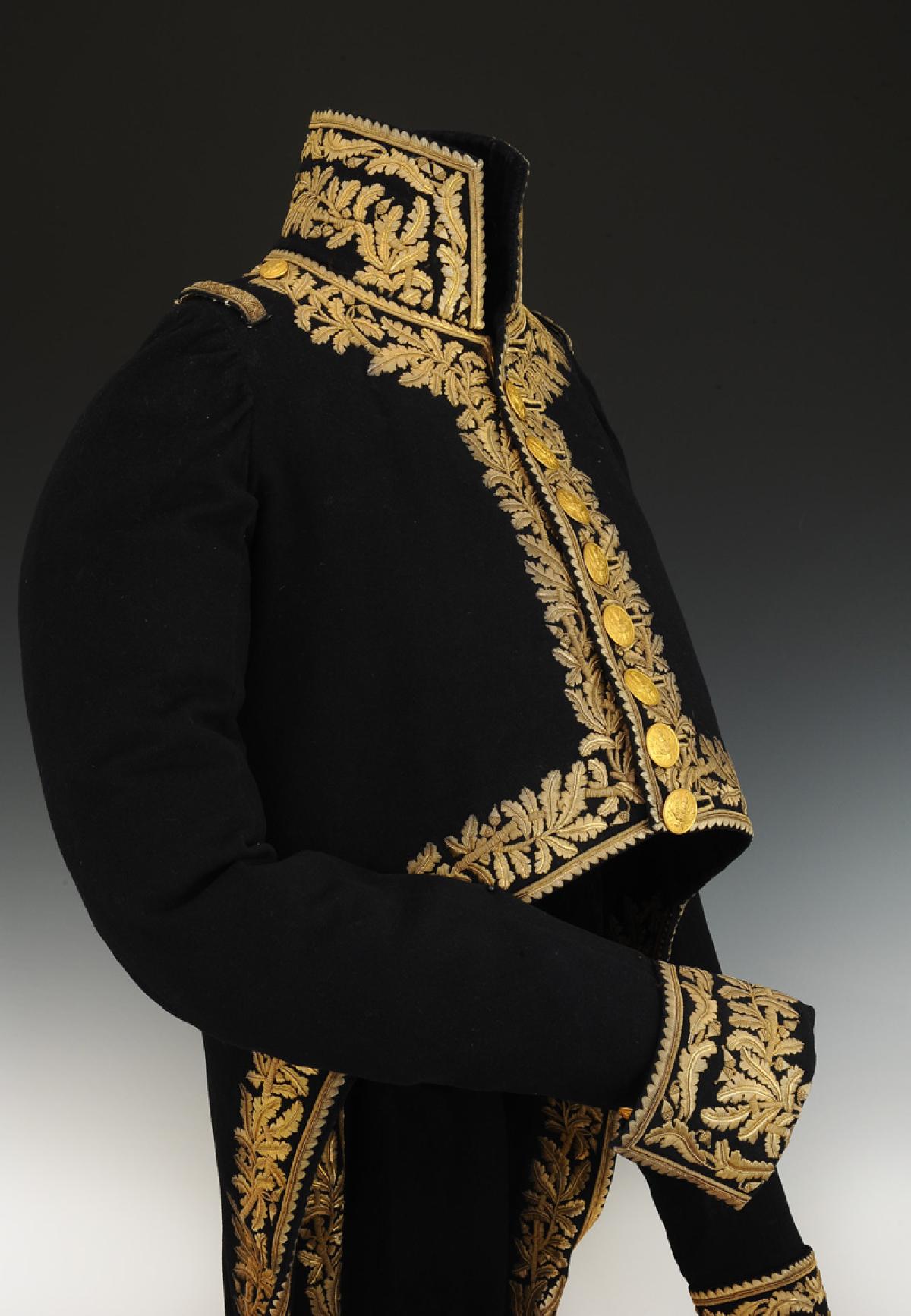
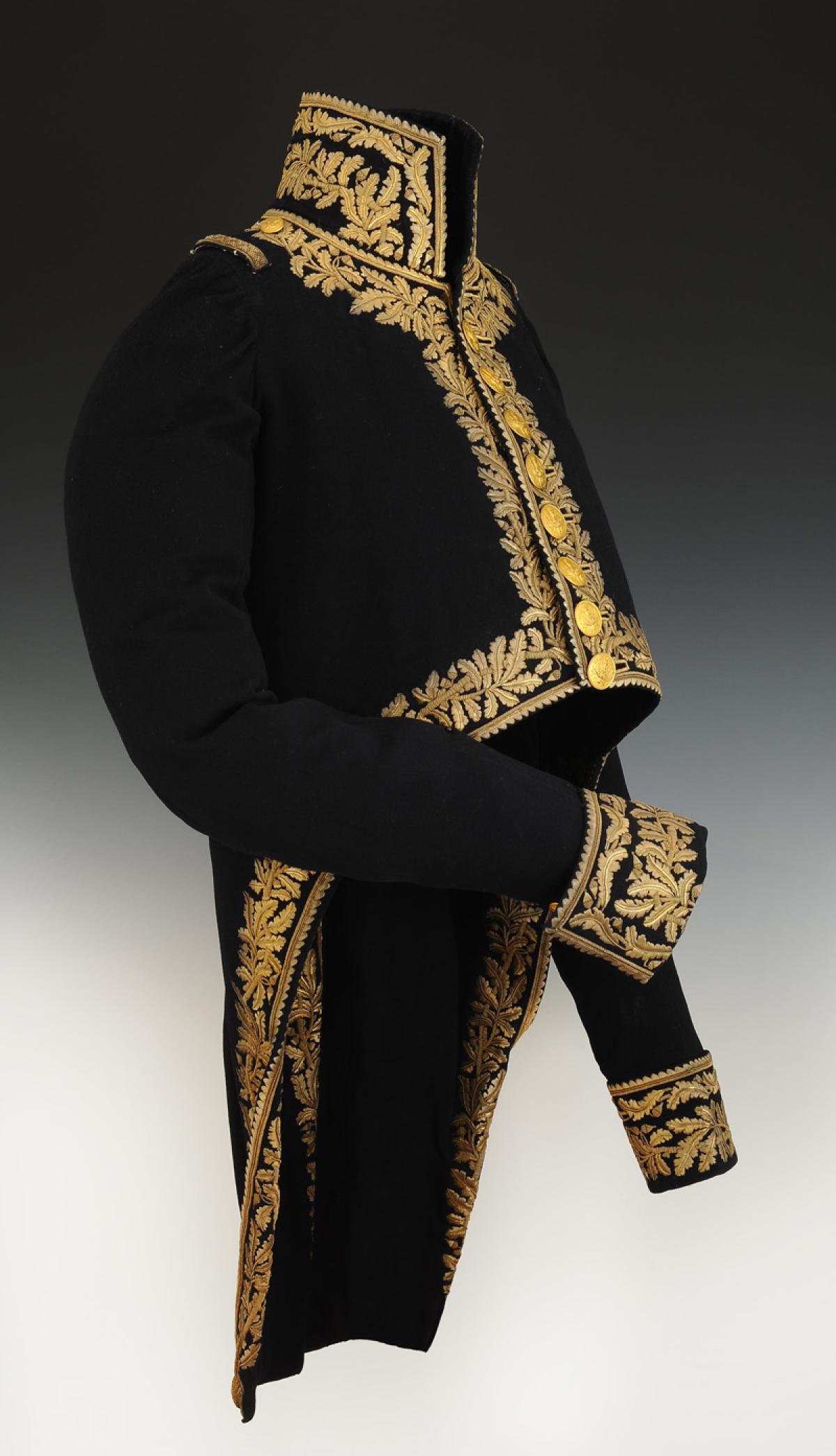
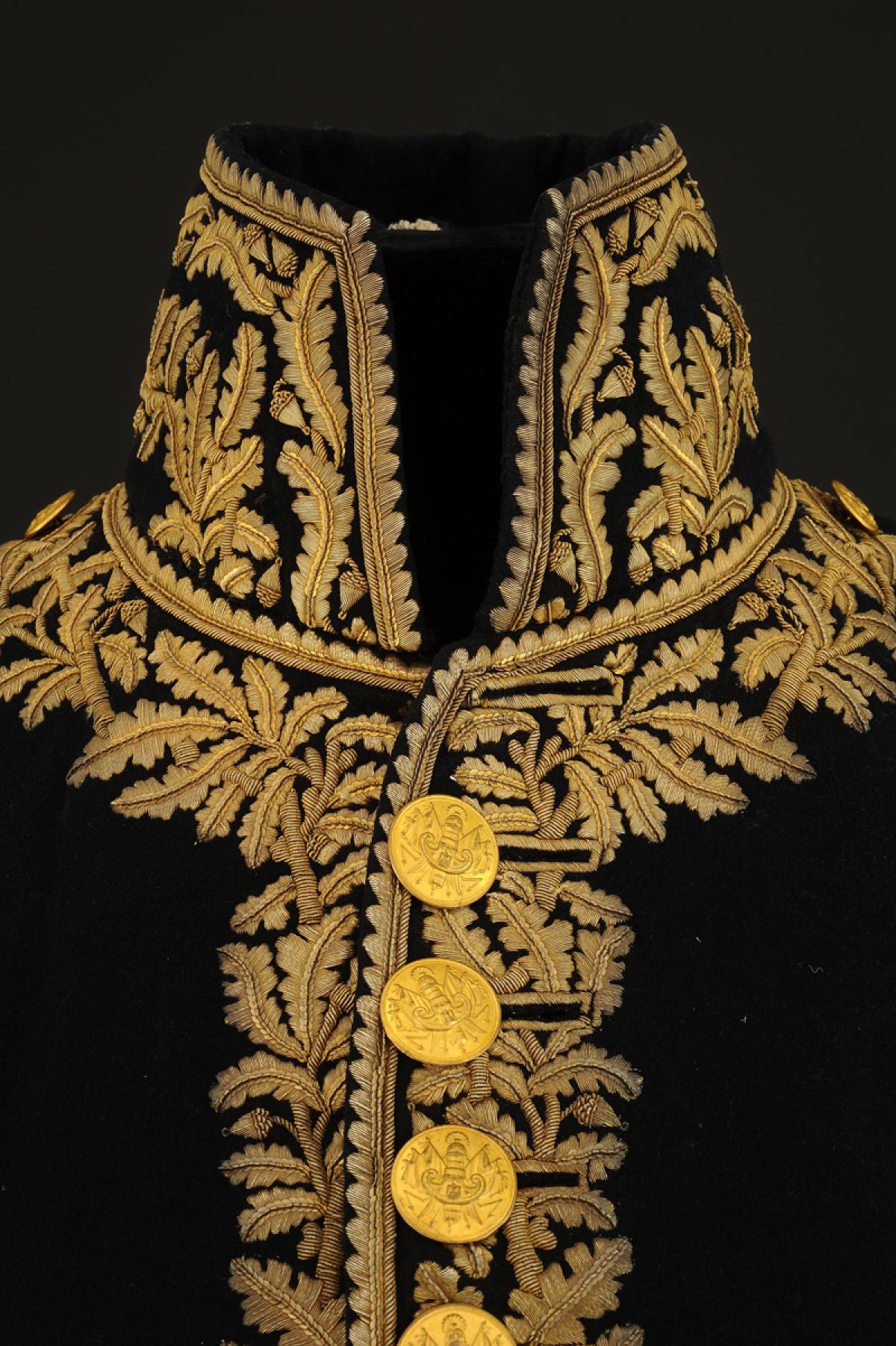
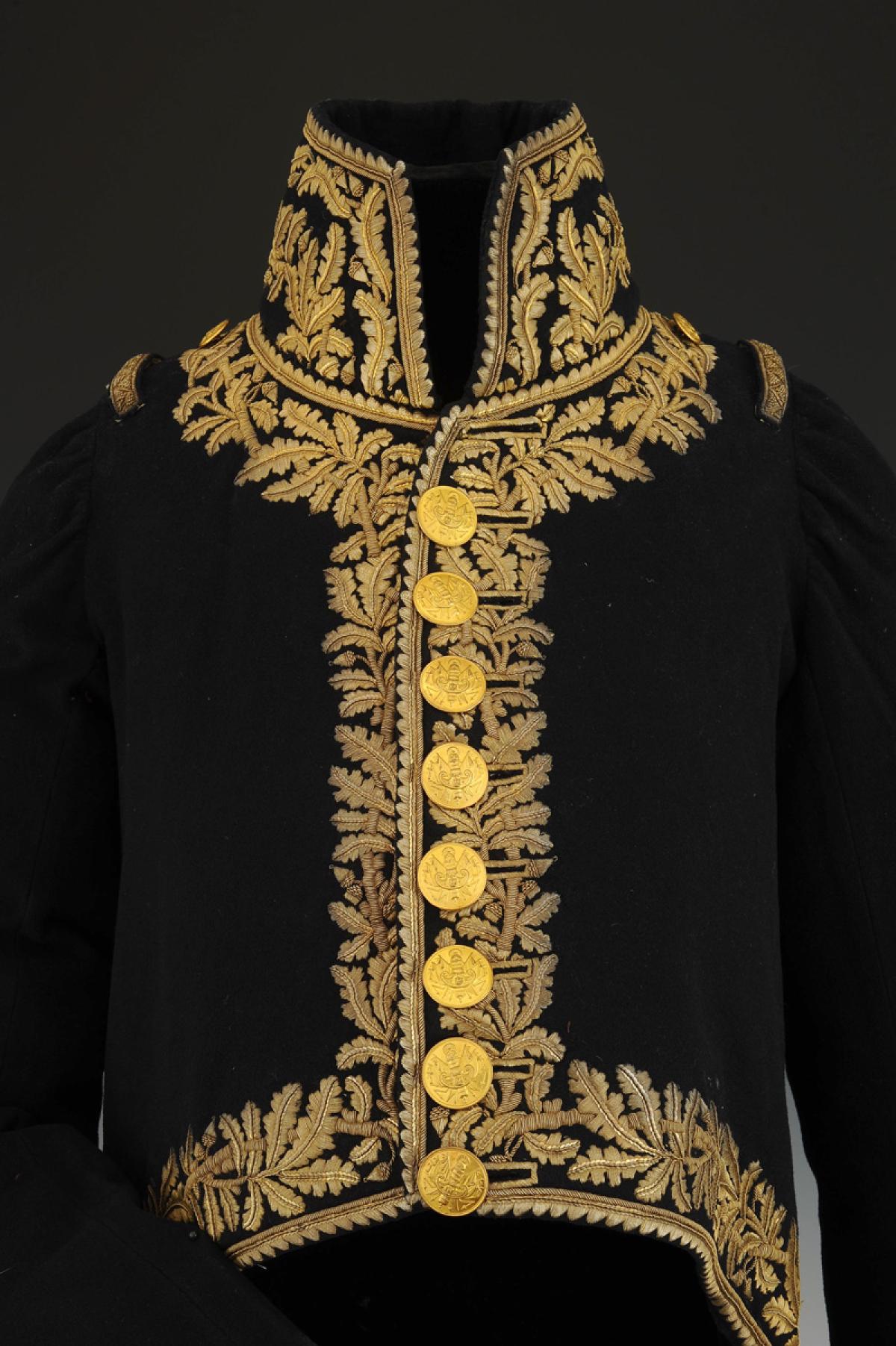
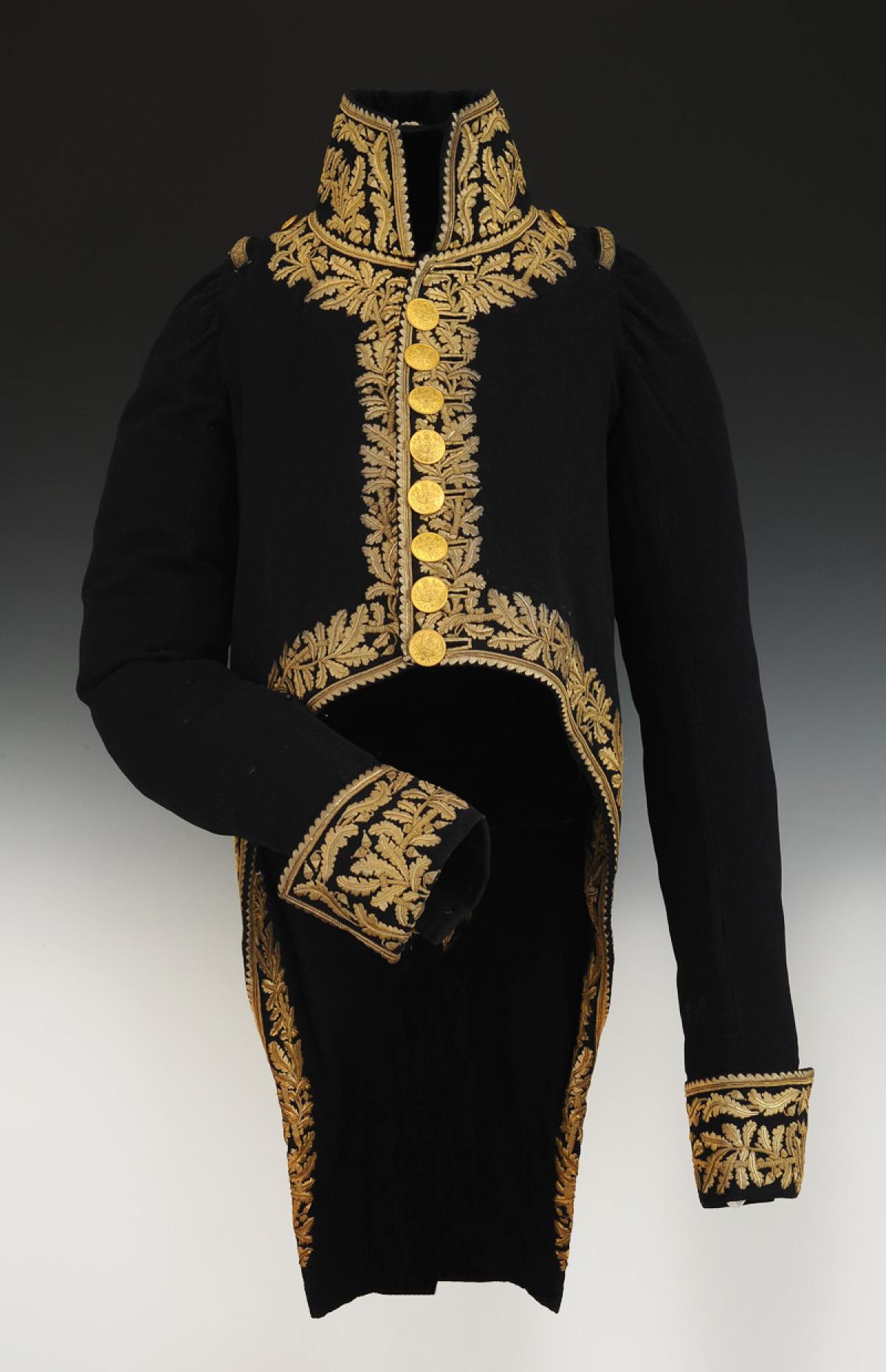
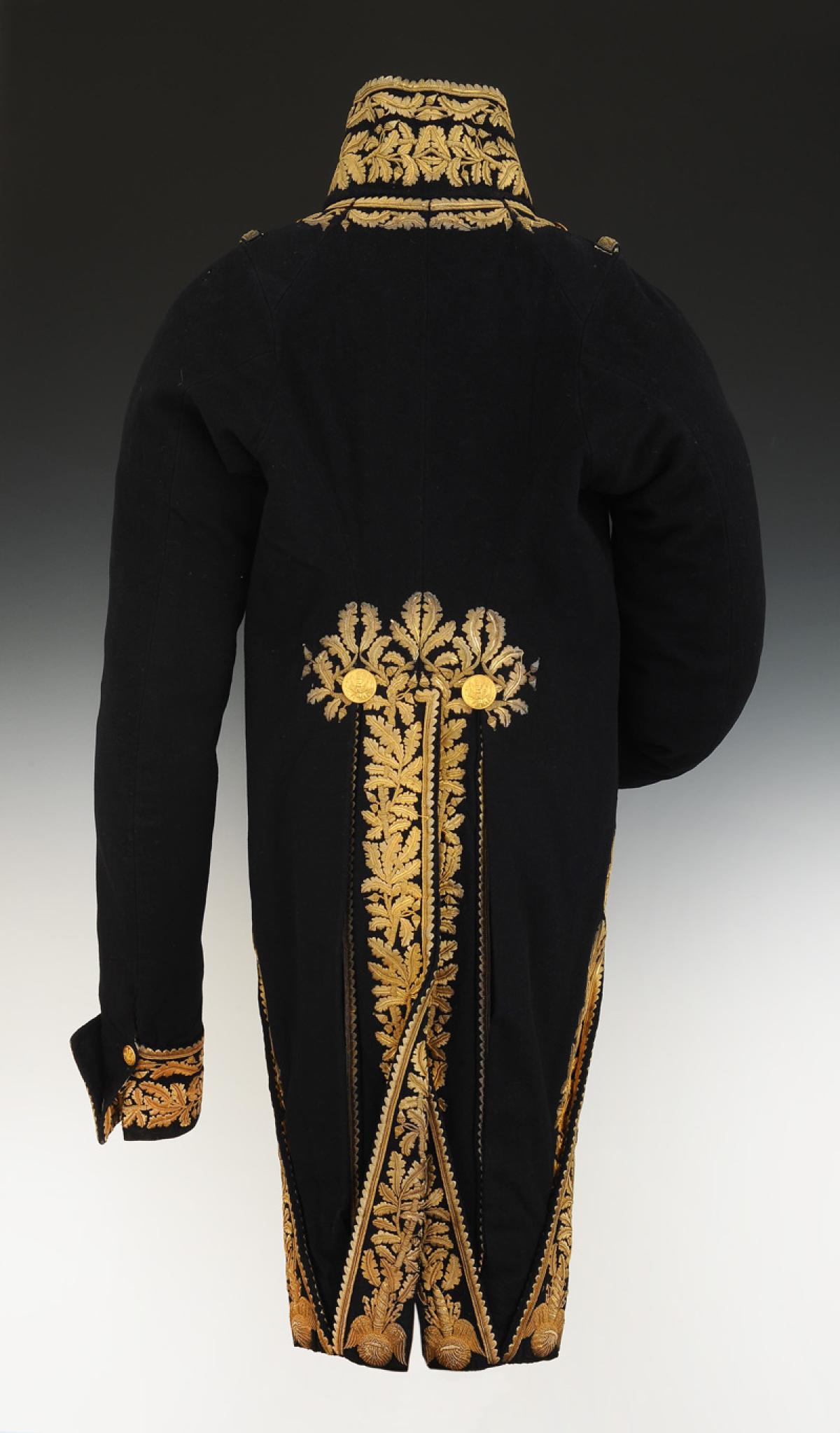
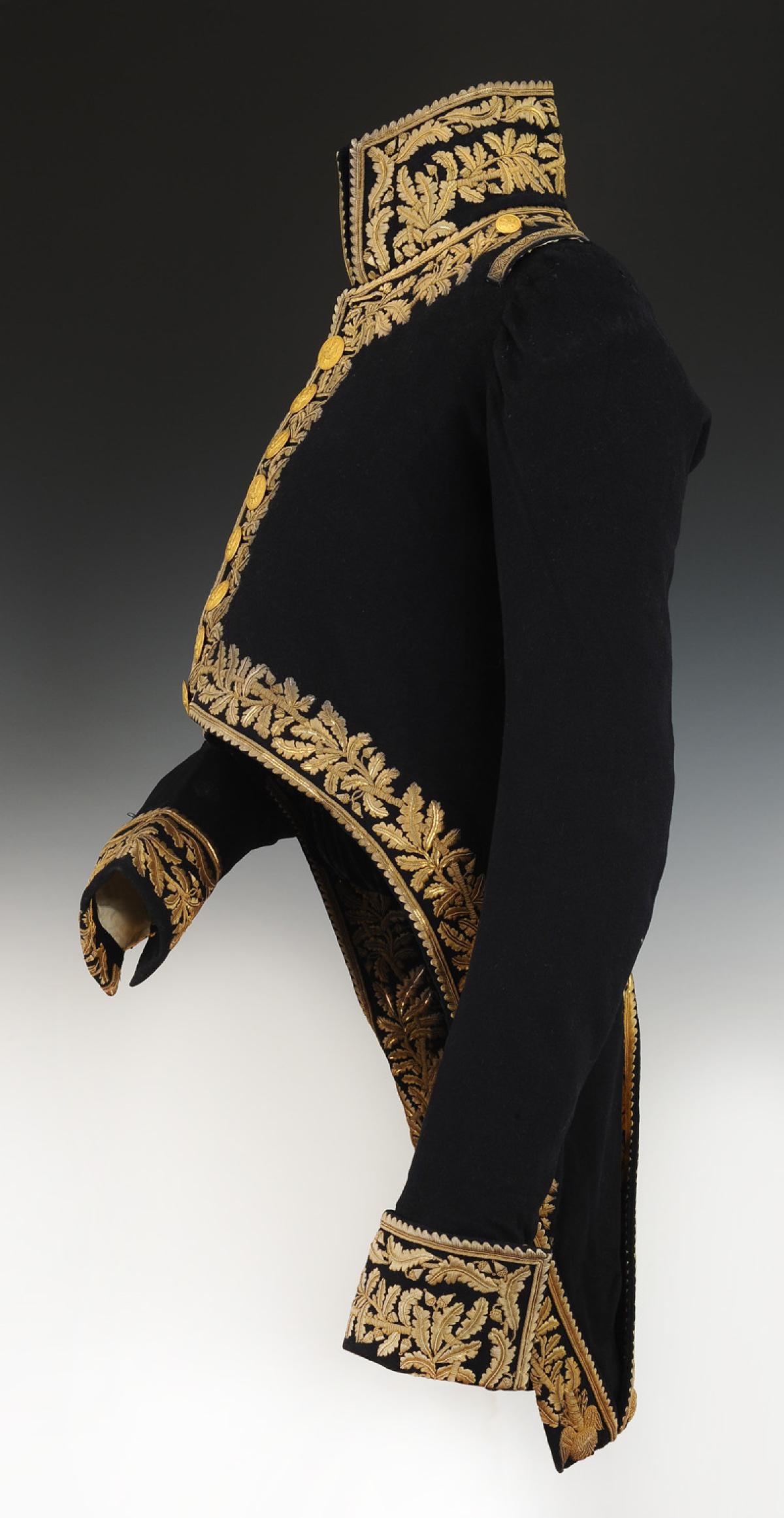
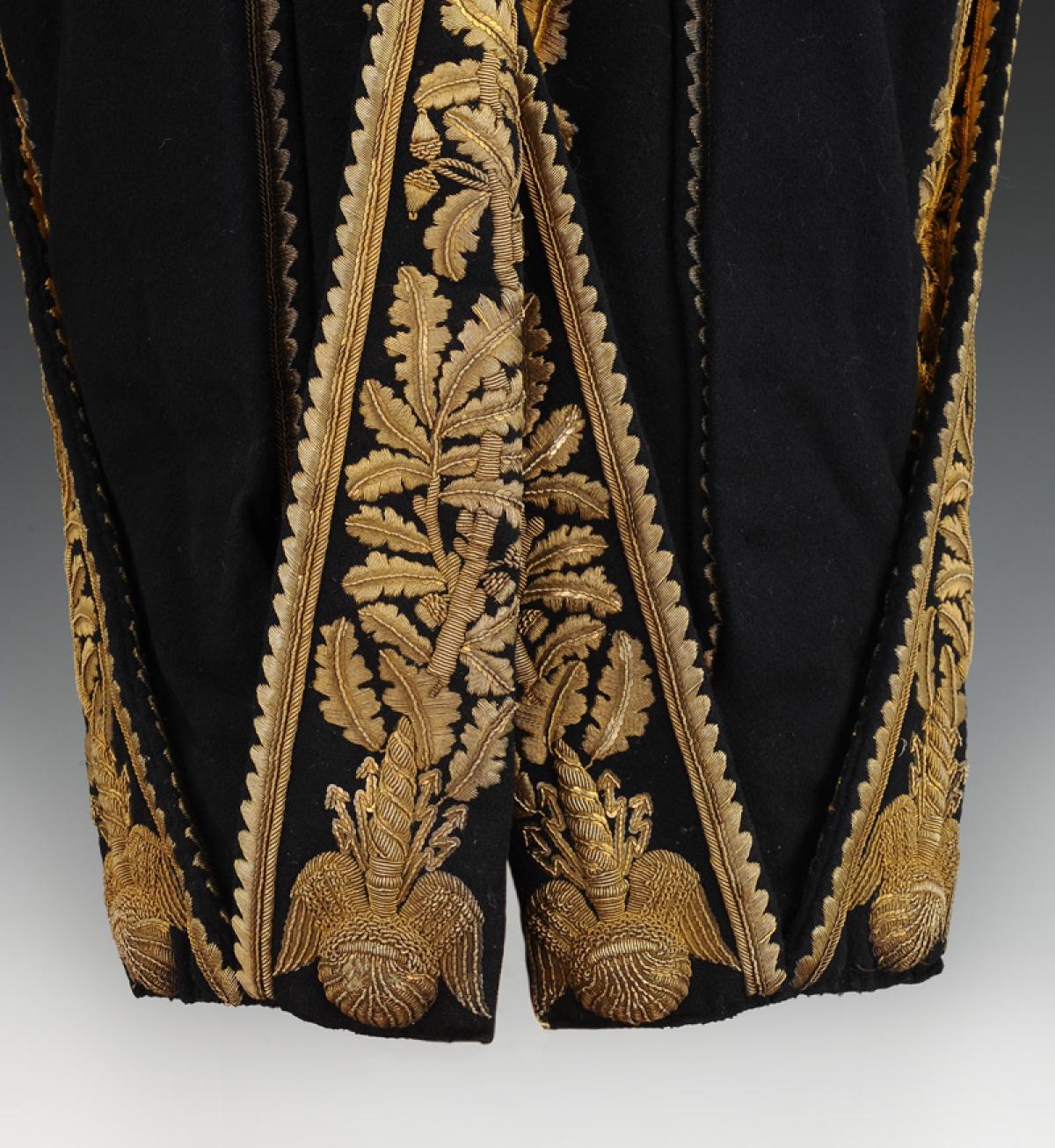
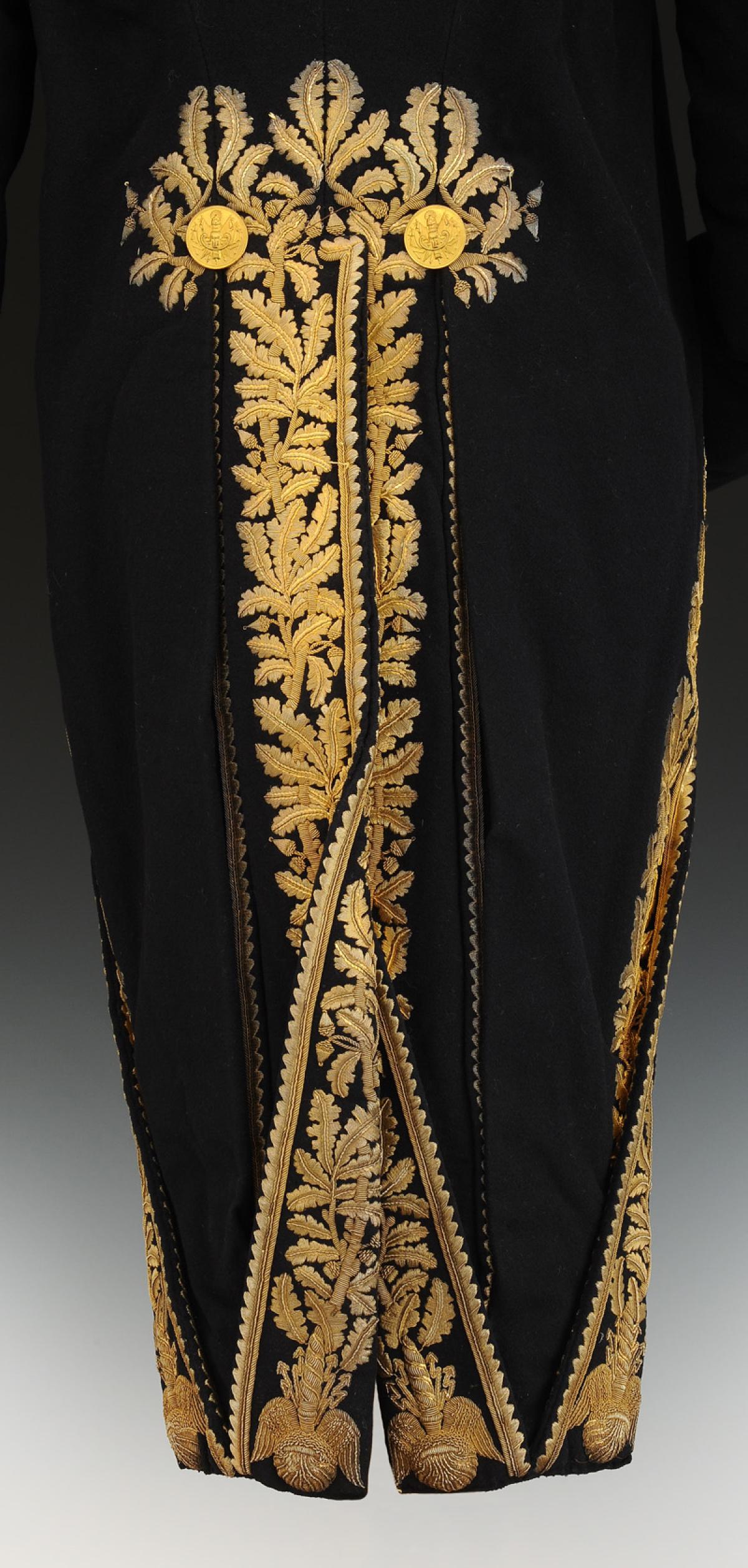
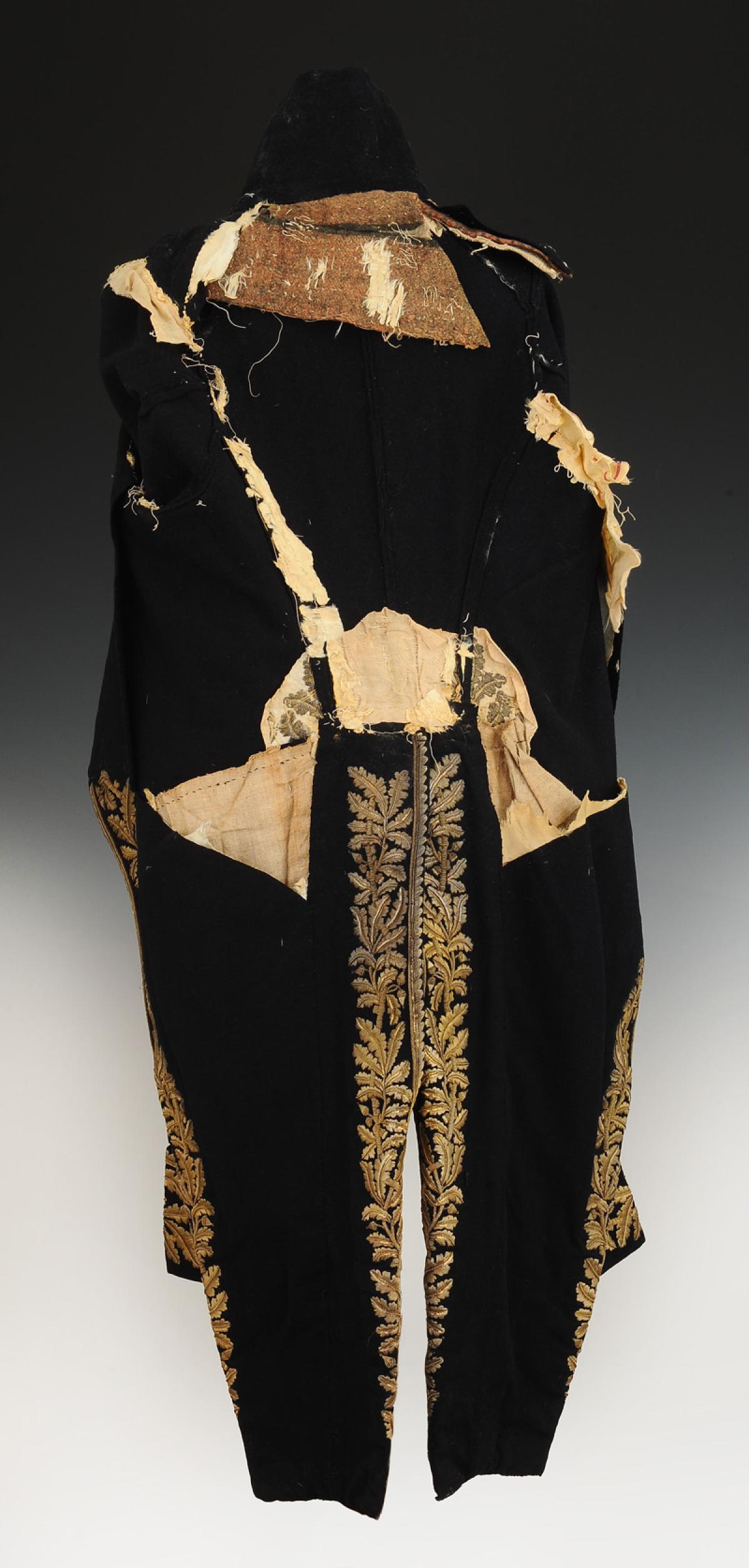
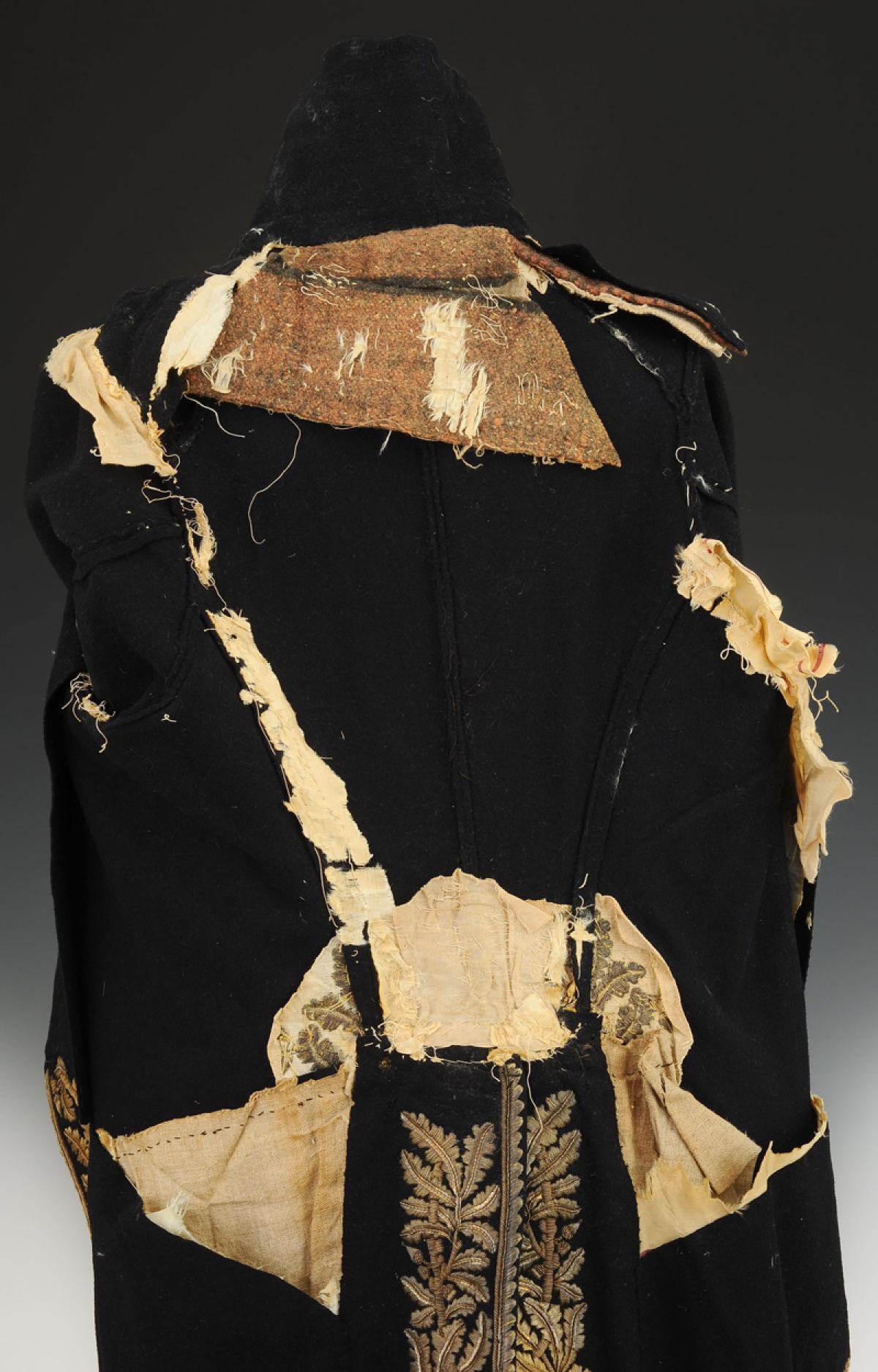

SMALL UNIFORM COAT OF A DIVISIONAL GENERAL, attributed to Joseph Bonaparte, King of Spain, model of the 1st Vendémiaire Year XII, First Empire (July 22, 1813 - November 27, 1815). 33622
"Divisional and brigade generals included in the organization of the army have a full and a small uniform."
Full dress coat in national blue wool, lined in the same fabric, without lapels, buttoning straight on the chest to the waist, flaring on the thigh, and not crossed at the back.
Straight national blue wool collar, height 11 cm.
Cuffs, made of the same wool, height 10 cm, cut wider by one centimeter than the sleeve, which will be fastened below by a small uniform brass button of Ø 1.7 cm.
At the rear, the two tails are folded in on themselves, forming turnbacks embellished in each corner with a bomb in flames and a winged and sparkling Jupiter's spindle richly embroidered in silver gilt threads, cannetilles, and sequins. Height of the embroidered insignia 7 cm x 5.2 cm.
Coat adorned on the front right side with nine large buttons (one button missing) Ø 2.7 cm in gilded brass mounted on a brass base, placed at equal distance from the collar to the pocket level, over a total distance of 33 cm, and one button at each hip.
Gilt metal buttons depicting a shield stamped with an imperial eagle, resting on a trophy, topped with a helmet and crossed by a winged and sparkling thunderbolt.
All rank embroideries, with two rows of oak leaves adorning the collar and cuffs (one row of oak leaves 5.3 cm underlined by a second row of 2.2 cm).
The front of the coat, the tails at the back and the pleats have embroidery of a fixed width of 6 cm including the scalloped rod. This embroidery features a branch of oak in gold (gilt silver), with very small sequins on the edges of the leaves and on the rod. Branch body and rod net embroidered in twisted strands.
Epaulet straps in blue wool embroidered with twisted strands and golden sequins, width 1.3 cm. On each side of the collar, at the level of the straps, a small button is sewn.
Inner lining in blue wool.
Sleeve length 71.5 cm.
Shoulder width approximately 38 cm.
Total height from the top of the collar to bottom approximately 87 cm.
France.
First Empire.
Perfect state of preservation with intact gold embroidery, missing upper front button, partially missing lining at the back.
PROVENANCE:
Joseph-Napoleon Bonaparte (1768-1844), King of Spain (1808-1813).
John Nevill, 3rd Earl of Abergavenny (1789-1845), who seized it at the Battle of Vitoria on June 21, 1813.
Then by descent to the Marquess of Abergavenny (PUITS TUNBRIDGE).
Public sale in the United Kingdom on September 19, 2018, at Mellors & Kirk.
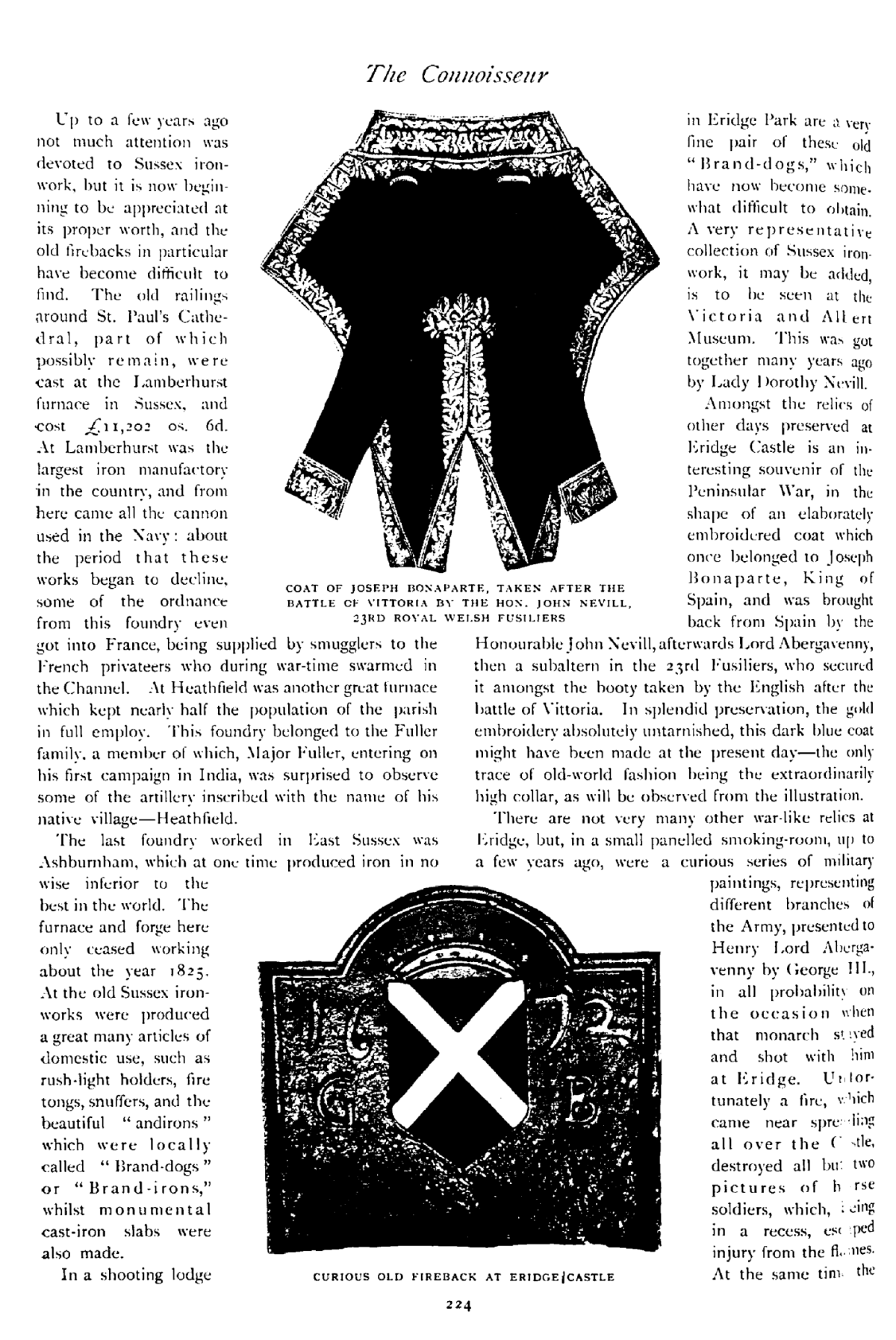
This uniform is a Napoleonian full dress coat (dark blue, richly embroidered in gold) attributed to Joseph Bonaparte and said to have been taken at the Battle of Vitoria on June 21, 1813, it is mentioned in an article in 1907 published in the magazine "The Connoisseur an Illustrated Magazine for Collectors" (later titled "Connoisseur"), a British magazine published from 1901 to 1992 in London dealing with subjects related to luxury in areas such as fine arts, collectibles, and antique furniture. The article "Eridge Castle and Its Contents, Part I" signed by R. Nevill and L. Willoughby was published in 1906, Volume XVI (September-December 1906), pages 221 to 226.
In this article, this uniform is described as an "interesting souvenir of the Peninsular War", in excellent condition with gold embroideries "absolutely intact". The article publishes a photograph of this piece then kept at Eridge Castle in Sussex, owned by the Nevill family. It is written that this uniform was seized by English soldiers during the French rout at Vitoria in Spain, on June 21, 1813. It was part of the royal baggage convoy abandoned by Joseph Bonaparte, King of Spain, when he fled the battlefield.
Among the many war spoils seized by officers and men of Wellington at the Battle of Vitoria, the huge baggage convoy of Joseph Bonaparte, consisting of over 200 carts, found itself blocked in the narrow streets of the city. The morale of his troops, shattered by Wellington's tactics and the skill of his subordinates, drove the French to flee, and chaos quickly ensued as the British pounced on the treasure-laden convoy. Ironically, Joseph himself had plundered whatever he could carry.
During the looting by the British, Joseph and his troops managed to escape. Wellington's army was completely disorganized by late afternoon, and the opportunity to drive the French out of the Iberian Peninsula was lost, leading the Duke of Fer to describe the participants as "ragtag".
Lieutenant John Nevill (1789-1845) of the 23rd Infantry Regiment witnessed the scene, which, by early evening, had degenerated into drunken revelry. Noticing a drunken soldier wearing the coat, he ordered him to hand it over. Nevill, who later inherited the title of 3rd Earl of Abergavenny and entered the clergy, took the coat with him to the family's Eridge Castle in Sussex, UK, where it was preserved and exhibited in the family collection.
In the twentieth century, it was loaned to the Military Museum and Fortress of Redoubt at Eastbourne.
The Connoisseur an illustrated magazine for collectors : ERIDGE and its CASTLE contents.
By Ralph Nevill and Leonard Willoughby — Part I
A building of considerable size, Eridge Castle stands upon a ridge amid wooded scenery of almost incomparable beauty. The deer park, reputed to be the oldest in England, already existed at the time of the Norman Conquest, and its magnificent deer were doubtless one of the reasons that prompted Queen Elizabeth I to visit Eridge in 1573, for the “Virgin Queen” greatly enjoyed watching deer and, on occasion, hunting them herself at the proper season.
It was here, during a stay of six days, that she met the French ambassador. Her host, Henry Nevill, Lord Abergavenny, had always been one of her great favorites, and before coming to Eridge she had spent three days at his residence at Roding.
At the time of Queen Elizabeth’s visit, Eridge appears to have been a residence of fine proportions, with three galleries, the remains of two of which may still be distinguished in an inner courtyard. Tradition asserts that the original house had been built on a quadrangular plan, though nothing clearly visible truly confirms this hypothesis. During her stay, Queen Elizabeth occupied apartments situated in what, until a few years ago, was still the long gallery, now incorporated into the dining room.
In 1730, a manor house was built at Kidbrooke, where the family settled, although Eridge itself seems never to have been entirely abandoned. The residence, however, had long been in ruins, and the remaining structures were used as a farm until 1787, when the Lord Abergavenny of the day decided to return to live at Eridge, neglected as the family seat for nearly two hundred years.
Thereafter, he incorporated the remains of the old manor into a new construction adorned with numerous machicolated turrets and battlements, in the Gothic style then very much in fashion. In certain parts of the building, ancient walls still survive, though concealed behind the more modern structure built, as already noted, in the style of “Strawberry Hill.” Upon entering the house, the eye is immediately drawn to the wrought ironwork of the entrance gate which, despite the effects of wind and weather, retains remarkable beauty. Many carvings of a similar kind may be found in certain rooms and corridors, probably collected from old churches and monasteries on the Continent at the time of the restoration of Eridge; some rooms, especially that known as the “Oak Room,” indeed contain remarkable examples of the sculptor’s art.
In a niche near the entrance hall stands a magnificent model of HMS Foudroyant, aboard which Ralph, Viscount Nevill, fought at the Battle of Trafalgar; it was also the vessel that carried Horatio Nelson’s body back to England. A letter from Viscount Nevill still existed not long ago, giving a vivid description of that great naval battle and dwelling especially upon the dreadful carnage caused by flying splinters of wood, even deadlier than the cannonballs themselves; unfortunately, it is much to be regretted that this letter has been lost in recent years.
It was also Viscount Nevill who, while captain of the frigate Boadicea, brought back from the Cape of Good Hope a goat intended for his cousin Reginald Nevill, the animal being depicted in a painting reproduced here.
Near the model of the Foudroyant hang, carefully preserved in a display case, the robes worn by Henry, Lord Abergavenny, when he sat among the judges at the trial of Mary, Queen of Scots, at Fotheringhay in 1586. According to tradition, in gratitude for his courtesy, Mary Stuart presented him with her pearl necklace, which remained in the family’s possession until comparatively recent times.
In the entrance hall, just inside the door, hangs a portrait of John Robinson, father of Mary, Lady Abergavenny, a man famous in his day and considered to be the origin of the expression “As soon as you can say Jack Robinson,” later popularized by Richard Brinsley Sheridan.
Almost directly opposite this painting, heavy doors give access to the dining room, whose walls are covered with numerous portraits of the Lords Abergavenny and their wives. Among them is Charles Nevill, Earl of Westmorland, whose cradle until recently remained at Apethorpe in Northamptonshire. This estate did not pass out of the Nevill family until the end of the sixteenth century, following a lawsuit lost to the Fane family.
Another portrait depicts the Honorable George Nevill, master of the old Surrey foxhound pack, standing beside his horse; the work is said to be by George Romney, though a meticulous critic might perhaps be inclined to doubt it.
This dining room also contains several remarkable Sussex iron firebacks. The oldest bears the inscription “G.R. (George Bergavenny), 1672” and is of great interest. Others, dated from 1731 to 1735, are admirably decorated with the Nevill arms in relief and originally came from the house at Kidbrooke, sold in 1805 by Henry Lord Abergavenny when he resolved to reside permanently at Eridge.
Formerly, Eridge stood at the very heart of the Sussex iron district, and until comparatively recently visitors were shown, on Eridge Green, the oldest mortar ever cast.
Until a few years ago, Sussex ironwork attracted little attention, but it is now beginning to be appreciated at its true value; old firebacks in particular have become difficult to obtain. The ancient railings surrounding St. Paul’s Cathedral, portions of which may perhaps still survive, were cast at the Lamberhurst furnace in Sussex at a cost of £1,202 and sixpence.
At Lamberhurst stood the largest ironworks in the country, from which all the cannon used by the British Navy were supplied. When these works began to decline, some of this artillery even found its way to France, secretly supplied to the French privateers who swarmed through the English Channel in wartime.
At Heathfield there existed another great furnace employing nearly half the population of the parish. This foundry belonged to the Fuller family; one of its members, Major Fuller, during his first campaign in India, was astonished to discover upon certain artillery pieces the name of his native village: Heathfield.
The last foundry operating in East Sussex was that at Ashburnham, which once produced iron considered among the finest in the world. Its furnace and forge did not cease operations until around 1825.
The old Sussex forges manufactured numerous domestic objects: rushlight holders, tongs, snuffers, as well as magnificent firedogs locally known as “Brand-dogs” or “Brand-irons.” They also produced cast-iron funerary slabs.
In a hunting lodge within the Eridge park may still be seen a very fine pair of these ancient “Brand-dogs,” now become rather rare. A particularly representative collection of Sussex ironwork may also be admired at the Victoria and Albert Museum; it was assembled many years ago by Lady Dorothy Nevill.
Among the old relics preserved at Eridge Castle is a remarkable memento of the Peninsular War: a richly embroidered cloak that had belonged to Joseph Bonaparte, brought back from Spain by the Honorable John Nevill, later Lord Abergavenny, then an ensign in the 23rd Regiment of Fusiliers. He had recovered it among the spoils taken by the English after the Battle of Vitoria.
Perfectly preserved, with its gold embroidery still intact, this dark blue cloak might appear to have been made in modern times, were it not for its extraordinarily high collar, visible in the illustration.
Eridge preserves few other military relics. However, in a small paneled smoking room there was until recently a curious series of military paintings representing different branches of the army, presented to Henry Lord Abergavenny by George III, probably during a stay by that sovereign at Eridge for hunting.
Unfortunately, a fire that nearly destroyed the whole castle consumed all these works except two paintings of cavalrymen, protected by their position within an alcove. The same fire also destroyed the “Nevill ship” carved above the fireplace; its place is now occupied by an excellent equestrian portrait of the Honorable George Nevill, painted as a child by Francis Sartorius in 1773.
As regards the Nevill ship emblem, it was probably this device that gave rise to the assertion, repeated in most works of noble genealogy, that the founder of the family was Gilbert de Neville, admiral of the Conqueror’s fleet. In reality, this story rests upon very little evidence. The true identifiable founder seems rather to have been Richard de Neville, who took his name from Neuville-sur-Touques, near Argentan, in what is now the département of Orne.
His name appears upon the western wall of the nave of the church at Dives among the companions-in-arms of William the Conqueror. It is probable that he followed the purple and gold sails of the ship Mora to Pevensey Bay aboard one of the forty ships supplied for the conquest of England by his brother Foulk d’Anou.
Richard’s mother was cousin to the Conqueror, while his sister Hawisia married Robert FitzErneis, who fell at the Battle of Hastings. The contribution of the forty ships, together with a play upon the French word nef — meaning ship — probably contributed greatly to the adoption of this heraldic symbol by the family.
In the Oak Room already mentioned are several curious religious paintings set within the carvings above the fireplace. They were discovered walled up inside the chimney of an upstairs chamber, a room presenting many indications that it had once served as a priest’s hiding place at a time when the family had not entirely renounced the Roman Catholic faith.
Another small adjoining room is noteworthy for the many niches, hiding places, and secret cupboards contrived within the wood paneling; in one of these, five hundred pounds sterling were discovered some years ago. It is by no means impossible that other concealed recesses still remain hidden within these panels, containing substantial sums secreted there by some eccentric occupant of former days.
This room also contains very fine old stained glass, together with various relics of the past: militia gorgets, models of ancient cannon, and other curiosities. In a neighboring chamber stands a strange barometer, one of three examples said to have been made for George III.
Among the finest paintings at Eridge are the portraits of William Lord Abergavenny, Master of the Jewel House in 1739, and of his first wife Catherine, daughter of Lieutenant-General Patton. She had previously been married to an earlier Lord Abergavenny, Edward, cousin of her second husband.
It is unfortunate that the names of the painters of these portraits are unknown; a detailed catalogue of the collections at Eridge has sadly disappeared in recent years. Compiled long ago, it contained much valuable information concerning the history of the Nevill family, which today knows comparatively little of the many works of art it once possessed.
The family’s former London residence was Abergavenny House, situated on the present site of Stationers’ Hall in Paternoster Row. This great mansion must once have contained many paintings and pieces of antique furniture; alas, even the memory of the house itself now seems to have vanished. »
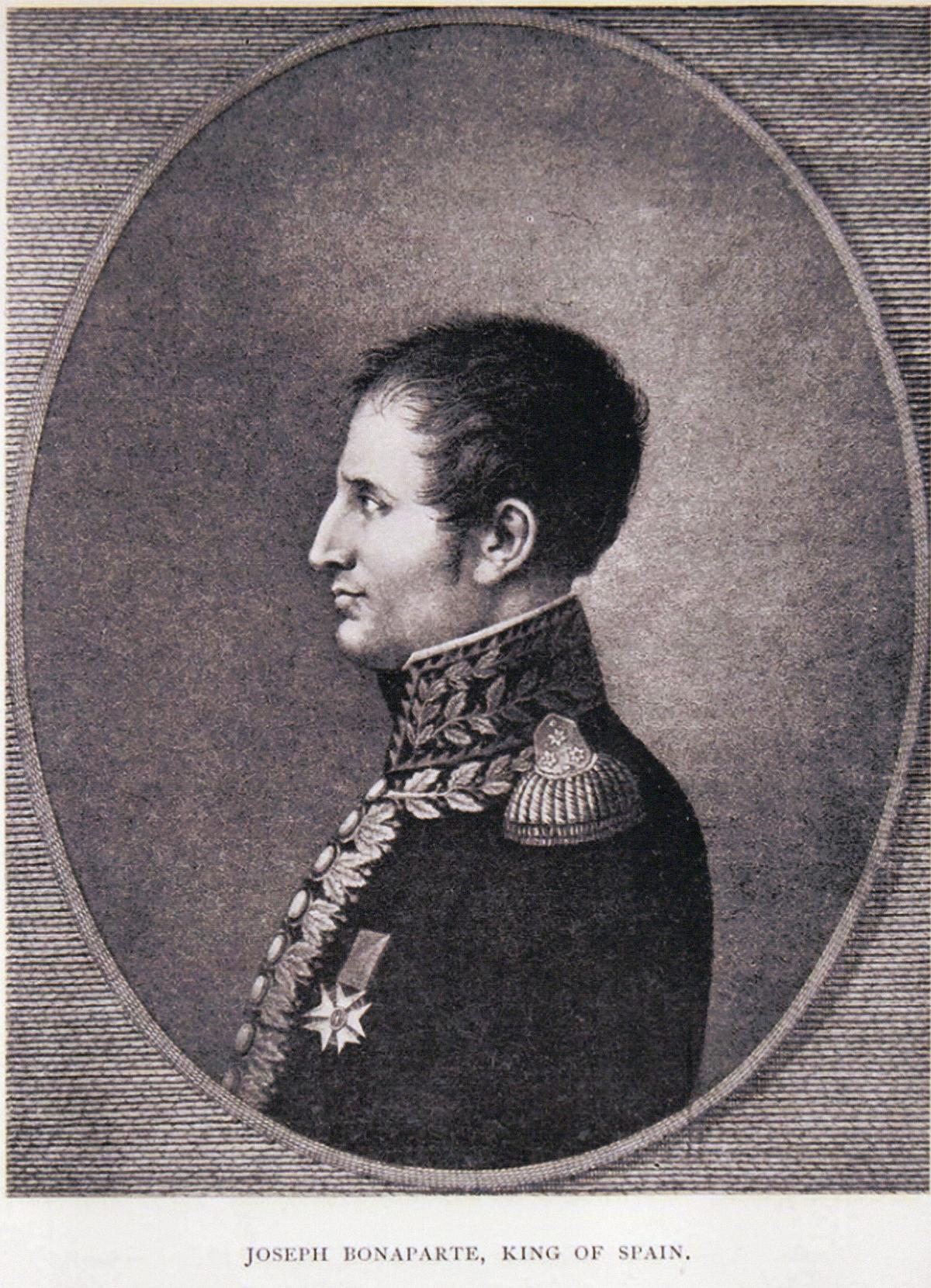
JOSEPH BONAPARTE:
Joseph Bonaparte, born on January 7, 1768 in Corte during the period of Corsican independence, and died on July 28, 1844 in Florence, in the Grand Duchy of Tuscany, was a French statesman and the older brother of Emperor Napoleon I. His political, diplomatic, and military career was closely intertwined with that of his brother Napoleon. Under the Consulate, he was initially appointed as a member of the Council of State and the Legislative Body as the deputy of Golo, and then tasked with several major diplomatic missions: it was he who negotiated the Treaty of Mortefontaine with the United States, the Treaty of Lunéville with Austria, and the Peace of Amiens with the United Kingdom, while also participating in discussions that led to the signing of the Concordat.
As a Grand Elector and French prince after the establishment of the Empire on May 18, 1804, Joseph Bonaparte took on the responsibility of governing during his brother's military campaigns. He was King of Naples from 1806 to 1808, and then of Spain from 1808 to 1813, playing a significant role in Napoleon's efforts to establish French sovereignty over continental Europe. His second reign, culminating in a decisive defeat of the Napoleonic armies he led at the Battle of Vitoria, was marked by continuous warfare, earning him the moniker "el rey intruso," an intruder king unable to govern due to the country's fragmentation and Napoleon's control over its policies.
Appointed as the Emperor's Lieutenant General during the 1814 French campaign, he was unable to prevent the capitulation of Paris to the allied forces. Exiled to Switzerland at the Château de Prangins, he was reinstated in all his functions during the Hundred Days, but eventually forced into another exile in the United States after his brother's abdication. Engaging in business ventures in America while sidelined from politics, he later sought to play a significant role in advocating for his country. Following the death of his nephew Napoleon II in 1832, he became the first heir to the imperial throne and returned to Europe. Settling in London, he endeavored unsuccessfully to promote his family's interests and to persuade French political leaders and the populace to restore the Empire. After another period in the United States between 1835 and 1839, he returned once more to Europe following the death of his third daughter, Charlotte, and settled in Florence, where he passed away in 1844.
At the Battle of Vitoria, Joseph Bonaparte held the title of King of Spain (Joseph I), representing French political authority in Spain. His military role officially was that of the commander-in-chief of the French army in Spain. However, being a relatively inexperienced military leader, he delegated the actual military leadership to Marshal Jean-Baptiste Jourdan, who served as his chief military advisor.
Jean-Baptiste JOURDAN Major General of the Army of Spain:
Born on April 29, 1762 in Limoges, Haute-Vienne, and died on November 23, 1833 in Paris, Jean-Baptiste Jourdan was a French military leader who rose to the rank of Marshal of the Empire. On May 19, 1804, while still in Italy, he learned of his appointment as Marshal of the Empire (fourth in the order of precedence) and escorted the Emperor's carriage during the Coronation ceremony. This appointment was more about Napoleon's desire to garner support from former Jacobin officers rather than recognizing Jourdan's military talents. Jourdan was among the Freemason marshals.
In 1808, he went to Spain as the major general under King Joseph, serving as his chief military advisor. However, his orders often clashed with the hostility of other marshals who only obeyed the Emperor's commands. Joseph, not well-versed in military strategy, nonetheless took on the chief command on several occasions, leading to detrimental outcomes. In these challenging circumstances, Jourdan focused on addressing the Anglo-Spanish army under Generals Wellesley and la Cuesta, who had repelled Marshal Soult in Portugal. Jourdan managed to convince the king to allow the enemy troops to advance towards Madrid, intending to encircle them with Soult's forces arriving from the north. However, on the day of the Battle of Talavera, Marshal Victor's impatience led to disregarding the major general's instructions, gaining Joseph's authorization to attack the English forces entrenched on a hill. After resisting French assaults for three days, Wellesley withdrew, escaping destruction.
Feeling disillusioned about having the appearance of command without the actual control, Jourdan requested his recall, which he received in October 1809, retiring to his estate in Le Coudray (Seine-et-Oise). When Napoleon, determined to wage war against Russia, ordered him back to Spain in 1811 with his primary role, in response to his brother's discord with Soult, he returned. During this second period, the retreat from Madrid unfolded, where he was governor since July 11, 1811, and the Battle of Vitoria took place. Joseph, eager to confront the enemy, disregarded Jourdan's advice to await reinforcements and to dispatch the convoy carrying his court and treasury back to France. Ill, the marshal was unable to assume any command during the battle, which ended in a decisive defeat for the French forces. Jourdan lost his marshal's baton when the king's carriage was attacked by the English. Blamed entirely for the defeat by Napoleon, he asked for his retirement.
For a long time, Marshal Jourdan was held responsible for the day's failure, but he had neither formal nor effective command, and his advice faced numerous contradictions.
THE BATTLE OF VITORIA:
The Battle of Vitoria took place on June 21, 1813, between the French troops escorting the King of Spain Joseph Bonaparte in his retreat and a conglomerate of British, Spanish, and Portuguese troops under the command of General Arthur Wellesley, Viscount Wellington. The Allies' victory marked the definitive retreat of French troops from Spain — except for Catalonia — and forced Emperor Napoleon to return the Spanish crown to Ferdinand VII, thus ending the Spanish War of Independence.
Following the decisive defeat of the French at the Battle of the Pyrenees (also known as the Battle of Salamanca) (1812), Napoleon's troops were unable to hold back the allied army's advance towards Madrid, which was evacuated in July 1812. The following month, Wellington entered the capital. After deploying some divisions to secure the area, he marched with the main army northwards and laid siege to Burgos. However, the French defenders held the stronghold, forcing Wellington to retreat on October 22. Subsequently, the British once again abandoned Madrid to withdraw to Salamanca and then to Ciudad Rodrigo, where they regrouped during the winter. In the meantime, the French forces, already severely diminished and disorganized by the harsh campaign in Spain, were further reduced when several divisions were withdrawn from the Iberian Peninsula to cover other European fronts following Napoleon's disastrous Russian campaign.
With the arrival of spring, Wellington advanced once more to the northeast, reaching the Esla Valley on May 20, 1813. This movement unsettled the French. Marshal Jean-Baptiste Jourdan withdrew the 58,000-strong army he had deployed to reoccupy the area between the Douro and Tagus rivers and concentrated them again at Burgos, ready to secure communications with southern France. The Allied army then moved to cut off this retreat route for Jourdan, who was already considering leaving Spanish soil to safeguard Joseph I's court.
Wellington's army, arranged in three columns, caught up with the retreating French forces near Vitoria in the Basque Country. The French were forced to engage in battle. After a series of fierce encounters, the 3rd Division under Thomas Picton broke the French center, causing it to collapse. The French then fled desperately towards their country's border, leaving behind 7,500 dead, wounded, and captured men. They also lost 151 of their 153 cannons and the abundant loot they were carrying back to France. The Allies (especially the British) then stopped pursuing the French to divide up the spoils, much to Wellington's annoyance.
Later, the Allied forces regrouped and occupied Saint Sebastian and Pamplona, and in December, the invasion of French Basque Country began from these bases. At the end of July 1813, when the news reached Vienna, Johann Nepomuk Maelzel commissioned Ludwig van Beethoven to compose a symphony to celebrate the victory; this became Wellington's Victory, Op. 91 (Wellingtons Sieg or Die Schlacht bei Vitoria or Siegessymphonie).
A monument on the Virgen Blanca square in the center of Vitoria commemorates this event, while another monument inaugurated in 1966 at the Jundiz site was buried during industrial zone development works.
JOSEPH BONAPARTE'S TREASURE IN SPAIN:
The "treasure" was not just a simple chest but a massive convoy consisting of hundreds of wagons containing the plundered goods in Spain, gold and silver from the Spanish Royal Treasury, precious items seized from palaces, jewelry, artworks, religious pieces (from monasteries and churches), as well as artistic collections including paintings by Spanish masters and works from royal collections (notably those from Madrid). The archives and personal belongings of Joseph Bonaparte, silverware, and luxurious furniture were also part of the treasure.
In total, it is said to have comprised over 250 wagons filled with riches.
"Divisional and brigade generals included in the organization of the army have a full and a small uniform."
Full dress coat in national blue wool, lined in the same fabric, without lapels, buttoning straight on the chest to the waist, flaring on the thigh, and not crossed at the back.
Straight national blue wool collar, height 11 cm.
Cuffs, made of the same wool, height 10 cm, cut wider by one centimeter than the sleeve, which will be fastened below by a small uniform brass button of Ø 1.7 cm.
At the rear, the two tails are folded in on themselves, forming turnbacks embellished in each corner with a bomb in flames and a winged and sparkling Jupiter's spindle richly embroidered in silver gilt threads, cannetilles, and sequins. Height of the embroidered insignia 7 cm x 5.2 cm.
Coat adorned on the front right side with nine large buttons (one button missing) Ø 2.7 cm in gilded brass mounted on a brass base, placed at equal distance from the collar to the pocket level, over a total distance of 33 cm, and one button at each hip.
Gilt metal buttons depicting a shield stamped with an imperial eagle, resting on a trophy, topped with a helmet and crossed by a winged and sparkling thunderbolt.
All rank embroideries, with two rows of oak leaves adorning the collar and cuffs (one row of oak leaves 5.3 cm underlined by a second row of 2.2 cm).
The front of the coat, the tails at the back and the pleats have embroidery of a fixed width of 6 cm including the scalloped rod. This embroidery features a branch of oak in gold (gilt silver), with very small sequins on the edges of the leaves and on the rod. Branch body and rod net embroidered in twisted strands.
Epaulet straps in blue wool embroidered with twisted strands and golden sequins, width 1.3 cm. On each side of the collar, at the level of the straps, a small button is sewn.
Inner lining in blue wool.
Sleeve length 71.5 cm.
Shoulder width approximately 38 cm.
Total height from the top of the collar to bottom approximately 87 cm.
France.
First Empire.
Perfect state of preservation with intact gold embroidery, missing upper front button, partially missing lining at the back.
PROVENANCE:
Joseph-Napoleon Bonaparte (1768-1844), King of Spain (1808-1813).
John Nevill, 3rd Earl of Abergavenny (1789-1845), who seized it at the Battle of Vitoria on June 21, 1813.
Then by descent to the Marquess of Abergavenny (PUITS TUNBRIDGE).
Public sale in the United Kingdom on September 19, 2018, at Mellors & Kirk.
This uniform is a Napoleonian full dress coat (dark blue, richly embroidered in gold) attributed to Joseph Bonaparte and said to have been taken at the Battle of Vitoria on June 21, 1813, it is mentioned in an article in 1907 published in the magazine "The Connoisseur an Illustrated Magazine for Collectors" (later titled "Connoisseur"), a British magazine published from 1901 to 1992 in London dealing with subjects related to luxury in areas such as fine arts, collectibles, and antique furniture. The article "Eridge Castle and Its Contents, Part I" signed by R. Nevill and L. Willoughby was published in 1906, Volume XVI (September-December 1906), pages 221 to 226.
In this article, this uniform is described as an "interesting souvenir of the Peninsular War", in excellent condition with gold embroideries "absolutely intact". The article publishes a photograph of this piece then kept at Eridge Castle in Sussex, owned by the Nevill family. It is written that this uniform was seized by English soldiers during the French rout at Vitoria in Spain, on June 21, 1813. It was part of the royal baggage convoy abandoned by Joseph Bonaparte, King of Spain, when he fled the battlefield.
Among the many war spoils seized by officers and men of Wellington at the Battle of Vitoria, the huge baggage convoy of Joseph Bonaparte, consisting of over 200 carts, found itself blocked in the narrow streets of the city. The morale of his troops, shattered by Wellington's tactics and the skill of his subordinates, drove the French to flee, and chaos quickly ensued as the British pounced on the treasure-laden convoy. Ironically, Joseph himself had plundered whatever he could carry.
During the looting by the British, Joseph and his troops managed to escape. Wellington's army was completely disorganized by late afternoon, and the opportunity to drive the French out of the Iberian Peninsula was lost, leading the Duke of Fer to describe the participants as "ragtag".
Lieutenant John Nevill (1789-1845) of the 23rd Infantry Regiment witnessed the scene, which, by early evening, had degenerated into drunken revelry. Noticing a drunken soldier wearing the coat, he ordered him to hand it over. Nevill, who later inherited the title of 3rd Earl of Abergavenny and entered the clergy, took the coat with him to the family's Eridge Castle in Sussex, UK, where it was preserved and exhibited in the family collection.
In the twentieth century, it was loaned to the Military Museum and Fortress of Redoubt at Eastbourne.
The Connoisseur an illustrated magazine for collectors : ERIDGE and its CASTLE contents.
By Ralph Nevill and Leonard Willoughby — Part I
A building of considerable size, Eridge Castle stands upon a ridge amid wooded scenery of almost incomparable beauty. The deer park, reputed to be the oldest in England, already existed at the time of the Norman Conquest, and its magnificent deer were doubtless one of the reasons that prompted Queen Elizabeth I to visit Eridge in 1573, for the “Virgin Queen” greatly enjoyed watching deer and, on occasion, hunting them herself at the proper season.
It was here, during a stay of six days, that she met the French ambassador. Her host, Henry Nevill, Lord Abergavenny, had always been one of her great favorites, and before coming to Eridge she had spent three days at his residence at Roding.
At the time of Queen Elizabeth’s visit, Eridge appears to have been a residence of fine proportions, with three galleries, the remains of two of which may still be distinguished in an inner courtyard. Tradition asserts that the original house had been built on a quadrangular plan, though nothing clearly visible truly confirms this hypothesis. During her stay, Queen Elizabeth occupied apartments situated in what, until a few years ago, was still the long gallery, now incorporated into the dining room.
In 1730, a manor house was built at Kidbrooke, where the family settled, although Eridge itself seems never to have been entirely abandoned. The residence, however, had long been in ruins, and the remaining structures were used as a farm until 1787, when the Lord Abergavenny of the day decided to return to live at Eridge, neglected as the family seat for nearly two hundred years.
Thereafter, he incorporated the remains of the old manor into a new construction adorned with numerous machicolated turrets and battlements, in the Gothic style then very much in fashion. In certain parts of the building, ancient walls still survive, though concealed behind the more modern structure built, as already noted, in the style of “Strawberry Hill.” Upon entering the house, the eye is immediately drawn to the wrought ironwork of the entrance gate which, despite the effects of wind and weather, retains remarkable beauty. Many carvings of a similar kind may be found in certain rooms and corridors, probably collected from old churches and monasteries on the Continent at the time of the restoration of Eridge; some rooms, especially that known as the “Oak Room,” indeed contain remarkable examples of the sculptor’s art.
In a niche near the entrance hall stands a magnificent model of HMS Foudroyant, aboard which Ralph, Viscount Nevill, fought at the Battle of Trafalgar; it was also the vessel that carried Horatio Nelson’s body back to England. A letter from Viscount Nevill still existed not long ago, giving a vivid description of that great naval battle and dwelling especially upon the dreadful carnage caused by flying splinters of wood, even deadlier than the cannonballs themselves; unfortunately, it is much to be regretted that this letter has been lost in recent years.
It was also Viscount Nevill who, while captain of the frigate Boadicea, brought back from the Cape of Good Hope a goat intended for his cousin Reginald Nevill, the animal being depicted in a painting reproduced here.
Near the model of the Foudroyant hang, carefully preserved in a display case, the robes worn by Henry, Lord Abergavenny, when he sat among the judges at the trial of Mary, Queen of Scots, at Fotheringhay in 1586. According to tradition, in gratitude for his courtesy, Mary Stuart presented him with her pearl necklace, which remained in the family’s possession until comparatively recent times.
In the entrance hall, just inside the door, hangs a portrait of John Robinson, father of Mary, Lady Abergavenny, a man famous in his day and considered to be the origin of the expression “As soon as you can say Jack Robinson,” later popularized by Richard Brinsley Sheridan.
Almost directly opposite this painting, heavy doors give access to the dining room, whose walls are covered with numerous portraits of the Lords Abergavenny and their wives. Among them is Charles Nevill, Earl of Westmorland, whose cradle until recently remained at Apethorpe in Northamptonshire. This estate did not pass out of the Nevill family until the end of the sixteenth century, following a lawsuit lost to the Fane family.
Another portrait depicts the Honorable George Nevill, master of the old Surrey foxhound pack, standing beside his horse; the work is said to be by George Romney, though a meticulous critic might perhaps be inclined to doubt it.
This dining room also contains several remarkable Sussex iron firebacks. The oldest bears the inscription “G.R. (George Bergavenny), 1672” and is of great interest. Others, dated from 1731 to 1735, are admirably decorated with the Nevill arms in relief and originally came from the house at Kidbrooke, sold in 1805 by Henry Lord Abergavenny when he resolved to reside permanently at Eridge.
Formerly, Eridge stood at the very heart of the Sussex iron district, and until comparatively recently visitors were shown, on Eridge Green, the oldest mortar ever cast.
Until a few years ago, Sussex ironwork attracted little attention, but it is now beginning to be appreciated at its true value; old firebacks in particular have become difficult to obtain. The ancient railings surrounding St. Paul’s Cathedral, portions of which may perhaps still survive, were cast at the Lamberhurst furnace in Sussex at a cost of £1,202 and sixpence.
At Lamberhurst stood the largest ironworks in the country, from which all the cannon used by the British Navy were supplied. When these works began to decline, some of this artillery even found its way to France, secretly supplied to the French privateers who swarmed through the English Channel in wartime.
At Heathfield there existed another great furnace employing nearly half the population of the parish. This foundry belonged to the Fuller family; one of its members, Major Fuller, during his first campaign in India, was astonished to discover upon certain artillery pieces the name of his native village: Heathfield.
The last foundry operating in East Sussex was that at Ashburnham, which once produced iron considered among the finest in the world. Its furnace and forge did not cease operations until around 1825.
The old Sussex forges manufactured numerous domestic objects: rushlight holders, tongs, snuffers, as well as magnificent firedogs locally known as “Brand-dogs” or “Brand-irons.” They also produced cast-iron funerary slabs.
In a hunting lodge within the Eridge park may still be seen a very fine pair of these ancient “Brand-dogs,” now become rather rare. A particularly representative collection of Sussex ironwork may also be admired at the Victoria and Albert Museum; it was assembled many years ago by Lady Dorothy Nevill.
Among the old relics preserved at Eridge Castle is a remarkable memento of the Peninsular War: a richly embroidered cloak that had belonged to Joseph Bonaparte, brought back from Spain by the Honorable John Nevill, later Lord Abergavenny, then an ensign in the 23rd Regiment of Fusiliers. He had recovered it among the spoils taken by the English after the Battle of Vitoria.
Perfectly preserved, with its gold embroidery still intact, this dark blue cloak might appear to have been made in modern times, were it not for its extraordinarily high collar, visible in the illustration.
Eridge preserves few other military relics. However, in a small paneled smoking room there was until recently a curious series of military paintings representing different branches of the army, presented to Henry Lord Abergavenny by George III, probably during a stay by that sovereign at Eridge for hunting.
Unfortunately, a fire that nearly destroyed the whole castle consumed all these works except two paintings of cavalrymen, protected by their position within an alcove. The same fire also destroyed the “Nevill ship” carved above the fireplace; its place is now occupied by an excellent equestrian portrait of the Honorable George Nevill, painted as a child by Francis Sartorius in 1773.
As regards the Nevill ship emblem, it was probably this device that gave rise to the assertion, repeated in most works of noble genealogy, that the founder of the family was Gilbert de Neville, admiral of the Conqueror’s fleet. In reality, this story rests upon very little evidence. The true identifiable founder seems rather to have been Richard de Neville, who took his name from Neuville-sur-Touques, near Argentan, in what is now the département of Orne.
His name appears upon the western wall of the nave of the church at Dives among the companions-in-arms of William the Conqueror. It is probable that he followed the purple and gold sails of the ship Mora to Pevensey Bay aboard one of the forty ships supplied for the conquest of England by his brother Foulk d’Anou.
Richard’s mother was cousin to the Conqueror, while his sister Hawisia married Robert FitzErneis, who fell at the Battle of Hastings. The contribution of the forty ships, together with a play upon the French word nef — meaning ship — probably contributed greatly to the adoption of this heraldic symbol by the family.
In the Oak Room already mentioned are several curious religious paintings set within the carvings above the fireplace. They were discovered walled up inside the chimney of an upstairs chamber, a room presenting many indications that it had once served as a priest’s hiding place at a time when the family had not entirely renounced the Roman Catholic faith.
Another small adjoining room is noteworthy for the many niches, hiding places, and secret cupboards contrived within the wood paneling; in one of these, five hundred pounds sterling were discovered some years ago. It is by no means impossible that other concealed recesses still remain hidden within these panels, containing substantial sums secreted there by some eccentric occupant of former days.
This room also contains very fine old stained glass, together with various relics of the past: militia gorgets, models of ancient cannon, and other curiosities. In a neighboring chamber stands a strange barometer, one of three examples said to have been made for George III.
Among the finest paintings at Eridge are the portraits of William Lord Abergavenny, Master of the Jewel House in 1739, and of his first wife Catherine, daughter of Lieutenant-General Patton. She had previously been married to an earlier Lord Abergavenny, Edward, cousin of her second husband.
It is unfortunate that the names of the painters of these portraits are unknown; a detailed catalogue of the collections at Eridge has sadly disappeared in recent years. Compiled long ago, it contained much valuable information concerning the history of the Nevill family, which today knows comparatively little of the many works of art it once possessed.
The family’s former London residence was Abergavenny House, situated on the present site of Stationers’ Hall in Paternoster Row. This great mansion must once have contained many paintings and pieces of antique furniture; alas, even the memory of the house itself now seems to have vanished. »
JOSEPH BONAPARTE:
Joseph Bonaparte, born on January 7, 1768 in Corte during the period of Corsican independence, and died on July 28, 1844 in Florence, in the Grand Duchy of Tuscany, was a French statesman and the older brother of Emperor Napoleon I. His political, diplomatic, and military career was closely intertwined with that of his brother Napoleon. Under the Consulate, he was initially appointed as a member of the Council of State and the Legislative Body as the deputy of Golo, and then tasked with several major diplomatic missions: it was he who negotiated the Treaty of Mortefontaine with the United States, the Treaty of Lunéville with Austria, and the Peace of Amiens with the United Kingdom, while also participating in discussions that led to the signing of the Concordat.
As a Grand Elector and French prince after the establishment of the Empire on May 18, 1804, Joseph Bonaparte took on the responsibility of governing during his brother's military campaigns. He was King of Naples from 1806 to 1808, and then of Spain from 1808 to 1813, playing a significant role in Napoleon's efforts to establish French sovereignty over continental Europe. His second reign, culminating in a decisive defeat of the Napoleonic armies he led at the Battle of Vitoria, was marked by continuous warfare, earning him the moniker "el rey intruso," an intruder king unable to govern due to the country's fragmentation and Napoleon's control over its policies.
Appointed as the Emperor's Lieutenant General during the 1814 French campaign, he was unable to prevent the capitulation of Paris to the allied forces. Exiled to Switzerland at the Château de Prangins, he was reinstated in all his functions during the Hundred Days, but eventually forced into another exile in the United States after his brother's abdication. Engaging in business ventures in America while sidelined from politics, he later sought to play a significant role in advocating for his country. Following the death of his nephew Napoleon II in 1832, he became the first heir to the imperial throne and returned to Europe. Settling in London, he endeavored unsuccessfully to promote his family's interests and to persuade French political leaders and the populace to restore the Empire. After another period in the United States between 1835 and 1839, he returned once more to Europe following the death of his third daughter, Charlotte, and settled in Florence, where he passed away in 1844.
At the Battle of Vitoria, Joseph Bonaparte held the title of King of Spain (Joseph I), representing French political authority in Spain. His military role officially was that of the commander-in-chief of the French army in Spain. However, being a relatively inexperienced military leader, he delegated the actual military leadership to Marshal Jean-Baptiste Jourdan, who served as his chief military advisor.
Jean-Baptiste JOURDAN Major General of the Army of Spain:
Born on April 29, 1762 in Limoges, Haute-Vienne, and died on November 23, 1833 in Paris, Jean-Baptiste Jourdan was a French military leader who rose to the rank of Marshal of the Empire. On May 19, 1804, while still in Italy, he learned of his appointment as Marshal of the Empire (fourth in the order of precedence) and escorted the Emperor's carriage during the Coronation ceremony. This appointment was more about Napoleon's desire to garner support from former Jacobin officers rather than recognizing Jourdan's military talents. Jourdan was among the Freemason marshals.
In 1808, he went to Spain as the major general under King Joseph, serving as his chief military advisor. However, his orders often clashed with the hostility of other marshals who only obeyed the Emperor's commands. Joseph, not well-versed in military strategy, nonetheless took on the chief command on several occasions, leading to detrimental outcomes. In these challenging circumstances, Jourdan focused on addressing the Anglo-Spanish army under Generals Wellesley and la Cuesta, who had repelled Marshal Soult in Portugal. Jourdan managed to convince the king to allow the enemy troops to advance towards Madrid, intending to encircle them with Soult's forces arriving from the north. However, on the day of the Battle of Talavera, Marshal Victor's impatience led to disregarding the major general's instructions, gaining Joseph's authorization to attack the English forces entrenched on a hill. After resisting French assaults for three days, Wellesley withdrew, escaping destruction.
Feeling disillusioned about having the appearance of command without the actual control, Jourdan requested his recall, which he received in October 1809, retiring to his estate in Le Coudray (Seine-et-Oise). When Napoleon, determined to wage war against Russia, ordered him back to Spain in 1811 with his primary role, in response to his brother's discord with Soult, he returned. During this second period, the retreat from Madrid unfolded, where he was governor since July 11, 1811, and the Battle of Vitoria took place. Joseph, eager to confront the enemy, disregarded Jourdan's advice to await reinforcements and to dispatch the convoy carrying his court and treasury back to France. Ill, the marshal was unable to assume any command during the battle, which ended in a decisive defeat for the French forces. Jourdan lost his marshal's baton when the king's carriage was attacked by the English. Blamed entirely for the defeat by Napoleon, he asked for his retirement.
For a long time, Marshal Jourdan was held responsible for the day's failure, but he had neither formal nor effective command, and his advice faced numerous contradictions.
THE BATTLE OF VITORIA:
The Battle of Vitoria took place on June 21, 1813, between the French troops escorting the King of Spain Joseph Bonaparte in his retreat and a conglomerate of British, Spanish, and Portuguese troops under the command of General Arthur Wellesley, Viscount Wellington. The Allies' victory marked the definitive retreat of French troops from Spain — except for Catalonia — and forced Emperor Napoleon to return the Spanish crown to Ferdinand VII, thus ending the Spanish War of Independence.
Following the decisive defeat of the French at the Battle of the Pyrenees (also known as the Battle of Salamanca) (1812), Napoleon's troops were unable to hold back the allied army's advance towards Madrid, which was evacuated in July 1812. The following month, Wellington entered the capital. After deploying some divisions to secure the area, he marched with the main army northwards and laid siege to Burgos. However, the French defenders held the stronghold, forcing Wellington to retreat on October 22. Subsequently, the British once again abandoned Madrid to withdraw to Salamanca and then to Ciudad Rodrigo, where they regrouped during the winter. In the meantime, the French forces, already severely diminished and disorganized by the harsh campaign in Spain, were further reduced when several divisions were withdrawn from the Iberian Peninsula to cover other European fronts following Napoleon's disastrous Russian campaign.
With the arrival of spring, Wellington advanced once more to the northeast, reaching the Esla Valley on May 20, 1813. This movement unsettled the French. Marshal Jean-Baptiste Jourdan withdrew the 58,000-strong army he had deployed to reoccupy the area between the Douro and Tagus rivers and concentrated them again at Burgos, ready to secure communications with southern France. The Allied army then moved to cut off this retreat route for Jourdan, who was already considering leaving Spanish soil to safeguard Joseph I's court.
Wellington's army, arranged in three columns, caught up with the retreating French forces near Vitoria in the Basque Country. The French were forced to engage in battle. After a series of fierce encounters, the 3rd Division under Thomas Picton broke the French center, causing it to collapse. The French then fled desperately towards their country's border, leaving behind 7,500 dead, wounded, and captured men. They also lost 151 of their 153 cannons and the abundant loot they were carrying back to France. The Allies (especially the British) then stopped pursuing the French to divide up the spoils, much to Wellington's annoyance.
Later, the Allied forces regrouped and occupied Saint Sebastian and Pamplona, and in December, the invasion of French Basque Country began from these bases. At the end of July 1813, when the news reached Vienna, Johann Nepomuk Maelzel commissioned Ludwig van Beethoven to compose a symphony to celebrate the victory; this became Wellington's Victory, Op. 91 (Wellingtons Sieg or Die Schlacht bei Vitoria or Siegessymphonie).
A monument on the Virgen Blanca square in the center of Vitoria commemorates this event, while another monument inaugurated in 1966 at the Jundiz site was buried during industrial zone development works.
JOSEPH BONAPARTE'S TREASURE IN SPAIN:
The "treasure" was not just a simple chest but a massive convoy consisting of hundreds of wagons containing the plundered goods in Spain, gold and silver from the Spanish Royal Treasury, precious items seized from palaces, jewelry, artworks, religious pieces (from monasteries and churches), as well as artistic collections including paintings by Spanish masters and works from royal collections (notably those from Madrid). The archives and personal belongings of Joseph Bonaparte, silverware, and luxurious furniture were also part of the treasure.
In total, it is said to have comprised over 250 wagons filled with riches.
Price :
120 000,00 €
| Destination | Envoi recommandé | Envoi Recommandé + Express |
|---|---|---|
| Shipping France | 17,00 € | 50,00 € |
| Shipping Europe | 25,00 € | 70,00 € |
| Shipping world | 70,00 € | 120,00 € |
Insurance (1%) :
1 200,00 €
Reference :
33622
Next update Friday, octobre 9 at 13:30 PM
FOR ALL PURCHASES, PAYMENT IN MULTIPLE CHECKS POSSIBLE
bertrand.malvaux@wanadoo.fr 06 07 75 74 63
SHIPPING COSTS
Shipping costs are calculated only once per order for one or more items, all shipments are sent via registered mail, as this is the only way to have proof of dispatch and receipt.
For parcels whose value cannot be insured by the Post, shipments are entrusted to DHL or Fedex with real value insured, the service is of high quality but the cost is higher.
RETURN POLICY
Items can be returned within 8 days of receipt. They must be returned by registered mail at the sender's expense, in their original packaging, and in their original condition.
AUTHENTICITY
The selection of items offered on this site allows me to guarantee the authenticity of each piece described here, all items offered are guaranteed to be period and authentic, unless otherwise noted or restricted in the description.
An authenticity certificate of the item including the description published on the site, the period, the sale price, accompanied by one or more color photographs is automatically provided for any item priced over 130 euros. Below this price, each certificate is charged 5 euros.
Only items sold by me are subject to an authenticity certificate, I do not provide any expert reports for items sold by third parties (colleagues or collectors).
FOR ALL PURCHASES, PAYMENT IN MULTIPLE CHECKS POSSIBLE
bertrand.malvaux@wanadoo.fr 06 07 75 74 63
An authenticity certificate of the item including the description published on the site, the period, the sale price, accompanied by one or more color photographs is automatically provided for any item priced over 130 euros. Below this price, each certificate is charged 5 euros.
Only items sold by me are subject to an authenticity certificate, I do not provide any expert reports for items sold by third parties (colleagues or collectors).