
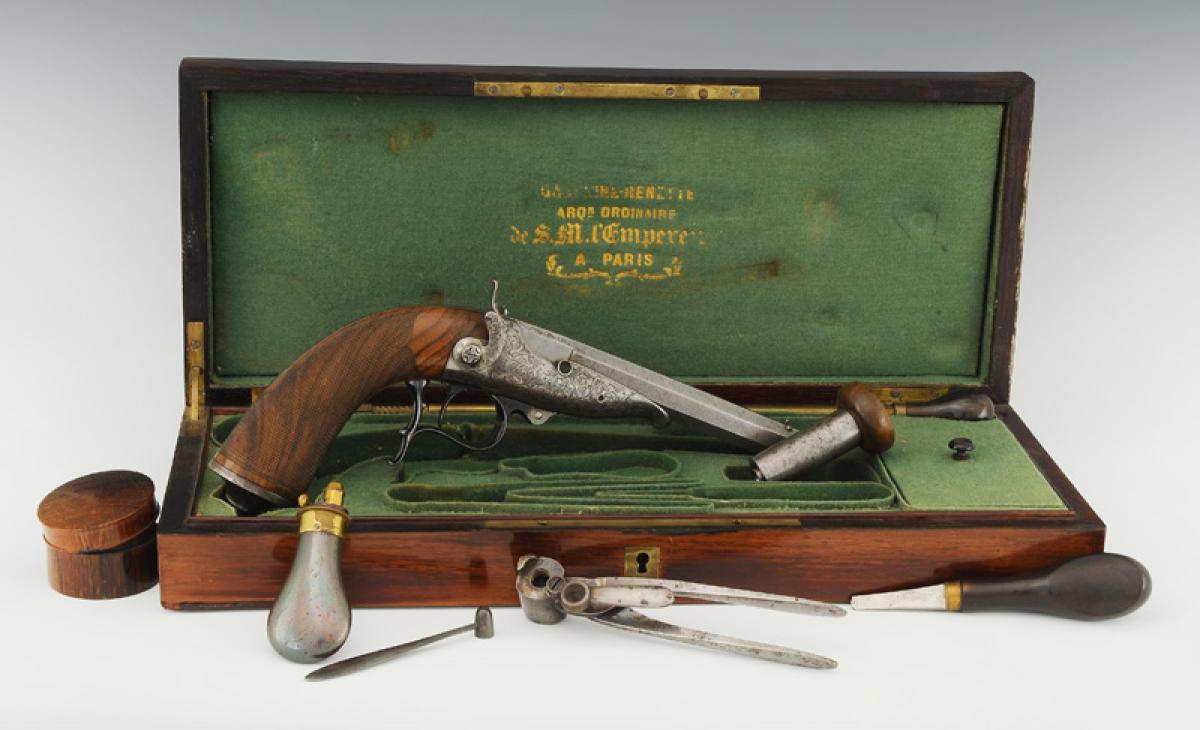
GASTINNE RENETTE FALLING BLOCK PISTOL, PRESENTED IN ITS ORIGINAL CASE, Second Empire. 33598
Sold out
GASTINNE RENETTE FALLING BLOCK PISTOL, PRESENTED IN ITS ORIGINAL CASE, Second Empire. 33598
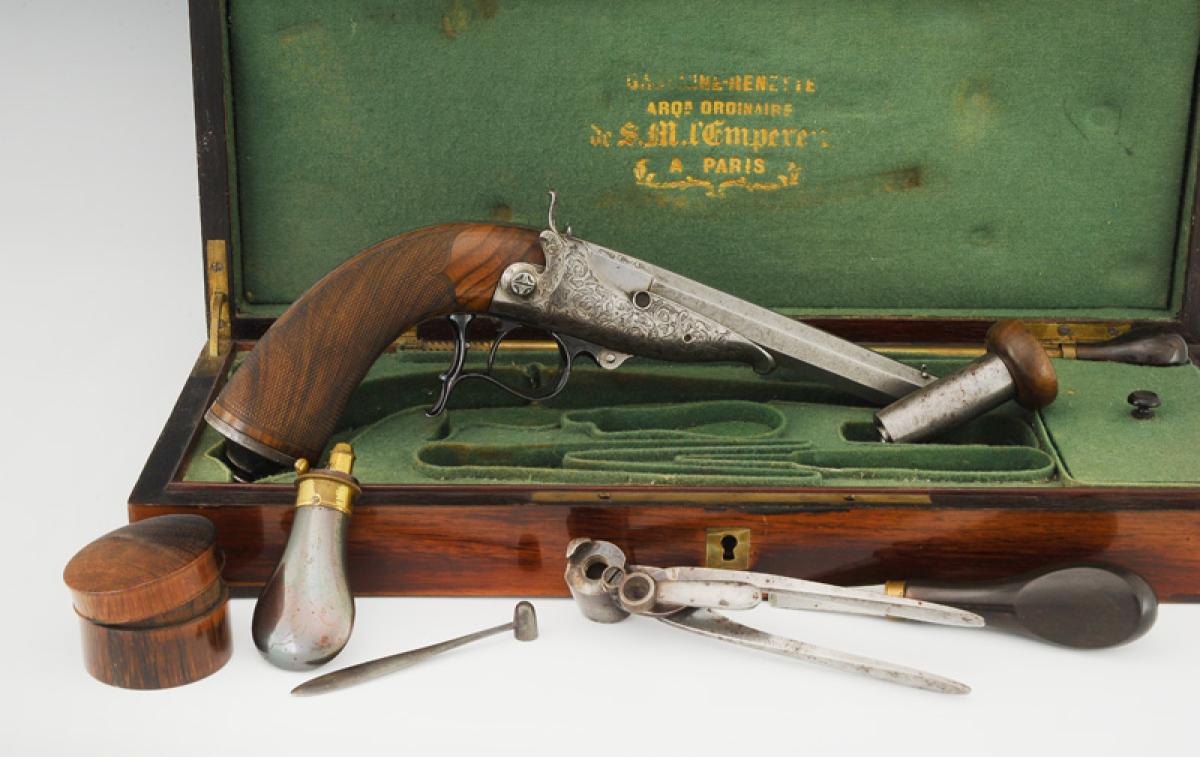
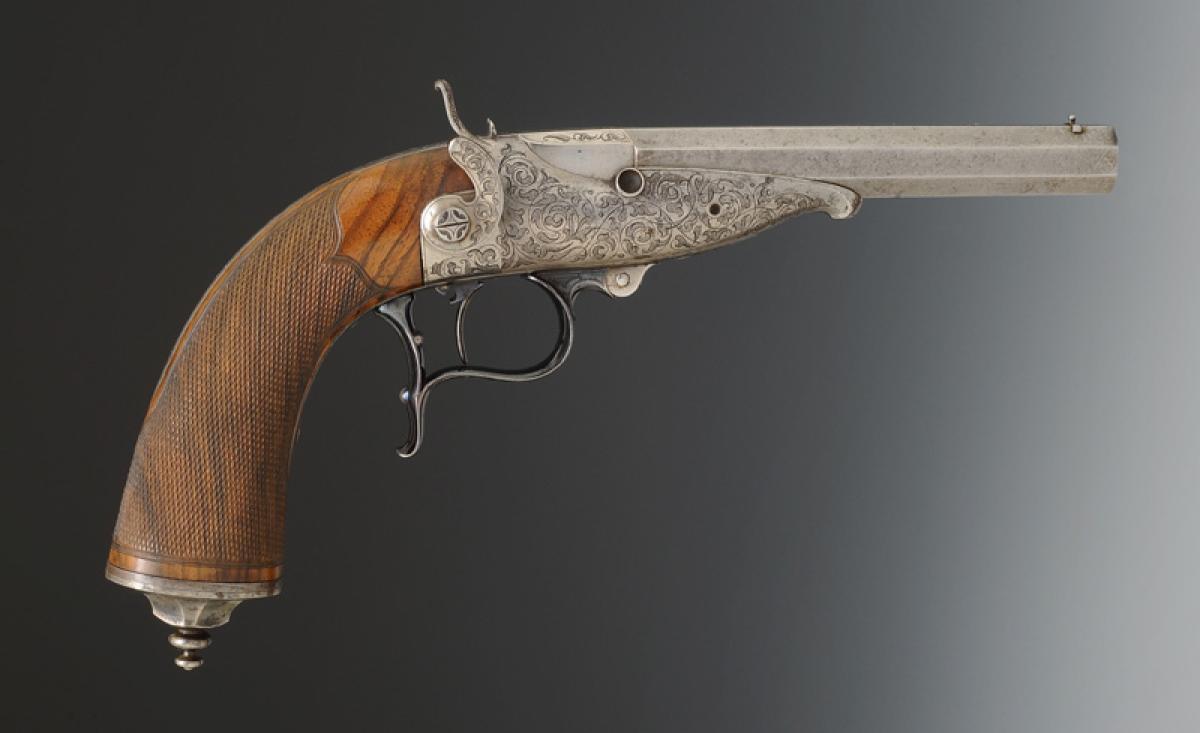
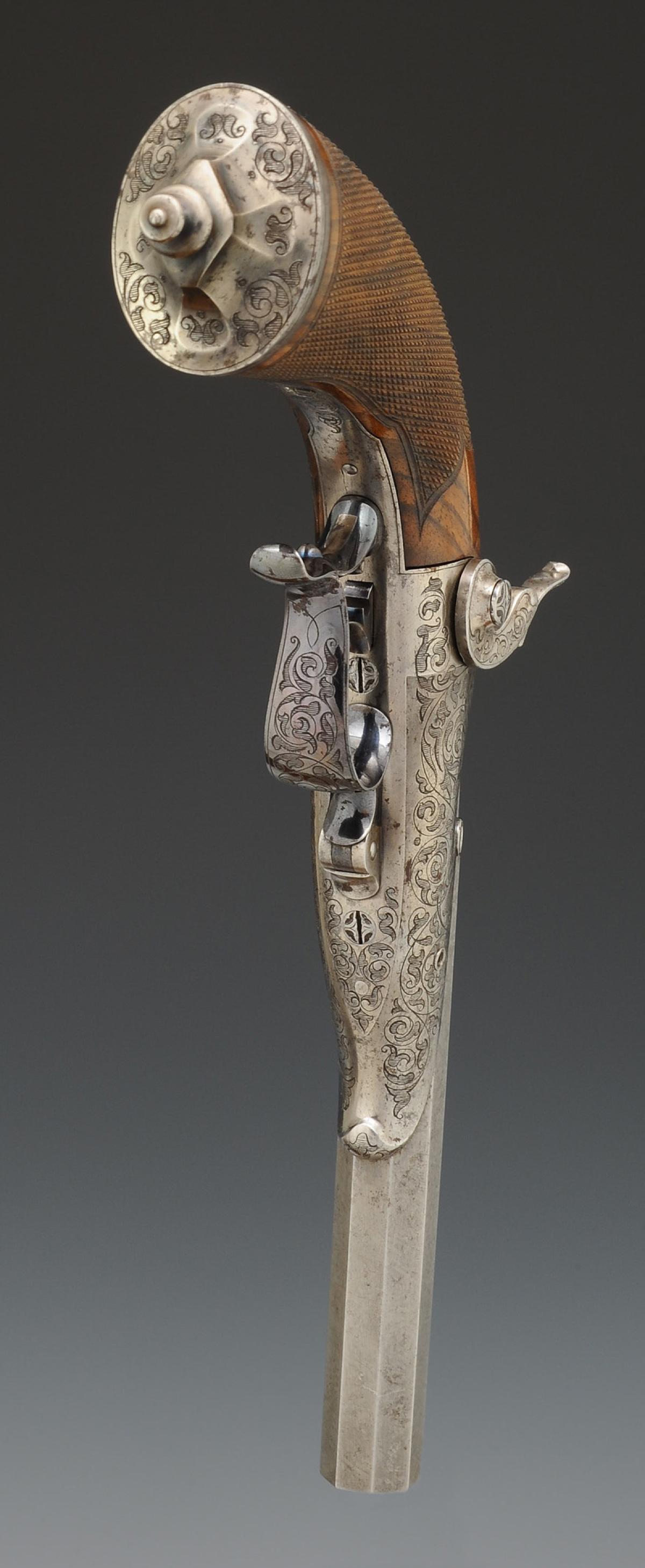
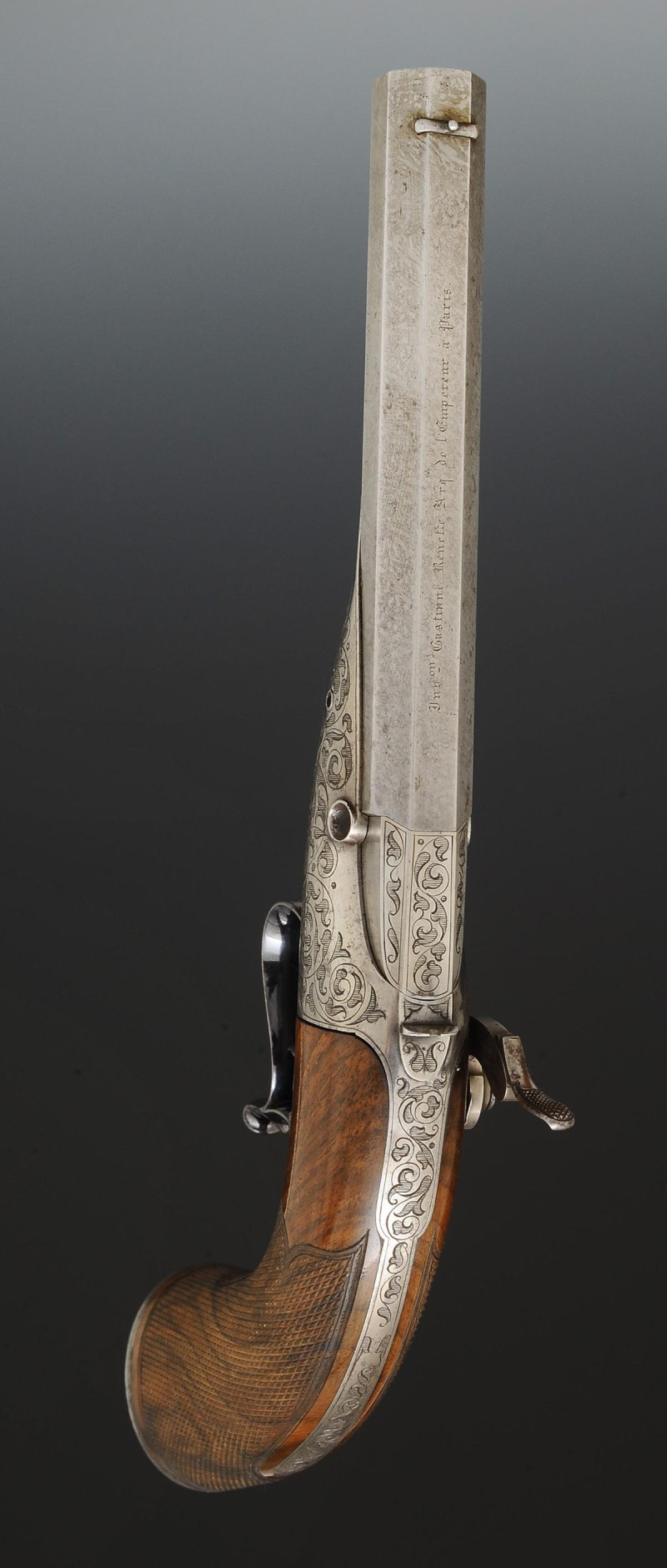
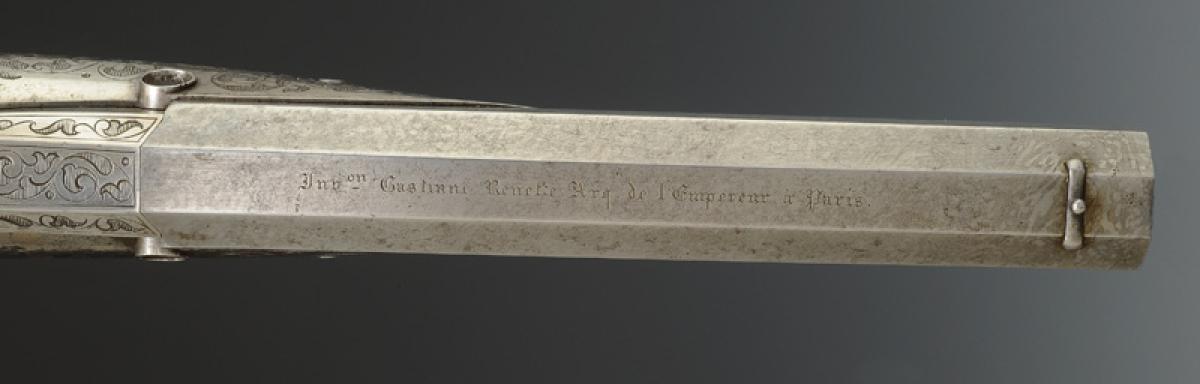
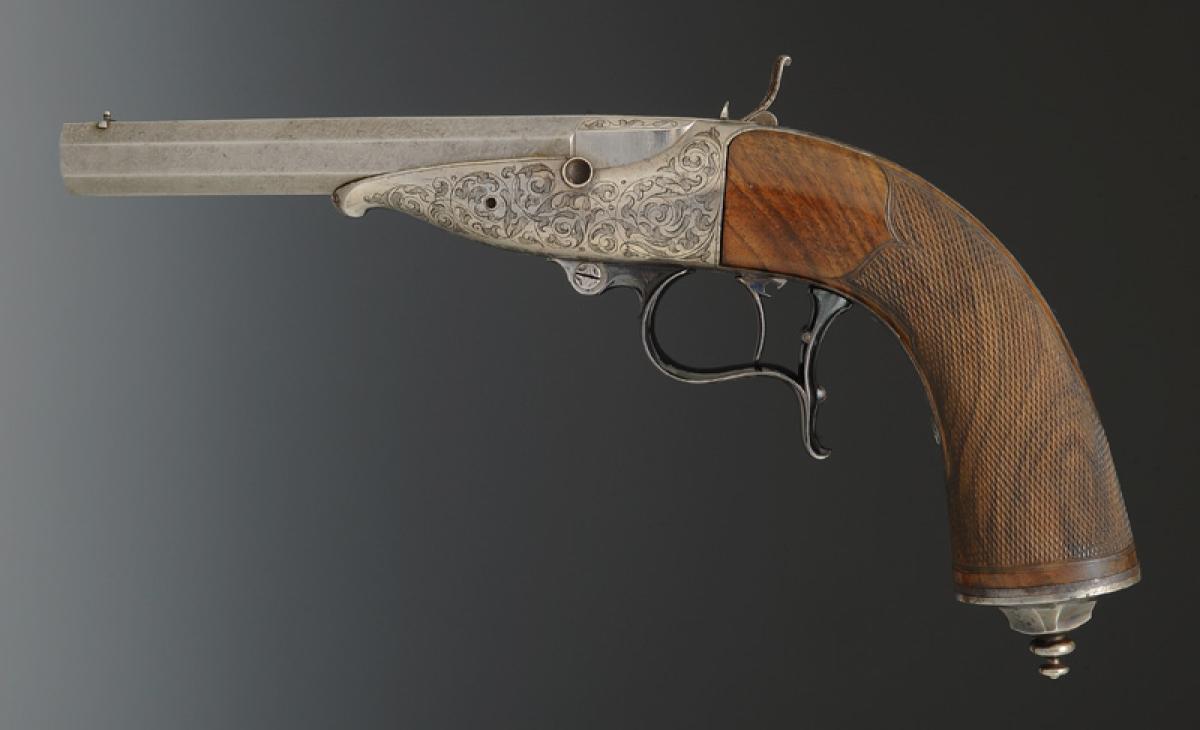
Octagonal Damascus barrel, rifled inside, length 12.8 cm, with rear sight, engraved on the upper panel "INVon (INVention) Gastinne. Renette. Emperor's gunsmith in Paris.". Falling block system with engraved foliage, block length 3.7 cm, opened by the trigger guard. Steel breech engraved with foliage. Receiver and cap engraved with a vegetal decoration. Dog linked to the striker housed in the block, which transmits the shot initiation to the primer through a short articulated rod on the frizzen, with the downward movement of the said frizzen serving as the internal dog. Trigger guard with blued steel finger rest engraved with foliage. Finely checkered walnut grip. Oval-shaped cap engraved with foliage. Total length of the pistol 26 cm. 9mm caliber.
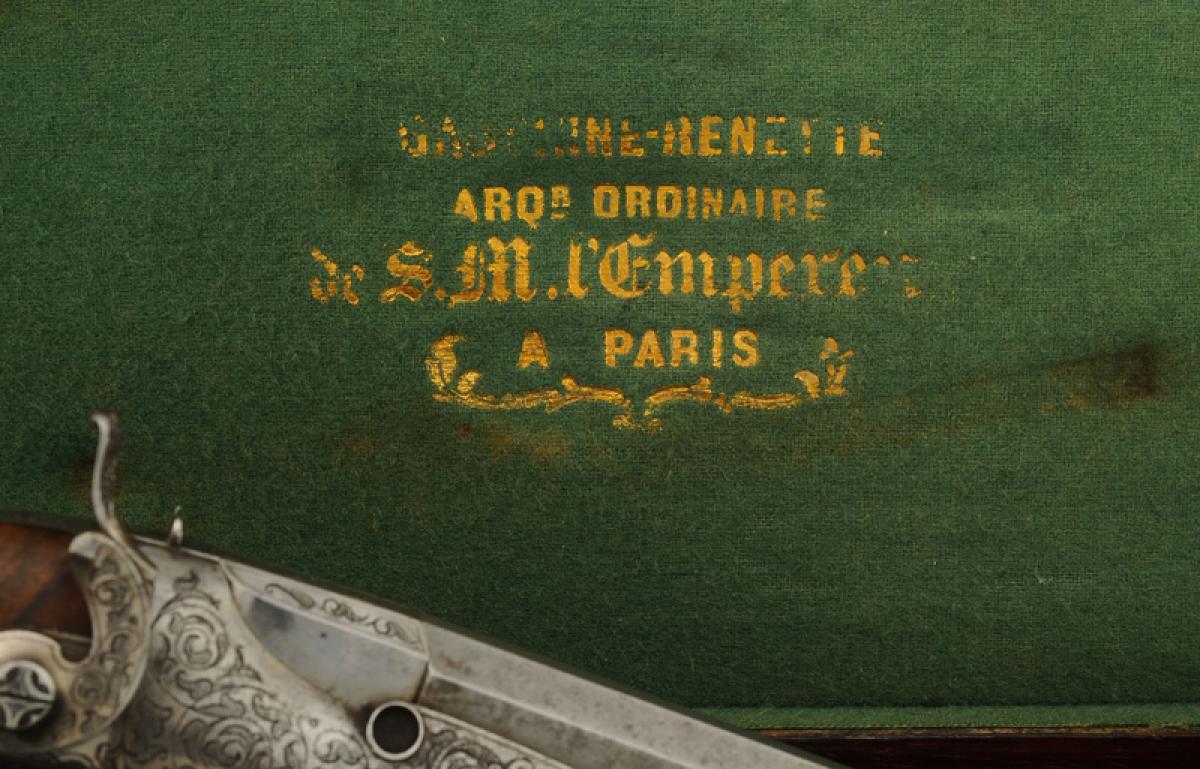
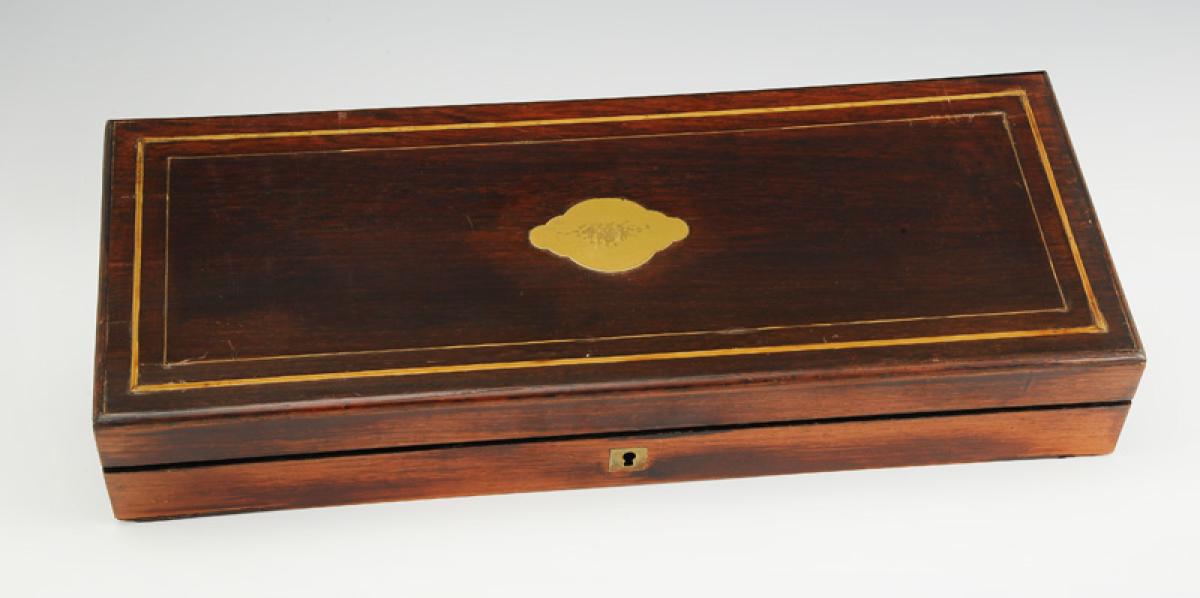
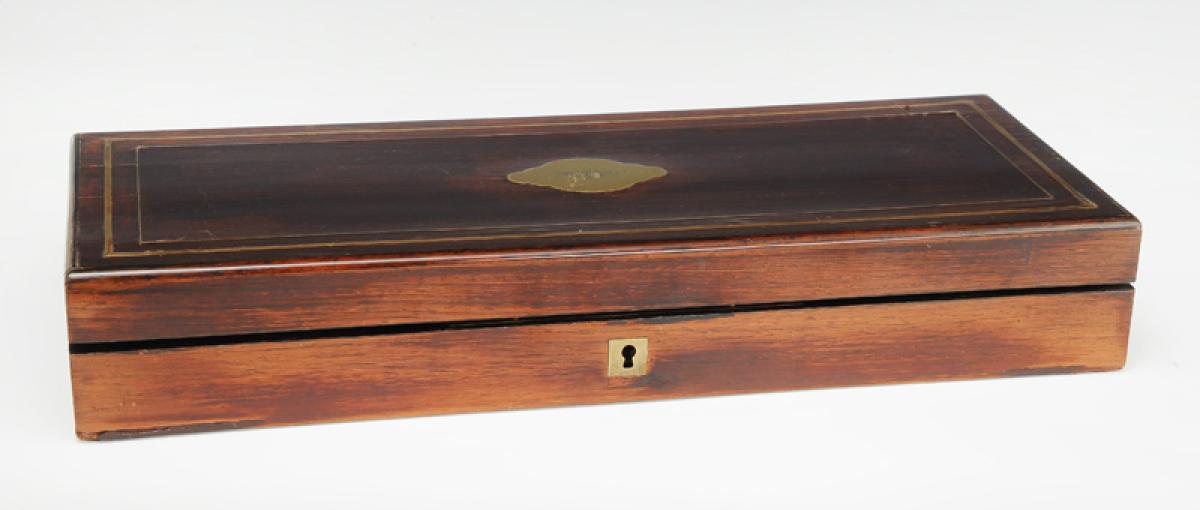
Mahogany case with brass inlays, length 41.5 cm, width 17 cm, height 6 cm. Interior lined with green felt marked in gold on the lid "GASTINNE-RENETTE / OFFICIAL GUNSMITH / to H.M. the Emperor / IN PARIS". Complete with all its accessories: screwdriver, bullet mold, powder measure, small bronze and brass powder flask, walnut powder flask, 19 period cartridges. Brass closure complete with its key.
France. Second Empire. Perfect condition.
HISTORICAL BACKGROUND:
Here is an article by Monsieur Clergeau published in the Gazette des Armes
a GASTINNE-RENETTE system
In 1812, Gastinne, a renowned craftsman in the circle of Parisian gunsmiths, joined forces with Renette from the famous family of gunners, whom he would later marry the daughter of. This was the foundation of the Gestinne-Renette house, whose reputation has remained strong since and continues to represent high-quality firearms. From the Second Empire to the Belle Époque, they were the leading specialists in duel pistols, and their stand was one of the most fashionable places to be. The fastest games where the best among the celebrities of the time gathered, often seeking platinum cards and dolls.
People also came there, less innocently, to prepare for a duel or a passionate encounter in those years when the Bureau of Publicity did not yet exist, and slightly sadistic developers had the idea that honor could only be avenged in blood... The house went to great lengths to serve its distinguished clientele, even renting pistols for these refined settlements of accounts, which were quite common at the time... For the record, M. Caillaux was seen there, rehearsing on the afternoon of March 15, 1914, before lodging the five bullets from her lady's pistol into the body of Calmette, director of the Figaro, thus opening the most sensational case of the pre-war period...
So the reputation of Gastinne-Renette combat pistols outshone the most famous firearms on the continent, both French and foreign. Justly so: their finish, balance, and precision even at a good distance, provided they were loaded with the necessary care, still amaze us. Thus, due to snobbery, it was considered top-notch to exchange shots with pistols of this brand on the field, despite the inherent dangers due to the recommended powder overload for the occasion, in order to lift the barrel and shoot the bullet over the target.
Combat or duel pistols had to adhere to fairly strict standards, due to the precise and imperative rules of this folkloric entertainment. Therefore, Gastinne-Renette did not limit itself to these prestigious productions, but expanded its talent to other handguns. This allowed them to freely express their inventive genius and even their whimsy, as defensive weapons allowed for various interpretations. This is why you can find, engraved with their brand, various very personal creations in terms of defense pistols, with loading through the muzzle or through the breech, including:
- pocket pistols with an underlever, right-angled grip, rifled barrel firing conical bullets forced onto a rod, encapsulating great precision and real power in a compact size;
- target pistols with breech loading, the sliding barrel separating from the breech for loading. It moves forward on a table through the action of a movable trigger guard transmitted by a linkage, a design later adopted by Ghaye and a few others.
It should be noted that these were always models produced in very limited numbers, and their originally high price greatly limited their spread. Gastinne-Renette, a gunsmith to His Majesty the Emperor and the King of Spain, as were the Renettes gunners to the king under the Ancient Regime, exclusively manufactured luxury firearms for aristocratic or highly privileged customers. This explains why a double signature in gothic letters generally signifies an enviable collector's piece and drives up auction bids in salesrooms...
Among the lesser-known systems invented and produced by the house, is one particularly rare (this is only the second time we have encountered it) and which we will speak to you about today: it is a defense pistol with breech loading and rifled barrel; with belt dimensions, suggesting it may have been used, personally, by an officer in the years preceding the widespread adoption of revolvers in France, around 1860, a date we had somewhat arbitrarily assigned to the first specimen of its kind presented here a few years ago. But today we have seen two forming a pair, prompting us to correct this estimation as they bear, damascened in gold on the barrel, the date 1855 alongside the signature of Gastinne-Renette. We will not dwell more than necessary on the richness of the decoration: the metallic parts are entirely covered with gold damascene, the grip is finely carved, and the pommel bears an intricately engraved cap. It is beyond doubt that these were commissioned pieces, perhaps intended as gifts for important figures. It is also worth noting that this lavish display of gold and ornaments somewhat deviates from the traditional style of the brand, which generally leaned towards simplicity, prioritizing the perfection of craftsmanship, the quality of materials used, and the purity of lines, all of which contributed to giving these pieces their exceptional character.
What particularly interests us here is the system, unusual for its time and very similar to that of Sharps, its seven-year elder, but without any overt signs of plagiarism. As it is known, when an idea is in the air, it is often simultaneously implemented in various places without communication between them. Thus, the vertical falling block closure, operated by a movable lever-trigger guard connected directly to the underside of this block by an axle on a pin. The pivot point of this lever-trigger, serving as the fulcrum of a second-class lever, is located under the receiver a few millimeters in front of the mortise in which the block slides. In the closed position, to prevent inadvertent opening, the front portion of the lever-trigger is held in place by a small spring-loaded hook acting in a mortise on the lower guard. The weapon features a rimfire percussion system, with the cap of the grip, movable by lateral pivoting, concealing a reserve of four cartridges in the pommel, and the movement of the block when opened acts as an extractor.
The shot is initiated by a striker housed in the block, which transmits the impact to the primer, through a short rod articulated on the frizzen, with the downward movement of the said frizzen acting as the striker. On the left side is an external lever, a sort of pseudo-hammer, which allows for arming and disarming this mechanism at will, all completely housed within the grip. Here, we can see a remarkable resemblance to the percussion system of a contemporary, the Devinme revolver.
Therefore, nothing special so far, but what intrigues us is the ammunition. The arrangement of the striker suggests a rimfire cartridge, a well-known type even by 1855, although still little used outside of Flobert-type small arms. It is worth noting that the technique of stamping cartridge cases was still in its infancy, requiring composite constructions for large caliber shells, such as Beringer cartridges, among others, established on this principle. However, there was already decent stamping of short shells of significant calibers for pistols.
Everything would seem to conform to the norm, even logically, if the box containing this magnificent pair of pistols did not also contain a series of accessories, including a bullet mold, powder flask, and bullet seating and crimping tool, which suggests the possibility of recharging the ammunition... Now, as everyone knows, rimfire ammunition is non-reloadable due to its design, except for rare exceptions that confirm the rule: one could mention Indigenous peoples who reportedly managed to reload Spencer or Henry cartridges, a practice also known in Central Europe and the Balkans, but always with great difficulties and highly unpredictable results. These were the strategies of poor souls unable to procure new cartridges, which could not have been the case for the wealthy clients of our gunsmith.
Therefore, and indeed it must be considered, there may have been a special reloadable rimfire cartridge, however, between 1835 and 1870, we find a series of patents for cartridges filed by Gastinne, or Gastinne-Renette, none of which seem to match what we are looking for, except for patent number 10519 of 1859, depicting a rimfire cartridge that may be reloadable... may be, as the accompanying explanations are too brief to draw a definite conclusion from the drawing.
Nonetheless, it seems that the primer consisted of a disk of some fulminating paper, placed at the bottom of the case, then (but again, maybe) removable and replaceable. Two compartments, closed by swiveling lids and hollowed out in the base of the powder flask, seem perfectly suited to contain such primers. Yes, but... this patent postdates the firearm itself by four years, and furthermore, we cannot confirm the actual existence of such ammunition.
Let's look further... The years from 1840 to 1870 saw the emergence of countless patents covering increasingly clever cartridges, most of which remained at the prototype stage. We have found one that, technically and chronologically, could suit our needs: Chaudin's patent number 3601 of 1847, which claims several models including a rimfire cartridge where the primer is held by the edge of a short tube inserted into the case, receiving the striker's impact through the case metal.
This removable tube allows for case re-priming, a definite advantage, but its complexity likely relegates it, alongside the majority of its competitors and contemporaries, to the realm of curious inventiveness. Therefore, considering everything, and unable to confirm the use of a special reloadable rimfire cartridge, we suspect that all this fine equipment is merely intended to reload single-use empty cases, as is the norm for rimfire case designs. It may have even been a relatively common case design, suitable for various firearms, but whose standard loading was deemed unsuitable for the specific pistol in question, hence the need to prepare them according to different standards. For now, this remains a mere speculation, subject to the acumen of the reader...
Octagonal Damascus barrel, rifled inside, length 12.8 cm, with rear sight, engraved on the upper panel "INVon (INVention) Gastinne. Renette. Emperor's gunsmith in Paris.". Falling block system with engraved foliage, block length 3.7 cm, opened by the trigger guard. Steel breech engraved with foliage. Receiver and cap engraved with a vegetal decoration. Dog linked to the striker housed in the block, which transmits the shot initiation to the primer through a short articulated rod on the frizzen, with the downward movement of the said frizzen serving as the internal dog. Trigger guard with blued steel finger rest engraved with foliage. Finely checkered walnut grip. Oval-shaped cap engraved with foliage. Total length of the pistol 26 cm. 9mm caliber.
Mahogany case with brass inlays, length 41.5 cm, width 17 cm, height 6 cm. Interior lined with green felt marked in gold on the lid "GASTINNE-RENETTE / OFFICIAL GUNSMITH / to H.M. the Emperor / IN PARIS". Complete with all its accessories: screwdriver, bullet mold, powder measure, small bronze and brass powder flask, walnut powder flask, 19 period cartridges. Brass closure complete with its key.
France. Second Empire. Perfect condition.
HISTORICAL BACKGROUND:
Here is an article by Monsieur Clergeau published in the Gazette des Armes
a GASTINNE-RENETTE system
In 1812, Gastinne, a renowned craftsman in the circle of Parisian gunsmiths, joined forces with Renette from the famous family of gunners, whom he would later marry the daughter of. This was the foundation of the Gestinne-Renette house, whose reputation has remained strong since and continues to represent high-quality firearms. From the Second Empire to the Belle Époque, they were the leading specialists in duel pistols, and their stand was one of the most fashionable places to be. The fastest games where the best among the celebrities of the time gathered, often seeking platinum cards and dolls.
People also came there, less innocently, to prepare for a duel or a passionate encounter in those years when the Bureau of Publicity did not yet exist, and slightly sadistic developers had the idea that honor could only be avenged in blood... The house went to great lengths to serve its distinguished clientele, even renting pistols for these refined settlements of accounts, which were quite common at the time... For the record, M. Caillaux was seen there, rehearsing on the afternoon of March 15, 1914, before lodging the five bullets from her lady's pistol into the body of Calmette, director of the Figaro, thus opening the most sensational case of the pre-war period...
So the reputation of Gastinne-Renette combat pistols outshone the most famous firearms on the continent, both French and foreign. Justly so: their finish, balance, and precision even at a good distance, provided they were loaded with the necessary care, still amaze us. Thus, due to snobbery, it was considered top-notch to exchange shots with pistols of this brand on the field, despite the inherent dangers due to the recommended powder overload for the occasion, in order to lift the barrel and shoot the bullet over the target.
Combat or duel pistols had to adhere to fairly strict standards, due to the precise and imperative rules of this folkloric entertainment. Therefore, Gastinne-Renette did not limit itself to these prestigious productions, but expanded its talent to other handguns. This allowed them to freely express their inventive genius and even their whimsy, as defensive weapons allowed for various interpretations. This is why you can find, engraved with their brand, various very personal creations in terms of defense pistols, with loading through the muzzle or through the breech, including:
- pocket pistols with an underlever, right-angled grip, rifled barrel firing conical bullets forced onto a rod, encapsulating great precision and real power in a compact size;
- target pistols with breech loading, the sliding barrel separating from the breech for loading. It moves forward on a table through the action of a movable trigger guard transmitted by a linkage, a design later adopted by Ghaye and a few others.
It should be noted that these were always models produced in very limited numbers, and their originally high price greatly limited their spread. Gastinne-Renette, a gunsmith to His Majesty the Emperor and the King of Spain, as were the Renettes gunners to the king under the Ancient Regime, exclusively manufactured luxury firearms for aristocratic or highly privileged customers. This explains why a double signature in gothic letters generally signifies an enviable collector's piece and drives up auction bids in salesrooms...
Among the lesser-known systems invented and produced by the house, is one particularly rare (this is only the second time we have encountered it) and which we will speak to you about today: it is a defense pistol with breech loading and rifled barrel; with belt dimensions, suggesting it may have been used, personally, by an officer in the years preceding the widespread adoption of revolvers in France, around 1860, a date we had somewhat arbitrarily assigned to the first specimen of its kind presented here a few years ago. But today we have seen two forming a pair, prompting us to correct this estimation as they bear, damascened in gold on the barrel, the date 1855 alongside the signature of Gastinne-Renette. We will not dwell more than necessary on the richness of the decoration: the metallic parts are entirely covered with gold damascene, the grip is finely carved, and the pommel bears an intricately engraved cap. It is beyond doubt that these were commissioned pieces, perhaps intended as gifts for important figures. It is also worth noting that this lavish display of gold and ornaments somewhat deviates from the traditional style of the brand, which generally leaned towards simplicity, prioritizing the perfection of craftsmanship, the quality of materials used, and the purity of lines, all of which contributed to giving these pieces their exceptional character.
What particularly interests us here is the system, unusual for its time and very similar to that of Sharps, its seven-year elder, but without any overt signs of plagiarism. As it is known, when an idea is in the air, it is often simultaneously implemented in various places without communication between them. Thus, the vertical falling block closure, operated by a movable lever-trigger guard connected directly to the underside of this block by an axle on a pin. The pivot point of this lever-trigger, serving as the fulcrum of a second-class lever, is located under the receiver a few millimeters in front of the mortise in which the block slides. In the closed position, to prevent inadvertent opening, the front portion of the lever-trigger is held in place by a small spring-loaded hook acting in a mortise on the lower guard. The weapon features a rimfire percussion system, with the cap of the grip, movable by lateral pivoting, concealing a reserve of four cartridges in the pommel, and the movement of the block when opened acts as an extractor.
The shot is initiated by a striker housed in the block, which transmits the impact to the primer, through a short rod articulated on the frizzen, with the downward movement of the said frizzen acting as the striker. On the left side is an external lever, a sort of pseudo-hammer, which allows for arming and disarming this mechanism at will, all completely housed within the grip. Here, we can see a remarkable resemblance to the percussion system of a contemporary, the Devinme revolver.
Therefore, nothing special so far, but what intrigues us is the ammunition. The arrangement of the striker suggests a rimfire cartridge, a well-known type even by 1855, although still little used outside of Flobert-type small arms. It is worth noting that the technique of stamping cartridge cases was still in its infancy, requiring composite constructions for large caliber shells, such as Beringer cartridges, among others, established on this principle. However, there was already decent stamping of short shells of significant calibers for pistols.
Everything would seem to conform to the norm, even logically, if the box containing this magnificent pair of pistols did not also contain a series of accessories, including a bullet mold, powder flask, and bullet seating and crimping tool, which suggests the possibility of recharging the ammunition... Now, as everyone knows, rimfire ammunition is non-reloadable due to its design, except for rare exceptions that confirm the rule: one could mention Indigenous peoples who reportedly managed to reload Spencer or Henry cartridges, a practice also known in Central Europe and the Balkans, but always with great difficulties and highly unpredictable results. These were the strategies of poor souls unable to procure new cartridges, which could not have been the case for the wealthy clients of our gunsmith.
Therefore, and indeed it must be considered, there may have been a special reloadable rimfire cartridge, however, between 1835 and 1870, we find a series of patents for cartridges filed by Gastinne, or Gastinne-Renette, none of which seem to match what we are looking for, except for patent number 10519 of 1859, depicting a rimfire cartridge that may be reloadable... may be, as the accompanying explanations are too brief to draw a definite conclusion from the drawing.
Nonetheless, it seems that the primer consisted of a disk of some fulminating paper, placed at the bottom of the case, then (but again, maybe) removable and replaceable. Two compartments, closed by swiveling lids and hollowed out in the base of the powder flask, seem perfectly suited to contain such primers. Yes, but... this patent postdates the firearm itself by four years, and furthermore, we cannot confirm the actual existence of such ammunition.
Let's look further... The years from 1840 to 1870 saw the emergence of countless patents covering increasingly clever cartridges, most of which remained at the prototype stage. We have found one that, technically and chronologically, could suit our needs: Chaudin's patent number 3601 of 1847, which claims several models including a rimfire cartridge where the primer is held by the edge of a short tube inserted into the case, receiving the striker's impact through the case metal.
This removable tube allows for case re-priming, a definite advantage, but its complexity likely relegates it, alongside the majority of its competitors and contemporaries, to the realm of curious inventiveness. Therefore, considering everything, and unable to confirm the use of a special reloadable rimfire cartridge, we suspect that all this fine equipment is merely intended to reload single-use empty cases, as is the norm for rimfire case designs. It may have even been a relatively common case design, suitable for various firearms, but whose standard loading was deemed unsuitable for the specific pistol in question, hence the need to prepare them according to different standards. For now, this remains a mere speculation, subject to the acumen of the reader...
Reference :
33598
Next update Friday, octobre 23 at 13:30 PM
FOR ALL PURCHASES, PAYMENT IN MULTIPLE CHECKS POSSIBLE
bertrand.malvaux@wanadoo.fr 06 07 75 74 63
SHIPPING COSTS
Shipping costs are calculated only once per order for one or more items, all shipments are sent via registered mail, as this is the only way to have proof of dispatch and receipt.
For parcels whose value cannot be insured by the Post, shipments are entrusted to DHL or Fedex with real value insured, the service is of high quality but the cost is higher.
RETURN POLICY
Items can be returned within 8 days of receipt. They must be returned by registered mail at the sender's expense, in their original packaging, and in their original condition.
AUTHENTICITY
The selection of items offered on this site allows me to guarantee the authenticity of each piece described here, all items offered are guaranteed to be period and authentic, unless otherwise noted or restricted in the description.
An authenticity certificate of the item including the description published on the site, the period, the sale price, accompanied by one or more color photographs is automatically provided for any item priced over 130 euros. Below this price, each certificate is charged 5 euros.
Only items sold by me are subject to an authenticity certificate, I do not provide any expert reports for items sold by third parties (colleagues or collectors).
FOR ALL PURCHASES, PAYMENT IN MULTIPLE CHECKS POSSIBLE
bertrand.malvaux@wanadoo.fr 06 07 75 74 63
An authenticity certificate of the item including the description published on the site, the period, the sale price, accompanied by one or more color photographs is automatically provided for any item priced over 130 euros. Below this price, each certificate is charged 5 euros.
Only items sold by me are subject to an authenticity certificate, I do not provide any expert reports for items sold by third parties (colleagues or collectors).