
ADAMS REVOLVER MODEL 1854 CALIBER 54 PRESENTED IN ITS CASE, Second half of the 19th century. 33597
Sold out
ADAMS MODEL 1854 REVOLVER CALIBER 54 PRESENTED IN ITS CASE, Second half of the 19th century. 33597
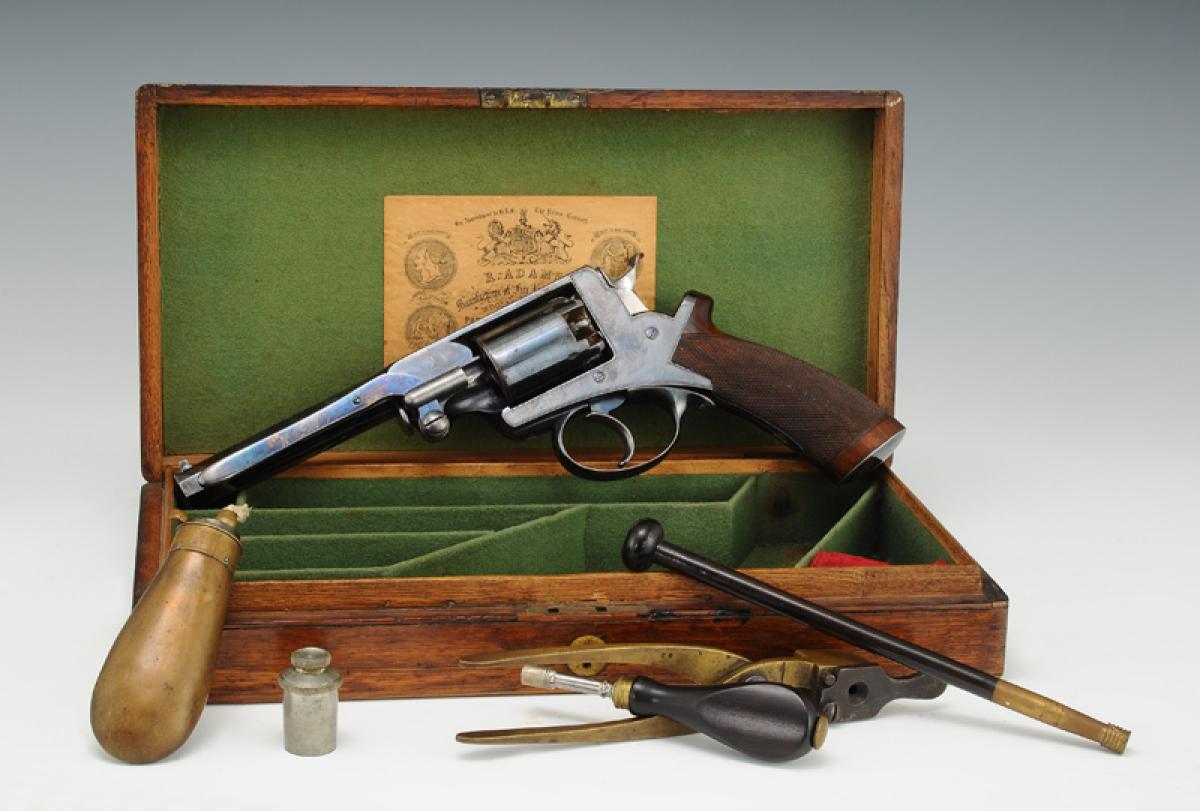
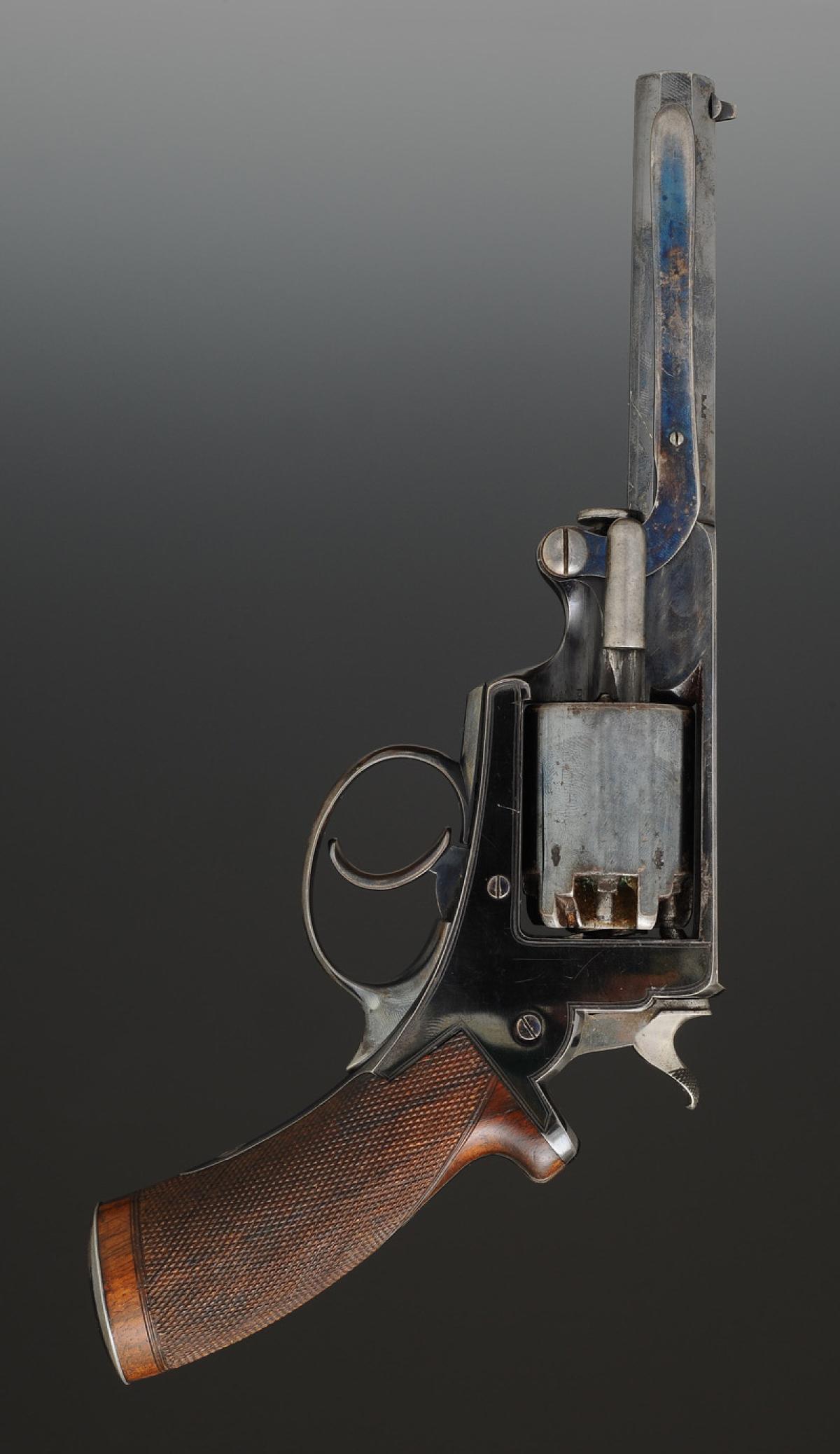
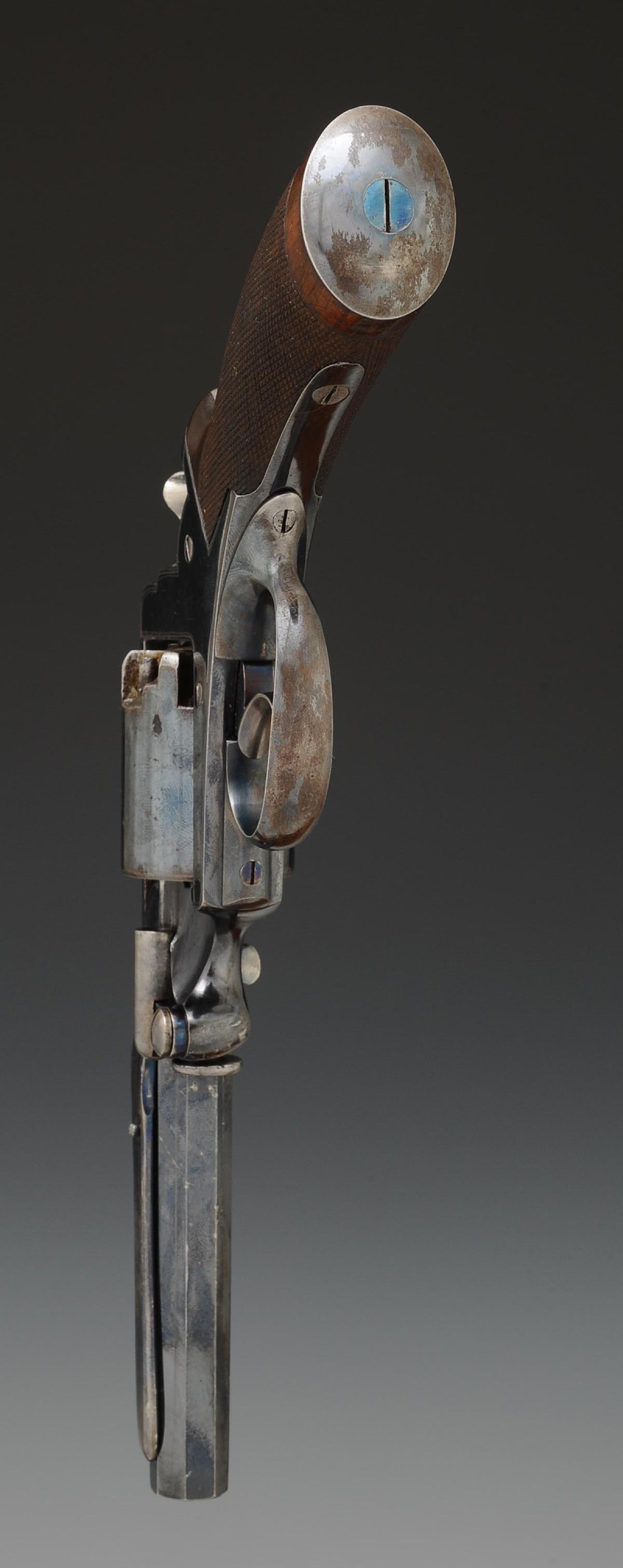
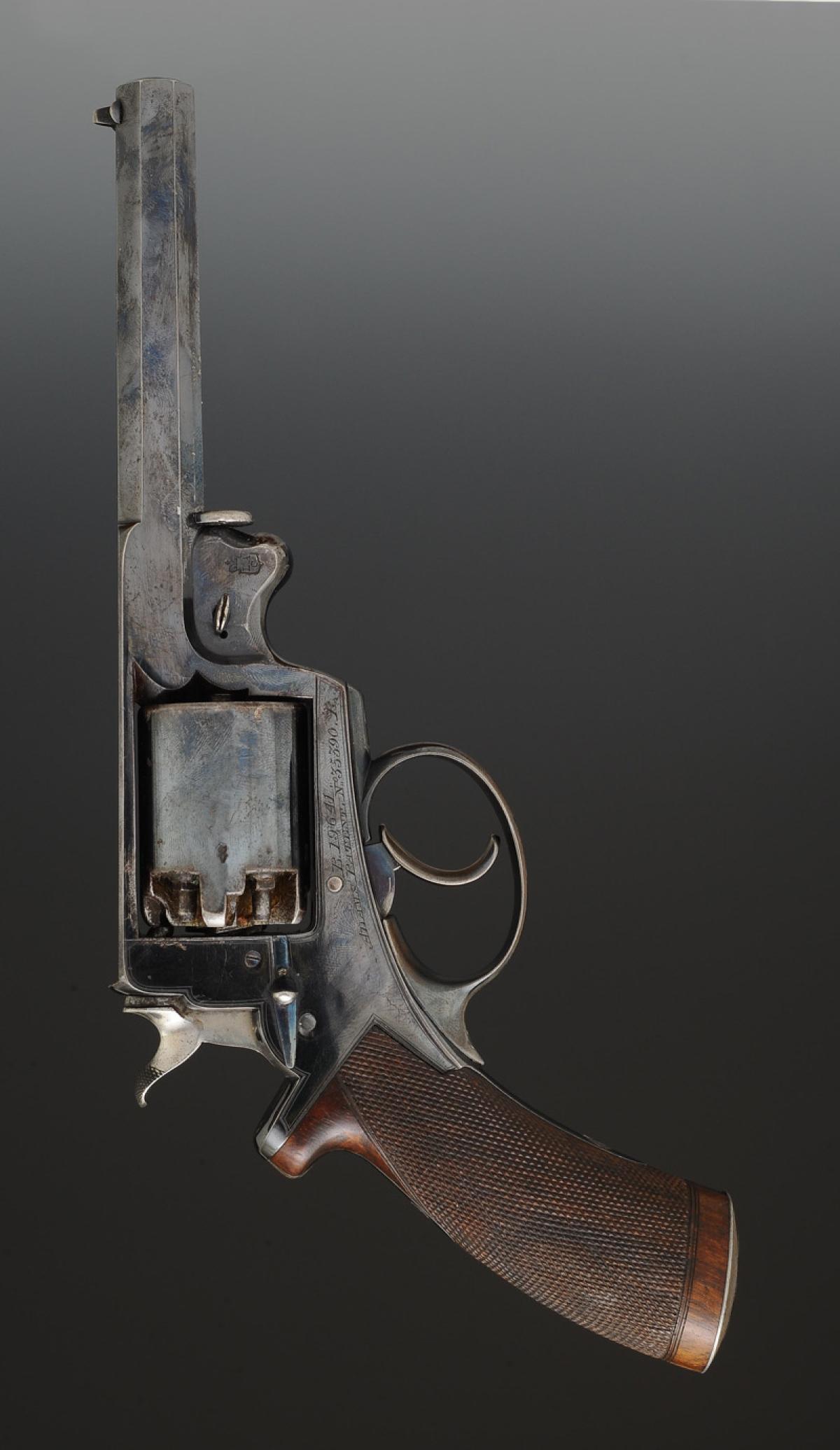
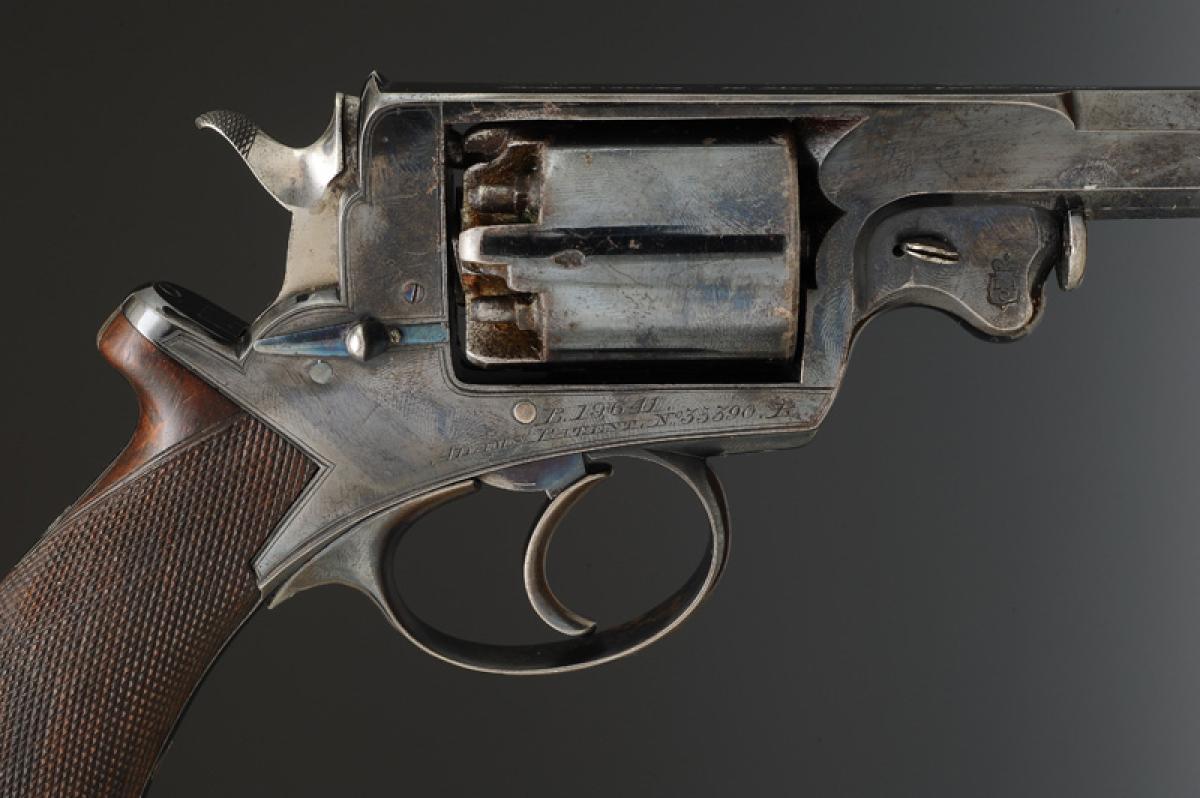
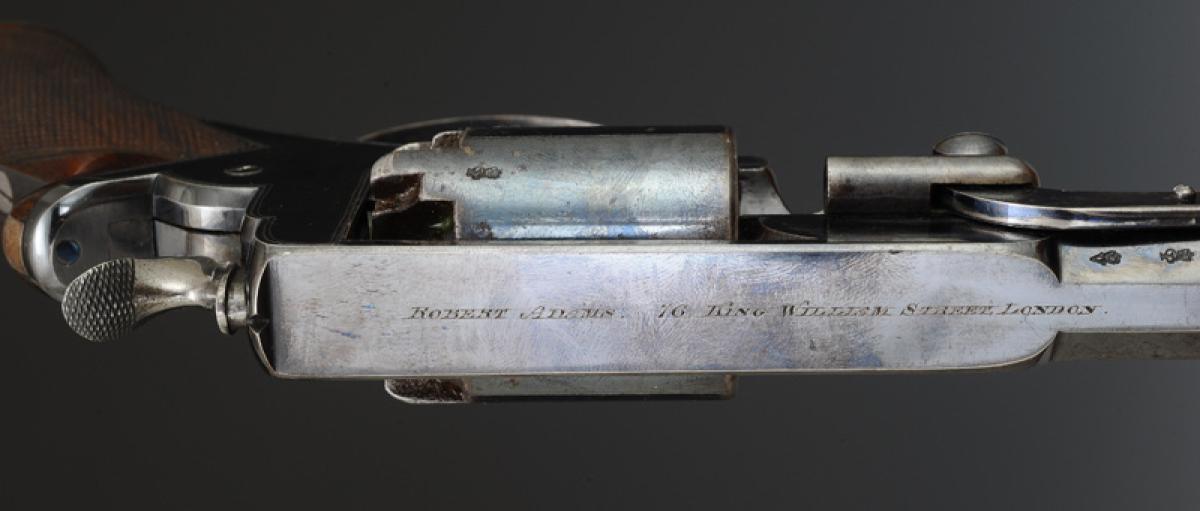
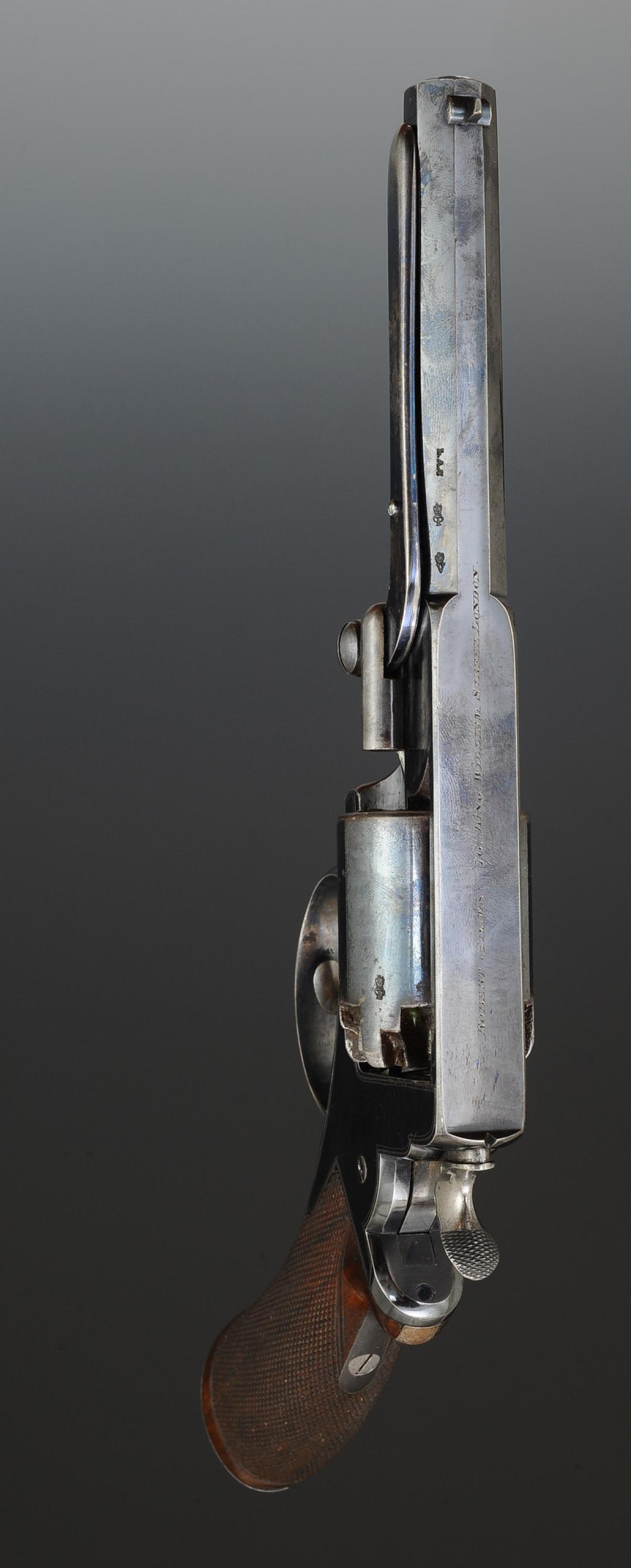
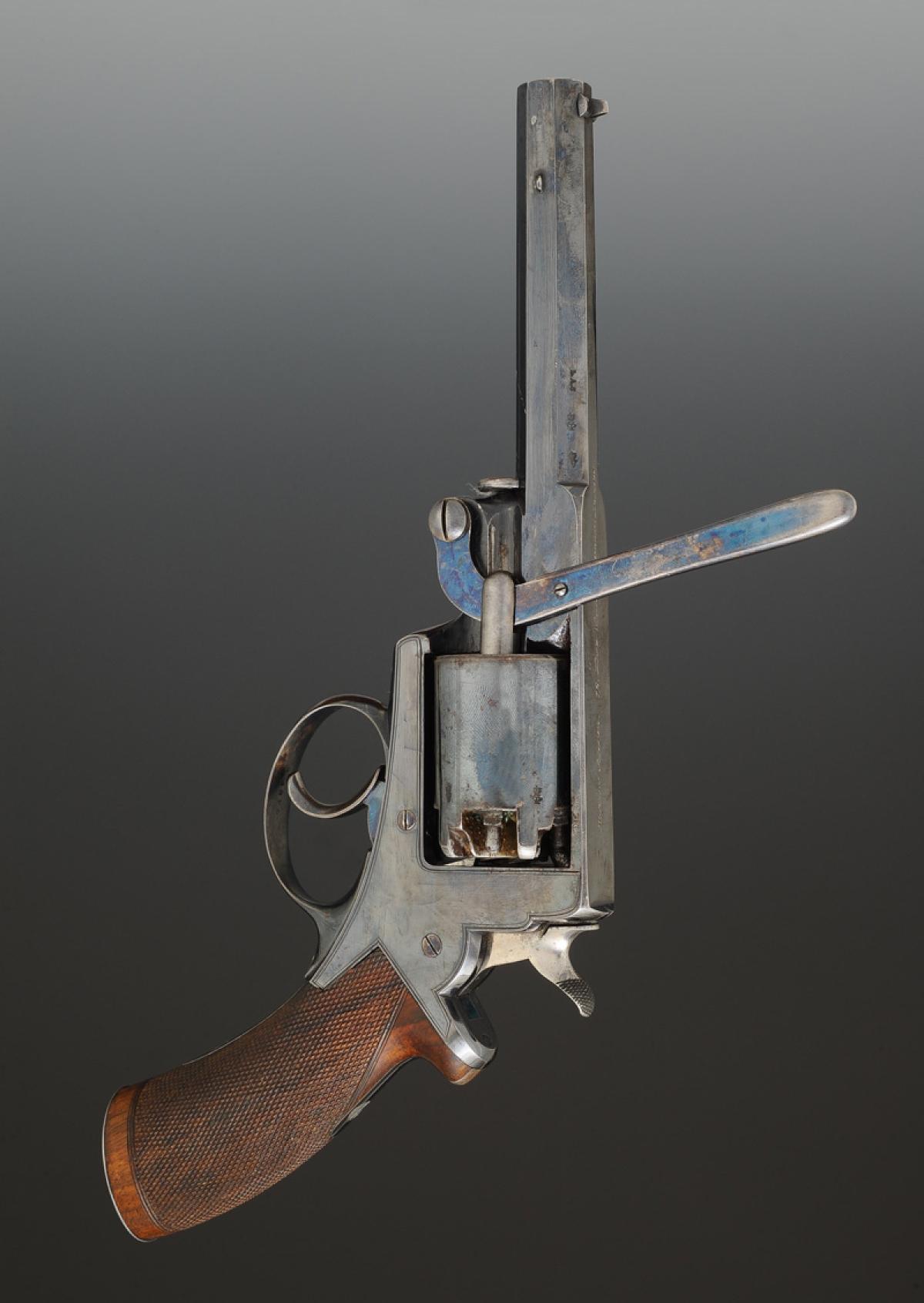
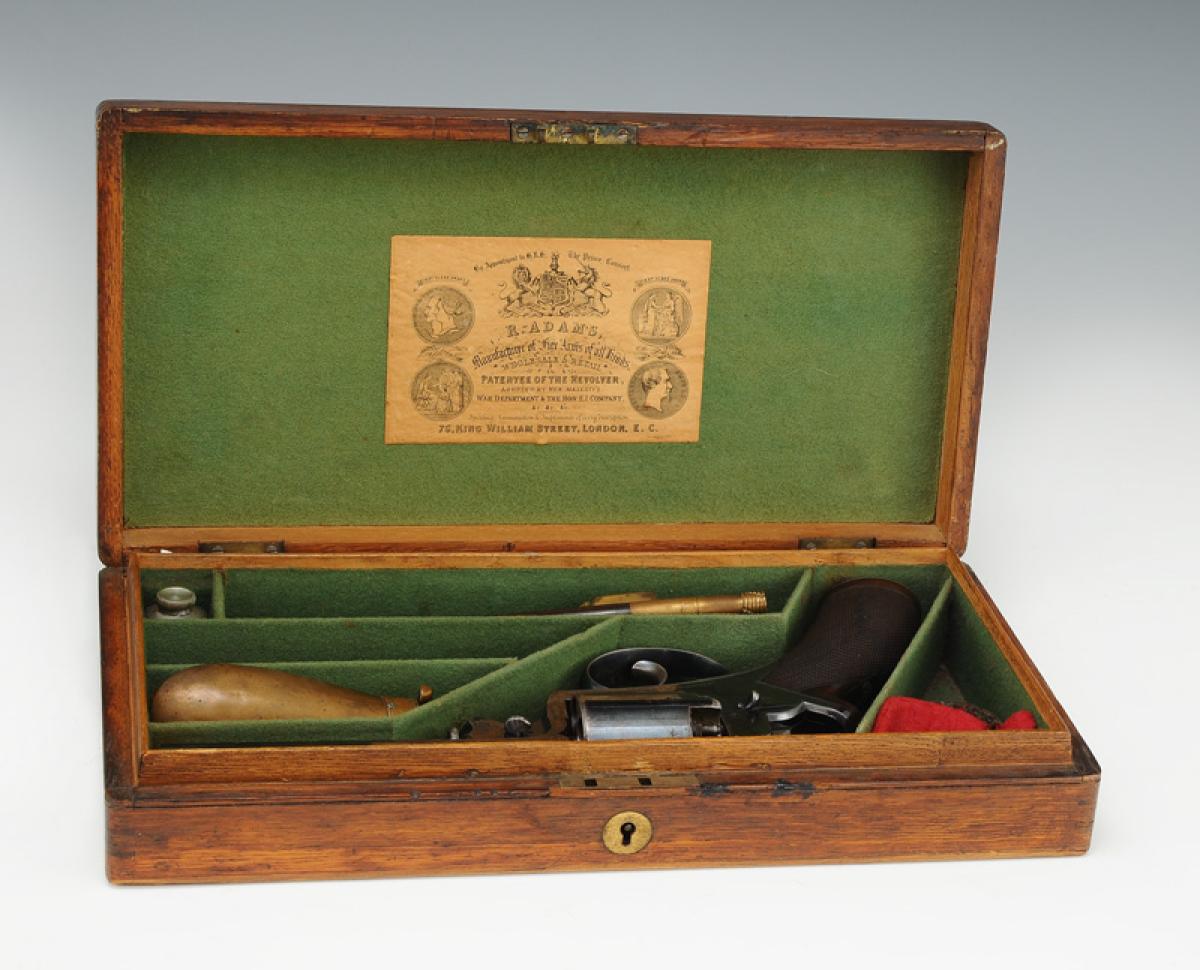
Fully bronzed revolver. Octagonal barrel, length 10 cm, marked on the top side of the barrel "ROBERT ADAMS. 76. KING WILLIAM STREET LONDON", with sight. Engraved frame "B. 19,641. / ADAMS'S PATENT. N° 35390.R.", stamped by the London Armory Company: coat of arms with the initials "LAC" surmounted by a royal crown. Finely checkered walnut grip. Double action. Five-shot cylinder. Loading lever positioned on the left side.
Total length of the weapon 30 cm.
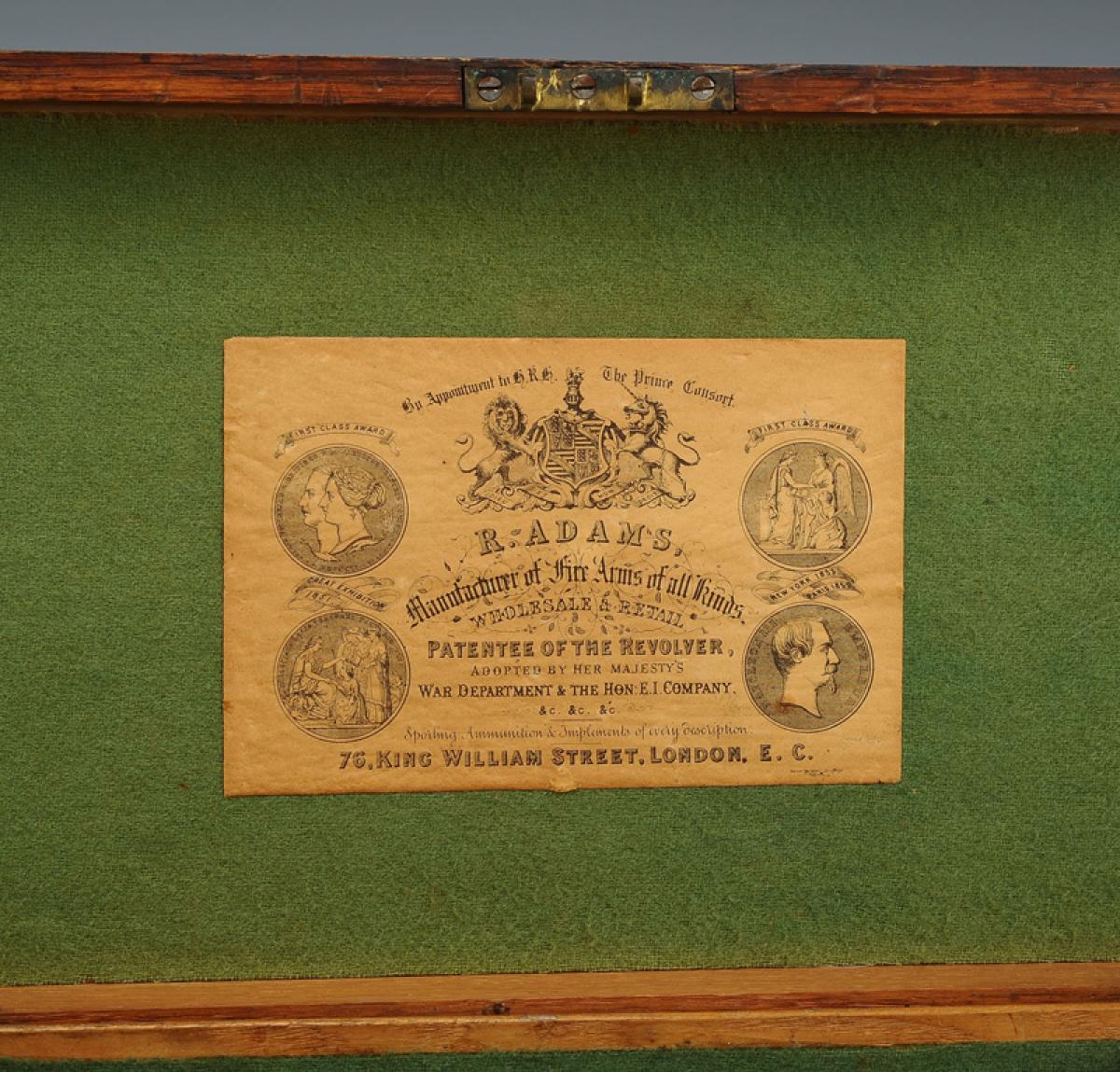
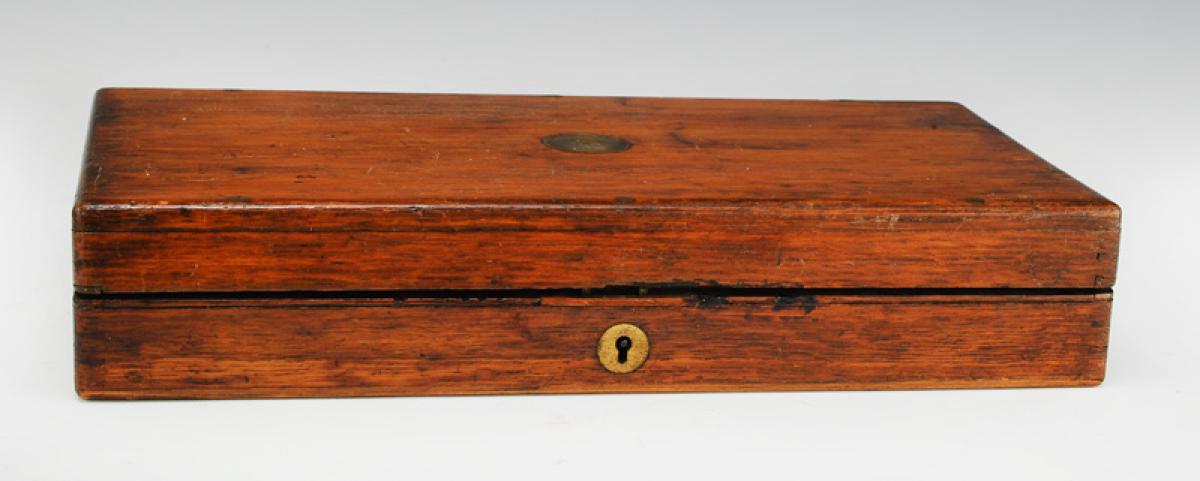
Presented in a walnut case, length 34.5 cm x 17 cm, H 6.5 cm. Clad in green felt, interior of the lid with a printed paper label with the manufacturer's name "R. ADAMS. Manufactured of Fire Arms of All Kinds ... 76. KING WILLIAM STREET. LONDON. E.C.". Brass lock with its key.
Brass bullet mold. Screwdriver, powder flask, and small powder measure in plain brass.
Great Britain.
Second half of the 19th century.
Revolver in very good condition with a beautiful bronzed and glazed finish, case in very good condition.
NOTE: This set is of particular interest for having a case from the manufacturer at the same address as the revolver's manufacturing period.
HISTORICAL BACKGROUND: These high-quality revolvers, with a monobloc frame, played as significant a role in the history and development of revolving firearms as Samuel Colt's creations. Robert Adams obtained a patent for a monobloc-frame revolver in 1851. This patent protected his innovative concept of a very sturdy revolver where the frame and barrel were machined from a single piece of forged steel. Unlike the majority of revolvers at the time, with separate barrel and frame components assembled with shims, screws, or other mechanical systems, Adams also patented an automatic cocking mechanism, what would be considered today as "double action only". This mechanism cocked the hammer, rotated the cylinder, and released the hammer with a single pull of the trigger. While this allowed for rapid firing, the long and heavy trigger pull affected accuracy. These features were integrated into the Adams M1851 automatic revolver. In 1854, Lieutenant Frederick Beaumont improved Adams' locking mechanism, leading to what would now be called a traditional "double action" revolver. This new mechanism allowed the revolver to function like Adams' original design (double action), while also offering the option to manually cock the revolver and fire with a lighter trigger pull, known as "single action". This improvement enabled more precise shooting. It is worth noting that, unlike the Colt model where cylinder rotation was simultaneous with cocking the hammer, most versions still required the trigger pull to rotate and index the cylinder. In 1854, Adams also patented enhancements to his original frame design, adding a sliding safety catch on the right side and an improved cylinder axis retention mechanism. These enhancements together gave rise to the M1854 revolver, better known as the Beaumont-Adams revolver. The revolvers were produced directly by Adams in partnership with the London firm Deane, Adams & Deane (circa 1853-1855), as well as under license by gunsmiths such as Joseph Brazier and Isaac Hollis & Sons. Birmingham gunsmith William Tranter also used Adams' solid frame for production. He made Beaumont-Adams revolvers but used mechanisms of his own design. After the dissolution of the firm Deane, Adams & Deane, he worked for the London Armoury Company, where his revolvers were also manufactured; he worked there from 1857 to 1858, until the production of the Kerr revolvers made by the London Armoury Company, around 1860. After leaving the London Armoury Company, Adams resumed production of his own revolvers, many of which were sold by other London and Birmingham gunsmiths and often bore the retailer's mark on the top strap. Most Beaumont-Adams revolvers were equipped with loading levers designed by Adams, Joseph Rigby, or patented by James Kerr (especially the weapons made by the London Armoury Company), but some had a rather complex loading lever designed by Joseph Brazier. Many existing Beaumont-Adams revolvers have dual serial numbers, one corresponding to royalties payable to Adams for his monobloc frame patent. These numbers are usually followed by a letter indicating the manufacturer authorized to use the patent (for example, "T" for Tranter, "B" for Brazier, and "X" for Hollis & Sons). Pistols produced by Adams himself generally bear an "R" suffix or none. The second number, preceded by a "B", serves to account for royalties due to Beaumont for his locking mechanism patent. However, after the expiration of both patents, the firearms typically carry a single serial number, without prefix or suffix. Beaumont's patent expiring in early 1862, these single-numbered weapons were likely assembled after the expiration of that patent. As Adams allocated specific serial number ranges to licensed holders authorized to manufacture firearms according to his solid frame principle, dating Adams handguns by serial number can be quite challenging, especially before Beaumont's patent expired. According to English authors and researchers W.H.J. Chamberlain and A.W.F. Taylerson, revolver specialists, Brazier was allocated serial numbers in the range 30,000B before 1854, with the suffix "B", while Adams himself produced revolvers in the same serial number range, with an "R" suffix. They note that Hollis & Sheath never had their own serial number range but used the "X" suffix to distinguish their productions, and that Adams often relied on frames made by William Tranter to manufacture his own revolvers. The smallest production series concerns the Adams-patented revolvers produced by Calisher & Terry of London, which were assigned the range 100,000, with a "C" suffix. It is estimated that fewer than 200 of these revolvers were made. All of this adds to the complexity of serial numbering for Adams handguns between 1854 and around 1860. However, from existing examples, it appears that around 30,000, the serial numbers become somewhat more consistent, and some deductions regarding production dates, attributed use, etc., can be drawn from the serial numbers of existing examples.
According to English authors and researchers W.H.J. Chamberlain and A.W.F. Taylerson, revolver specialists, Brazier was allocated serial numbers in the range 30,000B before 1854, with the suffix "B", while Adams himself produced revolvers in the same serial number range, with an "R" suffix. They note that Hollis & Sheath never had their own serial number range but used the "X" suffix to distinguish their productions, and that Adams often relied on frames made by William Tranter to manufacture his own revolvers. The smallest production series concerns the Adams-patented revolvers produced by Calisher & Terry of London, which were assigned the range 100,000, with a "C" suffix. It is estimated that fewer than 200 of these revolvers were made. All of this adds to the complexity of serial numbering for Adams handguns between 1854 and around 1860. However, from existing examples, it appears that around 30,000, the serial numbers become somewhat more consistent, and some deductions regarding production dates, attributed use, etc., can be drawn from the serial numbers of existing examples.
Beaumont-Adams revolvers, in caliber .54 (approximately .442), were among the finest combat revolvers of the mid-19th century and, as such, a number of them were imported for use during the American Civil War. Models in caliber 120 (approximately .33) were prized as personal defense weapons at the time, while medium-sized caliber 80 (approximately .38) revolvers were popular for both personal and military use. Despite the popularity of these revolvers, the lack of documentation makes it difficult to accurately determine the number of Adams patented revolvers imported for the American Civil War. At least 1,075 units were directly purchased by the U.S. government. It's also known that arms suppliers such as Schuyler, Hartley & Graham bought substantial quantities to resell to officers and volunteer groups who appealed to their state and local authorities (rather than the federal government) for weapon purchases. It seems that the state of Alabama acquired around 300 Schuyler, Hartley & Graham revolvers before the war began. Virginia and Georgia are also said to have made purchases of these revolvers before the war. While the Confederate central government never directly contracted for the purchase of Adams patented revolvers (preferring to acquire Kerr revolvers from the London Armoury Company), Confederate speculators and certain states nevertheless acquired these high-quality English revolvers in significant quantities. In fact, a large number of Adams revolvers, manufactured by the London Armoury Company, reportedly were in the L.A.C. stocks at the beginning of the conflict. It's very likely that when Major Anderson and Commander Bulloch initiated their dealings with Archibald Hamilton (of Sinclair, Hamilton & Co., and general manager of the London Armoury Company), these Adams revolvers were already in stock at the L.A.C.
The Armoury Company indicated having organized the delivery of a significant number of these revolvers to various Confederate states and the Confederate navy. Several identified Beaumont Adams revolvers, given by the Confederates, are found in public and private collections, including no. 40537 at the Museum of the Confederacy. This revolver is presented in a case adorned with a engraved plate, presented by Robert Adams to Confederate General Stonewall Jackson. Two other Adams revolvers, with serial numbers around 41,000, are attributed to use by the Confederate navy aboard the CSS Shenandoah. Most Confederate acquisitions during the war are believed to fall between 33,000 and 42,000, although it is highly likely that arms produced before this period (and imported to America) were employed. In some instances, old stock stored by London and Birmingham retailers was sold to Confederate speculators. Therefore, some pistols, several years old but really "new old stock," could break through the blockade. Regiments of the Civil War known to have carried or received Adams Patent revolvers include the 8th Pennsylvania Cavalry Regiment and the 2nd Michigan Cavalry Regiment on the American side, as well as the 1st, 5th, and 18th Virginia Cavalry Regiments and the 5th Georgia Cavalry Regiment on the Confederate side. Two Beaumont-Adams revolvers are specifically listed by serial number in Pratt's inventory, which records revolvers (by brand and serial number) in the possession of Lieutenant G. Julian Pratt's cavalry squad, serving in Company H of the 18th Virginia Cavalry Regiment. These are revolvers no. 36604, carried by soldier James Tharp, and no. 36609, carried by George Conrad. This roster, dated July 1864, not only mentions Adams revolvers but also Kerr, Webley, and Bentley revolvers. This first-hand document often serves as a temporal reference point for determining when certain English revolver serial numbers were in service in the Confederacy. This list is often used as an indication that Kerr revolvers with serial numbers in the 9XXX series were in service at that time. Regarding Adams revolvers, it shows they were in service in the field, but the serial numbers correspond to guns produced well before 1864. An identified Beaumont-Adams belonging to the Confederates, with the serial number 36853, is found in a private collection; it bears the mark of a retailer from New Orleans on the top strap. In fact, this means that any Beaumont-Adams with this number was produced before the fall of New Orleans in April 1862. It is generally assumed that the majority of Adams-type revolvers in Confederate service were in caliber .54 (approximately .442), but some examples in caliber .38 (.50) from the older M1851 model also have a Confederate origin. They were among the first double-action service revolvers to achieve real success. These weapons were used by both sides during the Civil War, and a Beaumont-Adams revolver is a must-have piece for any revolver collection from that period. Pocket revolvers in cases were particularly popular in the Southern United States and were a common accessory in the homes and offices of many affluent Southerners.
Fully bronzed revolver. Octagonal barrel, length 10 cm, marked on the top side of the barrel "ROBERT ADAMS. 76. KING WILLIAM STREET LONDON", with sight. Engraved frame "B. 19,641. / ADAMS'S PATENT. N° 35390.R.", stamped by the London Armory Company: coat of arms with the initials "LAC" surmounted by a royal crown. Finely checkered walnut grip. Double action. Five-shot cylinder. Loading lever positioned on the left side.
Total length of the weapon 30 cm.
Presented in a walnut case, length 34.5 cm x 17 cm, H 6.5 cm. Clad in green felt, interior of the lid with a printed paper label with the manufacturer's name "R. ADAMS. Manufactured of Fire Arms of All Kinds ... 76. KING WILLIAM STREET. LONDON. E.C.". Brass lock with its key.
Brass bullet mold. Screwdriver, powder flask, and small powder measure in plain brass.
Great Britain.
Second half of the 19th century.
Revolver in very good condition with a beautiful bronzed and glazed finish, case in very good condition.
NOTE: This set is of particular interest for having a case from the manufacturer at the same address as the revolver's manufacturing period.
HISTORICAL BACKGROUND: These high-quality revolvers, with a monobloc frame, played as significant a role in the history and development of revolving firearms as Samuel Colt's creations. Robert Adams obtained a patent for a monobloc-frame revolver in 1851. This patent protected his innovative concept of a very sturdy revolver where the frame and barrel were machined from a single piece of forged steel. Unlike the majority of revolvers at the time, with separate barrel and frame components assembled with shims, screws, or other mechanical systems, Adams also patented an automatic cocking mechanism, what would be considered today as "double action only". This mechanism cocked the hammer, rotated the cylinder, and released the hammer with a single pull of the trigger. While this allowed for rapid firing, the long and heavy trigger pull affected accuracy. These features were integrated into the Adams M1851 automatic revolver. In 1854, Lieutenant Frederick Beaumont improved Adams' locking mechanism, leading to what would now be called a traditional "double action" revolver. This new mechanism allowed the revolver to function like Adams' original design (double action), while also offering the option to manually cock the revolver and fire with a lighter trigger pull, known as "single action". This improvement enabled more precise shooting. It is worth noting that, unlike the Colt model where cylinder rotation was simultaneous with cocking the hammer, most versions still required the trigger pull to rotate and index the cylinder. In 1854, Adams also patented enhancements to his original frame design, adding a sliding safety catch on the right side and an improved cylinder axis retention mechanism. These enhancements together gave rise to the M1854 revolver, better known as the Beaumont-Adams revolver. The revolvers were produced directly by Adams in partnership with the London firm Deane, Adams & Deane (circa 1853-1855), as well as under license by gunsmiths such as Joseph Brazier and Isaac Hollis & Sons. Birmingham gunsmith William Tranter also used Adams' solid frame for production. He made Beaumont-Adams revolvers but used mechanisms of his own design. After the dissolution of the firm Deane, Adams & Deane, he worked for the London Armoury Company, where his revolvers were also manufactured; he worked there from 1857 to 1858, until the production of the Kerr revolvers made by the London Armoury Company, around 1860. After leaving the London Armoury Company, Adams resumed production of his own revolvers, many of which were sold by other London and Birmingham gunsmiths and often bore the retailer's mark on the top strap. Most Beaumont-Adams revolvers were equipped with loading levers designed by Adams, Joseph Rigby, or patented by James Kerr (especially the weapons made by the London Armoury Company), but some had a rather complex loading lever designed by Joseph Brazier. Many existing Beaumont-Adams revolvers have dual serial numbers, one corresponding to royalties payable to Adams for his monobloc frame patent. These numbers are usually followed by a letter indicating the manufacturer authorized to use the patent (for example, "T" for Tranter, "B" for Brazier, and "X" for Hollis & Sons). Pistols produced by Adams himself generally bear an "R" suffix or none. The second number, preceded by a "B", serves to account for royalties due to Beaumont for his locking mechanism patent. However, after the expiration of both patents, the firearms typically carry a single serial number, without prefix or suffix. Beaumont's patent expiring in early 1862, these single-numbered weapons were likely assembled after the expiration of that patent. As Adams allocated specific serial number ranges to licensed holders authorized to manufacture firearms according to his solid frame principle, dating Adams handguns by serial number can be quite challenging, especially before Beaumont's patent expired. According to English authors and researchers W.H.J. Chamberlain and A.W.F. Taylerson, revolver specialists, Brazier was allocated serial numbers in the range 30,000B before 1854, with the suffix "B", while Adams himself produced revolvers in the same serial number range, with an "R" suffix. They note that Hollis & Sheath never had their own serial number range but used the "X" suffix to distinguish their productions, and that Adams often relied on frames made by William Tranter to manufacture his own revolvers. The smallest production series concerns the Adams-patented revolvers produced by Calisher & Terry of London, which were assigned the range 100,000, with a "C" suffix. It is estimated that fewer than 200 of these revolvers were made. All of this adds to the complexity of serial numbering for Adams handguns between 1854 and around 1860. However, from existing examples, it appears that around 30,000, the serial numbers become somewhat more consistent, and some deductions regarding production dates, attributed use, etc., can be drawn from the serial numbers of existing examples.
According to English authors and researchers W.H.J. Chamberlain and A.W.F. Taylerson, revolver specialists, Brazier was allocated serial numbers in the range 30,000B before 1854, with the suffix "B", while Adams himself produced revolvers in the same serial number range, with an "R" suffix. They note that Hollis & Sheath never had their own serial number range but used the "X" suffix to distinguish their productions, and that Adams often relied on frames made by William Tranter to manufacture his own revolvers. The smallest production series concerns the Adams-patented revolvers produced by Calisher & Terry of London, which were assigned the range 100,000, with a "C" suffix. It is estimated that fewer than 200 of these revolvers were made. All of this adds to the complexity of serial numbering for Adams handguns between 1854 and around 1860. However, from existing examples, it appears that around 30,000, the serial numbers become somewhat more consistent, and some deductions regarding production dates, attributed use, etc., can be drawn from the serial numbers of existing examples.
Beaumont-Adams revolvers, in caliber .54 (approximately .442), were among the finest combat revolvers of the mid-19th century and, as such, a number of them were imported for use during the American Civil War. Models in caliber 120 (approximately .33) were prized as personal defense weapons at the time, while medium-sized caliber 80 (approximately .38) revolvers were popular for both personal and military use. Despite the popularity of these revolvers, the lack of documentation makes it difficult to accurately determine the number of Adams patented revolvers imported for the American Civil War. At least 1,075 units were directly purchased by the U.S. government. It's also known that arms suppliers such as Schuyler, Hartley & Graham bought substantial quantities to resell to officers and volunteer groups who appealed to their state and local authorities (rather than the federal government) for weapon purchases. It seems that the state of Alabama acquired around 300 Schuyler, Hartley & Graham revolvers before the war began. Virginia and Georgia are also said to have made purchases of these revolvers before the war. While the Confederate central government never directly contracted for the purchase of Adams patented revolvers (preferring to acquire Kerr revolvers from the London Armoury Company), Confederate speculators and certain states nevertheless acquired these high-quality English revolvers in significant quantities. In fact, a large number of Adams revolvers, manufactured by the London Armoury Company, reportedly were in the L.A.C. stocks at the beginning of the conflict. It's very likely that when Major Anderson and Commander Bulloch initiated their dealings with Archibald Hamilton (of Sinclair, Hamilton & Co., and general manager of the London Armoury Company), these Adams revolvers were already in stock at the L.A.C.
The Armoury Company indicated having organized the delivery of a significant number of these revolvers to various Confederate states and the Confederate navy. Several identified Beaumont Adams revolvers, given by the Confederates, are found in public and private collections, including no. 40537 at the Museum of the Confederacy. This revolver is presented in a case adorned with a engraved plate, presented by Robert Adams to Confederate General Stonewall Jackson. Two other Adams revolvers, with serial numbers around 41,000, are attributed to use by the Confederate navy aboard the CSS Shenandoah. Most Confederate acquisitions during the war are believed to fall between 33,000 and 42,000, although it is highly likely that arms produced before this period (and imported to America) were employed. In some instances, old stock stored by London and Birmingham retailers was sold to Confederate speculators. Therefore, some pistols, several years old but really "new old stock," could break through the blockade. Regiments of the Civil War known to have carried or received Adams Patent revolvers include the 8th Pennsylvania Cavalry Regiment and the 2nd Michigan Cavalry Regiment on the American side, as well as the 1st, 5th, and 18th Virginia Cavalry Regiments and the 5th Georgia Cavalry Regiment on the Confederate side. Two Beaumont-Adams revolvers are specifically listed by serial number in Pratt's inventory, which records revolvers (by brand and serial number) in the possession of Lieutenant G. Julian Pratt's cavalry squad, serving in Company H of the 18th Virginia Cavalry Regiment. These are revolvers no. 36604, carried by soldier James Tharp, and no. 36609, carried by George Conrad. This roster, dated July 1864, not only mentions Adams revolvers but also Kerr, Webley, and Bentley revolvers. This first-hand document often serves as a temporal reference point for determining when certain English revolver serial numbers were in service in the Confederacy. This list is often used as an indication that Kerr revolvers with serial numbers in the 9XXX series were in service at that time. Regarding Adams revolvers, it shows they were in service in the field, but the serial numbers correspond to guns produced well before 1864. An identified Beaumont-Adams belonging to the Confederates, with the serial number 36853, is found in a private collection; it bears the mark of a retailer from New Orleans on the top strap. In fact, this means that any Beaumont-Adams with this number was produced before the fall of New Orleans in April 1862. It is generally assumed that the majority of Adams-type revolvers in Confederate service were in caliber .54 (approximately .442), but some examples in caliber .38 (.50) from the older M1851 model also have a Confederate origin. They were among the first double-action service revolvers to achieve real success. These weapons were used by both sides during the Civil War, and a Beaumont-Adams revolver is a must-have piece for any revolver collection from that period. Pocket revolvers in cases were particularly popular in the Southern United States and were a common accessory in the homes and offices of many affluent Southerners.
Reference :
33597
Next update Friday, octobre 30 at 13:30 PM
FOR ALL PURCHASES, PAYMENT IN MULTIPLE CHECKS POSSIBLE
bertrand.malvaux@wanadoo.fr 06 07 75 74 63
SHIPPING COSTS
Shipping costs are calculated only once per order for one or more items, all shipments are sent via registered mail, as this is the only way to have proof of dispatch and receipt.
For parcels whose value cannot be insured by the Post, shipments are entrusted to DHL or Fedex with real value insured, the service is of high quality but the cost is higher.
RETURN POLICY
Items can be returned within 8 days of receipt. They must be returned by registered mail at the sender's expense, in their original packaging, and in their original condition.
AUTHENTICITY
The selection of items offered on this site allows me to guarantee the authenticity of each piece described here, all items offered are guaranteed to be period and authentic, unless otherwise noted or restricted in the description.
An authenticity certificate of the item including the description published on the site, the period, the sale price, accompanied by one or more color photographs is automatically provided for any item priced over 130 euros. Below this price, each certificate is charged 5 euros.
Only items sold by me are subject to an authenticity certificate, I do not provide any expert reports for items sold by third parties (colleagues or collectors).
FOR ALL PURCHASES, PAYMENT IN MULTIPLE CHECKS POSSIBLE
bertrand.malvaux@wanadoo.fr 06 07 75 74 63
An authenticity certificate of the item including the description published on the site, the period, the sale price, accompanied by one or more color photographs is automatically provided for any item priced over 130 euros. Below this price, each certificate is charged 5 euros.
Only items sold by me are subject to an authenticity certificate, I do not provide any expert reports for items sold by third parties (colleagues or collectors).