
VOLUNTEER OFFICER'S SABER, ATTRIBUTED TO THE SOUBISE REGIMENT, Former Monarchy, circa 1770-1775. 30821

Sold out
OFFICER'S VOLUNTEER SABER, ATTRIBUTED TO THE SOUBISE REGIMENT, Former Monarchy, circa 1770-1775. 30821
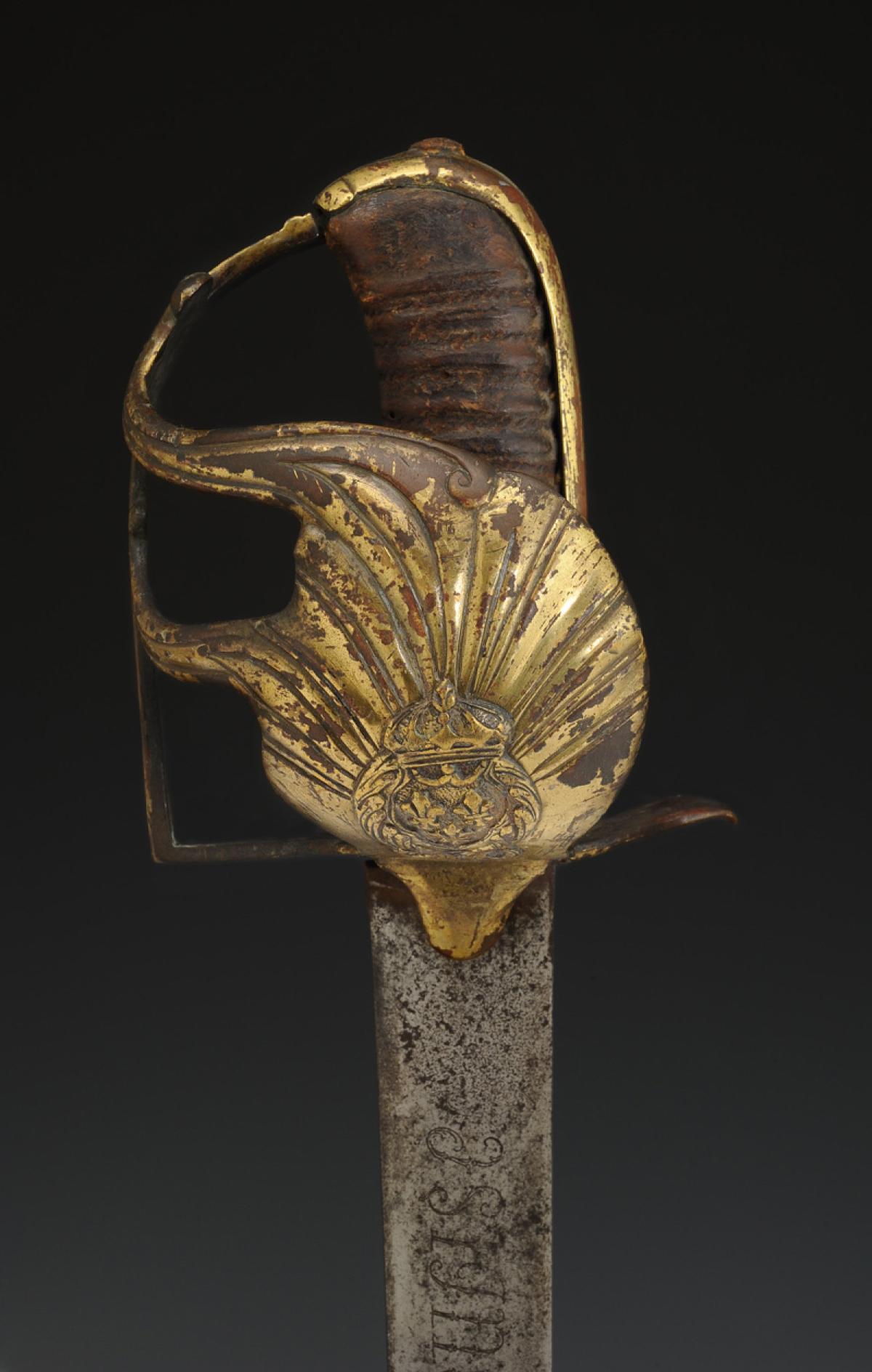
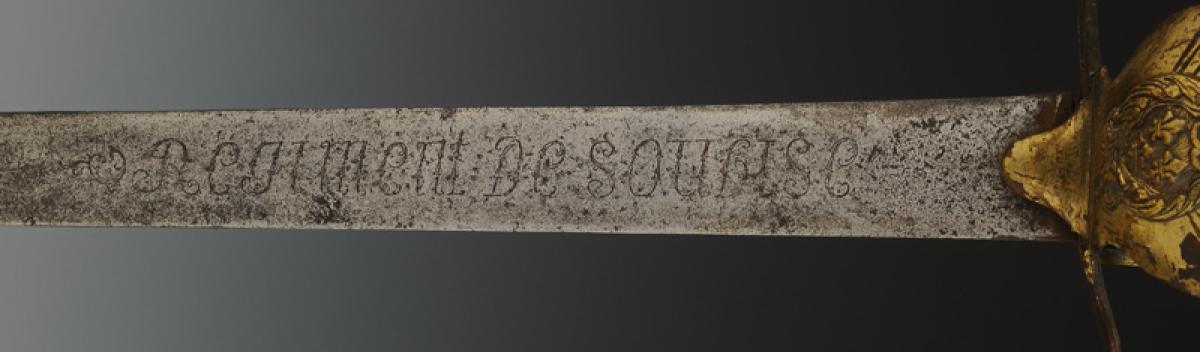
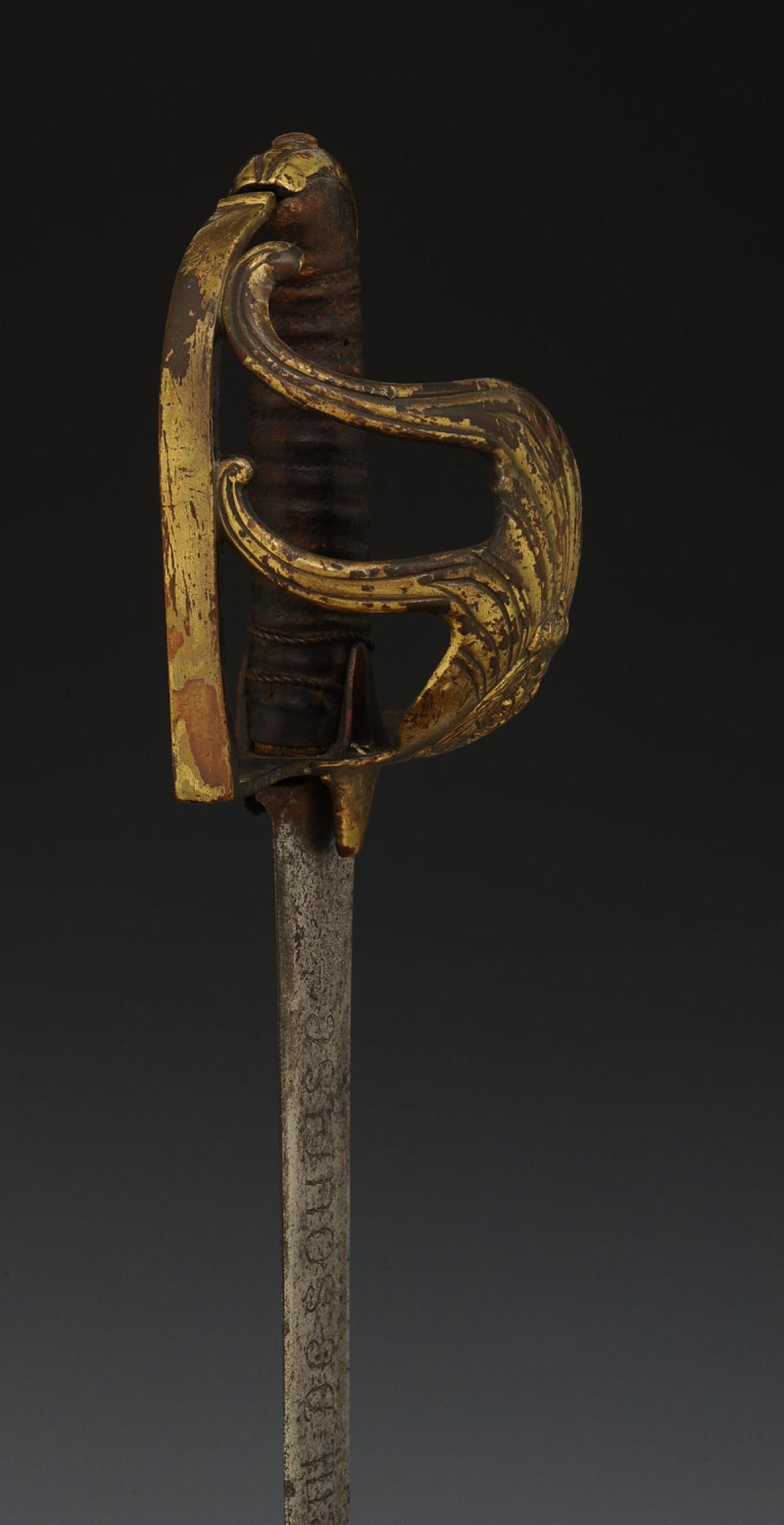
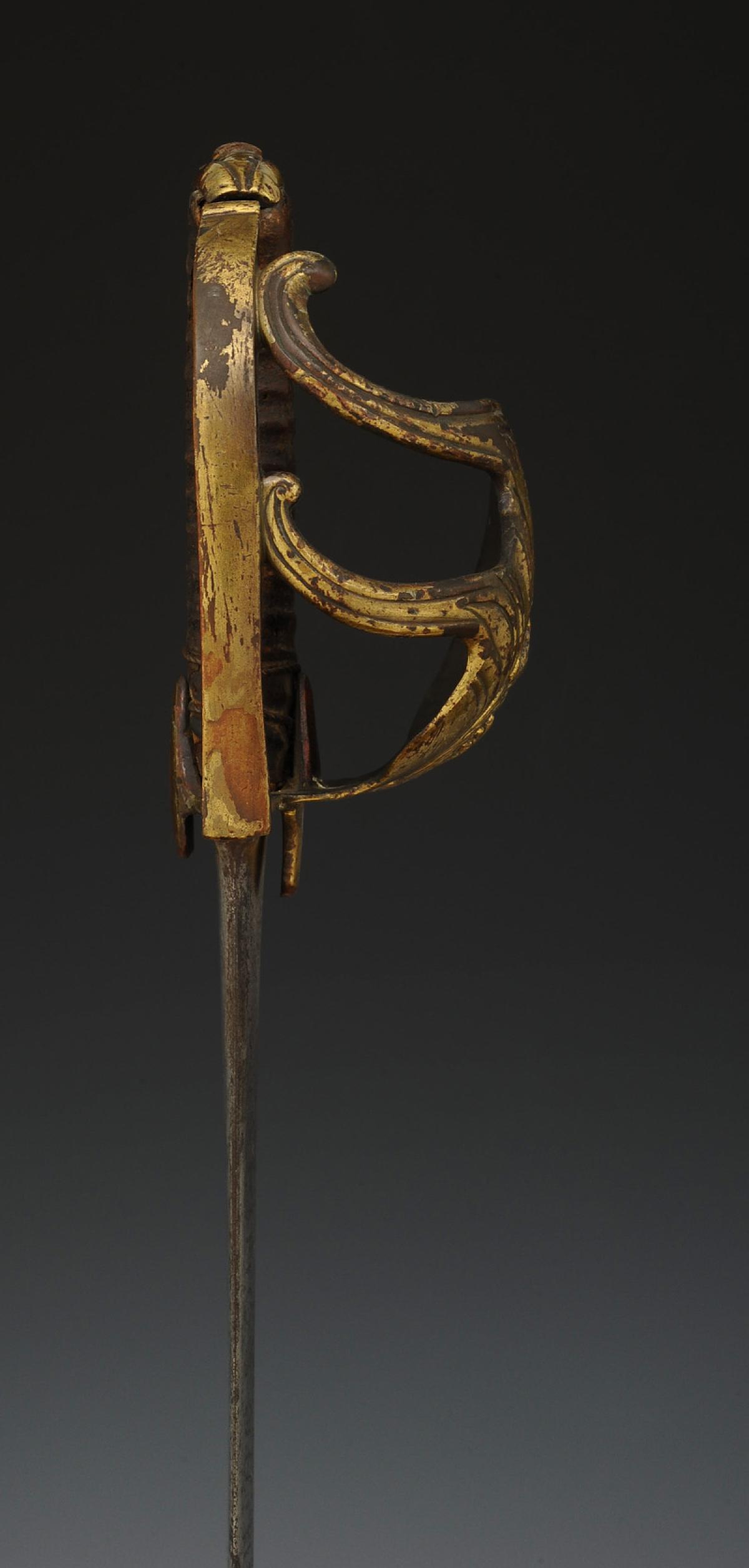
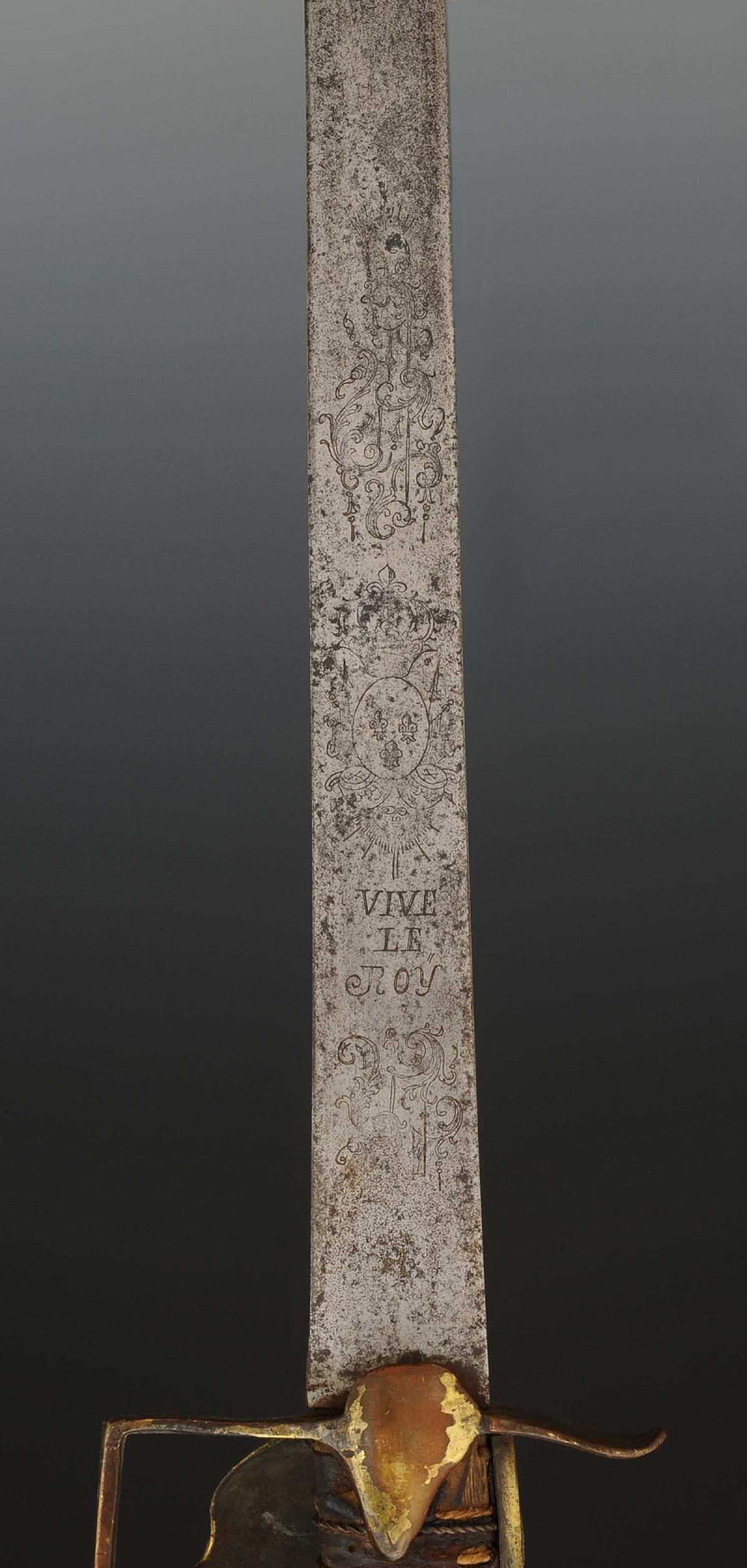
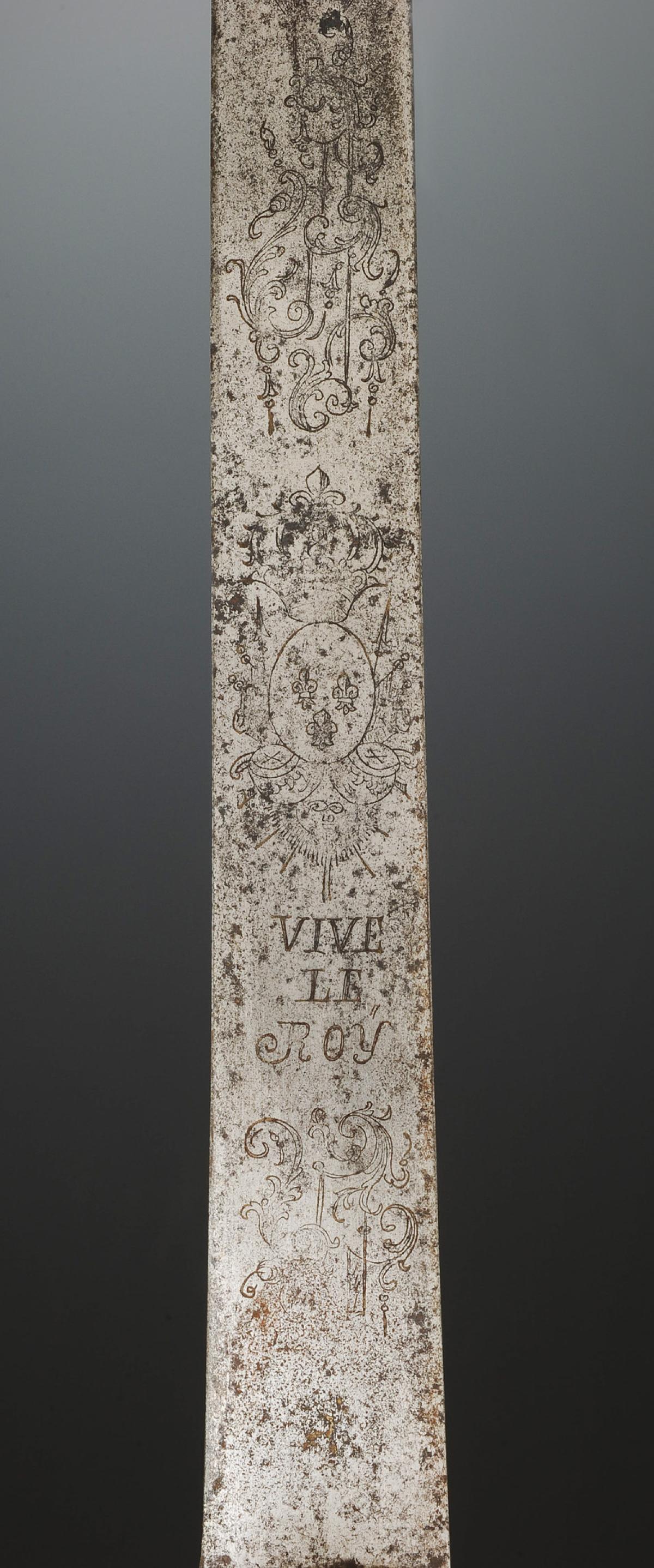
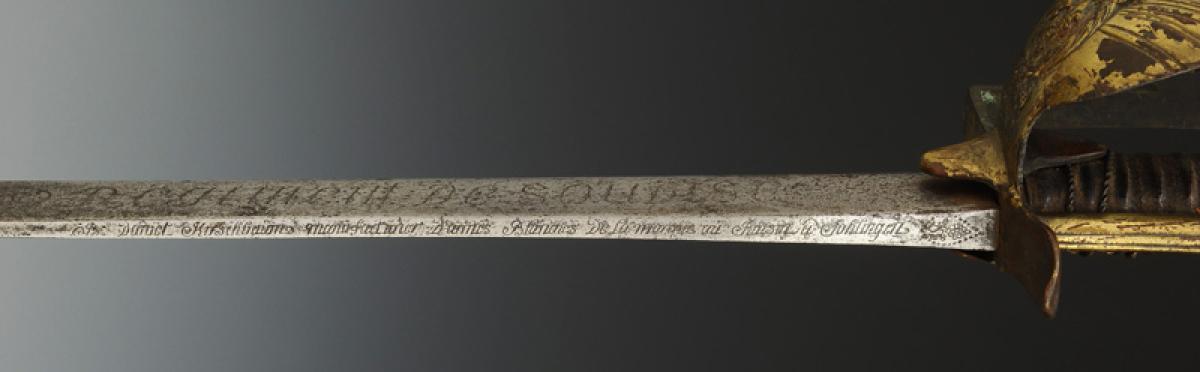
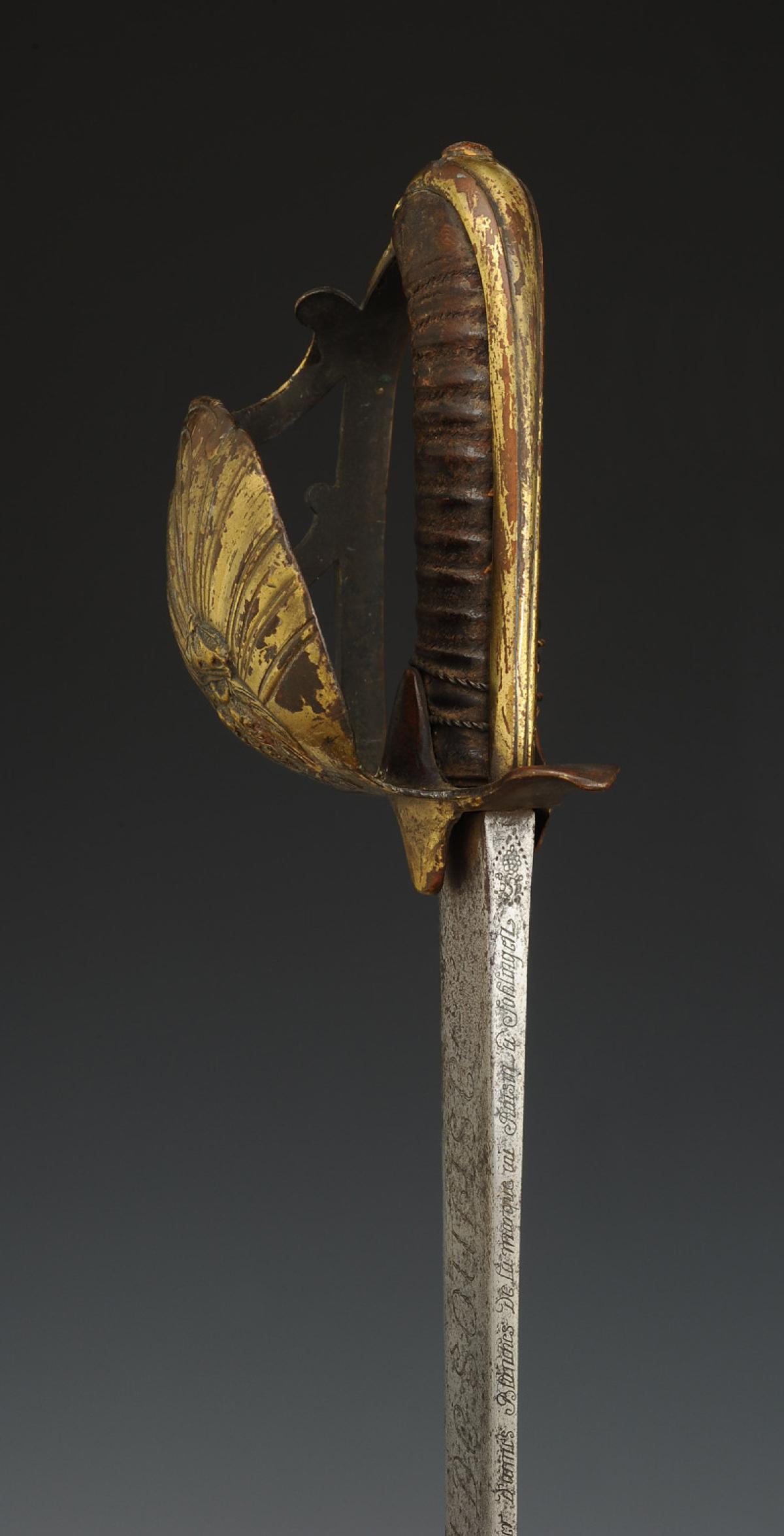
Gilt bronze hilt in the style of the 1755-1770 carabineers and horse grenadiers' sabers. Three-branch guard forming a shell decorated with the arms of France on a radiant background, long-tailed pommel, handle in wood covered with black waxed calfskin. Straight and flat blade, back signed "B. Daniel Kirschbaum Manufacturer of White Weapons From the brand with the Grapes in Solingen," engraved on the front face in capital and cursive letters "REGIMENT DE SOUBISE," and on the other side the arms of France surmounted by the inscription "VIVE LE ROY," all framed by foliage scrolls, blade length 96.5 cm.
France.
Former Monarchy (1770-1775)
Good condition, wear on the gilt, missing the filigree, oxidation on the blade from use, without scabbard.
NOTE: There exists a second similar specimen bearing the same inscription on the blade, making it difficult to precisely attribute this saber more to infantry than to dragoons. In his work "The light troops of the Old Regime, the privateers of the King from the ground army," Mr. Sapin-Lignières (les Presses Saltusiennes, Saint-Julien-du-Sault 1979).
SOUBISE VOLUNTEERS - SOUBISE LEGION 1761-1776: On February 20, 1761, the Prince de Soubise, marshal of France, was authorized to raise a corps of 948 men (a company of 60 grenadiers, 8 companies of 71 fusiliers, 8 companies of 40 dragoons, of the staff, a colonel, a lieutenant-colonel, a major, a battalion commander, an infantry assistant major, a dragoon assistant major, a chaplain, and a surgeon), recruited also in Germany and Bohemia. It is probable that this corps was already fully organized when it entered the service of France, as it took part in a significant battle in July 1761. The corps was formed in Quesnoy, ready in March 1761, it immediately left for Germany and fought at the battle of Soest. On August 30, the Soubise volunteers fought in the village of Bosencelles near Munster, taking 400 prisoners. The 1762 campaign continued in Germany, where they distinguished themselves at Asfeld and Ziegenheim. The ordinance of March 1, 1763, reorganizing the light troops, renamed the corps to the "6th Legion de Soubise," and the corps strength was reduced, with only one company of 3 officers and 29 grenadiers, 4 companies of 3 officers and 17 fusiliers, and 4 companies of 3 officers and 29 dragoons. The inspections for this troop were praiseworthy: "The regiment of Volontaires de Soubise is superb in men and horses," a report from 1764 noted, "this regiment is well maintained, very well trained, and deserves the highest praise. It is beautiful, particularly the dragoons." On May 21, 1766, the Soubise Volunteers took on the name Legion de Soubise. On March 25, 1776, the Count of Saint-Germain abolished the light troops. In 1779, the "5th Chasseurs à Cheval," which became the "Chasseurs du Gévaudan" on August 8, 1784, then the "Chasseurs de Normandie" on March 17, 1788, bearing the number 11. It is under these various designations that they participated in the battles during the Seven Years' War under the Monarchy until 1789.
BIOGRAPHY: Charles de Rohan, Prince of Soubise, Count of Saint-Pol, Peer of France, Marshal of France, known as the Marshal of Soubise
(Versailles, July 16, 1715 - July 1, 1787, Versailles). An orphan at nine, Soubise became close to the king, himself an orphan at 14. Intimate with Louis XV and favored by Madame de Pompadour, he was appointed, in 1751, governor general of Flanders and Hainaut, and in 1755, Louis XV named him a State Minister, seating him on his Privy Council. In 1758, Soubise was granted the dignity of Marshal of France. The Marquise de Pompadour died in 1764, and the Countess du Barry became the king's favorite in 1768, granting her friendship to Soubise, who thus benefited from all the court's favors. Upon the death of Louis XV in 1774, the new king Louis XVI confirmed Soubise in his position as State Minister. Prince de Soubise passed away in 1787, without a male heir, leading to the extinction of the Rohan-Soubise branch.
PROVENANCE :
- Vente Christie’s, 30 novembre 2009, lot 38.
PROVENANCE : Ancienne collection Philippe Missillier, n° 209 de la vente Giquello des 6 et 7 mrs 2025 Hôtel Drouot Paris.
BIOGRAPHIE Philippe MISSILLIER : J’ai eu la chance et le privilège de rencontrer Philippe Missillier il y a bien longtemps maintenant. À 15 ans, quand je traînais mes guêtres dans les bourses aux armes j’entendais déjà parler de lui. C’est dix ans plus tard, au moment où j’ai commencé à travailler à Drouot que nos routes se sont très fréquemment croisées jusqu’à mon installation en 2003 et le début de notre collaboration pendant de belles et passionnantes années. Né le 29 mars 1949 a Annecy, Philippe était très attaché à sa région.
Il fit toute sa scolarité à Lyon, chez les jésuites, formation qui l’avait durablement marqué et façonné. C’est dès 9 ans que la passion des armes anciennes débute. À cette époque, il passe régulièrement sur le chemin de l’école devant la vitrine d’un antiquaire qui vend des armes anciennes. Un jour, il pousse la porte du magasin. Il reviendra souvent pour discuter avec le propriétaire pendant que son frère ou ses camarades consacrent leur temps libre à des activités plus conformes à leur âge. À la même époque, lors d’une promenade avec son père et son frère aux Puces de Lyon, il achète deux kriss malais : c’est le début d’une longue et belle histoire. Après son bac, il choisit de se diriger vers des études de droit imaginant devenir commissaire-priseur. Il fait un premier stage chez Maître Guillomot à Lyon… il s’installera finalement comme marchand d’armes et de tissus anciens au 7, Place Gailleton à Lyon.
Dans les années 1970, désireux de développer son activité sur le marché international, précurseur, il prend la décision de s’installer à Londres. Enfin, dans les années 1990, après sa rencontre avec Lisa, le couple décide de prendre la direction des États-Unis.
Philippe aurait pu se contenter d’être l’un des plus grands marchands internationaux d'armes de collection, en Belgique, Allemagne, Italie, Espagne, France, Grande-Bretagne et États-Unis, rien ne lui échappera. "Ça c'est à moi" déclarera-t-il avant une vente publique, annonçant de la sorte sa détermination à prendre possession de l'objet débusqué et à combattre au besoin. D'une érudition remarquable, fort de ses échanges scientifiques avec les conservateurs de musées, de sa riche bibliothèque personnelle et de ses propres travaux de recherche, et avant tout grâce à son oeil, il étonnera les connaisseurs et experts par ses prises, objets dont on ne savait l'existence et qui suscitent immédiatement l'envie. Il enrichira ainsi les grandes collections privées et publiques du monde, de la Tour de Londres au Metropolitan Museum of Art de New York, sans oublier les musées nationaux français. Mais en quelques années, il était désormais connu comme l'un de nos plus brillants experts. À ce titre, il a inscrit à son palmarès d'expert de grandes ventes comme la vente Georges Pauilhac à Toulouse en 1983, l’important ensemble d’ordres de chevalerie à Lyon en 1989, la Collection Albert Grosjean, Drouot, 1993, la Collection Marsan 1994-1995-1996, la Succession Guy Monestier, la Collection Benoit, la collection Karsten Klingbeil, à Bruxelles, 2011 ou la vente des Importants souvenirs du marechal Ney, en 2012.
Philippe nous a quitté le 15 mars 2022. Une page de l’histoire du marché des armes anciennes de collection se tourne. Ceux d’entre nous qui ont eu le privilège de le connaître conserveront le souvenir inoubliable de sa silhouette élégante et n’entendront plus son impayable imitation du cor de chasse…
Très attaché aux beaux objets, la collection particulière qu'il a formée et protégée avec soin, et que seuls quelques amis ont pu contempler, est offerte pour la première fois au public.
Gilt bronze hilt in the style of the 1755-1770 carabineers and horse grenadiers' sabers. Three-branch guard forming a shell decorated with the arms of France on a radiant background, long-tailed pommel, handle in wood covered with black waxed calfskin. Straight and flat blade, back signed "B. Daniel Kirschbaum Manufacturer of White Weapons From the brand with the Grapes in Solingen," engraved on the front face in capital and cursive letters "REGIMENT DE SOUBISE," and on the other side the arms of France surmounted by the inscription "VIVE LE ROY," all framed by foliage scrolls, blade length 96.5 cm.
France.
Former Monarchy (1770-1775)
Good condition, wear on the gilt, missing the filigree, oxidation on the blade from use, without scabbard.
NOTE: There exists a second similar specimen bearing the same inscription on the blade, making it difficult to precisely attribute this saber more to infantry than to dragoons. In his work "The light troops of the Old Regime, the privateers of the King from the ground army," Mr. Sapin-Lignières (les Presses Saltusiennes, Saint-Julien-du-Sault 1979).
SOUBISE VOLUNTEERS - SOUBISE LEGION 1761-1776: On February 20, 1761, the Prince de Soubise, marshal of France, was authorized to raise a corps of 948 men (a company of 60 grenadiers, 8 companies of 71 fusiliers, 8 companies of 40 dragoons, of the staff, a colonel, a lieutenant-colonel, a major, a battalion commander, an infantry assistant major, a dragoon assistant major, a chaplain, and a surgeon), recruited also in Germany and Bohemia. It is probable that this corps was already fully organized when it entered the service of France, as it took part in a significant battle in July 1761. The corps was formed in Quesnoy, ready in March 1761, it immediately left for Germany and fought at the battle of Soest. On August 30, the Soubise volunteers fought in the village of Bosencelles near Munster, taking 400 prisoners. The 1762 campaign continued in Germany, where they distinguished themselves at Asfeld and Ziegenheim. The ordinance of March 1, 1763, reorganizing the light troops, renamed the corps to the "6th Legion de Soubise," and the corps strength was reduced, with only one company of 3 officers and 29 grenadiers, 4 companies of 3 officers and 17 fusiliers, and 4 companies of 3 officers and 29 dragoons. The inspections for this troop were praiseworthy: "The regiment of Volontaires de Soubise is superb in men and horses," a report from 1764 noted, "this regiment is well maintained, very well trained, and deserves the highest praise. It is beautiful, particularly the dragoons." On May 21, 1766, the Soubise Volunteers took on the name Legion de Soubise. On March 25, 1776, the Count of Saint-Germain abolished the light troops. In 1779, the "5th Chasseurs à Cheval," which became the "Chasseurs du Gévaudan" on August 8, 1784, then the "Chasseurs de Normandie" on March 17, 1788, bearing the number 11. It is under these various designations that they participated in the battles during the Seven Years' War under the Monarchy until 1789.
BIOGRAPHY: Charles de Rohan, Prince of Soubise, Count of Saint-Pol, Peer of France, Marshal of France, known as the Marshal of Soubise
(Versailles, July 16, 1715 - July 1, 1787, Versailles). An orphan at nine, Soubise became close to the king, himself an orphan at 14. Intimate with Louis XV and favored by Madame de Pompadour, he was appointed, in 1751, governor general of Flanders and Hainaut, and in 1755, Louis XV named him a State Minister, seating him on his Privy Council. In 1758, Soubise was granted the dignity of Marshal of France. The Marquise de Pompadour died in 1764, and the Countess du Barry became the king's favorite in 1768, granting her friendship to Soubise, who thus benefited from all the court's favors. Upon the death of Louis XV in 1774, the new king Louis XVI confirmed Soubise in his position as State Minister. Prince de Soubise passed away in 1787, without a male heir, leading to the extinction of the Rohan-Soubise branch.
PROVENANCE :
- Vente Christie’s, 30 novembre 2009, lot 38.
PROVENANCE : Ancienne collection Philippe Missillier, n° 209 de la vente Giquello des 6 et 7 mrs 2025 Hôtel Drouot Paris.
BIOGRAPHIE Philippe MISSILLIER : J’ai eu la chance et le privilège de rencontrer Philippe Missillier il y a bien longtemps maintenant. À 15 ans, quand je traînais mes guêtres dans les bourses aux armes j’entendais déjà parler de lui. C’est dix ans plus tard, au moment où j’ai commencé à travailler à Drouot que nos routes se sont très fréquemment croisées jusqu’à mon installation en 2003 et le début de notre collaboration pendant de belles et passionnantes années. Né le 29 mars 1949 a Annecy, Philippe était très attaché à sa région.
Il fit toute sa scolarité à Lyon, chez les jésuites, formation qui l’avait durablement marqué et façonné. C’est dès 9 ans que la passion des armes anciennes débute. À cette époque, il passe régulièrement sur le chemin de l’école devant la vitrine d’un antiquaire qui vend des armes anciennes. Un jour, il pousse la porte du magasin. Il reviendra souvent pour discuter avec le propriétaire pendant que son frère ou ses camarades consacrent leur temps libre à des activités plus conformes à leur âge. À la même époque, lors d’une promenade avec son père et son frère aux Puces de Lyon, il achète deux kriss malais : c’est le début d’une longue et belle histoire. Après son bac, il choisit de se diriger vers des études de droit imaginant devenir commissaire-priseur. Il fait un premier stage chez Maître Guillomot à Lyon… il s’installera finalement comme marchand d’armes et de tissus anciens au 7, Place Gailleton à Lyon.
Dans les années 1970, désireux de développer son activité sur le marché international, précurseur, il prend la décision de s’installer à Londres. Enfin, dans les années 1990, après sa rencontre avec Lisa, le couple décide de prendre la direction des États-Unis.
Philippe aurait pu se contenter d’être l’un des plus grands marchands internationaux d'armes de collection, en Belgique, Allemagne, Italie, Espagne, France, Grande-Bretagne et États-Unis, rien ne lui échappera. "Ça c'est à moi" déclarera-t-il avant une vente publique, annonçant de la sorte sa détermination à prendre possession de l'objet débusqué et à combattre au besoin. D'une érudition remarquable, fort de ses échanges scientifiques avec les conservateurs de musées, de sa riche bibliothèque personnelle et de ses propres travaux de recherche, et avant tout grâce à son oeil, il étonnera les connaisseurs et experts par ses prises, objets dont on ne savait l'existence et qui suscitent immédiatement l'envie. Il enrichira ainsi les grandes collections privées et publiques du monde, de la Tour de Londres au Metropolitan Museum of Art de New York, sans oublier les musées nationaux français. Mais en quelques années, il était désormais connu comme l'un de nos plus brillants experts. À ce titre, il a inscrit à son palmarès d'expert de grandes ventes comme la vente Georges Pauilhac à Toulouse en 1983, l’important ensemble d’ordres de chevalerie à Lyon en 1989, la Collection Albert Grosjean, Drouot, 1993, la Collection Marsan 1994-1995-1996, la Succession Guy Monestier, la Collection Benoit, la collection Karsten Klingbeil, à Bruxelles, 2011 ou la vente des Importants souvenirs du marechal Ney, en 2012.
Philippe nous a quitté le 15 mars 2022. Une page de l’histoire du marché des armes anciennes de collection se tourne. Ceux d’entre nous qui ont eu le privilège de le connaître conserveront le souvenir inoubliable de sa silhouette élégante et n’entendront plus son impayable imitation du cor de chasse…
Très attaché aux beaux objets, la collection particulière qu'il a formée et protégée avec soin, et que seuls quelques amis ont pu contempler, est offerte pour la première fois au public.
Reference :
30821
Next update Friday, octobre 23 at 13:30 PM
FOR ALL PURCHASES, PAYMENT IN MULTIPLE CHECKS POSSIBLE
bertrand.malvaux@wanadoo.fr 06 07 75 74 63
SHIPPING COSTS
Shipping costs are calculated only once per order for one or more items, all shipments are sent via registered mail, as this is the only way to have proof of dispatch and receipt.
For parcels whose value cannot be insured by the Post, shipments are entrusted to DHL or Fedex with real value insured, the service is of high quality but the cost is higher.
RETURN POLICY
Items can be returned within 8 days of receipt. They must be returned by registered mail at the sender's expense, in their original packaging, and in their original condition.
AUTHENTICITY
The selection of items offered on this site allows me to guarantee the authenticity of each piece described here, all items offered are guaranteed to be period and authentic, unless otherwise noted or restricted in the description.
An authenticity certificate of the item including the description published on the site, the period, the sale price, accompanied by one or more color photographs is automatically provided for any item priced over 130 euros. Below this price, each certificate is charged 5 euros.
Only items sold by me are subject to an authenticity certificate, I do not provide any expert reports for items sold by third parties (colleagues or collectors).
FOR ALL PURCHASES, PAYMENT IN MULTIPLE CHECKS POSSIBLE
bertrand.malvaux@wanadoo.fr 06 07 75 74 63
An authenticity certificate of the item including the description published on the site, the period, the sale price, accompanied by one or more color photographs is automatically provided for any item priced over 130 euros. Below this price, each certificate is charged 5 euros.
Only items sold by me are subject to an authenticity certificate, I do not provide any expert reports for items sold by third parties (colleagues or collectors).