
OFFICER'S HELMET OF THE 8th REGIMENT OF DRAGOONS (KNOWN AS THE CONDÉ), worn during the Hundred Days, from March 1, 1815 to May 1, 1815. 27478


Sold out
OFFICER'S HELMET OF THE 8th REGIMENT OF DRAGONS (KNOWN AS THE CONDÉ), worn during the Hundred Days, between March 1, 1815, and May 1, 1815. 27478
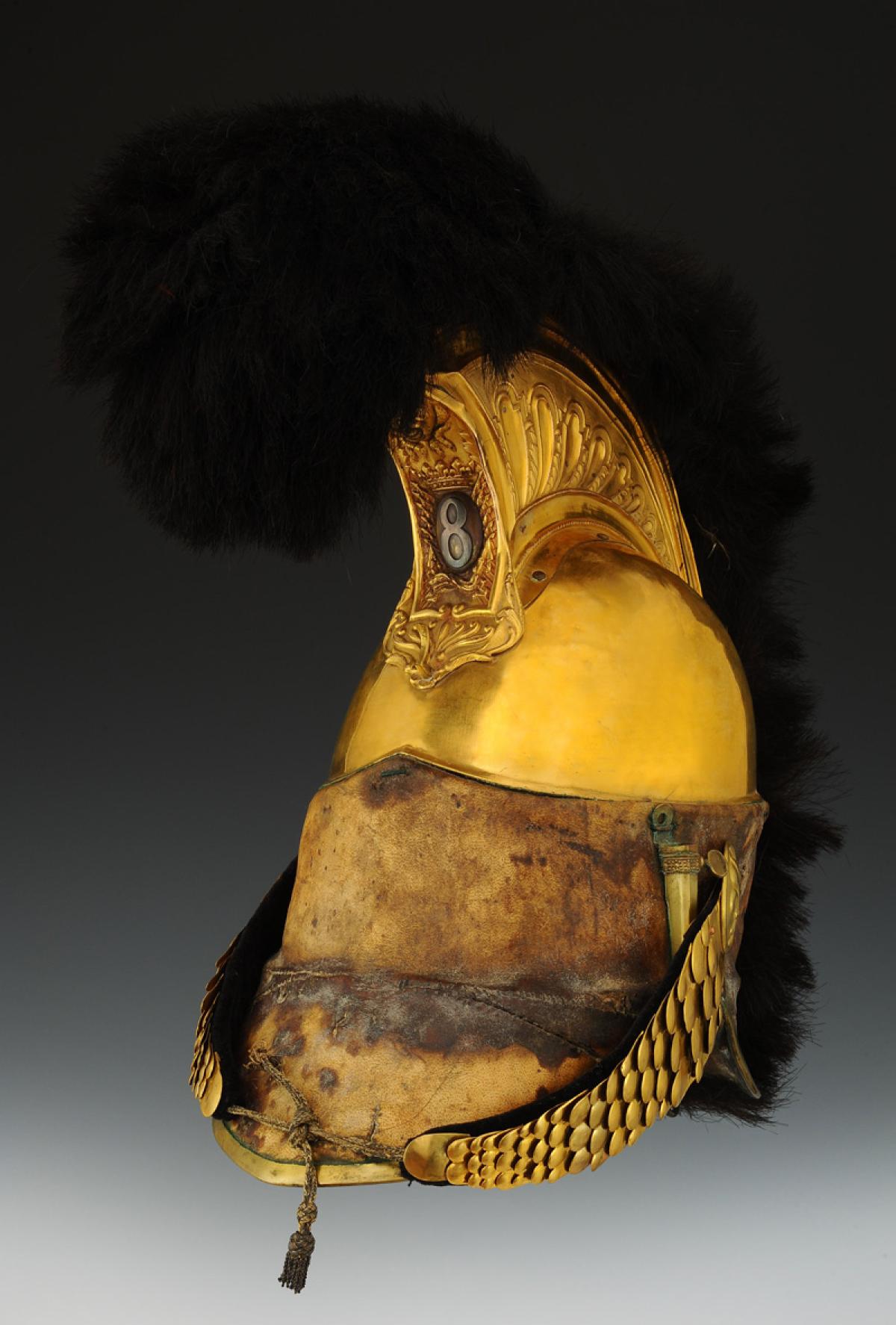
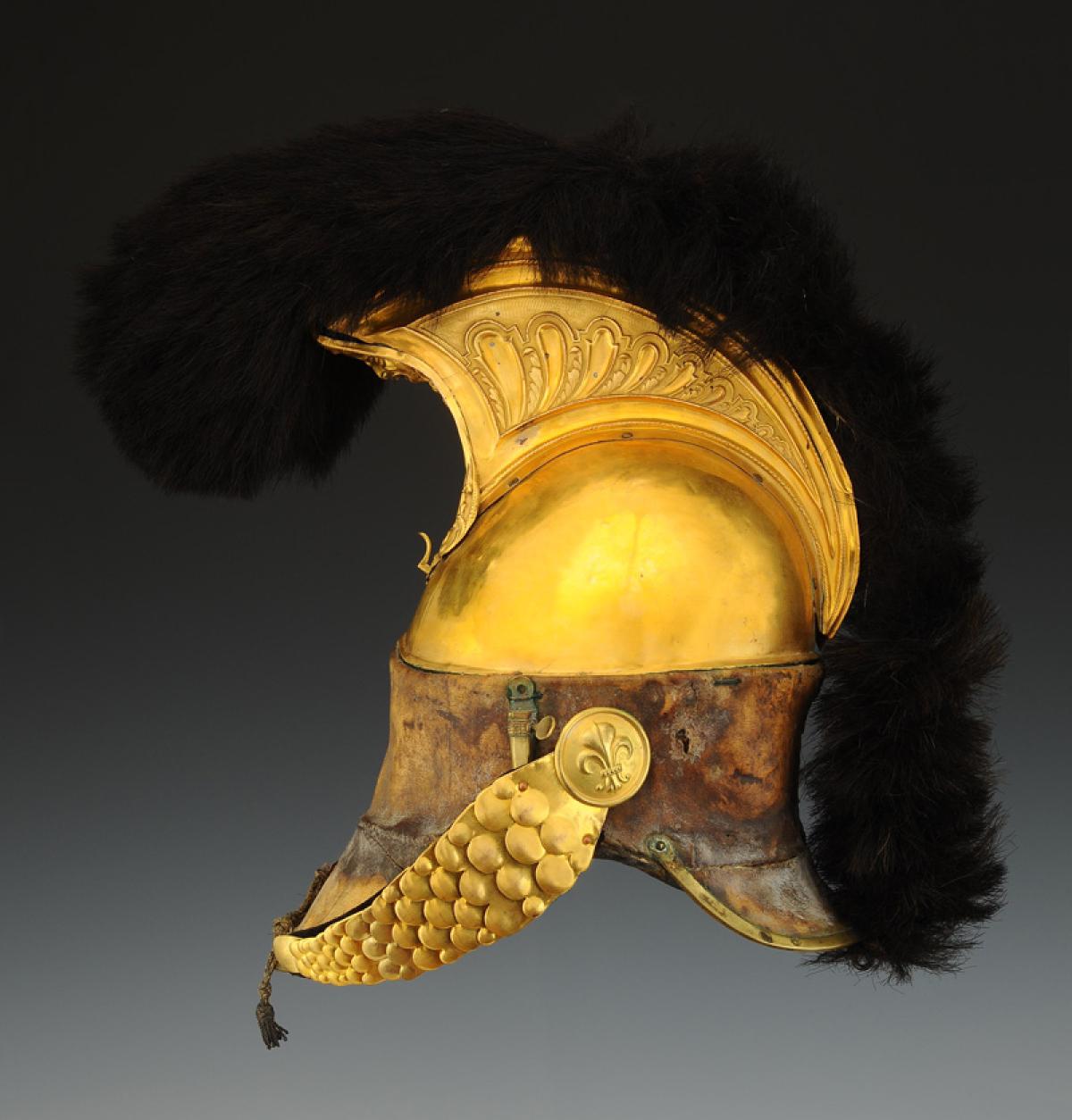
Gilded copper helmet approximately 11 cm deep, tilted backwards, in the "Minerva" style, with a bottom rim fitted with a 3/4 mm-wide gutter to prevent water infiltration under the turban.
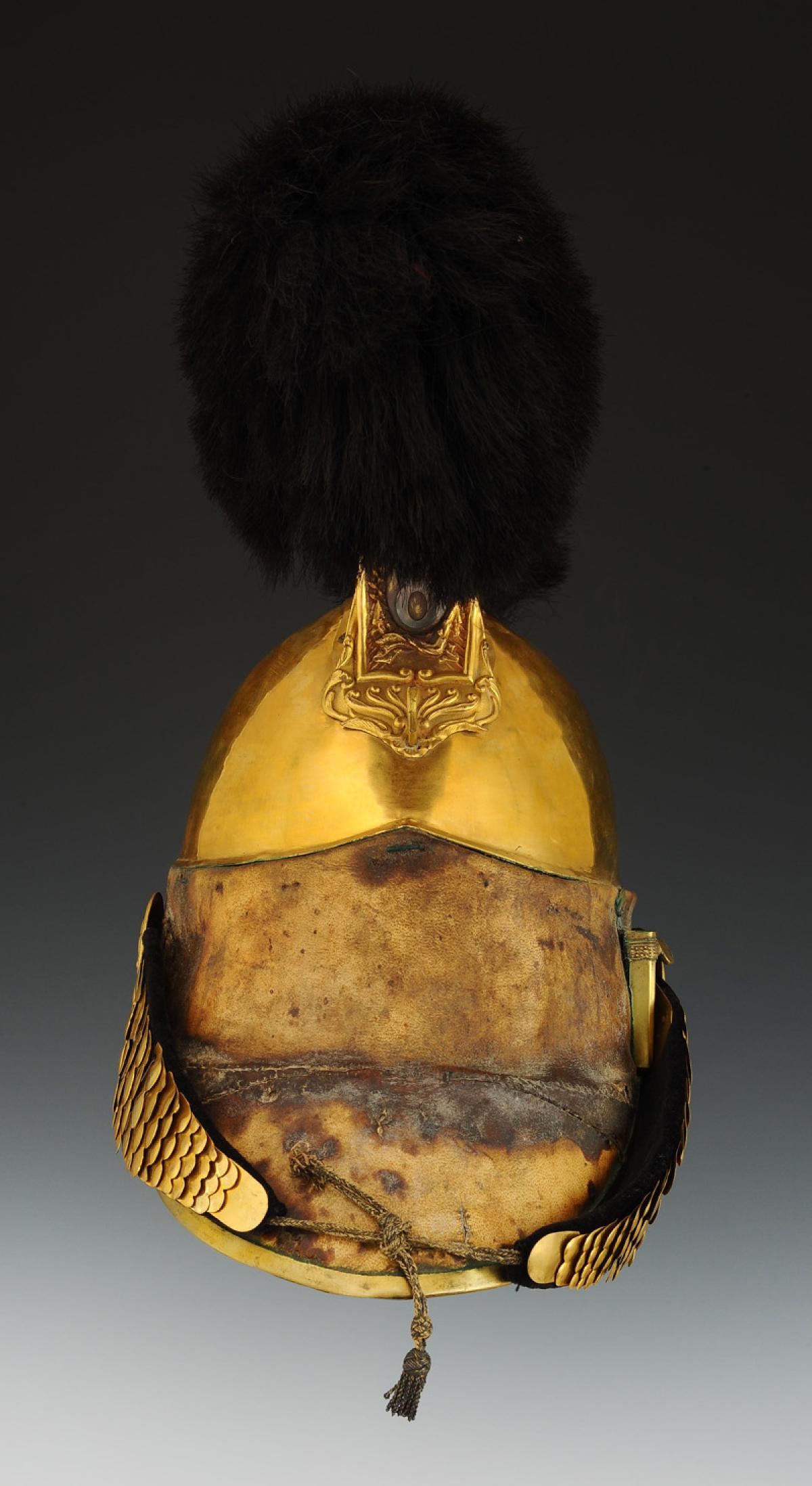
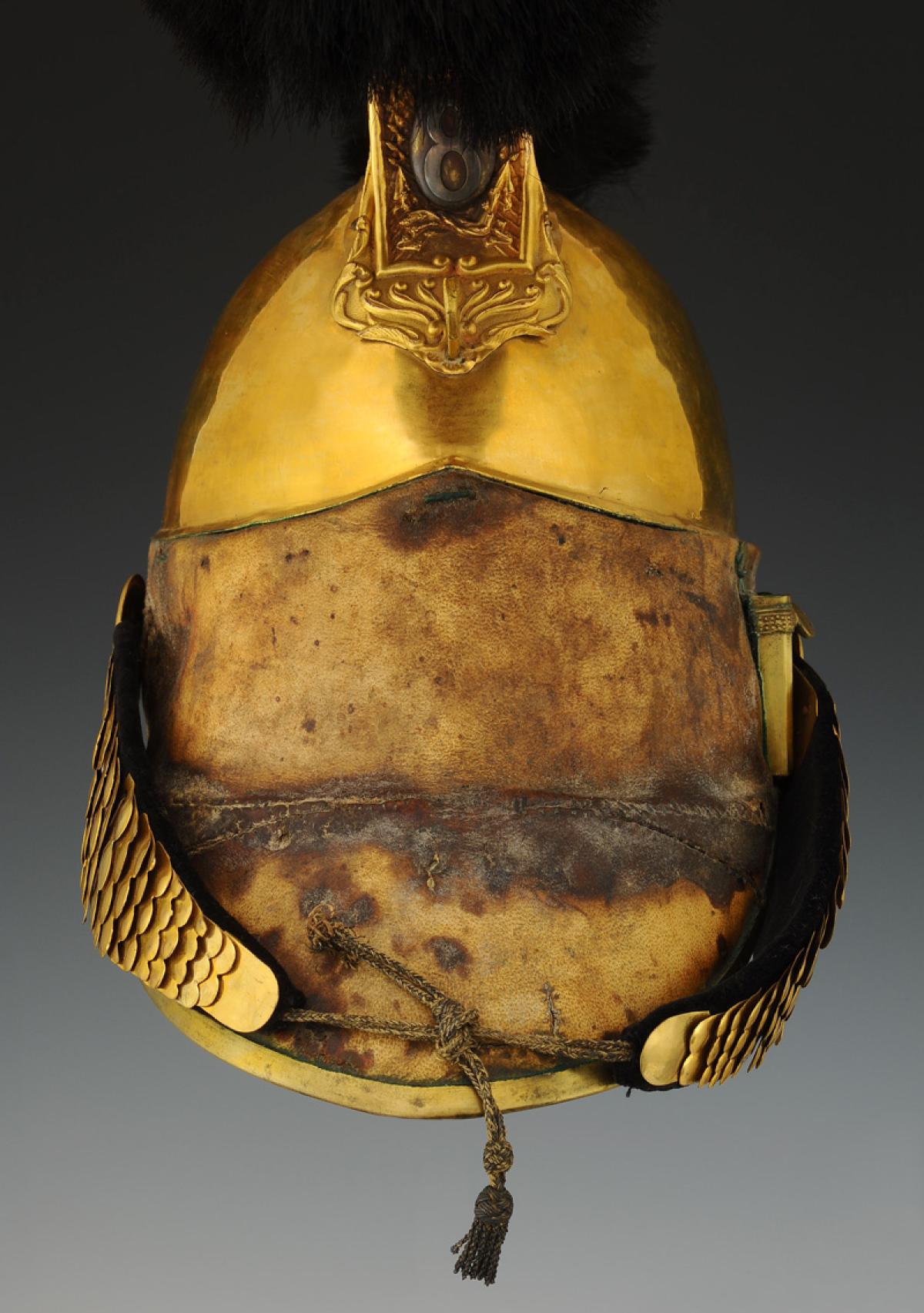
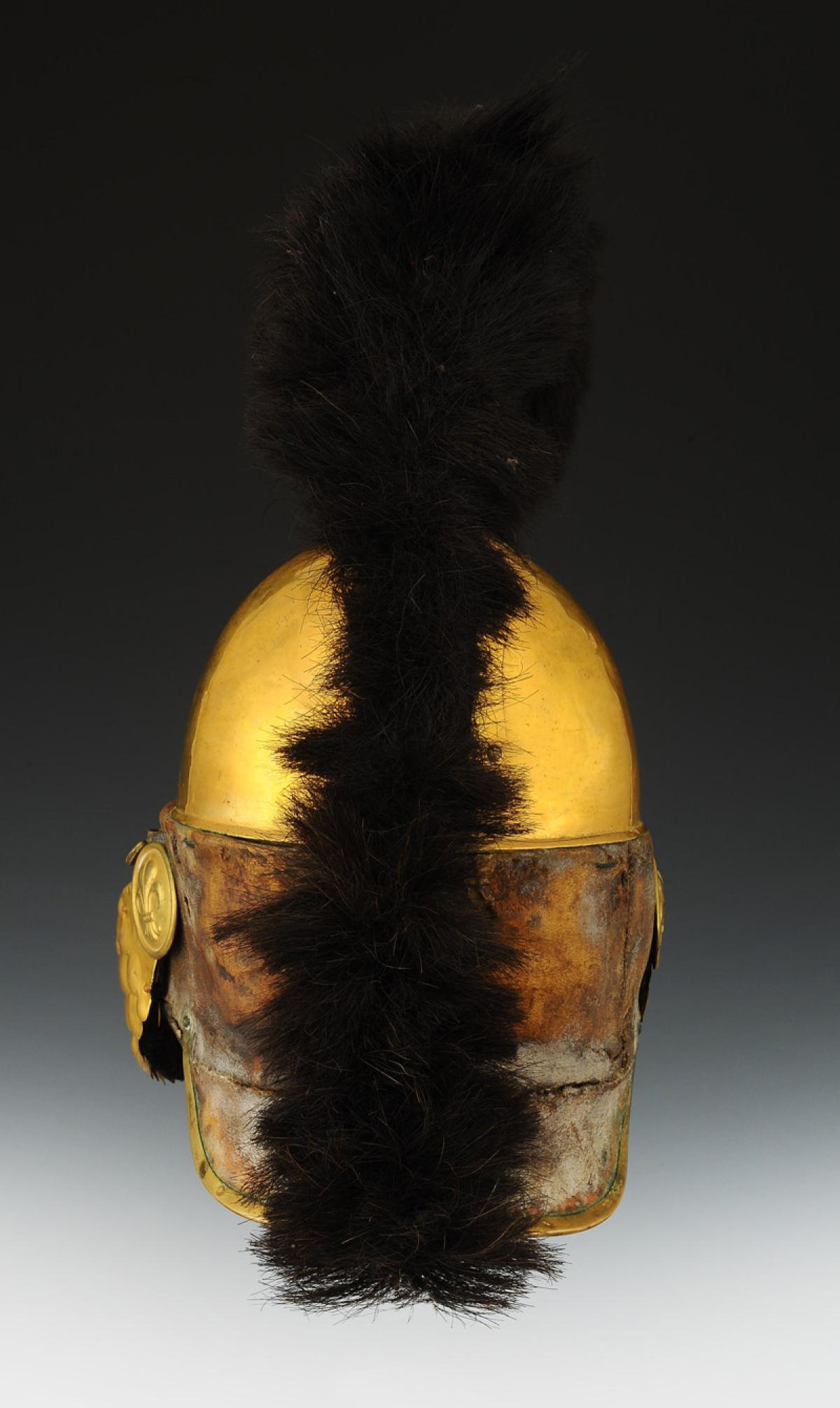
Turban composed of a leather band around 9 cm high at the front, 8 cm on the sides at the level of the rosettes, and 10 cm at the back, covered with genuine panther skin. Leather visor covered with skin, lined with black waxed morocco leather, encircled by a gilded brass rim folded over the outer edge, 7.5 cm wide in the center, sewn to the turban as an extension. Neck guard covered with skin, lined with black waxed morocco leather, encircled by a gilded brass rim folded over the outer edge, approximately 5 cm wide in the center.
Tubular plume holder with a square section, slightly tapering downwards, equipped with a screw clamp to secure the plume. Height 5 cm.
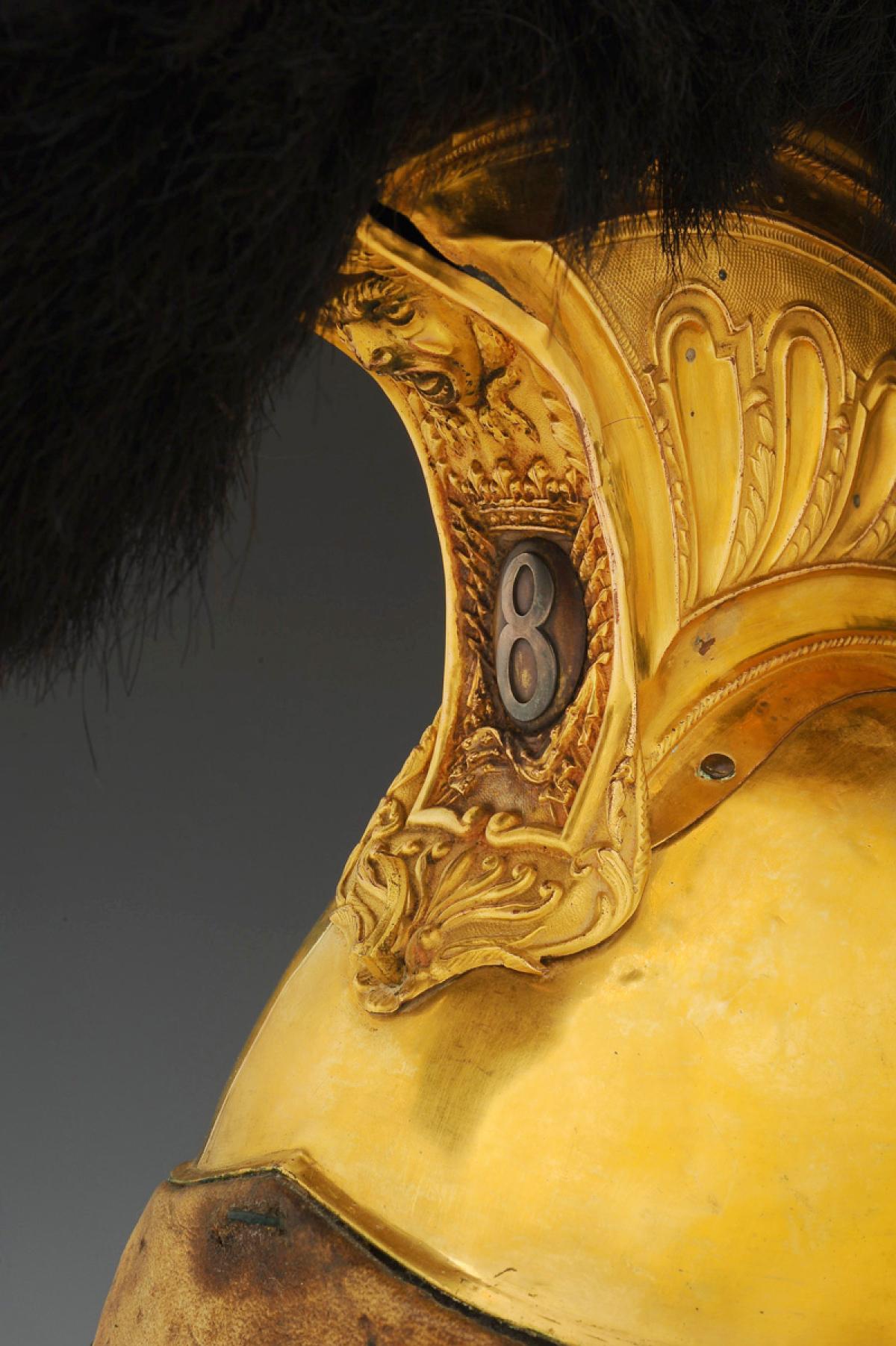
Gilded brass crest consisting of two fins and a mask. Maximum height of each fin is 12 cm, each adorned with 9 separated flutes, each attached to the helmet with four rivets.
Mask measuring 4 cm wide at its center, 5.5 cm at its base, and 13 cm high; embossed in relief with a Medusa head at the top, and at the bottom, embossed with seven petals, fixed to the helmet by a hook to hold the chinstraps up.
The central part of the mask originally bore the arms of Condé, modified during the Hundred Days by the addition of a silver medallion with the number "8" (8th Regiment of Dragons), medallion height 3 cm, width 2.3 cm.
Chinstraps composed of two parts: the soft leather chinstrap covered with black velvet, adorned with 18 gilded brass scales, alternately cut into 4 or 3 scallops (the widest measuring 5.5 cm and the narrowest 1.7 cm); round rosette made of gilded brass, Ø 4.5 cm, embossed with a fleur-de-lis. Chinstraps finished with golden silver passementerie cords.
Black horsehair tail extending 20 cm in front of the crest.
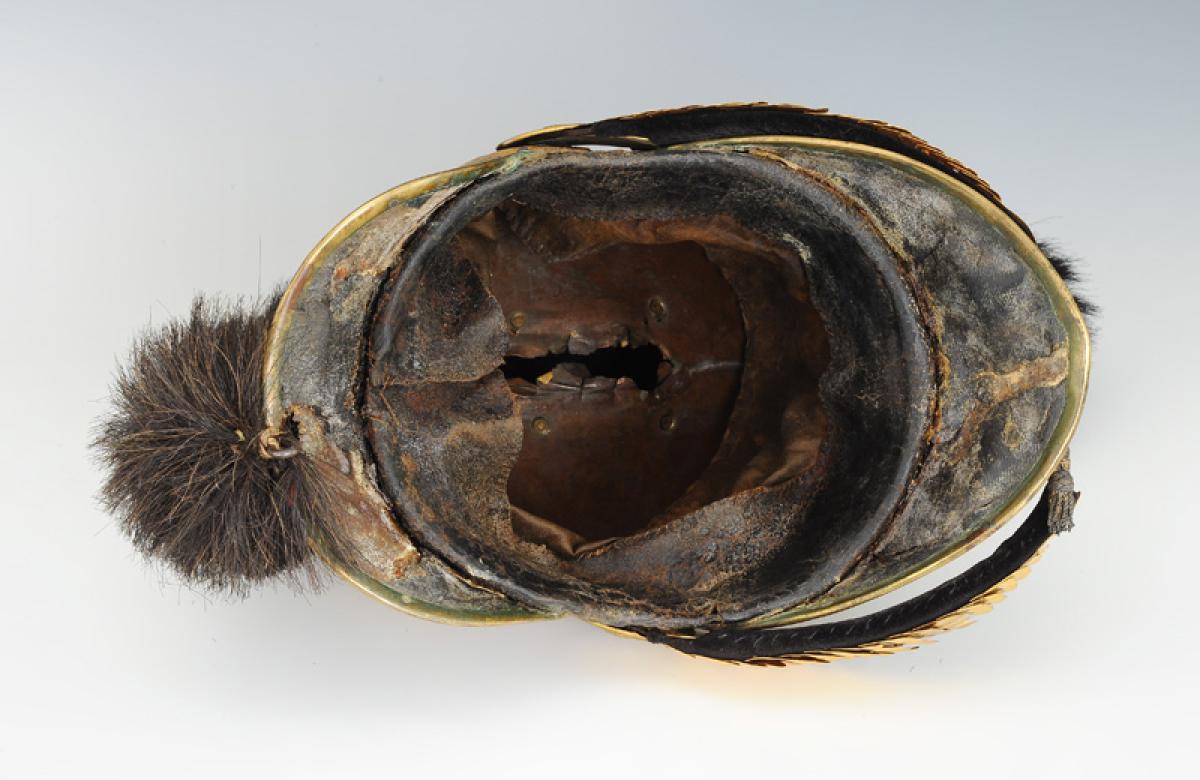
Interior lining composed of a black waxed fine leather band 6.3 cm high topped with 8 cm of beige fabric.
Total height of the helmet 39 cm.
France.
Hundred Days helmet worn from March 1, 1815, and May 1, 1815.
Good condition. Turban skin has lost all its fur. Minor damages on the crest and dents on the helmet. Plume holder gilding worn off, later replaced but period-appropriate. Rosettes of chinstraps modified in 1815. Leather and lining of chinstraps restored. One floche missing from one of the chinstrap cords. Complete but worn interior lining. Damage to the helmet under the crest (not visible to the naked eye).
PROVENANCE:
Former collection of Charles Marchal.
NOTE:
This helmet is an officer's helmet of the First Empire's Dragons. On May 1, 1814, when it became the Dragons de Condé regiment, it was given the number 8 in the army (composed of 4 squadrons of 2 companies of 78 men each) but retained the name "Dragon de Condé." The plume holder and the covering plate were removed and replaced by the horsehair tail, and the mask bearing a silver "N" was replaced by one bearing the arms of Condé.
On March 20, 1815, with the return of the Emperor, the regiment no longer carried the name "Condé" and naturally took the regiment's sequential number, "8"; the arms of Condé were hidden by the number "8" struck on the medallion fixed at the center of the mask. However, on both sides of the medallion, the six standard pikes characteristic of the Dragons de Condé still appear. It was worn in this configuration until May 1, 1815.
On May 1, 1815, the regiments were reorganized, and the 8th regiment became the 13th. However, due to the turbulent period, it is not impossible that this helmet was worn in this manner during the last three months of the Empire.
This is the only known specimen of this type to date.
HISTORICAL:
The 13th regiment of Dragons was raised in Languedoc by order of October 4, 1676. It successively bore the names: Condé-Dragons (1724-1740), Comte de Provence (1774), and then Monsieur (1774). In 1791, it became the 13th regiment of Dragons on January 1. At the fall of the Empire, under the First Restoration, on May 1, 1814, it became the Dragons de Condé regiment (8th regiment). On May 1, 1815, it resumed its name as the 13th regiment of Dragons and was disbanded on December 6, 1815, in Saintes.
During the Hundred Days, it was part of the 2nd Cavalry Corps under General Exelmans, in Stroltz's Dragons division of Burthe's brigade. It fought at Fleurus on June 15, at Ligny on June 16, at Perwez on June 17, and at Wavre under Marshal Grouchy on June 18. It retreated to Paris, engaging in a battle at Velizy on July 1, 1815.
The regiment would be reestablished in 1855 under the name of the regiment of the Empress's Dragons.
Gilded copper helmet approximately 11 cm deep, tilted backwards, in the "Minerva" style, with a bottom rim fitted with a 3/4 mm-wide gutter to prevent water infiltration under the turban.
Turban composed of a leather band around 9 cm high at the front, 8 cm on the sides at the level of the rosettes, and 10 cm at the back, covered with genuine panther skin. Leather visor covered with skin, lined with black waxed morocco leather, encircled by a gilded brass rim folded over the outer edge, 7.5 cm wide in the center, sewn to the turban as an extension. Neck guard covered with skin, lined with black waxed morocco leather, encircled by a gilded brass rim folded over the outer edge, approximately 5 cm wide in the center.
Tubular plume holder with a square section, slightly tapering downwards, equipped with a screw clamp to secure the plume. Height 5 cm.
Gilded brass crest consisting of two fins and a mask. Maximum height of each fin is 12 cm, each adorned with 9 separated flutes, each attached to the helmet with four rivets.
Mask measuring 4 cm wide at its center, 5.5 cm at its base, and 13 cm high; embossed in relief with a Medusa head at the top, and at the bottom, embossed with seven petals, fixed to the helmet by a hook to hold the chinstraps up.
The central part of the mask originally bore the arms of Condé, modified during the Hundred Days by the addition of a silver medallion with the number "8" (8th Regiment of Dragons), medallion height 3 cm, width 2.3 cm.
Chinstraps composed of two parts: the soft leather chinstrap covered with black velvet, adorned with 18 gilded brass scales, alternately cut into 4 or 3 scallops (the widest measuring 5.5 cm and the narrowest 1.7 cm); round rosette made of gilded brass, Ø 4.5 cm, embossed with a fleur-de-lis. Chinstraps finished with golden silver passementerie cords.
Black horsehair tail extending 20 cm in front of the crest.
Interior lining composed of a black waxed fine leather band 6.3 cm high topped with 8 cm of beige fabric.
Total height of the helmet 39 cm.
France.
Hundred Days helmet worn from March 1, 1815, and May 1, 1815.
Good condition. Turban skin has lost all its fur. Minor damages on the crest and dents on the helmet. Plume holder gilding worn off, later replaced but period-appropriate. Rosettes of chinstraps modified in 1815. Leather and lining of chinstraps restored. One floche missing from one of the chinstrap cords. Complete but worn interior lining. Damage to the helmet under the crest (not visible to the naked eye).
PROVENANCE:
Former collection of Charles Marchal.
NOTE:
This helmet is an officer's helmet of the First Empire's Dragons. On May 1, 1814, when it became the Dragons de Condé regiment, it was given the number 8 in the army (composed of 4 squadrons of 2 companies of 78 men each) but retained the name "Dragon de Condé." The plume holder and the covering plate were removed and replaced by the horsehair tail, and the mask bearing a silver "N" was replaced by one bearing the arms of Condé.
On March 20, 1815, with the return of the Emperor, the regiment no longer carried the name "Condé" and naturally took the regiment's sequential number, "8"; the arms of Condé were hidden by the number "8" struck on the medallion fixed at the center of the mask. However, on both sides of the medallion, the six standard pikes characteristic of the Dragons de Condé still appear. It was worn in this configuration until May 1, 1815.
On May 1, 1815, the regiments were reorganized, and the 8th regiment became the 13th. However, due to the turbulent period, it is not impossible that this helmet was worn in this manner during the last three months of the Empire.
This is the only known specimen of this type to date.
HISTORICAL:
The 13th regiment of Dragons was raised in Languedoc by order of October 4, 1676. It successively bore the names: Condé-Dragons (1724-1740), Comte de Provence (1774), and then Monsieur (1774). In 1791, it became the 13th regiment of Dragons on January 1. At the fall of the Empire, under the First Restoration, on May 1, 1814, it became the Dragons de Condé regiment (8th regiment). On May 1, 1815, it resumed its name as the 13th regiment of Dragons and was disbanded on December 6, 1815, in Saintes.
During the Hundred Days, it was part of the 2nd Cavalry Corps under General Exelmans, in Stroltz's Dragons division of Burthe's brigade. It fought at Fleurus on June 15, at Ligny on June 16, at Perwez on June 17, and at Wavre under Marshal Grouchy on June 18. It retreated to Paris, engaging in a battle at Velizy on July 1, 1815.
The regiment would be reestablished in 1855 under the name of the regiment of the Empress's Dragons.
Reference :
27478
Next update Friday, octobre 2 at 13:30 PM
FOR ALL PURCHASES, PAYMENT IN MULTIPLE CHECKS POSSIBLE
bertrand.malvaux@wanadoo.fr 06 07 75 74 63
SHIPPING COSTS
Shipping costs are calculated only once per order for one or more items, all shipments are sent via registered mail, as this is the only way to have proof of dispatch and receipt.
For parcels whose value cannot be insured by the Post, shipments are entrusted to DHL or Fedex with real value insured, the service is of high quality but the cost is higher.
RETURN POLICY
Items can be returned within 8 days of receipt. They must be returned by registered mail at the sender's expense, in their original packaging, and in their original condition.
AUTHENTICITY
The selection of items offered on this site allows me to guarantee the authenticity of each piece described here, all items offered are guaranteed to be period and authentic, unless otherwise noted or restricted in the description.
An authenticity certificate of the item including the description published on the site, the period, the sale price, accompanied by one or more color photographs is automatically provided for any item priced over 130 euros. Below this price, each certificate is charged 5 euros.
Only items sold by me are subject to an authenticity certificate, I do not provide any expert reports for items sold by third parties (colleagues or collectors).
FOR ALL PURCHASES, PAYMENT IN MULTIPLE CHECKS POSSIBLE
bertrand.malvaux@wanadoo.fr 06 07 75 74 63
An authenticity certificate of the item including the description published on the site, the period, the sale price, accompanied by one or more color photographs is automatically provided for any item priced over 130 euros. Below this price, each certificate is charged 5 euros.
Only items sold by me are subject to an authenticity certificate, I do not provide any expert reports for items sold by third parties (colleagues or collectors).