
SIGNED AUTOGRAPH LETTER FROM LEFEBVRE TO GENERAL KLÉBER, 30 fructidor year 3 (September 16, 1795). 18915-19
Sold out
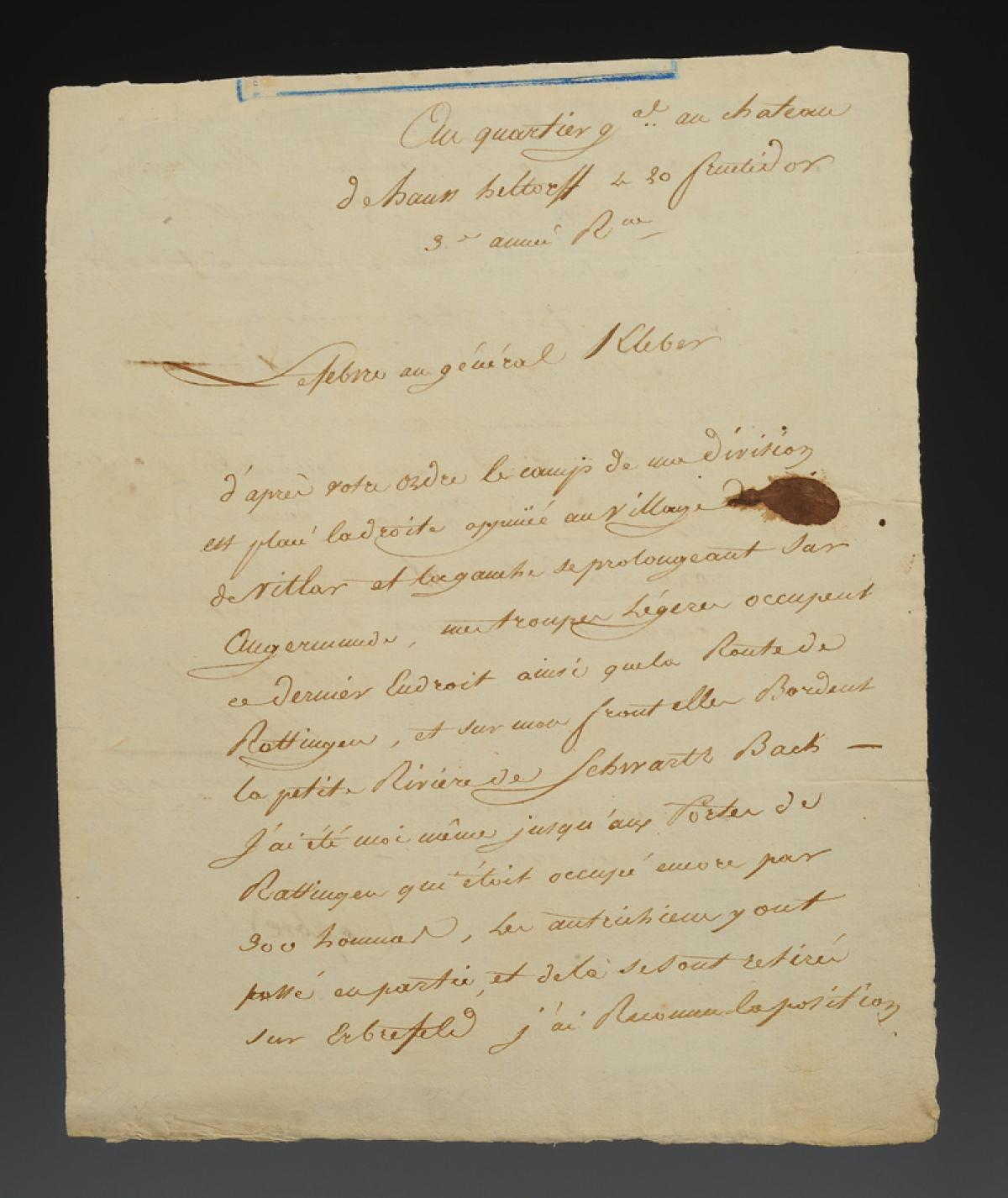
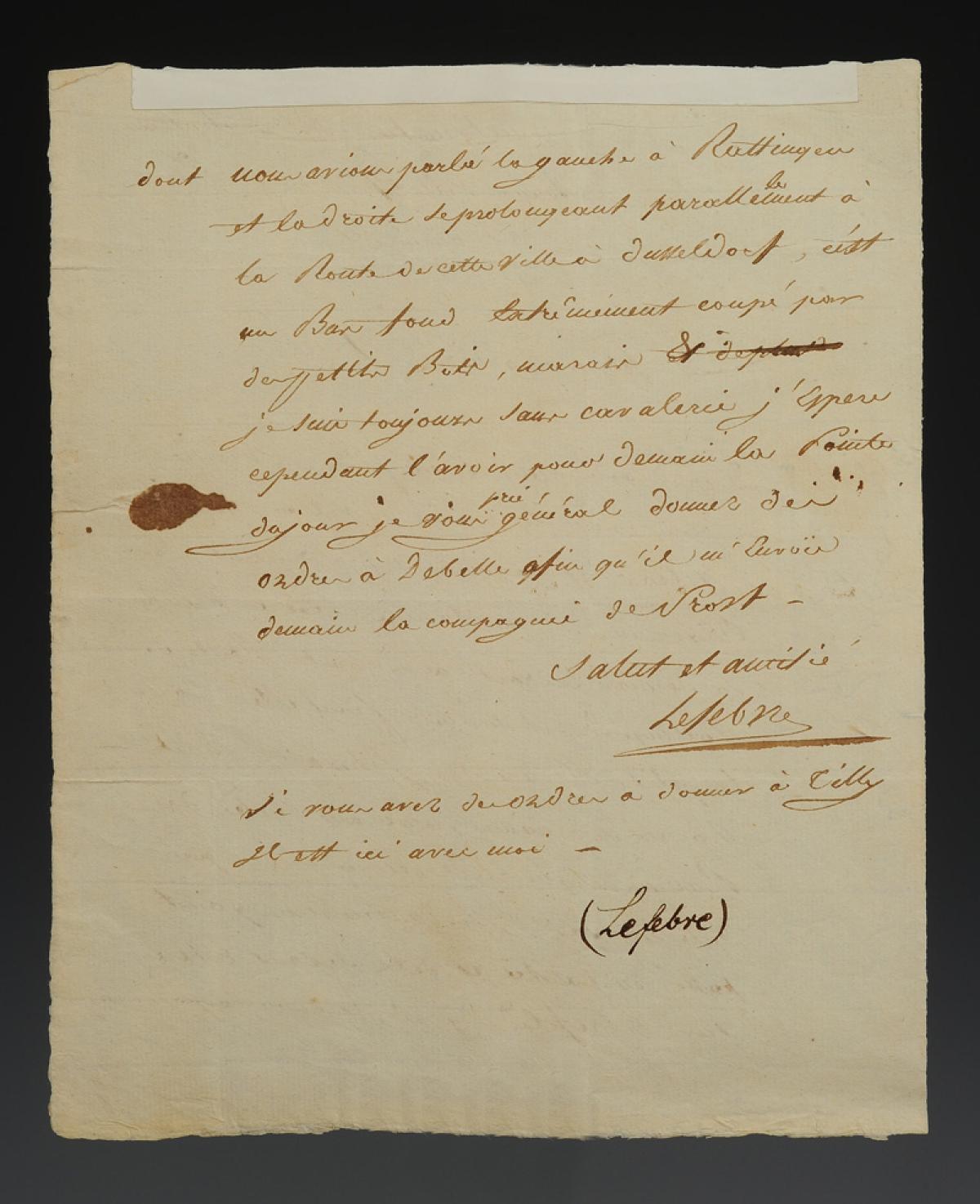
AUTOGRAPH SIGNED LETTER FROM LEFEBVRE TO GENERAL KLÉBER, 30 FRUCTIDOR YEAR 3 (SEPTEMBER 16, 1795). 18915-19
Headquarters, Hauss Heltorft Castle, 30 fructidor year 3.
General Lefebvre reports to General Kléber about the situation of his division in the Angermünd area (Germany), on the road to Rottingen.
"The Austrians have partly passed through there and then retreated to Erbrefeld. I have surveyed the position we discussed, the left at Rottingen and the right extending parallel to the road from that town to Dusseldorf...
I am still without cavalry, however I hope to have it by tomorrow...
Greetings and friendship. Signed Lefebvre.
If you have any orders for Tilly, he is here with me."
1 sheet, front and back. H 22.7 cm x 18.7 cm.
Average condition, crease marks, upper part cut with remains of glued paper, an ink stain concealing the name of a village.
* François Joseph Lefebvre, born on October 25, 1755, in Rouffach, Alsace, and died on September 4, 1820, in Paris, was a French general officer, Marshal of the Empire. His career began shortly before the French Revolution during which he fought in the Army of the Rhine and later in the Army of Sambre-et-Meuse, leading to his promotion to divisional general.
Appointed Marshal of the Empire in 1804, he was one of the two honorary marshals—alongside Kellermann—whom the Emperor used in military positions, and the only one to command a corps on the battlefields of the Empire.
He was also the first of Napoleon's marshals to receive a ducal title for a military victory, that of Duke of Dantzig.
Created a Peer of France by the king during the First Restoration, he sided with Napoleon during the Hundred Days.
[...]
Starting as a captain at the beginning of the war in 1792, he was promoted to brigadier general on December 2, 1793, and then to divisional general on January 10, 1794, after the battles of Lambach and Geisberg. He distinguished himself everywhere, almost always at the forefront. Lefebvre participated in all the major battles in the North and on the Rhine from 1793 to 1799, notably at Geisberg on December 26, 1793, the capture of Arlon on April 18, 1794, the capture of Dinant on May 29, 1794, Fleurus on June 26, Altenkirchen on June 4, 1796, Wetzlar on June 15, Friedberg on July 10, 1796, and the crossing of the Rhine at Neuwied on April 18, 1797. After Custine, he was the first of the Republic's generals to cross the Rhine. Leading his grenadiers, despite heavy fire, he established himself on the right bank in front of Eichelkamp.
Headquarters, Hauss Heltorft Castle, 30 fructidor year 3.
General Lefebvre reports to General Kléber about the situation of his division in the Angermünd area (Germany), on the road to Rottingen.
"The Austrians have partly passed through there and then retreated to Erbrefeld. I have surveyed the position we discussed, the left at Rottingen and the right extending parallel to the road from that town to Dusseldorf...
I am still without cavalry, however I hope to have it by tomorrow...
Greetings and friendship. Signed Lefebvre.
If you have any orders for Tilly, he is here with me."
1 sheet, front and back. H 22.7 cm x 18.7 cm.
Average condition, crease marks, upper part cut with remains of glued paper, an ink stain concealing the name of a village.
* François Joseph Lefebvre, born on October 25, 1755, in Rouffach, Alsace, and died on September 4, 1820, in Paris, was a French general officer, Marshal of the Empire. His career began shortly before the French Revolution during which he fought in the Army of the Rhine and later in the Army of Sambre-et-Meuse, leading to his promotion to divisional general.
Appointed Marshal of the Empire in 1804, he was one of the two honorary marshals—alongside Kellermann—whom the Emperor used in military positions, and the only one to command a corps on the battlefields of the Empire.
He was also the first of Napoleon's marshals to receive a ducal title for a military victory, that of Duke of Dantzig.
Created a Peer of France by the king during the First Restoration, he sided with Napoleon during the Hundred Days.
[...]
Starting as a captain at the beginning of the war in 1792, he was promoted to brigadier general on December 2, 1793, and then to divisional general on January 10, 1794, after the battles of Lambach and Geisberg. He distinguished himself everywhere, almost always at the forefront. Lefebvre participated in all the major battles in the North and on the Rhine from 1793 to 1799, notably at Geisberg on December 26, 1793, the capture of Arlon on April 18, 1794, the capture of Dinant on May 29, 1794, Fleurus on June 26, Altenkirchen on June 4, 1796, Wetzlar on June 15, Friedberg on July 10, 1796, and the crossing of the Rhine at Neuwied on April 18, 1797. After Custine, he was the first of the Republic's generals to cross the Rhine. Leading his grenadiers, despite heavy fire, he established himself on the right bank in front of Eichelkamp.
Reference :
18915-19
Next update Friday, march 20th at 13:30 PM
FOR ALL PURCHASES, PAYMENT IN MULTIPLE CHECKS POSSIBLE
bertrand.malvaux@wanadoo.fr 06 07 75 74 63
SHIPPING COSTS
Shipping costs are calculated only once per order for one or more items, all shipments are sent via registered mail, as this is the only way to have proof of dispatch and receipt.
For parcels whose value cannot be insured by the Post, shipments are entrusted to DHL or Fedex with real value insured, the service is of high quality but the cost is higher.
RETURN POLICY
Items can be returned within 8 days of receipt. They must be returned by registered mail at the sender's expense, in their original packaging, and in their original condition.
AUTHENTICITY
The selection of items offered on this site allows me to guarantee the authenticity of each piece described here, all items offered are guaranteed to be period and authentic, unless otherwise noted or restricted in the description.
An authenticity certificate of the item including the description published on the site, the period, the sale price, accompanied by one or more color photographs is automatically provided for any item priced over 130 euros. Below this price, each certificate is charged 5 euros.
Only items sold by me are subject to an authenticity certificate, I do not provide any expert reports for items sold by third parties (colleagues or collectors).
FOR ALL PURCHASES, PAYMENT IN MULTIPLE CHECKS POSSIBLE
bertrand.malvaux@wanadoo.fr 06 07 75 74 63
An authenticity certificate of the item including the description published on the site, the period, the sale price, accompanied by one or more color photographs is automatically provided for any item priced over 130 euros. Below this price, each certificate is charged 5 euros.
Only items sold by me are subject to an authenticity certificate, I do not provide any expert reports for items sold by third parties (colleagues or collectors).