
GENERAL NICOLAS CHARLES VICTOR OUDINOT: pastel on canvas, Second Empire. 32261
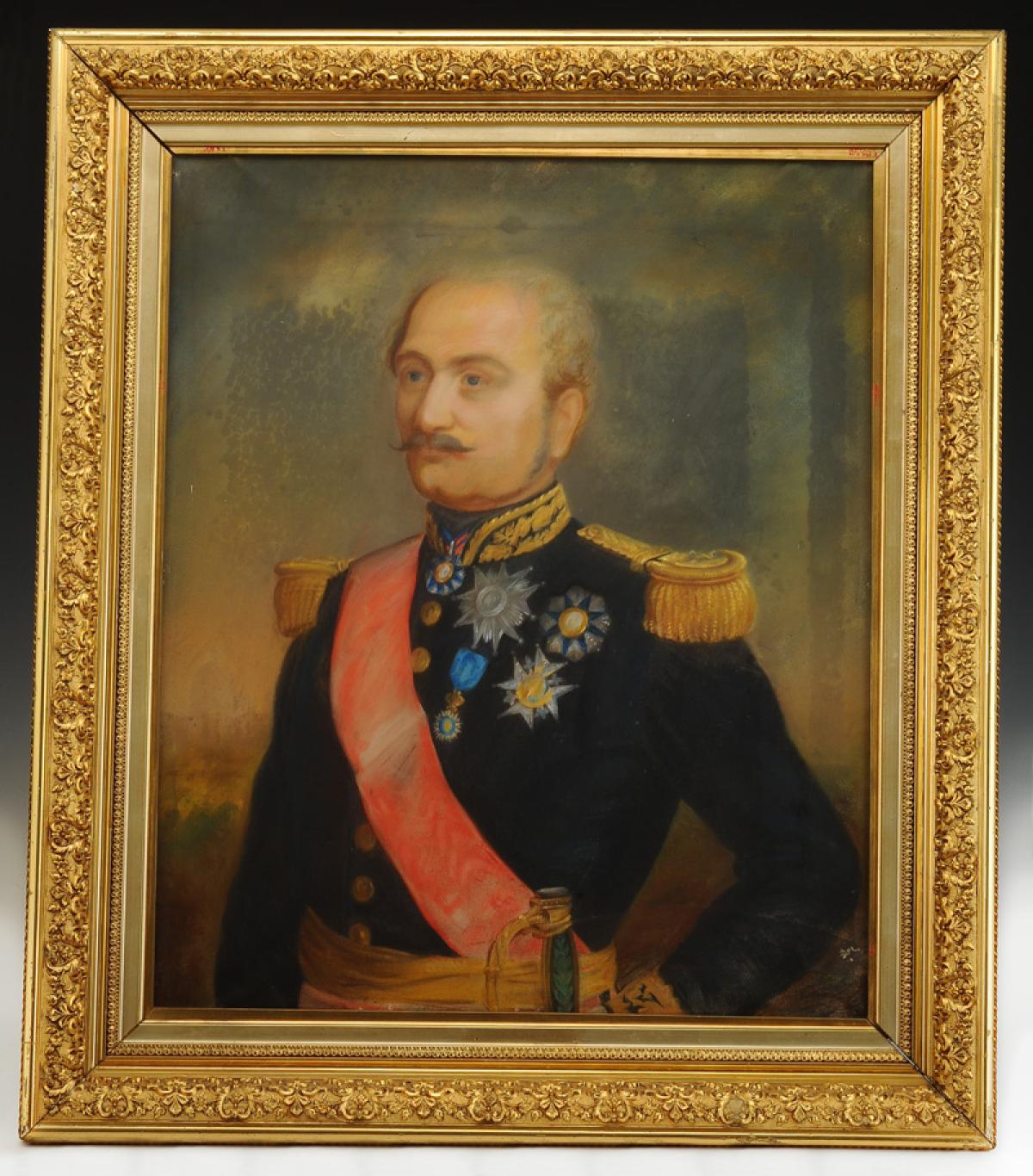
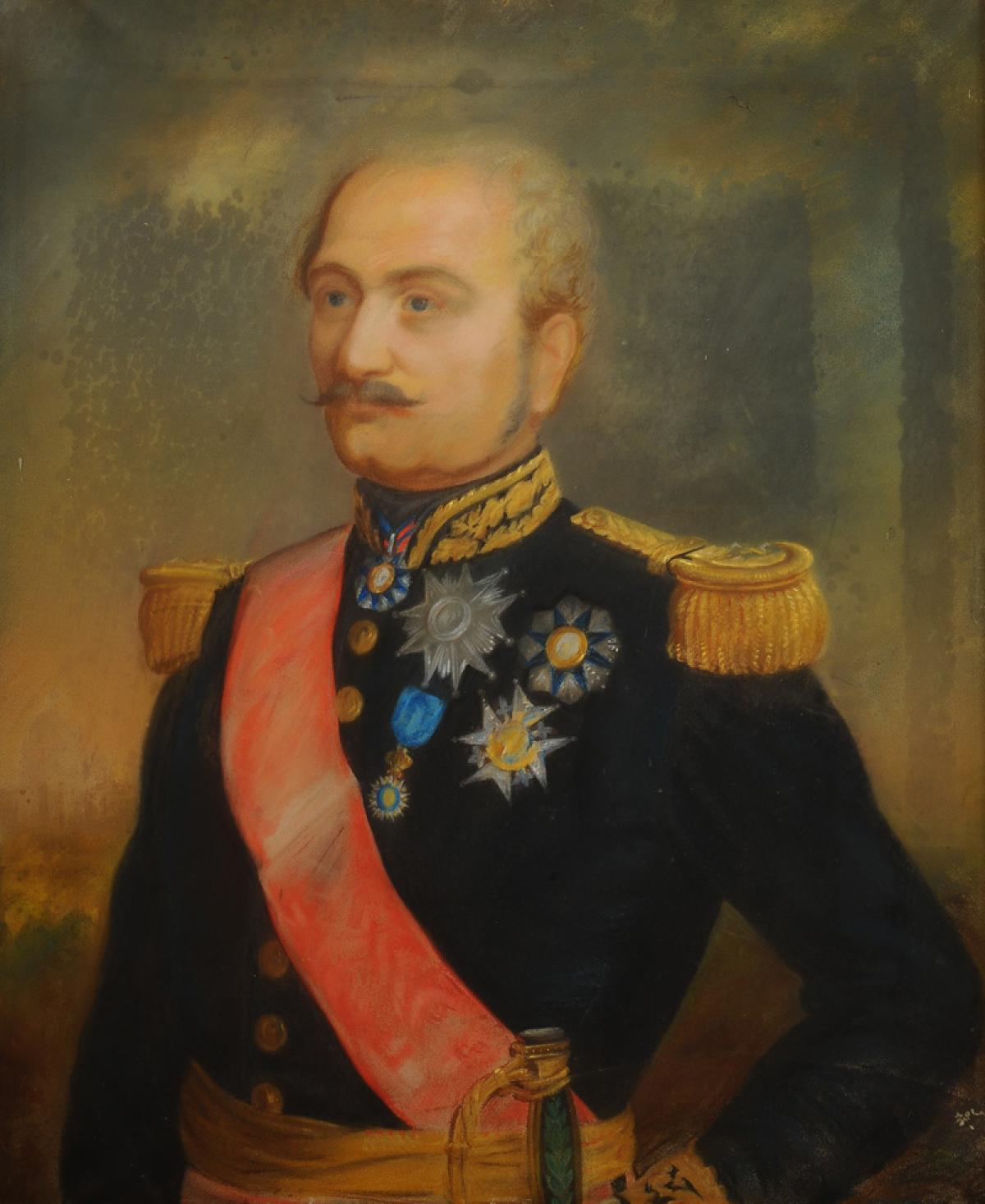
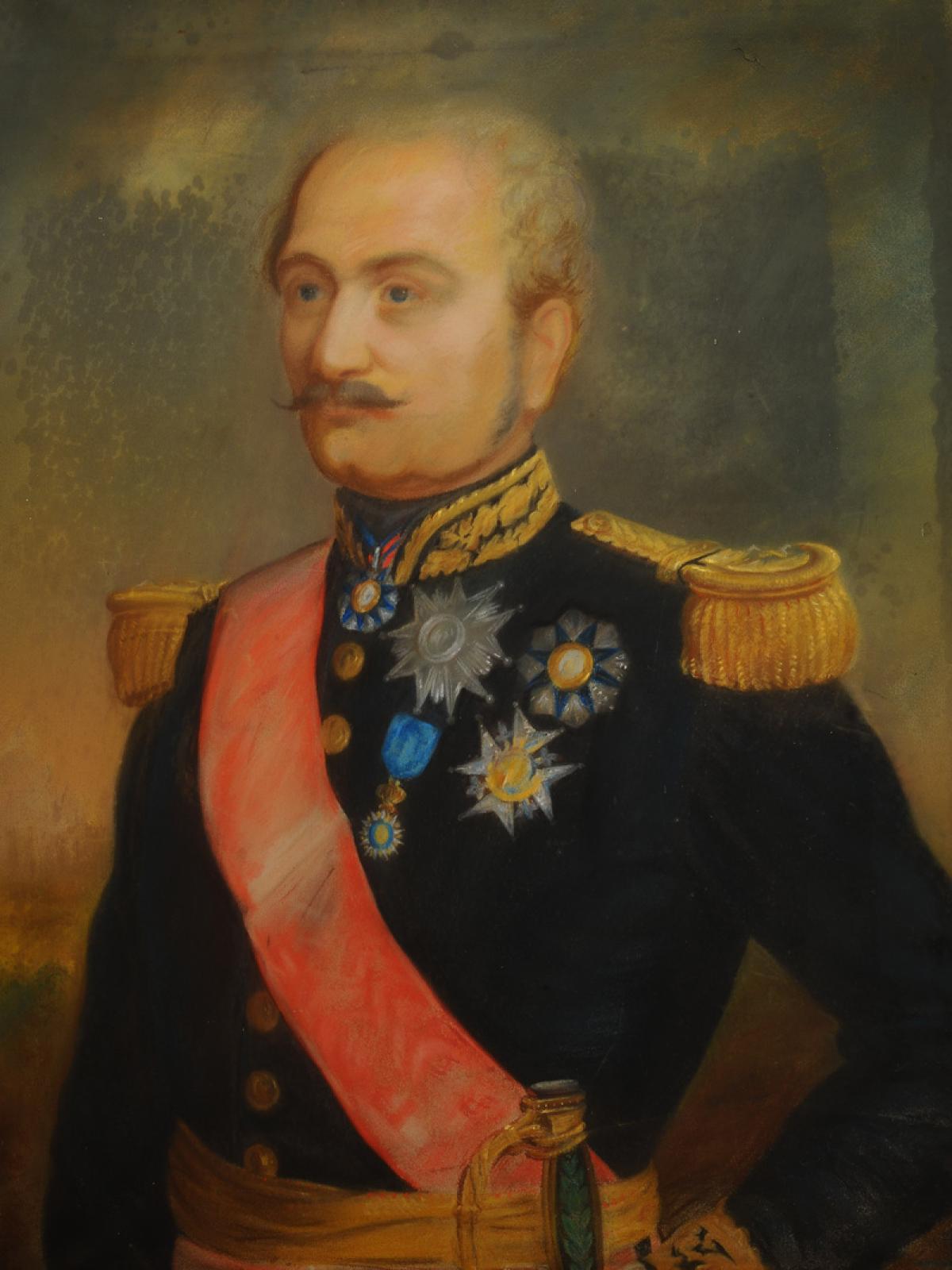

GENERAL NICOLAS CHARLES VICTOR OUDINOT: pastel on canvas, Second Empire. 32261
Pastel depicting the general in bust. H 74 cm x 61.5 cm.
Presented in a gilded wooden frame. H 95 cm x 82 cm.
France.
Second Empire.
Very good condition, rebacked.
BIOGRAPHY:
Nicolas-Charles-Victor Oudinot, born on November 3, 1791 in Bar-le-Duc, is the eldest son of Empire Marshal Charles Oudinot. Deputy of Maine-et-Loire under the July Monarchy, 2nd Duke of Reggio after his father's death in 1847, Grand Chancellor of the Legion of Honor and Governor of the Invalides, he died on July 7, 1863 in Paris. He is buried in the Père-Lachaise Cemetery in Paris in the 45th division.
Early years of a Lorraine hussar:
In 1805, the Emperor appointed this son of a senior Lorraine officer as his first page and at the Congress of Erfurt in 1808, he, in this capacity, participated in the 1809 campaign, during which, from three different battlefields, Napoleon I sent him back to France to report to the Senate on the army's situation.
Successively appointed lieutenant in the 5th hussars and aide-de-camp to Masséna during the Portugal campaign, the son of the "French Army's Bayard" returned to France in 1811 and was incorporated into the Guard. It was in this elite corps that he participated in the campaigns of Russia, Saxony, and France.
In 1814, as the Emperor was leaving Fontainebleau, he gave Marshal Oudinot a colonel's commission for his son. Louis XVIII confirmed this appointment on April 27, and charged Colonel Oudinot with organizing the King's hussar regiment.
The Oudinot father and son sided with the Restoration government. They held no command during the Hundred Days.
He married Eulalie Minguet (1802-1886), daughter of Parisian banker Louis Minguet, on March 20, 1820 in Paris. They had a son, Charles Oudinot (1821-1889), 3rd Duke of Reggio.
Officer of the King's cavalry:
In September 1815, he formed the North Hussars Regiment in Lille, which he commanded until 1822, when he was put in charge of the 1st regiment of Royal Guard cavalry grenadiers.
Promoted to major general in 1824, he took command of a brigade at the Lunéville camp, where his military capabilities were soon appreciated.
The King entrusted him with the task of reorganizing, on a broader basis, the cavalry school in Saumur, which had been disbanded a few years earlier.
The July Revolution took place, which did not affect the discipline of the School; however, Oudinot could not be persuaded to retain his command.
He resigns from the army.
Forced return to military life turned politician under the July Monarchy:
In 1835, his brother Auguste, colonel of the 2nd African Chasseurs, was fatally struck at the moment when, leading the vanguard in a vigorous charge, he forced the Muley-Ismaël pass in the Algerian gorges of the Macta held by Abd-el-Kader's troops. A few months later, Marquis Oudinot, after resuming his duties, was ordered to leave for Oran and take command of the 1st brigade of the Mascara expeditionary force. The general, obeying his father's wishes, went to Africa to reclaim his brother's mortal remains. Tasked with a dangerous expedition by Marshal Clausel, he received a serious injury and had to return to France to recover.
On December 31, 1835, he was promoted to the rank of lieutenant general.
Elected deputy of Maine-et-Loire from 1842 to 1851, he sat with the Independents, then the Moderate Opposition and the Right, and from the outset showed himself to be an enemy of favoritism that rewards complacent nullities and neglects independent merit. The army's interests, Algeria, studs, remounts, the military penal code, led him to the rostrum.
He devoted his leisure time to serious studies; he published works that were praised by "specialized men," that is, scholars or specialists, in France and abroad.
In service to Prince Louis-Napoléon, President of the Republic:
General Division Officer Oudinot, Commander of the Legion of Honor, member of the National Assembly, commander-in-chief of the Army of the Alps and then the Mediterranean expeditionary force, member of the Legislative Assembly, distinguished himself with a highly significant action: the Rome expedition, aimed at protecting the Pope from revolutionary unrest. He captured the city of Rome, now the seat of a republican government, and restored papal authority.
General Oudinot, back in France shortly after this expedition, returned to his place in the Legislative Assembly. Through this apparently easy but delicately and prudently conducted mission, akin to his father's approach, he could have obtained his marshal's baton.
Commander of the 1849 Italian expedition:
Departing from Marseille on April 18, 1849, under the command of General-in-Chief Oudinot de Reggio, the French expeditionary force landed on April 25, 1849 in Civita-Vecchia and occupied the city without a fight. On April 30, 6,000 French soldiers presented themselves before Rome, encountering unexpected resistance under its walls, facing numerous cannon shots; 200 men of the 20e line, carried away by their ardor, entered through Saint-Pancras gate and were taken prisoner.
A strategic retreat was ordered to establish an effective siege. The first attack against the city's fortifications took place on June 3. Operations continued throughout the month, with General Oudinot directing the attacks from the side where the monuments were less exposed to French battery fire. On June 28, a vigorous artillery battle opened the breach, which became passable on the 29th. After two assaults, the Roman municipality appeared at the headquarters on the evening of June 30, requesting a capitulation whose terms were discussed on July 1 and 2. On the evening of July 2, the city decided not to impose conditions and opened its gates. On July 3, General Oudinot victoriously entered Rome; on the 5th, he took possession of Castel Sant'Angelo.
Oudinot's moderation derived from a deep understanding of Prince Louis-Napoléon's instructions, which sought to balance, through good policy, the interests of the ultramontane order supporters and the democrat republic advocates of an authoritarian republic in France. French assistance to Pius IX, driven from his seat by the Italian revolution, was part of this framework. On July 17, Oudinot returned the city to the Pope after reaffirming to him the moderation he had shown during his military campaign. However, a ruthless oppression fell on the terrorized holy city.
The prince-president, immediately informed by the general, denounced the Roman excesses, particularly in a letter to Colonel Ney that was opportunistically leaked to the press. The affair involving the phrase "The French Republic did not send an army to Rome to stifle Roman freedom" led to the resignation of Catholic Minister Falloux on September 7 and caused strong disturbances in the Order party and the ministries. The brilliant general, discovering the hypocrisy of the political forgiveness of the Holy Father, returned to France with Christian disgust as Louis-Napoléon intensified his liberal turn at a time when reactionary forces, both Austrian in Italy and Russian in Poland or Austro-Russian in Hungary, triumphed with arrogance.
Pastel depicting the general in bust. H 74 cm x 61.5 cm.
Presented in a gilded wooden frame. H 95 cm x 82 cm.
France.
Second Empire.
Very good condition, rebacked.
BIOGRAPHY:
Nicolas-Charles-Victor Oudinot, born on November 3, 1791 in Bar-le-Duc, is the eldest son of Empire Marshal Charles Oudinot. Deputy of Maine-et-Loire under the July Monarchy, 2nd Duke of Reggio after his father's death in 1847, Grand Chancellor of the Legion of Honor and Governor of the Invalides, he died on July 7, 1863 in Paris. He is buried in the Père-Lachaise Cemetery in Paris in the 45th division.
Early years of a Lorraine hussar:
In 1805, the Emperor appointed this son of a senior Lorraine officer as his first page and at the Congress of Erfurt in 1808, he, in this capacity, participated in the 1809 campaign, during which, from three different battlefields, Napoleon I sent him back to France to report to the Senate on the army's situation.
Successively appointed lieutenant in the 5th hussars and aide-de-camp to Masséna during the Portugal campaign, the son of the "French Army's Bayard" returned to France in 1811 and was incorporated into the Guard. It was in this elite corps that he participated in the campaigns of Russia, Saxony, and France.
In 1814, as the Emperor was leaving Fontainebleau, he gave Marshal Oudinot a colonel's commission for his son. Louis XVIII confirmed this appointment on April 27, and charged Colonel Oudinot with organizing the King's hussar regiment.
The Oudinot father and son sided with the Restoration government. They held no command during the Hundred Days.
He married Eulalie Minguet (1802-1886), daughter of Parisian banker Louis Minguet, on March 20, 1820 in Paris. They had a son, Charles Oudinot (1821-1889), 3rd Duke of Reggio.
Officer of the King's cavalry:
In September 1815, he formed the North Hussars Regiment in Lille, which he commanded until 1822, when he was put in charge of the 1st regiment of Royal Guard cavalry grenadiers.
Promoted to major general in 1824, he took command of a brigade at the Lunéville camp, where his military capabilities were soon appreciated.
The King entrusted him with the task of reorganizing, on a broader basis, the cavalry school in Saumur, which had been disbanded a few years earlier.
The July Revolution took place, which did not affect the discipline of the School; however, Oudinot could not be persuaded to retain his command.
He resigns from the army.
Forced return to military life turned politician under the July Monarchy:
In 1835, his brother Auguste, colonel of the 2nd African Chasseurs, was fatally struck at the moment when, leading the vanguard in a vigorous charge, he forced the Muley-Ismaël pass in the Algerian gorges of the Macta held by Abd-el-Kader's troops. A few months later, Marquis Oudinot, after resuming his duties, was ordered to leave for Oran and take command of the 1st brigade of the Mascara expeditionary force. The general, obeying his father's wishes, went to Africa to reclaim his brother's mortal remains. Tasked with a dangerous expedition by Marshal Clausel, he received a serious injury and had to return to France to recover.
On December 31, 1835, he was promoted to the rank of lieutenant general.
Elected deputy of Maine-et-Loire from 1842 to 1851, he sat with the Independents, then the Moderate Opposition and the Right, and from the outset showed himself to be an enemy of favoritism that rewards complacent nullities and neglects independent merit. The army's interests, Algeria, studs, remounts, the military penal code, led him to the rostrum.
He devoted his leisure time to serious studies; he published works that were praised by "specialized men," that is, scholars or specialists, in France and abroad.
In service to Prince Louis-Napoléon, President of the Republic:
General Division Officer Oudinot, Commander of the Legion of Honor, member of the National Assembly, commander-in-chief of the Army of the Alps and then the Mediterranean expeditionary force, member of the Legislative Assembly, distinguished himself with a highly significant action: the Rome expedition, aimed at protecting the Pope from revolutionary unrest. He captured the city of Rome, now the seat of a republican government, and restored papal authority.
General Oudinot, back in France shortly after this expedition, returned to his place in the Legislative Assembly. Through this apparently easy but delicately and prudently conducted mission, akin to his father's approach, he could have obtained his marshal's baton.
Commander of the 1849 Italian expedition:
Departing from Marseille on April 18, 1849, under the command of General-in-Chief Oudinot de Reggio, the French expeditionary force landed on April 25, 1849 in Civita-Vecchia and occupied the city without a fight. On April 30, 6,000 French soldiers presented themselves before Rome, encountering unexpected resistance under its walls, facing numerous cannon shots; 200 men of the 20e line, carried away by their ardor, entered through Saint-Pancras gate and were taken prisoner.
A strategic retreat was ordered to establish an effective siege. The first attack against the city's fortifications took place on June 3. Operations continued throughout the month, with General Oudinot directing the attacks from the side where the monuments were less exposed to French battery fire. On June 28, a vigorous artillery battle opened the breach, which became passable on the 29th. After two assaults, the Roman municipality appeared at the headquarters on the evening of June 30, requesting a capitulation whose terms were discussed on July 1 and 2. On the evening of July 2, the city decided not to impose conditions and opened its gates. On July 3, General Oudinot victoriously entered Rome; on the 5th, he took possession of Castel Sant'Angelo.
Oudinot's moderation derived from a deep understanding of Prince Louis-Napoléon's instructions, which sought to balance, through good policy, the interests of the ultramontane order supporters and the democrat republic advocates of an authoritarian republic in France. French assistance to Pius IX, driven from his seat by the Italian revolution, was part of this framework. On July 17, Oudinot returned the city to the Pope after reaffirming to him the moderation he had shown during his military campaign. However, a ruthless oppression fell on the terrorized holy city.
The prince-president, immediately informed by the general, denounced the Roman excesses, particularly in a letter to Colonel Ney that was opportunistically leaked to the press. The affair involving the phrase "The French Republic did not send an army to Rome to stifle Roman freedom" led to the resignation of Catholic Minister Falloux on September 7 and caused strong disturbances in the Order party and the ministries. The brilliant general, discovering the hypocrisy of the political forgiveness of the Holy Father, returned to France with Christian disgust as Louis-Napoléon intensified his liberal turn at a time when reactionary forces, both Austrian in Italy and Russian in Poland or Austro-Russian in Hungary, triumphed with arrogance.
Price :
500,00 €
| Destination | Envoi recommandé | Envoi Recommandé + Express |
|---|---|---|
| Shipping France | 36,00 € | 70,00 € |
| Shipping Europe | 45,00 € | 100,00 € |
| Shipping world | 180,00 € | 300,00 € |
Insurance (1%) :
5,00 €
Reference :
32261
Next update Friday, octobre 9 at 13:30 PM
FOR ALL PURCHASES, PAYMENT IN MULTIPLE CHECKS POSSIBLE
bertrand.malvaux@wanadoo.fr 06 07 75 74 63
SHIPPING COSTS
Shipping costs are calculated only once per order for one or more items, all shipments are sent via registered mail, as this is the only way to have proof of dispatch and receipt.
For parcels whose value cannot be insured by the Post, shipments are entrusted to DHL or Fedex with real value insured, the service is of high quality but the cost is higher.
RETURN POLICY
Items can be returned within 8 days of receipt. They must be returned by registered mail at the sender's expense, in their original packaging, and in their original condition.
AUTHENTICITY
The selection of items offered on this site allows me to guarantee the authenticity of each piece described here, all items offered are guaranteed to be period and authentic, unless otherwise noted or restricted in the description.
An authenticity certificate of the item including the description published on the site, the period, the sale price, accompanied by one or more color photographs is automatically provided for any item priced over 130 euros. Below this price, each certificate is charged 5 euros.
Only items sold by me are subject to an authenticity certificate, I do not provide any expert reports for items sold by third parties (colleagues or collectors).
FOR ALL PURCHASES, PAYMENT IN MULTIPLE CHECKS POSSIBLE
bertrand.malvaux@wanadoo.fr 06 07 75 74 63
An authenticity certificate of the item including the description published on the site, the period, the sale price, accompanied by one or more color photographs is automatically provided for any item priced over 130 euros. Below this price, each certificate is charged 5 euros.
Only items sold by me are subject to an authenticity certificate, I do not provide any expert reports for items sold by third parties (colleagues or collectors).