
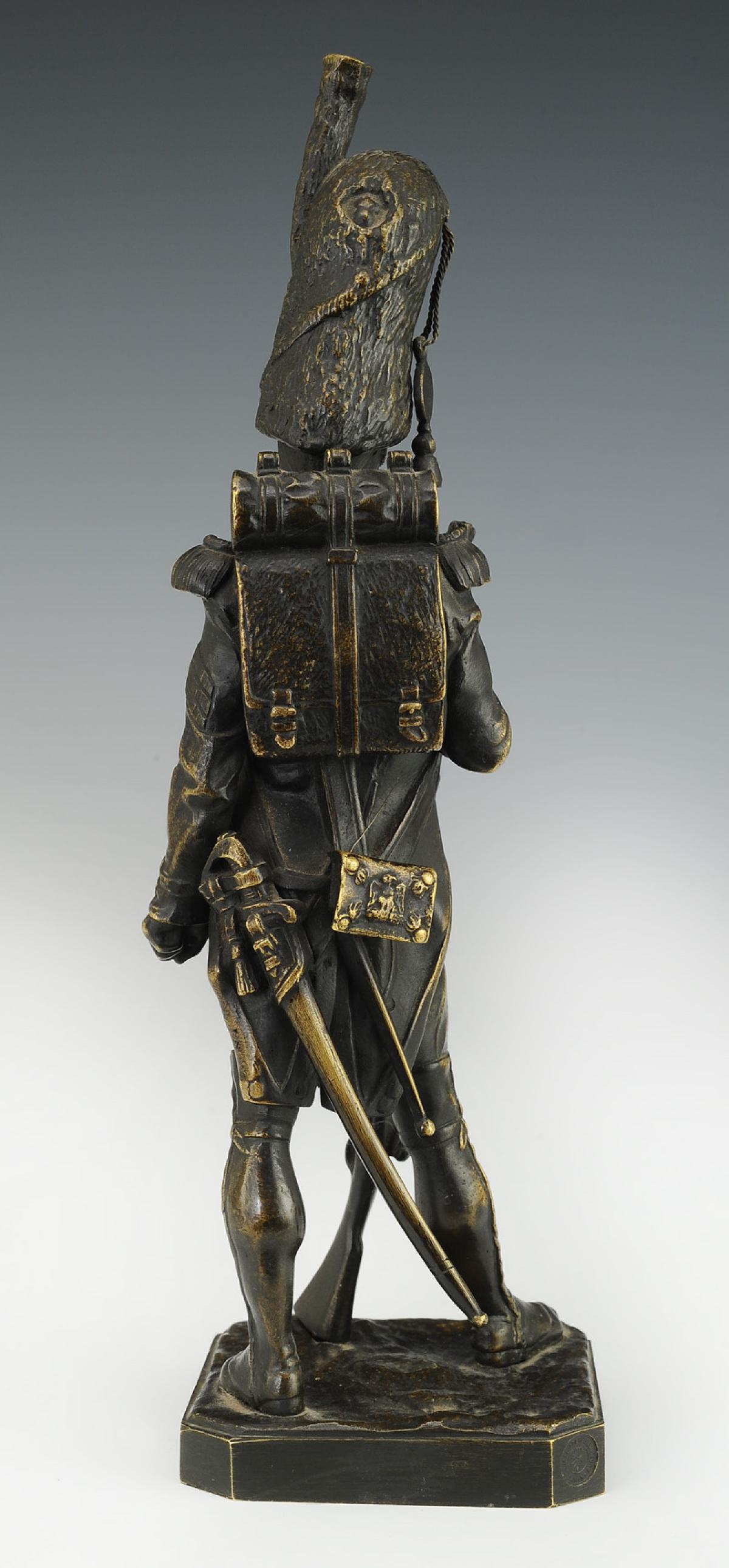
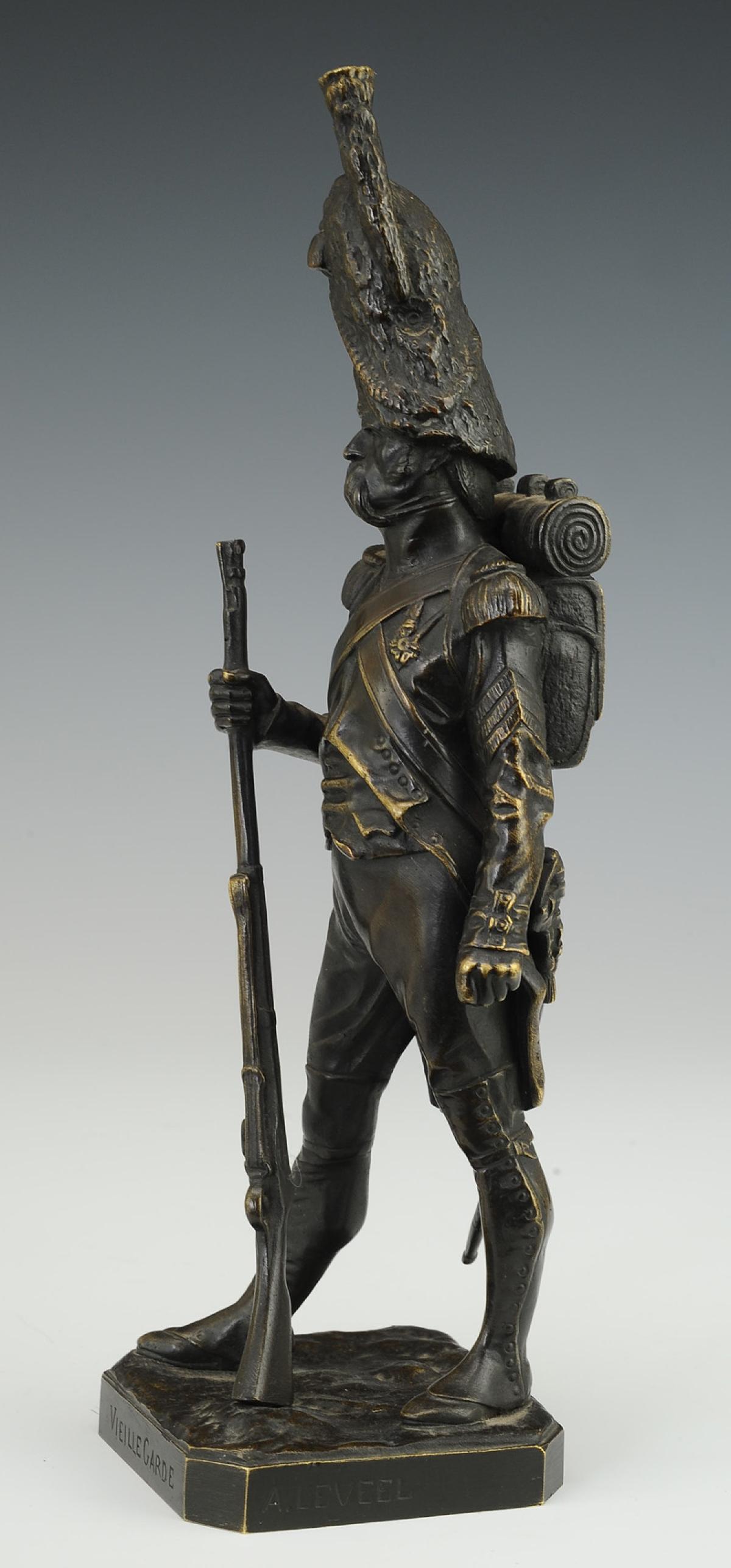
ARMAND JULES LE VEEL - OLD GUARD: patinated bronze, late 19th century. 33525
Sold out
ARMAND JULES LE VEEL - OLD GUARD: patinated bronze, Late 19th century. 33525
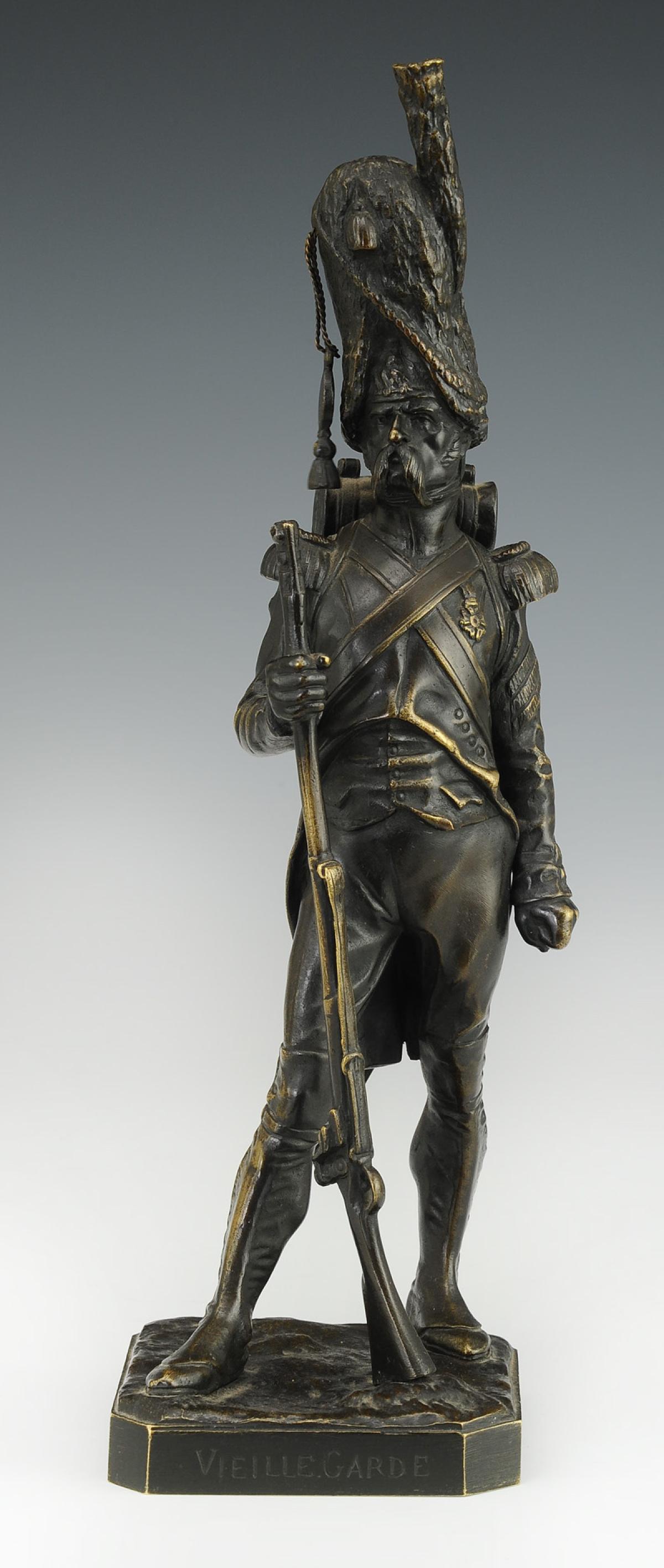
Grenadier of the Imperial Old Guard. Patinated bronze.
Depth: 7.3 cm
H: 25 cm
Width: 7.5 cm
French school of sculpture.
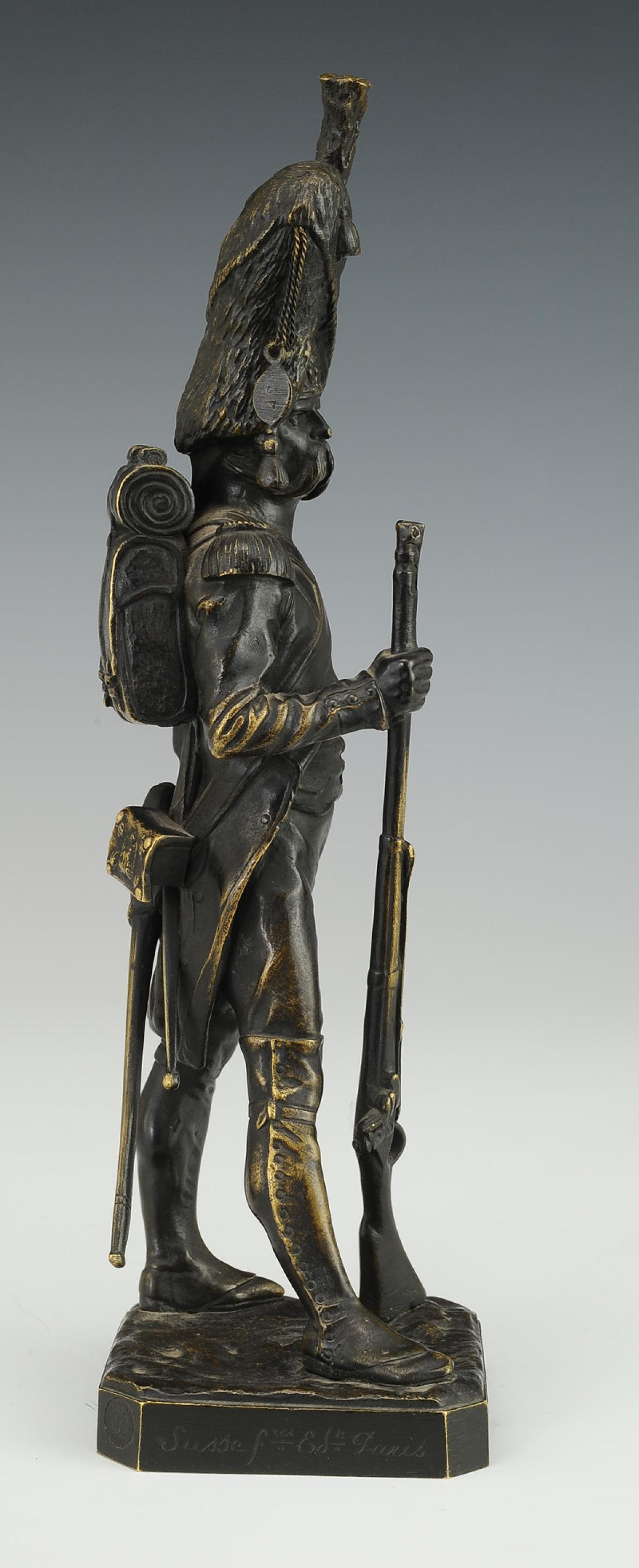
Signature on the right side of the terrace. Foundry stamp: Susse Frères. Titled on the front of the terrace "Old Guard."
France.
Late 19th century
Good condition, bayonet missing.
BIOGRAPHY:
Armand-Jules Le Véel. 1821-1905.
Born in Bricquebec, a small village in the Cotentin region (about twenty kilometers from Cherbourg), on January 27, 1821. His parents were merchants, and he quickly became the head of a family of twelve. At the age of 9, he began his studies at the Valogne college and continued at the one in Cherbourg, from which he was expelled for caricaturing one of his teachers. Despite strong opposition from young Armand, his father placed him with a grocer in Rouen. However, after three years of apprenticeship, he decided that being a grocer was not for him. Against his father's advice, he moved to Paris. He drew, sculpted, but his works did not bring in enough to live, not even enough to survive. He worked as a copyist for a bailiff, a substitute actor, an illustrator of business cards, a seller at the Susse house, and finally as an accountant at an iron merchant on Rue du Faubourg Saint-Antoine. This last position, stable and well-paid, finally provided him with a livelihood, and he then dedicated his free time to sculpture.
A solitary character, the young Armand, introduced to the renowned sculptor Jean-Jacques Feuchère, chose not to frequent his salon and workshop due to their overwhelming nature. When fate brought them together again, Jean-Jacques Feuchère, this time, did not let go of someone whose artistic potential he had detected. He introduced him to the workshop of his friend François Rude. Armand Le Véel began there the next day. He was 24 years old. Among the master's students were Emmanuel Frémiet and Jean-Baptiste Carpeaux.
Influenced by his paternal grandfather, who served in the armies of the Year III, and fascinated by the stories of the revolutionary wars and veterans of the Empire, Armand Le Véel dreamed of heroism. He idolized Napoleon I, a devotion he later expressed by sculpting the monumental equestrian statue of the hero of Austerlitz for the city of Cherbourg. At that time, he began his sculpting career by sculpting, in bronze statues, the history of France from Charlemagne to Napoleon I, encompassing events like the Jacqueries, the Albigensian Crusade, the Reformation, the Fronde, and the Republic. Regardless of any historical inaccuracies he may have made.
A convinced patriot, Armand Le Véel found his patriotic fervor tested again in February 1848 when Paris streets were lined with barricades during a popular movement fed up with the July Monarchy and aspiring to the Republic. Stirred by these ideals, Armand Le Véel, with his ancestor's sword held high, took command of the barricade on Rue de Rivoli. However, as months passed, the fervor faded, becoming more about politics than art. Uncertain about the future as the bourgeoisie stopped buying his historical statuettes that had been popular until then, Armand Le Véel decided it was time for a small visit to his family in Normandy. Driven by memory, he sculpted a bust of Samson Lavalesquerie, his Norman benefactor who had been supporting him for years, and presented it to him. Touched by this gesture, Samson Lavalesquerie commissioned an official bust, opening new prospects for our Norman sculptor, who, upon returning to Paris, delved into marble portraiture, although his preference remained for monumental equestrian sculptures.
A few years later, Armand Le Véel's patriotic fervor was once again tested. Amid the turmoil of the Franco-Prussian War of 1870, Armand Le Véel and the ten other members of the Commission chaired by the painter Gustave Courbet were tasked with protecting and saving artworks in a Paris on the brink of siege (Prussian forces were in Versailles).
In September 1883, at the age of 61, he reached the peak of his career and decided to retire from the bustling Parisian life, which he had never truly enjoyed. More taciturn than talkative, preferring calm and solitude to noise and agitation, he could only express himself with occasional brutal honesty. With his wife Eugénie (the daughter of the sculptor Jean-Jacques Feuchère, the one who had opened the doors to the workshop of his master François Rude), whom he married in 1852, he settled on Rue du Maupas in Cherbourg. From then on, he stopped sculpting but, being a great collector of earthenware, glassware, furniture, and medals, he devoted himself to his collections. After giving several works to the city, which took care of the casting, the sculptor-collector was offered the position of chief curator at the Thomas-Henry Museum.
The Imperial Guard:
Napoleon Bonaparte created the Imperial Guard on 28 floréal year XII, in our Gregorian calendar, on May 18, 1804. He officially decreed its establishment on July 29, 1804.
Why create such a force? The Emperor wanted an elite army corps around him, responsible for his personal defense, directly under his command, comprised of the oldest and best of his soldiers.
Initially numbering 9,798 men, its ranks quickly grew to 112,482 men by 1814. As it expanded, the Guard was divided into Young, Middle, and Old Guard. Each division included units of cavalry, artillery, and infantry, with the valiant Grenadiers, the Old Guard being the elite of the army.
The Guard soon evolved from being merely protective to being combat-ready and a role model for the rest of the army. Only a soldier's outstanding valor enabled them to join the Imperial Guard.
To enter the elite regiment of the First Grenadiers on foot of the Imperial Guard, one needed at least ten years of service (twelve for officers), a flawless combat behavior record, literacy, excellent morality, and a minimum height of five feet five inches (approximately 1.76 meters).
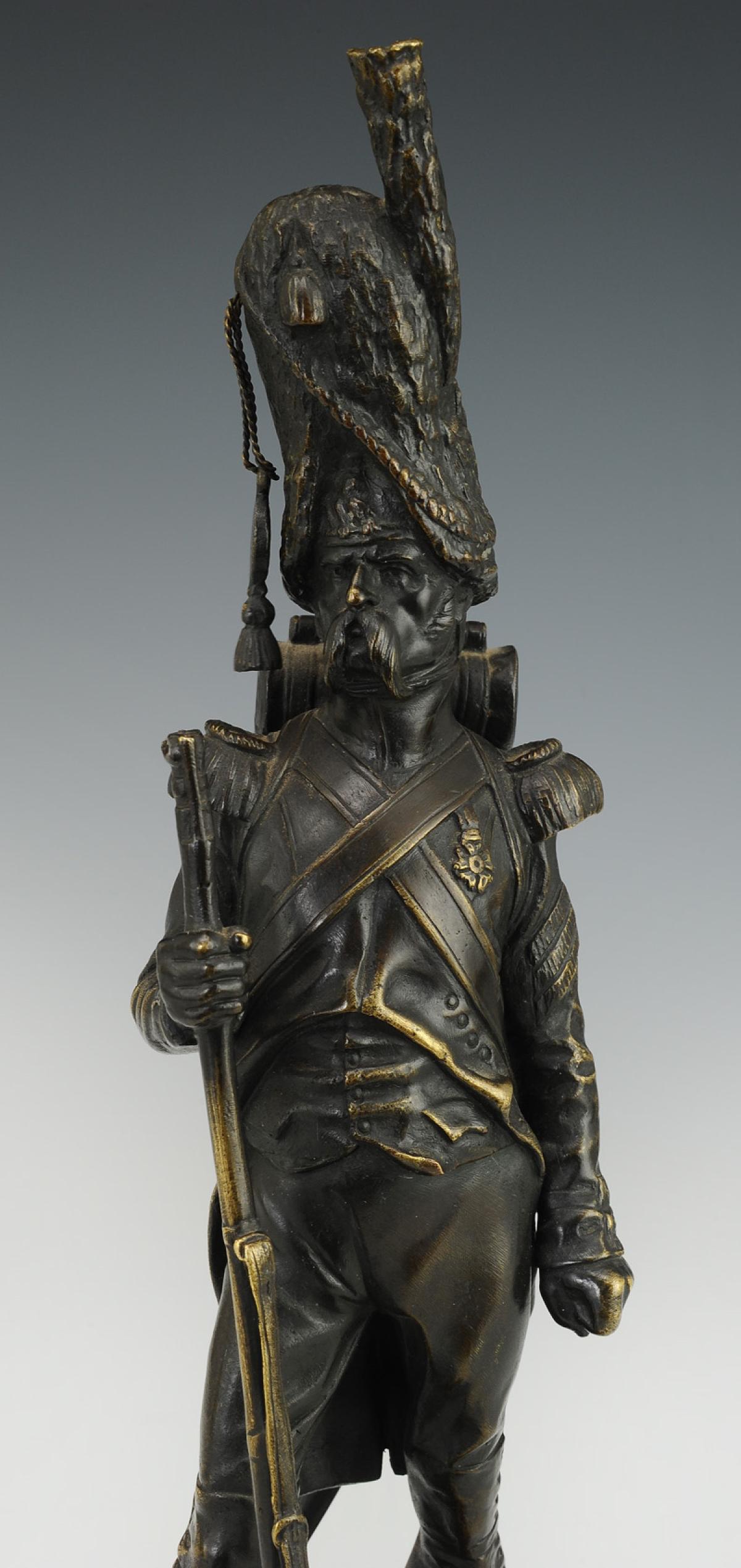
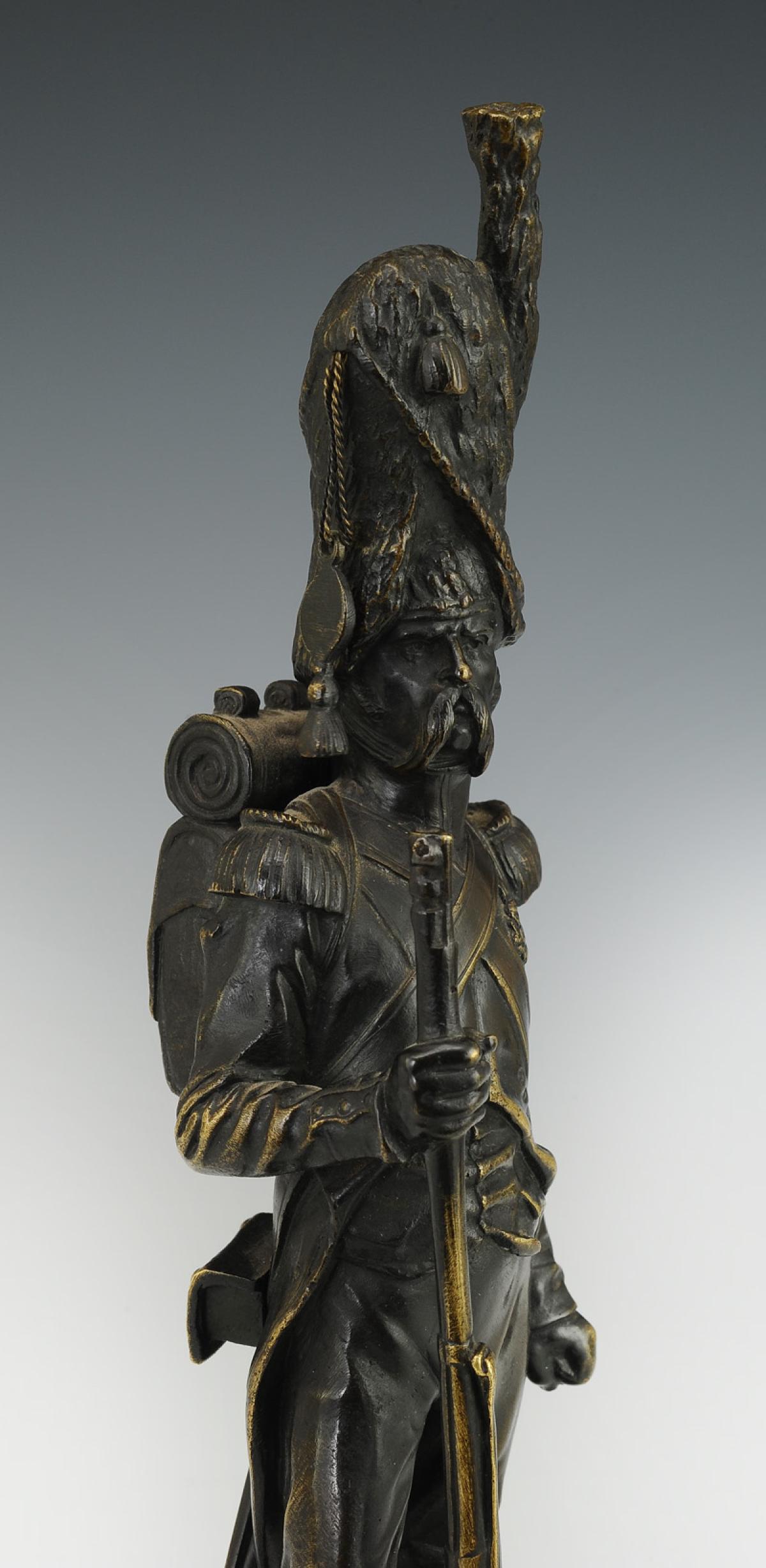
These small sculptures depicting soldiers from the First and Second Empires were highly popular throughout the 19th century and up to World War I, a time when national sentiment was strong. This grizzled veteran of the Old Guard, with a thick mustache, weathered features, and a determined gaze proudly displaying his Legion of Honor earned in the blood and dust of battlefields, is depicted standing firmly on both legs in a pose conveying movement and commitment.
Grenadier of the Imperial Old Guard. Patinated bronze.
Depth: 7.3 cm
H: 25 cm
Width: 7.5 cm
French school of sculpture.
Signature on the right side of the terrace. Foundry stamp: Susse Frères. Titled on the front of the terrace "Old Guard."
France.
Late 19th century
Good condition, bayonet missing.
BIOGRAPHY:
Armand-Jules Le Véel. 1821-1905.
Born in Bricquebec, a small village in the Cotentin region (about twenty kilometers from Cherbourg), on January 27, 1821. His parents were merchants, and he quickly became the head of a family of twelve. At the age of 9, he began his studies at the Valogne college and continued at the one in Cherbourg, from which he was expelled for caricaturing one of his teachers. Despite strong opposition from young Armand, his father placed him with a grocer in Rouen. However, after three years of apprenticeship, he decided that being a grocer was not for him. Against his father's advice, he moved to Paris. He drew, sculpted, but his works did not bring in enough to live, not even enough to survive. He worked as a copyist for a bailiff, a substitute actor, an illustrator of business cards, a seller at the Susse house, and finally as an accountant at an iron merchant on Rue du Faubourg Saint-Antoine. This last position, stable and well-paid, finally provided him with a livelihood, and he then dedicated his free time to sculpture.
A solitary character, the young Armand, introduced to the renowned sculptor Jean-Jacques Feuchère, chose not to frequent his salon and workshop due to their overwhelming nature. When fate brought them together again, Jean-Jacques Feuchère, this time, did not let go of someone whose artistic potential he had detected. He introduced him to the workshop of his friend François Rude. Armand Le Véel began there the next day. He was 24 years old. Among the master's students were Emmanuel Frémiet and Jean-Baptiste Carpeaux.
Influenced by his paternal grandfather, who served in the armies of the Year III, and fascinated by the stories of the revolutionary wars and veterans of the Empire, Armand Le Véel dreamed of heroism. He idolized Napoleon I, a devotion he later expressed by sculpting the monumental equestrian statue of the hero of Austerlitz for the city of Cherbourg. At that time, he began his sculpting career by sculpting, in bronze statues, the history of France from Charlemagne to Napoleon I, encompassing events like the Jacqueries, the Albigensian Crusade, the Reformation, the Fronde, and the Republic. Regardless of any historical inaccuracies he may have made.
A convinced patriot, Armand Le Véel found his patriotic fervor tested again in February 1848 when Paris streets were lined with barricades during a popular movement fed up with the July Monarchy and aspiring to the Republic. Stirred by these ideals, Armand Le Véel, with his ancestor's sword held high, took command of the barricade on Rue de Rivoli. However, as months passed, the fervor faded, becoming more about politics than art. Uncertain about the future as the bourgeoisie stopped buying his historical statuettes that had been popular until then, Armand Le Véel decided it was time for a small visit to his family in Normandy. Driven by memory, he sculpted a bust of Samson Lavalesquerie, his Norman benefactor who had been supporting him for years, and presented it to him. Touched by this gesture, Samson Lavalesquerie commissioned an official bust, opening new prospects for our Norman sculptor, who, upon returning to Paris, delved into marble portraiture, although his preference remained for monumental equestrian sculptures.
A few years later, Armand Le Véel's patriotic fervor was once again tested. Amid the turmoil of the Franco-Prussian War of 1870, Armand Le Véel and the ten other members of the Commission chaired by the painter Gustave Courbet were tasked with protecting and saving artworks in a Paris on the brink of siege (Prussian forces were in Versailles).
In September 1883, at the age of 61, he reached the peak of his career and decided to retire from the bustling Parisian life, which he had never truly enjoyed. More taciturn than talkative, preferring calm and solitude to noise and agitation, he could only express himself with occasional brutal honesty. With his wife Eugénie (the daughter of the sculptor Jean-Jacques Feuchère, the one who had opened the doors to the workshop of his master François Rude), whom he married in 1852, he settled on Rue du Maupas in Cherbourg. From then on, he stopped sculpting but, being a great collector of earthenware, glassware, furniture, and medals, he devoted himself to his collections. After giving several works to the city, which took care of the casting, the sculptor-collector was offered the position of chief curator at the Thomas-Henry Museum.
The Imperial Guard:
Napoleon Bonaparte created the Imperial Guard on 28 floréal year XII, in our Gregorian calendar, on May 18, 1804. He officially decreed its establishment on July 29, 1804.
Why create such a force? The Emperor wanted an elite army corps around him, responsible for his personal defense, directly under his command, comprised of the oldest and best of his soldiers.
Initially numbering 9,798 men, its ranks quickly grew to 112,482 men by 1814. As it expanded, the Guard was divided into Young, Middle, and Old Guard. Each division included units of cavalry, artillery, and infantry, with the valiant Grenadiers, the Old Guard being the elite of the army.
The Guard soon evolved from being merely protective to being combat-ready and a role model for the rest of the army. Only a soldier's outstanding valor enabled them to join the Imperial Guard.
To enter the elite regiment of the First Grenadiers on foot of the Imperial Guard, one needed at least ten years of service (twelve for officers), a flawless combat behavior record, literacy, excellent morality, and a minimum height of five feet five inches (approximately 1.76 meters).
These small sculptures depicting soldiers from the First and Second Empires were highly popular throughout the 19th century and up to World War I, a time when national sentiment was strong. This grizzled veteran of the Old Guard, with a thick mustache, weathered features, and a determined gaze proudly displaying his Legion of Honor earned in the blood and dust of battlefields, is depicted standing firmly on both legs in a pose conveying movement and commitment.
Reference :
33525
Next update Friday, octobre 23 at 13:30 PM
FOR ALL PURCHASES, PAYMENT IN MULTIPLE CHECKS POSSIBLE
bertrand.malvaux@wanadoo.fr 06 07 75 74 63
SHIPPING COSTS
Shipping costs are calculated only once per order for one or more items, all shipments are sent via registered mail, as this is the only way to have proof of dispatch and receipt.
For parcels whose value cannot be insured by the Post, shipments are entrusted to DHL or Fedex with real value insured, the service is of high quality but the cost is higher.
RETURN POLICY
Items can be returned within 8 days of receipt. They must be returned by registered mail at the sender's expense, in their original packaging, and in their original condition.
AUTHENTICITY
The selection of items offered on this site allows me to guarantee the authenticity of each piece described here, all items offered are guaranteed to be period and authentic, unless otherwise noted or restricted in the description.
An authenticity certificate of the item including the description published on the site, the period, the sale price, accompanied by one or more color photographs is automatically provided for any item priced over 130 euros. Below this price, each certificate is charged 5 euros.
Only items sold by me are subject to an authenticity certificate, I do not provide any expert reports for items sold by third parties (colleagues or collectors).
FOR ALL PURCHASES, PAYMENT IN MULTIPLE CHECKS POSSIBLE
bertrand.malvaux@wanadoo.fr 06 07 75 74 63
An authenticity certificate of the item including the description published on the site, the period, the sale price, accompanied by one or more color photographs is automatically provided for any item priced over 130 euros. Below this price, each certificate is charged 5 euros.
Only items sold by me are subject to an authenticity certificate, I do not provide any expert reports for items sold by third parties (colleagues or collectors).