
LIGHT CAVALRY SABER SIGNED BY THE VERSAILLES MANUFACTORY, model An XI (1802), First Empire. 33465-2

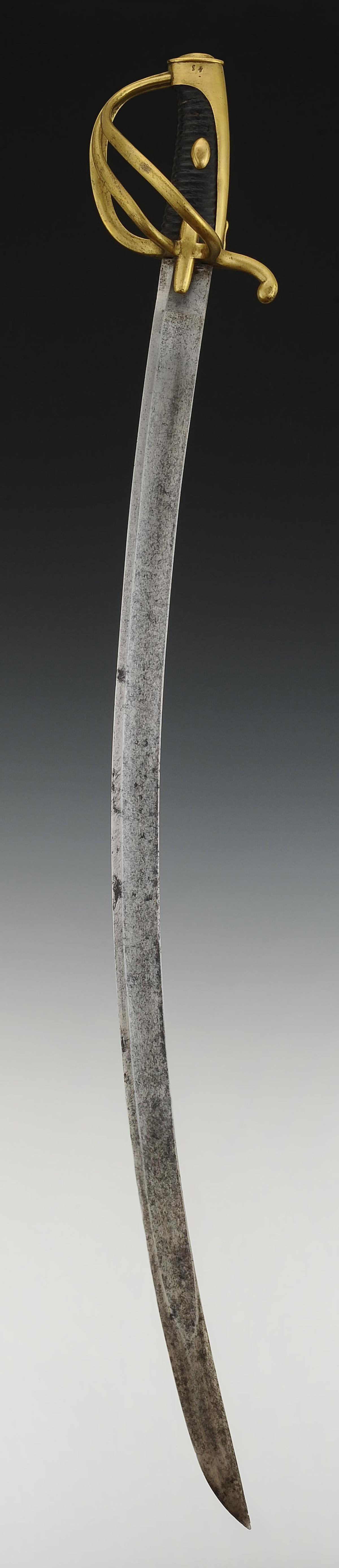
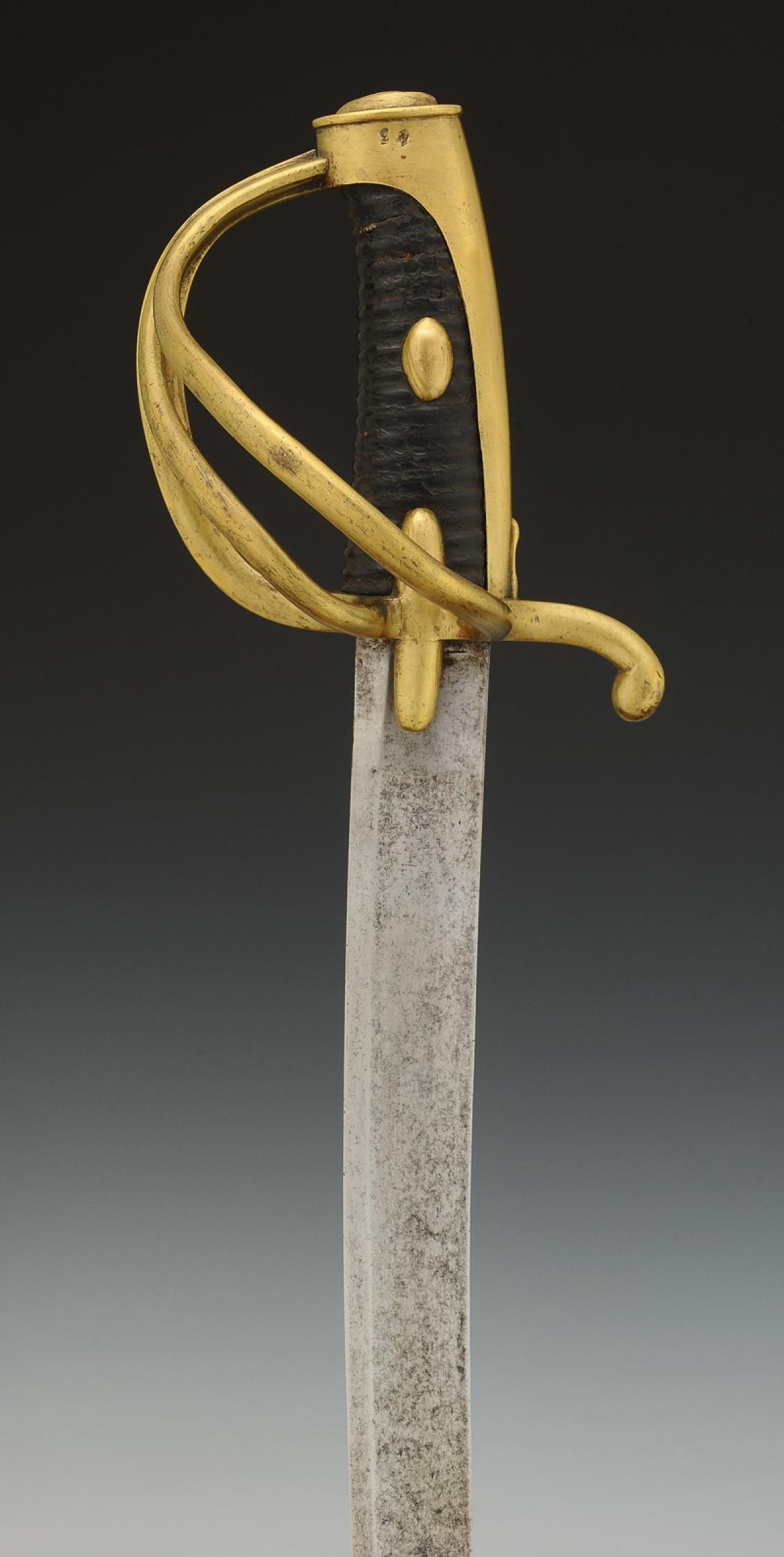
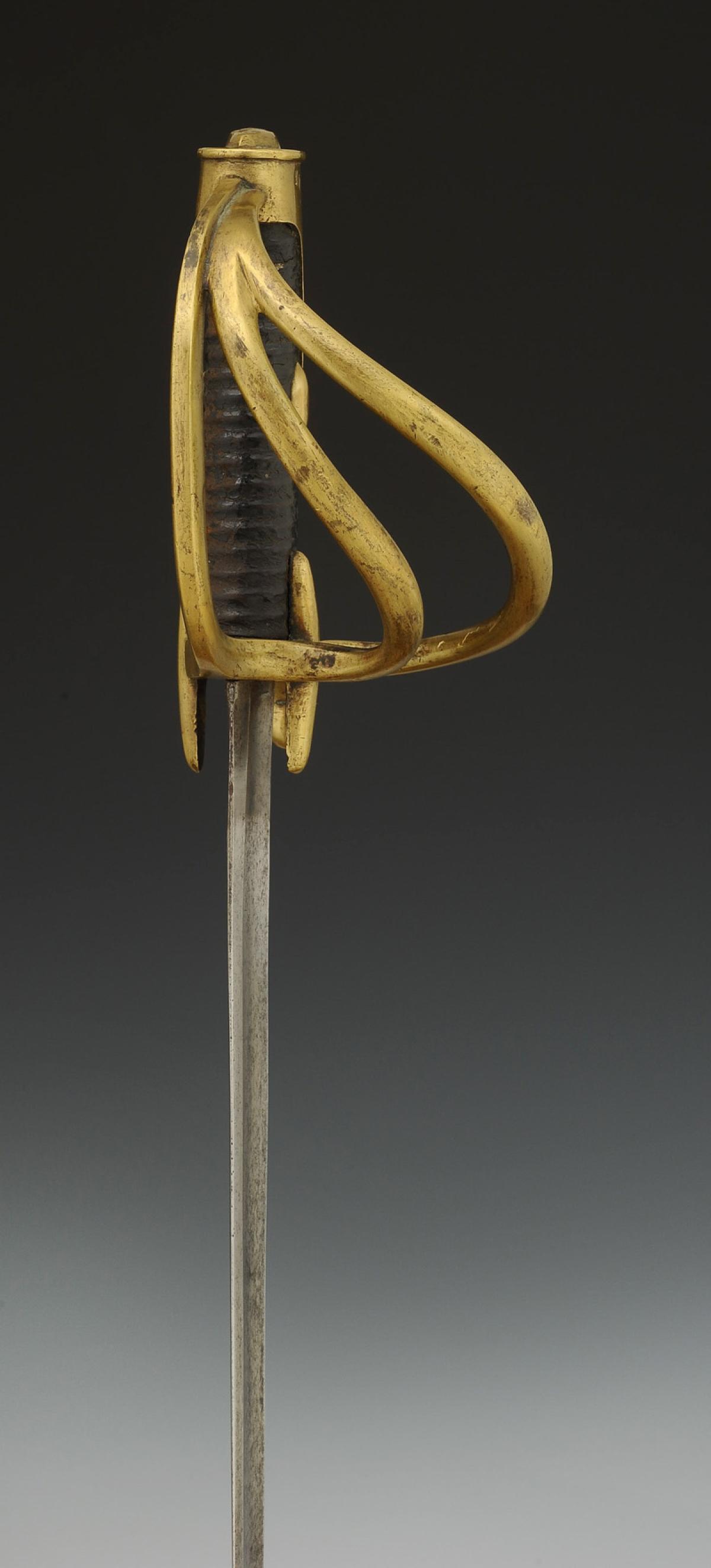
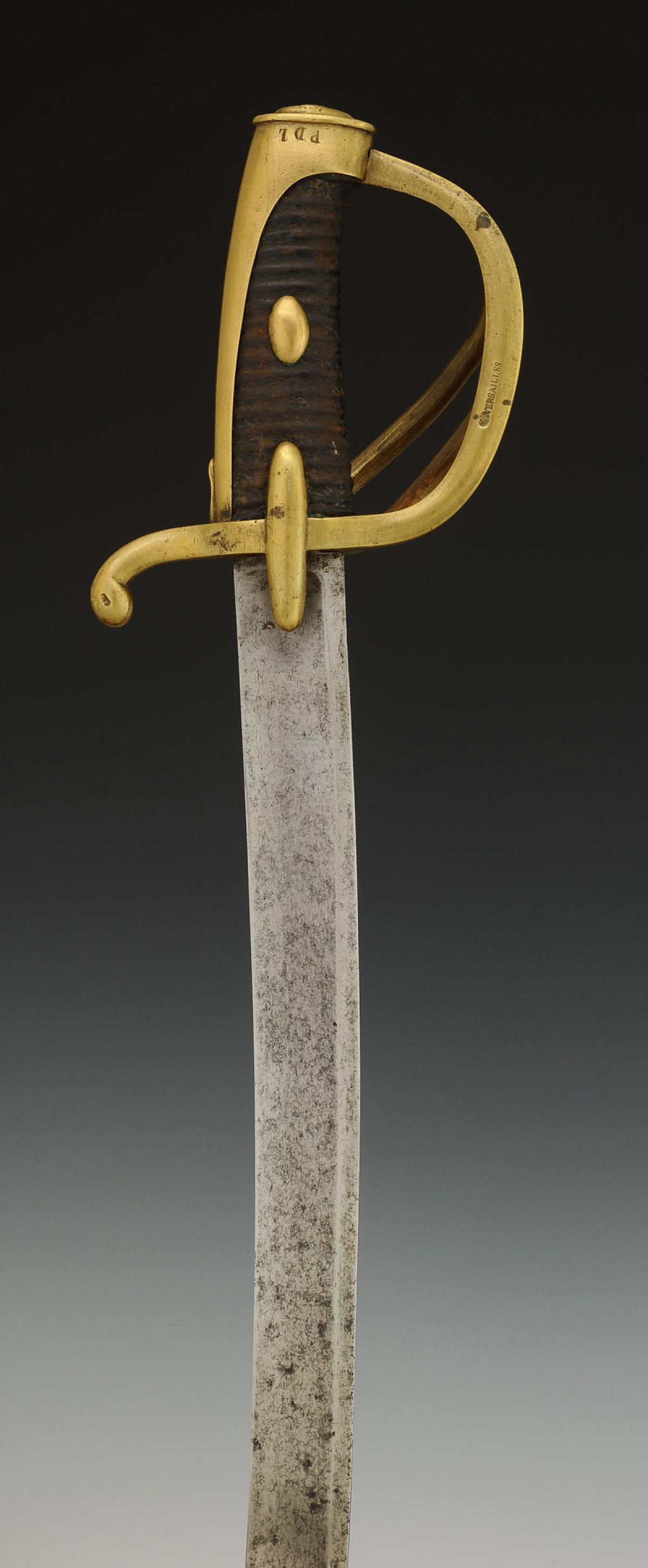
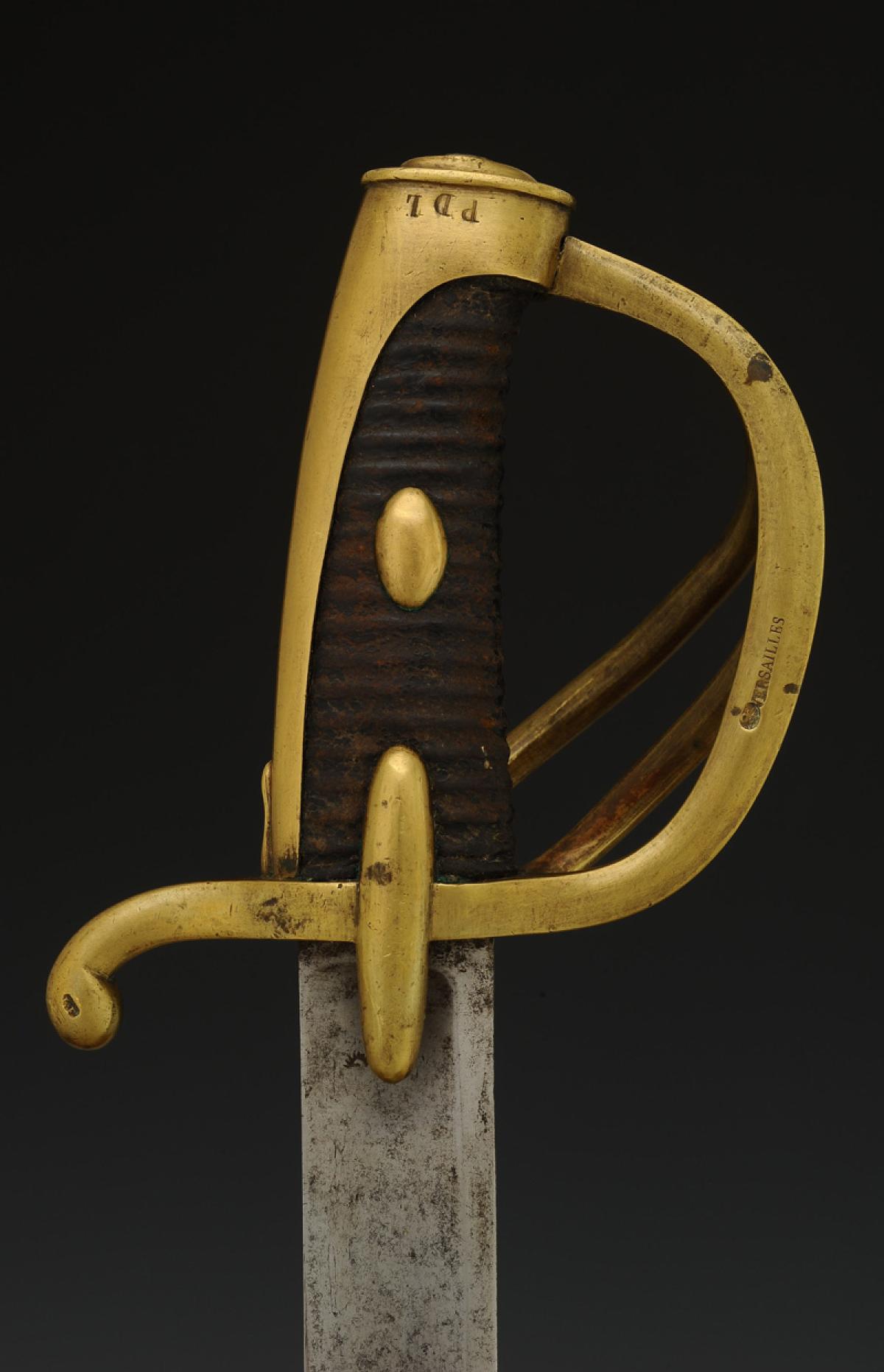
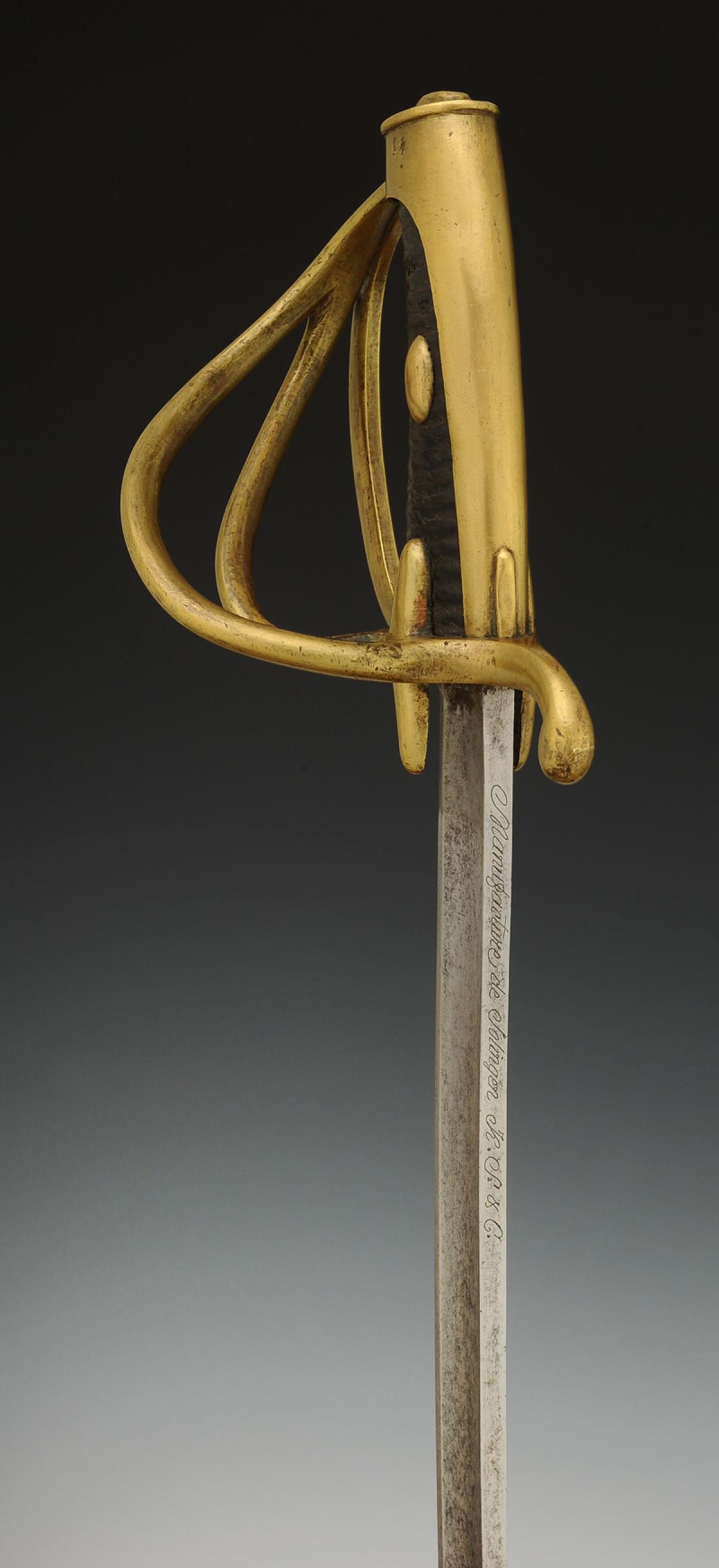
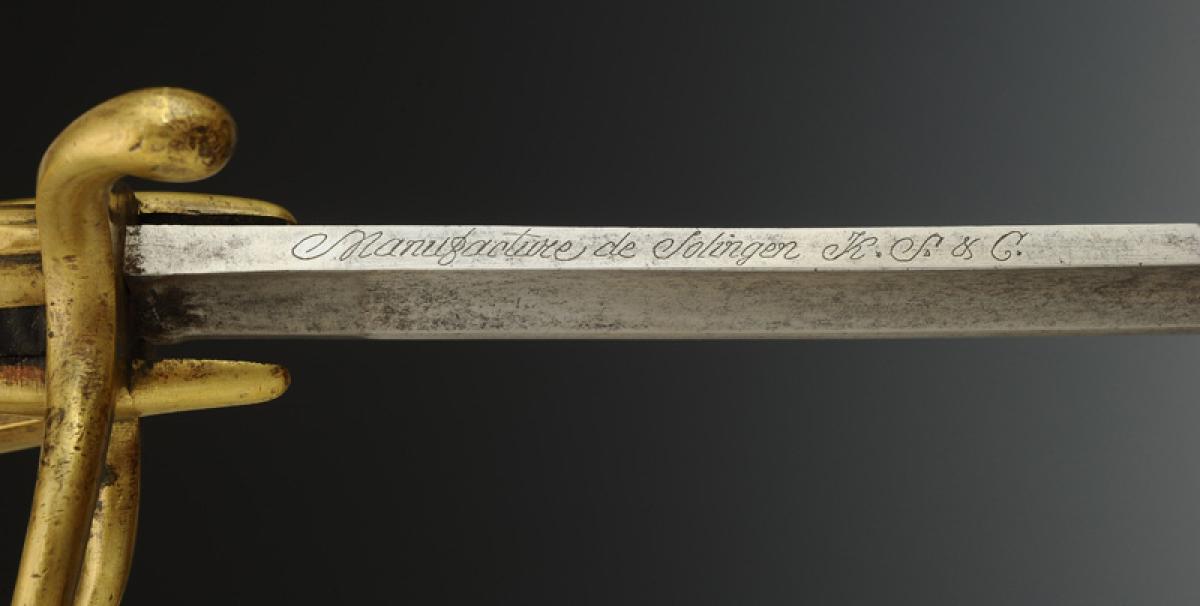

LIGHT CAVALRY SABER SIGNED BY THE VERSAILLES MANUFACTORY, An XI model (1802), First Empire. 33465-2
Brass hilt. Guard in the chasseur style with three side branches. Main branch signed by Versailles, stamped with "B D" in an oval of D. Brouilly, controller from September 1800 to November 1805. Quillon stamped with "L F" by J.B. Le Febvre, inspector from July 1807, then controller from January 1811 to December 1813. Pommel with a long tail stamped "43" "PDL". Grip made of black waxed calf leather, with an oval-shaped brass nail on each side. Curved blade with hollow facets, 87 cm long, with the back marked "Manufacture de Solingen K. S. & C.". Iron scabbard with wooden liners and semi-round sling rings.
France.
First Empire.
Very good condition, stamped with "Versailles" without warranty, scabbard without warranty.
NOTE:
THE END OF A LEGEND "PDL" THE STAMP ON THE WEAPONS OF THE NATIONAL GUARD
Extensive research has not allowed me to find any mention confirming the reality of this motto "Pour le droit" (For the right). So what is it about? What is the National Guard? The National Guard was created during the Revolution. It is a militia tasked with maintaining order and enforcing the law in troubled times. It consisted of all citizens aged 20 to 60. They were listed and classified for service, either in reserve or active guard duty. Initially, the National Guards were mostly bourgeois, as they were required to equip themselves at their own expense, and being in the cavalry required owning a horse. For these bourgeois, this role was a way to maintain a form of power, to distinguish themselves from the rest of the population. The National Guards were spread across all municipalities. They acted as the "Police" under the command of an officer, the mayor, and the prefect. During the Empire, the National Guard sometimes served as a reserve army and was mobilized for Napoleon's wars. Following their dissolution by Charles X in 1827, they were reestablished by Louis Philippe in 1830, with one company in each municipality. Companies were formed for infantry, artillery, cavalry, and firefighters. The National Guard was reactivated to quell disturbances and maintain peace throughout France after the July Revolution.
PDL Marking on Weapons in 1831
At the end of 1830, the Minister aimed to organize the National Guards. He requested the retrieval and registration of the weapons distributed during the July Revolution. A document from the Lyon city archives dated August 10, 1830, attests to this. In January 1831, a ministerial circular decided to mark the weapons distributed by the Ministry of War, and thus belonging to the state. These weapons were stamped with the mark "PDL" to indicate "Propriété De L'état" (Property of the State), as evidenced by a document dated January 20, 1831, from the prefecture to the Lyon archives.
This marking was done using a stamp traveling through each village in the canton. The stamping was carried out in the presence of assembled National Guards by mayors and commanders. The stamp remained the property of the canton's administrative center, allowing for future markings. A report was drafted, signed by the mayor, and sent to the prefecture.
It should be noted that weapons belonging to municipalities, purchased at their own expense or that of the National Guards, were not subject to this marking measure.
The armament of the National Guards varied widely. It included rifles, sabers, cartouche boxes, and other military equipment and uniforms, often of private manufacture and slightly different from standard models. Some were acquired by the National Guards themselves, while others were bought by municipalities. There were also standard weapons supplied to municipalities by the Ministry of War. It was this latter category of state-owned equipment that the Ministry aimed to mark, to assert its ownership and prevent the dispersal of arms. An excerpt from the January 1831 circular details the method for marking rifles with the stamp. The circular also mentions the creation, with the Interior Minister's approval, of an armament manual for the National Guards.
In 1848, after the February Revolution and the advent of the Second Republic, a decree reactivated the National Guard in March. An article in the "Courrier de la Drome et de l'Ardèche" from October 29, 1848, No.224, indicates the reinforcement of measures from 1831 (legislation still in force), including the registration of National Guards and their weapons. The "PDL" marking on state-owned weapons was reaffirmed. Additionally, the transformation to percussion of National Guard weapons by private gunsmiths was prohibited to avoid the proliferation of available calibers.
The "PLD" Mark
The mark on the wood, created by striking a blackened metal imprint with these three letters "PDL", has long been interpreted as standing for "Pour Le Droit" (For the Right), a motto lacking substantive basis. These documents clearly show that it simply signifies "Propriété De L'état" (Property of the State). The rooster at the top recalls a national symbol that Louis Philippe highlighted upon his arrival to power in 1831. This stamp can be found on the stocks of regulation pistols and rifles used by the National Guard, often the 1816 or 1822 troop models of pistols, and frequently the 1777 corrected An IX model rifles. The Ministry of War supplied the National Guards with outdated weapons, reserving the more recent 1822 models for the military. Subsequently, they received the 1822 T and Tbis models.
Evolution of the PDL Mark
Consulting military archive records has revealed further developments in this state identification mark.
PDL Marking on Edged Weapons
Observing sabers or bayonets may sometimes reveal this stamped designation.
Brass hilt. Guard in the chasseur style with three side branches. Main branch signed by Versailles, stamped with "B D" in an oval of D. Brouilly, controller from September 1800 to November 1805. Quillon stamped with "L F" by J.B. Le Febvre, inspector from July 1807, then controller from January 1811 to December 1813. Pommel with a long tail stamped "43" "PDL". Grip made of black waxed calf leather, with an oval-shaped brass nail on each side. Curved blade with hollow facets, 87 cm long, with the back marked "Manufacture de Solingen K. S. & C.". Iron scabbard with wooden liners and semi-round sling rings.
France.
First Empire.
Very good condition, stamped with "Versailles" without warranty, scabbard without warranty.
NOTE:
THE END OF A LEGEND "PDL" THE STAMP ON THE WEAPONS OF THE NATIONAL GUARD
Extensive research has not allowed me to find any mention confirming the reality of this motto "Pour le droit" (For the right). So what is it about? What is the National Guard? The National Guard was created during the Revolution. It is a militia tasked with maintaining order and enforcing the law in troubled times. It consisted of all citizens aged 20 to 60. They were listed and classified for service, either in reserve or active guard duty. Initially, the National Guards were mostly bourgeois, as they were required to equip themselves at their own expense, and being in the cavalry required owning a horse. For these bourgeois, this role was a way to maintain a form of power, to distinguish themselves from the rest of the population. The National Guards were spread across all municipalities. They acted as the "Police" under the command of an officer, the mayor, and the prefect. During the Empire, the National Guard sometimes served as a reserve army and was mobilized for Napoleon's wars. Following their dissolution by Charles X in 1827, they were reestablished by Louis Philippe in 1830, with one company in each municipality. Companies were formed for infantry, artillery, cavalry, and firefighters. The National Guard was reactivated to quell disturbances and maintain peace throughout France after the July Revolution.
PDL Marking on Weapons in 1831
At the end of 1830, the Minister aimed to organize the National Guards. He requested the retrieval and registration of the weapons distributed during the July Revolution. A document from the Lyon city archives dated August 10, 1830, attests to this. In January 1831, a ministerial circular decided to mark the weapons distributed by the Ministry of War, and thus belonging to the state. These weapons were stamped with the mark "PDL" to indicate "Propriété De L'état" (Property of the State), as evidenced by a document dated January 20, 1831, from the prefecture to the Lyon archives.
This marking was done using a stamp traveling through each village in the canton. The stamping was carried out in the presence of assembled National Guards by mayors and commanders. The stamp remained the property of the canton's administrative center, allowing for future markings. A report was drafted, signed by the mayor, and sent to the prefecture.
It should be noted that weapons belonging to municipalities, purchased at their own expense or that of the National Guards, were not subject to this marking measure.
The armament of the National Guards varied widely. It included rifles, sabers, cartouche boxes, and other military equipment and uniforms, often of private manufacture and slightly different from standard models. Some were acquired by the National Guards themselves, while others were bought by municipalities. There were also standard weapons supplied to municipalities by the Ministry of War. It was this latter category of state-owned equipment that the Ministry aimed to mark, to assert its ownership and prevent the dispersal of arms. An excerpt from the January 1831 circular details the method for marking rifles with the stamp. The circular also mentions the creation, with the Interior Minister's approval, of an armament manual for the National Guards.
In 1848, after the February Revolution and the advent of the Second Republic, a decree reactivated the National Guard in March. An article in the "Courrier de la Drome et de l'Ardèche" from October 29, 1848, No.224, indicates the reinforcement of measures from 1831 (legislation still in force), including the registration of National Guards and their weapons. The "PDL" marking on state-owned weapons was reaffirmed. Additionally, the transformation to percussion of National Guard weapons by private gunsmiths was prohibited to avoid the proliferation of available calibers.
The "PLD" Mark
The mark on the wood, created by striking a blackened metal imprint with these three letters "PDL", has long been interpreted as standing for "Pour Le Droit" (For the Right), a motto lacking substantive basis. These documents clearly show that it simply signifies "Propriété De L'état" (Property of the State). The rooster at the top recalls a national symbol that Louis Philippe highlighted upon his arrival to power in 1831. This stamp can be found on the stocks of regulation pistols and rifles used by the National Guard, often the 1816 or 1822 troop models of pistols, and frequently the 1777 corrected An IX model rifles. The Ministry of War supplied the National Guards with outdated weapons, reserving the more recent 1822 models for the military. Subsequently, they received the 1822 T and Tbis models.
Evolution of the PDL Mark
Consulting military archive records has revealed further developments in this state identification mark.
PDL Marking on Edged Weapons
Observing sabers or bayonets may sometimes reveal this stamped designation.
Price :
2 000,00 €
| Destination | Envoi recommandé | Envoi Recommandé + Express |
|---|---|---|
| Shipping France | 20,00 € | 80,00 € |
| Shipping Europe | 33,00 € | 200,00 € |
| Shipping world | 100,00 € | 300,00 € |
Insurance (1%) :
20,00 €
Reference :
33465-2
Order shipments will be suspended between July 31 and September 1.
Next update Friday, august 7 at 13:30 PM
FOR ALL PURCHASES, PAYMENT IN MULTIPLE CHECKS POSSIBLE
bertrand.malvaux@wanadoo.fr 06 07 75 74 63
SHIPPING COSTS
Shipping costs are calculated only once per order for one or more items, all shipments are sent via registered mail, as this is the only way to have proof of dispatch and receipt.
For parcels whose value cannot be insured by the Post, shipments are entrusted to DHL or Fedex with real value insured, the service is of high quality but the cost is higher.
RETURN POLICY
Items can be returned within 8 days of receipt. They must be returned by registered mail at the sender's expense, in their original packaging, and in their original condition.
AUTHENTICITY
The selection of items offered on this site allows me to guarantee the authenticity of each piece described here, all items offered are guaranteed to be period and authentic, unless otherwise noted or restricted in the description.
An authenticity certificate of the item including the description published on the site, the period, the sale price, accompanied by one or more color photographs is automatically provided for any item priced over 130 euros. Below this price, each certificate is charged 5 euros.
Only items sold by me are subject to an authenticity certificate, I do not provide any expert reports for items sold by third parties (colleagues or collectors).
Next update Friday, august 7 at 13:30 PM
FOR ALL PURCHASES, PAYMENT IN MULTIPLE CHECKS POSSIBLE
bertrand.malvaux@wanadoo.fr 06 07 75 74 63
An authenticity certificate of the item including the description published on the site, the period, the sale price, accompanied by one or more color photographs is automatically provided for any item priced over 130 euros. Below this price, each certificate is charged 5 euros.
Only items sold by me are subject to an authenticity certificate, I do not provide any expert reports for items sold by third parties (colleagues or collectors).