
Austrian prisoners of war. 1805. AUTOGRAPH LETTER SIGNED BY ADJUDANT-COMMANDANT HÉNIN DE CUVILLERS *, TO GENERAL LEVAL **, commander of the 5th Military Division, November 4, 1805. 18910-29
Sold out
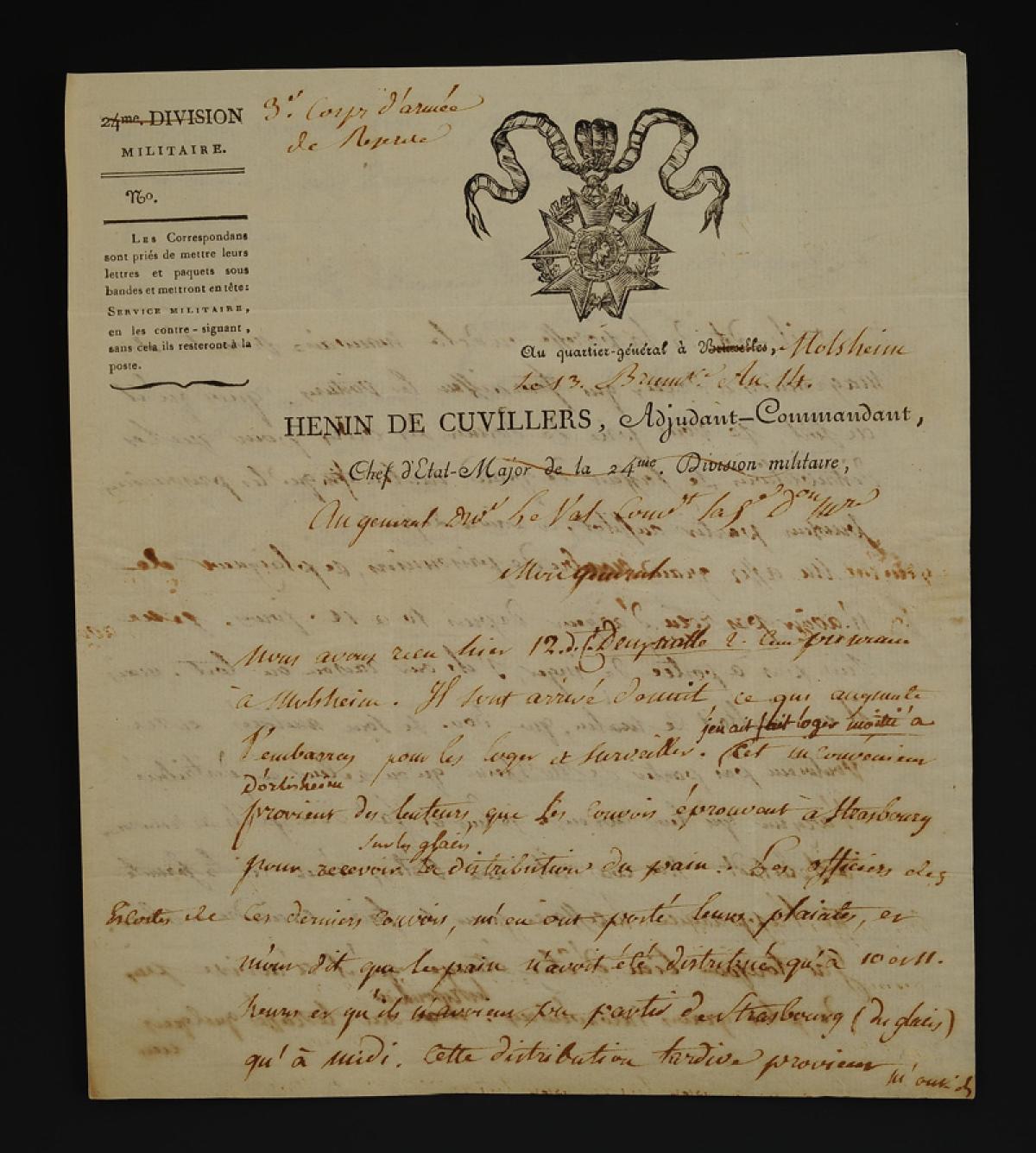
Austrian prisoners of war. 1805. AUTOGRAPH LETTER SIGNED BY ADJUDANT-COMMANDANT HÉNIN DE CUVILLERS *, TO GENERAL LEVAL **, commanding the 5th Military Division, November 4, 1805. 18910-29
Letter with header "3rd Reserve Army Corps" and printed header "HÉNIN DE CUVILLERS, Adjudant-Commandant, Chief of Staff" addressed to General LEVAL, commanding the 5th Military Division. Legion of Honor vignette.
Molsheim, 13 brumaire year 14 (November 4, 1805).
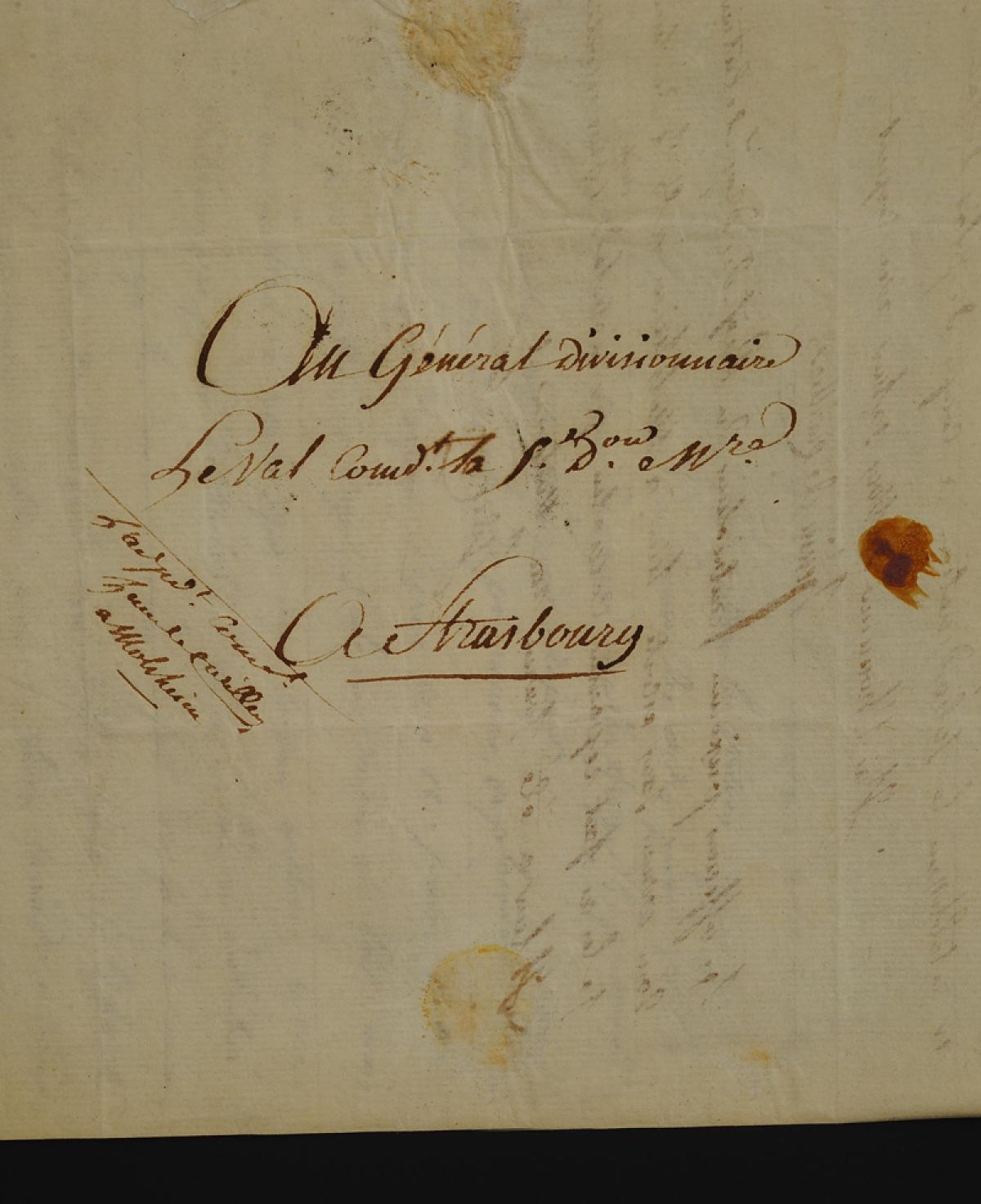
With address "To the General Divisional Commander / LE VAL, Comdt of the 5th Mil Div / In Strasbourg". Remaining red wax seal.
General Baron Hénin de Cuvillers has just received over 2000 Austrian prisoners to whom he could not distribute either bread or money. He laments the slowness of the convoys in Strasbourg to receive the bread distribution.
"Yesterday we received over two thousand prisoners in Molsheim. They arrived at night, which increases the difficulty of accommodating and supervising them, I had half of them housed in Dorlisheim. [...]
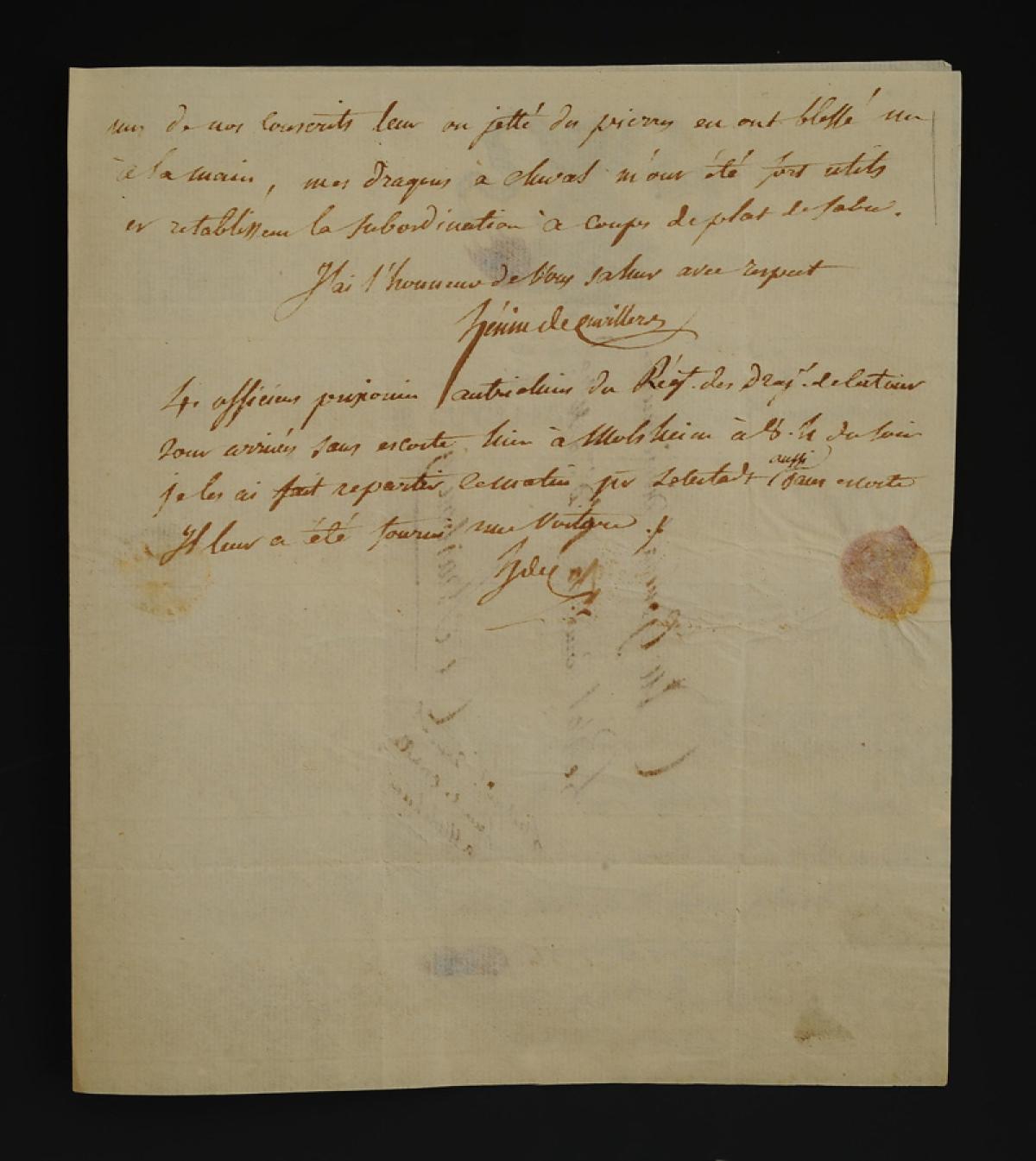
I am not in a position to judge whether they are right or wrong, but this morning 300 of them mutinied and refused to leave Molsheim until they were given the money that is due to them [...]
Double sheet, 2 1/2 pages of writing, address on page 4.
H 22.8 cm x W 19.7 cm.
Good condition, fold marks.
BIOGRAPHIES:
* Baron Étienne Félix d'Hénin de Cuvillers, born in Baloy (Yonne) on April 27, 1755 and died on August 2, 1841, in Paris, is a French officer and mesmerist.
He was an officer and an Imperial Baron. Along with Abbé José Custódio de Faria, physician Alexandre Bertrand, philosopher Maine de Biran, and General François Joseph Noizet, he was one of the mesmerists known as "imaginationists" who, unlike Franz Anton Mesmer, did not believe in the existence of a universal magnetic fluid.
In 1819, he became the editor of the Archives du Magnétisme Animal. That same year he was the first to use the prefix "hypn" (hypnosis, hypnotism, hypnotist) to describe animal magnetism phenomena. In his book "Le Magnétisme Éclairé," published in 1820, he describes magnetism in terms of belief and suggestibility.
Officer of the Legion of Honor (Napoleon I)
Knight of the Royal and Military Order of Saint Louis (Louis XVIII).
** Jean François Leval was a French General of the Revolution and the Empire, born on April 18, 1762, in Paris and died on August 7, 1834, in the same city.
As a soldier, he served from 1779 to 1783 in the colonies under Guichen's command, and was wounded on May 9, 1781, at the Battle of Pensacola. Promoted to captain in the Paris battalion in 1791, he later served as lieutenant-colonel in the 1st battalion of the Grenadiers de Paris the following year.
On March 16, 1793, during the Battle of Tirlemont under the eyes of General Valence, he defeated a regiment of cavalry and the Emperor's bodyguards before capturing three 13-caliber cannons and two howitzers. After this brilliant action, he became the colonel of the 99th Line Infantry Regiment. He rapidly rose through the ranks during the French Revolution: at the beginning of 1793, he commanded a demi-brigade in the Army of Sambre-et-Meuse. Promoted to brigadier general on October 2, 1793, under the command of Jourdan, he led a brigade during the Battle of Fleurus. He was promoted to divisional general on July 30, 1799.
Commander of the 5th military region in Strasbourg during the Duke of Enghien affair, he was responsible for arresting the Duke in Ettenheim, in the region of Baden, in March 1804.
At the beginning of the First Empire, he obtained command of a division of the Grande Armée with which he distinguished himself at Jena and Eylau. In 1808, Leval was appointed a Grand Officer of the Legion of Honor and went to Spain as the head of the "German division," a formation composed of the Dutch brigade, Nassau regiment, Baden regiment, Hesse-Darmstadt regiment, a regiment of Parisian National Guards, and a few other units. The division took part in the battles of Durango, Talavera, Almonacid, and Ocaña, where Leval was wounded. His most significant command took place during the siege of Tarifa in Andalusia, from December 1811 to January 1812, where, being solely in charge, he failed.
He finally participated in the 1814 campaign in France as part of the 6th Army Corps under Marshal Marmont. Leading the 7th Infantry Division, he notably distinguished himself at the Battle of Vauchamps on February 14. His name appears on the 7th column under the Arc de Triomphe. Having been in the vanguard for eight consecutive campaigns, he was created an Empire Baron on May 28, 1809.
Letter with header "3rd Reserve Army Corps" and printed header "HÉNIN DE CUVILLERS, Adjudant-Commandant, Chief of Staff" addressed to General LEVAL, commanding the 5th Military Division. Legion of Honor vignette.
Molsheim, 13 brumaire year 14 (November 4, 1805).
With address "To the General Divisional Commander / LE VAL, Comdt of the 5th Mil Div / In Strasbourg". Remaining red wax seal.
General Baron Hénin de Cuvillers has just received over 2000 Austrian prisoners to whom he could not distribute either bread or money. He laments the slowness of the convoys in Strasbourg to receive the bread distribution.
"Yesterday we received over two thousand prisoners in Molsheim. They arrived at night, which increases the difficulty of accommodating and supervising them, I had half of them housed in Dorlisheim. [...]
I am not in a position to judge whether they are right or wrong, but this morning 300 of them mutinied and refused to leave Molsheim until they were given the money that is due to them [...]
Double sheet, 2 1/2 pages of writing, address on page 4.
H 22.8 cm x W 19.7 cm.
Good condition, fold marks.
BIOGRAPHIES:
* Baron Étienne Félix d'Hénin de Cuvillers, born in Baloy (Yonne) on April 27, 1755 and died on August 2, 1841, in Paris, is a French officer and mesmerist.
He was an officer and an Imperial Baron. Along with Abbé José Custódio de Faria, physician Alexandre Bertrand, philosopher Maine de Biran, and General François Joseph Noizet, he was one of the mesmerists known as "imaginationists" who, unlike Franz Anton Mesmer, did not believe in the existence of a universal magnetic fluid.
In 1819, he became the editor of the Archives du Magnétisme Animal. That same year he was the first to use the prefix "hypn" (hypnosis, hypnotism, hypnotist) to describe animal magnetism phenomena. In his book "Le Magnétisme Éclairé," published in 1820, he describes magnetism in terms of belief and suggestibility.
Officer of the Legion of Honor (Napoleon I)
Knight of the Royal and Military Order of Saint Louis (Louis XVIII).
** Jean François Leval was a French General of the Revolution and the Empire, born on April 18, 1762, in Paris and died on August 7, 1834, in the same city.
As a soldier, he served from 1779 to 1783 in the colonies under Guichen's command, and was wounded on May 9, 1781, at the Battle of Pensacola. Promoted to captain in the Paris battalion in 1791, he later served as lieutenant-colonel in the 1st battalion of the Grenadiers de Paris the following year.
On March 16, 1793, during the Battle of Tirlemont under the eyes of General Valence, he defeated a regiment of cavalry and the Emperor's bodyguards before capturing three 13-caliber cannons and two howitzers. After this brilliant action, he became the colonel of the 99th Line Infantry Regiment. He rapidly rose through the ranks during the French Revolution: at the beginning of 1793, he commanded a demi-brigade in the Army of Sambre-et-Meuse. Promoted to brigadier general on October 2, 1793, under the command of Jourdan, he led a brigade during the Battle of Fleurus. He was promoted to divisional general on July 30, 1799.
Commander of the 5th military region in Strasbourg during the Duke of Enghien affair, he was responsible for arresting the Duke in Ettenheim, in the region of Baden, in March 1804.
At the beginning of the First Empire, he obtained command of a division of the Grande Armée with which he distinguished himself at Jena and Eylau. In 1808, Leval was appointed a Grand Officer of the Legion of Honor and went to Spain as the head of the "German division," a formation composed of the Dutch brigade, Nassau regiment, Baden regiment, Hesse-Darmstadt regiment, a regiment of Parisian National Guards, and a few other units. The division took part in the battles of Durango, Talavera, Almonacid, and Ocaña, where Leval was wounded. His most significant command took place during the siege of Tarifa in Andalusia, from December 1811 to January 1812, where, being solely in charge, he failed.
He finally participated in the 1814 campaign in France as part of the 6th Army Corps under Marshal Marmont. Leading the 7th Infantry Division, he notably distinguished himself at the Battle of Vauchamps on February 14. His name appears on the 7th column under the Arc de Triomphe. Having been in the vanguard for eight consecutive campaigns, he was created an Empire Baron on May 28, 1809.
Reference :
18910-29
Order shipments will be suspended between July 31 and September 1.
Next update Friday, august 28 at 13:30 PM
FOR ALL PURCHASES, PAYMENT IN MULTIPLE CHECKS POSSIBLE
bertrand.malvaux@wanadoo.fr 06 07 75 74 63
SHIPPING COSTS
Shipping costs are calculated only once per order for one or more items, all shipments are sent via registered mail, as this is the only way to have proof of dispatch and receipt.
For parcels whose value cannot be insured by the Post, shipments are entrusted to DHL or Fedex with real value insured, the service is of high quality but the cost is higher.
RETURN POLICY
Items can be returned within 8 days of receipt. They must be returned by registered mail at the sender's expense, in their original packaging, and in their original condition.
AUTHENTICITY
The selection of items offered on this site allows me to guarantee the authenticity of each piece described here, all items offered are guaranteed to be period and authentic, unless otherwise noted or restricted in the description.
An authenticity certificate of the item including the description published on the site, the period, the sale price, accompanied by one or more color photographs is automatically provided for any item priced over 130 euros. Below this price, each certificate is charged 5 euros.
Only items sold by me are subject to an authenticity certificate, I do not provide any expert reports for items sold by third parties (colleagues or collectors).
Next update Friday, august 28 at 13:30 PM
FOR ALL PURCHASES, PAYMENT IN MULTIPLE CHECKS POSSIBLE
bertrand.malvaux@wanadoo.fr 06 07 75 74 63
An authenticity certificate of the item including the description published on the site, the period, the sale price, accompanied by one or more color photographs is automatically provided for any item priced over 130 euros. Below this price, each certificate is charged 5 euros.
Only items sold by me are subject to an authenticity certificate, I do not provide any expert reports for items sold by third parties (colleagues or collectors).