
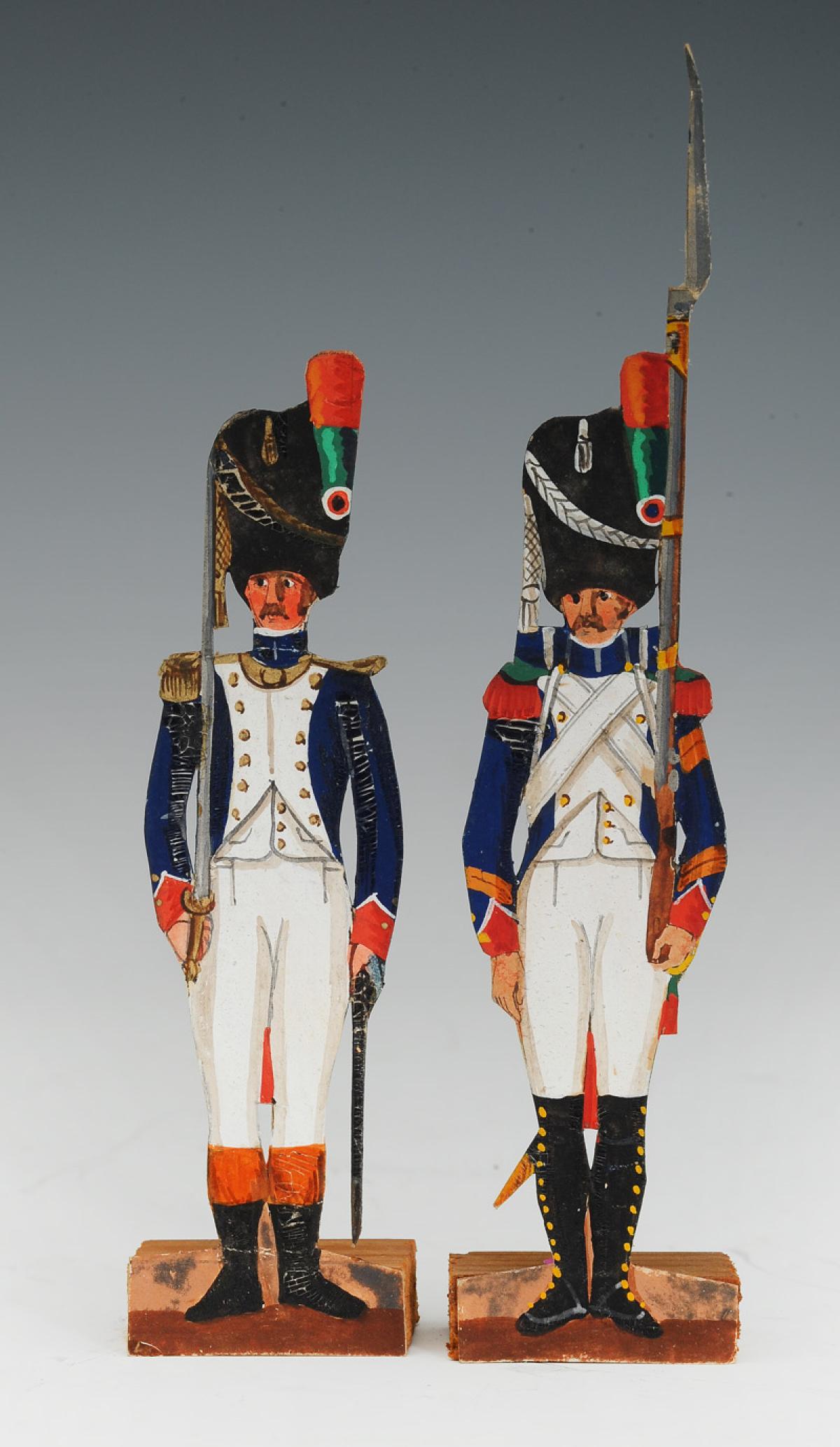
INFANTRY HUNTERS OF THE IMPERIAL GUARD FIRST EMPIRE: SOLDIERS OF STRASBOURG CARDBOARD FIGURINE GOUACHE BY THE WURTZ FAMILY, SECOND HALF OF THE 19TH CENTURY, AROUND 1815-1848. 31156-3
Sold out
INFANTRY HUNTERS OF THE IMPERIAL GUARD FIRST EMPIRE: SOLDIERS OF STRASBOURG CARDBOARD FIGURINE GOUACHE PAINTED BY THE WURTZ FAMILY, SECOND THIRD OF THE 19TH CENTURY, AROUND 1815-1848. 31156-3
Two pedestrians, height from the base of the base to eye level 8.5 cm.
Mounted on a wooden base.
France.
First half of the 19th century.
Good condition.
PROVENANCE:
Former Wurtz-Pees collection, then Saint-Aubin, and private collection.
Mr. Marcel Saint-Aubin, a collector turned antiquarian between the two World Wars. To my knowledge, no biography or article has ever been published about this personality, who is nevertheless known to collectors and often cited in the provenances of historical objects of great quality. That is why I will open my archives to better understand this great connoisseur:
"Called up during the First World War along with his brother in the infantry, the latter was killed at Verdun. Both shared the same taste for military memorabilia; both drew and published their drawings in the magazine 'La Giberne' before 1914.
After the war, he settled as an antiquarian. In 1926, he lived at 108 rue de Ménilmontant (Paris 20th), far from the preferred districts of antiquarians. His choice focused on the specialty that had attracted him for a long time: military curiosities. The spark that led him to this specialty came from his first find: an officer's saber of the Consulate, his first beautiful saber; he called it his 'lucky charm' and always kept it.
The antique dealer profession allowed Saint-Aubin to see and possess these objects he cherished for some time. A fine connoisseur, he never made a mistake, and his clients benefited from his knowledge. A passionate researcher, everything he discovered in his life was remarkably varied. Quiet and modest, he had an art and a manner that left an indelible memory among the enthusiasts who knew him.
Like most military object merchants of that time, Marcel Saint-Aubin did not have a shop. He received clients in his apartment, where few objects were found, and they only occupied a temporary place. Generally, like Paul Jean, he would fetch the objects he wanted to sell from the neighboring room and often present them without saying anything, with a slight smile, or if the item presented was truly exceptional, he would simply say without raising his voice, 'It's top-notch…'.
In June 1940, during the occupation, he left for Guingamp. He returned to Paris where he resettled at the end of 1951, in the house he had acquired, 16 rue Henri Pape, in the 13th arrondissement, once again, far from the district of antiquarians.
His love for the items he parted with was seen even in the care he took in their packaging. Very handy with his hands, he perfectly protected even the most modest piece.
Marcel Saint-Aubin passed away at the age of 83, taking with him the esteem of all who knew him, leaving behind the memory of a man with great moral values."
HISTORICAL BACKGROUND:
The soldiers of Strasbourg are cardboard figurines, "flat soldiers," cut from rigid cardboard. In most cases, these soldiers are drawn and then printed in sheets to more easily multiply their number.
Christian Blondieau in his work "Small soldiers of lead, tin, paper, cardboard ... 1765-1965 - The collector's guide" Editions Le Képi Rouge Paris 1996, specifies regarding cardboard soldiers:
"[...] unlike paper soldiers intended more for youth, often colored in a clumsy way, the cardboard soldier is made for adults and guarantees great uniformological precision, which serves as the basis of our modern documentation...
Why do the little soldiers of Alsace have such a reference? Because they were mainly made by eyewitnesses of the time or their descendants and are often contemporary to the era they represent.
During the wars of the Revolution and the Empire, the residents of Strasbourg (then a garrison town) saw a large number of soldiers with colorful uniforms passing through the streets of their city, heading to fight in Germany.
This influx of troops, which lasted more than fifteen years, gave some the idea to 'sketch' these beautiful soldiers live.
Alsatian authors agree to cite Benjamin Zix (1772-1811) as the precursor of the genre. Anticipating Léopold Beyer, the German Geisler, or the Austrian Klein, Alsatian Zix gives us a very realistic aspect of the soldier of the time since he himself, a combatant, traversed the battlefields more often armed with a pencil than a rifle. He became an Army Drawing Officer.
From the peace of 1815 to the war of 1914, Strasbourg artists continue from generation to generation this need to draw and paint [...]."
Under the First Empire, Strasbourg had about 30,000 inhabitants, with a permanent garrison between 6,000 and 10,000 soldiers. This city was also the obligatory passage for countless troops of the Revolution and the Grande Armée heading for campaigns across the Rhine.
Among all these artists, and for this period, the three most known are: Thiébaut Borerst (mistakenly spelled Boersch) (1782-1824) a flour miller who began drawing around 1800, nephew of the painter Benjamin Zix, his collection was dispersed at auction in Angers on March 10, 1971, and his style is arguably the most accomplished that we know. Eugène Nicollet (1802-1872) who painted his soldiers from 1817 (he was 15 years old) for 55 years, his collection is preserved at the Compiègne Museum, and his style is more naive. Wurtz, to whom we dedicate a specific paragraph. Paul Schmidt, whose every figurine is annotated on the back with the name of the soldier as depicted, this collection kept at the Musée de l'Armée in Paris has the characteristic of representing the soldiers of the National Guard of Strasbourg, among others.
Other artists have also worked in the same way: Frédérik Schmidt (born in 1796). But we can also mention Édouard Kratz (1803-1885), Schmidt's son (born in 1824), Théodore Carl (born in 1837)...
WURTZ-PEEZ COLLECTION (Würtz German spelling):
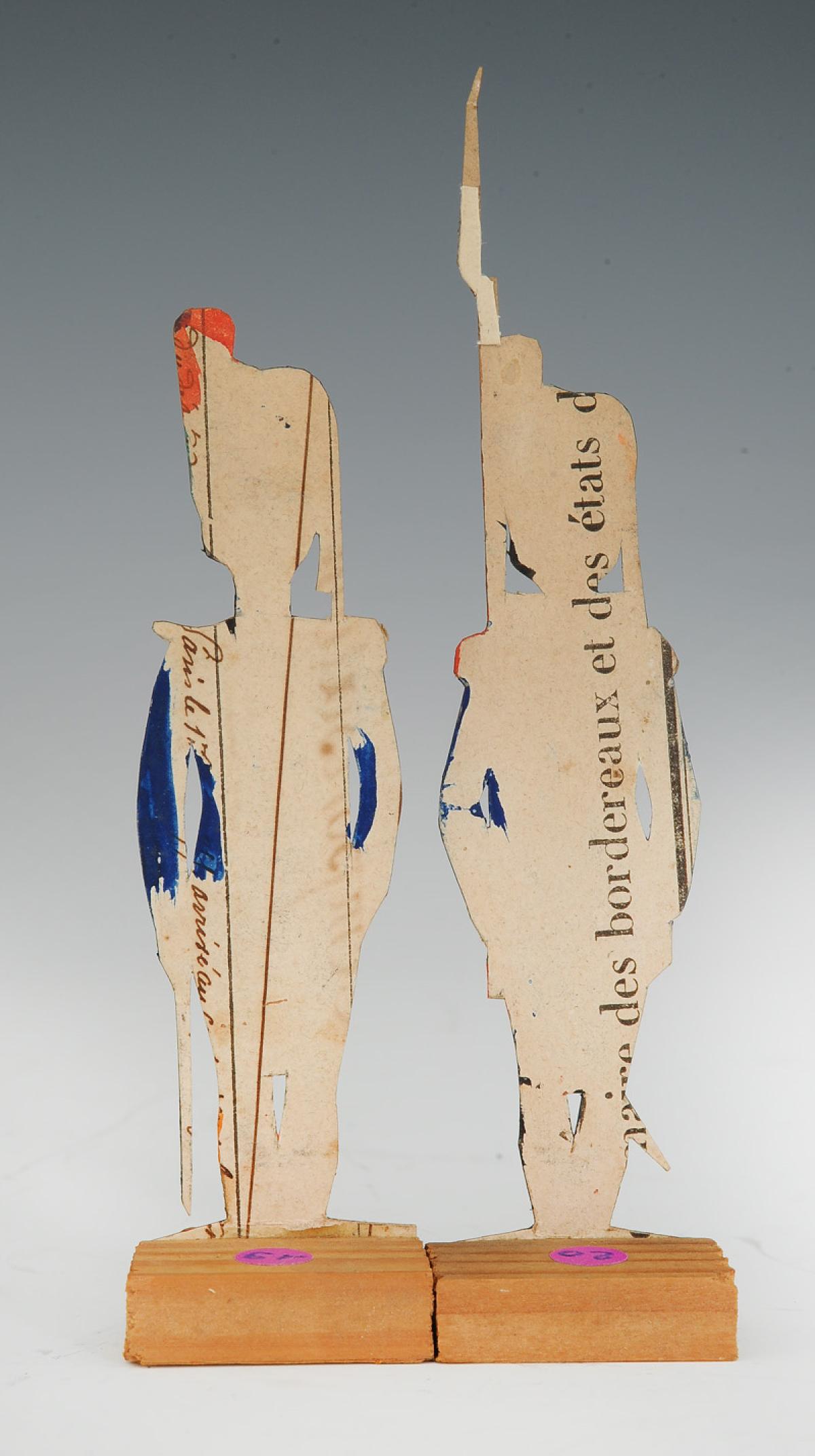
Wurtz began his documentation under the First Empire thanks to his friend J.P LÉvêque, a former surgeon of the Grande Armée who had gathered extensive documentation on Napoleon's armies. He started making his figurines as early as 1825 with the help of his son, then Pees, his stepfather. The production was continued by the son, who completed his "Napoleonic" collection with the help of his stepfather, Mr. Pees, during the Second Republic (1850), some of the figurines we present have the date 1848 on the back of the cardboard. These figurines are of very high quality. The author Edward Ryan in his work "Paper Soldiers the illustrated history of printed paper armies of the 18th, 19th & 20th centuries" (Golden Age Editions, London 1995) writes "the most precise and complete representation of the troops of the First Empire." Each regiment is represented in all ranks and types of uniforms in an exhaustive manner, which is rare in the representations of the soldiers of Strasbourg.
The son of Mr. Wurtz, Frédéric Wurtz, likely completed the uniforms he had not observed himself with other documentary sources.
Upon the fall of the Second Empire, Frédéric Wurtz refused to stay in Strasbourg under Prussian occupation and moved to Paris, where he held a pharmacy on Boulevard de Clichy. Following his death in 1898, the majority of his collection - nearly 16,000 figurines - was donated to the Musée de l’Armée on October 1, 1899, by his widow and his son, a medical officer; they were exhibited there in 1938 and have remained since.
The specialist expert Christian Blondieau judges Wurtz's style to be comparable to that of Nicollet and Kratz.
Two pedestrians, height from the base of the base to eye level 8.5 cm.
Mounted on a wooden base.
France.
First half of the 19th century.
Good condition.
PROVENANCE:
Former Wurtz-Pees collection, then Saint-Aubin, and private collection.
Mr. Marcel Saint-Aubin, a collector turned antiquarian between the two World Wars. To my knowledge, no biography or article has ever been published about this personality, who is nevertheless known to collectors and often cited in the provenances of historical objects of great quality. That is why I will open my archives to better understand this great connoisseur:
"Called up during the First World War along with his brother in the infantry, the latter was killed at Verdun. Both shared the same taste for military memorabilia; both drew and published their drawings in the magazine 'La Giberne' before 1914.
After the war, he settled as an antiquarian. In 1926, he lived at 108 rue de Ménilmontant (Paris 20th), far from the preferred districts of antiquarians. His choice focused on the specialty that had attracted him for a long time: military curiosities. The spark that led him to this specialty came from his first find: an officer's saber of the Consulate, his first beautiful saber; he called it his 'lucky charm' and always kept it.
The antique dealer profession allowed Saint-Aubin to see and possess these objects he cherished for some time. A fine connoisseur, he never made a mistake, and his clients benefited from his knowledge. A passionate researcher, everything he discovered in his life was remarkably varied. Quiet and modest, he had an art and a manner that left an indelible memory among the enthusiasts who knew him.
Like most military object merchants of that time, Marcel Saint-Aubin did not have a shop. He received clients in his apartment, where few objects were found, and they only occupied a temporary place. Generally, like Paul Jean, he would fetch the objects he wanted to sell from the neighboring room and often present them without saying anything, with a slight smile, or if the item presented was truly exceptional, he would simply say without raising his voice, 'It's top-notch…'.
In June 1940, during the occupation, he left for Guingamp. He returned to Paris where he resettled at the end of 1951, in the house he had acquired, 16 rue Henri Pape, in the 13th arrondissement, once again, far from the district of antiquarians.
His love for the items he parted with was seen even in the care he took in their packaging. Very handy with his hands, he perfectly protected even the most modest piece.
Marcel Saint-Aubin passed away at the age of 83, taking with him the esteem of all who knew him, leaving behind the memory of a man with great moral values."
HISTORICAL BACKGROUND:
The soldiers of Strasbourg are cardboard figurines, "flat soldiers," cut from rigid cardboard. In most cases, these soldiers are drawn and then printed in sheets to more easily multiply their number.
Christian Blondieau in his work "Small soldiers of lead, tin, paper, cardboard ... 1765-1965 - The collector's guide" Editions Le Képi Rouge Paris 1996, specifies regarding cardboard soldiers:
"[...] unlike paper soldiers intended more for youth, often colored in a clumsy way, the cardboard soldier is made for adults and guarantees great uniformological precision, which serves as the basis of our modern documentation...
Why do the little soldiers of Alsace have such a reference? Because they were mainly made by eyewitnesses of the time or their descendants and are often contemporary to the era they represent.
During the wars of the Revolution and the Empire, the residents of Strasbourg (then a garrison town) saw a large number of soldiers with colorful uniforms passing through the streets of their city, heading to fight in Germany.
This influx of troops, which lasted more than fifteen years, gave some the idea to 'sketch' these beautiful soldiers live.
Alsatian authors agree to cite Benjamin Zix (1772-1811) as the precursor of the genre. Anticipating Léopold Beyer, the German Geisler, or the Austrian Klein, Alsatian Zix gives us a very realistic aspect of the soldier of the time since he himself, a combatant, traversed the battlefields more often armed with a pencil than a rifle. He became an Army Drawing Officer.
From the peace of 1815 to the war of 1914, Strasbourg artists continue from generation to generation this need to draw and paint [...]."
Under the First Empire, Strasbourg had about 30,000 inhabitants, with a permanent garrison between 6,000 and 10,000 soldiers. This city was also the obligatory passage for countless troops of the Revolution and the Grande Armée heading for campaigns across the Rhine.
Among all these artists, and for this period, the three most known are: Thiébaut Borerst (mistakenly spelled Boersch) (1782-1824) a flour miller who began drawing around 1800, nephew of the painter Benjamin Zix, his collection was dispersed at auction in Angers on March 10, 1971, and his style is arguably the most accomplished that we know. Eugène Nicollet (1802-1872) who painted his soldiers from 1817 (he was 15 years old) for 55 years, his collection is preserved at the Compiègne Museum, and his style is more naive. Wurtz, to whom we dedicate a specific paragraph. Paul Schmidt, whose every figurine is annotated on the back with the name of the soldier as depicted, this collection kept at the Musée de l'Armée in Paris has the characteristic of representing the soldiers of the National Guard of Strasbourg, among others.
Other artists have also worked in the same way: Frédérik Schmidt (born in 1796). But we can also mention Édouard Kratz (1803-1885), Schmidt's son (born in 1824), Théodore Carl (born in 1837)...
WURTZ-PEEZ COLLECTION (Würtz German spelling):
Wurtz began his documentation under the First Empire thanks to his friend J.P LÉvêque, a former surgeon of the Grande Armée who had gathered extensive documentation on Napoleon's armies. He started making his figurines as early as 1825 with the help of his son, then Pees, his stepfather. The production was continued by the son, who completed his "Napoleonic" collection with the help of his stepfather, Mr. Pees, during the Second Republic (1850), some of the figurines we present have the date 1848 on the back of the cardboard. These figurines are of very high quality. The author Edward Ryan in his work "Paper Soldiers the illustrated history of printed paper armies of the 18th, 19th & 20th centuries" (Golden Age Editions, London 1995) writes "the most precise and complete representation of the troops of the First Empire." Each regiment is represented in all ranks and types of uniforms in an exhaustive manner, which is rare in the representations of the soldiers of Strasbourg.
The son of Mr. Wurtz, Frédéric Wurtz, likely completed the uniforms he had not observed himself with other documentary sources.
Upon the fall of the Second Empire, Frédéric Wurtz refused to stay in Strasbourg under Prussian occupation and moved to Paris, where he held a pharmacy on Boulevard de Clichy. Following his death in 1898, the majority of his collection - nearly 16,000 figurines - was donated to the Musée de l’Armée on October 1, 1899, by his widow and his son, a medical officer; they were exhibited there in 1938 and have remained since.
The specialist expert Christian Blondieau judges Wurtz's style to be comparable to that of Nicollet and Kratz.
Reference :
31156-3
Next update Friday, octobre 9 at 13:30 PM
FOR ALL PURCHASES, PAYMENT IN MULTIPLE CHECKS POSSIBLE
bertrand.malvaux@wanadoo.fr 06 07 75 74 63
SHIPPING COSTS
Shipping costs are calculated only once per order for one or more items, all shipments are sent via registered mail, as this is the only way to have proof of dispatch and receipt.
For parcels whose value cannot be insured by the Post, shipments are entrusted to DHL or Fedex with real value insured, the service is of high quality but the cost is higher.
RETURN POLICY
Items can be returned within 8 days of receipt. They must be returned by registered mail at the sender's expense, in their original packaging, and in their original condition.
AUTHENTICITY
The selection of items offered on this site allows me to guarantee the authenticity of each piece described here, all items offered are guaranteed to be period and authentic, unless otherwise noted or restricted in the description.
An authenticity certificate of the item including the description published on the site, the period, the sale price, accompanied by one or more color photographs is automatically provided for any item priced over 130 euros. Below this price, each certificate is charged 5 euros.
Only items sold by me are subject to an authenticity certificate, I do not provide any expert reports for items sold by third parties (colleagues or collectors).
FOR ALL PURCHASES, PAYMENT IN MULTIPLE CHECKS POSSIBLE
bertrand.malvaux@wanadoo.fr 06 07 75 74 63
An authenticity certificate of the item including the description published on the site, the period, the sale price, accompanied by one or more color photographs is automatically provided for any item priced over 130 euros. Below this price, each certificate is charged 5 euros.
Only items sold by me are subject to an authenticity certificate, I do not provide any expert reports for items sold by third parties (colleagues or collectors).