
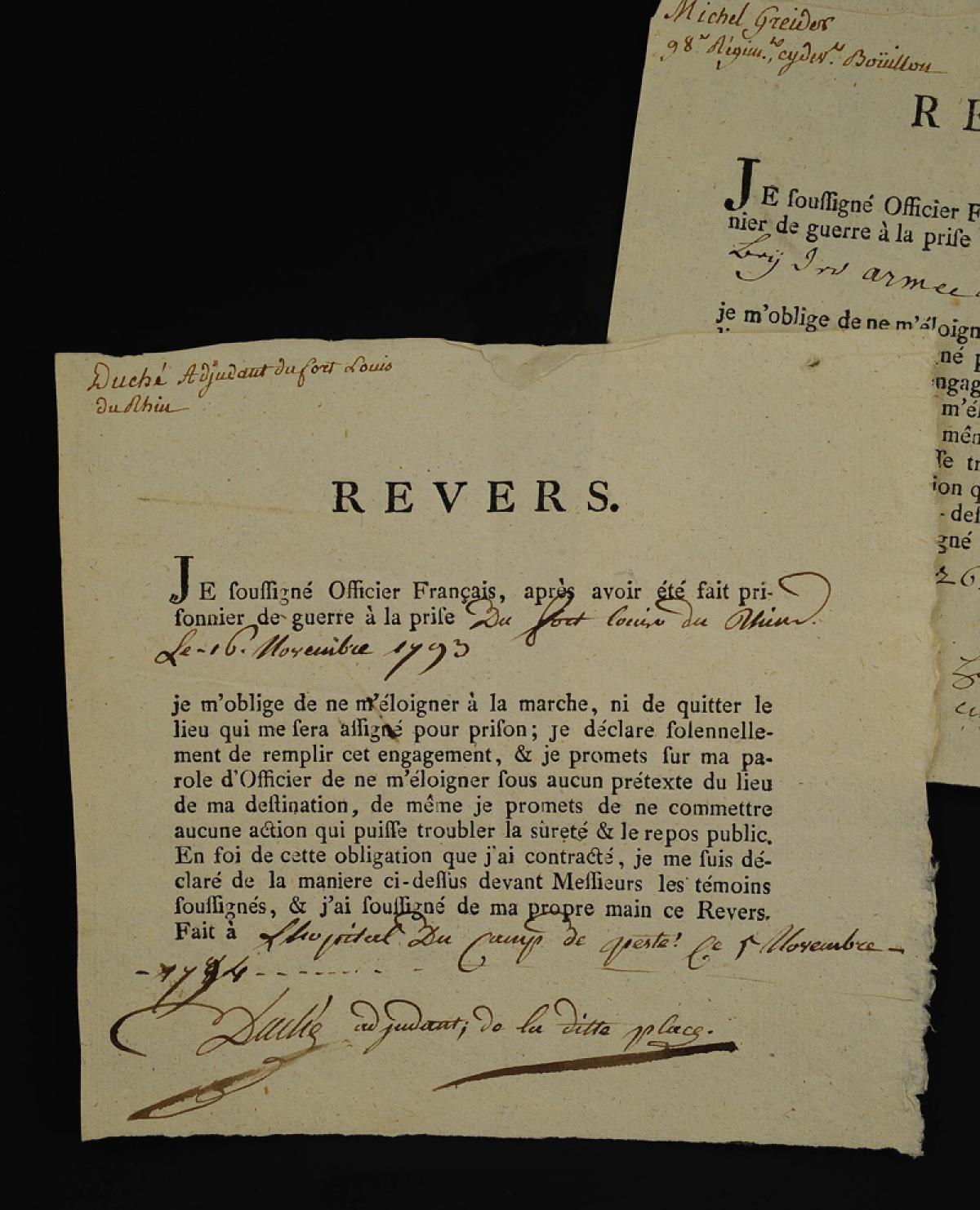
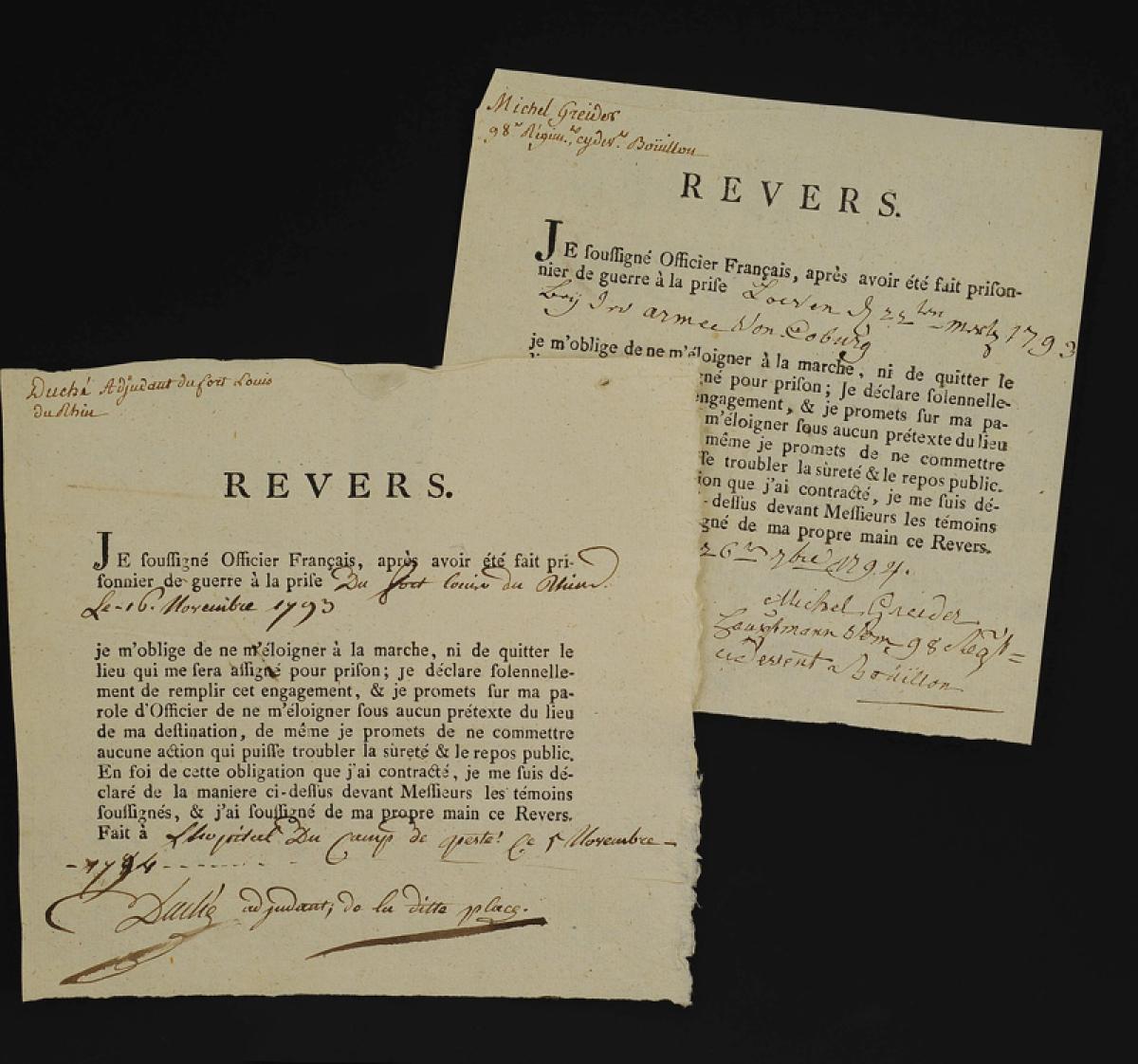
Prisoners of war 1794. TWO DOCUMENTS ENTITLED "REVERS", one signed by Michel GREIDER, 98th Bouillon Regiment on September 26, 1794, the second signed by DUCHÉ, adjutant at Fort Louis du Rhin on November 5, 1794. 18910-26
Sold out
Prisoners of War 1794. TWO DOCUMENTS ENTITLED "REVERSES," one signed by Michel GREIDER, 98th Bouillon Regiment on September 26, 1794, and the second signed by DUCHÉ, adjutant at Fort Louis du Rhin on November 5, 1794. 18910-26
Documents printed in black ink and completed in a handwritten manner (ellipsis).
"I, the undersigned French Officer, after being taken prisoner of war at the capture of ..... I undertake not to march away, nor to leave the place assigned to me for prison; I solemnly declare to fulfill this commitment, and I promise on my Officer's honor not to leave under any circumstances from the destination place, likewise, I promise not to commit any act that might disturb the public safety and peace.
In witness of this obligation I have undertaken, I have declared in the manner above before the undersigned witnesses, and I have personally signed this Revers.
Done at ...."
1 - Michel GREIDER, 98th Bouillon Regiment*, is taken prisoner of war at the capture of LOUVEN (Leuven) on March 22, 1793.
The document is dated September 26, 1794.
Dimensions: H 17.5 cm x 17.5 cm.
On the reverse, a handwritten number "No. 839" crossed out and replaced by "18."
2 - DUCHÉ, adjutant at Fort Louis du Rhin**, is taken prisoner during the capture of Fort Louis du Rhin on November 16, 1793.
The document is dated November 5, 1794.
Dimensions: H 18 cm x 18 cm.
On the reverse, a handwritten number "No. 753" crossed out and replaced by "13."
Documents in good condition.
* BOUILLON REGIMENT
The Bouillon Regiment is an infantry regiment of the Kingdom of France created in 1757.
January 18, 1757: Creation of the Bouillon Regiment
January 1, 1791: Renamed 98th Line Infantry Regiment
VON COMBURG Army:
[...] Revolutionary Wars, 1793–1794. March 23, 1793: Defeat of Combourg by Dumouriez in Leuven.
** FORT-LOUIS
The place is besieged several times during the 18th century, notably in 1793 by the Austrian General Lauer: During the War of the First Coalition, Austrian troops besieged Fort-Vauban (also known as Fort-Louis), with the help of emigrant troops. The French garrison, consisting of 4,500 men with 111 artillery pieces, was commanded by General Michel Durand, assisted by battalion chief of engineering Dominique-André de Chambarlhac. The attackers' fire set the city, most of which had wooden houses, and the Vauban and Alsace forts on fire. Civilians had taken refuge in the fort's underground tunnels to escape the bombardments.
On NOVEMBER 14, after a month-long siege, lacking ammunition and food, the place fell in the presence of the Prince de Condé's army corps. Republican prisoners were sent into captivity in the Banat of Temeswar in Romania. The French regained possession of the place the following year without rebuilding it.
On January 1, 1814 (during the Campaign of France), a Russian army corps under Wittgenstein and a Badenese corps under Count de Hochberg crossed the Rhine and partially restored the fortifications, but after the peace, they demolished them again. The Square Fort was dismantled in 1818. It was repurchased by the municipality in 1890.
Documents printed in black ink and completed in a handwritten manner (ellipsis).
"I, the undersigned French Officer, after being taken prisoner of war at the capture of ..... I undertake not to march away, nor to leave the place assigned to me for prison; I solemnly declare to fulfill this commitment, and I promise on my Officer's honor not to leave under any circumstances from the destination place, likewise, I promise not to commit any act that might disturb the public safety and peace.
In witness of this obligation I have undertaken, I have declared in the manner above before the undersigned witnesses, and I have personally signed this Revers.
Done at ...."
1 - Michel GREIDER, 98th Bouillon Regiment*, is taken prisoner of war at the capture of LOUVEN (Leuven) on March 22, 1793.
The document is dated September 26, 1794.
Dimensions: H 17.5 cm x 17.5 cm.
On the reverse, a handwritten number "No. 839" crossed out and replaced by "18."
2 - DUCHÉ, adjutant at Fort Louis du Rhin**, is taken prisoner during the capture of Fort Louis du Rhin on November 16, 1793.
The document is dated November 5, 1794.
Dimensions: H 18 cm x 18 cm.
On the reverse, a handwritten number "No. 753" crossed out and replaced by "13."
Documents in good condition.
* BOUILLON REGIMENT
The Bouillon Regiment is an infantry regiment of the Kingdom of France created in 1757.
January 18, 1757: Creation of the Bouillon Regiment
January 1, 1791: Renamed 98th Line Infantry Regiment
VON COMBURG Army:
[...] Revolutionary Wars, 1793–1794. March 23, 1793: Defeat of Combourg by Dumouriez in Leuven.
** FORT-LOUIS
The place is besieged several times during the 18th century, notably in 1793 by the Austrian General Lauer: During the War of the First Coalition, Austrian troops besieged Fort-Vauban (also known as Fort-Louis), with the help of emigrant troops. The French garrison, consisting of 4,500 men with 111 artillery pieces, was commanded by General Michel Durand, assisted by battalion chief of engineering Dominique-André de Chambarlhac. The attackers' fire set the city, most of which had wooden houses, and the Vauban and Alsace forts on fire. Civilians had taken refuge in the fort's underground tunnels to escape the bombardments.
On NOVEMBER 14, after a month-long siege, lacking ammunition and food, the place fell in the presence of the Prince de Condé's army corps. Republican prisoners were sent into captivity in the Banat of Temeswar in Romania. The French regained possession of the place the following year without rebuilding it.
On January 1, 1814 (during the Campaign of France), a Russian army corps under Wittgenstein and a Badenese corps under Count de Hochberg crossed the Rhine and partially restored the fortifications, but after the peace, they demolished them again. The Square Fort was dismantled in 1818. It was repurchased by the municipality in 1890.
Reference :
18910-26
Next update Friday, octobre 9 at 13:30 PM
FOR ALL PURCHASES, PAYMENT IN MULTIPLE CHECKS POSSIBLE
bertrand.malvaux@wanadoo.fr 06 07 75 74 63
SHIPPING COSTS
Shipping costs are calculated only once per order for one or more items, all shipments are sent via registered mail, as this is the only way to have proof of dispatch and receipt.
For parcels whose value cannot be insured by the Post, shipments are entrusted to DHL or Fedex with real value insured, the service is of high quality but the cost is higher.
RETURN POLICY
Items can be returned within 8 days of receipt. They must be returned by registered mail at the sender's expense, in their original packaging, and in their original condition.
AUTHENTICITY
The selection of items offered on this site allows me to guarantee the authenticity of each piece described here, all items offered are guaranteed to be period and authentic, unless otherwise noted or restricted in the description.
An authenticity certificate of the item including the description published on the site, the period, the sale price, accompanied by one or more color photographs is automatically provided for any item priced over 130 euros. Below this price, each certificate is charged 5 euros.
Only items sold by me are subject to an authenticity certificate, I do not provide any expert reports for items sold by third parties (colleagues or collectors).
FOR ALL PURCHASES, PAYMENT IN MULTIPLE CHECKS POSSIBLE
bertrand.malvaux@wanadoo.fr 06 07 75 74 63
An authenticity certificate of the item including the description published on the site, the period, the sale price, accompanied by one or more color photographs is automatically provided for any item priced over 130 euros. Below this price, each certificate is charged 5 euros.
Only items sold by me are subject to an authenticity certificate, I do not provide any expert reports for items sold by third parties (colleagues or collectors).