
DRAGOON TROOP HELMET, First Empire Style, manufactured in the late 19th century. Item number 32605.
Sold out
TROOP DRAGOON HELMET, First Empire Style, late 19th-century production. 32605
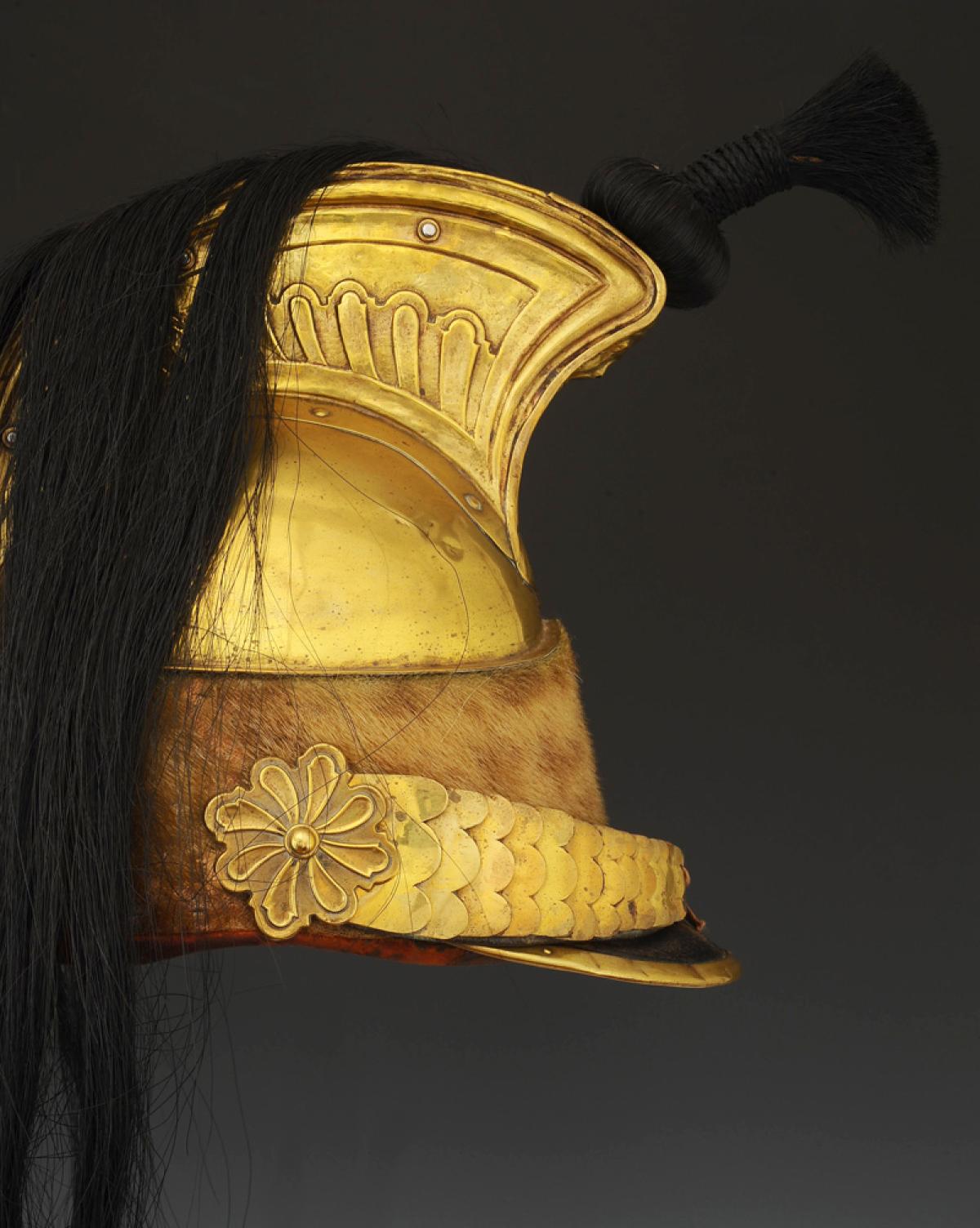
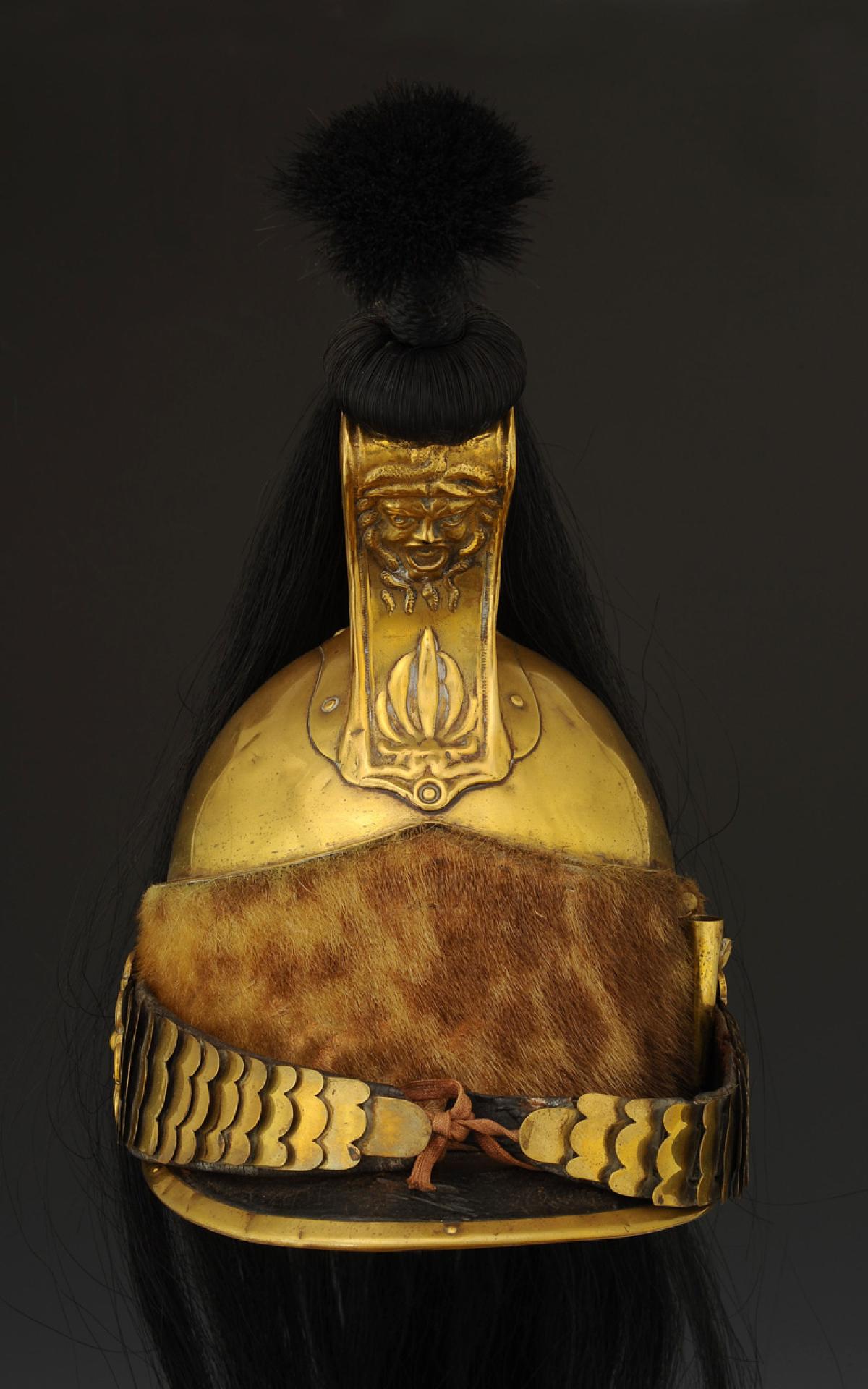
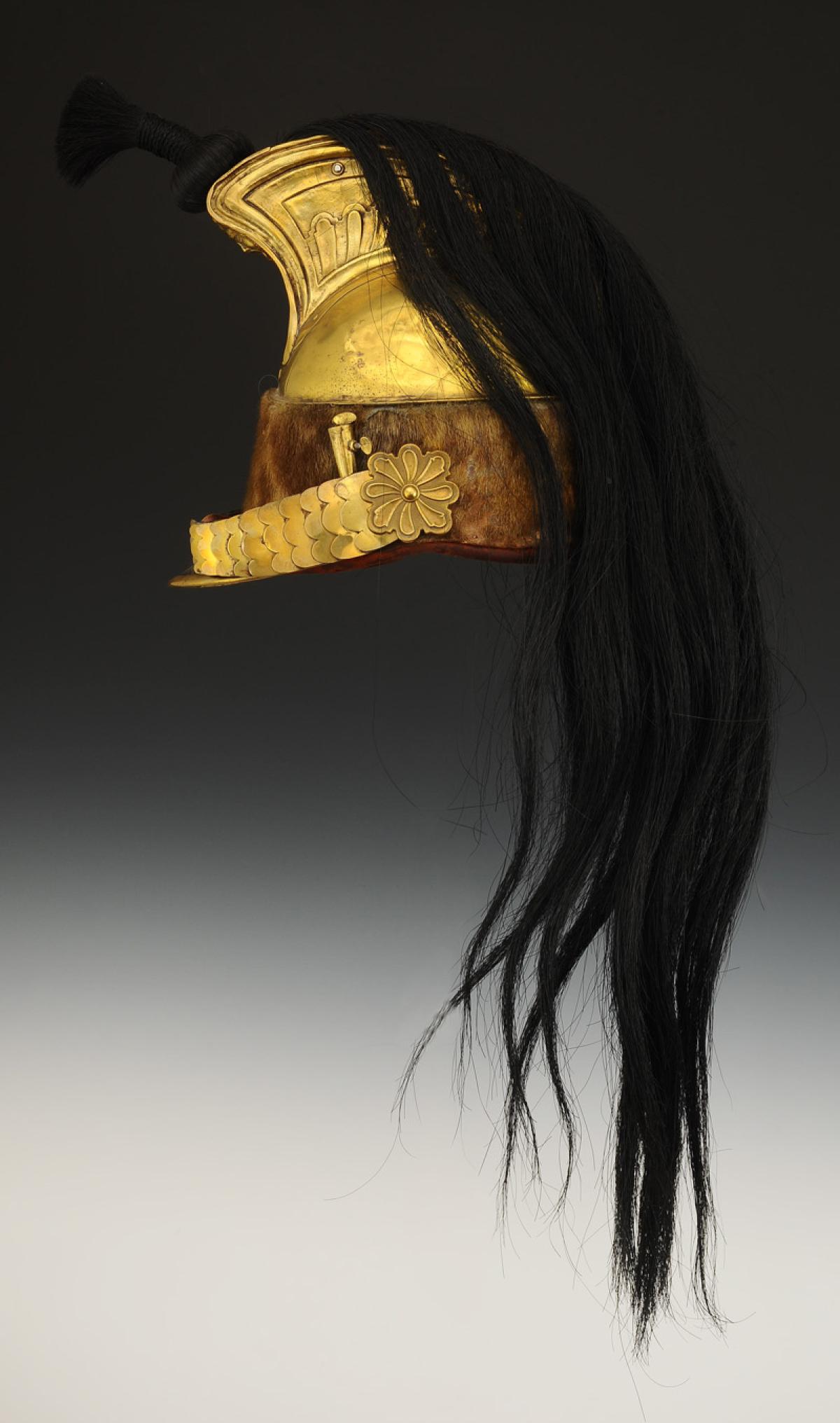
The brass skull (also called cap) is round in shape and measures approximately 10 cm in depth. The lower part is fitted with a gutter in the form of a flat band folded outward by 5 mm wide to prevent water infiltration under the turban.
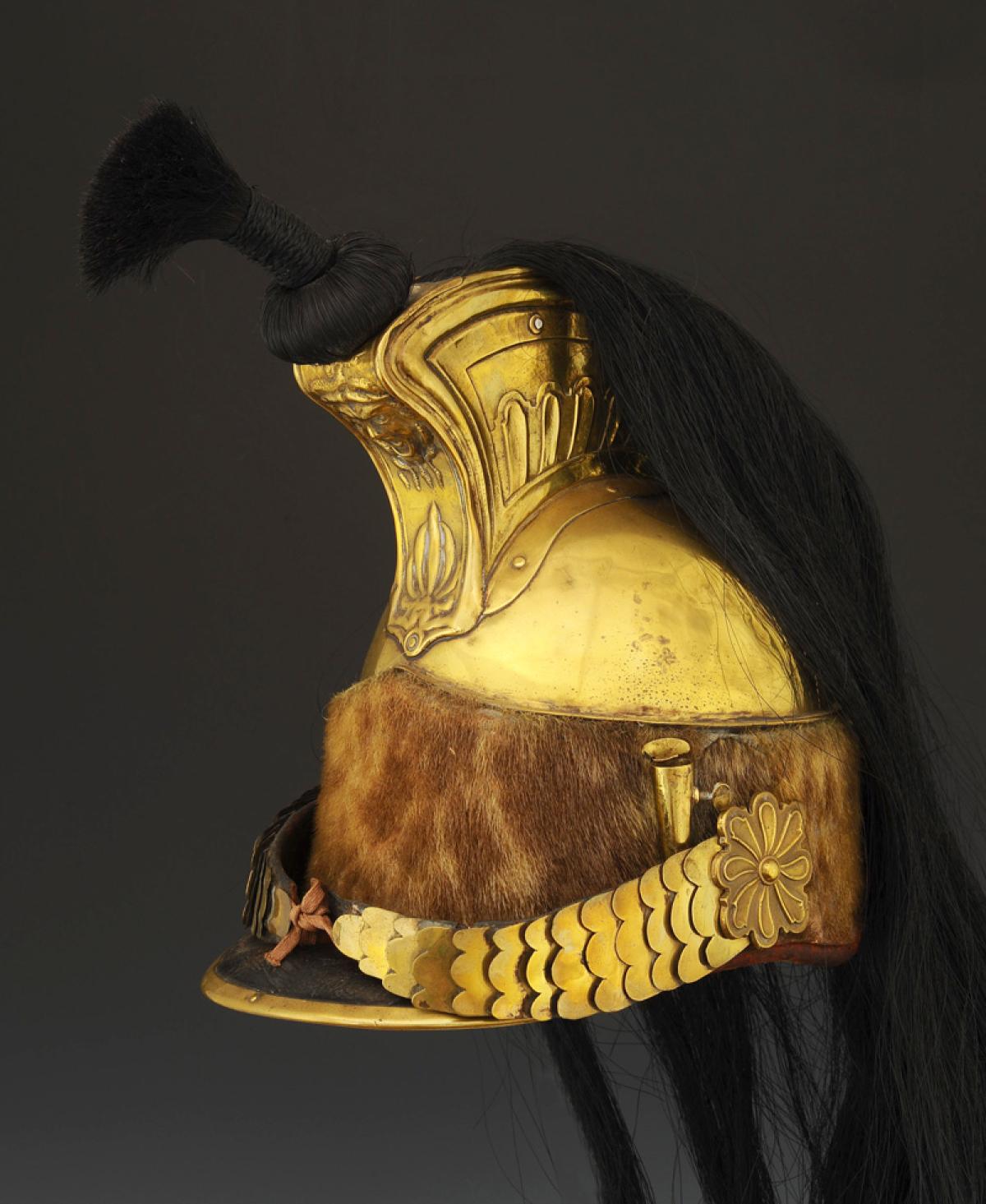
The turban consists of a leather band approximately 9.5 cm high at the front, 7.5 cm on the sides, and 8 cm at the back. It is covered in a skin of sea seal. At the bottom of the turban at the back, an iron buckle attached to a leather strap allows for tightening and size adjustment using a counter-strap.
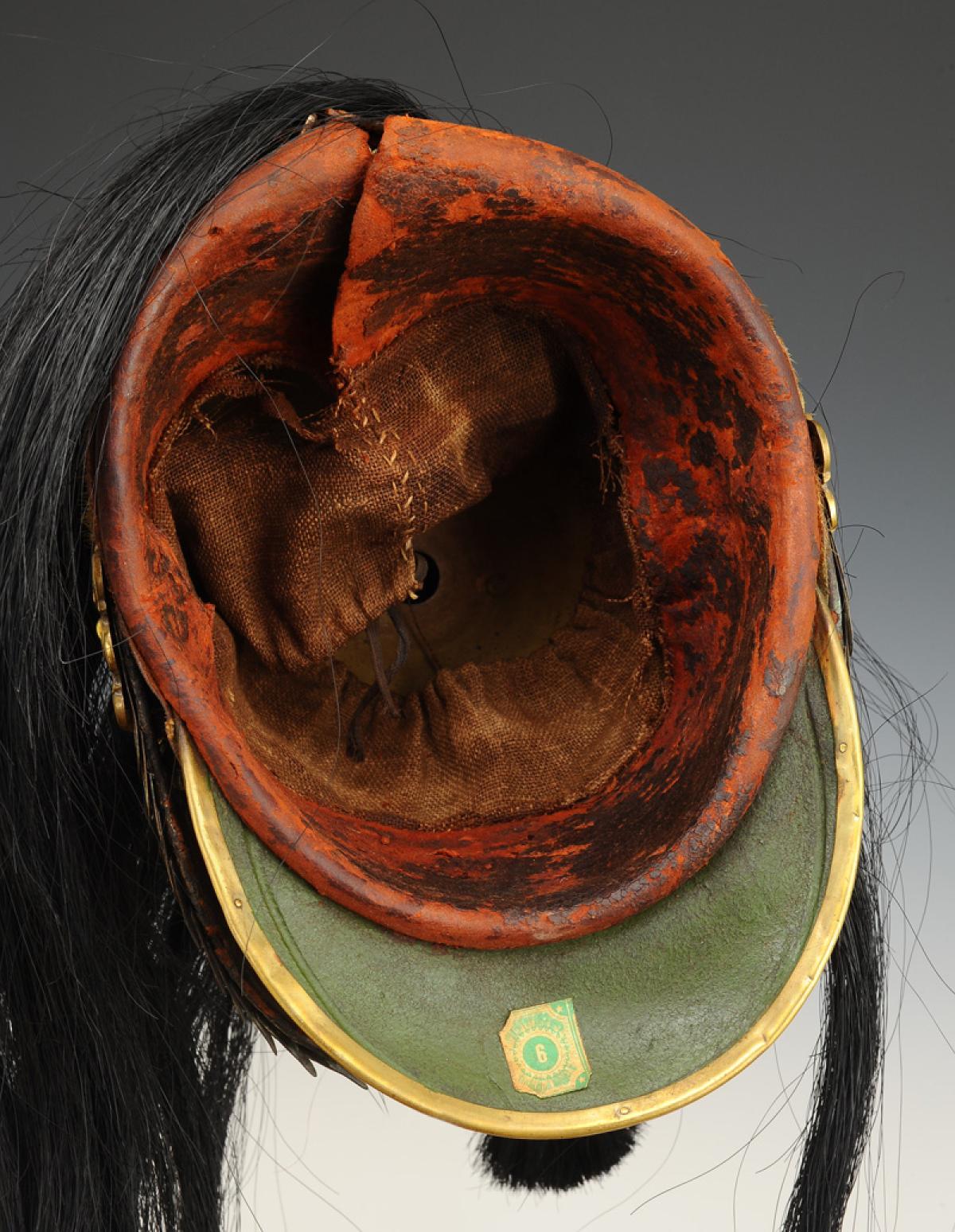
The visor is made of black waxed leather sewn at the bottom to the turban, encircled by a brass band folded over the outer edge (apparent width 8 mm), measuring 5 cm at its center.
The chinstraps are formed by two parts: the soft leather chin strap is covered with 13 brass scales, each cut in three scallops; the brass rosette is stamped in the shape of a 5.5 cm diameter palmette.
The plume holder is made of brass in a tubular shape with decreasing section towards the bottom, 5 cm high, with a screw at the top for fastening.
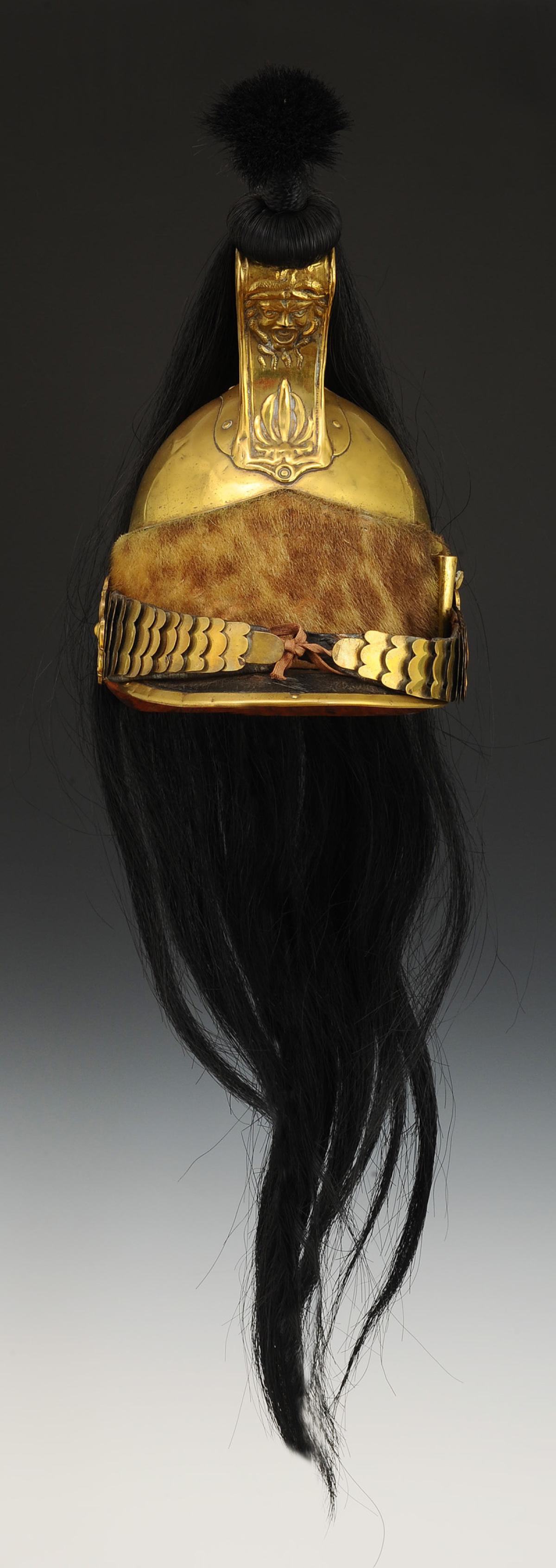
The crest is made of brass with relief-stamped decorations: the fins have a maximum height of 9.5 cm, each struck with 13 ridges; the mask is 12 cm high, 4.2 cm wide; in the upper part, a head of Medusa is represented, and in the lower part, a palmette.
The plume holder, reassembled, is composed of a wooden lens covered with tightly bound black hairs, blooming into a tassel shape. Total height 10 cm.
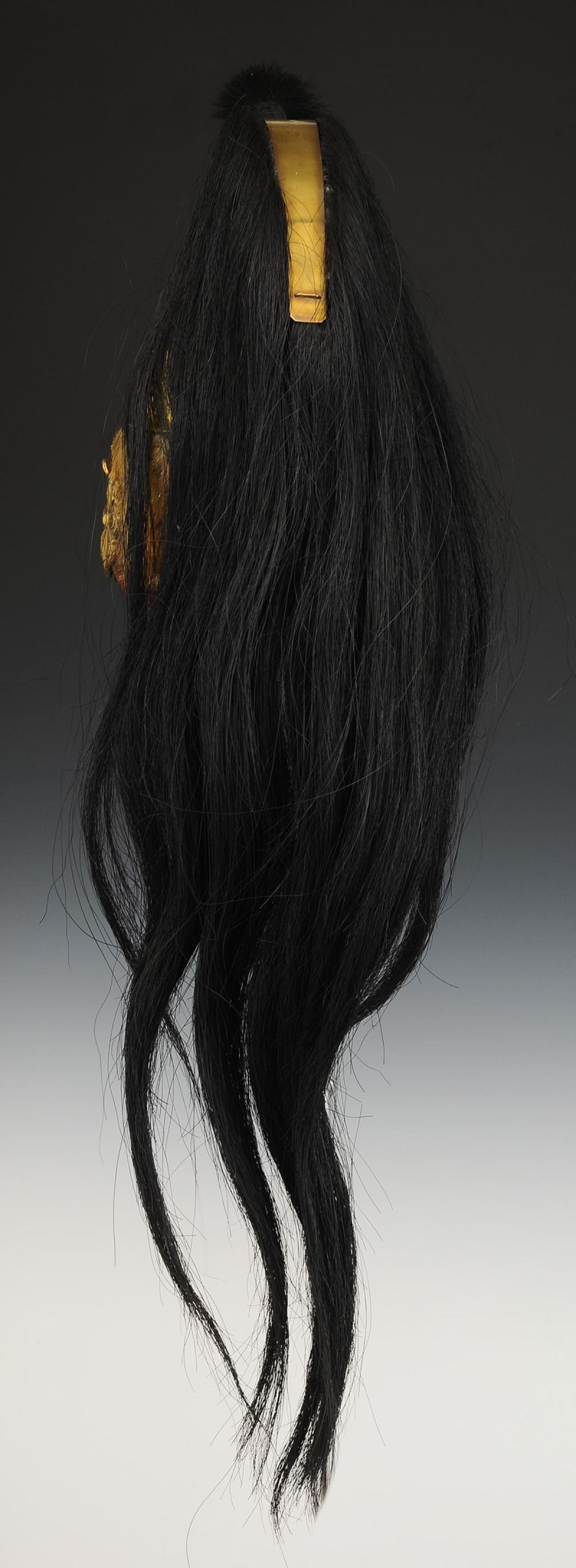
Black horsehair mane. Length approximately 76 cm. Plain brass covering plate. The rear base of the mane is sewn to a strap attached to a counter-strap with a steel buckle, and sewn to the rear of the band. Interior liner composed of a black varnished leather turban topped with an ecru canvas band.
France.
First Empire Style, late 19th-century production.
Very good condition.
Note:
Authors often interchangeably refer to the figure at the top of the crest mask as Gorgon or Medusa.
While in graphical representations, no distinction can be made between these two monsters - a monstrous face with hair made of both hair and snakes, it is important to preserve the word Medusa.
In fact, all texts from that era mention this decoration as the "head of Medusa."
In Greek mythology, the Gorgons are malevolent and hideous creatures, with the ability to petrify anyone who dares look them in the face. According to Hesiod, they were the three daughters of the sea deities Phorcys and Ceto: Stheno, Euryale, and the most famous, Medusa, who was mortal, unlike her two sisters who were immortal and ageless.
PROVENANCE:
Formerly in the collection of Irving Moskowitz (Brooklyn, New York) 1987, then Sheperd Paine (Chicago) 2012, and later Adrian Forman (United Kingdom).
The brass skull (also called cap) is round in shape and measures approximately 10 cm in depth. The lower part is fitted with a gutter in the form of a flat band folded outward by 5 mm wide to prevent water infiltration under the turban.
The turban consists of a leather band approximately 9.5 cm high at the front, 7.5 cm on the sides, and 8 cm at the back. It is covered in a skin of sea seal. At the bottom of the turban at the back, an iron buckle attached to a leather strap allows for tightening and size adjustment using a counter-strap.
The visor is made of black waxed leather sewn at the bottom to the turban, encircled by a brass band folded over the outer edge (apparent width 8 mm), measuring 5 cm at its center.
The chinstraps are formed by two parts: the soft leather chin strap is covered with 13 brass scales, each cut in three scallops; the brass rosette is stamped in the shape of a 5.5 cm diameter palmette.
The plume holder is made of brass in a tubular shape with decreasing section towards the bottom, 5 cm high, with a screw at the top for fastening.
The crest is made of brass with relief-stamped decorations: the fins have a maximum height of 9.5 cm, each struck with 13 ridges; the mask is 12 cm high, 4.2 cm wide; in the upper part, a head of Medusa is represented, and in the lower part, a palmette.
The plume holder, reassembled, is composed of a wooden lens covered with tightly bound black hairs, blooming into a tassel shape. Total height 10 cm.
Black horsehair mane. Length approximately 76 cm. Plain brass covering plate. The rear base of the mane is sewn to a strap attached to a counter-strap with a steel buckle, and sewn to the rear of the band. Interior liner composed of a black varnished leather turban topped with an ecru canvas band.
France.
First Empire Style, late 19th-century production.
Very good condition.
Note:
Authors often interchangeably refer to the figure at the top of the crest mask as Gorgon or Medusa.
While in graphical representations, no distinction can be made between these two monsters - a monstrous face with hair made of both hair and snakes, it is important to preserve the word Medusa.
In fact, all texts from that era mention this decoration as the "head of Medusa."
In Greek mythology, the Gorgons are malevolent and hideous creatures, with the ability to petrify anyone who dares look them in the face. According to Hesiod, they were the three daughters of the sea deities Phorcys and Ceto: Stheno, Euryale, and the most famous, Medusa, who was mortal, unlike her two sisters who were immortal and ageless.
PROVENANCE:
Formerly in the collection of Irving Moskowitz (Brooklyn, New York) 1987, then Sheperd Paine (Chicago) 2012, and later Adrian Forman (United Kingdom).
Reference :
32605
Next update Friday, octobre 23 at 13:30 PM
FOR ALL PURCHASES, PAYMENT IN MULTIPLE CHECKS POSSIBLE
bertrand.malvaux@wanadoo.fr 06 07 75 74 63
SHIPPING COSTS
Shipping costs are calculated only once per order for one or more items, all shipments are sent via registered mail, as this is the only way to have proof of dispatch and receipt.
For parcels whose value cannot be insured by the Post, shipments are entrusted to DHL or Fedex with real value insured, the service is of high quality but the cost is higher.
RETURN POLICY
Items can be returned within 8 days of receipt. They must be returned by registered mail at the sender's expense, in their original packaging, and in their original condition.
AUTHENTICITY
The selection of items offered on this site allows me to guarantee the authenticity of each piece described here, all items offered are guaranteed to be period and authentic, unless otherwise noted or restricted in the description.
An authenticity certificate of the item including the description published on the site, the period, the sale price, accompanied by one or more color photographs is automatically provided for any item priced over 130 euros. Below this price, each certificate is charged 5 euros.
Only items sold by me are subject to an authenticity certificate, I do not provide any expert reports for items sold by third parties (colleagues or collectors).
FOR ALL PURCHASES, PAYMENT IN MULTIPLE CHECKS POSSIBLE
bertrand.malvaux@wanadoo.fr 06 07 75 74 63
An authenticity certificate of the item including the description published on the site, the period, the sale price, accompanied by one or more color photographs is automatically provided for any item priced over 130 euros. Below this price, each certificate is charged 5 euros.
Only items sold by me are subject to an authenticity certificate, I do not provide any expert reports for items sold by third parties (colleagues or collectors).