
LIEUTENANT CLAUDE JOSEPH REVERCHON, OF THE 9th CUIRASSIER REGIMENT, WOUNDED AT THE BATTLE OF WAGRAM: Oil on canvas, First Empire. 32916
Sold out
LIEUTENANT CLAUDE JOSEPH REVERCHON, OF THE 9th REGIMENT OF CUIRASSIERS, WOUNDED IN THE BATTLE OF WAGRAM: Oil on canvas, First Empire. 32916
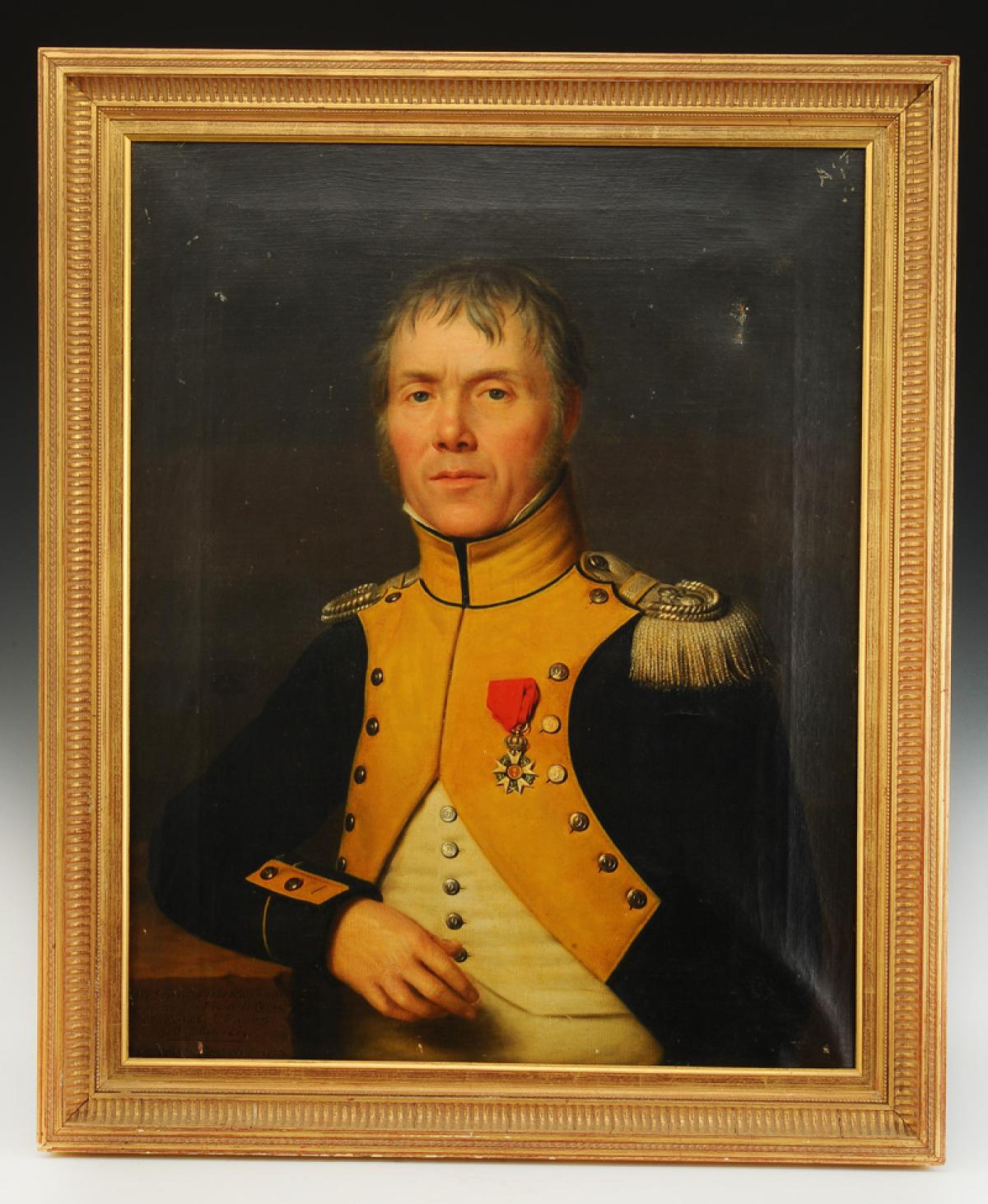
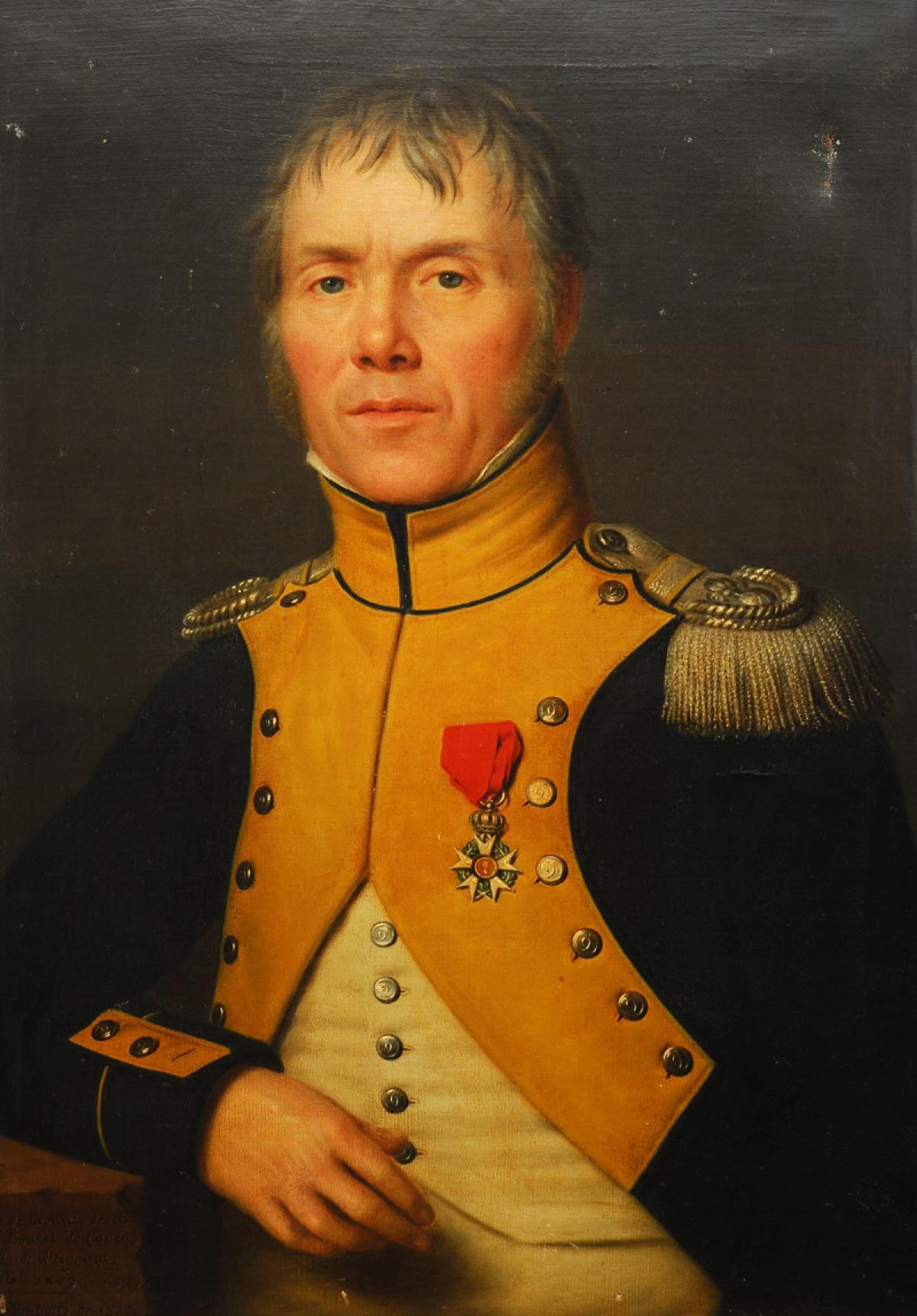
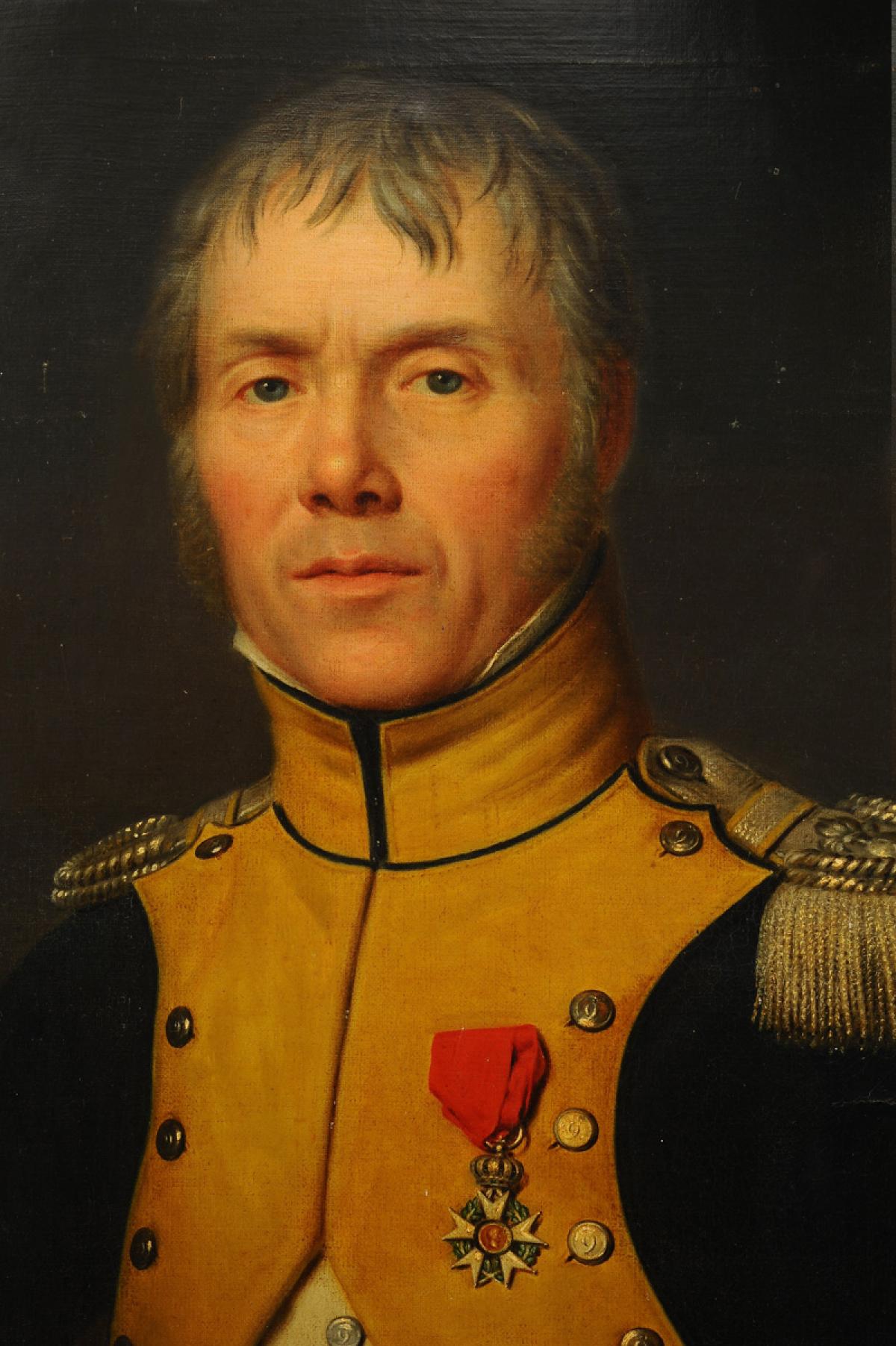
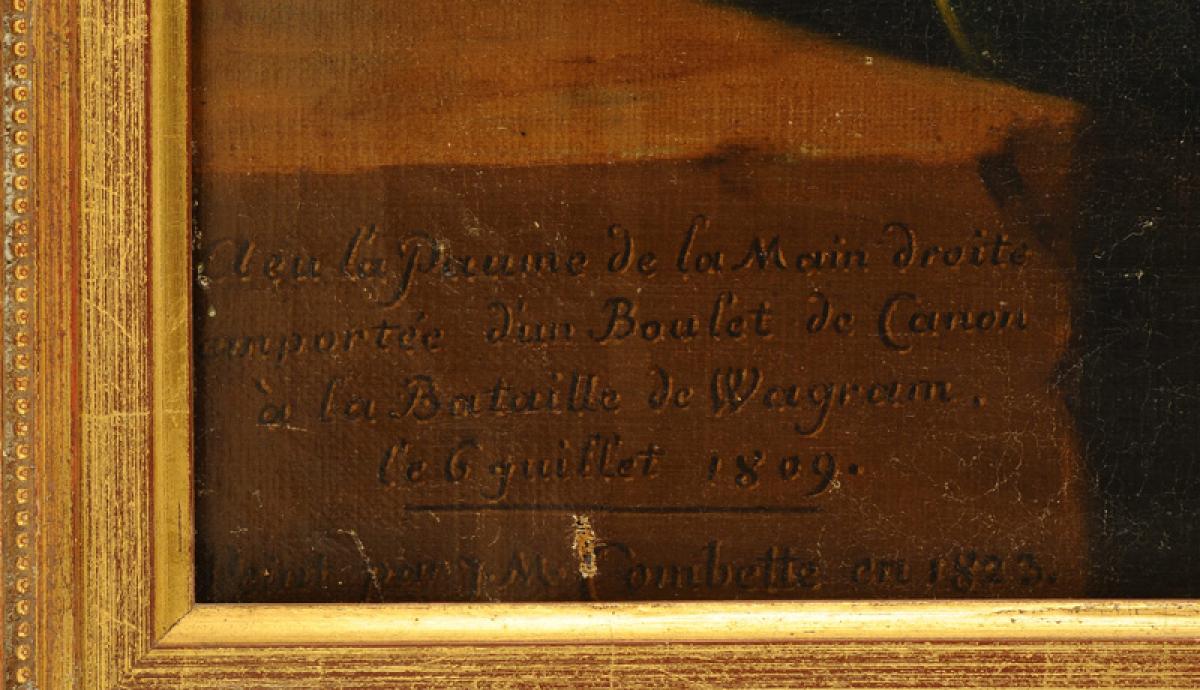
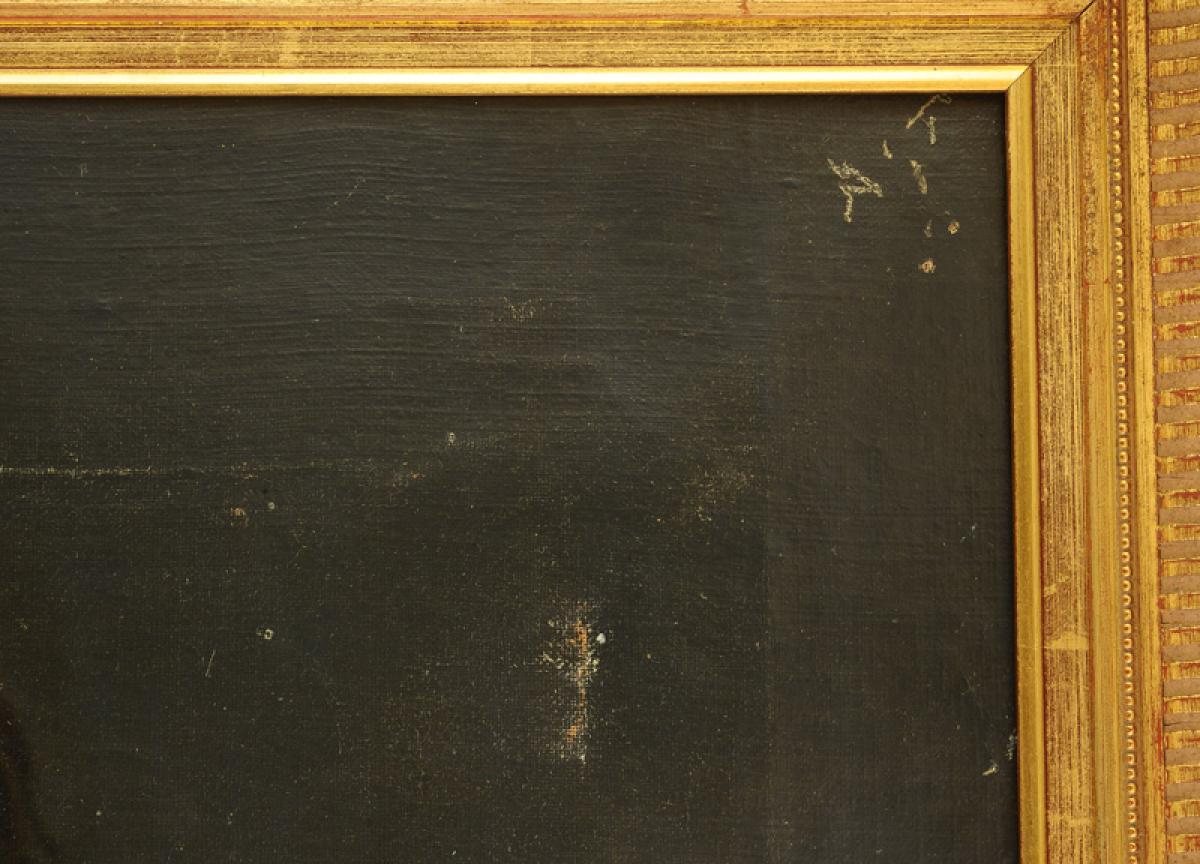
Anonymous oil on canvas. Bust portrait of Lieutenant Claude Joseph Reverchon of the 9th Regiment of Cuirassiers in a dark blue coat with jonquil collar, plastron, and cuff flaps. Silver buttons stamped with the number "9". Silver shoulder and counter-epaulets embroidered with a grenade emblem. Legion of Honor officer's star sewn on his plastron. At the bottom left of the canvas, the inscription reads: "Had the palm of his right hand / taken away by a cannonball / at the Battle of Wagram / on 6 July 1809." "Painted by J.M. Combette in 1823." H 80 cm x 64 cm. Presented in a modern gilt wooden frame, H 94 cm x 76.5 cm. THE REPRODUCED LETTERS ARE IN THE ARCHIVES AND ARE PROVIDED FOR ILLUSTRATIVE PURPOSES ONLY.
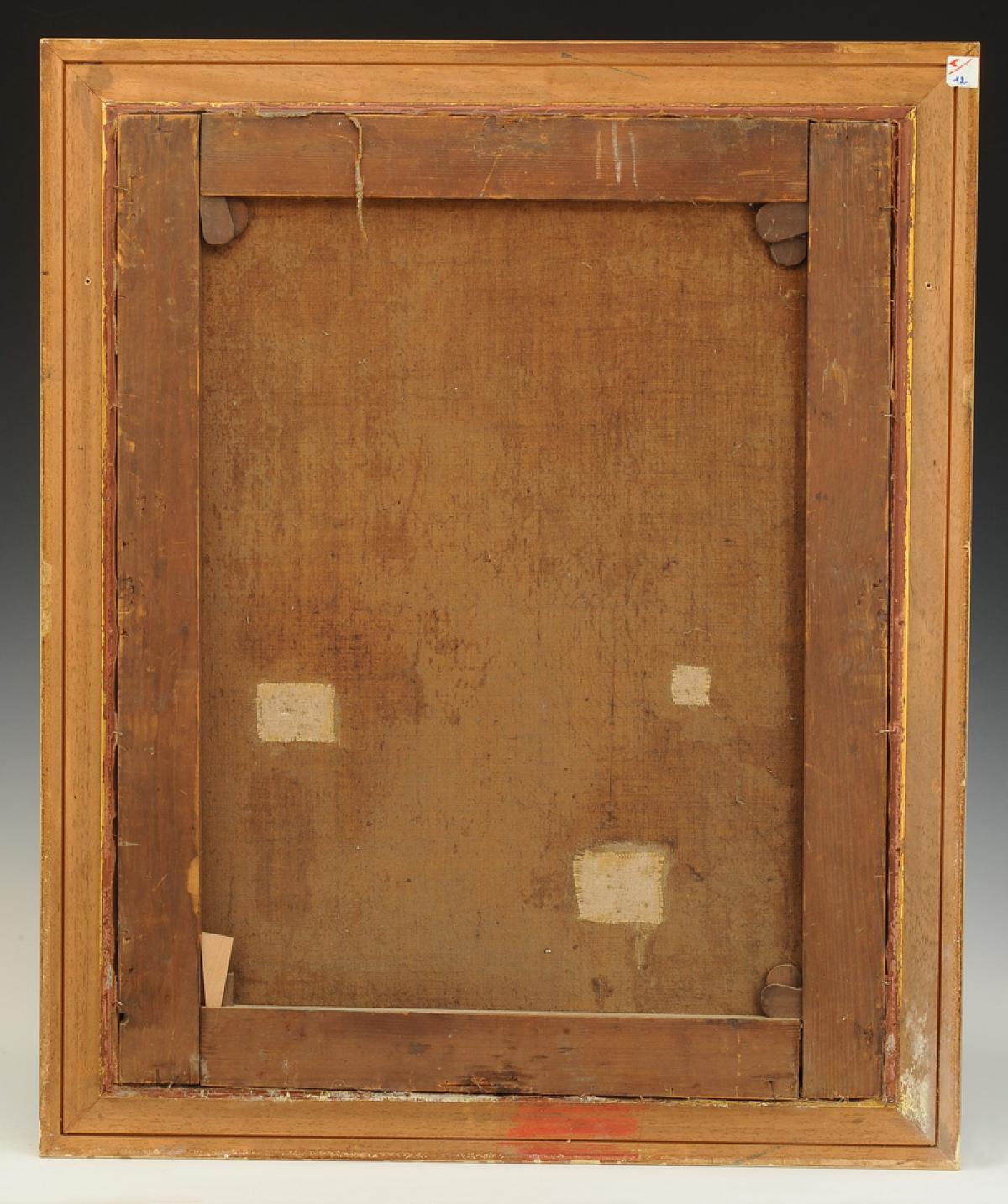
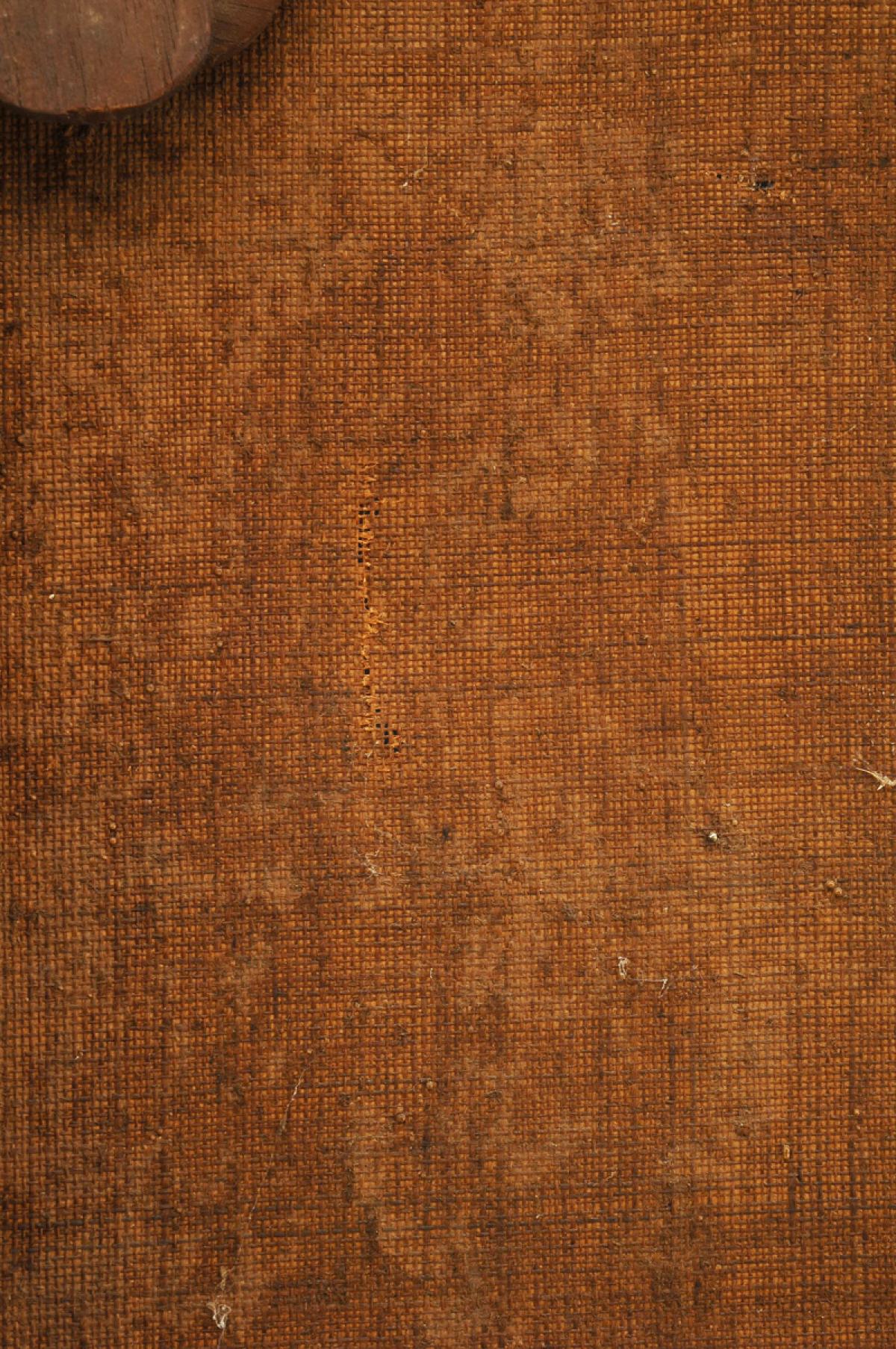
France. First Empire. Good condition, three old canvas repairs, some minor accidents with tiny holes.
NOTE: In the work of Mr. A. Martinien "Paintings by corps and by battle of officers killed and wounded during the wars of the Empire 1805-1815," the author lists seven officers of the 9th regiment of cuirassiers wounded at the Battle of Wagram. However, he made a mistake by citing Lieutenant Millot as part of the 9th when in reality Millot belongs to the 8th Regiment of Cuirassiers: Colonel Pierre-Louis-François Paultre de la Motte, Captain Brice-Pierre Lafleur (maimed in the left foot), Captain Antoine Viel (wounded in the right foot by shell fragments), Lieutenant Reverchon, Sub-Lieutenant Becking, and Sub-Lieutenant Grandidier.
BIOGRAPHY OF LIEUTENANT CLAUDE JOSEPH REVERCHON:
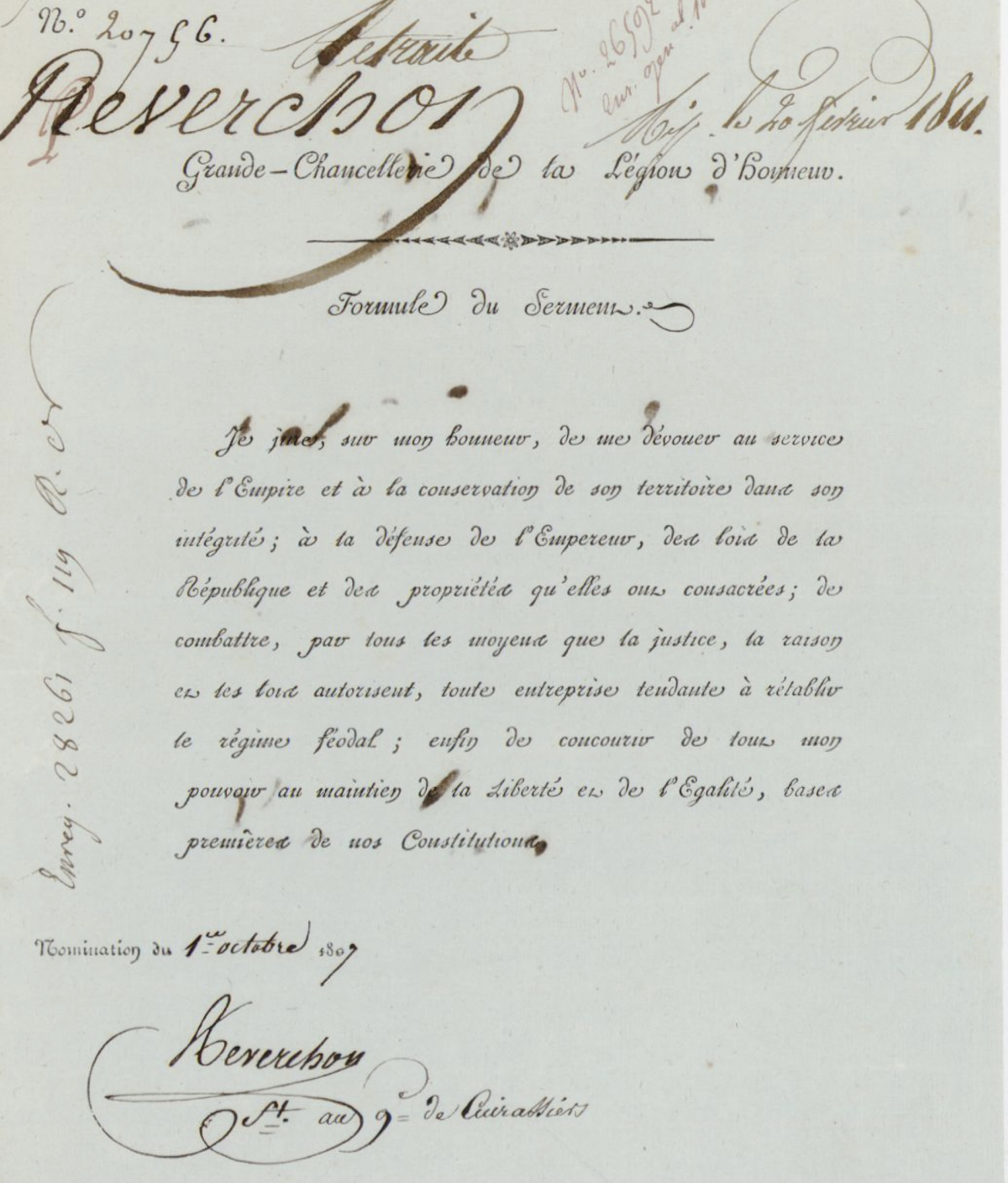
Claude Joseph REVERCHON, born on February 16, 1773, in Châtillon, Jura department, died on September 29, 1829. Son of Jean-Claude REVERCHON and Catherine PIEDAUX. Knight of the Legion of Honor on October 1, 1807, with the order number 20756.
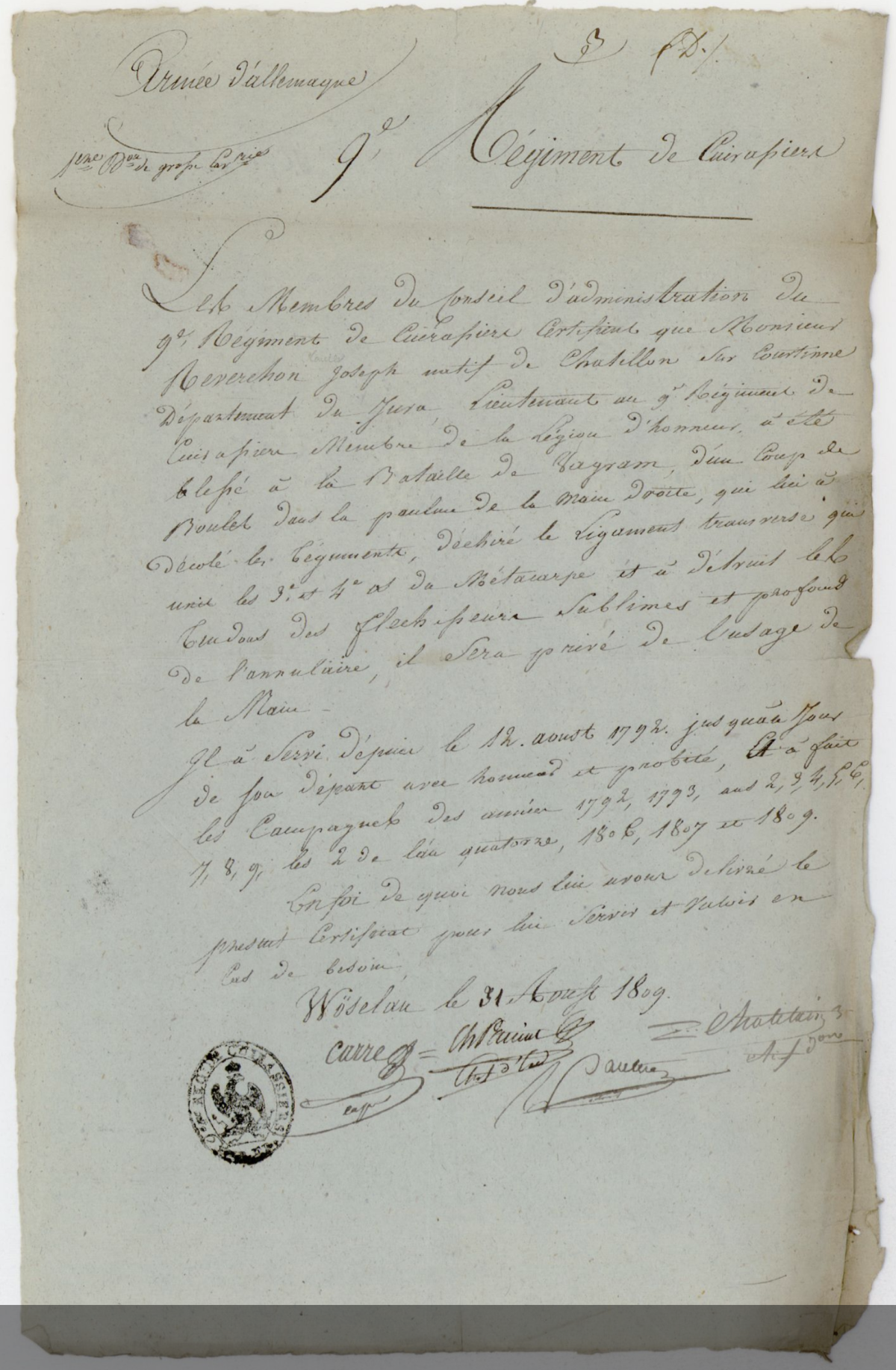
The Archives of the Chancellery of the Legion of Honor hold the following certificate: Document on the letterhead of the Army of Germany, 9th Regiment of Cuirassiers. Stamp of the 9th Regiment of Cuirassiers. The members of the Board of Directors of the 9th Regiment of Cuirassiers "certify that Mr. Reverchon Joseph, native of Châtillon sur Courtine, Jura department, lieutenant in the 9th Regiment of Cuirassiers, a member of the Legion of Honor, was wounded at the Battle of Wagram by a cannonball that removed the ligaments from the palm of his right hand, tore the transverse ligament that connects the 3rd and 4th metacarpal bones, and tore the extensor tendons of the ring finger, rendering the use of his hand impossible. He served with honor and probity from August 12, 1792, until his departure, and took part in the campaigns of the years 1792, 1793, 4, 5, 6, 7, 8, 9, the two of 14, 1806, 1807, and 1809. In witness whereof, we have issued this certificate to serve and be valid in case of need. Wöselau, August 31, 1809."
HISTORICAL BACKGROUND:
The 9th Regiment of Cuirassiers (9e RC) is a cavalry regiment of the French Army created during the Revolution from the Artois Cavalry Regiment, a French cavalry regiment from the Ancien Régime, under the name of the 9th Cavalry Regiment before taking its current name under the First Empire. The 9th Cuirassier Regiment participated in campaigns from 1805 (War of the Third Coalition) with the Grande Armée's reserve cavalry. During the 1805 Austrian campaign, in the War of the Third Coalition, the regiment fought on December 2 at the Battle of Austerlitz. From 1806 to 1808, the regiment was attached to the 1st Cavalry Corps of the Grande Armée. During the War of the Fourth Coalition, it fought on October 14, 1806, at the Battle of Jena, on February 8, 1807, at the Battle of Eylau, and on June 14, 1807, at the Battle of Friedland. In 1809 and 1810, it took part in the German and Austrian campaign. It fought at the Battle of Eckmühl on April 22, 1809, from April 19 to 23 at the Battle of Ratisbon, and on July 5 and 6 at the Battle of Wagram with the reserve cavalry corps. The Grande Armée's bulletin noted, "The cuirassiers, as usual, covered themselves in glory." From 1811 to 1812, the regiment was part of the Elbe observation corps. During the Russian Campaign, it was in the 1st Cuirassier Division from July 25 to 27 at the Battle of Ostrowno, on September 7 at the Battle of Borodino/Moskova, and on October 18 at the Battle of Winkowo. From 1813 to 1814, the regiment was part of the 1st Reserve Cavalry Corps and the garrison of Hamburg. During the German Campaign of 1813, it fought on May 2 at the Battle of Lützen, from May 20 to 21 at the Battle of Bautzen, from May 26 to 27 at the Battle of Dresden, and from October 16 to 19 at the Battle of Leipzig. During the French Campaign of 1814, it fought at the Battle of Saint-Dizier, the Battle of Brienne-le-Château, the Battle of La Rothière, the Battle of Champaubert, on February 14, 1814, at the Battle of Vauchamps, at the Battle of Craonne, at the Battle of Fère-Champenoise, and on March 28 at the Battle of Claye and the Villeparisis skirmish. In 1815, during the Belgian Campaign, it was part of the 3rd Reserve Cavalry Division. It fought at the Battle of Ligny and the Battle of Waterloo. Marshal Soult wrote, "The 9th cuirassiers carried out a charge that routed the enemy." The assets of the 9th cuirassier regiment, disbanded, were transferred to the 6th Cuirassier Regiment, which also received the assets of the former Commissar General.
BIOGRAPHY OF THE PAINTER:
Joseph-Marcellin COMBETTE (1770-1840)
This painter was born in Nozeroy in 1770 and died in Poligny in 1840. He was a student of Melchior Wyrsch (1732-1798), a Swiss painter who, along with Luc Breton, established the School of Fine Arts in Besançon in 1773.
Born to a cobbler father, he was, during his youth, a pupil of Johann Melchior Joseph Wyrsch (1732-1798), a Swiss painter who, along with Luc Breton, established the School of Fine Arts in Besançon in 1773.
• In the late 18th century, Combette moved to Paris, where he studied under sculptor Claude Dejoux (1732-1816). From 1804, he returned to Franche-Comté, specifically to Poligny, where he held the position of drawing professor at the college. He then spent the rest of his life in the region but still participated in three Salons in Paris (1800, 1801, and 1824), indicating a certain national renown.
Combette mainly excelled in creating portraits of families and prominent individuals in the region. Most of his known works focus on a single character with a close-up composition and a uniform background; the faces show great expressiveness, and great attention is paid to clothing details and accompanying accessories. Some paintings also depict group portraits, typically of families depicted in the intimacy of their homes, reflecting the taste of the period.
Combette also created numerous decorations for churches in the region. He was particularly active at the Saint-Hippolyte Church in Poligny, where initially thirteen of his canvases were located (biblical scenes, portraits of saints, and portraits of canons). His religious paintings also show a preference for details, subtle colors, and a smooth, delicate painting style. Attached to his native region, Combette liked to set his religious scenes in typical Jura landscapes.
• History and portrait painter. Joseph-Marcellin Combette was apprenticed to history and portrait painter Johann-Melchior Wyrsch (1732-1798), founder of the Besançon School of Drawing. Combette then established himself in Paris and joined the Parisian workshop of Jura sculptor Claude Dejoux between 1787 and 1804, when he permanently moved to Poligny. He exhibited several portraits at the Salon in 1800 and 1801. In 1806, he became a drawing professor at the Poligny College. While teaching drawing, he pursued a career as a portraitist sought after by local dignitaries. From the inception of the Jura Emulation Society, he was appointed a member.
His production of religious paintings seems to have started later, around 1820. Thus, during the last twenty years of his life, Combette dedicated himself to church paintings. His second wife, also a painter, assisted him in this endeavor, as did his only known student: Laurent Amaudru (1799-1860), a member of the Jura Emulation Society in 1843.
A convinced royalist, Combette was also part of the Poligny Masonic lodge "L'Accord Parfait." The end of his life found him in a precarious financial situation.
A PAINTER AND HIS TIMES
The exhibition Public Portraits, Private Portraits (1770-1830) in 2006 demonstrated the importance of political and social upheavals on portrait issues at the turn of the 18th and 19th centuries. Joseph-Marcellin Combette's career aligns almost exactly with this highly productive period during which painters navigated through several successive regimes and adapted to a society shaped by new rules. His trajectory saw him, on a small scale in Franche-Comté, face the same overturning of traditional values and adapt to the search for new formulas in his art, in line with his new patrons.
However, Combette was not only a portraitist, although his apprenticeship with Johann Melchior Wyrsch early on guided him towards this pictorial genre. He was also a painter of religious compositions, although it must be said that he did not always excel in this field. Between the theory advocated by the Royal Academy and the scale of painting values in provincial artistic circles, there was more than a gap, as the hierarchy of genres remained a rather abstract notion among art enthusiasts in the provinces.
IN SERVICE OF THE CHURCH
Combette's career as a religious painter seems to have started late, as his first known church painting is dated to 1821. Therefore, it was during the last twenty years of his life that Combette dedicated himself to large-scale works, which he likely executed with the help of anonymous assistants, except for Laurent Amaudru (1799-1860). He created several paintings for the Saint-Hippolyte Collegiate Church in Poligny, his adopted town.
His conception of religious painting remained traditional. He drew inspiration from the grand models of the 16th and 17th centuries (Raphael, Poussin, Lebrun). Thus, he created faithful copies rendered in his fluid style and smooth touch.
Anonymous oil on canvas. Bust portrait of Lieutenant Claude Joseph Reverchon of the 9th Regiment of Cuirassiers in a dark blue coat with jonquil collar, plastron, and cuff flaps. Silver buttons stamped with the number "9". Silver shoulder and counter-epaulets embroidered with a grenade emblem. Legion of Honor officer's star sewn on his plastron. At the bottom left of the canvas, the inscription reads: "Had the palm of his right hand / taken away by a cannonball / at the Battle of Wagram / on 6 July 1809." "Painted by J.M. Combette in 1823." H 80 cm x 64 cm. Presented in a modern gilt wooden frame, H 94 cm x 76.5 cm. THE REPRODUCED LETTERS ARE IN THE ARCHIVES AND ARE PROVIDED FOR ILLUSTRATIVE PURPOSES ONLY.
France. First Empire. Good condition, three old canvas repairs, some minor accidents with tiny holes.
NOTE: In the work of Mr. A. Martinien "Paintings by corps and by battle of officers killed and wounded during the wars of the Empire 1805-1815," the author lists seven officers of the 9th regiment of cuirassiers wounded at the Battle of Wagram. However, he made a mistake by citing Lieutenant Millot as part of the 9th when in reality Millot belongs to the 8th Regiment of Cuirassiers: Colonel Pierre-Louis-François Paultre de la Motte, Captain Brice-Pierre Lafleur (maimed in the left foot), Captain Antoine Viel (wounded in the right foot by shell fragments), Lieutenant Reverchon, Sub-Lieutenant Becking, and Sub-Lieutenant Grandidier.
BIOGRAPHY OF LIEUTENANT CLAUDE JOSEPH REVERCHON:
Claude Joseph REVERCHON, born on February 16, 1773, in Châtillon, Jura department, died on September 29, 1829. Son of Jean-Claude REVERCHON and Catherine PIEDAUX. Knight of the Legion of Honor on October 1, 1807, with the order number 20756.
The Archives of the Chancellery of the Legion of Honor hold the following certificate: Document on the letterhead of the Army of Germany, 9th Regiment of Cuirassiers. Stamp of the 9th Regiment of Cuirassiers. The members of the Board of Directors of the 9th Regiment of Cuirassiers "certify that Mr. Reverchon Joseph, native of Châtillon sur Courtine, Jura department, lieutenant in the 9th Regiment of Cuirassiers, a member of the Legion of Honor, was wounded at the Battle of Wagram by a cannonball that removed the ligaments from the palm of his right hand, tore the transverse ligament that connects the 3rd and 4th metacarpal bones, and tore the extensor tendons of the ring finger, rendering the use of his hand impossible. He served with honor and probity from August 12, 1792, until his departure, and took part in the campaigns of the years 1792, 1793, 4, 5, 6, 7, 8, 9, the two of 14, 1806, 1807, and 1809. In witness whereof, we have issued this certificate to serve and be valid in case of need. Wöselau, August 31, 1809."
HISTORICAL BACKGROUND:
The 9th Regiment of Cuirassiers (9e RC) is a cavalry regiment of the French Army created during the Revolution from the Artois Cavalry Regiment, a French cavalry regiment from the Ancien Régime, under the name of the 9th Cavalry Regiment before taking its current name under the First Empire. The 9th Cuirassier Regiment participated in campaigns from 1805 (War of the Third Coalition) with the Grande Armée's reserve cavalry. During the 1805 Austrian campaign, in the War of the Third Coalition, the regiment fought on December 2 at the Battle of Austerlitz. From 1806 to 1808, the regiment was attached to the 1st Cavalry Corps of the Grande Armée. During the War of the Fourth Coalition, it fought on October 14, 1806, at the Battle of Jena, on February 8, 1807, at the Battle of Eylau, and on June 14, 1807, at the Battle of Friedland. In 1809 and 1810, it took part in the German and Austrian campaign. It fought at the Battle of Eckmühl on April 22, 1809, from April 19 to 23 at the Battle of Ratisbon, and on July 5 and 6 at the Battle of Wagram with the reserve cavalry corps. The Grande Armée's bulletin noted, "The cuirassiers, as usual, covered themselves in glory." From 1811 to 1812, the regiment was part of the Elbe observation corps. During the Russian Campaign, it was in the 1st Cuirassier Division from July 25 to 27 at the Battle of Ostrowno, on September 7 at the Battle of Borodino/Moskova, and on October 18 at the Battle of Winkowo. From 1813 to 1814, the regiment was part of the 1st Reserve Cavalry Corps and the garrison of Hamburg. During the German Campaign of 1813, it fought on May 2 at the Battle of Lützen, from May 20 to 21 at the Battle of Bautzen, from May 26 to 27 at the Battle of Dresden, and from October 16 to 19 at the Battle of Leipzig. During the French Campaign of 1814, it fought at the Battle of Saint-Dizier, the Battle of Brienne-le-Château, the Battle of La Rothière, the Battle of Champaubert, on February 14, 1814, at the Battle of Vauchamps, at the Battle of Craonne, at the Battle of Fère-Champenoise, and on March 28 at the Battle of Claye and the Villeparisis skirmish. In 1815, during the Belgian Campaign, it was part of the 3rd Reserve Cavalry Division. It fought at the Battle of Ligny and the Battle of Waterloo. Marshal Soult wrote, "The 9th cuirassiers carried out a charge that routed the enemy." The assets of the 9th cuirassier regiment, disbanded, were transferred to the 6th Cuirassier Regiment, which also received the assets of the former Commissar General.
BIOGRAPHY OF THE PAINTER:
Joseph-Marcellin COMBETTE (1770-1840)
This painter was born in Nozeroy in 1770 and died in Poligny in 1840. He was a student of Melchior Wyrsch (1732-1798), a Swiss painter who, along with Luc Breton, established the School of Fine Arts in Besançon in 1773.
Born to a cobbler father, he was, during his youth, a pupil of Johann Melchior Joseph Wyrsch (1732-1798), a Swiss painter who, along with Luc Breton, established the School of Fine Arts in Besançon in 1773.
• In the late 18th century, Combette moved to Paris, where he studied under sculptor Claude Dejoux (1732-1816). From 1804, he returned to Franche-Comté, specifically to Poligny, where he held the position of drawing professor at the college. He then spent the rest of his life in the region but still participated in three Salons in Paris (1800, 1801, and 1824), indicating a certain national renown.
Combette mainly excelled in creating portraits of families and prominent individuals in the region. Most of his known works focus on a single character with a close-up composition and a uniform background; the faces show great expressiveness, and great attention is paid to clothing details and accompanying accessories. Some paintings also depict group portraits, typically of families depicted in the intimacy of their homes, reflecting the taste of the period.
Combette also created numerous decorations for churches in the region. He was particularly active at the Saint-Hippolyte Church in Poligny, where initially thirteen of his canvases were located (biblical scenes, portraits of saints, and portraits of canons). His religious paintings also show a preference for details, subtle colors, and a smooth, delicate painting style. Attached to his native region, Combette liked to set his religious scenes in typical Jura landscapes.
• History and portrait painter. Joseph-Marcellin Combette was apprenticed to history and portrait painter Johann-Melchior Wyrsch (1732-1798), founder of the Besançon School of Drawing. Combette then established himself in Paris and joined the Parisian workshop of Jura sculptor Claude Dejoux between 1787 and 1804, when he permanently moved to Poligny. He exhibited several portraits at the Salon in 1800 and 1801. In 1806, he became a drawing professor at the Poligny College. While teaching drawing, he pursued a career as a portraitist sought after by local dignitaries. From the inception of the Jura Emulation Society, he was appointed a member.
His production of religious paintings seems to have started later, around 1820. Thus, during the last twenty years of his life, Combette dedicated himself to church paintings. His second wife, also a painter, assisted him in this endeavor, as did his only known student: Laurent Amaudru (1799-1860), a member of the Jura Emulation Society in 1843.
A convinced royalist, Combette was also part of the Poligny Masonic lodge "L'Accord Parfait." The end of his life found him in a precarious financial situation.
A PAINTER AND HIS TIMES
The exhibition Public Portraits, Private Portraits (1770-1830) in 2006 demonstrated the importance of political and social upheavals on portrait issues at the turn of the 18th and 19th centuries. Joseph-Marcellin Combette's career aligns almost exactly with this highly productive period during which painters navigated through several successive regimes and adapted to a society shaped by new rules. His trajectory saw him, on a small scale in Franche-Comté, face the same overturning of traditional values and adapt to the search for new formulas in his art, in line with his new patrons.
However, Combette was not only a portraitist, although his apprenticeship with Johann Melchior Wyrsch early on guided him towards this pictorial genre. He was also a painter of religious compositions, although it must be said that he did not always excel in this field. Between the theory advocated by the Royal Academy and the scale of painting values in provincial artistic circles, there was more than a gap, as the hierarchy of genres remained a rather abstract notion among art enthusiasts in the provinces.
IN SERVICE OF THE CHURCH
Combette's career as a religious painter seems to have started late, as his first known church painting is dated to 1821. Therefore, it was during the last twenty years of his life that Combette dedicated himself to large-scale works, which he likely executed with the help of anonymous assistants, except for Laurent Amaudru (1799-1860). He created several paintings for the Saint-Hippolyte Collegiate Church in Poligny, his adopted town.
His conception of religious painting remained traditional. He drew inspiration from the grand models of the 16th and 17th centuries (Raphael, Poussin, Lebrun). Thus, he created faithful copies rendered in his fluid style and smooth touch.
Reference :
32916
Next update Friday, octobre 9 at 13:30 PM
FOR ALL PURCHASES, PAYMENT IN MULTIPLE CHECKS POSSIBLE
bertrand.malvaux@wanadoo.fr 06 07 75 74 63
SHIPPING COSTS
Shipping costs are calculated only once per order for one or more items, all shipments are sent via registered mail, as this is the only way to have proof of dispatch and receipt.
For parcels whose value cannot be insured by the Post, shipments are entrusted to DHL or Fedex with real value insured, the service is of high quality but the cost is higher.
RETURN POLICY
Items can be returned within 8 days of receipt. They must be returned by registered mail at the sender's expense, in their original packaging, and in their original condition.
AUTHENTICITY
The selection of items offered on this site allows me to guarantee the authenticity of each piece described here, all items offered are guaranteed to be period and authentic, unless otherwise noted or restricted in the description.
An authenticity certificate of the item including the description published on the site, the period, the sale price, accompanied by one or more color photographs is automatically provided for any item priced over 130 euros. Below this price, each certificate is charged 5 euros.
Only items sold by me are subject to an authenticity certificate, I do not provide any expert reports for items sold by third parties (colleagues or collectors).
FOR ALL PURCHASES, PAYMENT IN MULTIPLE CHECKS POSSIBLE
bertrand.malvaux@wanadoo.fr 06 07 75 74 63
An authenticity certificate of the item including the description published on the site, the period, the sale price, accompanied by one or more color photographs is automatically provided for any item priced over 130 euros. Below this price, each certificate is charged 5 euros.
Only items sold by me are subject to an authenticity certificate, I do not provide any expert reports for items sold by third parties (colleagues or collectors).