
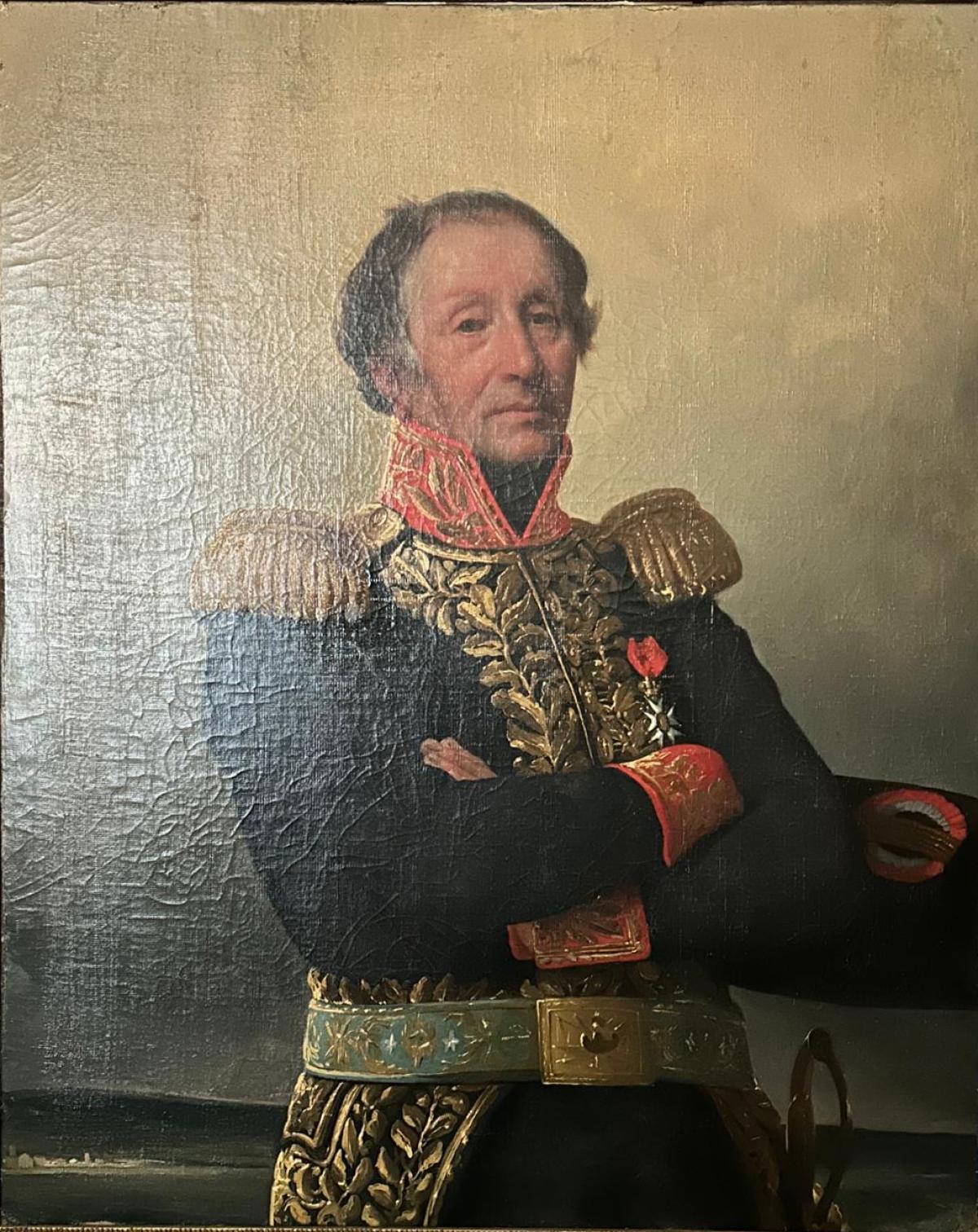
PORTRAIT OF GENERAL JEAN THOMAS IN THE FULL DRESS UNIFORM OF A BRIGADE GENERAL, model of the 1st Vendémiaire Year XII, First Empire (July 22, 1813 - November 27, 1815). Item number 32182.
Sold out
PORTRAIT OF GENERAL JEAN THOMAS IN FULL DRESS UNIFORM OF A BRIGADE GENERAL, model of the 1st day of Vendémiaire year XII, First Empire (July 22, 1813 - November 27, 1815). 32182
Oil on canvas, presented in a gilded wooden frame.
Bust portrait of Brigade General Jean Thomas. He is depicted wearing his full dress uniform, displaying a Knight's Cross of the Legion of Honour, with his sword and bicorn hat adorned with the cockade used on hats during the Hundred Days.
Dimensions: 2 meters x 1 meter.
France.
First Empire.
Very good condition, re-lined, frame with some damages.
NOTE:
This uniform conforms to the regulations of the time: "Regulations on the Uniform of Generals, Staff Officers of the Armies and Garrisons, Officers of the Corps of Engineers, Inspectors at Reviews, War Commissioners, Retired Officers, Officers on Pension, Medical Officers, and Members of the Administration of Military Hospitals. From the 1st... Day of Vendémiaire year XII (September 24, 1803)", regulations published by the Imprimerie de la République in Paris.
The uniforms of general officers are described in "Chapter One. UNIFORM OF GENERALS. Article One".
FAMILY PROVENANCE:
This uniform comes from Mr. Geoffroy Choppin de Janvry (2025), owner of the Albert Morot estate (Beaune) until September 2023, great-nephew of Albert Morot.
• Albert Morot (1830-1902) had a daughter: Berthe Morot (1866-1947).
• Berthe married Louis-Jean Blanlot.
• Berthe had two children, including Yvonne Blanlot (1890-1970).
• Yvonne first married Captain Paul Gonnet-Thomas. He died during a test flight in 1916. Yvonne remarried Albert Choppin, an officer from the same regiment.
• Captain Paul Gonnet-Thomas was the son of Madame Gonnet and a former husband. Madame Gonnet later married Colonel Thomas, who was already elderly. The colonel adopted Paul.
• Colonel Thomas is one of the two sons of General Thomas.
BIOGRAPHY:
General Jean Thomas, born on June 7, 1770 in Cheminot (Trois-Évêchés), died on December 18, 1853 in Ars-Laquenexy (Moselle), was a French general of the Revolution and the Empire.
On August 18, 1791, he was a lieutenant in the 3rd battalion of Moselle volunteers, and became a captain on September 11, commanding the military delegation. He served in the Army of Moselle from April 1, 1792 to July 2, 1794, participating in the defense of Thionville in September 1792. He was wounded at Frœschwiller on December 22, 1793 and took part in the siege of Charleroi in June 1794. Starting from July 2, he served in the Army of Sambre-et-Meuse and in the 53rd half-brigade of line infantry on December 31, 1794.
On May 12, 1796, he joined the 10th half-brigade of line infantry. From 1796 to 1797, he was in the Rhine army, where he was wounded during the battle of Rastatt on July 5, 1796. From 1798 to 1799, he served in the Army of England. His provisional appointment on August 6, 1799, as chief of battalion of the 10th half-brigade of line infantry was officially approved on October 11, 1801. From 1800 to 1806, he was included in the Army of Italy. From 1806 to 1813, he served in the Army of Naples, during which he was wounded during the siege of the fortress of Gaeta on June 27, 1806. He was appointed an officer of the Legion of Honour on July 8, 1806.
In 1807, he was appointed adjutant-commander on September 30, and was integrated into the general staff of the Army of Naples on November 15. In November 1811, he became chief of staff of the observers' corps in Southern Italy, and a year later chief of staff of the 35th infantry division. On May 7, 1813, he was wounded near Nossen before being appointed a brigade general on July 22.
Following the creation of the Grande Armée, he took command of the military department of Manche from October 20, 1813 to July 19, 1814. He was retired from active duty on September 1, 1814. He was made a Knight of the Order of Military Merit on April 15, 1815.
He was placed on leave on April 1, 1820, and retired on January 1, 1825. On January 14, 1831, he returned to service as commander of the Creuse department, and on March 22 of the same year, he was included in the active staff. He retired on July 1, 1832. He passed away in 1853 in Ars-Laquenexy, near Metz, at the age of 83.
THE DEFENSE OF SARRELOUIS IN 1815
Suddenly, on March 10, 1815, it was learned from the courier from Metz that Napoleon had left the island of Elba and was organizing his forces in Cannes. It was like thunder on a clear sky, but with a heavy and electrifying atmosphere. The enthusiasm was indescribable; there was not a dissenter. On the same day, even though Louis XVIII was still in Paris and would only leave on the night of March 19 to 20, the tricolour flag was hoisted on the bell tower of the church in Sarrelouis. However, it soon became necessary to prepare for war once again: the people of Sarrelouis, dreaming only of expelling the Prussians from their vicinity, welcomed this fateful event without hesitation, an opportunity for revenge. As soon as Napoleon arrived in Paris, orders were sent to the authorities of Sarrelouis to arm the fortress and put it in a defensive state; to stockpile three months' worth of supplies for 2,000 men from the region; every inhabitant had to provide themselves with food for the same period. The National Guard was reorganized; under the leadership of General Jean Thomas, everything was prepared with order and patriotic fervor as if expecting an imminent siege.
The troops that were to defend the city consisted of two infantry regiments, the 55th and 68th of the line, two cavalry regiments, firefighters, gendarmes, customs officers, and 1,500 to 1,600 men from the National Guards of the Vosges and Moselle departments.
They were ready to face the enemy head-on, when on June 23, news reached Sarrelouis of the disaster at Waterloo five days earlier. The following day, June 24, the first allied troops arrived to threaten the city. To their great astonishment, they found the people of Sarrelouis, whose courage was not shaken by the alarming news being spread, more determined than ever to energetically defend the place. They stood firm, against all odds, even after Napoleon's departure for Rochefort and the second restoration of Louis XVIII.
Lieutenant General Baron de Diebitsch, chief of staff of the Russian army, wrote on July 1, 1815, to "Mr. Maréchal de Camp, Baron de Thomas, commander of the fortress of Sarrelouis," to assure him, "that the intentions of the Emperor, his august master, are not hostile to France or the French," and to invite him to surrender the place.
General Thomas replied:
"General, I cannot hide my distress at the contents of the letter you have honored me with. As a general officer who knows the duties imposed by the laws of honor, you must understand that my only response to you is to assure you that I will defend the place entrusted to me to the utmost."
An old French émigré, General de Langeron, "general in chief in Russian service," wrote from Sarrebrück on July 5, 1815, to General Thomas:
"Mr. Commander, you are no doubt informed of the events which have happened recently... Your duty and your future interest urge you to hoist this white flag, so dear to good Frenchmen. Remember, Mr. Commander, that Louis XVIII, who has been all too forgiving, did not extend his clemency to Marshal Davoust, who fired on the white flag. It is in the name of Louis XVIII that I urge you to surrender your fortress..."
This letter earned Langeron a harsh lesson in patriotism; General Thomas disdainfully replied: "I have no response to offer you other than to assure you that the misfortunes of my country will never shake my loyalty, and that the place I command will only be surrendered to the government it freely chooses!..."
The next day, on July 6, 1815, it was Prince Charles of Mecklenburg who wrote to General Thomas, informing him that he had arrived with his army corps to besiege Sarrelouis if the general did not surrender: "I trust that your reply, which I will await until noon, will allow me not to act aggressively."
Thomas stoically replied: "...With Emperor Napoleon no longer the head of state, and the high powers having expressly declared that they did not intend to interfere with the Nation's choice of government form, the war being waged against us no longer has any purpose. Allow me to be surprised that hostilities are still being mentioned. I command this fortress in the name of my country and I will hold it to the bitter end, even if it is reduced to ashes. The population and the garrison share my determination."
On the same day, Duke of Mecklenburg passed a secret note to General Thomas in an attempt to corrupt him; he stated: "I am ready to grant you, for your person, the most honorable and advantageous conditions in every way, and it will be a real pleasure for me to anticipate all your desires..."
At the bottom of this letter, written by General Thomas's own hand, it reads: "The aide-de-camp who delivered this was tasked with offering me a so-called gift of 500,000 francs and the rank of lieutenant general in Prussia, should it be to my liking."
Response: "Prince, nothing would please me more than corresponding with Your Highness on any other point than the one addressed in these letters. With my resolve unshaken, my response to your personal letter can only be in accordance with that made to your official letter. I trust that Your Highness will approve it, as it would be your own response in such a circumstance."
While these negotiations were ongoing, revealing the indomitable and chivalrous character of the French warriors during this heroic period of our history, bloody battles continued to take place around the city, with the siege tightening. Despite the enemy's efforts to infiltrate Sarrelouis with letters and packages of newspapers aimed at demoralizing the population and informing them of the events that had shaken France and restored the monarchy, the people of Sarrelouis remained unwavering in their resolve to fight to keep the place until a formal order from the French Government instructed them to open their doors; they refused to negotiate with the enemy.
That order was finally, alas! sent from Paris by the Minister of War on November 27 – it was like a death sentence for the defenders of the place. At the same time, the mayor of Sarrelouis, in a state of shock, received the following letter from the Minister of the Interior:
Paris, November 26, 1815.
"Mr. Mayor, you are no doubt aware of the peace treaty concluded in Paris between the King and the allied Powers... By this treaty, France cedes four places to the Allies: your city is one of these places. I fulfill, Mr. Mayor, a very painful duty, in asking you to prepare your fellow citizens for the sad sacrifice they are forced to make. The King orders me to tell you of his profound sorrow when he saw that an imperative necessity forced him to separate you from his great family... Of all the misfortunes that treachery has inflicted on His Majesty, there is none more severe on Him than the order He is giving me today. The bond that united you to France is broken; His Majesty's affection for you will endure forever... Be his interpreter to your fellow citizens, and tell them that His Majesty offers, on behalf of the nation and in his own name, the sad and final assurances of his regrets and his love..."
The minister, Secretary of State for the Interior,
VAUBLANC.
In reward for their bravery and patriotic loyalty, the people of Sarrelouis were handed over to the enemy they had refused to let into their walls; the heroic General Thomas, who had so intrepidly sought to preserve Sarrelouis for France, ended his military career there and broke his sword. Born in Cheminot (Moselle) on June 7, 1770, he retired to Ars-Laquenexy, near Metz, where, like Cincinnatus, he privately engaged in agriculture until his death.
Disciplined as well as courageous, his soldiers, like the inhabitants of the sacrificed city, submitted to the received orders, with hearts filled with anger and tears. A convention was concluded on November 30 between the Prussian royal commissioner, Major General von Steinmetz, and the French commissioners, the chief delegate being Colonel of Artillery Marion. The French troops, soldiers, and customs officers exited the city in silent ranks, heading towards Metz, under the humiliating supervision of a Prussian officer who escorted them to the end of their ordeal. However, they were granted the honors of war; they withdrew with their arms and belongings. On December 2, 1815, Prussian commissioner Mathias Simon established the governance of the place named Preussich-Saarlouis.
Oil on canvas, presented in a gilded wooden frame.
Bust portrait of Brigade General Jean Thomas. He is depicted wearing his full dress uniform, displaying a Knight's Cross of the Legion of Honour, with his sword and bicorn hat adorned with the cockade used on hats during the Hundred Days.
Dimensions: 2 meters x 1 meter.
France.
First Empire.
Very good condition, re-lined, frame with some damages.
NOTE:
This uniform conforms to the regulations of the time: "Regulations on the Uniform of Generals, Staff Officers of the Armies and Garrisons, Officers of the Corps of Engineers, Inspectors at Reviews, War Commissioners, Retired Officers, Officers on Pension, Medical Officers, and Members of the Administration of Military Hospitals. From the 1st... Day of Vendémiaire year XII (September 24, 1803)", regulations published by the Imprimerie de la République in Paris.
The uniforms of general officers are described in "Chapter One. UNIFORM OF GENERALS. Article One".
FAMILY PROVENANCE:
This uniform comes from Mr. Geoffroy Choppin de Janvry (2025), owner of the Albert Morot estate (Beaune) until September 2023, great-nephew of Albert Morot.
• Albert Morot (1830-1902) had a daughter: Berthe Morot (1866-1947).
• Berthe married Louis-Jean Blanlot.
• Berthe had two children, including Yvonne Blanlot (1890-1970).
• Yvonne first married Captain Paul Gonnet-Thomas. He died during a test flight in 1916. Yvonne remarried Albert Choppin, an officer from the same regiment.
• Captain Paul Gonnet-Thomas was the son of Madame Gonnet and a former husband. Madame Gonnet later married Colonel Thomas, who was already elderly. The colonel adopted Paul.
• Colonel Thomas is one of the two sons of General Thomas.
BIOGRAPHY:
General Jean Thomas, born on June 7, 1770 in Cheminot (Trois-Évêchés), died on December 18, 1853 in Ars-Laquenexy (Moselle), was a French general of the Revolution and the Empire.
On August 18, 1791, he was a lieutenant in the 3rd battalion of Moselle volunteers, and became a captain on September 11, commanding the military delegation. He served in the Army of Moselle from April 1, 1792 to July 2, 1794, participating in the defense of Thionville in September 1792. He was wounded at Frœschwiller on December 22, 1793 and took part in the siege of Charleroi in June 1794. Starting from July 2, he served in the Army of Sambre-et-Meuse and in the 53rd half-brigade of line infantry on December 31, 1794.
On May 12, 1796, he joined the 10th half-brigade of line infantry. From 1796 to 1797, he was in the Rhine army, where he was wounded during the battle of Rastatt on July 5, 1796. From 1798 to 1799, he served in the Army of England. His provisional appointment on August 6, 1799, as chief of battalion of the 10th half-brigade of line infantry was officially approved on October 11, 1801. From 1800 to 1806, he was included in the Army of Italy. From 1806 to 1813, he served in the Army of Naples, during which he was wounded during the siege of the fortress of Gaeta on June 27, 1806. He was appointed an officer of the Legion of Honour on July 8, 1806.
In 1807, he was appointed adjutant-commander on September 30, and was integrated into the general staff of the Army of Naples on November 15. In November 1811, he became chief of staff of the observers' corps in Southern Italy, and a year later chief of staff of the 35th infantry division. On May 7, 1813, he was wounded near Nossen before being appointed a brigade general on July 22.
Following the creation of the Grande Armée, he took command of the military department of Manche from October 20, 1813 to July 19, 1814. He was retired from active duty on September 1, 1814. He was made a Knight of the Order of Military Merit on April 15, 1815.
He was placed on leave on April 1, 1820, and retired on January 1, 1825. On January 14, 1831, he returned to service as commander of the Creuse department, and on March 22 of the same year, he was included in the active staff. He retired on July 1, 1832. He passed away in 1853 in Ars-Laquenexy, near Metz, at the age of 83.
THE DEFENSE OF SARRELOUIS IN 1815
Suddenly, on March 10, 1815, it was learned from the courier from Metz that Napoleon had left the island of Elba and was organizing his forces in Cannes. It was like thunder on a clear sky, but with a heavy and electrifying atmosphere. The enthusiasm was indescribable; there was not a dissenter. On the same day, even though Louis XVIII was still in Paris and would only leave on the night of March 19 to 20, the tricolour flag was hoisted on the bell tower of the church in Sarrelouis. However, it soon became necessary to prepare for war once again: the people of Sarrelouis, dreaming only of expelling the Prussians from their vicinity, welcomed this fateful event without hesitation, an opportunity for revenge. As soon as Napoleon arrived in Paris, orders were sent to the authorities of Sarrelouis to arm the fortress and put it in a defensive state; to stockpile three months' worth of supplies for 2,000 men from the region; every inhabitant had to provide themselves with food for the same period. The National Guard was reorganized; under the leadership of General Jean Thomas, everything was prepared with order and patriotic fervor as if expecting an imminent siege.
The troops that were to defend the city consisted of two infantry regiments, the 55th and 68th of the line, two cavalry regiments, firefighters, gendarmes, customs officers, and 1,500 to 1,600 men from the National Guards of the Vosges and Moselle departments.
They were ready to face the enemy head-on, when on June 23, news reached Sarrelouis of the disaster at Waterloo five days earlier. The following day, June 24, the first allied troops arrived to threaten the city. To their great astonishment, they found the people of Sarrelouis, whose courage was not shaken by the alarming news being spread, more determined than ever to energetically defend the place. They stood firm, against all odds, even after Napoleon's departure for Rochefort and the second restoration of Louis XVIII.
Lieutenant General Baron de Diebitsch, chief of staff of the Russian army, wrote on July 1, 1815, to "Mr. Maréchal de Camp, Baron de Thomas, commander of the fortress of Sarrelouis," to assure him, "that the intentions of the Emperor, his august master, are not hostile to France or the French," and to invite him to surrender the place.
General Thomas replied:
"General, I cannot hide my distress at the contents of the letter you have honored me with. As a general officer who knows the duties imposed by the laws of honor, you must understand that my only response to you is to assure you that I will defend the place entrusted to me to the utmost."
An old French émigré, General de Langeron, "general in chief in Russian service," wrote from Sarrebrück on July 5, 1815, to General Thomas:
"Mr. Commander, you are no doubt informed of the events which have happened recently... Your duty and your future interest urge you to hoist this white flag, so dear to good Frenchmen. Remember, Mr. Commander, that Louis XVIII, who has been all too forgiving, did not extend his clemency to Marshal Davoust, who fired on the white flag. It is in the name of Louis XVIII that I urge you to surrender your fortress..."
This letter earned Langeron a harsh lesson in patriotism; General Thomas disdainfully replied: "I have no response to offer you other than to assure you that the misfortunes of my country will never shake my loyalty, and that the place I command will only be surrendered to the government it freely chooses!..."
The next day, on July 6, 1815, it was Prince Charles of Mecklenburg who wrote to General Thomas, informing him that he had arrived with his army corps to besiege Sarrelouis if the general did not surrender: "I trust that your reply, which I will await until noon, will allow me not to act aggressively."
Thomas stoically replied: "...With Emperor Napoleon no longer the head of state, and the high powers having expressly declared that they did not intend to interfere with the Nation's choice of government form, the war being waged against us no longer has any purpose. Allow me to be surprised that hostilities are still being mentioned. I command this fortress in the name of my country and I will hold it to the bitter end, even if it is reduced to ashes. The population and the garrison share my determination."
On the same day, Duke of Mecklenburg passed a secret note to General Thomas in an attempt to corrupt him; he stated: "I am ready to grant you, for your person, the most honorable and advantageous conditions in every way, and it will be a real pleasure for me to anticipate all your desires..."
At the bottom of this letter, written by General Thomas's own hand, it reads: "The aide-de-camp who delivered this was tasked with offering me a so-called gift of 500,000 francs and the rank of lieutenant general in Prussia, should it be to my liking."
Response: "Prince, nothing would please me more than corresponding with Your Highness on any other point than the one addressed in these letters. With my resolve unshaken, my response to your personal letter can only be in accordance with that made to your official letter. I trust that Your Highness will approve it, as it would be your own response in such a circumstance."
While these negotiations were ongoing, revealing the indomitable and chivalrous character of the French warriors during this heroic period of our history, bloody battles continued to take place around the city, with the siege tightening. Despite the enemy's efforts to infiltrate Sarrelouis with letters and packages of newspapers aimed at demoralizing the population and informing them of the events that had shaken France and restored the monarchy, the people of Sarrelouis remained unwavering in their resolve to fight to keep the place until a formal order from the French Government instructed them to open their doors; they refused to negotiate with the enemy.
That order was finally, alas! sent from Paris by the Minister of War on November 27 – it was like a death sentence for the defenders of the place. At the same time, the mayor of Sarrelouis, in a state of shock, received the following letter from the Minister of the Interior:
Paris, November 26, 1815.
"Mr. Mayor, you are no doubt aware of the peace treaty concluded in Paris between the King and the allied Powers... By this treaty, France cedes four places to the Allies: your city is one of these places. I fulfill, Mr. Mayor, a very painful duty, in asking you to prepare your fellow citizens for the sad sacrifice they are forced to make. The King orders me to tell you of his profound sorrow when he saw that an imperative necessity forced him to separate you from his great family... Of all the misfortunes that treachery has inflicted on His Majesty, there is none more severe on Him than the order He is giving me today. The bond that united you to France is broken; His Majesty's affection for you will endure forever... Be his interpreter to your fellow citizens, and tell them that His Majesty offers, on behalf of the nation and in his own name, the sad and final assurances of his regrets and his love..."
The minister, Secretary of State for the Interior,
VAUBLANC.
In reward for their bravery and patriotic loyalty, the people of Sarrelouis were handed over to the enemy they had refused to let into their walls; the heroic General Thomas, who had so intrepidly sought to preserve Sarrelouis for France, ended his military career there and broke his sword. Born in Cheminot (Moselle) on June 7, 1770, he retired to Ars-Laquenexy, near Metz, where, like Cincinnatus, he privately engaged in agriculture until his death.
Disciplined as well as courageous, his soldiers, like the inhabitants of the sacrificed city, submitted to the received orders, with hearts filled with anger and tears. A convention was concluded on November 30 between the Prussian royal commissioner, Major General von Steinmetz, and the French commissioners, the chief delegate being Colonel of Artillery Marion. The French troops, soldiers, and customs officers exited the city in silent ranks, heading towards Metz, under the humiliating supervision of a Prussian officer who escorted them to the end of their ordeal. However, they were granted the honors of war; they withdrew with their arms and belongings. On December 2, 1815, Prussian commissioner Mathias Simon established the governance of the place named Preussich-Saarlouis.
Reference :
32182
Next update Friday, octobre 23 at 13:30 PM
FOR ALL PURCHASES, PAYMENT IN MULTIPLE CHECKS POSSIBLE
bertrand.malvaux@wanadoo.fr 06 07 75 74 63
SHIPPING COSTS
Shipping costs are calculated only once per order for one or more items, all shipments are sent via registered mail, as this is the only way to have proof of dispatch and receipt.
For parcels whose value cannot be insured by the Post, shipments are entrusted to DHL or Fedex with real value insured, the service is of high quality but the cost is higher.
RETURN POLICY
Items can be returned within 8 days of receipt. They must be returned by registered mail at the sender's expense, in their original packaging, and in their original condition.
AUTHENTICITY
The selection of items offered on this site allows me to guarantee the authenticity of each piece described here, all items offered are guaranteed to be period and authentic, unless otherwise noted or restricted in the description.
An authenticity certificate of the item including the description published on the site, the period, the sale price, accompanied by one or more color photographs is automatically provided for any item priced over 130 euros. Below this price, each certificate is charged 5 euros.
Only items sold by me are subject to an authenticity certificate, I do not provide any expert reports for items sold by third parties (colleagues or collectors).
FOR ALL PURCHASES, PAYMENT IN MULTIPLE CHECKS POSSIBLE
bertrand.malvaux@wanadoo.fr 06 07 75 74 63
An authenticity certificate of the item including the description published on the site, the period, the sale price, accompanied by one or more color photographs is automatically provided for any item priced over 130 euros. Below this price, each certificate is charged 5 euros.
Only items sold by me are subject to an authenticity certificate, I do not provide any expert reports for items sold by third parties (colleagues or collectors).