
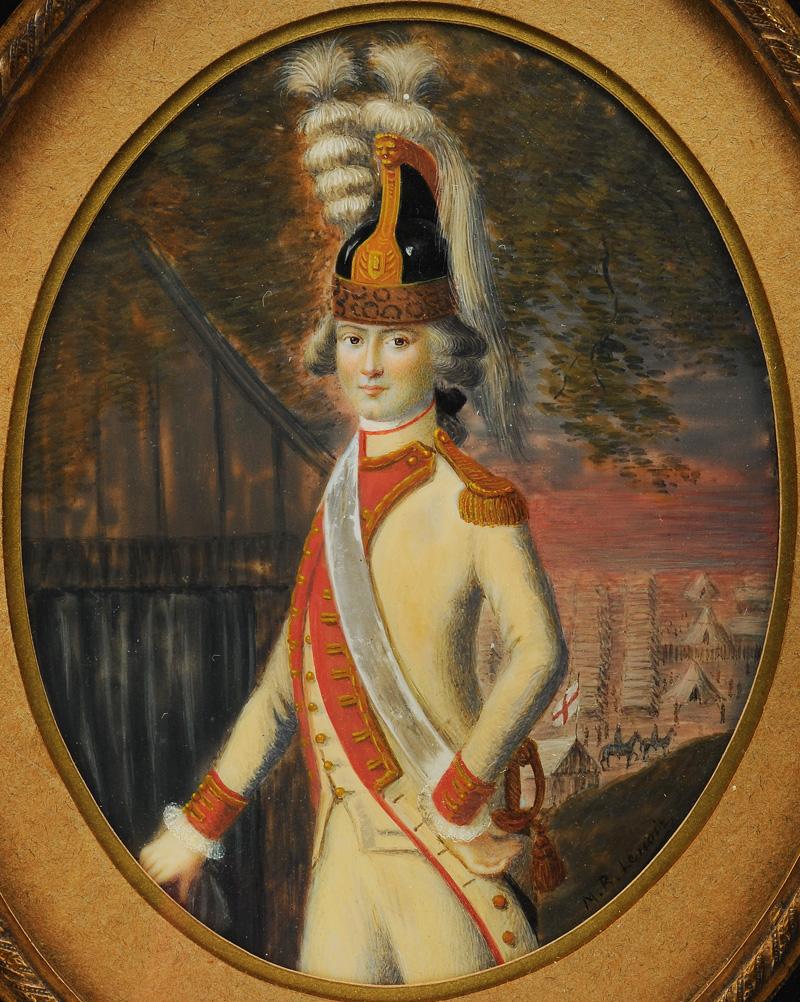
MR LENOIR: CAPTAIN IN SECOND OF COLONEL GENERAL, regulations of 1786, Former Monarchy, reign of Louis XVI, around 1786-1789: miniature portrait. 26642
Sold out
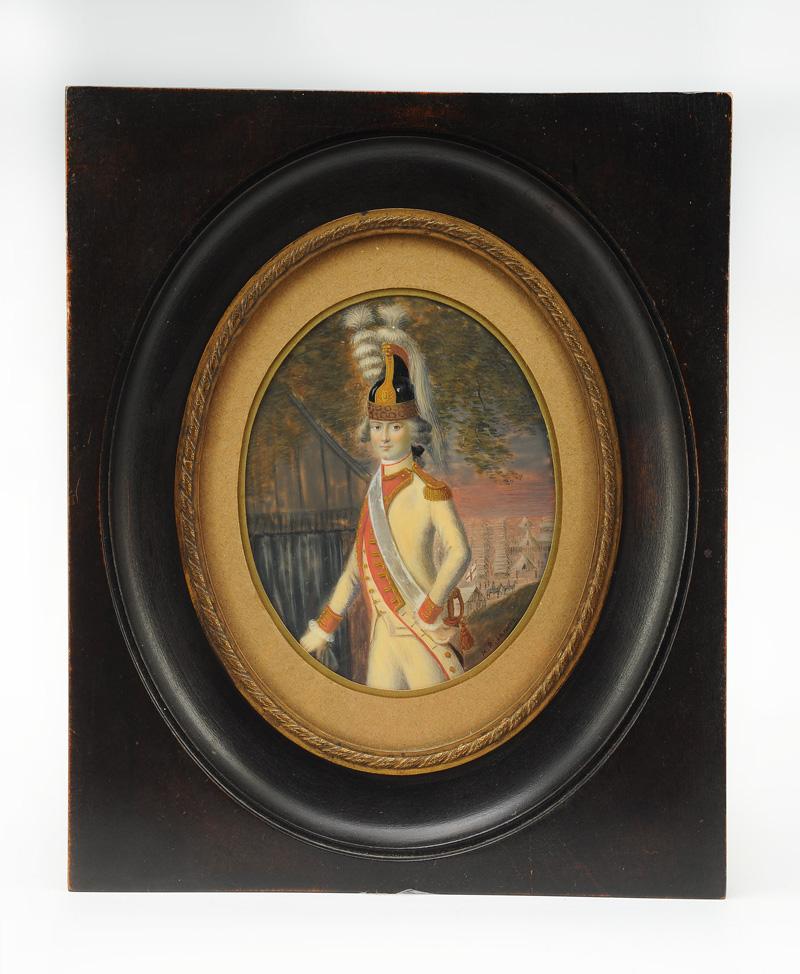
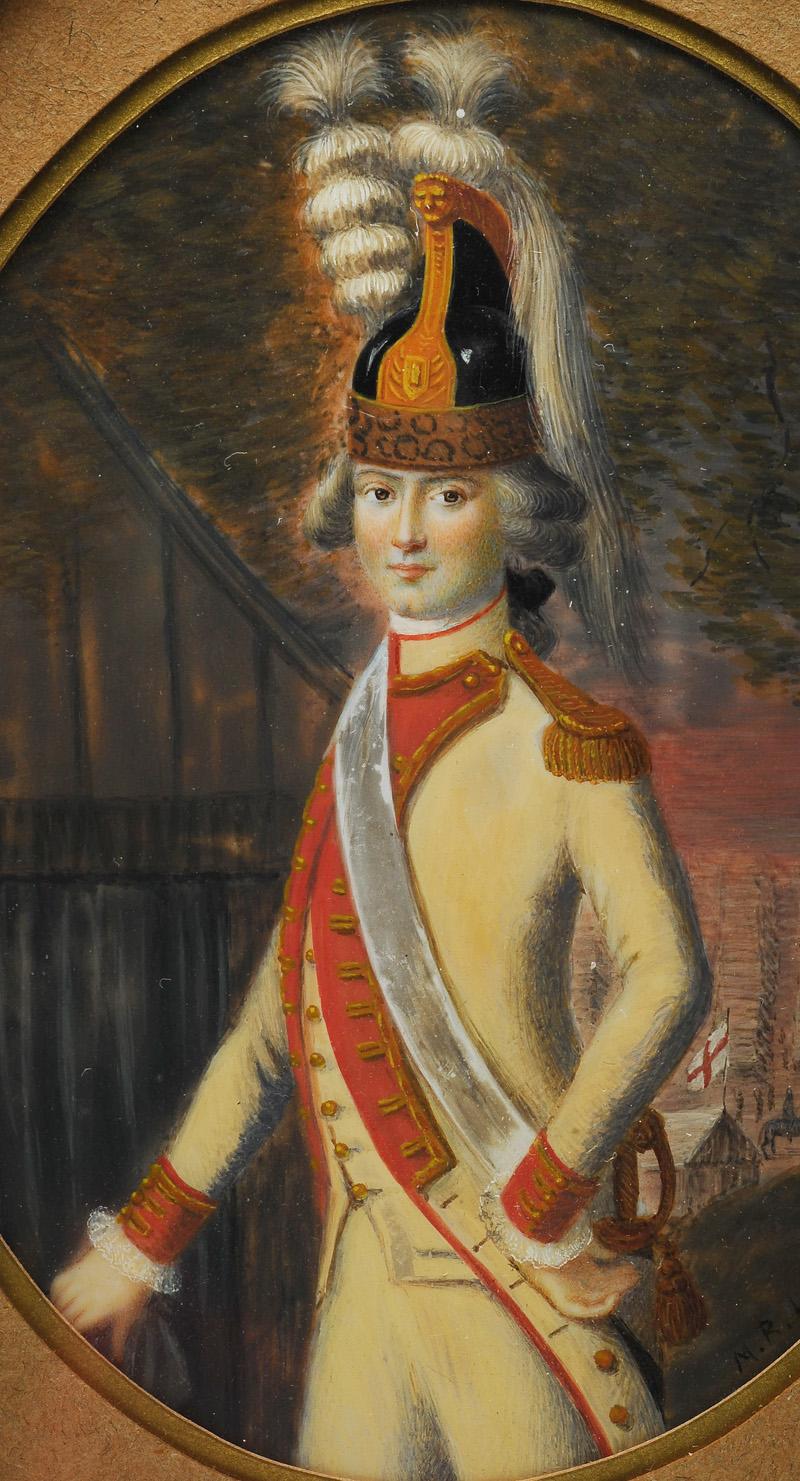
M.R LENOIR: SECOND CAPTAIN TO THE COLONEL GENERAL, 1786 Regulation, Old Monarchy, reign of Louis XVI, around 1786-1789: miniature portrait. 26642
Oval-shaped miniature Height 11 cm, Width 8.5 cm (visible).
Watercolor and gouache on vellum.
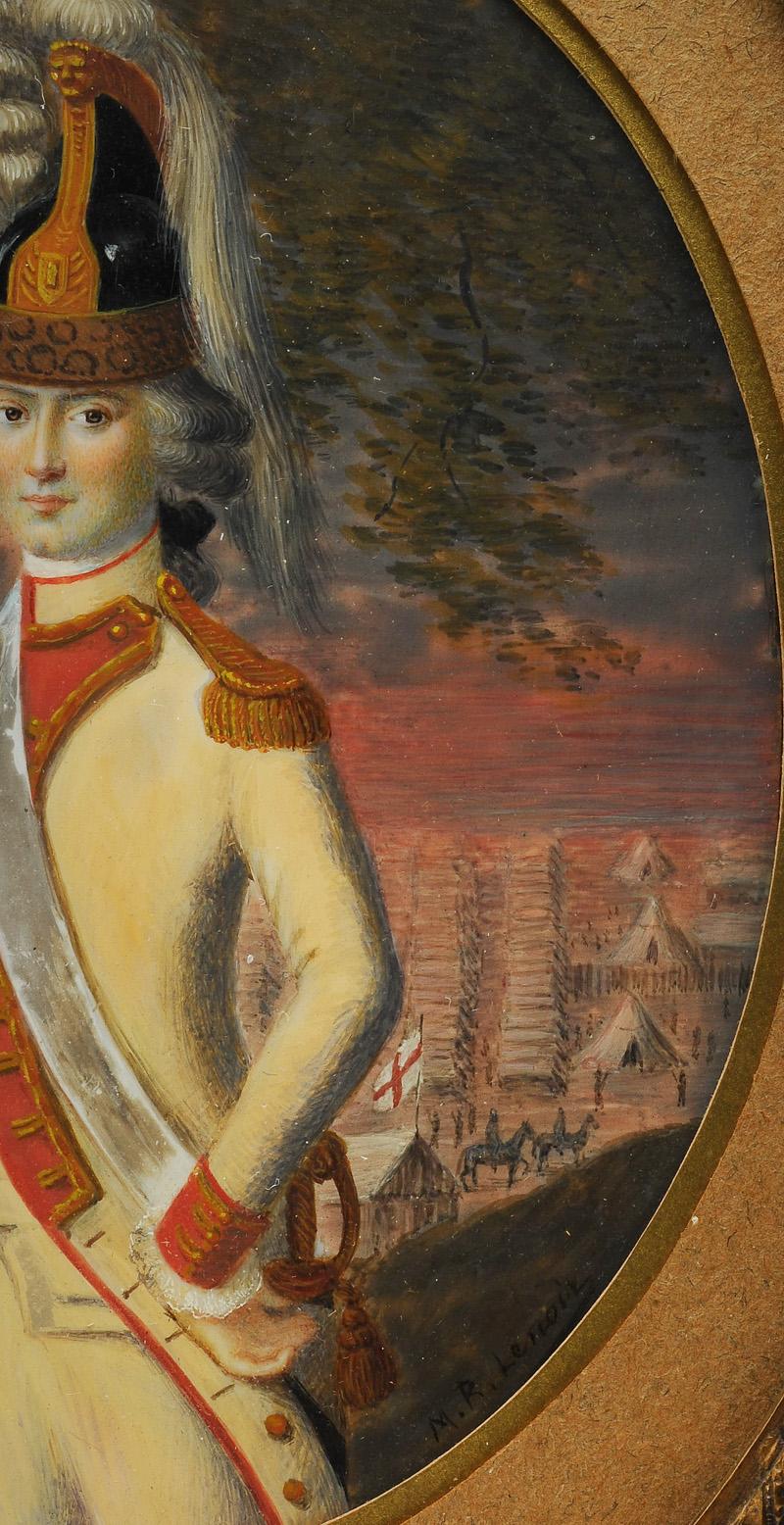
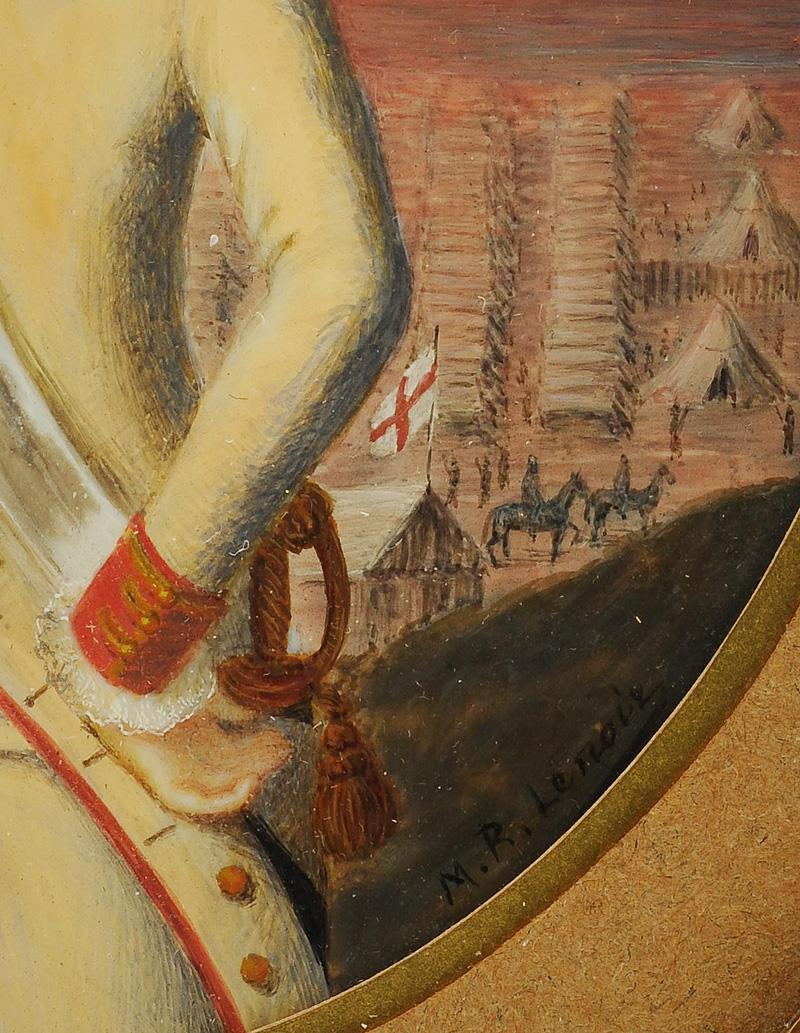
It depicts the officer standing in full dress uniform entirely in white cloth, with crimson velvet pipings, lapels, cuffs, and turnbacks. Straight standing collar piped. Buttoning straight on the chest. The front is adorned with two crimson velvet lapels with ten false buttonholes in golden braiding, golden uniform buttons. Cuffs in crimson velvet and piping of the same color edged with braid and two false buttonholes similar to the lapels. Pair of epaulettes in golden braiding, consisting of a plain epaulette (no fringe) and one with soft fringes known as "cords à puits." White calfskin baldric with gold-mounted sword. The officer is wearing his black varnished leather helmet with gold trimmings, front plate with a fleur-de-lys and the letter "I", black mane and white plume. In the background, a military camp scene is painted.
Signed and dated at the bottom right "OSMONT Henry pixi 80" (1780).
Golden brass frame, glass-protected in a blackened wooden frame, Height 21.8 cm, Width 17.8 cm.
France.
Old Monarchy, reign of Louis XVI, around 1786-1789.
Very good condition.
PROVENANCE:
Former Bernard Franck collection then Raoul and Jean Brunon.
In his work "Idéal vécu," Jean Brunon writes about Bernard Franck's collection: "In my time, the two most important collectors of military memorabilia were firstly André Lévy, and a little later, Dr. Polaillon. There was a third one, Bernard Franck, but his collection, significant in quantity, was somewhat inferior in quality."
…
I met this character in the late 1920s. Bernard Franck, owner of a significant military supplies company, passed away shortly after, and the magnitude of his collections was such that the sales at the Hôtel Drouot spread over several years, with each session offering varied pieces composed of genuine or fake items.
…
The most astonishing set due to its quantity consisted of several hundreds of miniatures, almost all, of course, from the Republic and the Empire. The vast majority of these miniatures, unfortunately, were the work of copyists or even artists for whom Bernard Franck was the ideal client, as their imagination could run wild, knowing that they would find in this uncritical enthusiast buyer. One wonders what has become of these "wonders." Some miniatures were from the Louis XVI era, all authentic.
NOTE:
Representations of officers from the Colonel regiment are rare.
HISTORICAL BACKGROUND:
The Colonel General regiment is an infantry regiment of the Kingdom of France, created in 1480 from the Picardie bands, the oldest military unit, and one of the five "Petits Vieux," which became, during the Revolution, the 1st regiment of the line infantry.
Establishment and Various Designations
October 9, 1480: Creation of the Picardie bands.
May 29, 1569: Creation of the Sarrieu regiment.
1585: Renamed the Picardie regiment.
1780: Renamed the Colonel General regiment, adopting the title of Colonel General regiment. By an ordinance dated April 5 of that year, the king had reinstated the position of Colonel General of the infantry in favor of the Prince of Condé.
1791: Became the 1st regiment of the line infantry formerly Colonel General.
The position of Colonel General of the infantry in favor of the Prince of Condé.
As the first corps of the line infantry, the regiment became the property of the Colonel General and was tasked with guarding his flag.
The Ordnance flag of the Colonel General regiment, as well as its Colonel flag, bears the Latin motto Praetriti fides exemplum que futuri, which translates to "faithfulness to the past, example for the future."
The regiment was stationed in Le Havre in 1781, Lille in 1782, Besançon in 1784, Schelestadt in 1785, Toul in 1787, and again in Lille in 1788.
PROVENANCE:
Former Bernard Franck Collection (1848-1924), industrialist, Paris. Prints and drawings.
Born and died in Paris, Bernard Franck (his descendants later combined the first name and surname and adopted the patronymic name of Bernard-Franck) completed his secondary studies in the city. He then underwent a two-year internship in America. During the 1870 war, he served as a corporal in the "Mobile Corps"; he enlisted for the duration of hostilities in the 1st Zouave Regiment. Captured, he escaped, rejoined the Loire army, and was made a Knight of the Legion of Honor for his outstanding conduct. He, alongside his father, led the family firm founded in 1804 by his grandfather, a manufacturer of military equipment, which still exists today. Grandson and great-nephews of soldiers of the Empire, son of a collector, he naturally became a collector himself, primarily focusing on items related to military life, mainly during the Revolution and the Empire: weapons, insignias, portrait miniatures, paintings, drawings, prints, books, including costume compilations. His interest then extended to display items from the same periods and previous ones, shining with the refined 18th century. The collector often lent items for various exhibitions, such as the retrospective of the 1900 World's Fair (a whole special display case acquired by Pierpont Morgan, now at the Metropolitan Museum in New York), the French 18th-century Art Exhibition, Brussels 1904 (80 pieces); the Centenary Exhibition of Eugène Isabey and Raffet, Paris, 1904 (20 miniatures); the 18th-century Exhibition, Paris, National Library, 1906 (15 miniatures), etc. Part of the collections Bernard Franck had amassed in fifty years of effort was dispersed in around fifteen public sales, most of them anonymous. We provide a summary of the five most significant auctions conducted under his name below. Another section, remaining in the family, suffered substantial theft during the German occupation in the Second World War. Fortunately, whole crates were found and recovered.
The label, in color and gold, is located on the back of the frames.
AUCTIONS
I. February 22-23, 1935, Paris (experts P. Foury, G. Bernard, L. Bourdier). Preface by H. Nocq. 272 lots including 39 of paintings and drawings, 62 of miniatures (by David, Gasparolio, Gigola, Heinsius, J. B. Isabey, Lagrenée, Léandri, Lecour, Nasti, Quaglia, etc.), the others for weapons, decorations, military bronzes, copperware, historical items, etc.
II. March 8-9, 1935, Paris (same experts). Library. 430 lots. Books, albums, and compilations of prints and watercolors related to French and foreign military costumes and historical scenes by: V. Adam, Andrieux, Aubry, Bürger, H. Bellangé, Charlet, Chéreau, A. Dumaresq, Duplessi-Bertaux, Grasset Saint-Sauveur, Gravelot, Imagerie, H. Lalaisse, Martinet, A. Menzel, de Montigny, Raffet, Sergent, H. Vernet, etc., albums or collections of various lithographs: V. Adam, Boilly, La Caricature, Charlet, G. Doré, Gavarni, H. Monnier, etc. Books on fine arts, theater, fashion, Paris and its surroundings (albums of views including Bacler d'Albe, Janinet), etc.
III. March 21-22, 1935, Paris (same experts). 346 lots. Items of the same kind as in the first sale. Among the 60 lots of paintings, watercolors, and engravings, we highlight the series of 8 military costumes engraved after Hoffmann, proof in color, enhanced with gold and silver, and his 2 original gouaches. 109 lots of miniatures.
IV. April 3-4, 1935, Paris (same experts). Similar to the previous one. 449 lots, including 36 for engravings, 47 for paintings, drawings, posters, etc., and 104 for miniatures.
V. February 17, 1955, Paris (experts M. Rousseau, P. Foury, R. J. Charles). Without a catalogue. Watercolors, drawings, pieces related to balloons, popular images, historical scenes, portraits (Napoleonic, French and foreign generals and marshals), military costumes and scenes, prints from the early 19th century, views (France and abroad) "from the former Bernard Franck collection." Key auctions: Kobell, "General Table" of French infantry and cavalry 20,000 francs, same for Austrian infantry and cavalry 26,000 francs; Rugendas, 13 battles 28,000 francs; Debucourt after C. Vernet, Polish Lancers in cantonment and Grand-guard of Polish lancers 20,000 francs.
Other sales of the same provenance, being prepared, will also take place without a catalogue.
Oval-shaped miniature Height 11 cm, Width 8.5 cm (visible).
Watercolor and gouache on vellum.
It depicts the officer standing in full dress uniform entirely in white cloth, with crimson velvet pipings, lapels, cuffs, and turnbacks. Straight standing collar piped. Buttoning straight on the chest. The front is adorned with two crimson velvet lapels with ten false buttonholes in golden braiding, golden uniform buttons. Cuffs in crimson velvet and piping of the same color edged with braid and two false buttonholes similar to the lapels. Pair of epaulettes in golden braiding, consisting of a plain epaulette (no fringe) and one with soft fringes known as "cords à puits." White calfskin baldric with gold-mounted sword. The officer is wearing his black varnished leather helmet with gold trimmings, front plate with a fleur-de-lys and the letter "I", black mane and white plume. In the background, a military camp scene is painted.
Signed and dated at the bottom right "OSMONT Henry pixi 80" (1780).
Golden brass frame, glass-protected in a blackened wooden frame, Height 21.8 cm, Width 17.8 cm.
France.
Old Monarchy, reign of Louis XVI, around 1786-1789.
Very good condition.
PROVENANCE:
Former Bernard Franck collection then Raoul and Jean Brunon.
In his work "Idéal vécu," Jean Brunon writes about Bernard Franck's collection: "In my time, the two most important collectors of military memorabilia were firstly André Lévy, and a little later, Dr. Polaillon. There was a third one, Bernard Franck, but his collection, significant in quantity, was somewhat inferior in quality."
…
I met this character in the late 1920s. Bernard Franck, owner of a significant military supplies company, passed away shortly after, and the magnitude of his collections was such that the sales at the Hôtel Drouot spread over several years, with each session offering varied pieces composed of genuine or fake items.
…
The most astonishing set due to its quantity consisted of several hundreds of miniatures, almost all, of course, from the Republic and the Empire. The vast majority of these miniatures, unfortunately, were the work of copyists or even artists for whom Bernard Franck was the ideal client, as their imagination could run wild, knowing that they would find in this uncritical enthusiast buyer. One wonders what has become of these "wonders." Some miniatures were from the Louis XVI era, all authentic.
NOTE:
Representations of officers from the Colonel regiment are rare.
HISTORICAL BACKGROUND:
The Colonel General regiment is an infantry regiment of the Kingdom of France, created in 1480 from the Picardie bands, the oldest military unit, and one of the five "Petits Vieux," which became, during the Revolution, the 1st regiment of the line infantry.
Establishment and Various Designations
October 9, 1480: Creation of the Picardie bands.
May 29, 1569: Creation of the Sarrieu regiment.
1585: Renamed the Picardie regiment.
1780: Renamed the Colonel General regiment, adopting the title of Colonel General regiment. By an ordinance dated April 5 of that year, the king had reinstated the position of Colonel General of the infantry in favor of the Prince of Condé.
1791: Became the 1st regiment of the line infantry formerly Colonel General.
The position of Colonel General of the infantry in favor of the Prince of Condé.
As the first corps of the line infantry, the regiment became the property of the Colonel General and was tasked with guarding his flag.
The Ordnance flag of the Colonel General regiment, as well as its Colonel flag, bears the Latin motto Praetriti fides exemplum que futuri, which translates to "faithfulness to the past, example for the future."
The regiment was stationed in Le Havre in 1781, Lille in 1782, Besançon in 1784, Schelestadt in 1785, Toul in 1787, and again in Lille in 1788.
PROVENANCE:
Former Bernard Franck Collection (1848-1924), industrialist, Paris. Prints and drawings.
Born and died in Paris, Bernard Franck (his descendants later combined the first name and surname and adopted the patronymic name of Bernard-Franck) completed his secondary studies in the city. He then underwent a two-year internship in America. During the 1870 war, he served as a corporal in the "Mobile Corps"; he enlisted for the duration of hostilities in the 1st Zouave Regiment. Captured, he escaped, rejoined the Loire army, and was made a Knight of the Legion of Honor for his outstanding conduct. He, alongside his father, led the family firm founded in 1804 by his grandfather, a manufacturer of military equipment, which still exists today. Grandson and great-nephews of soldiers of the Empire, son of a collector, he naturally became a collector himself, primarily focusing on items related to military life, mainly during the Revolution and the Empire: weapons, insignias, portrait miniatures, paintings, drawings, prints, books, including costume compilations. His interest then extended to display items from the same periods and previous ones, shining with the refined 18th century. The collector often lent items for various exhibitions, such as the retrospective of the 1900 World's Fair (a whole special display case acquired by Pierpont Morgan, now at the Metropolitan Museum in New York), the French 18th-century Art Exhibition, Brussels 1904 (80 pieces); the Centenary Exhibition of Eugène Isabey and Raffet, Paris, 1904 (20 miniatures); the 18th-century Exhibition, Paris, National Library, 1906 (15 miniatures), etc. Part of the collections Bernard Franck had amassed in fifty years of effort was dispersed in around fifteen public sales, most of them anonymous. We provide a summary of the five most significant auctions conducted under his name below. Another section, remaining in the family, suffered substantial theft during the German occupation in the Second World War. Fortunately, whole crates were found and recovered.
The label, in color and gold, is located on the back of the frames.
AUCTIONS
I. February 22-23, 1935, Paris (experts P. Foury, G. Bernard, L. Bourdier). Preface by H. Nocq. 272 lots including 39 of paintings and drawings, 62 of miniatures (by David, Gasparolio, Gigola, Heinsius, J. B. Isabey, Lagrenée, Léandri, Lecour, Nasti, Quaglia, etc.), the others for weapons, decorations, military bronzes, copperware, historical items, etc.
II. March 8-9, 1935, Paris (same experts). Library. 430 lots. Books, albums, and compilations of prints and watercolors related to French and foreign military costumes and historical scenes by: V. Adam, Andrieux, Aubry, Bürger, H. Bellangé, Charlet, Chéreau, A. Dumaresq, Duplessi-Bertaux, Grasset Saint-Sauveur, Gravelot, Imagerie, H. Lalaisse, Martinet, A. Menzel, de Montigny, Raffet, Sergent, H. Vernet, etc., albums or collections of various lithographs: V. Adam, Boilly, La Caricature, Charlet, G. Doré, Gavarni, H. Monnier, etc. Books on fine arts, theater, fashion, Paris and its surroundings (albums of views including Bacler d'Albe, Janinet), etc.
III. March 21-22, 1935, Paris (same experts). 346 lots. Items of the same kind as in the first sale. Among the 60 lots of paintings, watercolors, and engravings, we highlight the series of 8 military costumes engraved after Hoffmann, proof in color, enhanced with gold and silver, and his 2 original gouaches. 109 lots of miniatures.
IV. April 3-4, 1935, Paris (same experts). Similar to the previous one. 449 lots, including 36 for engravings, 47 for paintings, drawings, posters, etc., and 104 for miniatures.
V. February 17, 1955, Paris (experts M. Rousseau, P. Foury, R. J. Charles). Without a catalogue. Watercolors, drawings, pieces related to balloons, popular images, historical scenes, portraits (Napoleonic, French and foreign generals and marshals), military costumes and scenes, prints from the early 19th century, views (France and abroad) "from the former Bernard Franck collection." Key auctions: Kobell, "General Table" of French infantry and cavalry 20,000 francs, same for Austrian infantry and cavalry 26,000 francs; Rugendas, 13 battles 28,000 francs; Debucourt after C. Vernet, Polish Lancers in cantonment and Grand-guard of Polish lancers 20,000 francs.
Other sales of the same provenance, being prepared, will also take place without a catalogue.
Reference :
26642
Next update Friday, septembre 18 at 13:30 PM
FOR ALL PURCHASES, PAYMENT IN MULTIPLE CHECKS POSSIBLE
bertrand.malvaux@wanadoo.fr 06 07 75 74 63
SHIPPING COSTS
Shipping costs are calculated only once per order for one or more items, all shipments are sent via registered mail, as this is the only way to have proof of dispatch and receipt.
For parcels whose value cannot be insured by the Post, shipments are entrusted to DHL or Fedex with real value insured, the service is of high quality but the cost is higher.
RETURN POLICY
Items can be returned within 8 days of receipt. They must be returned by registered mail at the sender's expense, in their original packaging, and in their original condition.
AUTHENTICITY
The selection of items offered on this site allows me to guarantee the authenticity of each piece described here, all items offered are guaranteed to be period and authentic, unless otherwise noted or restricted in the description.
An authenticity certificate of the item including the description published on the site, the period, the sale price, accompanied by one or more color photographs is automatically provided for any item priced over 130 euros. Below this price, each certificate is charged 5 euros.
Only items sold by me are subject to an authenticity certificate, I do not provide any expert reports for items sold by third parties (colleagues or collectors).
FOR ALL PURCHASES, PAYMENT IN MULTIPLE CHECKS POSSIBLE
bertrand.malvaux@wanadoo.fr 06 07 75 74 63
An authenticity certificate of the item including the description published on the site, the period, the sale price, accompanied by one or more color photographs is automatically provided for any item priced over 130 euros. Below this price, each certificate is charged 5 euros.
Only items sold by me are subject to an authenticity certificate, I do not provide any expert reports for items sold by third parties (colleagues or collectors).