
OIL ON CANVAS PORTRAIT OF COUNT JEAN FRANÇOIS AIMÉ DE JEAN, DIVISION GENERAL, First Empire. 34450


OIL ON CANVAS PORTRAIT OF COUNT JEAN FRANÇOIS AIMÉ DE JEJEAN, DIVISION GENERAL, First Empire. 34450
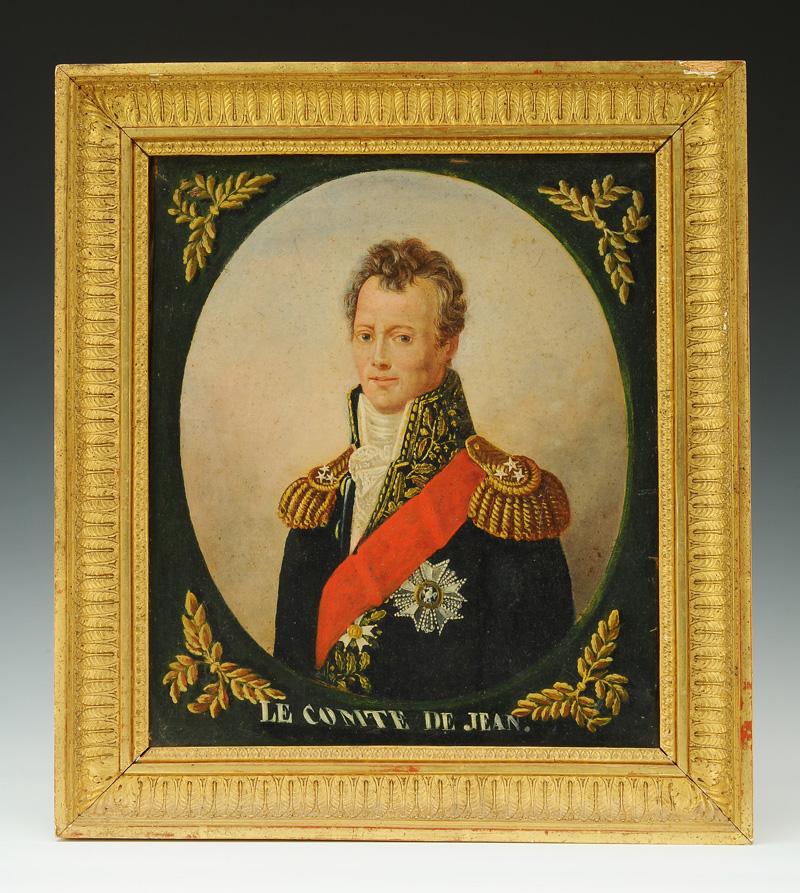
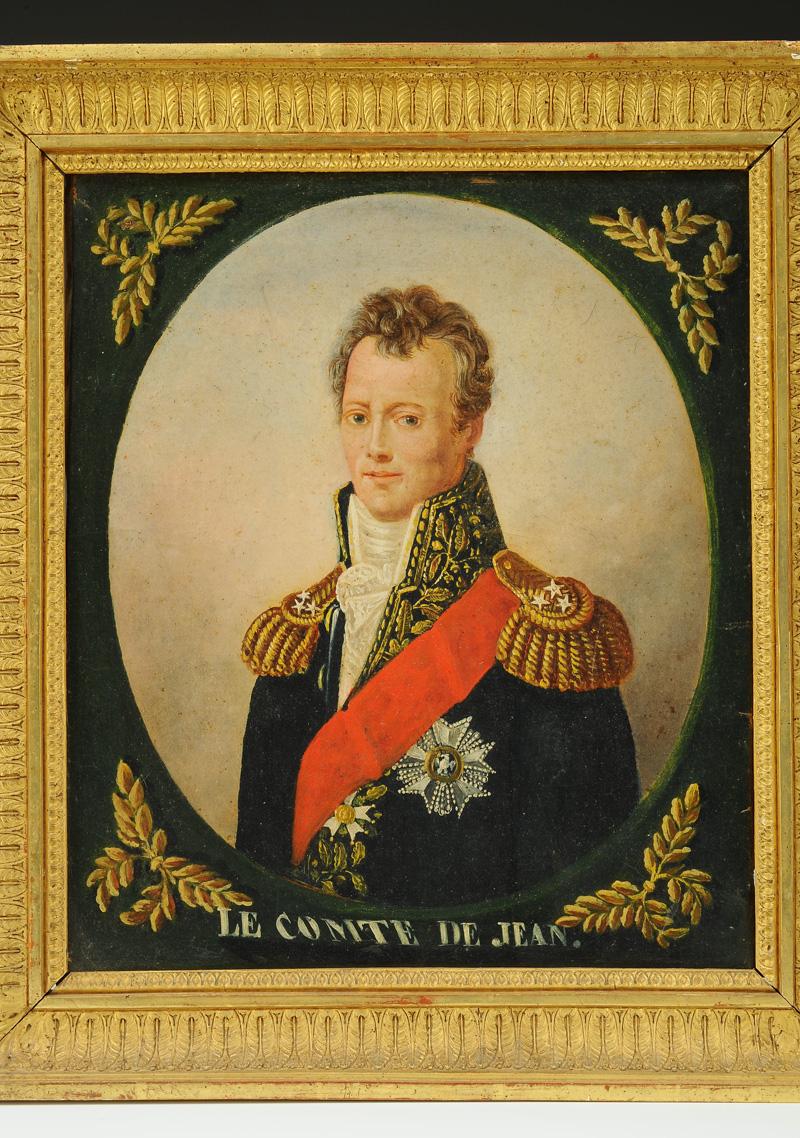
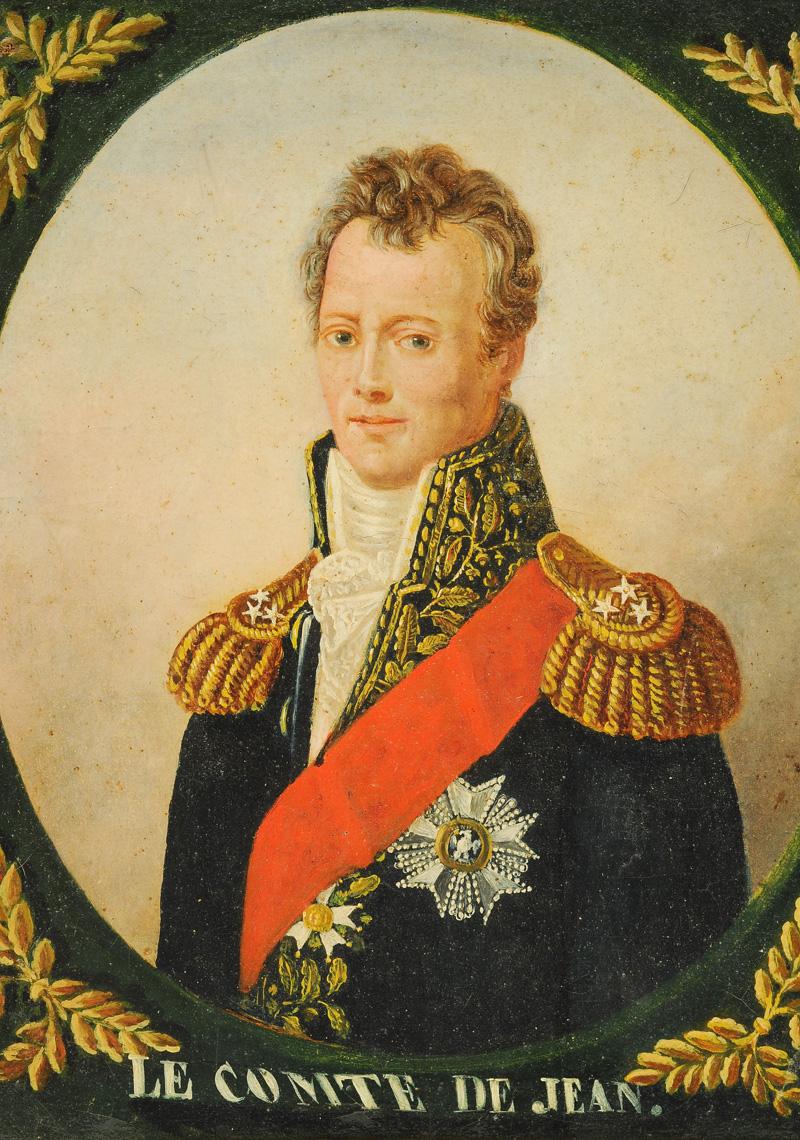
Portrait H 38 cm W 32 cm depicting the General in a small uniform with the Legion of Honor badge and Grand Cordon. He is depicted in a large oval medallion with the inscription "THE COUNT OF JEAN" at the bottom.
Presented in its original gilded wood frame H 48.5 cm, W 43 cm.
France.
First Empire
Oil on canvas in good condition, canvas with a fractured stretcher in fair condition, frame in good condition.
BIOGRAPHY:
Jean François Aimé, Count Dejean (October 6, 1749, Castelnaudary - May 12, 1824, Paris) was a French military officer, general of the French Revolution, then a minister of Napoleon I and senator of the First Empire, who ended his military and parliamentary career (as a member of the Chamber of Peers) during the French Restoration.
Military Engineer
Jean-François-Aimé Dejean was born in Castelnaudary on October 6, 1749. The son of a subdelegate of the Intendance of Languedoc, he was destined by his father for a military career. After completing his initial studies at the École de Sorèze, he graduated in 1766 and joined the Royal School of Engineering at Mézières (class of 1769), where he graduated as a second lieutenant.
Employed in several strongholds, the young Dejean's zeal and extensive knowledge quickly led to his appointment as an ordinary engineer, and later as a chief engineer, from 1781 to 1791. He was in Picardy at the time of the Revolution. The French Revolutionary Wars would open a distinguished career for his talents. A Knight of Saint Louis, he was appointed in 1791 as second in command of the National Guards of the Somme, and later as a member of the administration of that department.
General of the French Revolution
He served under Dumouriez (1792-1793) and submitted his resignation as a captain of engineers upon hearing of the death of Louis XVI; however, he later withdrew the resignation due to the army's setbacks at the same time. Already serving as a battalion chief in the Army of the North, Dejean's brilliant conduct during the capture of the citadel of Antwerp led to his appointment as commander of the engineers under Pichegru and director of fortifications in 1793. In June 1795, he was promoted to the rank of brigadier general in recognition of his services during the attacks on Courtrai and Ménin, as well as the sieges of Nijmegen (18 Brumaire, Year III) and Ypres (1794). Dejean secretly assembled the boats and equipment needed in Holland for the successful Rhine River crossing carried out by Kléber on the night of September 5-6, 1795, above Düsseldorf. His skill and talents in this incident earned him the rank of divisional general on October 10, 1795. Upon his return to the headquarters of the Army of the North shortly after, he assumed temporary command (along with the Franco-Batavian troops) in place of General Beurnonville from September 1796 to September 1797. On September 23, 1797, he was dismissed for refusing to join his army in supporting the grievances of the Army of Italy against the Councils. General Dejean was immediately retired. The following year, at the request of the fortifications committee, he was reinstated in his role as Inspector General of Fortifications.
Minister of Napoleon I
Appointed as a State Councillor after the events of 18 Brumaire, the First Consul entrusted him with several important missions that showcased his administrative and statesman capabilities. He was tasked with implementing the Alexandria Convention and organizing the government of the Ligurian Republic. On 21 Ventôse Year X (March 12, 1802), he was appointed as Minister of War, and on August 21 of the following year, he was elevated to the position of Grand Treasurer of the Legion of Honor. Chosen by Napoleon I in April 1805 to preside over the electoral college of the Somme, he was subsequently elected to the Conservative Senate by the same college.
Dejean was made a Count of the Empire on June 1, 1808. In 1809, during the English landing on the island of Walcheren, he went to Antwerp to organize means of resistance. Shortly after, Napoleon relieved Count Dejean of his position as Minister of War for requesting a higher budget than allocated. However, this disgrace was short-lived, and Napoleon soon appointed him as the Chief Inspector of Engineers (October 25, 1808, with general inspection duties in Holland on April 21, 1810) and a member of the Conservative Senate (February 5, 1810). In 1812, he was elected as a lifetime president of the electoral college of Indre-et-Loire. That same year, he presided over the military commission that sentenced Generals Malet, Lahorie, and Guidal to death.
Member of the Chamber of Peers
Upon the Emperor's abdication, Count Dejean joined the provisional government of 1814. Louis XVIII appointed him as his extraordinary commissioner in the 11th military division (Bordeaux, where he stayed briefly), a Knight of Saint Louis, a "peer of France" (member of the Chamber of Peers), governor of the Polytechnic School, and president of the backlog liquidation committee. With Napoleon's return in 1815, Count Dejean became a member of the new Chamber of Peers; he was reinstated in his position as the Chief Inspector of Engineers and, in the absence of Count Lacépède, also served as the Grand Chancellor of the Legion of Honor. Following the Battle of Waterloo, he strongly dissented with most generals who opposed the defense of Paris, exclaiming, "It is quite astonishing! That men who have been so brave their whole lives show so much weakness."
During the second Restoration, the royal decree of July 24, 1815, stripped Count Dejean of all his functions, "but he found in the esteem and gratitude of his fellow citizens the reward for the services he had rendered to the State, both as a warrior and as an administrator" (Legion of Honor Annals). Nevertheless, he was appointed to lead a military subdivision on December 10, 1817, and reinstated, under the government of Gouvion-Saint-Cyr (Dessolles government), as the Director-General of Subsistence, a position he held until the end of 1820, when his declining health forced him to resign (he was then succeeded by Count Andréossy). On March 19, 1819, he was among the peers created during the Decazes ministry. He sat in the upper house, "where he continued to prove his talents, his strict integrity, and the zeal for the interests of France," (Legion of Honor Annals), among the defenders of the liberties granted by the Charter of 1814.
Count Dejean retired as the Inspector General of Engineers on September 19, 1821. In 1823, he suffered a stroke (cerebral congestion), resulting in hemiplegia (paralysis of the right side of his body). Count Dejean passed away at the age of seventy-four on May 12, 1824, in Paris, at the Hôtel Bochart de Saron (17, Rue de l'Université). He was laid to rest at Père Lachaise Cemetery (40th division), Paris 20th arrondissement.
Portrait H 38 cm W 32 cm depicting the General in a small uniform with the Legion of Honor badge and Grand Cordon. He is depicted in a large oval medallion with the inscription "THE COUNT OF JEAN" at the bottom.
Presented in its original gilded wood frame H 48.5 cm, W 43 cm.
France.
First Empire
Oil on canvas in good condition, canvas with a fractured stretcher in fair condition, frame in good condition.
BIOGRAPHY:
Jean François Aimé, Count Dejean (October 6, 1749, Castelnaudary - May 12, 1824, Paris) was a French military officer, general of the French Revolution, then a minister of Napoleon I and senator of the First Empire, who ended his military and parliamentary career (as a member of the Chamber of Peers) during the French Restoration.
Military Engineer
Jean-François-Aimé Dejean was born in Castelnaudary on October 6, 1749. The son of a subdelegate of the Intendance of Languedoc, he was destined by his father for a military career. After completing his initial studies at the École de Sorèze, he graduated in 1766 and joined the Royal School of Engineering at Mézières (class of 1769), where he graduated as a second lieutenant.
Employed in several strongholds, the young Dejean's zeal and extensive knowledge quickly led to his appointment as an ordinary engineer, and later as a chief engineer, from 1781 to 1791. He was in Picardy at the time of the Revolution. The French Revolutionary Wars would open a distinguished career for his talents. A Knight of Saint Louis, he was appointed in 1791 as second in command of the National Guards of the Somme, and later as a member of the administration of that department.
General of the French Revolution
He served under Dumouriez (1792-1793) and submitted his resignation as a captain of engineers upon hearing of the death of Louis XVI; however, he later withdrew the resignation due to the army's setbacks at the same time. Already serving as a battalion chief in the Army of the North, Dejean's brilliant conduct during the capture of the citadel of Antwerp led to his appointment as commander of the engineers under Pichegru and director of fortifications in 1793. In June 1795, he was promoted to the rank of brigadier general in recognition of his services during the attacks on Courtrai and Ménin, as well as the sieges of Nijmegen (18 Brumaire, Year III) and Ypres (1794). Dejean secretly assembled the boats and equipment needed in Holland for the successful Rhine River crossing carried out by Kléber on the night of September 5-6, 1795, above Düsseldorf. His skill and talents in this incident earned him the rank of divisional general on October 10, 1795. Upon his return to the headquarters of the Army of the North shortly after, he assumed temporary command (along with the Franco-Batavian troops) in place of General Beurnonville from September 1796 to September 1797. On September 23, 1797, he was dismissed for refusing to join his army in supporting the grievances of the Army of Italy against the Councils. General Dejean was immediately retired. The following year, at the request of the fortifications committee, he was reinstated in his role as Inspector General of Fortifications.
Minister of Napoleon I
Appointed as a State Councillor after the events of 18 Brumaire, the First Consul entrusted him with several important missions that showcased his administrative and statesman capabilities. He was tasked with implementing the Alexandria Convention and organizing the government of the Ligurian Republic. On 21 Ventôse Year X (March 12, 1802), he was appointed as Minister of War, and on August 21 of the following year, he was elevated to the position of Grand Treasurer of the Legion of Honor. Chosen by Napoleon I in April 1805 to preside over the electoral college of the Somme, he was subsequently elected to the Conservative Senate by the same college.
Dejean was made a Count of the Empire on June 1, 1808. In 1809, during the English landing on the island of Walcheren, he went to Antwerp to organize means of resistance. Shortly after, Napoleon relieved Count Dejean of his position as Minister of War for requesting a higher budget than allocated. However, this disgrace was short-lived, and Napoleon soon appointed him as the Chief Inspector of Engineers (October 25, 1808, with general inspection duties in Holland on April 21, 1810) and a member of the Conservative Senate (February 5, 1810). In 1812, he was elected as a lifetime president of the electoral college of Indre-et-Loire. That same year, he presided over the military commission that sentenced Generals Malet, Lahorie, and Guidal to death.
Member of the Chamber of Peers
Upon the Emperor's abdication, Count Dejean joined the provisional government of 1814. Louis XVIII appointed him as his extraordinary commissioner in the 11th military division (Bordeaux, where he stayed briefly), a Knight of Saint Louis, a "peer of France" (member of the Chamber of Peers), governor of the Polytechnic School, and president of the backlog liquidation committee. With Napoleon's return in 1815, Count Dejean became a member of the new Chamber of Peers; he was reinstated in his position as the Chief Inspector of Engineers and, in the absence of Count Lacépède, also served as the Grand Chancellor of the Legion of Honor. Following the Battle of Waterloo, he strongly dissented with most generals who opposed the defense of Paris, exclaiming, "It is quite astonishing! That men who have been so brave their whole lives show so much weakness."
During the second Restoration, the royal decree of July 24, 1815, stripped Count Dejean of all his functions, "but he found in the esteem and gratitude of his fellow citizens the reward for the services he had rendered to the State, both as a warrior and as an administrator" (Legion of Honor Annals). Nevertheless, he was appointed to lead a military subdivision on December 10, 1817, and reinstated, under the government of Gouvion-Saint-Cyr (Dessolles government), as the Director-General of Subsistence, a position he held until the end of 1820, when his declining health forced him to resign (he was then succeeded by Count Andréossy). On March 19, 1819, he was among the peers created during the Decazes ministry. He sat in the upper house, "where he continued to prove his talents, his strict integrity, and the zeal for the interests of France," (Legion of Honor Annals), among the defenders of the liberties granted by the Charter of 1814.
Count Dejean retired as the Inspector General of Engineers on September 19, 1821. In 1823, he suffered a stroke (cerebral congestion), resulting in hemiplegia (paralysis of the right side of his body). Count Dejean passed away at the age of seventy-four on May 12, 1824, in Paris, at the Hôtel Bochart de Saron (17, Rue de l'Université). He was laid to rest at Père Lachaise Cemetery (40th division), Paris 20th arrondissement.
Price :
1 200,00 €
| Destination | Envoi recommandé | Envoi Recommandé + Express |
|---|---|---|
| Shipping France | 25,00 € | 60,00 € |
| Shipping Europe | 30,00 € | 80,00 € |
| Shipping world | 90,00 € | 250,00 € |
Insurance (1%) :
12,00 €
Reference :
34450 (23016)

Next update Friday, octobre 2 at 13:30 PM
FOR ALL PURCHASES, PAYMENT IN MULTIPLE CHECKS POSSIBLE
bertrand.malvaux@wanadoo.fr 06 07 75 74 63
SHIPPING COSTS
Shipping costs are calculated only once per order for one or more items, all shipments are sent via registered mail, as this is the only way to have proof of dispatch and receipt.
For parcels whose value cannot be insured by the Post, shipments are entrusted to DHL or Fedex with real value insured, the service is of high quality but the cost is higher.
RETURN POLICY
Items can be returned within 8 days of receipt. They must be returned by registered mail at the sender's expense, in their original packaging, and in their original condition.
AUTHENTICITY
The selection of items offered on this site allows me to guarantee the authenticity of each piece described here, all items offered are guaranteed to be period and authentic, unless otherwise noted or restricted in the description.
An authenticity certificate of the item including the description published on the site, the period, the sale price, accompanied by one or more color photographs is automatically provided for any item priced over 130 euros. Below this price, each certificate is charged 5 euros.
Only items sold by me are subject to an authenticity certificate, I do not provide any expert reports for items sold by third parties (colleagues or collectors).
FOR ALL PURCHASES, PAYMENT IN MULTIPLE CHECKS POSSIBLE
bertrand.malvaux@wanadoo.fr 06 07 75 74 63
An authenticity certificate of the item including the description published on the site, the period, the sale price, accompanied by one or more color photographs is automatically provided for any item priced over 130 euros. Below this price, each certificate is charged 5 euros.
Only items sold by me are subject to an authenticity certificate, I do not provide any expert reports for items sold by third parties (colleagues or collectors).