
TOILETRY KIT BELONGING TO GENERAL JEAN MAXIMILIEN, BARON LAMARQUE, First Empire. 34443

TOILETRY CASE ONCE BELONGING TO GENERAL JEAN MAXIMILIEN, BARON LAMARQUE, First Empire. 34443
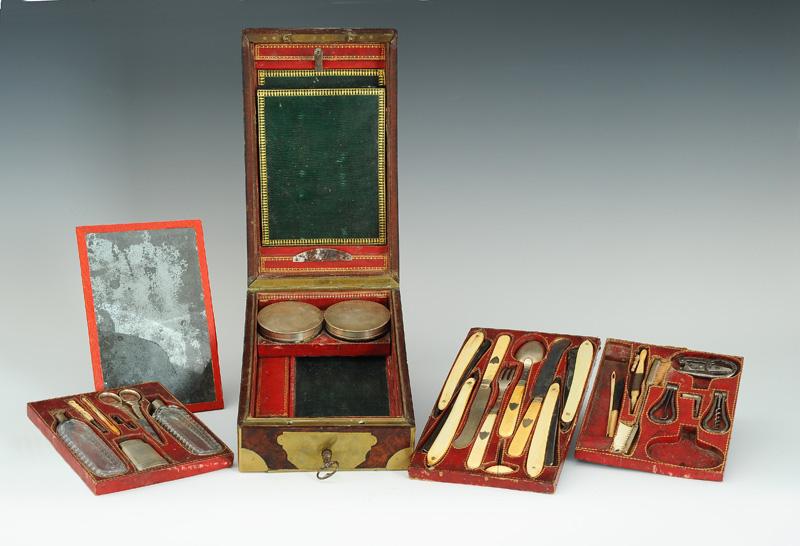
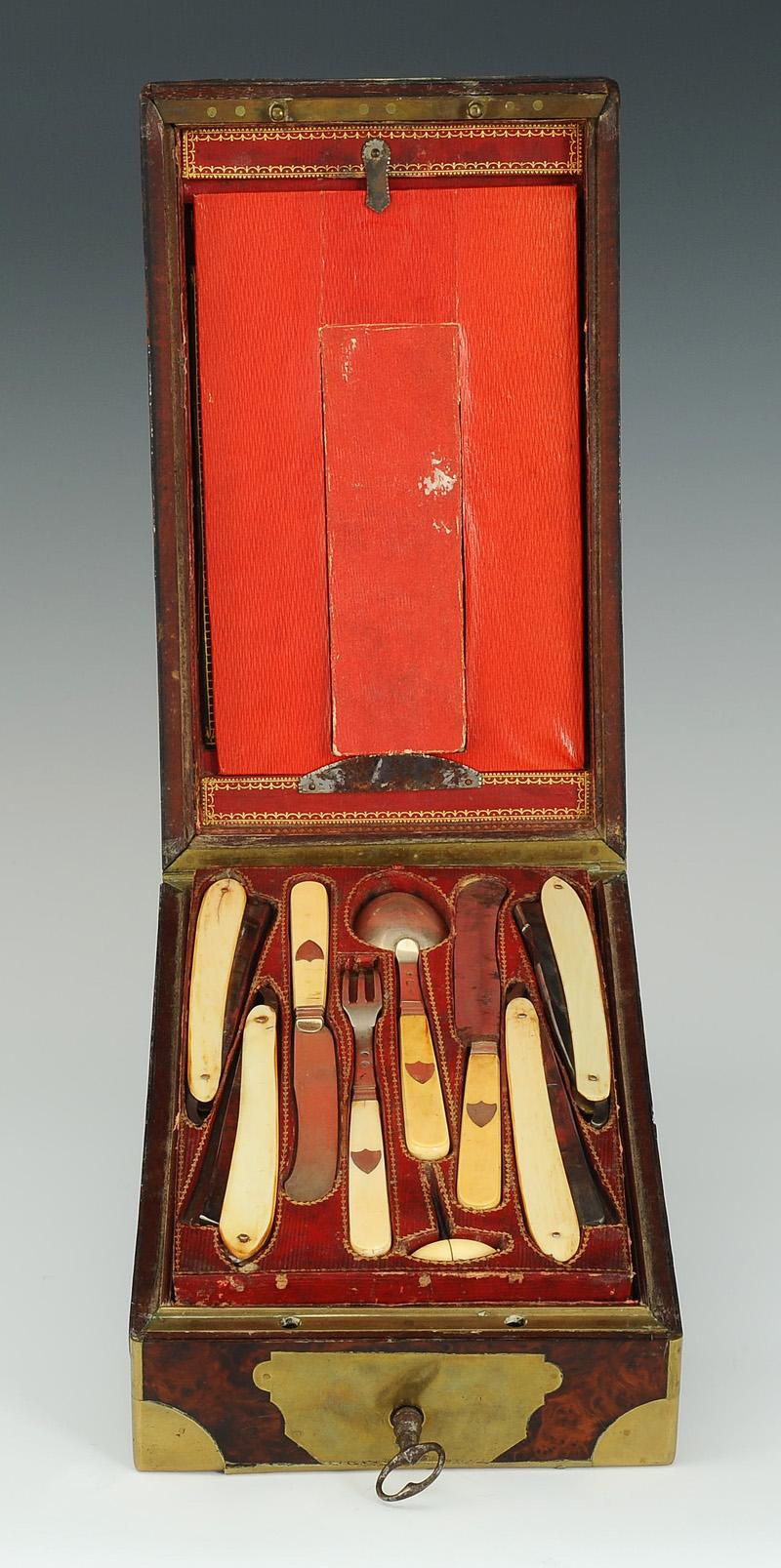
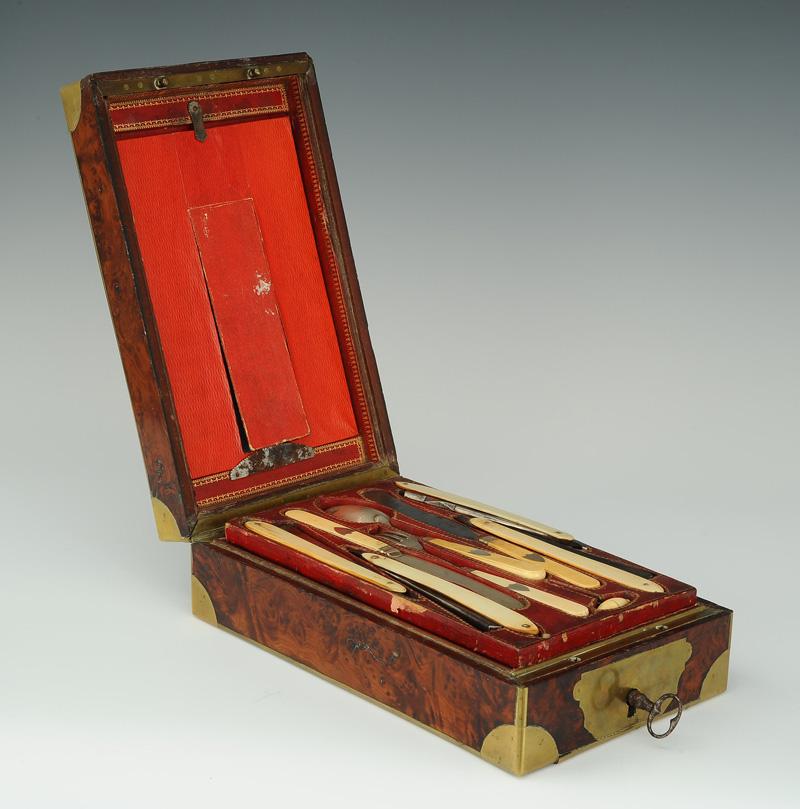
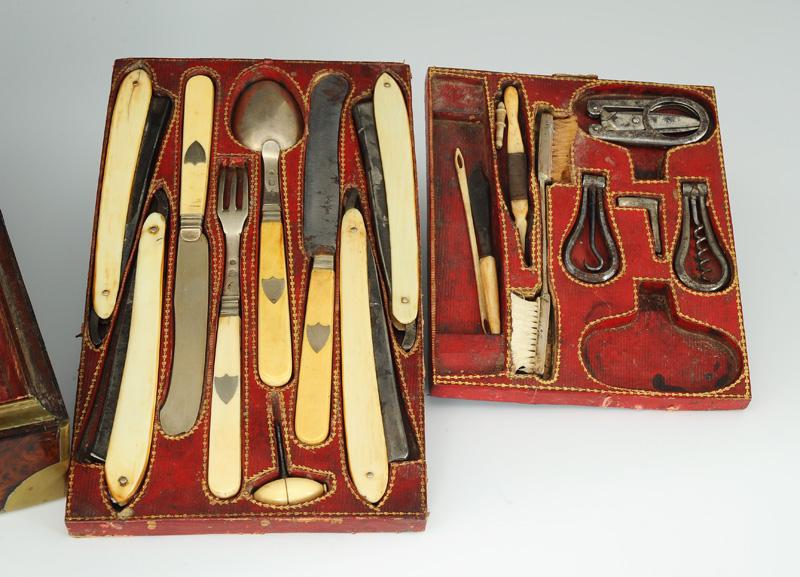
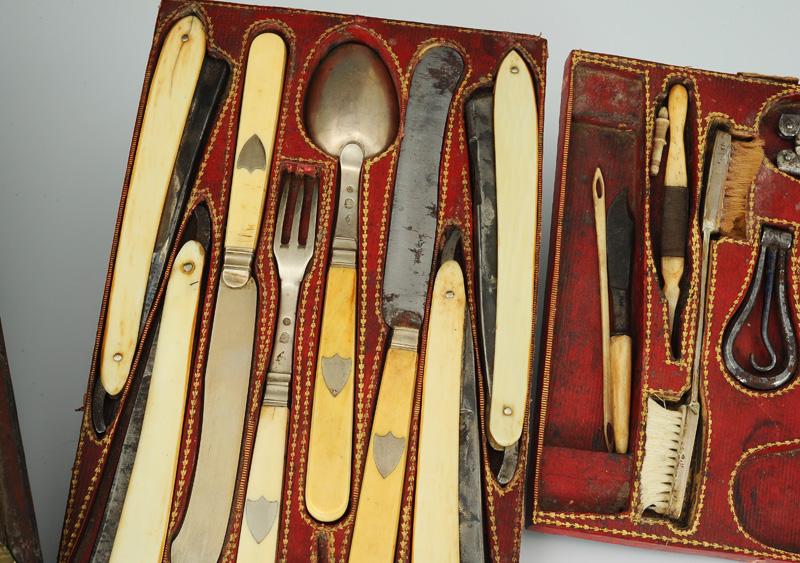
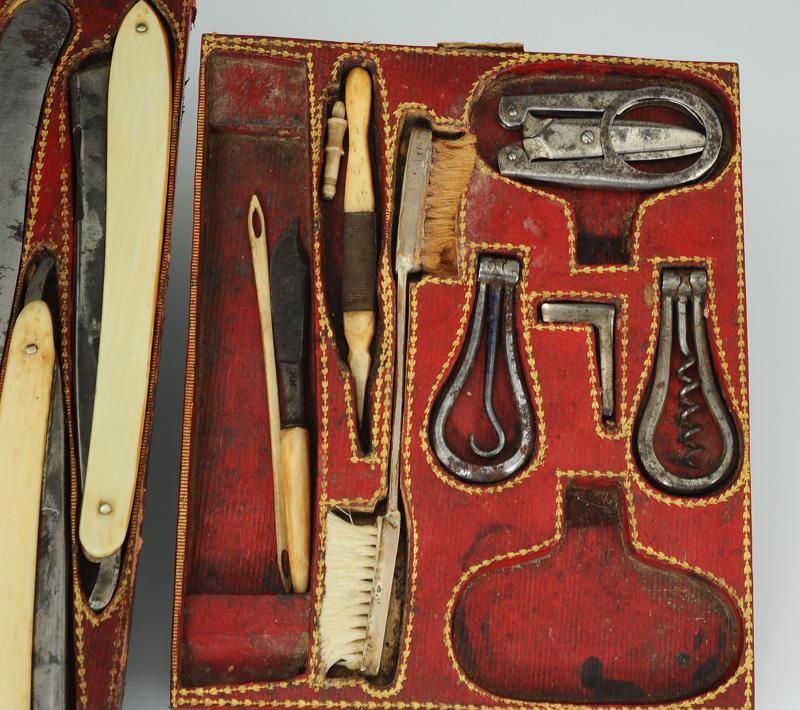
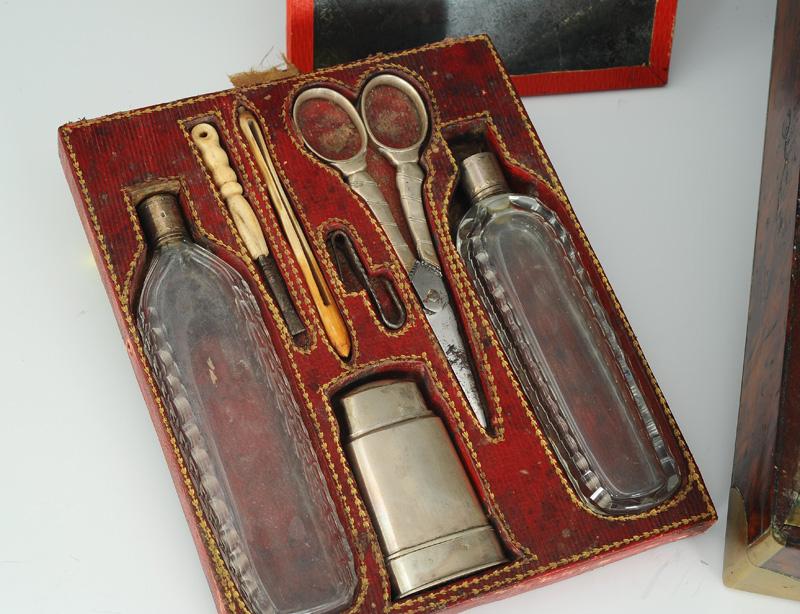
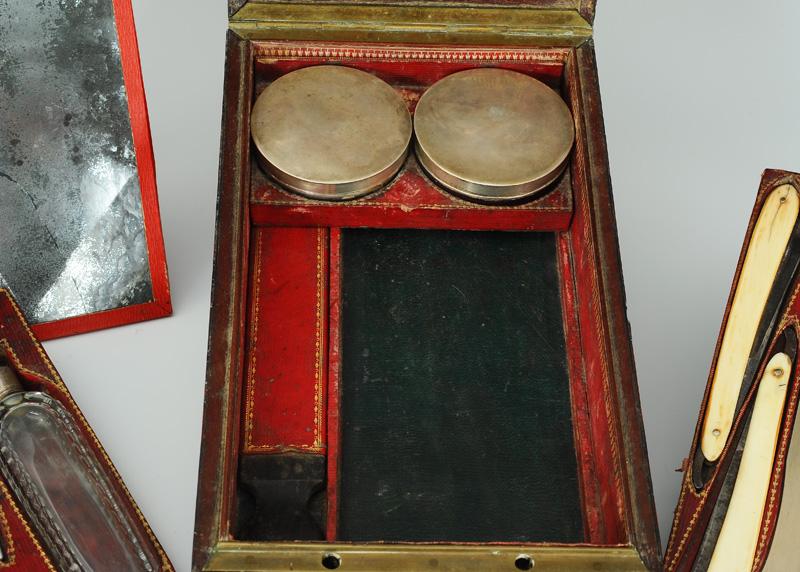
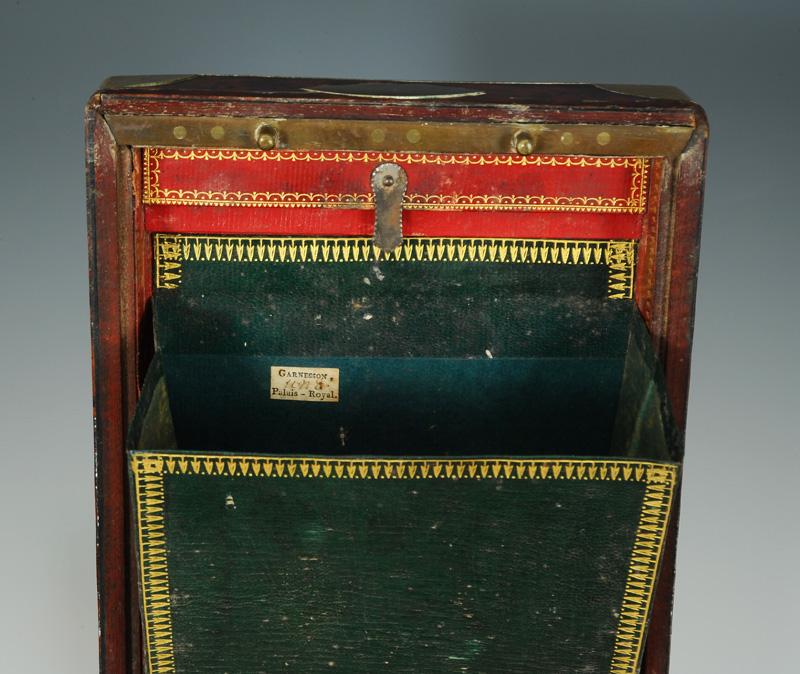
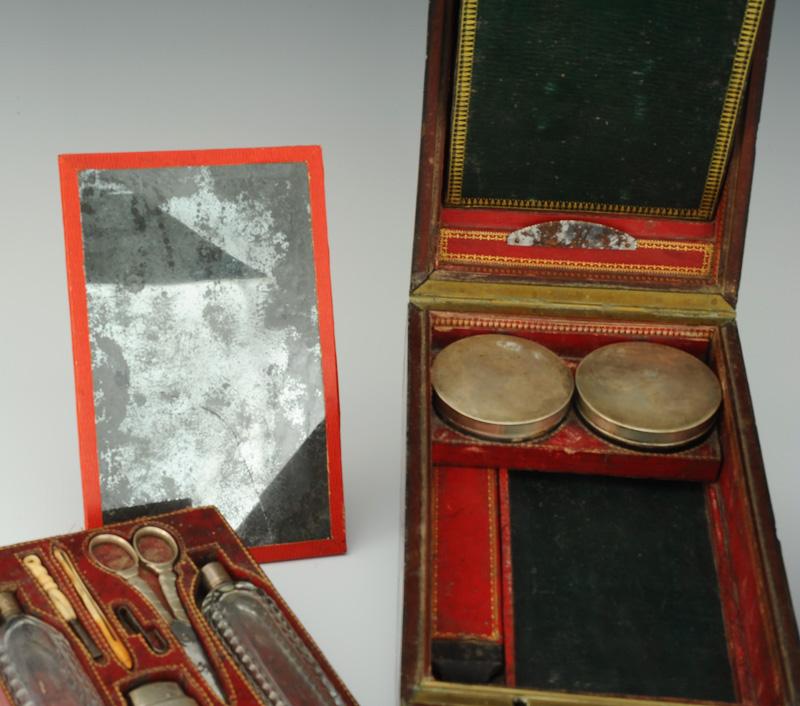
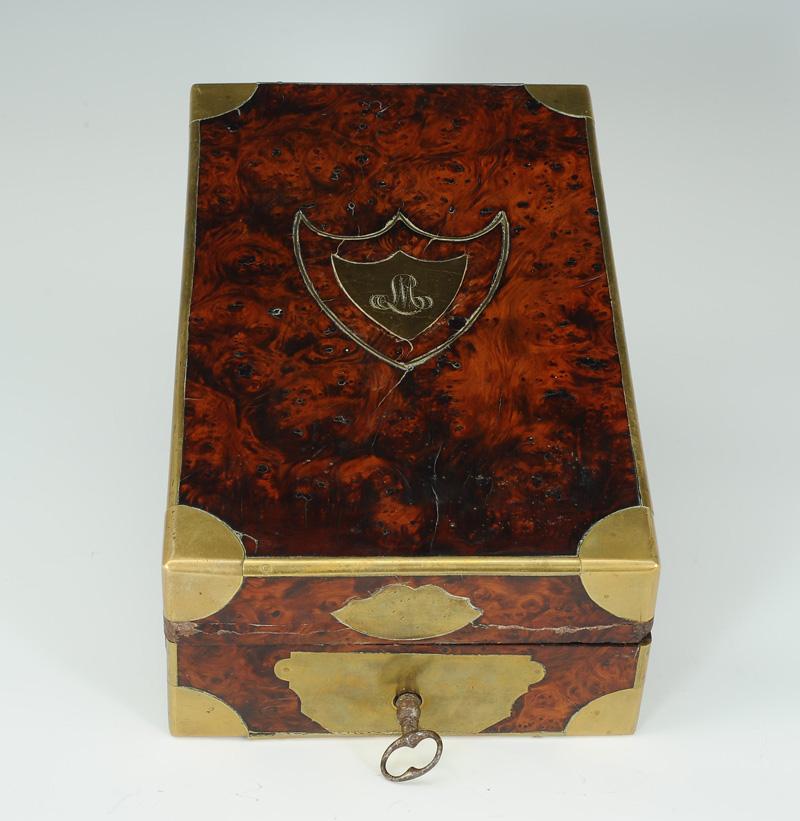
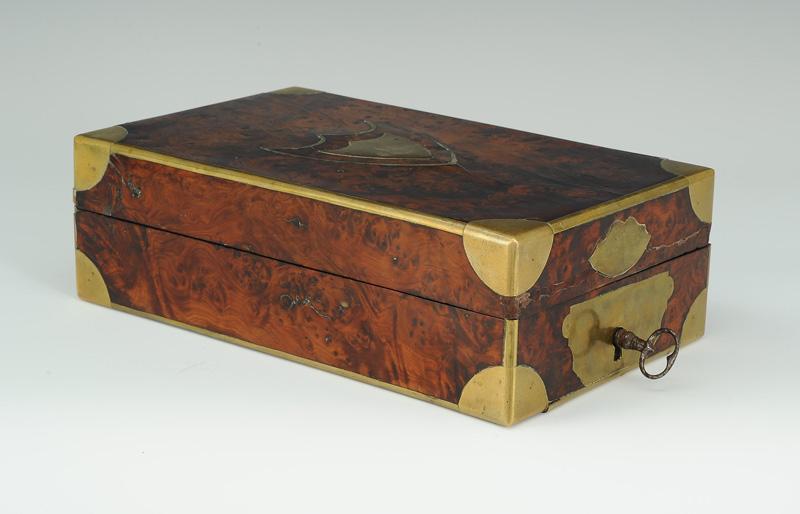
Wooden case veneered with burl elm wood, with brass trim and decorations (Length 27 cm, width 15.5 cm, height 8.5 cm). The lid features a brass decor in the shape of shields, engraved with the initials of Baron Lamarque "M L". A bellows pocket in gilded green leather is embedded on the back of the lid, with the original mirror lined with red leather. The interior of the case is entirely lined with red leather gilt with a green background. Four levels with compartments allow for the storage of a toiletry and meal set with almost all elements present with ivory handles (two knives, fork, spoon, scissors, four razors, toothpick, corkscrew, hook, brush, toothbrush, letter opener, two powder or cream boxes in crystal and silvered metal, two crystal and silvered metal salt flasks, a silvered metal powder box, folding scissors, pliers, and various small sewing or other instruments). The boot puller and another instrument are missing. One knife, the fork, and the spoon are silver stamped with the large guarantee mark of Paris, with a title of 800, and the recense stamp in use from June 19, 1798, to September 1, 1809.
France.
First Empire.
Good condition, some damage to the veneer.
PROVENANCE:
This set was part of the memories of General Jean Maximilien, Baron Lamarque, dispersed on May 19, 1992, in Bordeaux under lot 62 (label still present on the back of the case), directly from the family.
BIOGRAPHY:
Jean Maximilien Lamarque, born in Saint-Sever (Landes) on July 22, 1770, died of cholera on June 1, 1832, was a French general officer who had a career in the armies of the Revolution and the Empire, particularly in the Vendée and Spanish wars.
His Childhood and Education:
Jean Maximilien Lamarque's youth unfolded in a very affluent family; his father Pierre-Joseph Lamarque (1733-1802) was a lawyer at the parliament, royal prosecutor at the Seneschal of Saint-Sever. He was sent to the college of the Jacobins in Saint-Sever, where one of his uncles, Jean-Jacques Lamarque (1737-1809), was a prior, before becoming the director of the grand seminary of Dax, and eventually the vicar general of the diocese. In 1791, this uncle refused to take an oath and was persecuted during the Terror. Jean Maximilien excelled in his studies.
The French Revolution:
His father, Pierre-Joseph Lamarque (1733-1802), was elected as a deputy of the Third Estate to the Estates-General of 1789 and took the Oath of the Tennis Court, then became part of the National Constituent Assembly. In March 1790, the young 19-year-old Jean Maximilien left his hometown to join his father in Paris to further his studies, attending courses by Chaptal, La Harpe, and Chamfort. He fervently engaged in the political life of the capital and enlisted as a simple soldier in 1792. Shortly after, he led the battalion that looted the cathedral of Vabres, tearing down the marble altar to build a monument and gather Marat's works. He later set fire to the building. At the beginning of 1793, he was part of the 4th battalion of volunteers from the Landes.
His Military Life and Ascension:
French Revolutionary Wars:
Appointed as a lieutenant on April 3, 1793, he became a captain of grenadiers on May 13, 1793, in the famous "hellish column" of the Tour d'Auvergne in the Army of the Western Pyrenees. He distinguished himself by capturing, with reduced forces, the fortress of Fuenterrabia on July 24, 1794, defended by 1700 men. On the 21st Thermidor, Year II, he was promoted to battalion chief and served in the Army of the Rhine. He notably participated in the battles of Engen (May 3, 1800), Messkirch (June 5, 1800), Höchstädt (June 19, 1800), and finally, Hohenlinden (December 3, 1800), where he covered himself in glory, leading to a request from General Moreau for him to receive the epaulettes of a brigadier general on March 6, 1801, from Bonaparte.
Napoleonic Wars:
The statue of General Lamarque on the Butte de Morlanne in Saint-Sever. Work created in 1896 by Félix Soulès (1857-1904). He subsequently took part in the campaigns of the Imperial Army, particularly distinguishing himself at the Battle of Austerlitz, where he commanded a brigade of Marshal Augereau's 7th corps. He then left the Grande Armée to follow Joseph Bonaparte with Marshal Masséna in Italy, participating in the siege of Gaeta. Appointed as the chief of staff by Joseph, Jean Maximilien Lamarque, on December 6, 1807, with the rank of a divisional general. When Marshal Murat, the Grand Duke of Berg and Cleves, succeeded his brother-in-law in the Kingdom of Naples, Jean Maximilien Lamarque led the capture of the island of Capri on December 18, 1808, where the British garrison commanded by Hudson Lowe, the future jailer of the Emperor in Saint Helena, defied the French presence—the British flag being visible from the windows of the royal palace. It was seen as one of the finest actions of the imperial wars, demanding courage, audacity, and intelligence. Given the natural configuration of the island, it seemed impregnable, surrounded by sheer cliffs crowned with heavily armed enemy defenses, it could only be invaded by climbing and under heavy fire from a large garrison. Lamarque led the climb with his men, removing the ladders and withdrawing the ships to eliminate any possibility of retreat; the French had no choice but to either be decimated on the spot or conquer, and they succeeded with bayonets fixed after multiple attempts to break through the English defenses, imposing a capitulation that left French troops with stores, ammunition, and workshops. Paying tribute to the valor of his opponents, General Lamarque granted the freedom to the British, who left the island without arms or baggage. General Lamarque left the Kingdom of Naples to join, with his division, Prince Eugène de Beauharnais's army in Northern Italy in 1809. He captured Laybach, taking 4000 prisoners and 65 pieces of artillery, then rejoined the Grande Armée in Lobau and played a brilliant role in the Battle of Wagram, where he had four horses killed under him. He was appointed as a baron of the Empire by letters patent issued on June 4, 1810. Subsequently, with the affairs of Spain mobilizing the French forces, Jean Maximilien Lamarque found himself alongside King Joseph and, on February 8, 1812, won the Battle of Altafulla with his division.
Restoration and the Hundred Days:
During the first Restoration, General Lamarque reluctantly rallied to the Bourbons but, fascinated by the Emperor's personality, followed him during the Hundred Days, charged with pacifying the Vendée, which had once again risen up upon learning of the return from Elba. General Lamarque successfully completed his mission, disarming the insurgents to the extent that their leaders offered to serve "under his command as Frenchmen to prevent any attempts by foreign powers aiming to dismember France," after signing the peace of Cholet. General Lamarque's military career came to an end with the fall of the Empire. Banished during the second Restoration, he returned to France following the royal ordinance of October 20, 1818. Kept on the sidelines, he was retired by Charles X on June 30, 1830. As a reward for his past services, but perhaps also for his opposition to the Restoration regime, Louis-Philippe, the new King of the French, elevated him to the rank of Grand Cross of the Legion of Honor on August 21, 1830.
His Political Life: From Bonapartist to Liberal:
Jean Maximilien Lamarque was also a writer and a deputy, a liberal opponent of the Restoration government. During his exile first in Belgium and then in Holland, he indulged in literature by translating into verse the poems of Ossian by James Macpherson, which his family later had published. In the preface, he depicted the manners of the Caledonians and studied their literature, and the translation of these five Ossianic chants demonstrates great culture and enlightened romanticism. Drawing comparisons with Virgil, Torquato Tasso, Milton, and even Voltaire, Lamarque also paralleled it with Homer, whom he knew perfectly. Returning to France when Louis-Philippe I took power, General Lamarque became passionate about agriculture and used the wealth he gained during the Revolution to buy farmsteads, mills, and various lands, believing, as he himself said, to help 'humanize' the arid land of the Landes through his agronomy work. An ardent follower of the physiocrats, he studied ways to improve the condition of rural areas by advocating for soil improvement, crop rotation, and giving maize a prominent place. Invited to join the Agricultural Society of the Landes, he was admitted on July 8, 1827, and described in his acceptance speech his efforts and attempts in agronomy. Alongside these economic considerations, it is possible that his memoir, in memory of the issues posed by the Spanish War in which Lamarque had actively participated for many years, was not entirely devoid of military and strategic second thoughts. Without any military command since 1815 and retired in Saint-Sever, Jean Maximilien Lamarque turned to politics, finding an outlet for his forced inaction. A systematic opponent since his return from exile to the elder branch of the Bourbons, whom he reproached for what he considered debasing pacifism and also out of loyalty to the Empire, of which he believed a restoration was still possible with the King of Rome, he presented himself for the suffrage of his fellow citizens in 1820 but initially faced only failures, both in the electoral colleges of Saint-Sever and Mont-de-Marsan. It wasn’t until July 1828, after the death of the Marquis Du Lyon, a former mayor of Mont-de-Marsan, that partial elections allowed him to become a deputy by defeating Baron de Poyferré de Cère on December 23, 1828. He was reelected by the electoral college of Mont-de-Marsan on June 23, 1830, against Baron d'Haussez, after Minister Polignac dissolved the Chamber on May 16.
Names inscribed under the Arc de Triomphe on the Etoile WEstern Pillar, 35th and 36th columns.
He aligned with the July Monarchy, which he hoped would establish a truly liberal regime, while continuing to criticize a pacifism that he still deemed incompatible with the greatness of France. While he continued to sit on the left of the Chamber, he remained a man of the middle ground, considering that true liberals were the target of ultra-royalists nostalgic for the Ancien Régime and extremists who sought 1793.
End of His Life:
Lamarque died of cholera on June 1, 1832. His funeral served as a pretext for the republican insurrection of 1832 (which served as a backdrop for part of Victor Hugo's Les Misérables), repressed by the military. Indeed, Lamarque had become a popular symbol, partly due to his reputation as a former officer and "principled" politician from the Revolution and the Napoleonic era, and partly due to his republican commitment. He was respected for his leadership qualities: He was a popular left-wing deputy and one of the republican leaders. Republican supporters were unhappy that the last honors were paid to this fervent republican by legitimist royalists; they perceived it as a form of appropriation. The extent of the insurrection was such that Louis-Philippe even considered leaving Paris. A curious epilogue for a life made of contrasts, but which nonetheless ended where it had begun, in the family chapel of Eyres-Moncube, built on the Chalosse land that was his.
Napoleon's Opinion:
"The generals who seemed destined to rise were Gérard, Clausel, Foy, Lamarque, etc. They were my new marshals."
"During the last uprisings in the Vendée, General Lamarque, whom I had sent there at the height of the crisis, performed wonders and exceeded my expectations."
"Whether from Lamarque's ignorance of the true state of affairs or from the vain fancy of the victor? Anyway, there he is in exile: he is among the thirty-eight. It is easier to proscribe than to conquer." (Napoleon at Saint Helena).
Wooden case veneered with burl elm wood, with brass trim and decorations (Length 27 cm, width 15.5 cm, height 8.5 cm). The lid features a brass decor in the shape of shields, engraved with the initials of Baron Lamarque "M L". A bellows pocket in gilded green leather is embedded on the back of the lid, with the original mirror lined with red leather. The interior of the case is entirely lined with red leather gilt with a green background. Four levels with compartments allow for the storage of a toiletry and meal set with almost all elements present with ivory handles (two knives, fork, spoon, scissors, four razors, toothpick, corkscrew, hook, brush, toothbrush, letter opener, two powder or cream boxes in crystal and silvered metal, two crystal and silvered metal salt flasks, a silvered metal powder box, folding scissors, pliers, and various small sewing or other instruments). The boot puller and another instrument are missing. One knife, the fork, and the spoon are silver stamped with the large guarantee mark of Paris, with a title of 800, and the recense stamp in use from June 19, 1798, to September 1, 1809.
France.
First Empire.
Good condition, some damage to the veneer.
PROVENANCE:
This set was part of the memories of General Jean Maximilien, Baron Lamarque, dispersed on May 19, 1992, in Bordeaux under lot 62 (label still present on the back of the case), directly from the family.
BIOGRAPHY:
Jean Maximilien Lamarque, born in Saint-Sever (Landes) on July 22, 1770, died of cholera on June 1, 1832, was a French general officer who had a career in the armies of the Revolution and the Empire, particularly in the Vendée and Spanish wars.
His Childhood and Education:
Jean Maximilien Lamarque's youth unfolded in a very affluent family; his father Pierre-Joseph Lamarque (1733-1802) was a lawyer at the parliament, royal prosecutor at the Seneschal of Saint-Sever. He was sent to the college of the Jacobins in Saint-Sever, where one of his uncles, Jean-Jacques Lamarque (1737-1809), was a prior, before becoming the director of the grand seminary of Dax, and eventually the vicar general of the diocese. In 1791, this uncle refused to take an oath and was persecuted during the Terror. Jean Maximilien excelled in his studies.
The French Revolution:
His father, Pierre-Joseph Lamarque (1733-1802), was elected as a deputy of the Third Estate to the Estates-General of 1789 and took the Oath of the Tennis Court, then became part of the National Constituent Assembly. In March 1790, the young 19-year-old Jean Maximilien left his hometown to join his father in Paris to further his studies, attending courses by Chaptal, La Harpe, and Chamfort. He fervently engaged in the political life of the capital and enlisted as a simple soldier in 1792. Shortly after, he led the battalion that looted the cathedral of Vabres, tearing down the marble altar to build a monument and gather Marat's works. He later set fire to the building. At the beginning of 1793, he was part of the 4th battalion of volunteers from the Landes.
His Military Life and Ascension:
French Revolutionary Wars:
Appointed as a lieutenant on April 3, 1793, he became a captain of grenadiers on May 13, 1793, in the famous "hellish column" of the Tour d'Auvergne in the Army of the Western Pyrenees. He distinguished himself by capturing, with reduced forces, the fortress of Fuenterrabia on July 24, 1794, defended by 1700 men. On the 21st Thermidor, Year II, he was promoted to battalion chief and served in the Army of the Rhine. He notably participated in the battles of Engen (May 3, 1800), Messkirch (June 5, 1800), Höchstädt (June 19, 1800), and finally, Hohenlinden (December 3, 1800), where he covered himself in glory, leading to a request from General Moreau for him to receive the epaulettes of a brigadier general on March 6, 1801, from Bonaparte.
Napoleonic Wars:
The statue of General Lamarque on the Butte de Morlanne in Saint-Sever. Work created in 1896 by Félix Soulès (1857-1904). He subsequently took part in the campaigns of the Imperial Army, particularly distinguishing himself at the Battle of Austerlitz, where he commanded a brigade of Marshal Augereau's 7th corps. He then left the Grande Armée to follow Joseph Bonaparte with Marshal Masséna in Italy, participating in the siege of Gaeta. Appointed as the chief of staff by Joseph, Jean Maximilien Lamarque, on December 6, 1807, with the rank of a divisional general. When Marshal Murat, the Grand Duke of Berg and Cleves, succeeded his brother-in-law in the Kingdom of Naples, Jean Maximilien Lamarque led the capture of the island of Capri on December 18, 1808, where the British garrison commanded by Hudson Lowe, the future jailer of the Emperor in Saint Helena, defied the French presence—the British flag being visible from the windows of the royal palace. It was seen as one of the finest actions of the imperial wars, demanding courage, audacity, and intelligence. Given the natural configuration of the island, it seemed impregnable, surrounded by sheer cliffs crowned with heavily armed enemy defenses, it could only be invaded by climbing and under heavy fire from a large garrison. Lamarque led the climb with his men, removing the ladders and withdrawing the ships to eliminate any possibility of retreat; the French had no choice but to either be decimated on the spot or conquer, and they succeeded with bayonets fixed after multiple attempts to break through the English defenses, imposing a capitulation that left French troops with stores, ammunition, and workshops. Paying tribute to the valor of his opponents, General Lamarque granted the freedom to the British, who left the island without arms or baggage. General Lamarque left the Kingdom of Naples to join, with his division, Prince Eugène de Beauharnais's army in Northern Italy in 1809. He captured Laybach, taking 4000 prisoners and 65 pieces of artillery, then rejoined the Grande Armée in Lobau and played a brilliant role in the Battle of Wagram, where he had four horses killed under him. He was appointed as a baron of the Empire by letters patent issued on June 4, 1810. Subsequently, with the affairs of Spain mobilizing the French forces, Jean Maximilien Lamarque found himself alongside King Joseph and, on February 8, 1812, won the Battle of Altafulla with his division.
Restoration and the Hundred Days:
During the first Restoration, General Lamarque reluctantly rallied to the Bourbons but, fascinated by the Emperor's personality, followed him during the Hundred Days, charged with pacifying the Vendée, which had once again risen up upon learning of the return from Elba. General Lamarque successfully completed his mission, disarming the insurgents to the extent that their leaders offered to serve "under his command as Frenchmen to prevent any attempts by foreign powers aiming to dismember France," after signing the peace of Cholet. General Lamarque's military career came to an end with the fall of the Empire. Banished during the second Restoration, he returned to France following the royal ordinance of October 20, 1818. Kept on the sidelines, he was retired by Charles X on June 30, 1830. As a reward for his past services, but perhaps also for his opposition to the Restoration regime, Louis-Philippe, the new King of the French, elevated him to the rank of Grand Cross of the Legion of Honor on August 21, 1830.
His Political Life: From Bonapartist to Liberal:
Jean Maximilien Lamarque was also a writer and a deputy, a liberal opponent of the Restoration government. During his exile first in Belgium and then in Holland, he indulged in literature by translating into verse the poems of Ossian by James Macpherson, which his family later had published. In the preface, he depicted the manners of the Caledonians and studied their literature, and the translation of these five Ossianic chants demonstrates great culture and enlightened romanticism. Drawing comparisons with Virgil, Torquato Tasso, Milton, and even Voltaire, Lamarque also paralleled it with Homer, whom he knew perfectly. Returning to France when Louis-Philippe I took power, General Lamarque became passionate about agriculture and used the wealth he gained during the Revolution to buy farmsteads, mills, and various lands, believing, as he himself said, to help 'humanize' the arid land of the Landes through his agronomy work. An ardent follower of the physiocrats, he studied ways to improve the condition of rural areas by advocating for soil improvement, crop rotation, and giving maize a prominent place. Invited to join the Agricultural Society of the Landes, he was admitted on July 8, 1827, and described in his acceptance speech his efforts and attempts in agronomy. Alongside these economic considerations, it is possible that his memoir, in memory of the issues posed by the Spanish War in which Lamarque had actively participated for many years, was not entirely devoid of military and strategic second thoughts. Without any military command since 1815 and retired in Saint-Sever, Jean Maximilien Lamarque turned to politics, finding an outlet for his forced inaction. A systematic opponent since his return from exile to the elder branch of the Bourbons, whom he reproached for what he considered debasing pacifism and also out of loyalty to the Empire, of which he believed a restoration was still possible with the King of Rome, he presented himself for the suffrage of his fellow citizens in 1820 but initially faced only failures, both in the electoral colleges of Saint-Sever and Mont-de-Marsan. It wasn’t until July 1828, after the death of the Marquis Du Lyon, a former mayor of Mont-de-Marsan, that partial elections allowed him to become a deputy by defeating Baron de Poyferré de Cère on December 23, 1828. He was reelected by the electoral college of Mont-de-Marsan on June 23, 1830, against Baron d'Haussez, after Minister Polignac dissolved the Chamber on May 16.
Names inscribed under the Arc de Triomphe on the Etoile WEstern Pillar, 35th and 36th columns.
He aligned with the July Monarchy, which he hoped would establish a truly liberal regime, while continuing to criticize a pacifism that he still deemed incompatible with the greatness of France. While he continued to sit on the left of the Chamber, he remained a man of the middle ground, considering that true liberals were the target of ultra-royalists nostalgic for the Ancien Régime and extremists who sought 1793.
End of His Life:
Lamarque died of cholera on June 1, 1832. His funeral served as a pretext for the republican insurrection of 1832 (which served as a backdrop for part of Victor Hugo's Les Misérables), repressed by the military. Indeed, Lamarque had become a popular symbol, partly due to his reputation as a former officer and "principled" politician from the Revolution and the Napoleonic era, and partly due to his republican commitment. He was respected for his leadership qualities: He was a popular left-wing deputy and one of the republican leaders. Republican supporters were unhappy that the last honors were paid to this fervent republican by legitimist royalists; they perceived it as a form of appropriation. The extent of the insurrection was such that Louis-Philippe even considered leaving Paris. A curious epilogue for a life made of contrasts, but which nonetheless ended where it had begun, in the family chapel of Eyres-Moncube, built on the Chalosse land that was his.
Napoleon's Opinion:
"The generals who seemed destined to rise were Gérard, Clausel, Foy, Lamarque, etc. They were my new marshals."
"During the last uprisings in the Vendée, General Lamarque, whom I had sent there at the height of the crisis, performed wonders and exceeded my expectations."
"Whether from Lamarque's ignorance of the true state of affairs or from the vain fancy of the victor? Anyway, there he is in exile: he is among the thirty-eight. It is easier to proscribe than to conquer." (Napoleon at Saint Helena).
Price :
5 000,00 €
| Destination | Envoi recommandé | Envoi Recommandé + Express |
|---|---|---|
| Shipping France | 17,00 € | 50,00 € |
| Shipping Europe | 24,00 € | 70,00 € |
| Shipping world | 68,00 € | 120,00 € |
Insurance (1%) :
50,00 €
Reference :
34443 (18252)
Next update Friday, octobre 9 at 13:30 PM
FOR ALL PURCHASES, PAYMENT IN MULTIPLE CHECKS POSSIBLE
bertrand.malvaux@wanadoo.fr 06 07 75 74 63
SHIPPING COSTS
Shipping costs are calculated only once per order for one or more items, all shipments are sent via registered mail, as this is the only way to have proof of dispatch and receipt.
For parcels whose value cannot be insured by the Post, shipments are entrusted to DHL or Fedex with real value insured, the service is of high quality but the cost is higher.
RETURN POLICY
Items can be returned within 8 days of receipt. They must be returned by registered mail at the sender's expense, in their original packaging, and in their original condition.
AUTHENTICITY
The selection of items offered on this site allows me to guarantee the authenticity of each piece described here, all items offered are guaranteed to be period and authentic, unless otherwise noted or restricted in the description.
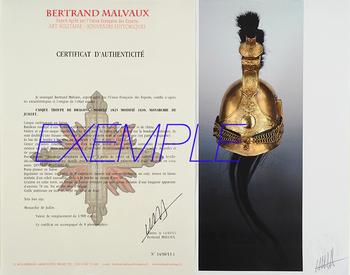
An authenticity certificate of the item including the description published on the site, the period, the sale price, accompanied by one or more color photographs is automatically provided for any item priced over 130 euros. Below this price, each certificate is charged 5 euros.
Only items sold by me are subject to an authenticity certificate, I do not provide any expert reports for items sold by third parties (colleagues or collectors).
FOR ALL PURCHASES, PAYMENT IN MULTIPLE CHECKS POSSIBLE
bertrand.malvaux@wanadoo.fr 06 07 75 74 63
An authenticity certificate of the item including the description published on the site, the period, the sale price, accompanied by one or more color photographs is automatically provided for any item priced over 130 euros. Below this price, each certificate is charged 5 euros.
Only items sold by me are subject to an authenticity certificate, I do not provide any expert reports for items sold by third parties (colleagues or collectors).