
OFFICER'S CARABINIERS HELMET AND BREASTPLATE, 1810 model, First Empire. 33671-33610(3616)




Sold out
OFFICER'S CARABINIER HELMET AND CUIRASS, 1810 model, First Empire. 33671-33610(3616)
Former collection of Raoul and Jean Brunon.
HELMET
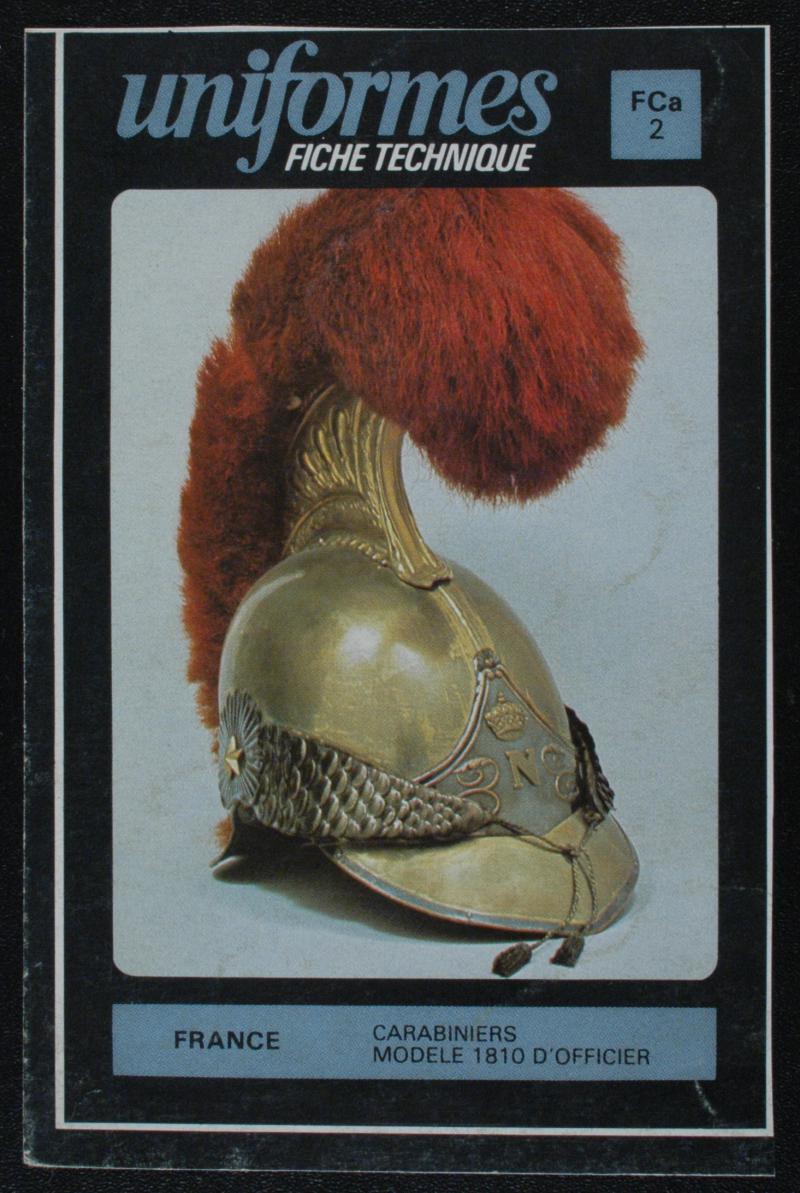
Helmet presented by Jean Brunon in the technical sheets published in the magazine Uniformes, under reference FCa2 in which he describes the helmet of his collection as follows:
"Napoleon decided to armor the two carabinier regiments, with helmet and cuirass models being richer than those of the cuirassiers. During the campaign of 1809, they served alongside the Emperor in the Imperial Guard before his return from Spain. At Landshut, Eckmühl, and Ratisbon, Napoleon noticed the inefficiency of the bearskin caps against saber blows. After Wagram, his decision made, the Emperor signed the decree for the armor's allocation on December 24, 1809, despite the reluctance of the two regiments who saw it as a critique of their conduct, which had always been exemplary, especially as they regretted, at the same time, the replacement of their dark blue uniform with a white one.
The officer's helmet, even more lavish, had a gilded copper (or un-gilded red) dome, the visor, the chin scales, and rosettes in silvered copper, as well as the fittings of the visor and neck guard. The crowned N, always plain, was smaller than that of the troops (the N of the Second Empire, larger and grooved, was sometimes added to some helmets whose original N had been removed in 1814). Very narrow and decorated gilded copper crest. Chin scale glands in silver wire. These helmets are even rarer as they were worn for less than 4 years."
Helmet entirely in gilded brass except for the two strips, chin scales, and visor and neck guard edges which are in silvered copper. Dome shaped like a minerva, quite tall and leaning towards the back. H 14 cm. It is composed of two half-shells soldered together at the top, the joint covered with a 5 mm wide brass strip.
Visor forming a point in its center, width 6 cm, bordered by a silvered copper strip folded over the outer edge (width 7 mm). This strip is riveted by 4 silvered copper nails. Visor lining in waxed black morocco leather.
Neck guard similarly edged to the visor, strip fixed with 2 nails (width 6 mm). Neck guard lining in waxed black morocco leather.
Front strip in silvered copper bordered in its upper part by a double prominent molding with a striated center (width of the double molding 8.5 mm), in its center the strip forms a point where the molding wraps around itself in a droplet shape; it is topped by a palmette on which a gilded brass screw with a conical head is placed to fix the strip. In its lower part, the strip has no molding, it forms a point in its center. H of the strip on the sides 2.5 cm, H in the center 11 cm. On each side, the strip is stamped in relief with delicate scrolls, the pattern of these scrolls characterizes authentic helmets (on copies, the designs are different or coarser). In its center a "N" is riveted (H 2.1 cm, width 1.9 cm), topped with the imperial crown (H 2.7 cm, width 2.7 cm).
Back strip in silvered copper bordered in its upper part by a prominent double molding. H on the sides 2.7 cm, H in the center 3.7 cm.
Crest composed of two flaps and a brass mask. Each flap presents a curvilinear triangle, the base of which connects to the dome with a scalloped rim, 1 to 1.6 cm, adorned with small gadroons. The flaps are stamped in relief with a frame of acanthus leaves and intertwined laurel branches tied with ribbons, in the center a descending series towards the back of nine gadroons separated by water leaves on a sandblasted background. Each flap is fixed to the dome with four brass iron screws with conical heads. Max height of the flaps 14 cm. Mask welded to the two flaps, bordered by a prominent molding and a striated ribbon (width at the top 2.2 cm, width in the center 2 cm); its base is flared, framed by palm leaves (width 3.8 cm). Originally, this crest extends to the top of the strip where it is fixed underneath. At the top of the crest, a winged screw secures the plume, as on the right flap.
Plume in scarlet horsehair mounted on an iron rod (Ø at the back 6 cm, Ø at the front 15 cm); it extends about 10 cm beyond the crest.
Chin scales composed of a leather chin strap covered in black velvet finished with silver passementerie cords, covered with a sequence of 17 silvered copper scales alternately cut into four and three scallops; the penultimate scale is cut into two and the last into a single scallop. Apparent length of the chin straps 14 cm, max width 5.7 cm, min width 1.7 cm. Rosette in silvered copper cut and stamped in relief with a radiant sun design (H 6.7 cm, width 8 cm); in the center, a five-pointed star made of brass with a 2.6 cm diameter is attached.
Inner helmet lining in waxed black sheepskin cut into seven sections.
France.
First Empire.
Very good condition, gilding on the dome, visor, and neck guard partially absent, silvering on the front strip rubbed on the reliefs, edges of the visor and neck guard rubbed on their ends, split visor strip on its left side, crest retaining its gilding, base of the mask missing, inner lining tired with losses and tears.
CUIRASS
The troop cuirass for the Carabiniers is described in a text dated June 1811 kept in the artillery archives:
"CARABINIERS. The fronts (plastrons) are made with corroyé German sheet metal that is laminated in Sedan. Each sheet is 36 inches (97.5 cm) in length, 18 inches (48.7 cm) in width, and 10 to 11 points (0.19 to 0.21 cm) thick which is reduced from 9 to 10 points (0.17 to 0.19 cm). One sheet yields two fronts and weighs 15 to 15 1/2 pounds (7.33 to 7.58 kg)."
"The backs (backplates) are made of iron sheet metal. The sheet for these backs is 36 inches (97.5 cm) in length, 18 inches (48.7 cm) in width, and 9 to 10 points (0.17 to 0.19 cm) thick which is reduced to 8 & 9 points (0.15 to 0.17 cm). One sheet yields two backs and weighs 14 to 15 pounds (6.84 to 7.33 kg)."
"The yellow copper sheets that apply to the cuirasses come from Stolbert or Namur. Each sheet is 46 inches (124.5 cm) in length and 4 points (0.07 cm) in thickness and weighs 7 1/2 to 8 pounds (3.67 to 4.11 kg); one sheet yields three pieces, either for the fronts or backs. Width 16 inches (47.8 cm)."
"Here are the technical conditions for fabrication, tinning, and soldering. It will suffice to indicate that the copper sheet is fixed to the sheet metal by a small copper rivet placed at each corner, four on the breastplate and four on the backplate."
"The shoulder pads are made like those of the cuirasses of the cuirassiers, except that they are lined with black basane instead of cloth and are covered, each one, with two flat copper chains, instead of scales. The straps are made of black cowhide leather. All carabinier cuirasses are of the first size. The finished cuirass weighs 15 1/2 to 16 pounds (7.58 to 7.82 kg)."
Adding to this description of the troop model, the specific elements for the officer's cuirass are as follows.
The brass sheets are either gilded or, as in this case, in a material called "red copper". Each is riveted to the steel part with four domed head brass rivets.
Breastplate:
It is decorated in its center with a round ornament in silvered metal, representing a radiant sun with a five-pointed star in the center (Ø 2.9 cm) made of gilded brass cast at the back, attached at the top between the shoulder pads. On this piece, the sun is made of silver (H 10.8 cm, width 10.5 cm; this difference is due to the sun being slightly curved to fit the chest plate). It tapers with a slight peak featuring a specific officer's plastron.
2.3 cm wide edging, not covered in copper, framing the outline of the breastplate trimmed with 34 domed brass rivets. At the bottom of this edging above the central rivet, the breastplate is marked "ZUDERELL PARIS." Outer edges of this edging terminated by a rounded bead.
Two studs are placed on the front of the breastplate to allow the attachment of the shoulder pad locks.
Backplate:
Similar to the breastplate, the backplate is covered with a copper sheet leaving a 2.3 cm wide uncovered edging framing its outline, decorated with 28 domed brass rivets. Outer edges of this edging at the sides and back terminated by a rounded bead, at the neck and armholes by a protruding bead.
At the lower part, a leather belt (H 2.8 cm) covered in red waxed morocco leather (color faded to brown), embroidered at the top and bottom with a silver grosgrain strip fixed to the backplate on each side with two brass screws, allowing the breastplate to be secured to the backplate. This belt fastens with an oval-shaped brass buckle (H 4.1 cm, width 4.6 cm).
The shoulder pads are covered in crimson cloth (width 5 cm) and bordered on each side with a silver galon (width 1 cm). At the top, a silvered metal tab secures the shoulder pad to the backplate with three large flat screws. This tab is covered with a relieved gilded brass lion's head (H 6 cm, width 5.4 cm). The leather part is covered by a double chainette (on some pieces, these chainettes are three in number) in silvered metal consisting of intertwined rings (Ø of the rings 1.6 cm). These shoulder pads end at the bottom with silvered metal locks cut in scallops at their ends and stamped in relief with a lion's head (total height of the locks 11.3 cm, lion's head height 6.3 cm, max width 5.3 cm). At the top, these locks are attached to the shoulder pad with two domed brass rivets (Ø 1.3 cm) and at the bottom with two smaller domed brass rivets, 9 mm in diameter, securing a heart-shaped tab (H 5.8 cm, width 5.3 cm) made of leather covered in red waxed morocco leather bordered with a silver embroidered strip.
France.
First Empire.
Very good preservation condition, wear on the belt, the two parts have been reinforced with a beige calf lining, end of the belt with the tightening buckle has been replaced for 9 cm but the buckle is indeed the original one.
EPAULETTES
Pair of colonel epaulettes in silver passementerie, body with woven gall in "cul de dé," rotating and fringes with large spinach seeds.
France.
First Empire.
Very good condition, lacking the cloth lining.
NOTE: Helmet: Officers' helmets of the Carabiniers of the First Empire are extremely rare, a term we use only exceptionally but which is by no means overused in this case. While helmets for the troops still exist in a few dozen examples, officer models were all modified in 1814, and during the Second Restoration, they were transformed because they were transferred to the Carabiniers of Monsieur. The Raoul and Jean Brunon collection owned three officers' helmets of the Carabiniers of the First Empire: - the exemplary piece presented here, the most exceptional, which has preserved in its original state the N and crown of the First Empire, - a piece sold in 1966 to the Museum of the Army, modified in 1814 and then for the Hundred Days period with the N and crown replaced by a gilded brass flaming bomb, currently displayed at the Empéri Castle in Salon de Provence, in the 1814 room on the officer mannequin of the regiment, - a piece modified in 1815-1816 for the Carabiniers of Monsieur with the N and crown replaced by a brass motif of the Arms of Monsieur. There is a lone silver headband with original imperial figures in a private collection, and the Museum of the Army also has an officer's helmet. We only know of two authentic examples from the First Empire, plus a lone headband. All the other officer helmets that I have had the opportunity to observe over the past forty years are either reconstructions from the late 19th century or heterogeneous remounts. In his work "Les coiffures de l'Armée Française" (The Headgear of the French Army), Joseph Margerand presents in the chapter "Headgear of the French Cavalry from 1791 to 1815 - Chapter 1 Carabiniers" two officers' helmets: Plate no. 1 - figures 3 and 4, helmet of an officer from the Refoulé collection. This helmet is a reproduction. Plate no. 2 - figures 3 and 4, Poilpot collection, the officer's helmet is annotated by Jean Brunon in his personal work "completely remounted helmet with disparate elements: N and a crown from the Second Empire, fanciful headband, same rosettes, foreign jugulars".
Cuirass: There are two types of officer cuirasses. One model is quite luxurious with plates in gilded brass framed with raised fillets, featuring richer epaulettes with three straps, a lion's head of a different design, and elaborately ornamented locks in relief with oak and laurel leaves. The second model is more rustic, likely meant for combat, with copper plates and epaulettes with two chains and less detailed locks, based on the officer cuirass epaulettes of the Cuirassiers towards the end of the Empire. This second type of cuirass was probably used towards the very end of the Empire, often depicted in contemporary iconography, and remains the rarer of the two examples. The specimen from the former Brunon collection is one of the few, if not the only, known examples.
PROVENANCE:
This helmet and breastplate set come from the former Raoul and Jean Brunon collection, purchased between 1919 and 1938 by Jean Brunon, a renowned collector.
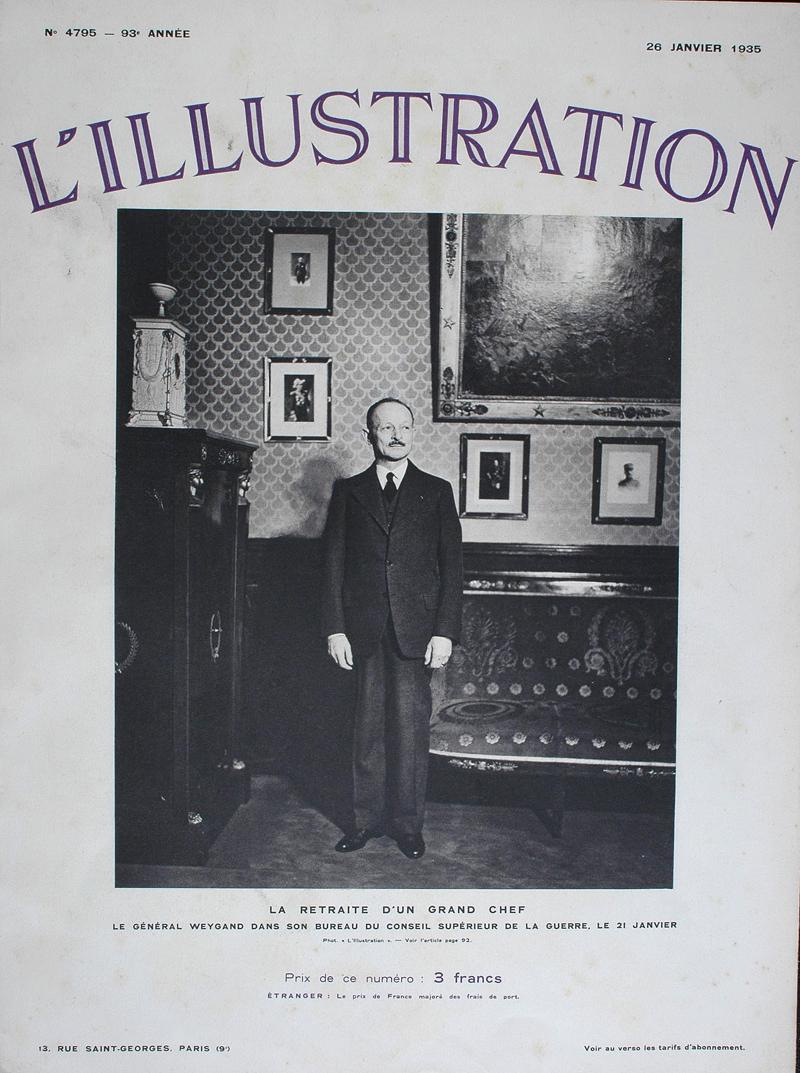
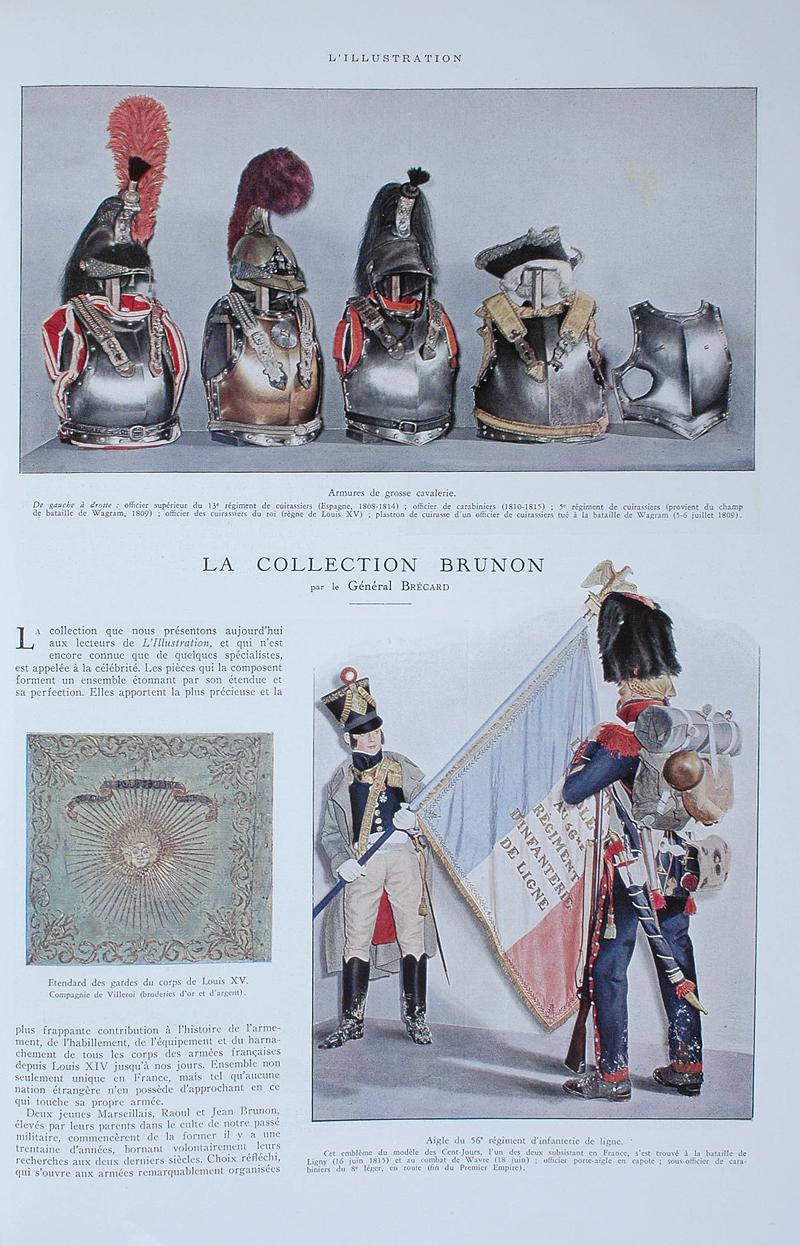
On January 26, 1935, in issue 4795 of the famous magazine L'ILLUSTRATION, General Brécard dedicated a four-page full-color article to "The Brunon Collection." Photos for the title feature five sets of First Empire and Ancient Monarchy breastplates, including an officer's set of Carabiniers from the First Empire with the helmet presented here (the breastplate is of the luxury model sold to the Army Museum in 1966).
In 1966, this helmet was inventoried by Jean Brunon in the document "Inventory of the collection 'History through objects of the French armies since 1700' from the Raoul and Jean Brunon Archives and Collections," on page 65: "Helmet and breastplate of an officer of Carabiniers, First Empire. Very beautiful set, extremely rare."
"Helmet and breastplate, ditto, 1815." This second set was sold to the Army Museum in 1967; it is the one where the helmet was modified in 1815 with a grenade on the headband and is now displayed on a mannequin at the Château de l'Empéri in Salon-de-Provence.
In 1967, during the sale of the collection to the Army Museum, Mr. Brunon retained a selection of objects, including this set, mentioned on page 2.
Following the death of Jean Brunon in 1983, his collection was divided among his three children: Anne, Paul, and Raoul (who was a curator at the time of the Empéri Museum). Paul Brunon inherited the set of officer's Carabiniers from the First Empire, which he sold to the Parisian antiques dealer Charles Marchal in February 1983 (officer's helmets and breastplates of Cuirassiers from the First Empire, officer's helmet of Dragons from the First Empire, officer's helmet of the Guard Dragons model 1804). A document certified by Raoul Brunon attests to this.
Mr. Guy Kaufmann acquired this year the complete set of Cuirassiers officer uniform, the officer helmet of Line Dragoons, and the officer set of Carabiniers from the former Charles Marchal collection.
Former collection of Raoul and Jean Brunon.
HELMET
Helmet presented by Jean Brunon in the technical sheets published in the magazine Uniformes, under reference FCa2 in which he describes the helmet of his collection as follows:
"Napoleon decided to armor the two carabinier regiments, with helmet and cuirass models being richer than those of the cuirassiers. During the campaign of 1809, they served alongside the Emperor in the Imperial Guard before his return from Spain. At Landshut, Eckmühl, and Ratisbon, Napoleon noticed the inefficiency of the bearskin caps against saber blows. After Wagram, his decision made, the Emperor signed the decree for the armor's allocation on December 24, 1809, despite the reluctance of the two regiments who saw it as a critique of their conduct, which had always been exemplary, especially as they regretted, at the same time, the replacement of their dark blue uniform with a white one.
The officer's helmet, even more lavish, had a gilded copper (or un-gilded red) dome, the visor, the chin scales, and rosettes in silvered copper, as well as the fittings of the visor and neck guard. The crowned N, always plain, was smaller than that of the troops (the N of the Second Empire, larger and grooved, was sometimes added to some helmets whose original N had been removed in 1814). Very narrow and decorated gilded copper crest. Chin scale glands in silver wire. These helmets are even rarer as they were worn for less than 4 years."
Helmet entirely in gilded brass except for the two strips, chin scales, and visor and neck guard edges which are in silvered copper. Dome shaped like a minerva, quite tall and leaning towards the back. H 14 cm. It is composed of two half-shells soldered together at the top, the joint covered with a 5 mm wide brass strip.
Visor forming a point in its center, width 6 cm, bordered by a silvered copper strip folded over the outer edge (width 7 mm). This strip is riveted by 4 silvered copper nails. Visor lining in waxed black morocco leather.
Neck guard similarly edged to the visor, strip fixed with 2 nails (width 6 mm). Neck guard lining in waxed black morocco leather.
Front strip in silvered copper bordered in its upper part by a double prominent molding with a striated center (width of the double molding 8.5 mm), in its center the strip forms a point where the molding wraps around itself in a droplet shape; it is topped by a palmette on which a gilded brass screw with a conical head is placed to fix the strip. In its lower part, the strip has no molding, it forms a point in its center. H of the strip on the sides 2.5 cm, H in the center 11 cm. On each side, the strip is stamped in relief with delicate scrolls, the pattern of these scrolls characterizes authentic helmets (on copies, the designs are different or coarser). In its center a "N" is riveted (H 2.1 cm, width 1.9 cm), topped with the imperial crown (H 2.7 cm, width 2.7 cm).
Back strip in silvered copper bordered in its upper part by a prominent double molding. H on the sides 2.7 cm, H in the center 3.7 cm.
Crest composed of two flaps and a brass mask. Each flap presents a curvilinear triangle, the base of which connects to the dome with a scalloped rim, 1 to 1.6 cm, adorned with small gadroons. The flaps are stamped in relief with a frame of acanthus leaves and intertwined laurel branches tied with ribbons, in the center a descending series towards the back of nine gadroons separated by water leaves on a sandblasted background. Each flap is fixed to the dome with four brass iron screws with conical heads. Max height of the flaps 14 cm. Mask welded to the two flaps, bordered by a prominent molding and a striated ribbon (width at the top 2.2 cm, width in the center 2 cm); its base is flared, framed by palm leaves (width 3.8 cm). Originally, this crest extends to the top of the strip where it is fixed underneath. At the top of the crest, a winged screw secures the plume, as on the right flap.
Plume in scarlet horsehair mounted on an iron rod (Ø at the back 6 cm, Ø at the front 15 cm); it extends about 10 cm beyond the crest.
Chin scales composed of a leather chin strap covered in black velvet finished with silver passementerie cords, covered with a sequence of 17 silvered copper scales alternately cut into four and three scallops; the penultimate scale is cut into two and the last into a single scallop. Apparent length of the chin straps 14 cm, max width 5.7 cm, min width 1.7 cm. Rosette in silvered copper cut and stamped in relief with a radiant sun design (H 6.7 cm, width 8 cm); in the center, a five-pointed star made of brass with a 2.6 cm diameter is attached.
Inner helmet lining in waxed black sheepskin cut into seven sections.
France.
First Empire.
Very good condition, gilding on the dome, visor, and neck guard partially absent, silvering on the front strip rubbed on the reliefs, edges of the visor and neck guard rubbed on their ends, split visor strip on its left side, crest retaining its gilding, base of the mask missing, inner lining tired with losses and tears.
CUIRASS
The troop cuirass for the Carabiniers is described in a text dated June 1811 kept in the artillery archives:
"CARABINIERS. The fronts (plastrons) are made with corroyé German sheet metal that is laminated in Sedan. Each sheet is 36 inches (97.5 cm) in length, 18 inches (48.7 cm) in width, and 10 to 11 points (0.19 to 0.21 cm) thick which is reduced from 9 to 10 points (0.17 to 0.19 cm). One sheet yields two fronts and weighs 15 to 15 1/2 pounds (7.33 to 7.58 kg)."
"The backs (backplates) are made of iron sheet metal. The sheet for these backs is 36 inches (97.5 cm) in length, 18 inches (48.7 cm) in width, and 9 to 10 points (0.17 to 0.19 cm) thick which is reduced to 8 & 9 points (0.15 to 0.17 cm). One sheet yields two backs and weighs 14 to 15 pounds (6.84 to 7.33 kg)."
"The yellow copper sheets that apply to the cuirasses come from Stolbert or Namur. Each sheet is 46 inches (124.5 cm) in length and 4 points (0.07 cm) in thickness and weighs 7 1/2 to 8 pounds (3.67 to 4.11 kg); one sheet yields three pieces, either for the fronts or backs. Width 16 inches (47.8 cm)."
"Here are the technical conditions for fabrication, tinning, and soldering. It will suffice to indicate that the copper sheet is fixed to the sheet metal by a small copper rivet placed at each corner, four on the breastplate and four on the backplate."
"The shoulder pads are made like those of the cuirasses of the cuirassiers, except that they are lined with black basane instead of cloth and are covered, each one, with two flat copper chains, instead of scales. The straps are made of black cowhide leather. All carabinier cuirasses are of the first size. The finished cuirass weighs 15 1/2 to 16 pounds (7.58 to 7.82 kg)."
Adding to this description of the troop model, the specific elements for the officer's cuirass are as follows.
The brass sheets are either gilded or, as in this case, in a material called "red copper". Each is riveted to the steel part with four domed head brass rivets.
Breastplate:
It is decorated in its center with a round ornament in silvered metal, representing a radiant sun with a five-pointed star in the center (Ø 2.9 cm) made of gilded brass cast at the back, attached at the top between the shoulder pads. On this piece, the sun is made of silver (H 10.8 cm, width 10.5 cm; this difference is due to the sun being slightly curved to fit the chest plate). It tapers with a slight peak featuring a specific officer's plastron.
2.3 cm wide edging, not covered in copper, framing the outline of the breastplate trimmed with 34 domed brass rivets. At the bottom of this edging above the central rivet, the breastplate is marked "ZUDERELL PARIS." Outer edges of this edging terminated by a rounded bead.
Two studs are placed on the front of the breastplate to allow the attachment of the shoulder pad locks.
Backplate:
Similar to the breastplate, the backplate is covered with a copper sheet leaving a 2.3 cm wide uncovered edging framing its outline, decorated with 28 domed brass rivets. Outer edges of this edging at the sides and back terminated by a rounded bead, at the neck and armholes by a protruding bead.
At the lower part, a leather belt (H 2.8 cm) covered in red waxed morocco leather (color faded to brown), embroidered at the top and bottom with a silver grosgrain strip fixed to the backplate on each side with two brass screws, allowing the breastplate to be secured to the backplate. This belt fastens with an oval-shaped brass buckle (H 4.1 cm, width 4.6 cm).
The shoulder pads are covered in crimson cloth (width 5 cm) and bordered on each side with a silver galon (width 1 cm). At the top, a silvered metal tab secures the shoulder pad to the backplate with three large flat screws. This tab is covered with a relieved gilded brass lion's head (H 6 cm, width 5.4 cm). The leather part is covered by a double chainette (on some pieces, these chainettes are three in number) in silvered metal consisting of intertwined rings (Ø of the rings 1.6 cm). These shoulder pads end at the bottom with silvered metal locks cut in scallops at their ends and stamped in relief with a lion's head (total height of the locks 11.3 cm, lion's head height 6.3 cm, max width 5.3 cm). At the top, these locks are attached to the shoulder pad with two domed brass rivets (Ø 1.3 cm) and at the bottom with two smaller domed brass rivets, 9 mm in diameter, securing a heart-shaped tab (H 5.8 cm, width 5.3 cm) made of leather covered in red waxed morocco leather bordered with a silver embroidered strip.
France.
First Empire.
Very good preservation condition, wear on the belt, the two parts have been reinforced with a beige calf lining, end of the belt with the tightening buckle has been replaced for 9 cm but the buckle is indeed the original one.
EPAULETTES
Pair of colonel epaulettes in silver passementerie, body with woven gall in "cul de dé," rotating and fringes with large spinach seeds.
France.
First Empire.
Very good condition, lacking the cloth lining.
NOTE: Helmet: Officers' helmets of the Carabiniers of the First Empire are extremely rare, a term we use only exceptionally but which is by no means overused in this case. While helmets for the troops still exist in a few dozen examples, officer models were all modified in 1814, and during the Second Restoration, they were transformed because they were transferred to the Carabiniers of Monsieur. The Raoul and Jean Brunon collection owned three officers' helmets of the Carabiniers of the First Empire: - the exemplary piece presented here, the most exceptional, which has preserved in its original state the N and crown of the First Empire, - a piece sold in 1966 to the Museum of the Army, modified in 1814 and then for the Hundred Days period with the N and crown replaced by a gilded brass flaming bomb, currently displayed at the Empéri Castle in Salon de Provence, in the 1814 room on the officer mannequin of the regiment, - a piece modified in 1815-1816 for the Carabiniers of Monsieur with the N and crown replaced by a brass motif of the Arms of Monsieur. There is a lone silver headband with original imperial figures in a private collection, and the Museum of the Army also has an officer's helmet. We only know of two authentic examples from the First Empire, plus a lone headband. All the other officer helmets that I have had the opportunity to observe over the past forty years are either reconstructions from the late 19th century or heterogeneous remounts. In his work "Les coiffures de l'Armée Française" (The Headgear of the French Army), Joseph Margerand presents in the chapter "Headgear of the French Cavalry from 1791 to 1815 - Chapter 1 Carabiniers" two officers' helmets: Plate no. 1 - figures 3 and 4, helmet of an officer from the Refoulé collection. This helmet is a reproduction. Plate no. 2 - figures 3 and 4, Poilpot collection, the officer's helmet is annotated by Jean Brunon in his personal work "completely remounted helmet with disparate elements: N and a crown from the Second Empire, fanciful headband, same rosettes, foreign jugulars".
Cuirass: There are two types of officer cuirasses. One model is quite luxurious with plates in gilded brass framed with raised fillets, featuring richer epaulettes with three straps, a lion's head of a different design, and elaborately ornamented locks in relief with oak and laurel leaves. The second model is more rustic, likely meant for combat, with copper plates and epaulettes with two chains and less detailed locks, based on the officer cuirass epaulettes of the Cuirassiers towards the end of the Empire. This second type of cuirass was probably used towards the very end of the Empire, often depicted in contemporary iconography, and remains the rarer of the two examples. The specimen from the former Brunon collection is one of the few, if not the only, known examples.
PROVENANCE:
This helmet and breastplate set come from the former Raoul and Jean Brunon collection, purchased between 1919 and 1938 by Jean Brunon, a renowned collector.
On January 26, 1935, in issue 4795 of the famous magazine L'ILLUSTRATION, General Brécard dedicated a four-page full-color article to "The Brunon Collection." Photos for the title feature five sets of First Empire and Ancient Monarchy breastplates, including an officer's set of Carabiniers from the First Empire with the helmet presented here (the breastplate is of the luxury model sold to the Army Museum in 1966).
In 1966, this helmet was inventoried by Jean Brunon in the document "Inventory of the collection 'History through objects of the French armies since 1700' from the Raoul and Jean Brunon Archives and Collections," on page 65: "Helmet and breastplate of an officer of Carabiniers, First Empire. Very beautiful set, extremely rare."
"Helmet and breastplate, ditto, 1815." This second set was sold to the Army Museum in 1967; it is the one where the helmet was modified in 1815 with a grenade on the headband and is now displayed on a mannequin at the Château de l'Empéri in Salon-de-Provence.
In 1967, during the sale of the collection to the Army Museum, Mr. Brunon retained a selection of objects, including this set, mentioned on page 2.
Following the death of Jean Brunon in 1983, his collection was divided among his three children: Anne, Paul, and Raoul (who was a curator at the time of the Empéri Museum). Paul Brunon inherited the set of officer's Carabiniers from the First Empire, which he sold to the Parisian antiques dealer Charles Marchal in February 1983 (officer's helmets and breastplates of Cuirassiers from the First Empire, officer's helmet of Dragons from the First Empire, officer's helmet of the Guard Dragons model 1804). A document certified by Raoul Brunon attests to this.
Mr. Guy Kaufmann acquired this year the complete set of Cuirassiers officer uniform, the officer helmet of Line Dragoons, and the officer set of Carabiniers from the former Charles Marchal collection.
Reference :
33671-33610(3616)
Next update Friday, septembre 18 at 13:30 PM
FOR ALL PURCHASES, PAYMENT IN MULTIPLE CHECKS POSSIBLE
bertrand.malvaux@wanadoo.fr 06 07 75 74 63
SHIPPING COSTS
Shipping costs are calculated only once per order for one or more items, all shipments are sent via registered mail, as this is the only way to have proof of dispatch and receipt.
For parcels whose value cannot be insured by the Post, shipments are entrusted to DHL or Fedex with real value insured, the service is of high quality but the cost is higher.
RETURN POLICY
Items can be returned within 8 days of receipt. They must be returned by registered mail at the sender's expense, in their original packaging, and in their original condition.
AUTHENTICITY
The selection of items offered on this site allows me to guarantee the authenticity of each piece described here, all items offered are guaranteed to be period and authentic, unless otherwise noted or restricted in the description.
An authenticity certificate of the item including the description published on the site, the period, the sale price, accompanied by one or more color photographs is automatically provided for any item priced over 130 euros. Below this price, each certificate is charged 5 euros.
Only items sold by me are subject to an authenticity certificate, I do not provide any expert reports for items sold by third parties (colleagues or collectors).
FOR ALL PURCHASES, PAYMENT IN MULTIPLE CHECKS POSSIBLE
bertrand.malvaux@wanadoo.fr 06 07 75 74 63
An authenticity certificate of the item including the description published on the site, the period, the sale price, accompanied by one or more color photographs is automatically provided for any item priced over 130 euros. Below this price, each certificate is charged 5 euros.
Only items sold by me are subject to an authenticity certificate, I do not provide any expert reports for items sold by third parties (colleagues or collectors).