
HELMET OF COLONEL DAVID NIEPCE OF THE 8th REGIMENT OF QUEEN'S DRAGOONS WORN DURING THE BELGIAN CAMPAIGN-HUNDRED DAYS, 1814 model, First Restoration - Hundred Days. 33672 (4661)
Sold out
COLONEL DAVID NIEPCE'S HELMET FROM THE 8th REGIMENT OF THE QUEEN'S DRAGOONS WORN DURING THE BELGIAN CAMPAIGN-THE HUNDRED DAYS, model 1814, First Restoration - Hundred Days. 33672 (4661)
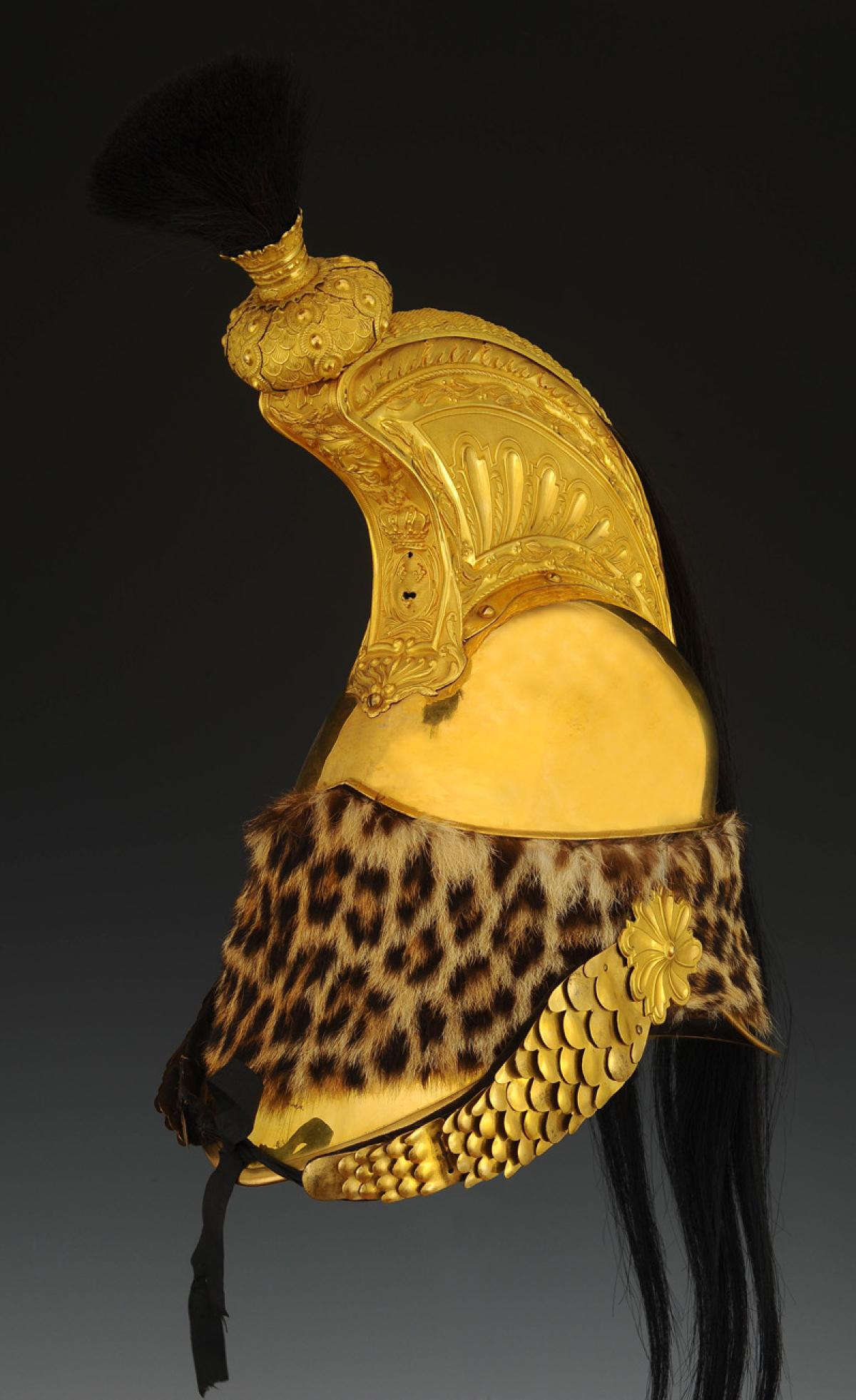
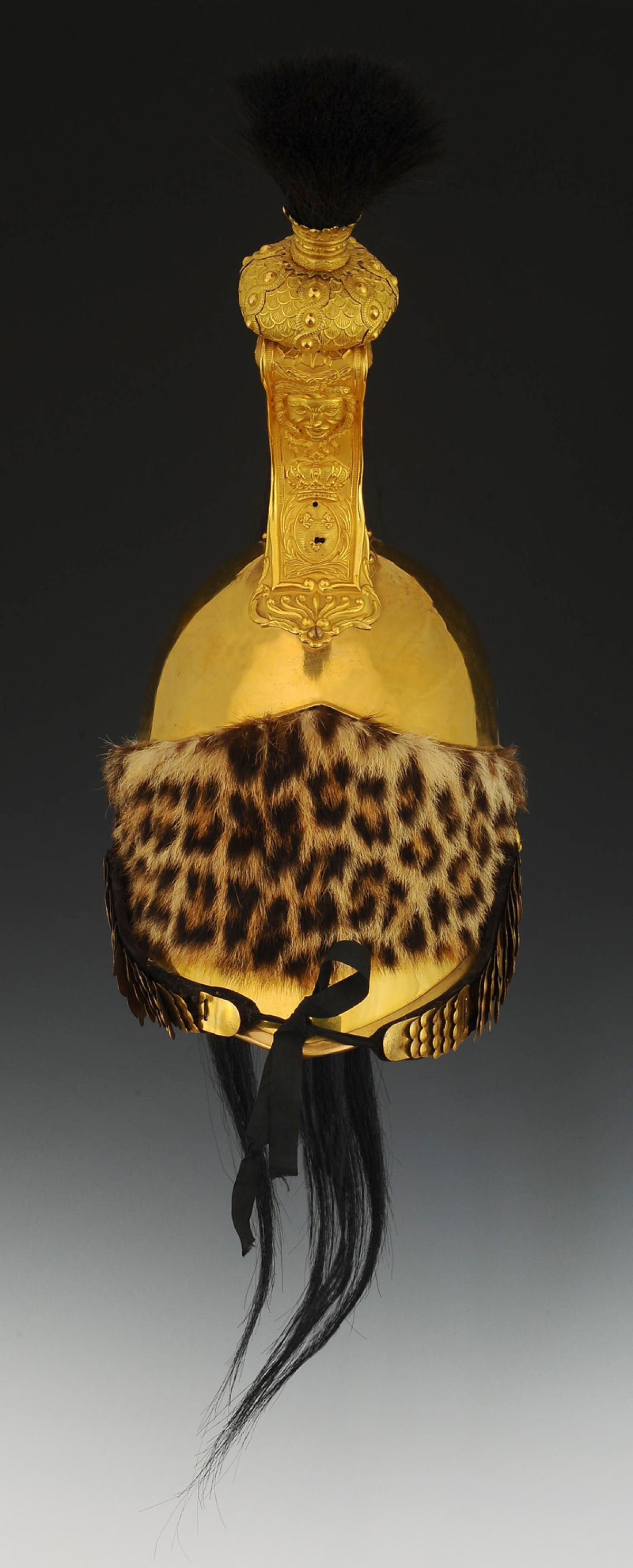
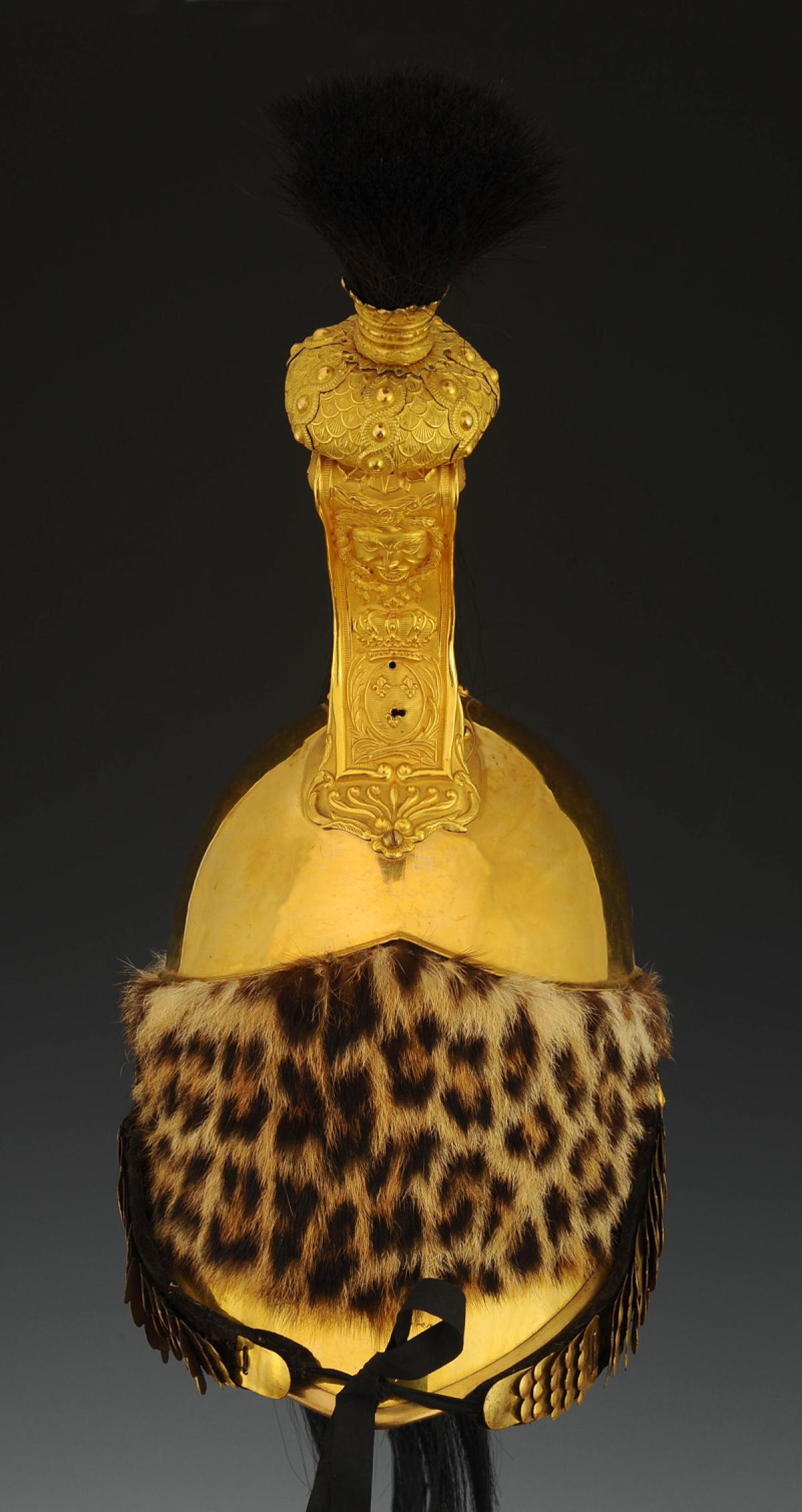
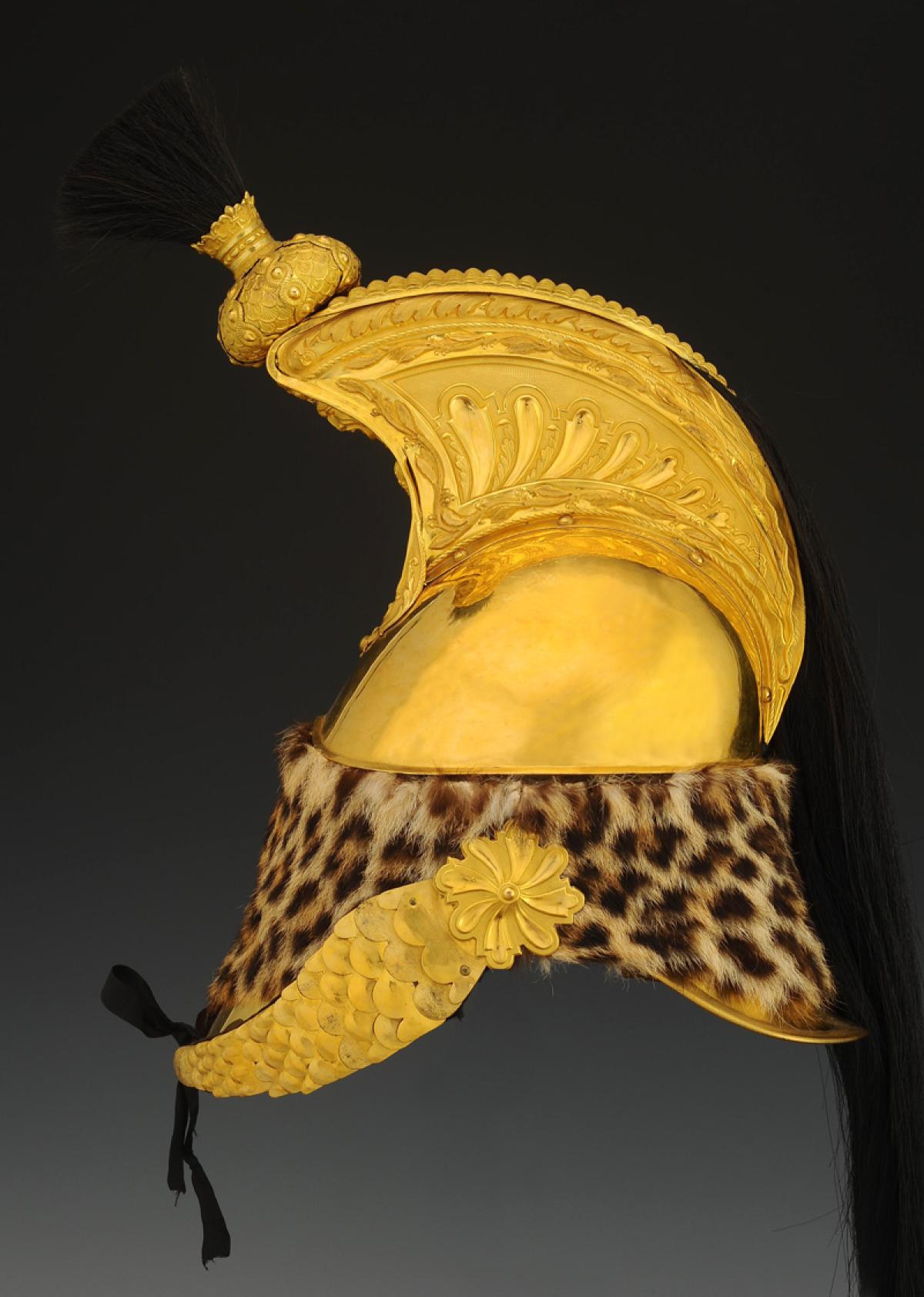
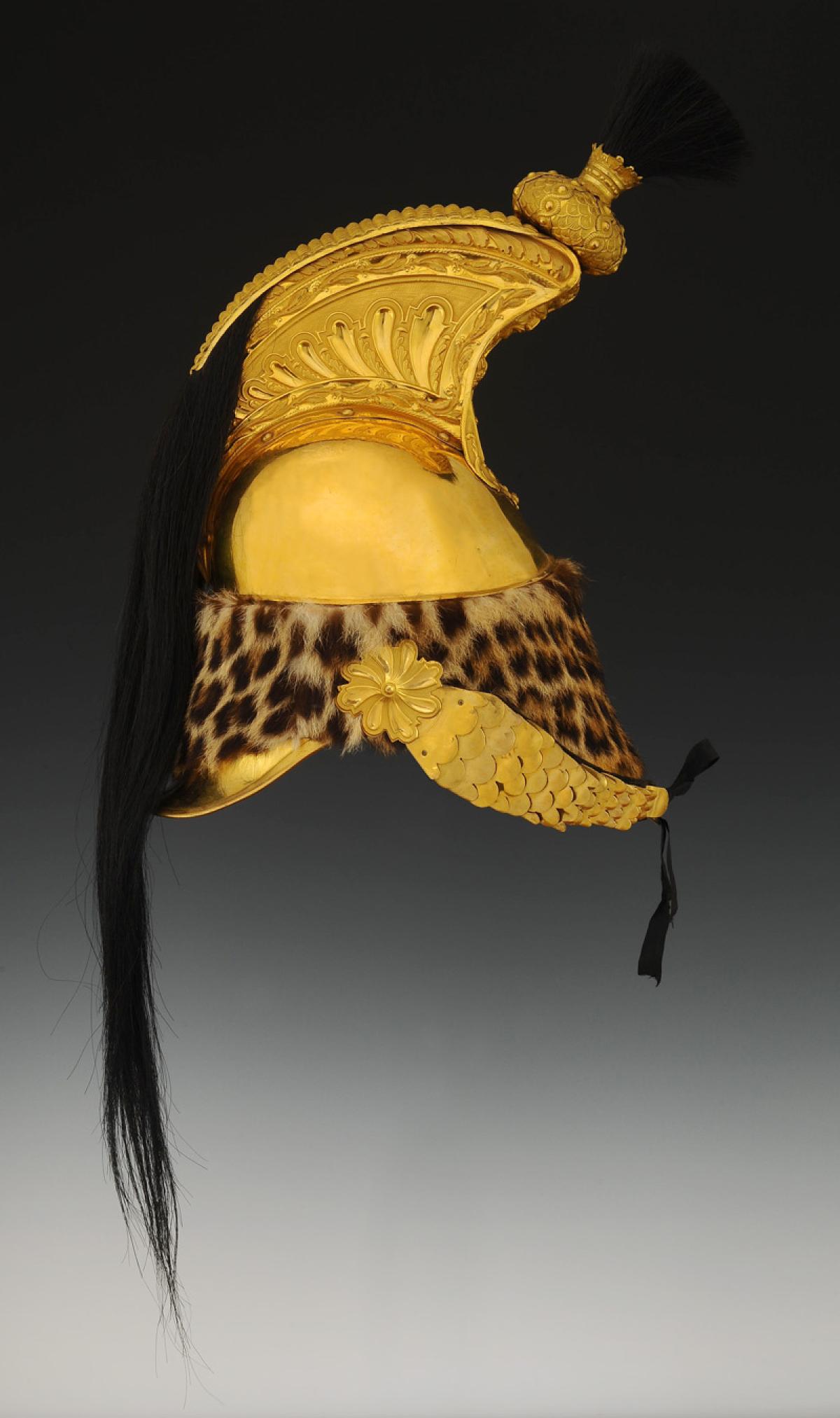
Helmet made of gold-plated copper, approximately 11 cm deep, tilted backwards in the so-called "minerve" shape, the lower part equipped with a 3-4 mm wide gutter to prevent water from infiltrating under the turban. The turban consists of a leather band, reinforced with polished metal blades, approximately 10 cm high at the front, 7 cm on the sides at the level of the rosettes, and 9 cm at the back, covered with genuine panther skin. The visor, 6 cm wide, is gold-plated copper partly covered with skin, encircled by a gold-plated brass ring bent over the outer edge by 7 mm, sewn to the turban and forming its extension. The interior is lined with waxed green morocco leather. The neck guard is gold-plated copper partially covered with skin, brass ring bent in the same manner as the visor, lined inside with waxed black morocco leather.
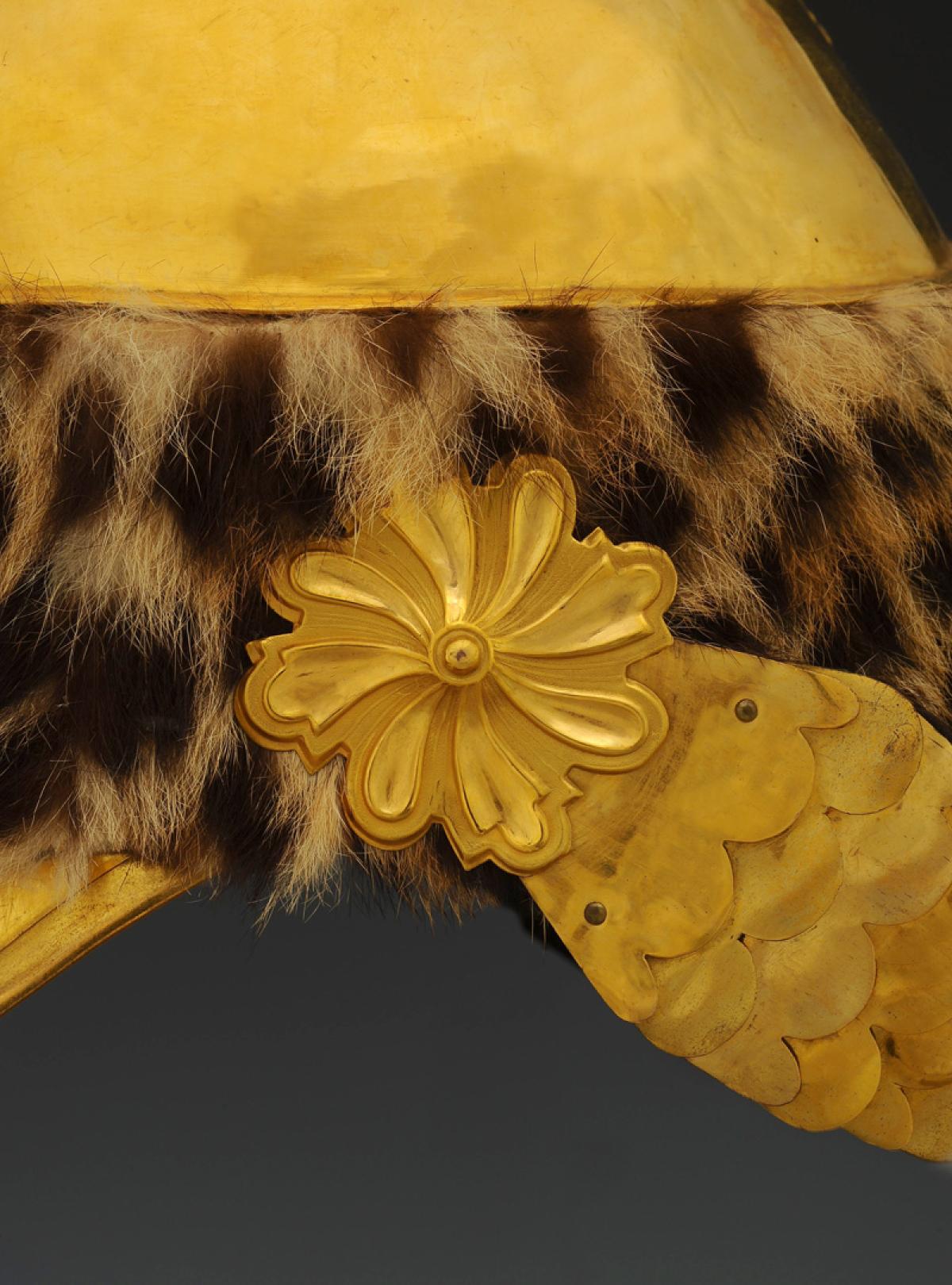
The chinstraps consist of two parts: the chin strap made of soft leather, covered in black velvet, adorned with 18 gold-plated brass scales cut alternately into 4 or 3 festoons (the widest measuring 5.4 cm and the narrowest 10.7 cm); rosette stamped and cut into a palmette shape, gold-plated, with the smooth parts burnished with agate stone and the background in a matte finish, Ø 5.9 cm. The chin strap is finished with a replacement black silk ribbon.
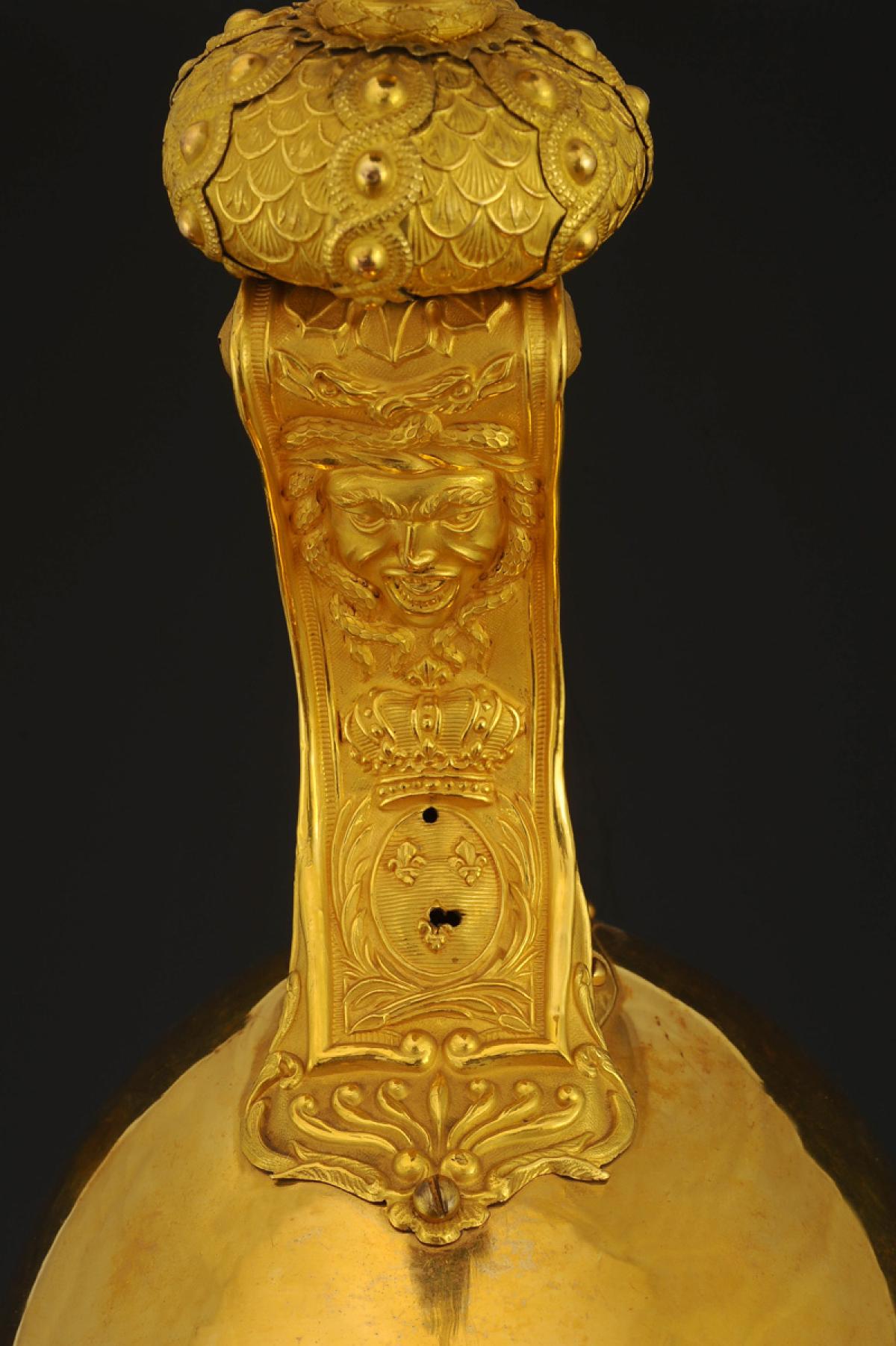
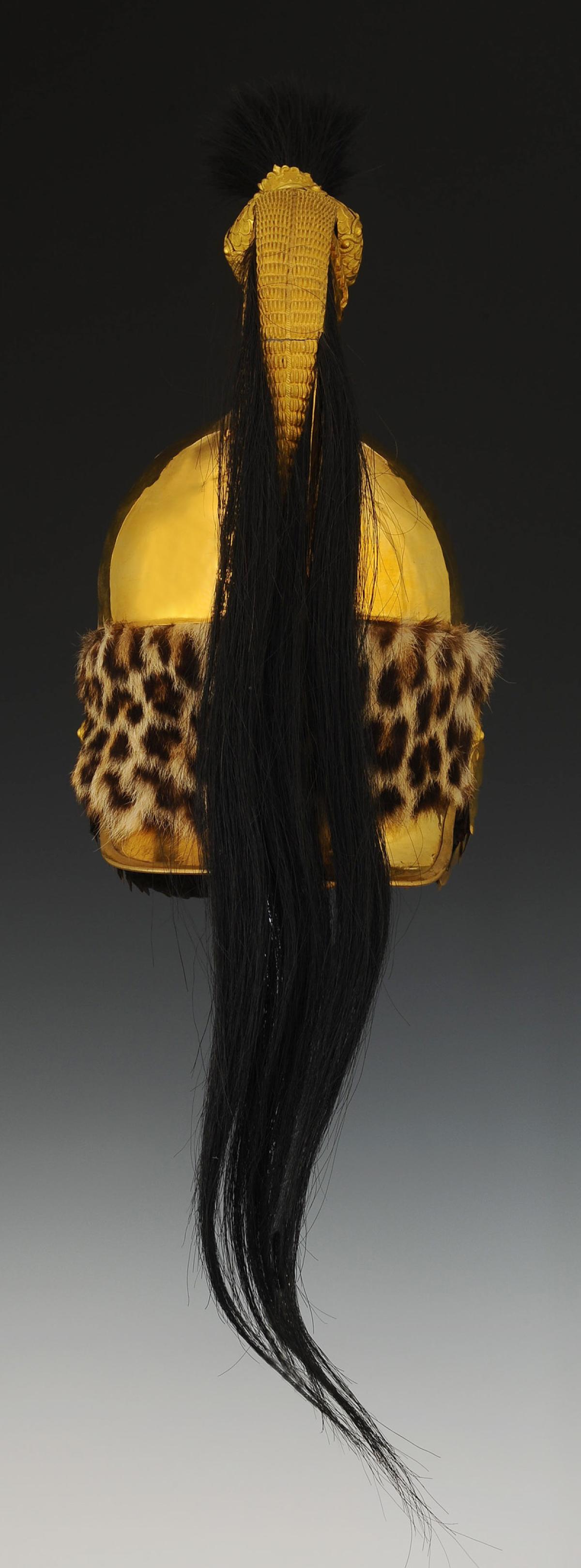
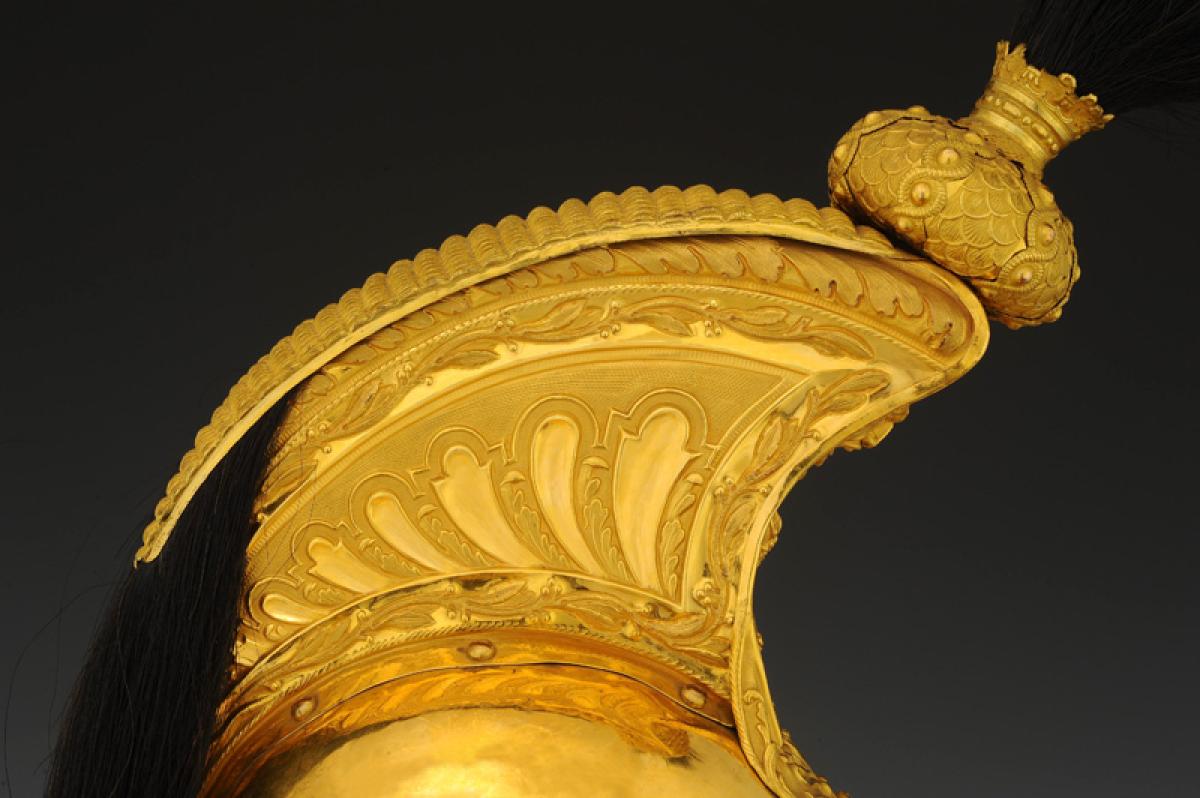
The plume holder, normally intended to hold the colonel's plume, is missing from this model; no traces of the original plume holder's attachment are present on the turban. The crest is made of gold-plated brass and consists of two crests, a mask, and a covering plate: the maximum height of the crests is 13 cm, with a width of 4.4 cm, each of them stamped with a sanded background within which a series of 9 decreasing godrons separated by acanthus leaves are depicted; this panel is bordered by a smooth background decorated in relief with a laurel branch on the upper part and another laurel branch on the lower part rising towards the front; this frame is edged with a twisted molding. The upper part of the crests stamped with acanthus leaves cascading downwards; the mask's width is 4.4 cm; a relief-stamped medusa head at the top, and a wide palmette framed by acanthus leaves at the bottom. The central part of the mask bears a relief-stamped depiction of the Arms of France surrounded by two palms and surmounted by the royal crown. The mask and crest are attached to the helmet by nine gold-plated round-headed screws. The covering plate decorating the top of the crest is relief-stamped to imitate a braided mane.
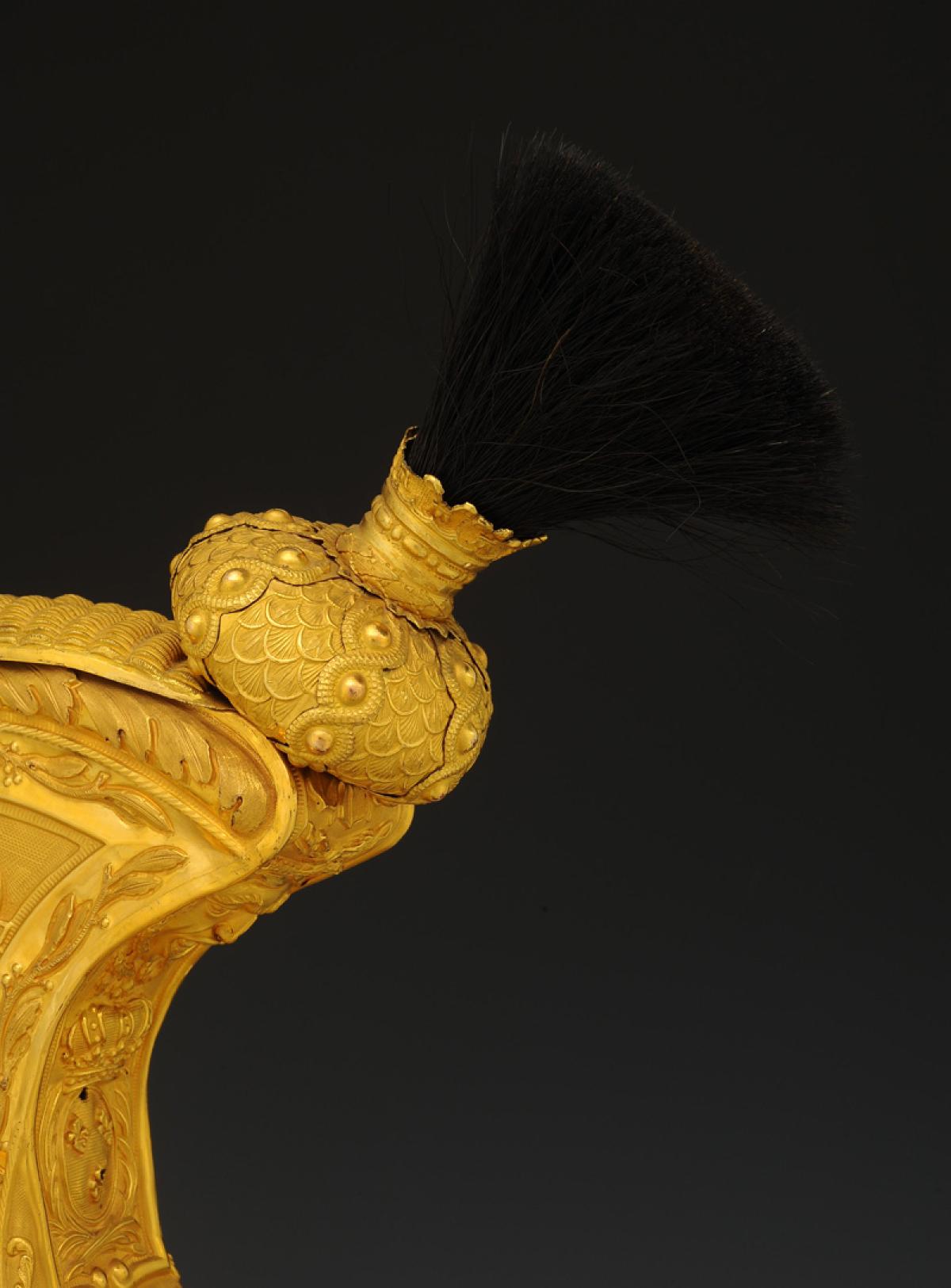
The plume socket consists of an olive, H 3.5 cm, Ø 7.2 cm, formed by 7 gold-plated brass strips relief-stamped with flower-decorated scales riveted together by small relief-stamped strips portraying two intertwined serpents around four vertically arranged pearls; a socket relief-stamped with a laurel leaf crown, a pearl rod, and topped with a series of fleur de lis, H 2.7 cm, Ø at the base 2.6 cm, Ø at the top 2.9 cm; plume made of black horsehair H 6.3 cm.
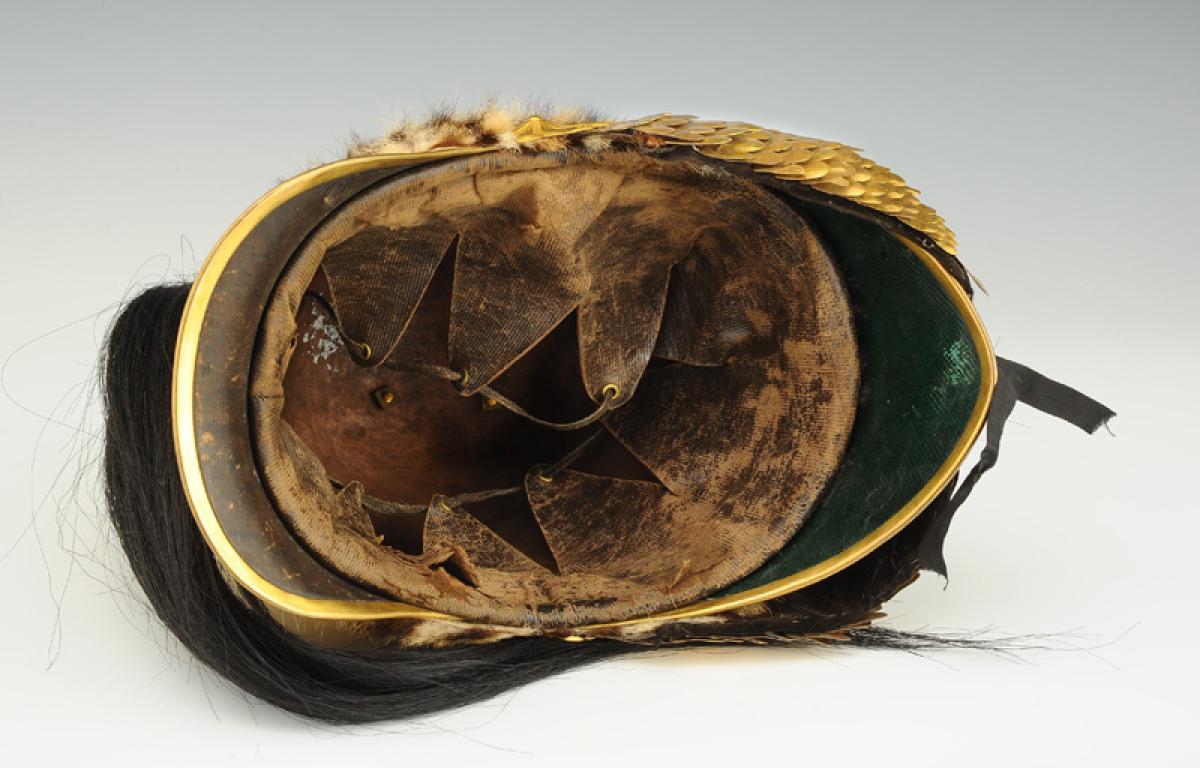
The black horsehair mane is approximately 50 cm long. The inner lining consists of a fine leather headband, 13 cm high, notched in 10 "wolf teeth" and ending in a brass eyelet.
Total height of the helmet 43.5 cm.
France.
First Restoration - Hundred Days.
Superb condition, missing one scale on each chinstrap, original panther skin but later replaced.
PROVENANCE:
Helmet from the direct descendants of Colonel Niepce.
BIOGRAPHY:
David François Étienne Laurent David NIEPCE was born in Chalon on September 12, 1781, into a royalist family, and was a cousin of Nicéphore, the inventor of photography.
At the Oratorians school in Chalon, he preferred playing truant with a group of friends, where his liveliness, strength, and sense of justice made him a leader. This character, which he maintained throughout his life, marked the major milestones of his career: declared a "good patriot and republican" during the revolution, a first encounter with the sub-lieutenant Bonaparte would shape his life. He enlisted in Givry in the Republic's volunteer army at the age of 17, on March 21, 1799; he participated in the Italian campaign with the army commanded by the First Consul; in the Fontana-Bua valley, he actively engaged in combat against the Barbets and earned a reward saber; BONAPARTE appointed him sub-lieutenant in the 4th light infantry on the 13th of prairial, year VIII; lieutenant in the 18th brigade, year XI; chevalier of the Legion of Honor on December 18, 1803. David Nièpce experienced all the epic battles of the Napoleonic Wars: Marengo, Austerlitz, Jena, the campaigns of Prussia, Silesia, Poland. He transitioned to the cavalry as a captain in the 6th hussars on June 17, 1806; captain and aide de camp to General HÉDOUVILLE, then attached to the staff of the Prince of Wagram. Knight of the Military Merit of Bavaria in 1807. On June 21, 1809, he was appointed orderly officer of King Jérôme of Westphalia (Napoleon's brother); he rose to the rank of major on September 1, 1810, and colonel on January 4, 1812; knight of the Crown of Westphalia on February 15, 1810; he took part in the campaigns of Russia and Saxony in 1812 and 1813; appointed colonel of King Jérôme's guards on August 1, 1813.
After the Emperor's exile to Elba, he reunited with his wife, the Baroness de Zandt, and their six children. Appointed colonel of the 8th Queen's Dragoon Regiment in July 1814; knight of Saint Louis in 1815; during the Hundred Days, he placed himself under Napoleon's command and participated in the campaign of Mont-Saint-Jean as commander of a dragoon brigade; on half-pay during the second Restoration; he returned to the army on December 14, 1815. Officer of the Legion of Honor in 1827; he commanded the Lyon garrison in 1831; commander of the Legion of Honor on December 5, 1831.
After the Revolution of 1848, he was elected to the General Council of Saône-et-Loire from 1852 until his death in 1869, seventeen years during which Sennecey and its district benefited from his progressive will, particularly for public education, the lives of teachers and students.
He died in Sennecey-le-Grand in 1869 at the age of 88.
Colonel David Niépce also played a significant role in the invention of photography as he frequently traveled between Sennecey-le-Grand and Paris, serving as the link between Nicéphore and Charles Chevalier, the Parisian optician. It was Charles Chevalier who introduced Daguerre to Nicéphore. All the objects in the world's oldest photo laboratory, once owned by Petiot Groffier and already stored at Maison Niépce, came from Charles Chevalier's workshop.
David and Nicéphore were cousins and close friends, and Nicéphore enjoyed visiting Sennecey knowing that the whole family would be there during his visits.
It was in the attics of this same house in Sennecey, meticulously searched, that we found his library, objects from his cabinet of curiosities, and some photo accessories, as he had followed Nicéphore's work and became interested in photography as early as 1839.
NOTE:
This helmet features the same decorations of the fins and the plume holder as the helmet of the colonel of the Imperial Guard Dragoon Regiment model 1806.
The neck cover first appeared in 1814 on the helmets of the First Empire's Imperial Guard Dragoons, such as Captain Dulac's helmet from the Bourges museum collections, currently on deposit at the Army Museum in Paris. In this case, the interior linings are of the wolf's teeth model.
The helmets from the 1814 period of officer dragons bearing the Arms of France on the mask belonged to the former Imperial Guard, which became the Royal Corps of the Dragoons of France in 1814. These are highly rare helmets; we have only identified five officer models of this kind: one in the collections of the Army Museum on display at the Château de l'Emperi in Salon-de-Provence (formerly from the Raoul and Jean Brunon collection), one from the former collection of Commandant Lachouque, another belonging to the former Jank collection in Munich before World War I, which was later owned by Mr. Hollitzer and was auctioned in 1933, a fourth helmet with a decorative fantasy mask is preserved in the collections of the Fort de Joux Museum in Pontarlier. The fifth example is the one presented today. Colonel Niepce's helmet is of a very exceptional manufacture, the only known one of its kind.
Helmet made of gold-plated copper, approximately 11 cm deep, tilted backwards in the so-called "minerve" shape, the lower part equipped with a 3-4 mm wide gutter to prevent water from infiltrating under the turban. The turban consists of a leather band, reinforced with polished metal blades, approximately 10 cm high at the front, 7 cm on the sides at the level of the rosettes, and 9 cm at the back, covered with genuine panther skin. The visor, 6 cm wide, is gold-plated copper partly covered with skin, encircled by a gold-plated brass ring bent over the outer edge by 7 mm, sewn to the turban and forming its extension. The interior is lined with waxed green morocco leather. The neck guard is gold-plated copper partially covered with skin, brass ring bent in the same manner as the visor, lined inside with waxed black morocco leather.
The chinstraps consist of two parts: the chin strap made of soft leather, covered in black velvet, adorned with 18 gold-plated brass scales cut alternately into 4 or 3 festoons (the widest measuring 5.4 cm and the narrowest 10.7 cm); rosette stamped and cut into a palmette shape, gold-plated, with the smooth parts burnished with agate stone and the background in a matte finish, Ø 5.9 cm. The chin strap is finished with a replacement black silk ribbon.
The plume holder, normally intended to hold the colonel's plume, is missing from this model; no traces of the original plume holder's attachment are present on the turban. The crest is made of gold-plated brass and consists of two crests, a mask, and a covering plate: the maximum height of the crests is 13 cm, with a width of 4.4 cm, each of them stamped with a sanded background within which a series of 9 decreasing godrons separated by acanthus leaves are depicted; this panel is bordered by a smooth background decorated in relief with a laurel branch on the upper part and another laurel branch on the lower part rising towards the front; this frame is edged with a twisted molding. The upper part of the crests stamped with acanthus leaves cascading downwards; the mask's width is 4.4 cm; a relief-stamped medusa head at the top, and a wide palmette framed by acanthus leaves at the bottom. The central part of the mask bears a relief-stamped depiction of the Arms of France surrounded by two palms and surmounted by the royal crown. The mask and crest are attached to the helmet by nine gold-plated round-headed screws. The covering plate decorating the top of the crest is relief-stamped to imitate a braided mane.
The plume socket consists of an olive, H 3.5 cm, Ø 7.2 cm, formed by 7 gold-plated brass strips relief-stamped with flower-decorated scales riveted together by small relief-stamped strips portraying two intertwined serpents around four vertically arranged pearls; a socket relief-stamped with a laurel leaf crown, a pearl rod, and topped with a series of fleur de lis, H 2.7 cm, Ø at the base 2.6 cm, Ø at the top 2.9 cm; plume made of black horsehair H 6.3 cm.
The black horsehair mane is approximately 50 cm long. The inner lining consists of a fine leather headband, 13 cm high, notched in 10 "wolf teeth" and ending in a brass eyelet.
Total height of the helmet 43.5 cm.
France.
First Restoration - Hundred Days.
Superb condition, missing one scale on each chinstrap, original panther skin but later replaced.
PROVENANCE:
Helmet from the direct descendants of Colonel Niepce.
BIOGRAPHY:
David François Étienne Laurent David NIEPCE was born in Chalon on September 12, 1781, into a royalist family, and was a cousin of Nicéphore, the inventor of photography.
At the Oratorians school in Chalon, he preferred playing truant with a group of friends, where his liveliness, strength, and sense of justice made him a leader. This character, which he maintained throughout his life, marked the major milestones of his career: declared a "good patriot and republican" during the revolution, a first encounter with the sub-lieutenant Bonaparte would shape his life. He enlisted in Givry in the Republic's volunteer army at the age of 17, on March 21, 1799; he participated in the Italian campaign with the army commanded by the First Consul; in the Fontana-Bua valley, he actively engaged in combat against the Barbets and earned a reward saber; BONAPARTE appointed him sub-lieutenant in the 4th light infantry on the 13th of prairial, year VIII; lieutenant in the 18th brigade, year XI; chevalier of the Legion of Honor on December 18, 1803. David Nièpce experienced all the epic battles of the Napoleonic Wars: Marengo, Austerlitz, Jena, the campaigns of Prussia, Silesia, Poland. He transitioned to the cavalry as a captain in the 6th hussars on June 17, 1806; captain and aide de camp to General HÉDOUVILLE, then attached to the staff of the Prince of Wagram. Knight of the Military Merit of Bavaria in 1807. On June 21, 1809, he was appointed orderly officer of King Jérôme of Westphalia (Napoleon's brother); he rose to the rank of major on September 1, 1810, and colonel on January 4, 1812; knight of the Crown of Westphalia on February 15, 1810; he took part in the campaigns of Russia and Saxony in 1812 and 1813; appointed colonel of King Jérôme's guards on August 1, 1813.
After the Emperor's exile to Elba, he reunited with his wife, the Baroness de Zandt, and their six children. Appointed colonel of the 8th Queen's Dragoon Regiment in July 1814; knight of Saint Louis in 1815; during the Hundred Days, he placed himself under Napoleon's command and participated in the campaign of Mont-Saint-Jean as commander of a dragoon brigade; on half-pay during the second Restoration; he returned to the army on December 14, 1815. Officer of the Legion of Honor in 1827; he commanded the Lyon garrison in 1831; commander of the Legion of Honor on December 5, 1831.
After the Revolution of 1848, he was elected to the General Council of Saône-et-Loire from 1852 until his death in 1869, seventeen years during which Sennecey and its district benefited from his progressive will, particularly for public education, the lives of teachers and students.
He died in Sennecey-le-Grand in 1869 at the age of 88.
Colonel David Niépce also played a significant role in the invention of photography as he frequently traveled between Sennecey-le-Grand and Paris, serving as the link between Nicéphore and Charles Chevalier, the Parisian optician. It was Charles Chevalier who introduced Daguerre to Nicéphore. All the objects in the world's oldest photo laboratory, once owned by Petiot Groffier and already stored at Maison Niépce, came from Charles Chevalier's workshop.
David and Nicéphore were cousins and close friends, and Nicéphore enjoyed visiting Sennecey knowing that the whole family would be there during his visits.
It was in the attics of this same house in Sennecey, meticulously searched, that we found his library, objects from his cabinet of curiosities, and some photo accessories, as he had followed Nicéphore's work and became interested in photography as early as 1839.
NOTE:
This helmet features the same decorations of the fins and the plume holder as the helmet of the colonel of the Imperial Guard Dragoon Regiment model 1806.
The neck cover first appeared in 1814 on the helmets of the First Empire's Imperial Guard Dragoons, such as Captain Dulac's helmet from the Bourges museum collections, currently on deposit at the Army Museum in Paris. In this case, the interior linings are of the wolf's teeth model.
The helmets from the 1814 period of officer dragons bearing the Arms of France on the mask belonged to the former Imperial Guard, which became the Royal Corps of the Dragoons of France in 1814. These are highly rare helmets; we have only identified five officer models of this kind: one in the collections of the Army Museum on display at the Château de l'Emperi in Salon-de-Provence (formerly from the Raoul and Jean Brunon collection), one from the former collection of Commandant Lachouque, another belonging to the former Jank collection in Munich before World War I, which was later owned by Mr. Hollitzer and was auctioned in 1933, a fourth helmet with a decorative fantasy mask is preserved in the collections of the Fort de Joux Museum in Pontarlier. The fifth example is the one presented today. Colonel Niepce's helmet is of a very exceptional manufacture, the only known one of its kind.
Reference :
33672 (4661)
Next update Friday, octobre 23 at 13:30 PM
FOR ALL PURCHASES, PAYMENT IN MULTIPLE CHECKS POSSIBLE
bertrand.malvaux@wanadoo.fr 06 07 75 74 63
SHIPPING COSTS
Shipping costs are calculated only once per order for one or more items, all shipments are sent via registered mail, as this is the only way to have proof of dispatch and receipt.
For parcels whose value cannot be insured by the Post, shipments are entrusted to DHL or Fedex with real value insured, the service is of high quality but the cost is higher.
RETURN POLICY
Items can be returned within 8 days of receipt. They must be returned by registered mail at the sender's expense, in their original packaging, and in their original condition.
AUTHENTICITY
The selection of items offered on this site allows me to guarantee the authenticity of each piece described here, all items offered are guaranteed to be period and authentic, unless otherwise noted or restricted in the description.
An authenticity certificate of the item including the description published on the site, the period, the sale price, accompanied by one or more color photographs is automatically provided for any item priced over 130 euros. Below this price, each certificate is charged 5 euros.
Only items sold by me are subject to an authenticity certificate, I do not provide any expert reports for items sold by third parties (colleagues or collectors).
FOR ALL PURCHASES, PAYMENT IN MULTIPLE CHECKS POSSIBLE
bertrand.malvaux@wanadoo.fr 06 07 75 74 63
An authenticity certificate of the item including the description published on the site, the period, the sale price, accompanied by one or more color photographs is automatically provided for any item priced over 130 euros. Below this price, each certificate is charged 5 euros.
Only items sold by me are subject to an authenticity certificate, I do not provide any expert reports for items sold by third parties (colleagues or collectors).