
OFFICER'S HELMET OF CHASSEURS À CHEVAL, First Empire (1811-1815). 33649 (8677)
Sold out
OFFICER'S HELMET OF CHEVAU-LÉGERS, First Empire (1811-1815). 33649(8677)
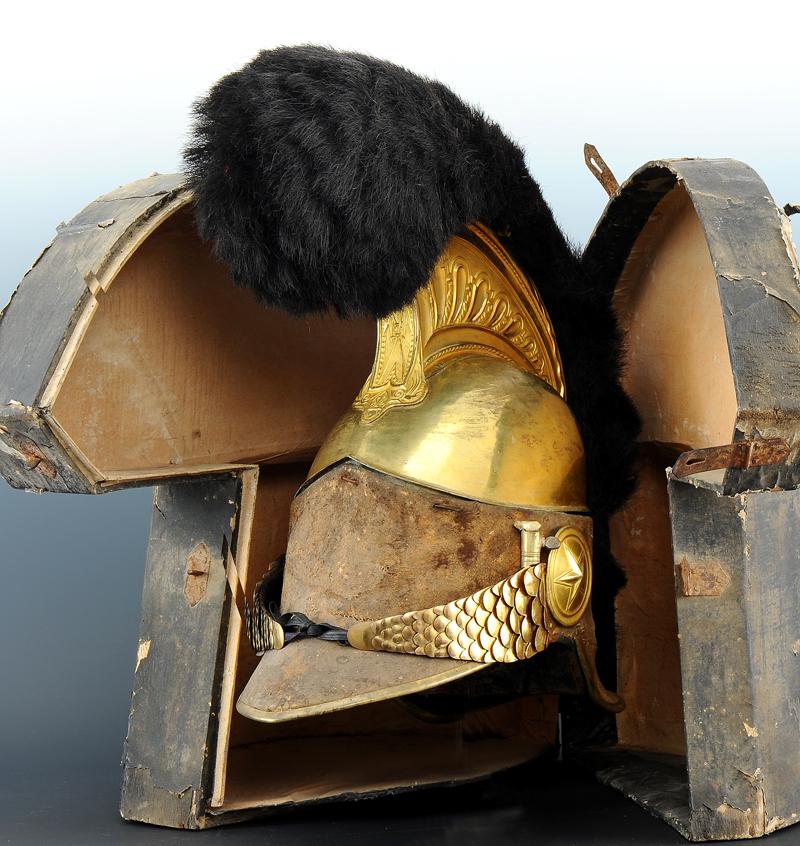
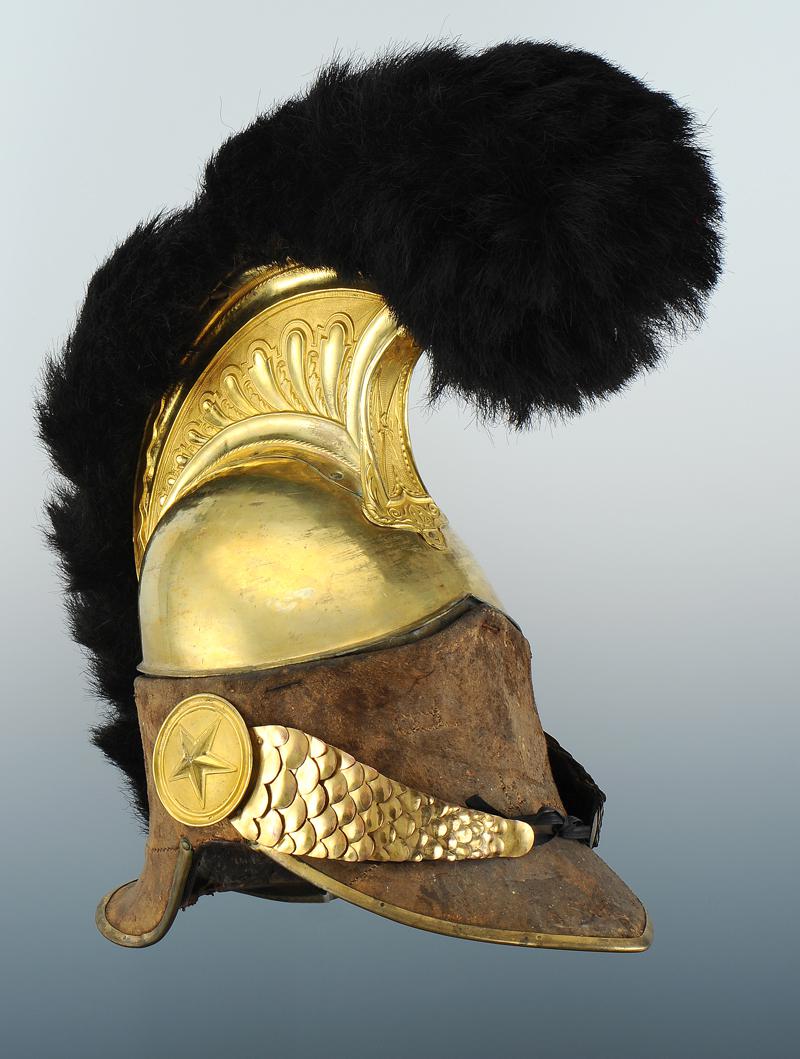
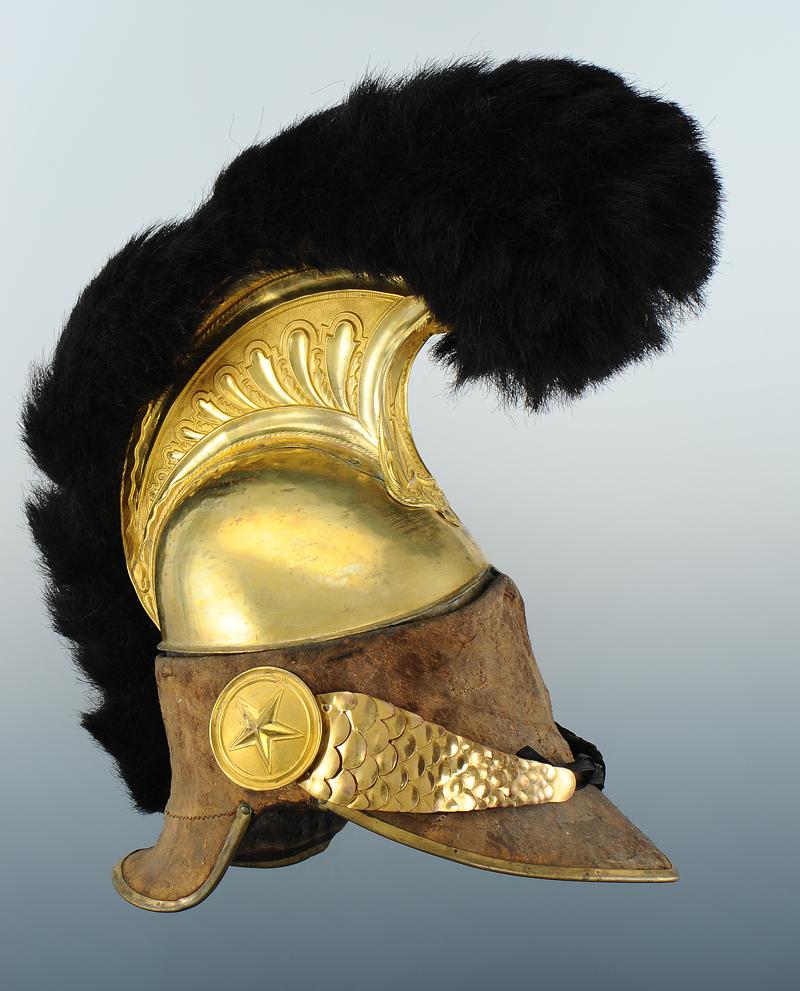
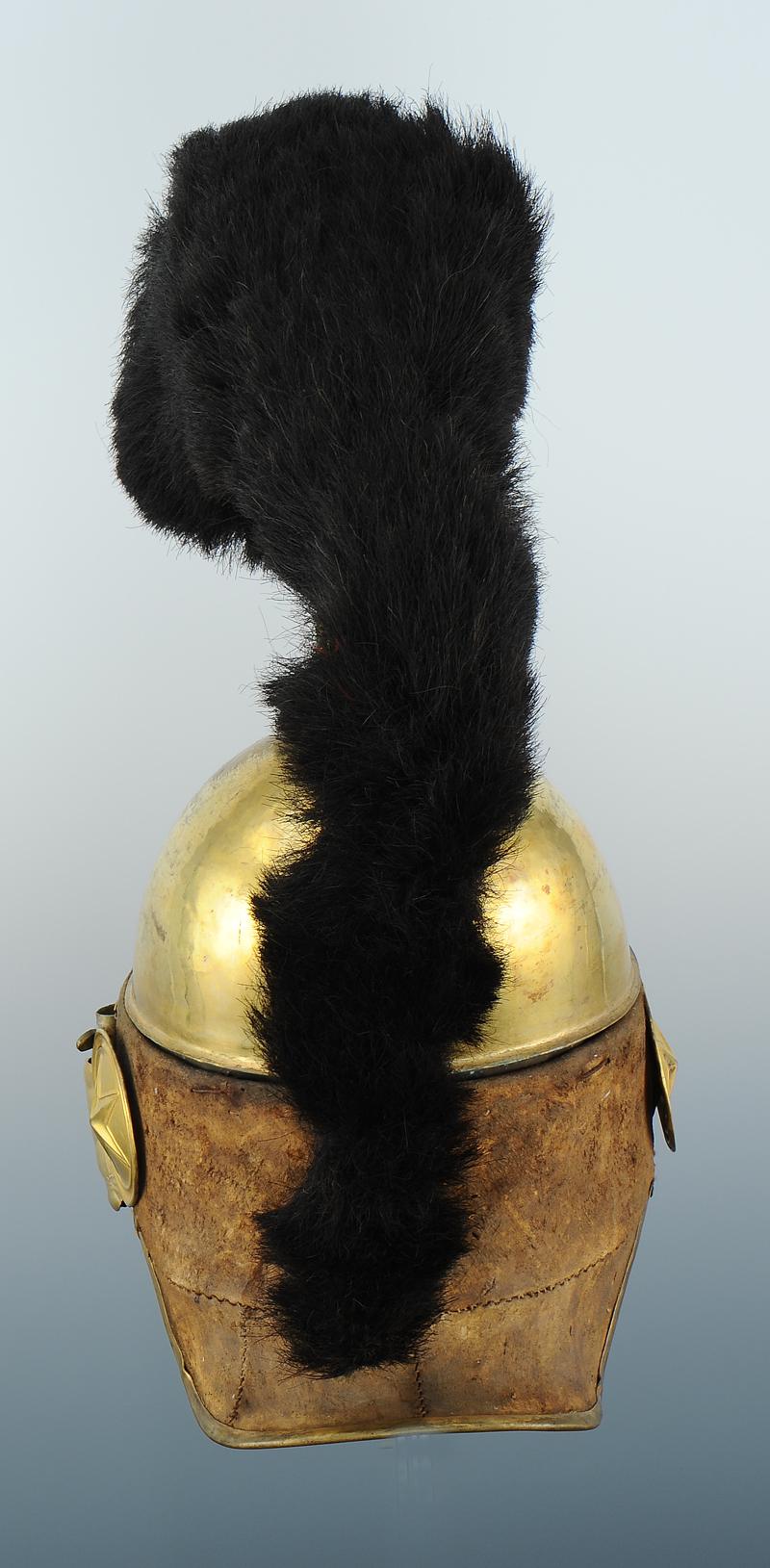
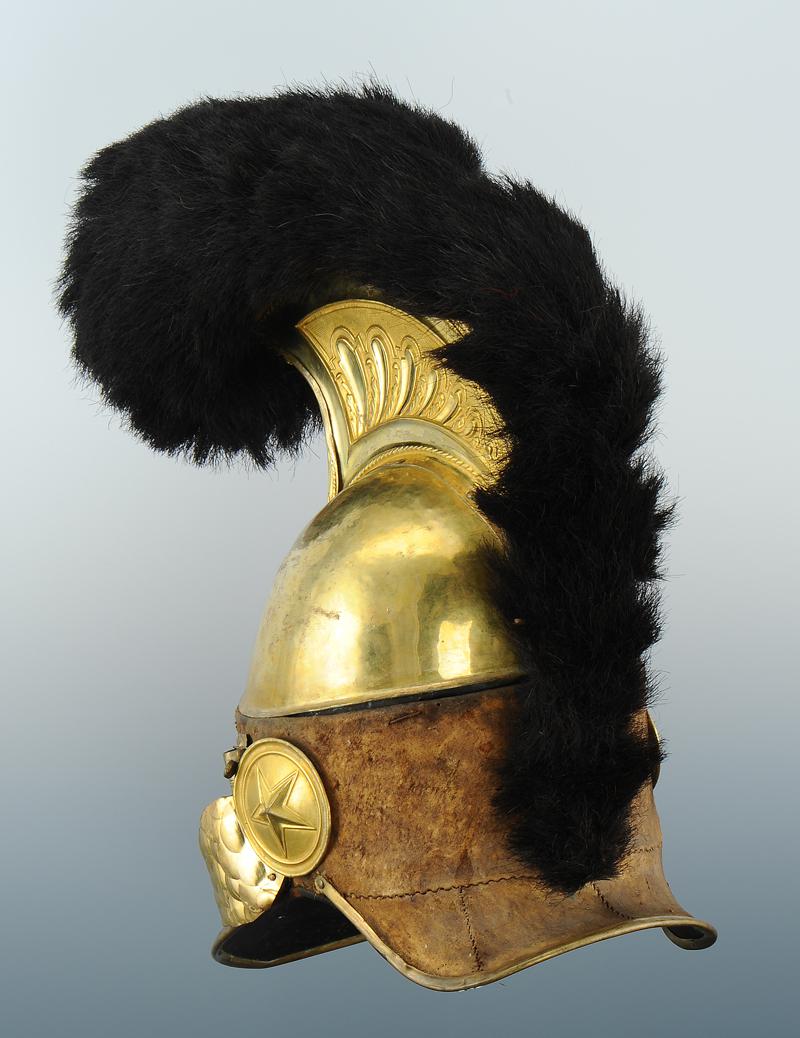
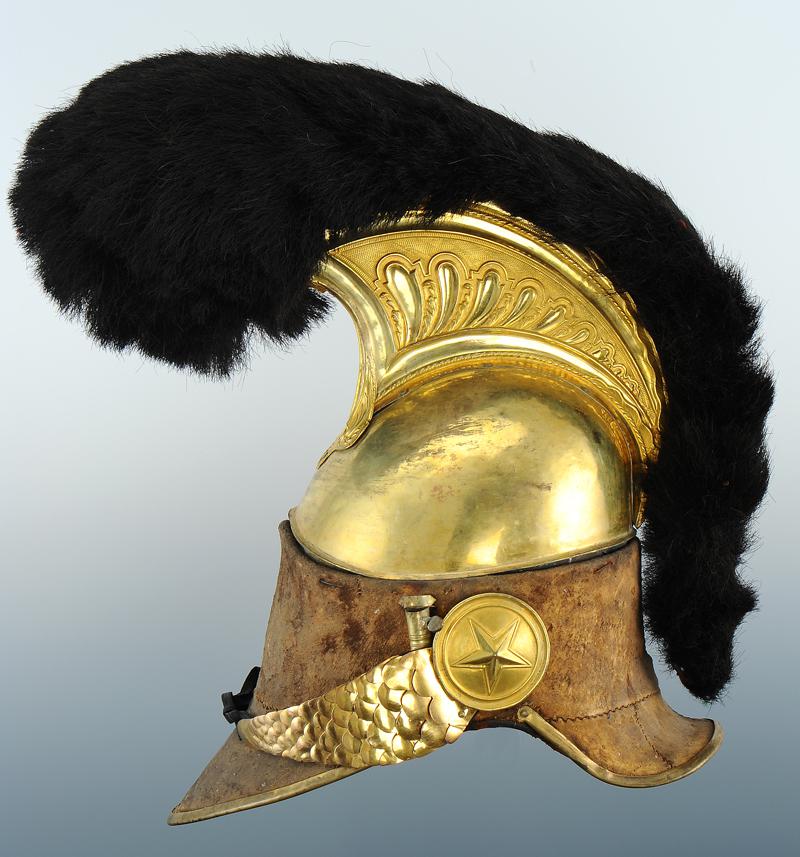
Gilded brass helmet of approximately 11 cm in depth, tilted backwards, in a so-called minerva shape, with a base fitted with a 4 mm wide gutter to prevent water infiltration under the turban.
The turban consists of a leather band approximately 10 mm high at the front, 8.7 cm on the sides, and 9 cm at the back, originally covered with genuine panther skin now missing.
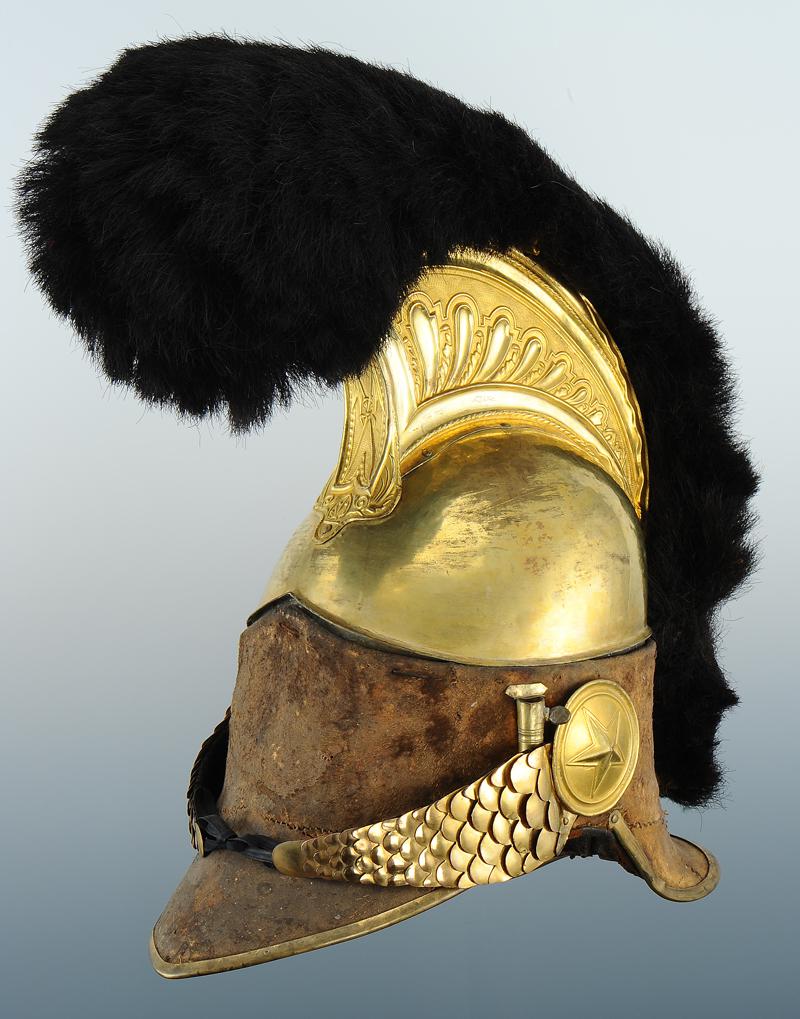
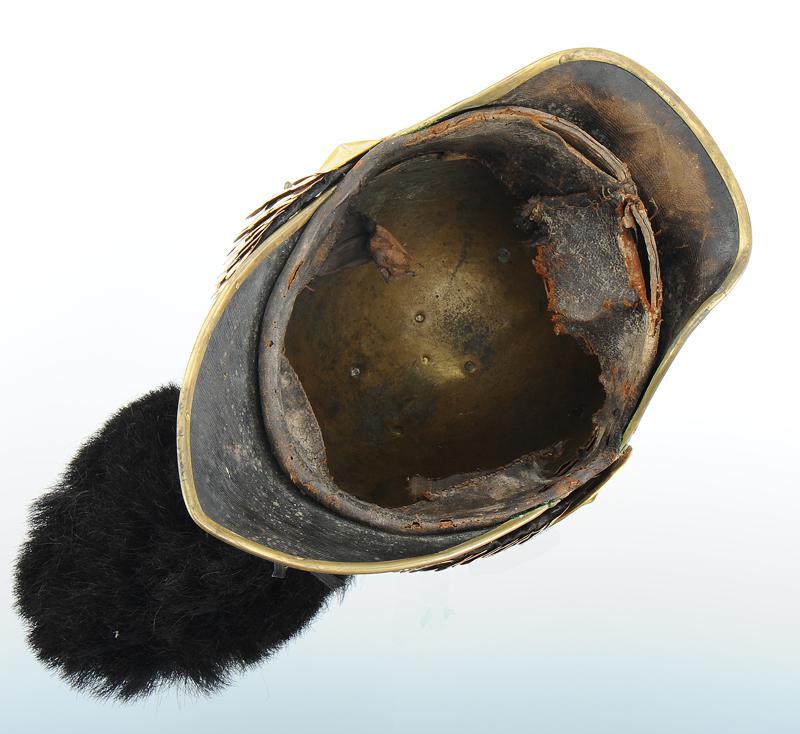
Leather visor covered with skin encircled by a gilded brass strip bent over the outer edge (width 6 mm) and riveted by six small brass nails; it measures approximately 8.2 cm in length, sewn to the turban, and forms its extension. Black sheepskin lining.
Nape cover approximately 4.5 cm wide, identical to the visor. Black sheepskin lining.
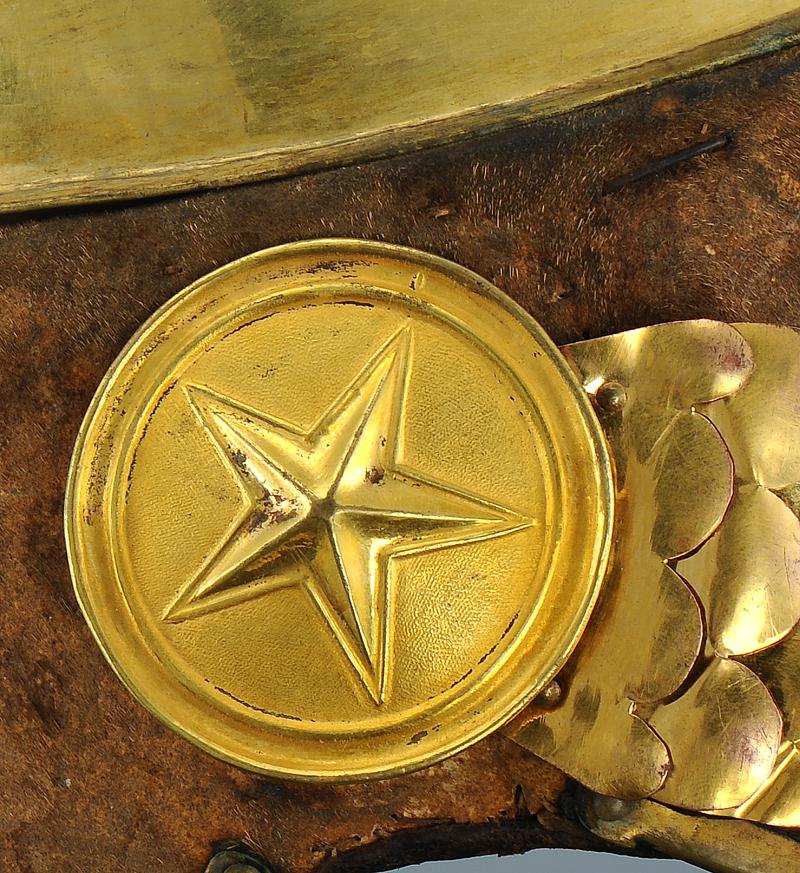
Chinstraps composed of two parts: the chinstrap in soft leather, sheathed in black velvet, covered with 16 gold-plated copper scales, alternately cut into 4 or 3 festoons (the widest measuring 5.5 cm and the narrowest 1.7 cm cut into a single festoon); the rosette in a round shape, in gilded copper embossed in relief with a 5-pointed star, Ø 6.3 cm.
Plume holder, round tubular section 5.5 cm high forming a flared top and bottom held to the turban by a brass wire; at the top, a clamping screw to fix the plume.
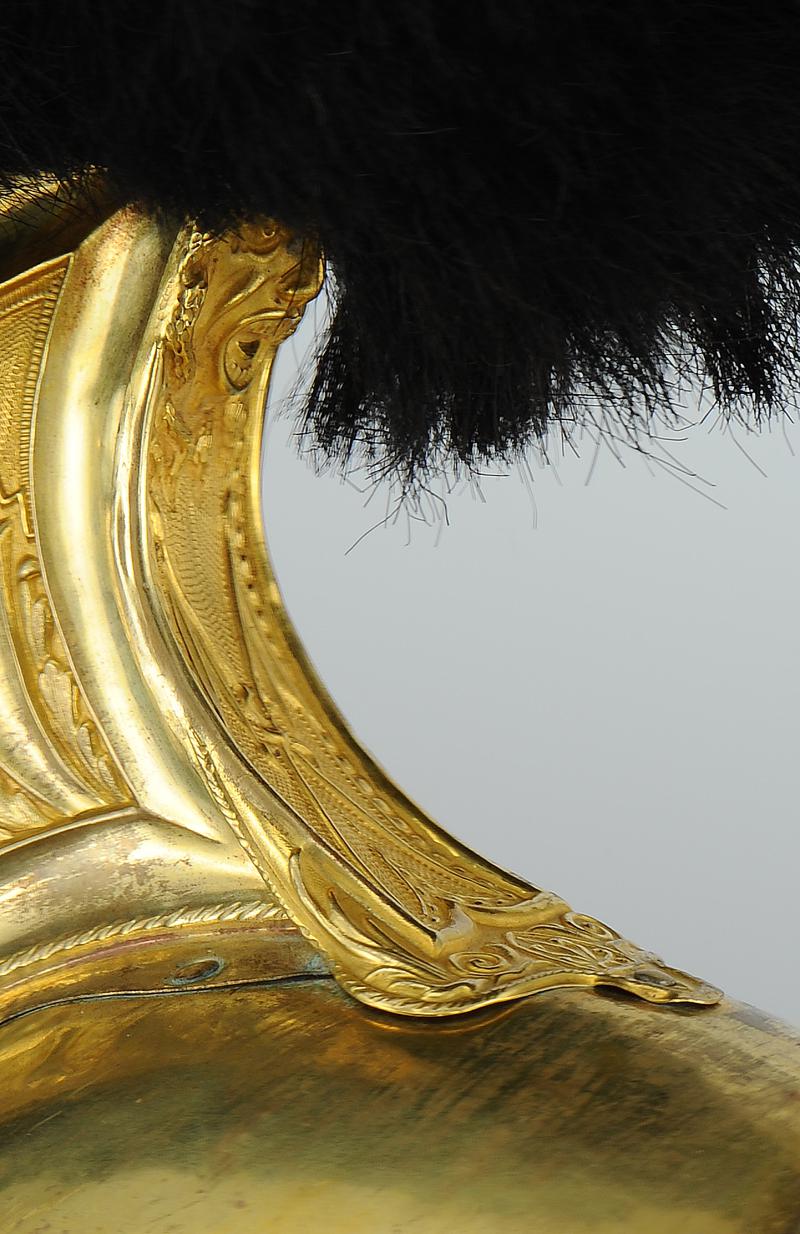
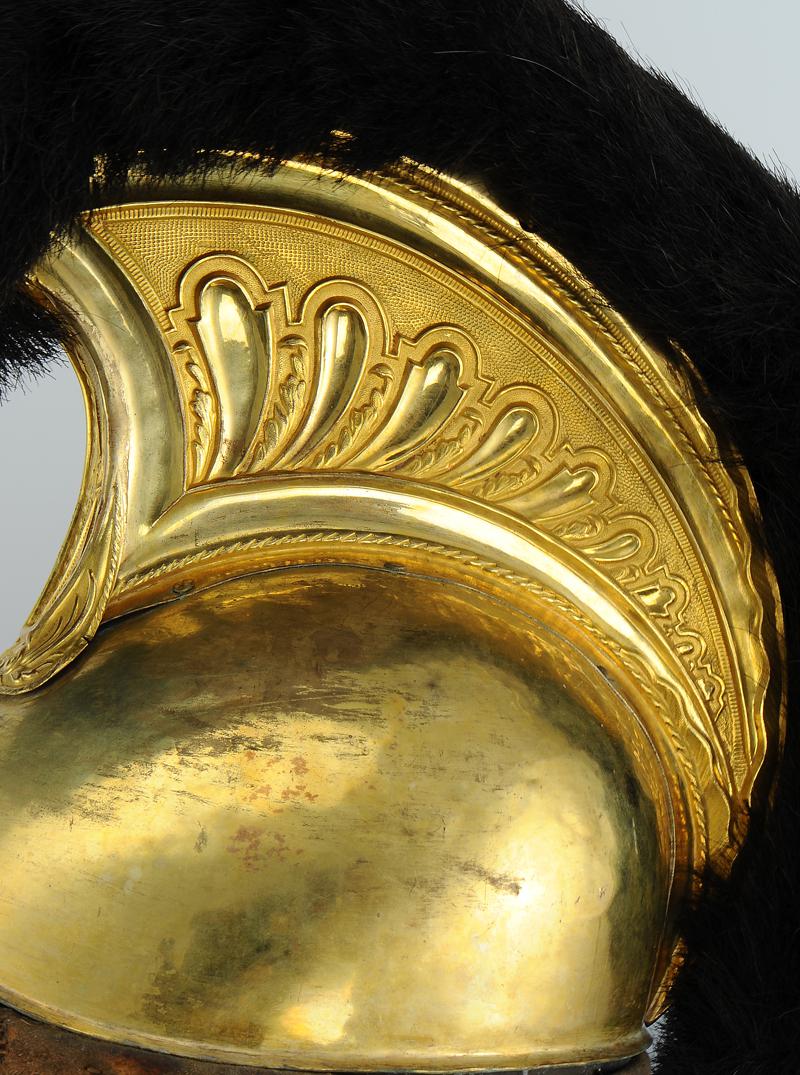
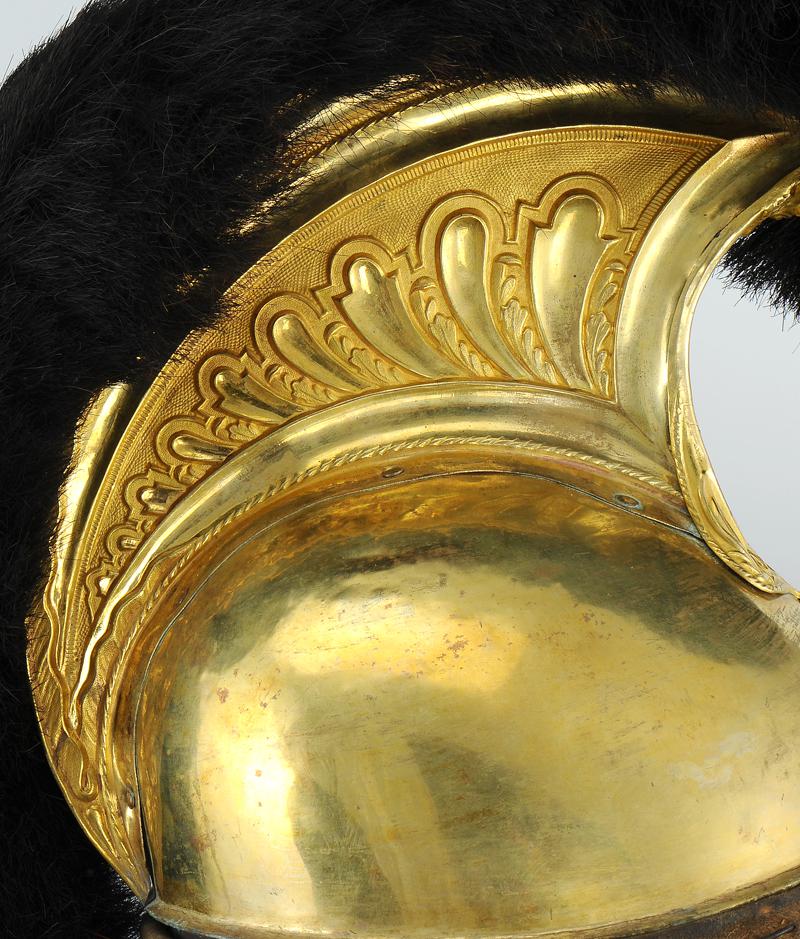
Gilded brass crest with embossed decorative elements: maximum height of the fins 12 cm, each being struck inside a compartment of 9 diminishing gadroons towards the back separated by an acanthus leaf, underlined by a ribbon with a prominent edge on a sanded background. This compartment is framed by a smooth molding with polished gilding using agate stone. The top and bottom of this molding are underlined by a twisted projecting molding, and at the top by a smooth convex relief molding. At the back, a large embossed acanthus leaf encloses each fin. In the center of the upper part of the fins, there is a hole to receive a screw with a fin-shaped head to fix the crest.
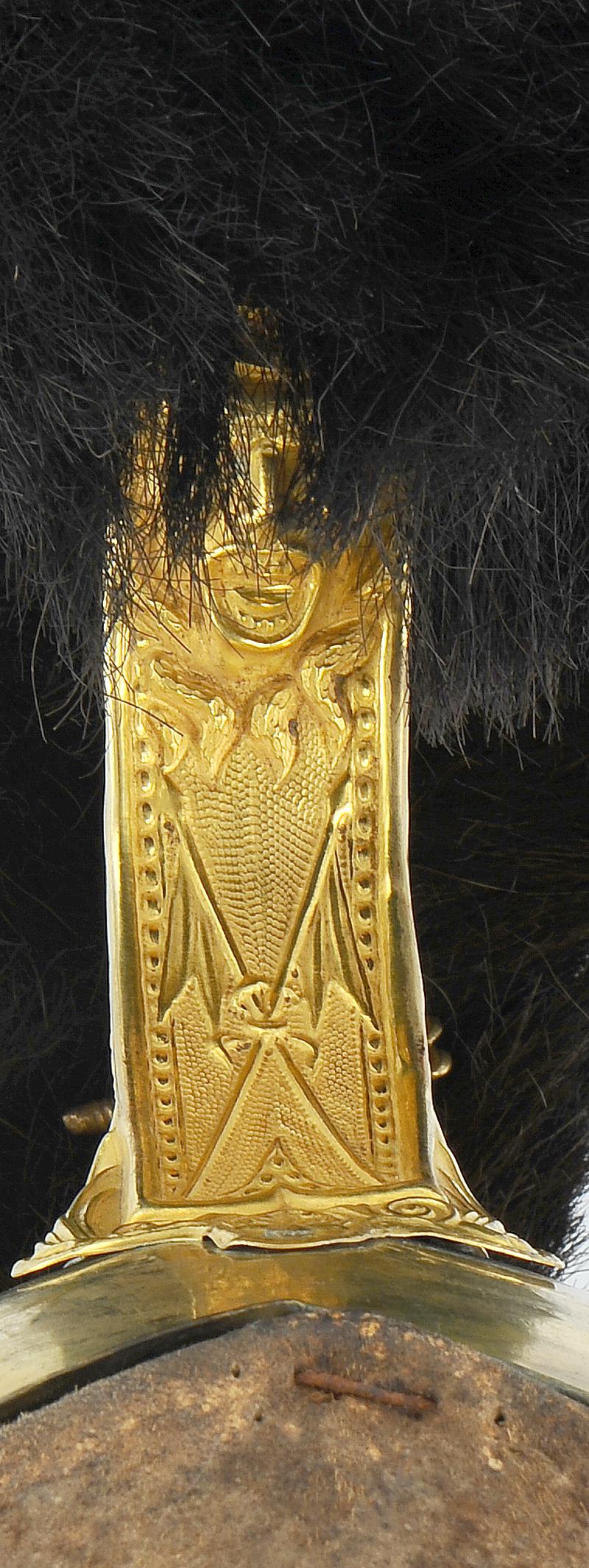
Center mask of 3.2 cm wide; at the top, a medusa head surmounted by a hole allowing the passage of a screw with a fin-shaped head to fix the crest; lower part of the mask 5.6 cm wide, emphasized by a palmette in the center surrounded by scrolls and palm leaves; in the center, two crossed cavalry lances embossed in relief. Mask fixed to the helmet by a gilded brass rivet and each fin by four gilded brass rivets.
Black horsehair plume protruding from the crest at the front by approximately 11 cm for a diameter of about 13 cm.
Interior liner composed of a thin leather band (6.5 cm high) topped with a black silk band (9 cm high).
Total height of the helmet 41 cm.
Overall very good condition, rubbing to the gilding of the helmet, skin has lost its hair, inner liner in poor condition.
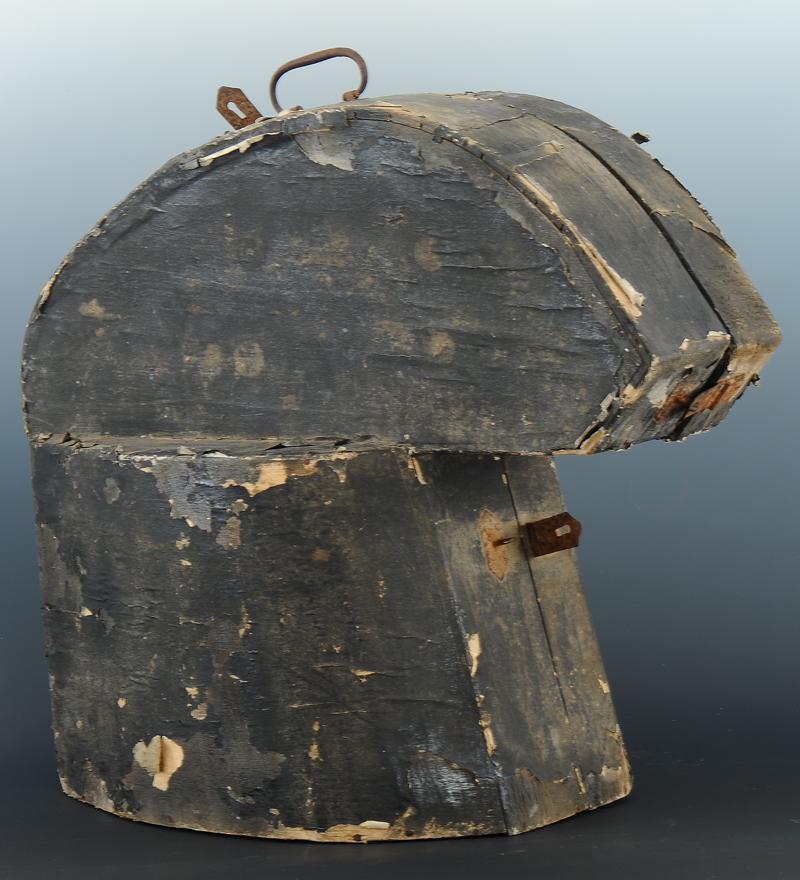
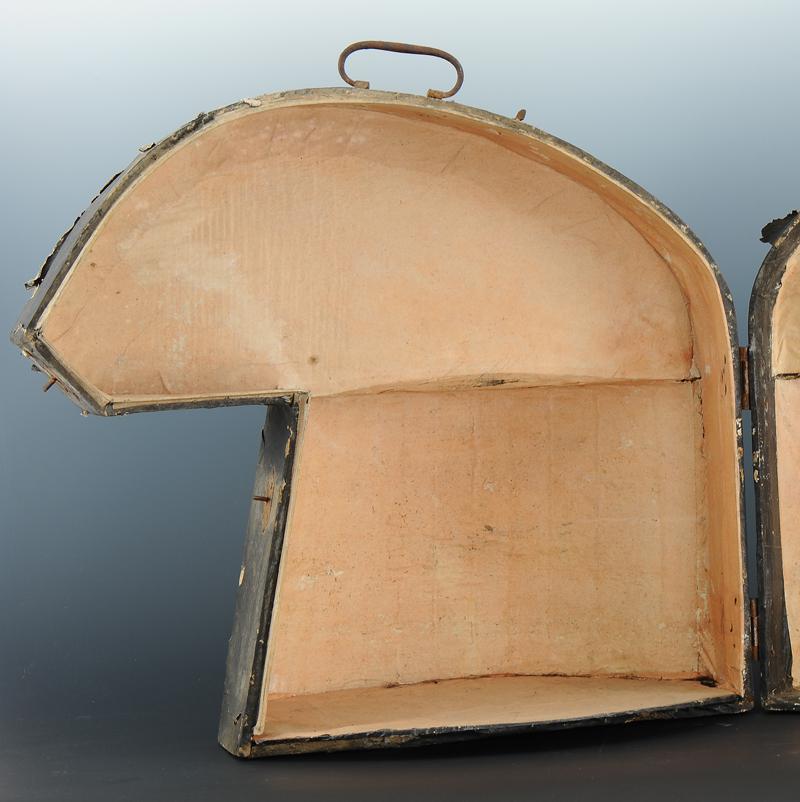
Wooden transport box covered in black waxed paper with steel handle and closures, interior lined with cream paper.
Fair condition, external paper showing wear and tear, oxidation on metal parts.
France.
First Empire (1811-1815).
HISTORICAL BACKGROUND:
"Emperor Napoleon, wanting to reassure the French cavalry, astonished by foreign lances, and having recognized the full moral power of his weapons for attack as well as their material strength in retreats, decided to grant it to a portion of the cavalry" (note on the Lance Arm, by Colonel de Brack, 1833). To this end, the decree of June 18, 1811, created 9 regiments of Chevau-légers.
The 1st regiment of Chevau-légers Lancers, formed with the 1st regiment of Dragoons, participated in the campaign of France in 1814; it was engaged in the battles of Reims and Paris, and on June 18, 1815, it was present on the battlefield of Waterloo.
The 3rd regiment of Chevau-légers Lancers, formed with the 8th regiment of Dragoons, was engaged during the campaign of France at Champaubert, Vauchamps, and Troyes. During the campaign in Belgium in 1815, it was engaged at Ligny and on June 18 at Waterloo.
The 4th regiment of Chevau-légers Lancers, formed with the 9th regiment of Dragoons, was engaged in the campaign of France in 1814 at Champaubert and Vauchamps. In 1815 during the campaign in Belgium, it distinguished itself on the battlefield of Waterloo where Maréchal des Logis ORBAN, rushing into the melee, took the English General PONSONBY prisoner.
The 5th regiment of Chevau-légers Lancers, formed with the 10th Dragoons, was engaged in the campaign of France in 1814. It was present at the battle of Montmirail. During the campaign in Belgium in 1815, it was present on the battlefields of Ligny and Waterloo.
The 6th regiment of Chevau-légers Lancers, formed with the 29th regiment of Dragoons, was engaged in the campaign of France. It took part in the battles of Champaubert, Montimirail, Vauchamps, Arcy sur Aube, and Saint Dizier. In 1815, it joined the 6th cavalry corps and then the 2nd division of light cavalry, which was attached to the 2nd cavalry corps; it was engaged in the battles of Fleurus and Waterloo on June 18.
The 9th regiment of Chevau-légers Lancers, created with the 30th regiment of Chasseurs à Cheval, was engaged in the campaign of France in 1814 at the battle of Vauchamps.
Gilded brass helmet of approximately 11 cm in depth, tilted backwards, in a so-called minerva shape, with a base fitted with a 4 mm wide gutter to prevent water infiltration under the turban.
The turban consists of a leather band approximately 10 mm high at the front, 8.7 cm on the sides, and 9 cm at the back, originally covered with genuine panther skin now missing.
Leather visor covered with skin encircled by a gilded brass strip bent over the outer edge (width 6 mm) and riveted by six small brass nails; it measures approximately 8.2 cm in length, sewn to the turban, and forms its extension. Black sheepskin lining.
Nape cover approximately 4.5 cm wide, identical to the visor. Black sheepskin lining.
Chinstraps composed of two parts: the chinstrap in soft leather, sheathed in black velvet, covered with 16 gold-plated copper scales, alternately cut into 4 or 3 festoons (the widest measuring 5.5 cm and the narrowest 1.7 cm cut into a single festoon); the rosette in a round shape, in gilded copper embossed in relief with a 5-pointed star, Ø 6.3 cm.
Plume holder, round tubular section 5.5 cm high forming a flared top and bottom held to the turban by a brass wire; at the top, a clamping screw to fix the plume.
Gilded brass crest with embossed decorative elements: maximum height of the fins 12 cm, each being struck inside a compartment of 9 diminishing gadroons towards the back separated by an acanthus leaf, underlined by a ribbon with a prominent edge on a sanded background. This compartment is framed by a smooth molding with polished gilding using agate stone. The top and bottom of this molding are underlined by a twisted projecting molding, and at the top by a smooth convex relief molding. At the back, a large embossed acanthus leaf encloses each fin. In the center of the upper part of the fins, there is a hole to receive a screw with a fin-shaped head to fix the crest.
Center mask of 3.2 cm wide; at the top, a medusa head surmounted by a hole allowing the passage of a screw with a fin-shaped head to fix the crest; lower part of the mask 5.6 cm wide, emphasized by a palmette in the center surrounded by scrolls and palm leaves; in the center, two crossed cavalry lances embossed in relief. Mask fixed to the helmet by a gilded brass rivet and each fin by four gilded brass rivets.
Black horsehair plume protruding from the crest at the front by approximately 11 cm for a diameter of about 13 cm.
Interior liner composed of a thin leather band (6.5 cm high) topped with a black silk band (9 cm high).
Total height of the helmet 41 cm.
Overall very good condition, rubbing to the gilding of the helmet, skin has lost its hair, inner liner in poor condition.
Wooden transport box covered in black waxed paper with steel handle and closures, interior lined with cream paper.
Fair condition, external paper showing wear and tear, oxidation on metal parts.
France.
First Empire (1811-1815).
HISTORICAL BACKGROUND:
"Emperor Napoleon, wanting to reassure the French cavalry, astonished by foreign lances, and having recognized the full moral power of his weapons for attack as well as their material strength in retreats, decided to grant it to a portion of the cavalry" (note on the Lance Arm, by Colonel de Brack, 1833). To this end, the decree of June 18, 1811, created 9 regiments of Chevau-légers.
The 1st regiment of Chevau-légers Lancers, formed with the 1st regiment of Dragoons, participated in the campaign of France in 1814; it was engaged in the battles of Reims and Paris, and on June 18, 1815, it was present on the battlefield of Waterloo.
The 3rd regiment of Chevau-légers Lancers, formed with the 8th regiment of Dragoons, was engaged during the campaign of France at Champaubert, Vauchamps, and Troyes. During the campaign in Belgium in 1815, it was engaged at Ligny and on June 18 at Waterloo.
The 4th regiment of Chevau-légers Lancers, formed with the 9th regiment of Dragoons, was engaged in the campaign of France in 1814 at Champaubert and Vauchamps. In 1815 during the campaign in Belgium, it distinguished itself on the battlefield of Waterloo where Maréchal des Logis ORBAN, rushing into the melee, took the English General PONSONBY prisoner.
The 5th regiment of Chevau-légers Lancers, formed with the 10th Dragoons, was engaged in the campaign of France in 1814. It was present at the battle of Montmirail. During the campaign in Belgium in 1815, it was present on the battlefields of Ligny and Waterloo.
The 6th regiment of Chevau-légers Lancers, formed with the 29th regiment of Dragoons, was engaged in the campaign of France. It took part in the battles of Champaubert, Montimirail, Vauchamps, Arcy sur Aube, and Saint Dizier. In 1815, it joined the 6th cavalry corps and then the 2nd division of light cavalry, which was attached to the 2nd cavalry corps; it was engaged in the battles of Fleurus and Waterloo on June 18.
The 9th regiment of Chevau-légers Lancers, created with the 30th regiment of Chasseurs à Cheval, was engaged in the campaign of France in 1814 at the battle of Vauchamps.
Reference :
33649(8677)
Next update Friday, octobre 2 at 13:30 PM
FOR ALL PURCHASES, PAYMENT IN MULTIPLE CHECKS POSSIBLE
bertrand.malvaux@wanadoo.fr 06 07 75 74 63
SHIPPING COSTS
Shipping costs are calculated only once per order for one or more items, all shipments are sent via registered mail, as this is the only way to have proof of dispatch and receipt.
For parcels whose value cannot be insured by the Post, shipments are entrusted to DHL or Fedex with real value insured, the service is of high quality but the cost is higher.
RETURN POLICY
Items can be returned within 8 days of receipt. They must be returned by registered mail at the sender's expense, in their original packaging, and in their original condition.
AUTHENTICITY
The selection of items offered on this site allows me to guarantee the authenticity of each piece described here, all items offered are guaranteed to be period and authentic, unless otherwise noted or restricted in the description.
An authenticity certificate of the item including the description published on the site, the period, the sale price, accompanied by one or more color photographs is automatically provided for any item priced over 130 euros. Below this price, each certificate is charged 5 euros.
Only items sold by me are subject to an authenticity certificate, I do not provide any expert reports for items sold by third parties (colleagues or collectors).
FOR ALL PURCHASES, PAYMENT IN MULTIPLE CHECKS POSSIBLE
bertrand.malvaux@wanadoo.fr 06 07 75 74 63
An authenticity certificate of the item including the description published on the site, the period, the sale price, accompanied by one or more color photographs is automatically provided for any item priced over 130 euros. Below this price, each certificate is charged 5 euros.
Only items sold by me are subject to an authenticity certificate, I do not provide any expert reports for items sold by third parties (colleagues or collectors).