
CARABINIER OFFICER’S HELMET AND CUIRASS SET, MODEL 1856, SECOND EMPIRE.


Sold out
CARABINIER OFFICER’S HELMET AND CUIRASS SET, MODEL 1856, SECOND EMPIRE.
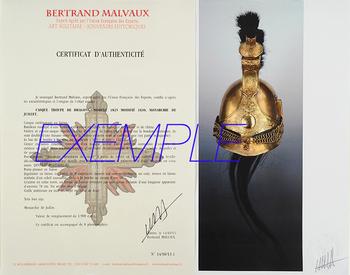
The helmet consists of the parts described below, namely:
1° A gilt brass skull (the gilding remains only beneath the parts protecting it: the band and crest), hammer-formed in two shells joined by a crimped seam, depth 150 mm.
2° A copper peak, likewise, edged with a silvered metal rim, fitted over the edge, 6 mm wide on each folded face, and secured at each end by a rivet; it is lined with glued green sheepskin leather held in the setting of the rim.
This peak is attached to the skull by five copper rivets; its width at the centre is 53 mm.
3° A copper neck guard, composed of two pieces, namely:
A circular flat band, soldered to the rear edge of the skull, which it extends. The second piece, soldered inside and at the bottom of the first, forms a pendant; its lower corners are rounded. The whole is edged in silvered metal like the peak. Black sheepskin leather is glued beneath the neck guard.
A silver band, stamped around its entire perimeter with three raised lines and a branch of laurel leaves on each side. It is attached to the skull; its base rests on the peak; its height at the sides is 35 mm. At the centre it features a rounded point, 105 mm high, reaching the crest and secured by a gilt brass screw with hemispherical head. Both ends of the band are riveted to the skull near the chinstraps.
At the centre of the band, an embossed gilt copper device, depicting a grenade surrounded by palm branches, is secured by two tempered iron screws whose heads are on the inside (height of this ornament 77 mm; maximum width 75 mm).
4° Two chinstraps of chased and gilt copper wire links. The links are in the form of a horizontal figure 8 and are attached, by the final B-shaped link, to the chinstrap rosette. The lower end of the right chinstrap terminates in a square brass buckle with bar and hook. The left one is fitted with a varnished leather strap.
The chinstrap rosettes are silver, circular in form (diameter 57 mm), edged with a raised cord and stamped with rays. They are secured to the helmet by a pivot, the head of which is a chased and gilt copper star (radius from centre to points 12.5 mm, diameter 25 mm). This threaded stem is received in a small tube serving as a nut, soldered to the skull, which forms the pivot for the chinstrap and its rosette.
The chinstraps are mounted on a metal fitting covered with fine black cloth, extending beneath the rosette and fitted at the centre with a flat clasp to retain the chain.
Length of each chinstrap, excluding the rosette: 150 mm
Width of the first link: 45 mm
Width of the lower link: 17 mm
5° A crest composed of two wings and a mask, in gilt copper.
Each wing forms a curvilinear triangle, the base of which joins the skull by means of a scalloped rim, 10 mm to 15 mm wide, ornamented with small palmettes. This joining curve has a developed length of 230 mm. The upper curve has a developed length of approximately 350 mm, from its origin on the skull to the centre of the rounded projecting portion of the crest. Finally, the inward-curving inner line, from this same point to the skull, has a developed length of 150 mm, with a 130 mm chord and a 35 mm rise.
The wings are stamped in relief with a border of acanthus leaves and, at the centre, a branch of laurel against a stippled ground. H. 120 mm.
The mask joins the two wings at the front, to which it is soldered by its edges, ornamented with raised lines. It terminates squarely at the top and at the bottom with a pendant fitting beneath the band and pierced by the same screw. (Width of mask at top 30 mm; at centre 23 mm; at bottom 42 mm).
Apart from the soldering to the mask, the two wings are joined to one another by a tinplate partition, soldered from one to the other at half their height over a curved length of approximately 130 mm, and additionally by a tinplate cover soldered 5 mm inside the edges. It has two openings: the first, 35 mm long, near the mask, to allow passage of the hook of the horsehair mane, which engages in a small tube soldered beneath the cover, its opening being within this gap. The second is 110 mm from the first and is likewise 35 to 40 mm long; it receives the wire ring of the horsehair mane.
The crest is assembled to the skull by the screw passing through the band and mask, and by four similar screws placed in the rim of each wing at its two ends and received inside the skull in curved iron nuts.
6° A scarlet horsehair mane, mounted on a steel wire. It increases in thickness from the neck guard, where its circumference is approximately 60 mm, to its head, where it is approximately 100 mm in circumference and projects approximately 60 mm beyond the crest. Beneath the head of the mane, the wire forms a 110 mm hook and, towards the centre, a ring, by which the mane is attached, as well as by a threaded stem passing through the skull approximately 30 mm below the rear of the crest, through a hole provided for this purpose. A curved nut inside the helmet receives this threaded stem. The horsehair of this mane is denser and finer than that of a trooper’s mane.
7° The interior lining consists of a turban and a liner.
The turban is of cowhide and fine canvas. It is attached to the helmet by four iron screws, two of which are at the front. These are the same screws that secure the band device. Their flattened hemispherical heads are on the turban, through which these screws pass, as well as through the helmet, to screw into the device. The other two screws have flat heads situated outside the helmet, slightly above the chinstrap pivots; they pass through the skull and turban and are secured on the latter by a small fitted copper nut.
The liner is of strong glazed black sheepskin leather, cut into wolf teeth, with a black cord passing through the points, each fitted with a metal eyelet. Between the turban and the liner is a percaline pad filled with wool wadding and of the same height as the turban. The liner of the officer’s helmet is enhanced with small straps of fine fabric incorporating small internal springs, improving the comfort of wearing the helmet; one end is sewn to the band and the other fastens with a clasp.
Very good state of preservation. This helmet came directly from the family and has been completely cleaned. One of the stars was missing and has been replaced with an original example of slightly different size. All parts are original. The threaded stem allowing the rear of the horsehair mane to be fixed to the skull was broken and has been refitted.
MODEL CUIRASS, waisted, in steel plated with a sheet of brass, composed of a backplate and a breastplate.
Breastplate edged with 10 brass studs and lined with a sheet of brass itself bordered by 6 brass rivets. At the centre is fixed a silver glory in the form of a radiant sun (H. 19 cm, W. 16 cm), upon which is mounted an oval badge (H. 9.8 cm, W. 9 cm) of brass, stamped with the Imperial eagle against a stippled ground and framed by laurel branches.
Backplate edged with 6 brass studs, lined with a brass plate itself bordered by 6 brass rivets, fitted at the top with two leather shoulder straps covered with a double brass chain of interlaced round links, with gilt brass clasps stamped in relief with laurel branches and palmettes. They are each fixed to the backplate by an embossed gilt copper lion’s head, ending in a section of varnished leather embossed with lines in the shape of a heart. At the bottom is a black leather waist belt with a specific officer’s buckle.
Good condition. The officer undoubtedly fell from his horse while wearing this set, as the brass plates of the backplate and breastplate are slightly unseated at the corners; the clasp fixing buttons have been moved to readjust the cuirass. The shoulder-strap leathers have been replaced with old leather; the leathers at the ends are original.
France.
Second Empire.
Reference :
3951
Next update Friday, november 27 at 13:30 PM
FOR ALL PURCHASES, PAYMENT IN MULTIPLE CHECKS POSSIBLE
bertrand.malvaux@wanadoo.fr 06 07 75 74 63
SHIPPING COSTS
Shipping costs are calculated only once per order for one or more items, all shipments are sent via registered mail, as this is the only way to have proof of dispatch and receipt.
For parcels whose value cannot be insured by the Post, shipments are entrusted to DHL or Fedex with real value insured, the service is of high quality but the cost is higher.
RETURN POLICY
Items can be returned within 8 days of receipt. They must be returned by registered mail at the sender's expense, in their original packaging, and in their original condition.
AUTHENTICITY
The selection of items offered on this site allows me to guarantee the authenticity of each piece described here, all items offered are guaranteed to be period and authentic, unless otherwise noted or restricted in the description.
An authenticity certificate of the item including the description published on the site, the period, the sale price, accompanied by one or more color photographs is automatically provided for any item priced over 130 euros. Below this price, each certificate is charged 5 euros.
Only items sold by me are subject to an authenticity certificate, I do not provide any expert reports for items sold by third parties (colleagues or collectors).