
INFANTRY AND HORSE CHASSEUR'S CATERPILLAR HELMET, model 1791, Revolution (1791-1796).
Sold out
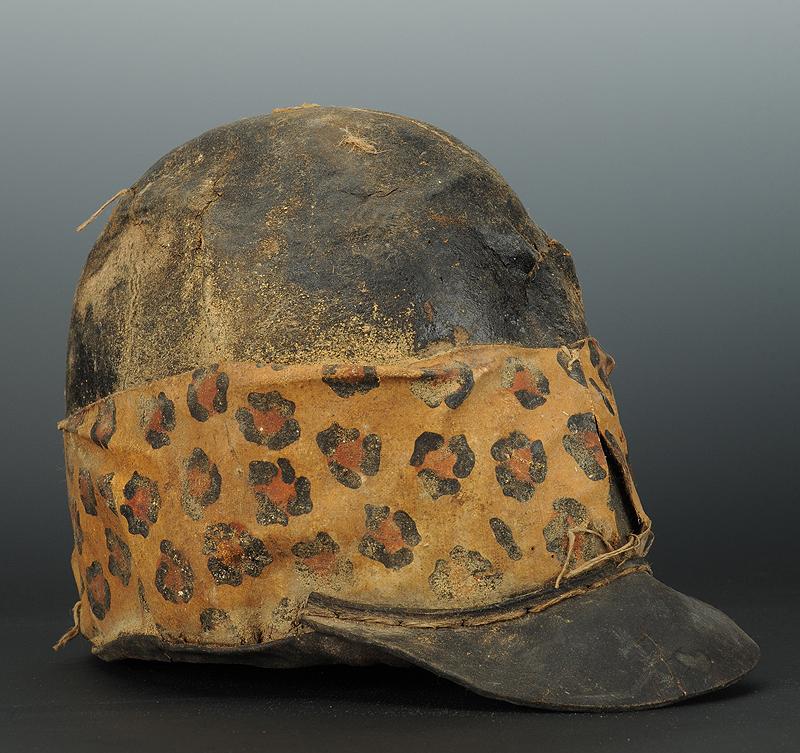
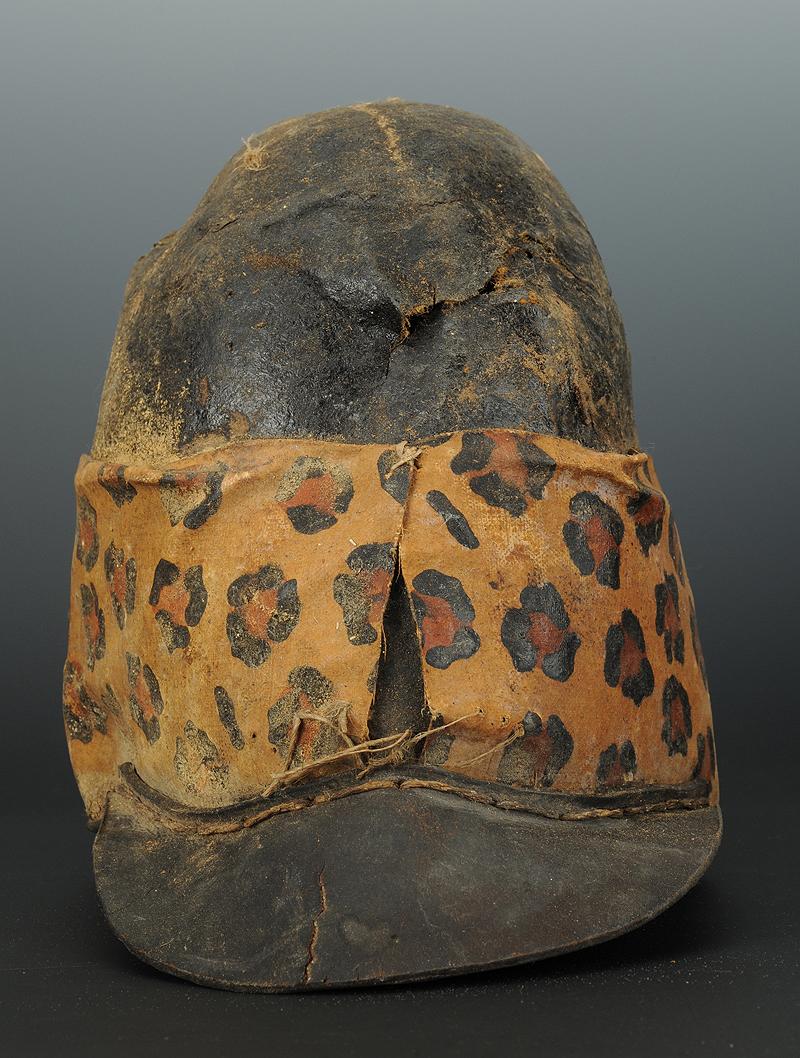
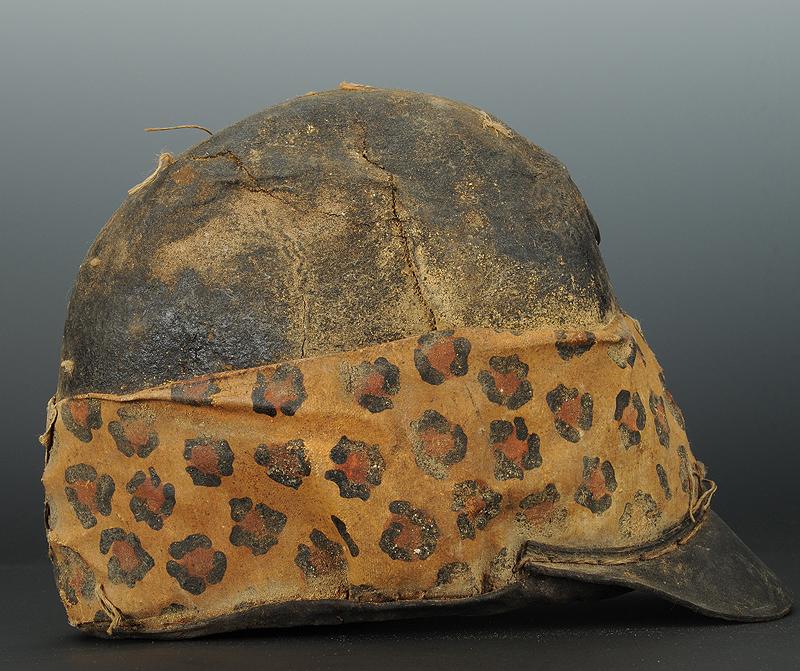
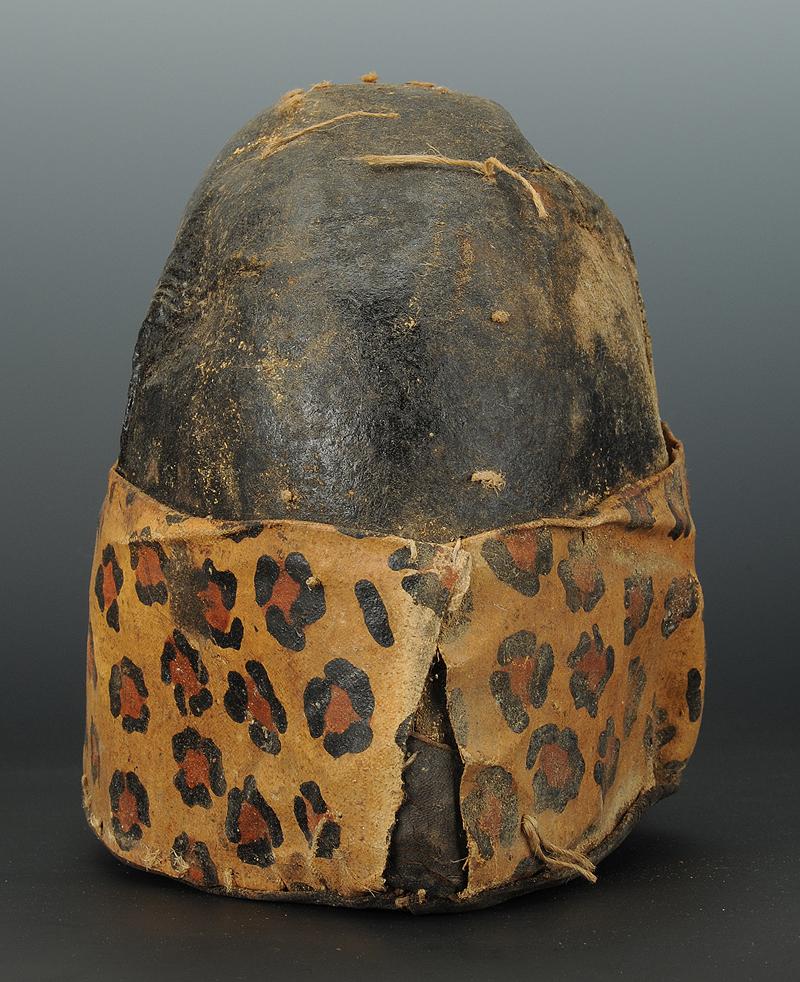
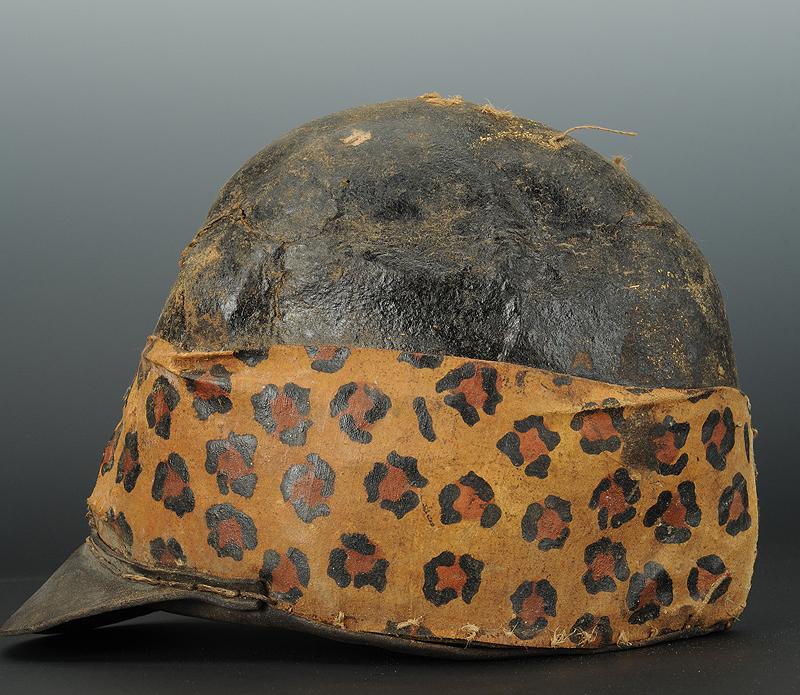
INFANTRY AND CHASSEURS À CHEVAL CATERPILLAR HELMET, model 1791, Revolution (1791-1796).
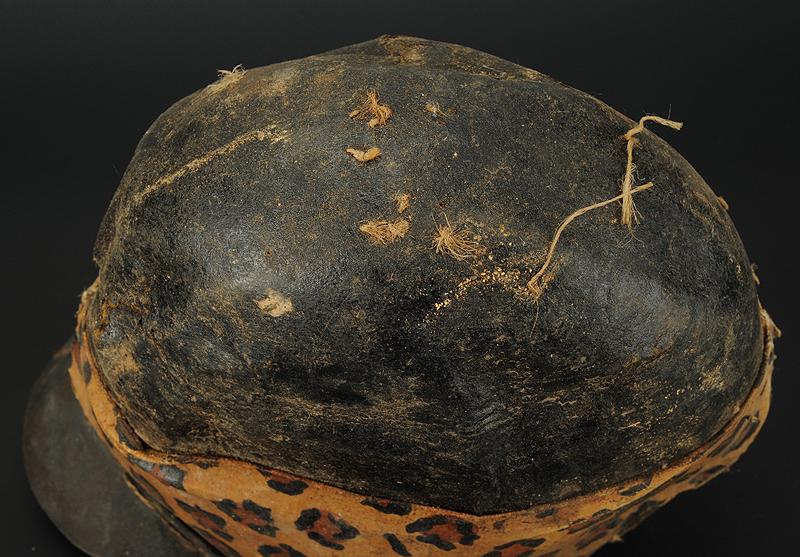
Helmet in waxed and varnished black felt on the external side, approximately 19 cm deep.
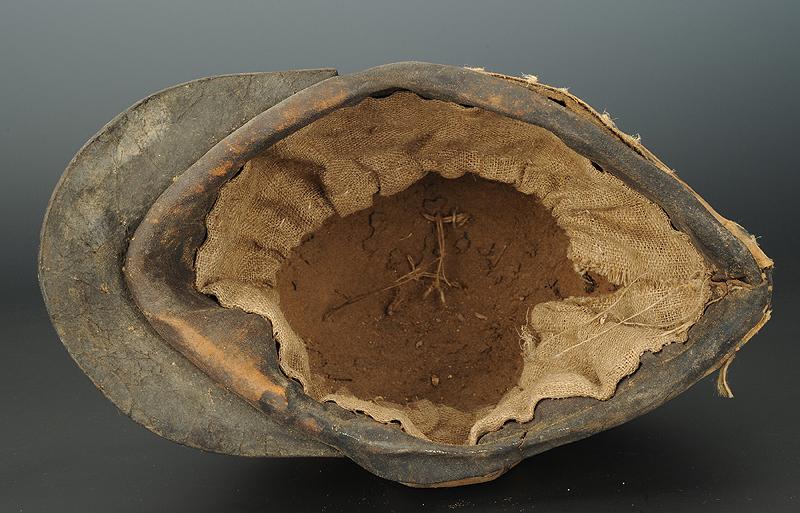
At its base, a 0.9 cm bourdalou is formed by the return of the leather of the inner cap.
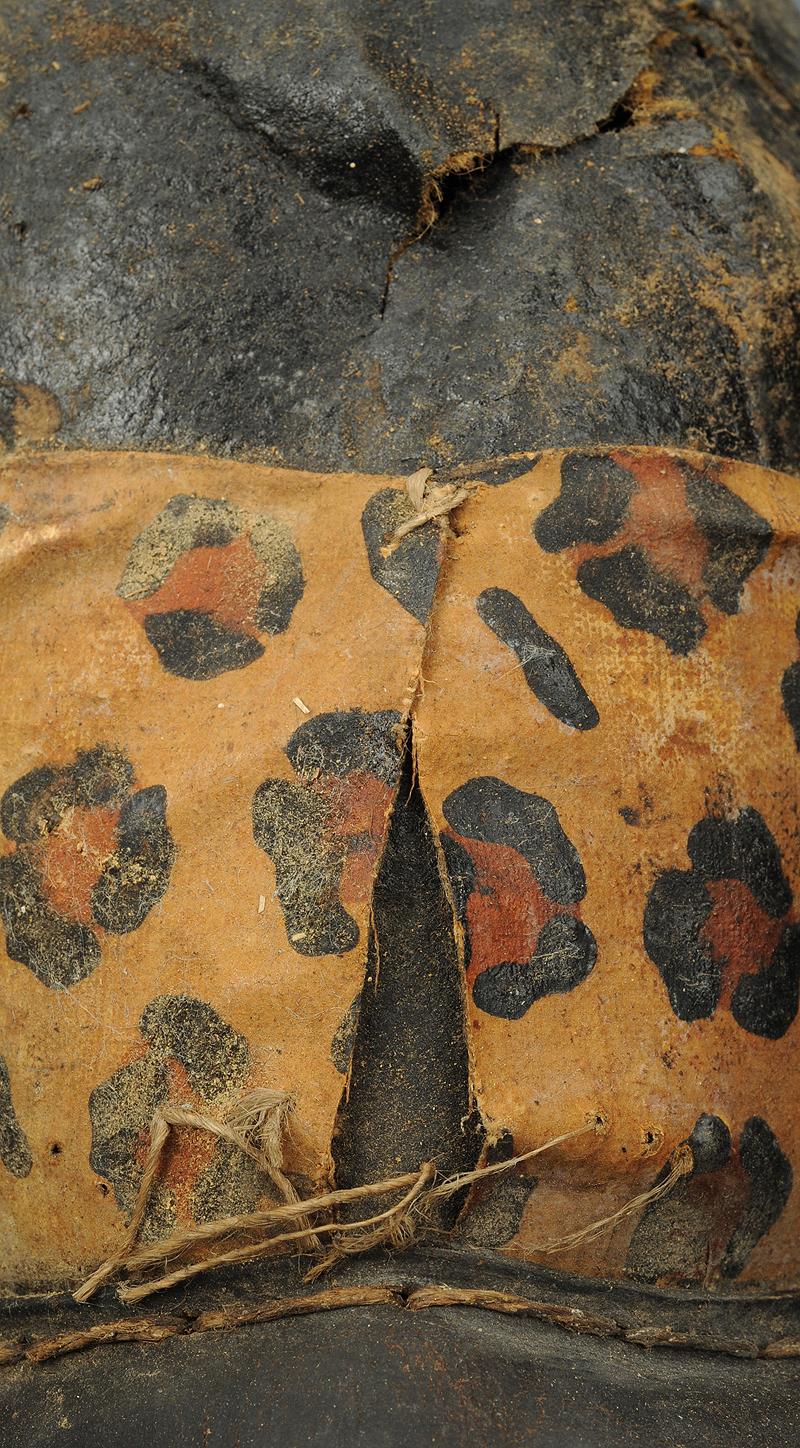
Band painted canvas to imitate a panther skin. It consists of a strong canvas folded in two, fastened by a lace and sewn at the base of the helmet. Height 8 cm.
Black leather visor in a round shape, 5.5 cm wide.
Inner cap composed of a 5 cm high leather band topped with a canvas band approximately 9 cm high.
France.
Revolution around 1791-1795.
Fair condition, missing the caterpillar, some minor damage, left in the state of its discovery in 2011 in the church of a German family castle.
PROVENANCE:
This helmet comes from a batch of identical helmets (all without caterpillars) found in 2011 in Wurtzbourg, Bavaria, by carpenters working on the renovation of a private chapel in a castle. They likely come from the Battle of Wurtzbourg on September 3, 1796, where the French army lost 2,000 killed or wounded, and 1,000 prisoners.
NOTE:
This model is adopted by the provisional instruction on the clothing and equipment of the troops of April 1, 1791 (Royal Printing Office, 1792, 17 pages), for the French infantry. The infantry exercise regulations of August 1, 1791 confirm the existence of this model, depicted in its plates showing infantrymen wearing the new caterpillar helmet. Plates 3, 4, and 5 thus depict the soldiers in different exercise positions with this headgear.
This helmet was gradually replaced from 1792-1793, but the units in service continued to use them for a while due to cost-saving measures.
There are variations in manufacturing, but very few authentic specimens have reached us.
This specimen can be compared to the one in the Douai Museum, which is similar in every detail. Another authentic (complete) specimen is on display at the Empéri Museum in Salon de Provence, from the former Raoul and Jean Brunon collection.
Some of these helmets were made by the Delpont house, others bear the "MERLE" marking hot-stamped on the visor.
DELPONT:
Under Year V of the Republic (1796-1797), the National Archives already mention "Delpont, military headgear contractor." A document dates back to 27 Ventôse Year VII (March 17, 1799), concerning his activity.
Toward the end of the Directory, he was significant enough to be listed among the Parisian military suppliers. A historical study identifies him as "François Delpont, hatter and supplier," showing that he benefited from financial support from the banker Nicolas Seillière.
At the beginning of the 19th century, his establishment was still active. Antoine de Jomini, after leaving the Swiss service, worked in Paris at François Delpont's, in his specialized headgear factory at 52 Rue de Grenelle, before leaving in 1803.
Finally, the F. Delpont and Le Thuillier house, at 52 Rue de Grenelle, Faubourg Saint-Germain, still produced military headgear and equipment during the Restoration, including the 1816 model shako-caterpillar helmet. One specimen bears the direct mark "Delpont a Paris," as well as leather helmets for the National Guard on horseback.
WURTZBOURG BATTLE HISTORY:
The Battle of Wurtzbourg took place on September 3, 1796, in Wurtzbourg, in the Episcopal Principality of Wurtzbourg, during the War of the First Coalition. It opposed the French Sambre-et-Meuse army commanded by General Jean-Baptiste Jourdan to the Austrian Imperial army of Archduke Charles. The French attacked the archduke's forces, but he held off the French assaults throughout the day until the arrival of reinforcements definitively tipped the balance in favor of the Austrians.
In the summer of 1796, two French armies, under the command of Generals Jourdan and Moreau, entered Southern Germany. Facing them, Archduke Charles of Austria tried to slow down their advance with two Austrian armies under the command of Generals Wilhelm von Wartensleben and Maximilien Antoine de Baillet de Latour. During the Battle of Amberg on August 24, Charles overwhelmed Jourdan's forces and forced them to retreat. Jourdan's attempt to counterattack at Wurtzbourg in hopes of halting his retreat failed. Defeated, the French general was forced to retreat to the Rhine, compelling Moreau's army to also abandon Southern Germany.
The fortress of Marienberg overlooking the city of Wurtzbourg.
The French army attacked what they believed to be an isolated Austrian division under General Sztáray. Jourdan's plan was to strike Sztáray's troops with the divisions of Bernadotte and Championnet, while Grenier's infantry and Bonnaud's cavalry remained in reserve. However, the morning mist gave Archduke Charles time to send the division led by General Hotze as reinforcements to Sztáray, negating the French numerical advantage.
The French were further disadvantaged as Jourdan was without a significant part of his forces due to the absence of General Lefebvre's division, engaged to the north by the Austrian division of Elsnitz. The situation worsened when the rest of the archduke's army crossed the Main on pontoons set up by the Austrian sappers. French attacks on enemy positions were repelled until the arrival of the Austrian divisions Kray and Wartensleben, which drove the French off the battlefield.
The French army lost 2,000 killed or wounded, 1,000 prisoners, and 7 cannons. Austrian losses were half that: 1,200 men out of action and 300 prisoners. Jourdan's defeat at Wurtzbourg led to the definite failure of the 1796 campaign in Southern Germany. Charles pursued the defeated French and bypassed Jourdan's army to the south, preventing the latter from receiving support from Moreau's forces, who were also operating in Germany.
On September 7, the archduke forced the French to lift the siege of Mayence. Around the 16th, the belligerents met on the banks of the Lahn River, where the 11,000 men of the Austrian General Kray defeated the 15,000 French under Jourdan at Limburg an der Lahn. Following this defeat, Jourdan retreated to Düsseldorf before crossing the Rhine again.
French Order of Battle
Sambre-et-Meuse Army: General of Division Jean-Baptiste Jourdan, Commander-in-Chief — 25,000 infantry, 5,000 cavalry, 11 artillery batteries
• 1st Division: General of Division François Joseph Lefebvre
• 2nd Division: General of Division Paul Grenier
• 3rd Division: General of Division Jean-Étienne Championnet
• 4th Division: General of Division Jean-Baptiste Bernadotte
• Cavalry Reserve: General of Division Jacques Philippe Bonnaud
Austrian Order of Battle
Lower Rhine Army: Field Marshal Archduke Charles-Louis d'Autriche-Teschen, Commander-in-Chief — 30,000 men
• 1st Division: Field Marshal-Leutnant Friedrich von Hotze
◦ Mixed Brigade: Major General Michael Kienmayer
◦ Infantry Brigade: Major General Johann von Hiller
◦ Cavalry Brigade: Colonel Anton Canisius
• 2nd Division: Field Marshal-Leutnant Anton Sztáray
◦ Mixed Brigade: Major General Jean de Liechtenstein
◦ Infantry Brigade: Major General Eugen Montfrault
◦ Bavarian Infantry Brigade: Major General Bartels
◦ Grenadier Brigade: Major General Konrad Valentin von Kaim
• 3rd Division: Field Marshal-Leutnant Johann von Riesch
◦ Cavalry Brigade: Major General Prince Alexander of Wurtemberg
◦ Cavalry Brigade: Major General Joseph Spiegelberg
• 4th Division: Field Marshal-Leutnant Pál Kray
◦ Cavalry Brigade: Major General Frederick Louis of Hohenlohe-Ingelfingen
◦ Cavalry Brigade: Major General Karl Joseph Hadik von Futak
◦ Infantry Brigade: Major General Franz Sebottendorf
◦ Infantry Brigade: Major General Prince Frederick of Orange
◦ Infantry Brigade: Major General Joseph Staader
• Reserve: Master of Ordnance Wilhelm von Wartensleben
◦ Grenadier Brigade: Major General Johann Kollowrat
◦ Grenadier Brigade: Major General Joseph von Schellenberg
◦ Grenadier Brigade: Major General Ludwig von Vogelsang
◦ Cavalry Brigade: Major General Franz Seraph von Rosenberg-Orsini
◦ Cavalry Brigade: Field Marshal-Leutnant Charles-Eugene de Lorraine de Lambesc
Helmet in waxed and varnished black felt on the external side, approximately 19 cm deep.
At its base, a 0.9 cm bourdalou is formed by the return of the leather of the inner cap.
Band painted canvas to imitate a panther skin. It consists of a strong canvas folded in two, fastened by a lace and sewn at the base of the helmet. Height 8 cm.
Black leather visor in a round shape, 5.5 cm wide.
Inner cap composed of a 5 cm high leather band topped with a canvas band approximately 9 cm high.
France.
Revolution around 1791-1795.
Fair condition, missing the caterpillar, some minor damage, left in the state of its discovery in 2011 in the church of a German family castle.
PROVENANCE:
This helmet comes from a batch of identical helmets (all without caterpillars) found in 2011 in Wurtzbourg, Bavaria, by carpenters working on the renovation of a private chapel in a castle. They likely come from the Battle of Wurtzbourg on September 3, 1796, where the French army lost 2,000 killed or wounded, and 1,000 prisoners.
NOTE:
This model is adopted by the provisional instruction on the clothing and equipment of the troops of April 1, 1791 (Royal Printing Office, 1792, 17 pages), for the French infantry. The infantry exercise regulations of August 1, 1791 confirm the existence of this model, depicted in its plates showing infantrymen wearing the new caterpillar helmet. Plates 3, 4, and 5 thus depict the soldiers in different exercise positions with this headgear.
This helmet was gradually replaced from 1792-1793, but the units in service continued to use them for a while due to cost-saving measures.
There are variations in manufacturing, but very few authentic specimens have reached us.
This specimen can be compared to the one in the Douai Museum, which is similar in every detail. Another authentic (complete) specimen is on display at the Empéri Museum in Salon de Provence, from the former Raoul and Jean Brunon collection.
Some of these helmets were made by the Delpont house, others bear the "MERLE" marking hot-stamped on the visor.
DELPONT:
Under Year V of the Republic (1796-1797), the National Archives already mention "Delpont, military headgear contractor." A document dates back to 27 Ventôse Year VII (March 17, 1799), concerning his activity.
Toward the end of the Directory, he was significant enough to be listed among the Parisian military suppliers. A historical study identifies him as "François Delpont, hatter and supplier," showing that he benefited from financial support from the banker Nicolas Seillière.
At the beginning of the 19th century, his establishment was still active. Antoine de Jomini, after leaving the Swiss service, worked in Paris at François Delpont's, in his specialized headgear factory at 52 Rue de Grenelle, before leaving in 1803.
Finally, the F. Delpont and Le Thuillier house, at 52 Rue de Grenelle, Faubourg Saint-Germain, still produced military headgear and equipment during the Restoration, including the 1816 model shako-caterpillar helmet. One specimen bears the direct mark "Delpont a Paris," as well as leather helmets for the National Guard on horseback.
WURTZBOURG BATTLE HISTORY:
The Battle of Wurtzbourg took place on September 3, 1796, in Wurtzbourg, in the Episcopal Principality of Wurtzbourg, during the War of the First Coalition. It opposed the French Sambre-et-Meuse army commanded by General Jean-Baptiste Jourdan to the Austrian Imperial army of Archduke Charles. The French attacked the archduke's forces, but he held off the French assaults throughout the day until the arrival of reinforcements definitively tipped the balance in favor of the Austrians.
In the summer of 1796, two French armies, under the command of Generals Jourdan and Moreau, entered Southern Germany. Facing them, Archduke Charles of Austria tried to slow down their advance with two Austrian armies under the command of Generals Wilhelm von Wartensleben and Maximilien Antoine de Baillet de Latour. During the Battle of Amberg on August 24, Charles overwhelmed Jourdan's forces and forced them to retreat. Jourdan's attempt to counterattack at Wurtzbourg in hopes of halting his retreat failed. Defeated, the French general was forced to retreat to the Rhine, compelling Moreau's army to also abandon Southern Germany.
The fortress of Marienberg overlooking the city of Wurtzbourg.
The French army attacked what they believed to be an isolated Austrian division under General Sztáray. Jourdan's plan was to strike Sztáray's troops with the divisions of Bernadotte and Championnet, while Grenier's infantry and Bonnaud's cavalry remained in reserve. However, the morning mist gave Archduke Charles time to send the division led by General Hotze as reinforcements to Sztáray, negating the French numerical advantage.
The French were further disadvantaged as Jourdan was without a significant part of his forces due to the absence of General Lefebvre's division, engaged to the north by the Austrian division of Elsnitz. The situation worsened when the rest of the archduke's army crossed the Main on pontoons set up by the Austrian sappers. French attacks on enemy positions were repelled until the arrival of the Austrian divisions Kray and Wartensleben, which drove the French off the battlefield.
The French army lost 2,000 killed or wounded, 1,000 prisoners, and 7 cannons. Austrian losses were half that: 1,200 men out of action and 300 prisoners. Jourdan's defeat at Wurtzbourg led to the definite failure of the 1796 campaign in Southern Germany. Charles pursued the defeated French and bypassed Jourdan's army to the south, preventing the latter from receiving support from Moreau's forces, who were also operating in Germany.
On September 7, the archduke forced the French to lift the siege of Mayence. Around the 16th, the belligerents met on the banks of the Lahn River, where the 11,000 men of the Austrian General Kray defeated the 15,000 French under Jourdan at Limburg an der Lahn. Following this defeat, Jourdan retreated to Düsseldorf before crossing the Rhine again.
French Order of Battle
Sambre-et-Meuse Army: General of Division Jean-Baptiste Jourdan, Commander-in-Chief — 25,000 infantry, 5,000 cavalry, 11 artillery batteries
• 1st Division: General of Division François Joseph Lefebvre
• 2nd Division: General of Division Paul Grenier
• 3rd Division: General of Division Jean-Étienne Championnet
• 4th Division: General of Division Jean-Baptiste Bernadotte
• Cavalry Reserve: General of Division Jacques Philippe Bonnaud
Austrian Order of Battle
Lower Rhine Army: Field Marshal Archduke Charles-Louis d'Autriche-Teschen, Commander-in-Chief — 30,000 men
• 1st Division: Field Marshal-Leutnant Friedrich von Hotze
◦ Mixed Brigade: Major General Michael Kienmayer
◦ Infantry Brigade: Major General Johann von Hiller
◦ Cavalry Brigade: Colonel Anton Canisius
• 2nd Division: Field Marshal-Leutnant Anton Sztáray
◦ Mixed Brigade: Major General Jean de Liechtenstein
◦ Infantry Brigade: Major General Eugen Montfrault
◦ Bavarian Infantry Brigade: Major General Bartels
◦ Grenadier Brigade: Major General Konrad Valentin von Kaim
• 3rd Division: Field Marshal-Leutnant Johann von Riesch
◦ Cavalry Brigade: Major General Prince Alexander of Wurtemberg
◦ Cavalry Brigade: Major General Joseph Spiegelberg
• 4th Division: Field Marshal-Leutnant Pál Kray
◦ Cavalry Brigade: Major General Frederick Louis of Hohenlohe-Ingelfingen
◦ Cavalry Brigade: Major General Karl Joseph Hadik von Futak
◦ Infantry Brigade: Major General Franz Sebottendorf
◦ Infantry Brigade: Major General Prince Frederick of Orange
◦ Infantry Brigade: Major General Joseph Staader
• Reserve: Master of Ordnance Wilhelm von Wartensleben
◦ Grenadier Brigade: Major General Johann Kollowrat
◦ Grenadier Brigade: Major General Joseph von Schellenberg
◦ Grenadier Brigade: Major General Ludwig von Vogelsang
◦ Cavalry Brigade: Major General Franz Seraph von Rosenberg-Orsini
◦ Cavalry Brigade: Field Marshal-Leutnant Charles-Eugene de Lorraine de Lambesc
Reference :
1386
Next update Friday, octobre 2 at 13:30 PM
FOR ALL PURCHASES, PAYMENT IN MULTIPLE CHECKS POSSIBLE
bertrand.malvaux@wanadoo.fr 06 07 75 74 63
SHIPPING COSTS
Shipping costs are calculated only once per order for one or more items, all shipments are sent via registered mail, as this is the only way to have proof of dispatch and receipt.
For parcels whose value cannot be insured by the Post, shipments are entrusted to DHL or Fedex with real value insured, the service is of high quality but the cost is higher.
RETURN POLICY
Items can be returned within 8 days of receipt. They must be returned by registered mail at the sender's expense, in their original packaging, and in their original condition.
AUTHENTICITY
The selection of items offered on this site allows me to guarantee the authenticity of each piece described here, all items offered are guaranteed to be period and authentic, unless otherwise noted or restricted in the description.
An authenticity certificate of the item including the description published on the site, the period, the sale price, accompanied by one or more color photographs is automatically provided for any item priced over 130 euros. Below this price, each certificate is charged 5 euros.
Only items sold by me are subject to an authenticity certificate, I do not provide any expert reports for items sold by third parties (colleagues or collectors).
FOR ALL PURCHASES, PAYMENT IN MULTIPLE CHECKS POSSIBLE
bertrand.malvaux@wanadoo.fr 06 07 75 74 63
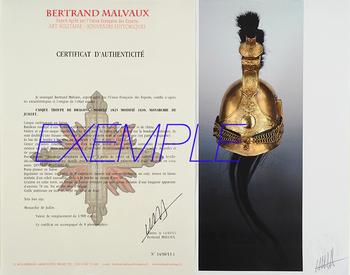
An authenticity certificate of the item including the description published on the site, the period, the sale price, accompanied by one or more color photographs is automatically provided for any item priced over 130 euros. Below this price, each certificate is charged 5 euros.
Only items sold by me are subject to an authenticity certificate, I do not provide any expert reports for items sold by third parties (colleagues or collectors).