
CARABINIER HELMET AND CUIRASS SET, MODEL 1854, SECOND EMPIRE.


Sold out
CARABINIER HELMET AND CUIRASS SET, MODEL 1854, SECOND EMPIRE.
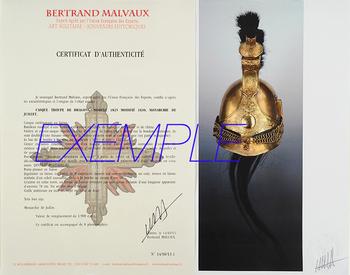
The helmet comprises the parts described below, namely:
1. A brass skull, hammer-formed in two halves joined by a crimped seam; pierced at the top by a socket hole (diameter: 25 millimetres).
Stamped “DELACHAUSSÉE”, numbered “1 - 872 - 663”.
2. A visor likewise of brass. Its outer curve, which features a very obtuse projecting angle at the centre, is edged with a strip of white metal, known as nickel silver, fitted over the edge, 6 millimetres wide on each folded face, and secured at either end by a rivet; it is lined with glued green sheepskin, held in the setting of the edging strip.
This visor is attached to the skull by five brass rivets; its width at the centre is 60 millimetres; its outer development is 300 millimetres; that of its inner curve near the skull is 260 millimetres; its centre line is inclined 40 degrees below a plane passing through the junction of the skull and visor.
3. A brass neck guard, composed of two parts, namely:
A circular flat band (visible height, 18 millimetres), soldered to the rear edge of the skull, which it extends; its development is 230 millimetres near the skull and 205 millimetres at the bottom. – The second piece, soldered inside and at the bottom of the first, forms a flared apron (development at the top, 205; at the bottom, approximately 300 millimetres); the lower corners are rounded. – The joining of these two neck-guard pieces forms a curve measuring 50 millimetres chord by 7 millimetres rise, measured on the centre line. The whole is edged in nickel silver like the visor, and this edging measures 420 millimetres from the rear edge of one chinstrap rosette to that of the opposite one. – Black sheepskin is glued beneath the neck guard. At 4 millimetres inside the edging are, on each side of the neck guard, three iron studs with hemispherical heads, 7 millimetres in diameter, riveted inside the helmet. The first is 7 millimetres above the first band; the second in the middle of this band; and the third on the lower piece, 22 millimetres from the second.
A tinned-iron band, embossed around its entire perimeter with three raised lines, together 5 millimetres wide. It is fitted against the skull; its base rests on the visor; its height at the sides is 30 millimetres. At the centre it has a rounded point, 100 millimetres high, which joins the crest and is secured by an iron screw with a hemispherical head. The two ends of the band are riveted to the skull near the chinstraps.
At the centre of the band, an embossed brass device representing a grenade surrounded by palm branches is secured by two hardened iron screws, the heads of which are on the inside (height of this ornament, 75 millimetres; maximum width, 72 millimetres).
4. Two chinstraps of brass-wire links. The 19 links are in the shape of a horizontal figure 8 and are attached, by a 20th link in the shape of a B, to the chinstrap rosette. The lower end of the right-hand chinstrap terminates in a double brass-wire hook, 27 millimetres long. The left-hand one is fitted with a short chain of 16 round brass rings (length 110 millimetres) to receive the hook. At the end of this chain is a small clasp for holding up the chain when the chinstrap is not worn under the chin.
The chinstrap rosettes are of tinned iron, circular in shape (diameter 55 millimetres), edged with a raised wire and stamped with rays. They are attached to the helmet by a pivot, the head of which is a brass star (radius from centre to points, 12 millimetres). This threaded stem is received in a small tube serving as a nut, soldered to the skull, and forming the pivot for the chinstrap and its rosette.
The chinstraps are mounted on a black patent-leather backing extending beneath the rosette and fitted at the centre with a flat clasp to retain the chain.
Length of each chinstrap, excluding fittings: 140 millimetres
Width of the first link: 45 millimetres
Width of the lower link: 17 millimetres
5. A crest formed of two wings and a front mask, in brass.
Each wing forms a curvilinear triangle, the base of which joins the skull by means of a scalloped rim, from 10 to 15 millimetres wide, ornamented with small palmettes. This joining curve has a development of 230 millimetres. The upper curve has a development of approximately 350 millimetres from its origin on the skull to the centre of the rounded projection of the crest. Finally, the inward curve, from that same point to the skull, has a development of 150 millimetres, with a 130-millimetre chord and a 35-millimetre rise.
The wings are embossed in relief with a border of acanthus leaves and, at the centre, a laurel branch.
The mask joins the two wings at the front, to which it is soldered along its edges, which are ornamented with raised lines. It terminates squarely at the top and at the bottom in a flared extension which engages beneath the band and is pierced by the same screw. (Width of the mask at the top, 40 millimetres; at the centre, 25 millimetres; at the bottom, 30 millimetres).
In addition to their soldering to the mask, the two wings are joined together by a tinned-iron partition, soldered from one to the other at half their height and over a curved development of approximately 130 millimetres, and also by a tinned-iron cover soldered 5 millimetres inside the edges. It has two openings: the first, 35 millimetres wide, near the mask, to allow the hook of the crest plume to pass through; this hook engages in a small tube soldered beneath the cover, the opening of which lies within this gap. The second is 110 millimetres from the first and is likewise 35 to 40 millimetres wide; it receives the iron-wire ring of the crest plume.
The crest is mounted on the skull by the screw passing through the band and mask, and by four similar screws placed in the rim of each wing at its two ends, received inside the skull in curved iron nuts.
6. A scarlet horsehair crest plume, mounted on No. 20 gold wire. It gradually increases in circumference from the neck guard, where it measures approximately 150 millimetres around, to its head, where it measures approximately 360 millimetres around and projects approximately 60 millimetres beyond the crest. The wire forms a 110-millimetre hook beneath the head of the plume and, near its centre, a ring, by means of which the plume is attached, together with a threaded stem passing through the skull approximately 30 millimetres below the rear of the crest, through a hole made for this purpose. A curved nut receives this threaded stem inside the helmet. It is fitted with a leather washer.
The ring is numbered “1341”; a zinc plate dated “569” and numbered “1862” is affixed to the crest plume.
7. An interior lining consisting of a headband and a liner.
The headband is of one piece of cowhide, 70 millimetres high at the front and 40 millimetres at the rear. It is attached to the helmet by four iron screws, two of which are at the front. These are the same screws that secure the device on the band. Their flattened hemispherical heads are on the headband, which these screws pass through, as well as through the helmet, to screw into the device. The heads of the other two screws are flat and located outside the helmet, slightly above the chinstrap pivots; they pass through the skull and headband and are secured on the latter by a small fitted brass nut.
The liner is of heavy glazed black sheepskin, cut into wolf teeth, with a black drawstring passing through the points, each fitted with a metal eyelet. Between the headband and liner is a glazed-fabric pad filled with wool wadding, of the same height as the headband.
Very good state of preservation.
Waisted MODEL CUIRASS in steel plated with a sheet of brass, comprising a backplate and a breastplate (backplate numbered “347”).
Breastplate edged with 10 brass studs and lined with a brass sheet itself edged with 6 brass rivets. At the centre is affixed a steel glory in the form of a radiant sun, upon which is mounted an oval brass badge stamped with the Imperial eagle on a stippled ground, framed by laurel branches. The breastplate is marked “Manufacture Royale de Klingenthal September 1832 – 1T - 1L - 1528”.
Backplate edged with 6 brass studs, lined with a brass plate itself edged with 6 brass rivets, fitted at the top with two leather shoulder straps covered with a double brass chain of interlocking round links, with brass clasp, and at the bottom with a black leather waist belt, the portion with the tightening buckle missing. Backplate marked “Manufacture Royale de Klingenthal October 1827 – 154”.
Perfect condition.
Second Empire.
Reference :
2973-E7-B
Next update Friday, november 27 at 13:30 PM
FOR ALL PURCHASES, PAYMENT IN MULTIPLE CHECKS POSSIBLE
bertrand.malvaux@wanadoo.fr 06 07 75 74 63
SHIPPING COSTS
Shipping costs are calculated only once per order for one or more items, all shipments are sent via registered mail, as this is the only way to have proof of dispatch and receipt.
For parcels whose value cannot be insured by the Post, shipments are entrusted to DHL or Fedex with real value insured, the service is of high quality but the cost is higher.
RETURN POLICY
Items can be returned within 8 days of receipt. They must be returned by registered mail at the sender's expense, in their original packaging, and in their original condition.
AUTHENTICITY
The selection of items offered on this site allows me to guarantee the authenticity of each piece described here, all items offered are guaranteed to be period and authentic, unless otherwise noted or restricted in the description.
An authenticity certificate of the item including the description published on the site, the period, the sale price, accompanied by one or more color photographs is automatically provided for any item priced over 130 euros. Below this price, each certificate is charged 5 euros.
Only items sold by me are subject to an authenticity certificate, I do not provide any expert reports for items sold by third parties (colleagues or collectors).